ISSN: 2231-5381
http://www.ijettjournal.org
Page 532
Studying Methods of Estimating Heat
Generation at Three Different Zones in Metal
Cutting: A Review of Analytical models
Ajay Goyal#1, Shailendra Kumar*2, Suresh Dhiman*3, Rajesh Kumar Sharma*4
#1
Assistant Professor, Mechanical EngineeringDepartment, Mangalayatan University, Aligarh, Uttar Pradesh, India
*2
M. Tech. student, National Institute of Technology, Hamirpur, Himachal Pradesh, India
*3
Assistant Professor, National Institute of Technology, Hamirpur, Himachal Pradesh, India
*4
Associate Professor National Institute of Technology, Hamirpur, Himachal Pradesh, India
ABSTRACT: The temperature rise during machining would severely affects the quality of work as well as tool life, if goes beyond a limit. Prior estimation and control of this temperature rise have always being a thrust area for machinists in adopting the optimum machining parameters. Though the temperature rise can be measured experimentally but reliable and time tested mathematical model(s) will serve the purpose in a better way. Mathematical model(s) is handy and economic as compared to experimental methods for set of machining parameters. A number of mathematical methods are developed, and the results have been compared with reality. In this paper efforts have been made to review and systemize the study of all such major analytical methods developed in past to identify the future scope of research. Further, a Comparative study of merits and demerits of experimental methods for measurement of temperature rise developed, in past is tabulated.
Keywords: Analytical models, experimental methods, temperature rise, metal cutting, primary deformation
zone, secondary deformation zone, tertiary
deformation zone
1. Introduction
It is a well-known fact that a sufficiently large amount of mechanical energy required for metal cutting, is ultimately transformed into heat energy [1], [2], [3]. This heat energy results in the rise in temperature of tool, chip and work piece. The temperature rise affects the machinability, metallurgical, and other properties of work piece, & tool life, if goes beyond a limit. Though the temperature rise is different for different work and tool combinations, it has been well understood that this temperature rise mainly depends upon machining parameters [4] and can be contained by setting machining parameters optimally. Therefore, a prior estimation of temperature rise would be highly beneficial as this will make the task of selecting optimum machining parameters much easier. Researchers concluded that this temperature rise mainly due to three deformation zones namely
primary, secondary, and tertiary deformation zones [5]. Primary deformation zone contributes maximum to temperature rise followed by secondary deformation zone.
Fig.1 Heat zones in metal cutting [5]
The contribution of tertiary deformation zone does not make significant difference in the temperature rise.
ISSN: 2231-5381
http://www.ijettjournal.org
Page 533
I.I Experimental methods
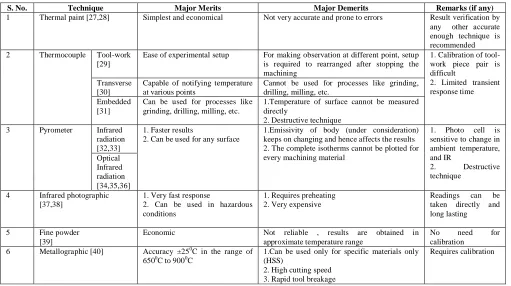
Experimental methods for determining temperature rise in metal cutting are expensive but easy to perform once setup is installed. These methods give direct reading of temperature rise and do not need any input parameters during machining but apparatus needed for measurement of temperature is costly and requires special settings. Results obtained by these methods are near to reality although much accuracy is not desired for number of industrial applications. Installation of special experimental setup for temperature measurement by these methods is a tedious and expensive project itself. To the best of authors knowledge, following seven experimental methods for measurement of temperature rise have been reported in the literature: (1) Thermal paints technique, (2) Thermocouple techniques -Tool-work thermocouple technique, Transverse thermocouple technique, and Embedded thermocouple technique, (3) Infrared radiation pyrometer technique, (4) Optical infrared radiation pyrometer technique, (5) Infra-red photography,(6) Fine powder techniques, (7) Metallographic methods. A comparative study of merits and demerits of these experimental methods is tabulated in table 1.
I.II ANALYTICAL METHODS
In contrast with the experimental methods, analytical methods do not require any special experimental setup. In analytical methods the result(s) can be obtained by using computational software (like ANSYS®, MATLAB®, ANOVA®, etc.) along with few input data. This input data normally adopted from the experimental investigations (uses setup which is easy to install) carried out during machining of material. A little compromise on accuracy makes the analytical methods very fast and extensive. That’s why; now day’s industries are relying more on analytical models rather experimental. In this paper, an effort has been made to review all analytical models in past.
Idiom ‘Rome was not built in a day’ is also applicable to the development of analytical models. Rapid development in computer science gives the impetus to the development of analytical models. The pioneer work of Rosenthal [6], Blok [7], and Jaeger [8] during 1930’s and 1940’s has been the basis for further investigation and inspired the next generation to work in this field. The major work in this field is observed as the extension of Jaeger's [8], [9] approximate solutions of a moving-band heat source for the chip and a stationary rectangular heat source for the tool in metal cutting. In order to systemize the study, first we reviewed the effect of primary, secondary, and tertiary heat zone on temperature rise by considering one at a time. The combined effect of primary and secondary heat zone on temperature rise is studied afterwards.
II. Study of temperature rise due to Primary Deformation Zone
Most of the scientists have tried to develop the model(s) by considering shear plane as a moving band of heat source. For the ease of understanding, the research is further divided in two groups, the first group of scientists treated work piece and chip as different entities, while the second group treated work piece, and chip as single entity. Here, we first discuss the research carried out by former group followed by the later.
II.1 Research by assuming work piece and chip as different entity
It is observed that the scientists whose research area is falling in this category made a common assumption that work piece is sliding relative to chip. They applied Blok’s model [7] for prediction of sharing of heat evolved between chip and work piece due to shearing action during metal cutting. Different models are discussed below in chronological order:
II.1.1 Loewen and Shaw’s model
Figure 2 encompasses Loewen and Shaw’s model [10]. They used the concept of Blok's heat partition [7], Jaeger’s solution for the moving slider problem [8], and Piispanen's sliding deck of cards [11], with the following major assumptions:
a) Adiabatic shear plane and hence no heat flow from work piece to the chip,
b) Moving heat source with a shear velocity
Fig. 2 Schematic diagram of Loewen and Shaw’s model [10]
The average temperature on either side of shear plane was calculated using solutions of moving plane heat source after Carslaw and Jaeger’s theory [9].
This model could not give accurate results for distribution of temperature in the chip during its formation.
II. I.II Leone's Model
ISSN: 2231-5381
http://www.ijettjournal.org
Page 534
velocity and simplified the tedious calculations to simple frictional sliding contact calculations.
The author also assumed that shear plane is moving with cutting velocity however, this model was also not found accurate in prediction of results.
Fig. 3 Schematic diagram of Leone’s model [12]
The major common drawback observed in both the above discussed models was non-consideration of the material flow while machining.
II.I.III Weiner's model
The common drawback of previous two models was overcome by Weiner's model [13] which is schematically presented in Fig.4. He used the concept of three models namely Loewen and Shaw’s model [10]; Leone's model [12], and Trigger and Chao’s model [14] (discussed later in section 2.2.1), with the following major assumptions:
a) Machined and un machined surface considered to be adiabatic
b) Moving heat source is inclined at shear angle c) Heat source is moving with cutting velocity so
the heat source moves into the material, not in an imaginary space.
d) Flow of chip to be perpendicular to shear plane
Fig. 4 Schematic diagram of Weiner’s model [13]
The model used partial differential equation for conduction of heat while earlier discussed models used Jaeger’s solution for modeling. The results were improper due to the large number of assumptions.
II.I.IV Dutt and Brewer’s model
Dutt and Brewer [15] model (Fig.5) used finite difference methods; moreover the authors developed equations of temperature distribution for chip, tool, and
work piece as separate entities and then combined them to form equations for determining temperature distribution of the whole system using some boundary conditions. They considered side boundaries of chip, machined and unmachined surface as adiabatic boundaries. The heat source was considered to be moving at cutting velocity.
Fig. 5 Schematic diagram of Dutt and Brewer’s model [15]
II.I.V. Dawson and Malkin’s model
Dawson and Malkin [16] got inspiration from Weiner's model [13] and prepared almost same model (Fig.6) but with a different approach. They assumed boundaries to be convective instead of adiabatic & used Finite Element Analysis to predict distribution of temperature at various zones of heat generation. The model still gave approximate results.
Fig.6 Schematic diagram of Dawson and Malkin’s model [16]
ISSN: 2231-5381
http://www.ijettjournal.org
Page 535
II.II Research by assuming work piece and chip as single entity
The second group of scientist assumed chip and work piece as same entity, where chip is deformed plastically during metal cutting. Major contributions in this field are discussed below:
II.II.1 Trigger and Chao Model:
Trigger and Chao [18] were the first to consider above mentioned approach and directed the research in this area. The main assumptions for the model (Fig.7) are:
a) Shear plane as moving band heat source
b) Machined and work surface as adiabatic boundaries, hence no loss of heat and same temperature rise at all points
c) Heat band is moving with shear velocity
Fig.7 Schematic diagram of Trigger and Chao’s model [18]
Average temperature of chip during its formation was expressed by the equation (1):
(1)
They further modified the equation (1) by eliminating the parameter of latent energy, as expressed in equation (2):
(2)
The model was able to calculate the average temperature. But it fails to calculate the temperature distribution at different points; the reason might be the lack of computational resources at that time. Further, the assumption that there is no loss of heat from the surfaces and same temperature rise at all points is not realistic and leads to erroneous results.
II.II.II Hahn’s model
Figs. 8 and 9 show schematic and mathematical modeling diagram of Hahn’s model [14]. This model is based on the same principal as proposed by Trigger and Chao [18]. The difference is that Hahn assumed no boundary conditions and shear plane moving with cutting velocity at oblique angle ( )in an infinite medium.
Fig.8 Schematic diagram of Hahn’s model [14]
Fig. 9 Mathematical Modeling Diagram of Hahn’s Model [14]
Hahn proposed equation (3) for determining temperature rise at any point due to moving band heat source.
where
R = (3)
The equation (3) was further generalized to equation (4) by using z=0 (i.e. only temperature rises at heat zone is considered),
(4)
It is interesting to note that substitution of =90 in equation (3), leads to Rosenthal’s [6] solution, substitution of =0 , leads to Jaeger’s [8] solution. Thus equation (3) can be considered as generalized equation for Jaeger [6] and Rosenthal [8] solution.
Non availability of required computational power in 1950s, restricted the Hahn’s work in determining temperature distribution at any point due to shear plane for the case z = 0. While the relations developed by him could be used for determining temperature rise at any point around the moving heat source. The model is treated as mile stone, and the basis for further developments.
ISSN: 2231-5381
http://www.ijettjournal.org
Page 536
with one end always coinciding with a boundary. While Hahn did not consider the boundary (i.e. z = 0), and ended with results lower than intended.
II.II.III Chao and Trigger’s Model
Chao and Trigger [17] (Fig.10) modified Hahn's model [14] by considering a semi-infinite medium by assuming that the temperature at any point (obtained from modified model) to be twice that which will be obtained from Hahn’s model [14]. This is true only for the special case of the heat source moving entirely on the boundary surface of a semi-infinite body. But in reality, only a single point of the band is in contact with the boundary surface.
Loewen and Shaw [10] pointed that Chao and Trigger’s model [17] is not correct as the model shows uniform temperature distribution. Similar to Hahn [14], Chao and Trigger [17] were unable to calculate temperature distribution in the chip and the work piece near the shear zone due to lack of computational software.
Fig.10 Schematic diagram of Chao and Trigger’s Model [17]
II.II.IV Modified Hahn’s model
Komanduri and Hou [19] further modified Hahn’s model for their modeling on latest computational software and claimed that temperature distribution on chip/ work piece/ tool, could be determined in fraction of minute. Figs. 11 and 12 show schematic of modified Hahn’s model for work side and chip side respectively. Fig. 13 shows oblique band heat source model of modified Hahn’s model in an infinite medium. They developed the model by inclining heat source at an oblique angle, moving at cutting speed along oX direction.
Fig.11 Schematic diagram of modified Hahn’s model for thermal analysis of work [19]
Fig.12 Schematic diagram of modified Hahn’s model for thermal analysis of chip [19]
Komanduri and Hou [19] proposed equation (5) for determination temperature rise at any point M(X,z) around a moving band heat source in an infinite medium which is written below. Like previous models this model also estimates lesser temperature rise than the actual.
(5)
Fig. 13 Schematic diagram of modified Hahn’s model of an oblique band heat source in an infinite medium [19]
Both the concepts of finite medium and semi-infinite medium produced inaccurate results. It indicates that there must also be any other factor left untreated. In the quest of this untreated factor, Komanduri and Hou developed a model [19] by considering a new dimension i.e. image heat source [9] in modified Hahn’s model. II.II.V Komanduri and Hou’s model
ISSN: 2231-5381
http://www.ijettjournal.org
Page 537
(a) Shear plane as infinitely long oblique plane; moving at cutting velocity in a semi infinite medium.
(b) Work piece and chip as same entity
(c) Chip is plastically deformed along shear plane in semi infinite medium
(d) Image heat source of same heat intensity as that of original heat source
(e) The work material and the chip were extended past the shear plane as an imaginary region for continuity and ease of modeling (Fig.14 and Fig.15)
Fig. 14 Schematic diagram of Komanduri and Hou’s model for thermal analysis of work [19]
Fig. 15 Schematic diagram of Komanduri and Hou’s model for thermal analysis of chip [19]
Fig. 16 Komanduri and Hou’s model for determining temperature distribution at any point around the moving band heat source in semi-infinite medium [19]
The temperature rise due to real and imaginary heat source at any point M is given by equation (6):
(6)
Equation (6) can also be used to determine temperature distribution at work surface due to shear plane by replacing with ). Similarly, for determining distribution of temperature at chip due to shear plane, equation (6) can be used by replacing with [19]. Results obtained are considerably satisfactory in nature.
II.II.VI Huang and Liang’s model
They modified Komanduri and Hou’s model [19] and introduced different models for chip and work piece described here under.
II.II.VI.I Huang and Liang’s model for chip side
Schematic, and mathematical model of Huang and Liang [20] for chip side temperature distribution are shown in Fig. 17 and Fig.18 respectively. They considered the same assumptions as Komanduri and Hou [19] except the followings:
(a) Both boundaries of chip as adiabatic, hence temperature distribution on chip and tool side should be identical.
(b) Two image heat source of half heat intensity as that of original primary heat source.
ISSN: 2231-5381
http://www.ijettjournal.org
Page 538
Fig.18 Schematic diagram of Huang and Liang heat transfer model tothe chip side [20]
Equation (7) is developed by Huang and Liang for estimation of temperature rise on chip side due to shear heat at any point M:
Where,
, and
(7)
II.II.VI.II Huang and Liang’s model for work piece side Komanduri and Hou [19] considered the following right part of the work piece next to shear plane ‘eocd’ (refer Fig.14)) as imaginary and extended it for continuity in their modeling. Huang and Liang [21] modified it by considering boundary conditions of the work piece to be insulated as shown in fig.19. They also considered an imaginary heat source HH with the same heat intensity as that of the primary heat source for their model [21]. Using the model, they developed equation (8) for temperature rise at work piece side:
(8)
Fig.19 Schematic diagram of Huang and Liang heat transfer model for work piece side [21]
III. Study of temperature rise due to Secondary Deformation Zone
Heat generated due to secondary deformation zone directly affects the rake face of the tool which leads the deterioration of tool surface and thus tool life [10], [18], [22], [23] and [24]. It is inevitable to estimate and check this heat generation at tool-chip interface for increased tool life. Major work in development of analytical methods in this regards are expressed here.
The work of Trigger and Chao [18] was pioneer in the field and similar work was followed by Loewen and Shaw [10]. Both of them considered chip is moving relative to stationary tool at chip velocity and applied Blok’s model [7]. They calculated the average temperature at interface of tool and chip by considering uniform distribution of heat at tool-chip interface which is obviously not correct as the distribution of heat flux could not be uniform [25].
ISSN: 2231-5381
http://www.ijettjournal.org
Page 539
Komanduri and Hao [25] proposed another solution of the issue by modifying Jaeger’s solution of moving band heat source for chip side (Fig.20) and stationary rectangular heat source for tool side (Fig.21) along with the effect of additional boundaries and non-uniform distribution of heat partition fraction using functional analysis.
Fig. 20 Schematic showing the heat transfer model for the frictional heat source at the tool-chip interface on the chip side considering as a
moving-band heat source problem [25]
The temperature rise at any point M(X, z) on chip side due to secondary heat zone was arrived as equation (9):
and
(9)
Fig.21 Schematic showing the heat transfer model of the frictional heat source at the tool-chip interfaces on the tool side considering as a
stationary rectangular heat source problem [25]
The temperature rise at any point M(X,Y, z) on tool side due to secondary heat zone was found as:
Where,
, and
(10)
Tool wear and coolant effects were not accounted for in equation (10). It limits its applicability to unrealistic conditions. To address this, a parameter ‘n’ (0<n<1) was introduced by Komanduri and Hou [25]. The modified equation (11) for real conditions is expressed as:
(11)
Using equation (9) and (11), and Blok’s [7] heat partition fraction and considering z=0, local and average temperature rise on both chip and tool due to secondary heat source can be determined.
ISSN: 2231-5381
http://www.ijettjournal.org
Page 540
Huang and Liang [21] recently developed a model (Fig.22) by taking following major considerations:
(a) The interface boundary as adiabatic, and the tool clearance face as an insulated boundary (b) For simplification, ignored the rake angle
effect, and cutting wedge angle as 90o (c) Two main imaginary heat sources FF and
GG (Fig.22)
(d) The heat intensity of the imaginary heat source FF is the same as that of the secondary heat source and the heat intensity of the imaginary heat source GG is double that of the secondary heat source.
The expression developed for total
temperature rise at any point M(X, Y, z) on the
tool side is given as equation (12):
=
Where,
and
(12)
Fig.22 Huang and Liang heat transfer model of secondary heat source for tool side [21]
Huang and Liang model for chip side
A schematic of the heat transfer model proposed by Huang and Liang [21] for non-uniform secondary heat source to the chip side is shown in Fig.23. The model is similar to the model developed by Komanduri and Hou [25] except the following considerations:
(a) Adiabatic interface, and insulated upper surface of the chip,
(b) Three main imaginary heat sources CC, DD, and EE based on the method of images [9].
(c) Heat source CC has the same intensity as the secondary heat source, while DD and EE have double that the intensity of secondary heat source.
The temperature rise on the chip side due to the secondary heat source can be modeled as the effect of non-uniform band heat sources moving at the chip velocity according to equation (13).
]}dx
Where,
and
(13)
Fig.23 Huang and Liang heat transfer model of secondary heat source for chip side [21]
IV. Study of temperature rise due to Tertiary Deformation Zone
ISSN: 2231-5381
http://www.ijettjournal.org
Page 541
IV.I Huang and Liang model for work piece side
Huang and Liang [21] developed the model (Fig.24) by accounting the effect of tertiary heat source with following major considerations:
(a) Heat source is moving in semi-infinite medium with cutting velocity
(b) Insulated boundary conditions for the work piece surface
(c) An imaginary heat source II with the same heat intensity as that of the tertiary heat source [9].
Fig.24 Huang and Liang heat transfer model of tertiary heat source relative to the work piece side [21]
Temperature rise on the part of work piece in contact with the tool worn flank face due to tertiary heat zone can be expressed as equation (14):
{ (14)
IV.II Huang and Liang model for tool side
Major considerations accounted in the model (Fig. 25) [21] are as:
(a) Both interface boundaries are adiabatic, (b) Two main imaginary heat sources JJ and KK [9] (c) The heat intensity of the imaginary heat source
JJ is equivalent to that of the tertiary heat source, and the heat intensity of the imaginary heat source KK is twice the tertiary heat source. The temperature rise at any point M(X, Y, z) on the tool side due to tertiary is expressed as equation (15). =
Where,
and
(15)
Fig.25Huang and Liang heat transfer model of tertiary heat source relative to the tool side [21]
V. Study of temperature rise due to combined effect of Primary and Secondary Deformation zone Prior to Komanduri and Hou, no major work was reported on the effect of combined heat source. Komanduri and Hou [26] were probably the first to study the combined effect of primary and secondary heat zone. Subsequently, Huang and Liang [20], [21] were the first to study the combined effect of all three heat sources.
Komanduri and Hou’s model for combined effect of primary and secondary heat zones
In order to obtain the combined effect of primary heat zone and secondary heat zone, Komanduri and Hou proposed that the individual effect of primary heat zone and secondary heat zone may be superimposed, if both are calculated on common co-ordinate system. The model [26] is explained in Fig.26. The pertaining equation (16) is as:
Fig.26 Schematic of Komanduri and Hou’s heat transfer model with a common coordinate system for the combined effect of two principal heat
ISSN: 2231-5381
http://www.ijettjournal.org
Page 542
VI. Conclusion
At the end of the paper following observations can be made:
1. Form observation of comparative study of merits and demerits of experimental methods available in literature, it is evident that still we are in search of a perfect technique which is economic and implementable to all materials in all respects.
2. The combined effect of two or three deformation zone from primary, secondary, and tertiary on temperature rise may be closely approximated by simply superimposing their individual effects in a common co-ordinate system.
3. Results of Komanduri and Hou & Huang and Liang are very close to reality; however, they are obtained from different approaches.
4. Some input parameters in Komanduri and Hou model for Secondary deformation zone is based on hit and trail, while no such hit and trail data is used by Huang and Liang. Though, their results are similar and in close conformation with the experimental results.
5. Tertiary deformation zone do not add much in temperature rise, and left unaccounted by majority of researchers but in the time of modern computing this minor effect may be studied thoroughly individually
and in combination with the effect of other zone(s) in or other direction(s) shown by Huang and Liang.
VII. Scope of further work
From the above study the scope of further work identified by the authors are as under:
1. In present era of modern computing, the availability of economic and powerful computers, hardly any method could be tedious and time consuming. In fact, approaches rejected earlier on the ground of tedious and lengthy calculations should be relooked. Some of them may be more convenient and time saving than most numerical methods used earlier.
2. A lack of diversification in cutting parameters is observed in validation of modeling equations. For generalization of modeling equation, the models must be tested with a variety of machining parameters. 3. The values of some constants used in Komanduri and
Hou’s model as well as in Huang and Liangs’ Model are to be approximated by trial and error method. Efforts could be made to develop a general and simplified relation to obtain the value of these constants by giving some input parameters.
ISSN: 2231-5381
http://www.ijettjournal.org
Page 543
TABLE 1COMPARATIVE STUDY OF MERITS AND DEMERITS OF VARIOUS EXPERIMENTAL TECHNIQUES
S. No. Technique Major Merits Major Demerits Remarks (if any)
1 Thermal paint [27,28] Simplest and economical Not very accurate and prone to errors Result verification by any other accurate enough technique is recommended 2 Thermocouple Tool-work
[29]
Ease of experimental setup For making observation at different point, setup is required to rearranged after stopping the machining
1. Calibration of tool-work piece pair is difficult
2. Limited transient response time Transverse
[30]
Capable of notifying temperature at various points
Cannot be used for processes like grinding, drilling, milling, etc.
Embedded [31]
Can be used for processes like grinding, drilling, milling, etc.
1.Temperature of surface cannot be measured directly
2. Destructive technique 3 Pyrometer Infrared
radiation [32,33]
1. Faster results
2. Can be used for any surface
1.Emissivity of body (under consideration) keeps on changing and hence affects the results 2. The complete isotherms cannot be plotted for every machining material
1. Photo cell is sensitive to change in ambient temperature, and IR
2. Destructive technique
Optical Infrared radiation [34,35,36] 4 Infrared photographic
[37,38]
1. Very fast response
2. Can be used in hazardous conditions
1. Requires preheating 2. Very expensive
Readings can be taken directly and long lasting
5 Fine powder [39]
Economic Not reliable , results are obtained in approximate temperature range
No need for calibration
6 Metallographic [40] Accuracy ±250C in the range of
6500C to 9000C 1.Can be used only for specific materials only (HSS)
2. High cutting speed 3. Rapid tool breakage
ISSN: 2231-5381
http://www.ijettjournal.org
Page 544
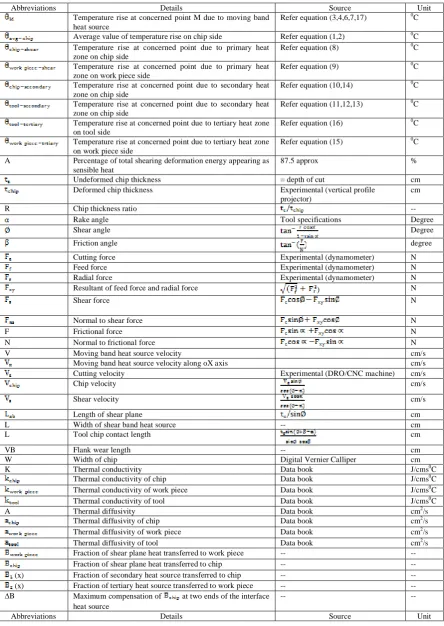
TABLE 2EXPLAINATIONS FOR ABBREVATIONS USED
Abbreviations Details Source Unit
Temperature rise at concerned point M due to moving band heat source
Refer equation (3,4,6,7,17) 0C
Average value of temperature rise on chip side Refer equation (1,2) 0C
Temperature rise at concerned point due to primary heat zone on chip side
Refer equation (8) 0C
Temperature rise at concerned point due to primary heat zone on work piece side
Refer equation (9) 0C
Temperature rise at concerned point due to secondary heat zone on chip side
Refer equation (10,14) 0C
Temperature rise at concerned point due to secondary heat zone on chip side
Refer equation (11,12,13) 0C
Temperature rise at concerned point due to tertiary heat zone on tool side
Refer equation (16) 0C
Temperature rise at concerned point due to tertiary heat zone on work piece side
Refer equation (15) 0C
A Percentage of total shearing deformation energy appearing as sensible heat
87.5 approx %
Undeformed chip thickness = depth of cut cm
Deformed chip thickness Experimental (vertical profile projector)
cm
R Chip thickness ratio --
Rake angle Tool specifications Degree
Shear angle Degree
Friction angle degree
Cutting force Experimental (dynamometer) N
Feed force Experimental (dynamometer) N
Radial force Experimental (dynamometer) N
Resultant of feed force and radial force ) N
Shear force N
Normal to shear force N
F Frictional force N
N Normal to frictional force N
V Moving band heat source velocity cm/s
Moving band heat source velocity along oX axis cm/s Cutting velocity Experimental (DRO/CNC machine) cm/s
Chip velocity cm/s
Shear velocity cm/s
Length of shear plane cm
L Width of shear band heat source -- cm
L Tool chip contact length cm
VB Flank wear length -- cm
W Width of chip Digital Vernier Calliper cm
K Thermal conductivity Data book J/cms0C
Thermal conductivity of chip Data book J/cms0C
Thermal conductivity of work piece Data book J/cms0C
Thermal conductivity of tool Data book J/cms0C
A Thermal diffusivity Data book cm2/s
Thermal diffusivity of chip Data book cm2/s
Thermal diffusivity of work piece Data book cm2/s
Thermal diffusivity of tool Data book cm2/s
Fraction of shear plane heat transferred to work piece -- -- Fraction of shear plane heat transferred to chip -- -- (x) Fraction of secondary heat source transferred to chip -- -- (x) Fraction of tertiary heat source transferred to work piece -- -- ∆B Maximum compensation of at two ends of the interface
heat source
-- --
ISSN: 2231-5381
http://www.ijettjournal.org
Page 545
O Origin of moving co-ordinate system -- --
X,Y,z The co-ordinate of the point where the temperature rise is to be measured in moving co-ordinate system
-- --
Oblique angle -- Degree
M, ,C Constants By trial and error
Heat intensity of the primary heat source J/cm2s
Heat intensity of the secondary heat J/cm2s
Heat intensity of the tertiary heat -- J/cm2s
Density Data book gm/cc
C Specific heat Data book J/gm0C
J Mechanical Equivalent of Heat Data book J/calorie
R Distance between infinitely small element on moving line heat source and the point M, where temperature rise is concerned
-- Cm
REFERENCES
[1] Thompson B. Count Rumford, 1798, An inquiry concerning the source of heat which is excited by friction, Philosophical Transactions of the Royal Society of London; 18:278-87.
[2] Joule JP., 1850, Mechanical equivalent of heat, Philosophical Transactions of the Royal Society of London; 61-81
[3] Taylor, G.I. and Quinney, H., 1934, The Latent Energy Remaining in a Metal after Cold Working, Proc. Roy. Soc. A, 143, 307-326
[4] A.B. Chattopadhyay, Cutting temperature causes effects, assessment and control. MHRD NEPTEL Manufacturing Science II, Lecture 11, IIT Kharagpur Version 2.
[5] Lei Pang, 2012, Analytical modeling and simulation of metal cutting forces for engineering alloys: Ph.D. thesis, department of Engineering and Applied Science, University of Ontario Institute of Technology, page 8 [6] Rosenthal D., 1946, The theory of moving sources of heat and its application to metal treatments, Transactions of ASME; 68: 849-66
[7] Blok H., 1938, Theoretical study of temperature rise at surfaces of actual contact under oiliness lubricating conditions. Proceedings of General Discussion on Lubrication and Lubricants, Institute of Mechanical Engineers London,. pg. 222-235.
[8] Jaeger JC., 1942, Moving sources of heat and the temperature at sliding contacts. Proceedings of the Royal Society of NSW; 76 : 203-24
[9] Carlsaw HS, Jaeger JC., 1959, Conduction of heat in solids. Oxford, UK: Oxford University Press.
[10] Loewen EG, Shaw MC., 1954, On the analysis of cutting tool temperatures, Transactions of ASME; 71: 217-31
[11] Cook NH et al., 1954, Discontinuous chip formation. Transactions of the ASME; 76: 153–62
[12] Leone WC., 1954, Distribution of shear-zone heat in metal cutting, Transactions of ASME; 76: 121-5
[13] Weiner JH., 1955, Shear plane temperature distribution in orthogonal machining, Transactions of ASME; 77: 1331-41
[14] Hahn RS., 1951, On the temperature developed at the shear plane in the metal cutting process. Proceedings of First U.S. National Congress of Applied Mechanics pg. 661-6
[15] Dutt RP, Brewer RC., 1964, On the theoretical determination of the temperature field in orthogonal machining. International Journal of Production Research; 4:91-114
[16] Dawson PR, Malkin S., 1984, Inclined moving heat source model for calculating metal cutting temperatures. Transactions of ASME; 106: 179-86 [17] Chao BT, Trigger KJ., 1953, The significance of thermal number in metal machining, Transactions of ASME; 75: 109-20
[18] Trigger KJ, Chao BT., 1951, An analytical evaluation of metal cutting temperature, Transactions of ASME; 73: 57-68
[19] R. Komanduri, Z.B. Hou, 2005, Thermal modeling of the metal cutting process Part I - Temperature rise distribution due to shear plane heat source, International Journal of Mechanical Sciences 2000; 42: 1715-52
[20] Y. Huang, S. Liang, Cutting temperature modeling based on non-uniform heat intensity and partition ratio, Taylor and Francis, Machining Science and Technology, 9: 301–323
[21] Y. Huang and S. Liang, Modelling of the cutting temperature distribution under the tool flank wear effect
[22] Chao BT, Trigger KJ., 1955, Temperature distribution at the tool-chip interface in metal cutting, Transactions of the ASME; 72: 1107-21
[23] Chao BT, Trigger KJ., 1958, Temperature distribution at the tool-chip and tool-work interface in metal cutting, Transactions of the ASME; 80: 311-20
[24]Nakayama K., 1956, Temperature rise of work piece during metal cutting, Bulletin of the Faculty of Engineering,Yokohama National University, Yokohama, Japan; 5: 1
[25] R. Komanduri, Z.B. Hou, 2001, Thermal modeling of the metal cutting process - Part II: temperature rise distribution due to frictional heat source at the tool-chip interface, International Journal of Mechanical Sciences; 43: 57-88
[26] R. Komanduri, Z.B. Hou, 2001, Thermal modeling of the metal cutting process - Part III: temperature rise distribution due to the combined effects of shear plane heat source and the tool-chip interface frictional heat source, International Journal of Mechanical Sciences;43: 89-107
[27] Schallbroach H, Lang M. , 1943, Messung der SchnittemperaturmittelsTemperaturanzeigenderFarbanstriche. Zeitschrift des VereinesDeutscherIngenieure ;87:15–9.
[28] Bickel E, Widmer W. 1954, Die Temperaturenan der Werkzeugschneide. Zurich, Switzerland: Industrielle Organization.
[29] L.B.Abhang and M. Hameedullah. , 2010, Chip-tool interface temperature prediction model for turning process.International Journal of Engineering Science and Technology Vol. 2(4), 382-393
[30] Kraemer G. 1936, Neitragzur Erkenntnis der beim Drehenauftretended Temperaturen und deren Messungmiteinem Gesamtstrahlungsempfanger. Dissertation, Hannover.
[31] A.B. Chattopadhyay, Cutting temperature causes, effects, assessment and control. MHRD NEPTEL Manufacturing Science II, Lecture 11, IIT Kharagpur Version 2. Page 9
[32] Schwerd F., 1933, UeberdieBestimmung des TemperaturfeldesbeimSpanablauf (Determination of the Temperature Distribution During Cutting). Z VDI; 9:211.
[33] Kraemer G., 1936., NeitragzurErkenntnis der beimDrehenauftretendedTemperaturen und derenMessungmiteinemGesamtstrahlungsempfanger. Dissertation, Hannover, [34] Lenz E. , 1963, Der Einfluss der Schnittempertur auf die standzeit der keramischenSchneidstoffen. Maschinenmarkt;28:30.
[35] Friedman MY, Lenz E. , 1971, Determination of temperature field on upper chip surface. Annals of CIRP;19:395–8.
[36] Ueda T, Hosokawa A, Yamamoto A. , 1985, Studies on temperarature of abrasive grains in grinding — application of infrared radiation pyrometer. Trans ASME, J of Engg for Ind;107:127–33.
[37] Boothroyd G., 1961, Photographic techniques for the determination of metal cutting temperatures.Brit J of Appl Physics;12:238–42.
[38] Jeelani S., 1981, Measurement of temperature distribution in machining using IR photography. Wear;68:191–202.
[39] Kato S, Yamaguchi K, Watanabe Y, Hiraiwa Y., 1976, Measurement of temperature distribution within tool using powders of constant melting point. Trans ASME, J of Engg for Ind;108:607–13.
![Fig. 2 Schematic diagram of Loewen and Shaw’s model [10]](https://thumb-us.123doks.com/thumbv2/123dok_us/8601677.1724278/2.612.339.549.375.523/fig-schematic-diagram-loewen-and-shaw-s-model.webp)
![Fig. 5 Schematic diagram of Dutt and Brewer’s model [15]](https://thumb-us.123doks.com/thumbv2/123dok_us/8601677.1724278/3.612.343.539.388.492/fig-schematic-diagram-of-dutt-brewer-s-model.webp)
![Fig.7 Schematic diagram of Trigger and Chao’s model [18]](https://thumb-us.123doks.com/thumbv2/123dok_us/8601677.1724278/4.612.57.282.192.356/fig-schematic-diagram-trigger-and-chao-s-model.webp)
![Fig.11 Schematic diagram of modified Hahn’s model for thermal analysis of work [19]](https://thumb-us.123doks.com/thumbv2/123dok_us/8601677.1724278/5.612.89.275.580.663/fig-schematic-diagram-modified-hahn-model-thermal-analysis.webp)

![Fig. 20 Schematic showing the heat transfer model for the frictional heat source at the tool-chip interface on the chip side considering as a moving-band heat source problem [25]](https://thumb-us.123doks.com/thumbv2/123dok_us/8601677.1724278/8.612.54.280.160.314/schematic-showing-transfer-frictional-interface-considering-moving-problem.webp)