Review Article
C
are for men with prostate cancer is a major global health care challenge, compounded by an aging population and increasing frequency of diagnosis. The priorities today are similar to those in the recent past: minimizing overtreatment of indolent disease and improving outcomes for pa-tients with aggressive disease. Herein we focus on recent accomplishments and future challenges in the management of metastatic disease, which continues to be associated with a high rate of death despite multiple new-drug approvals in recent years. Metastatic prostate cancer can be broadly divided into two groups: disease that has not been treated with androgen deprivation and disease that is resistant to such therapy. Treating metastatic prostate cancer is becomingly increasingly complex. We review studies that are changing the standard of care, and we offer a conceptual perspective for addressing ongoing challenges and opportunities.Metas tatic Dise ase Not Pr ev iously Tr e ated w ith Androgen Depr ivation
In 1941, Charles Huggins and a colleague showed that metastatic prostate cancer responds to endocrine manipulation,1 and this advance led to a Nobel Prize in
Physiology or Medicine for Huggins in 1966. The endocrine responsiveness of prostate cancer continues to influence care today, with androgen-deprivation therapy remaining the standard of care for patients presenting with metastatic disease. Dr. Andrew Schally (who won the Nobel Prize in Physiology or Medicine in 1977) and colleagues elucidated the hypothalamic control of pituitary function.2
The characterization of gonadotropin-releasing hormone analogues paved the way for medical therapy as an alternative to surgical therapy, and this approach is now the most commonly used method of androgen-deprivation therapy in developed countries. Surgical castration remains an effective, inexpensive alternative with some advantages.3
For men with an initial diagnosis of metastatic prostate cancer, continuous androgen-deprivation therapy represented the standard of care from 1941 until 2015, when two trials (Androgen Ablation Therapy with or without Chemotherapy in Treating Patients with Metastatic Prostate Cancer [CHAARTED], ClinicalTrials.gov number, NCT00309985; and Systemic Therapy in Advancing or Metastatic Prostate Cancer: Evaluation of Drug Efficacy [STAMPEDE], NCT00268476) showed that androgen-deprivation therapy combined with six courses of docetaxel improved survival4,5 (Table 1). Docetaxel is a taxane that binds tubulin and stabilizes
micro-tubules, thereby inhibiting mitosis and androgen-receptor signaling by disrupting nuclear transport of the receptor.17 A meta-analysis of all available data from
ran-domized trials comparing docetaxel with the standard of care showed an overall survival benefit with docetaxel (hazard ratio for death, 0.77; 95% confidence in-terval [CI], 0.68 to 0.87; P<0.001).18
From Tulane Medical School, New Or-leans (O.S.); and the Institute of Cancer Research and the Royal Marsden NHS Foundation Trust, London (J.S.B.). Ad-dress reprint requests to Dr. Sartor at Tulane Cancer Center, Box SL-42, 1430 Tulane Ave., New Orleans, LA 70112, or at osartor@ tulane . edu.
N Engl J Med 2018;378:645-57. DOI: 10.1056/NEJMra1701695 Copyright © 2018 Massachusetts Medical Society. Dan L. Longo, M.D., Editor
Metastatic Prostate Cancer
Table 1. Practice-Changing Trials of Treatments for Metastatic Prostate Cancer That Improve Survival.* Trial and Registration No. Treatment Median Overall Survival Hazard Ratio for Death (95% CI) Year of Initial Report† Study Treatment Control Study Treatment Control months No previous ADT CHAARTED, NCT00309985 Docetaxel plus ADT ADT 57.6 44.0 0.61 (0.47–0.80) 2015 4 STAMPEDE, NCT00268476 Docetaxel plus ADT ADT 60 45 0.76 (0.62–0.92) 2015 5 LATITUDE, NCT01715285 Abiraterone and prednisone, plus ADT ADT Not reached 34.7 0.62 (0.51–0.76) 2017 6 STAMPEDE, NCT00268476 Abiraterone and prednisolone, plus ADT ADT Not reached 48 0.61 (0.49–0.75) 2017 7 Recurrent disease after ADT without chemotherapy TAX 327‡ Docetaxel and prednisone Mitoxantrone and prednisone 18.9 16.5 0.76 (0.62–0.94) 2004 8 SWOG 9916, NCT00004001 Docetaxel and estramustine Mitoxantrone and prednisone 17.5 15.6 0.80 (0.67–0.97) 2004 9 COU-302, NCT00887198 (minimal or no symptoms) Abiraterone and prednisone Prednisone Not reached 27.2 0.75 (0.61–0.93) 2013 10 PREVAIL, NCT01212991 (minimal or no symptoms) Enzalutamide Placebo 32.4 30.2 0.71 (0.60–0.84) 2014 11 Recurrent disease after ADT and docetaxel TROPIC, NCT00417079 Cabazitaxel and prednisone Mitoxantrone and prednisone 15.1 12.7 0.70 (0.59–0.83) 2010 12 COU-301, NCT00638690 Abiraterone and prednisone Prednisone 14.8 10.9 0.65 (0.54–0.77) 2011 13 AFFIRM, NCT00974311 Enzalutamide Placebo 18.4 13.6 0.63 (0.53–0.75) 2012 14 Recurrent disease after ADT, docetaxel status unspecified IMPACT, NCT00065442 (minimal symptoms) Sipuleucel-T Placebo 25.8 21.7 0.77 (0.61–0.98) 2010 15 ALSYMPCA, NCT00699751 (symptomatic) Standard of care plus radium-223 Standard of care 14.9 11.3 0.70 (0.58–0.83) 2013 16 *
ADT denotes androgen-deprivation therapy, and CI confidence interval.
†
The CHAARTED study analyzed treatment with docetaxel in a subset of patients who had low-volume disease and a subset with high-volume disease (high-volume disease was defined as dis-ease involving any visceral metastases or at least four bone lesions [with at least one lesion be-yond the vertebral bodies and pelvis]).4 Whereas
a considerable benefit was noted for patients with high-volume disease (hazard ratio for death, 0.61; 95% CI, 0.45 to 0.81; P<0.001; median overall survival, 49.2 vs. 32.2 months), patients with low-volume disease had fewer events, with sur-vival data not reaching statistical significance (hazard ratio for death, 0.60; 95% CI, 0.32 to 1.13; P = 0.11); longer follow-up data are awaited. The distinction between high- and low-volume metastatic disease is incompletely explored be-yond the CHAARTED study. Thus, in assessing data from other trials, distinctions between these subsets are unclear. Toxic effects of docetaxel included grade 3 or 4 febrile neutropenia (in 8 to 12% of patients), neuropathies, alopecia, diarrhea, and fatigue.
The combination of androgen-deprivation ther-apy and abiraterone with prednisone represents a new standard of care for metastatic disease that is based on data from the CHAARTED and STAMPEDE trials. Abiraterone inhibits andro-genic steroid synthesis, targeting cytochrome P450 17A1 (CYP17A1) and blocking 17 alpha-hydroxylase and 17,20 lyase.19 Recent studies
in-dicate that a common abiraterone metabolite is also an androgen-receptor antagonist, though its clinical significance has not yet been proved.20
Abiraterone decreases androgens beyond the castrate state by inhibiting adrenal (and possibly intratumoral) steroid synthesis but increases steroid precursors upstream of CYP17, if given without glucocorticoids.21 Upstream
accumula-tion of steroid precursors can result in hypoka-lemia and hypertension, as in hereditary CYP17 deficiency.22 Abiraterone alone has antitumor
ac-tivity and has been safely administered without glucocorticoids, in combination with the mineralo-corticoid receptor antagonist eplerenone, but full clinical activity is unproven.23 Administration of
glucocorticoids in addition to abiraterone de-creases upstream mineralocorticoids, as well as related adverse events, and may enhance anti-cancer activity.24
The STAMPEDE trial and the LATITUDE trial (NCT01715285) evaluated androgen-deprivation
therapy with or without abiraterone and a gluco-corticoid (Table 1). The STAMPEDE trial ran-domly assigned a total of 1917 patients to a study treatment, 1002 (52%) of whom had re-ceived an initial diagnosis of metastatic disease.7
For patients with metastatic disease, no land-mark survival data were reported, but the reduc-tion in the risk of death was substantial for those in the group that received abiraterone and prednisolone (hazard ratio, 0.61; 95% CI, 0.49 to 0.75; P<0.001). For the STAMPEDE group as a whole, including both patients with metastatic disease and those with nonmetastatic disease, the 3-year survival rate was 76% for those who received androgen-deprivation therapy alone, as compared with 83% for those treated with abi-raterone and prednisolone in addition to andro-gen deprivation (hazard ratio with combination treatment, 0.63; 95% CI, 0.52 to 0.76; P<0.001).7
There was heterogeneity in the outcome accord-ing to age, with no survival benefit observed for combined treatment in men with metastatic or nonmetastatic disease who were more than 70 years old.
The LATITUDE trial randomly assigned 1199 men with metastatic prostate cancer to receive androgen-deprivation therapy with or without abiraterone and prednisone.6 Survival was clearly
improved in the abiraterone group (hazard ratio for death, 0.62; 95% CI, 0.51 to 0.76; P<0.001). The 3-year survival rate was 66% for combina-tion therapy, as compared with 49% for andro-gen deprivation alone. Primary toxic effects in-cluded hypertension, hypokalemia, and increased risk of elevated hepatic-enzyme levels.
Overall, these data provide the basis for add-ing androgen-deprivation therapy combined with abiraterone and a glucocorticoid to the standard of care for patients with metastatic disease at diagnosis; however, neither trial prospectively planned crossover to abiraterone for patients with castration-resistant disease. Thus, the ques-tion regarding earlier versus later treatment re-mains unanswered. Earlier treatment raises con-cerns about the increased risk of chronic toxic effects of glucocorticoids and androgen-depriva-tion therapy — specifically, weight gain and my-opathy with prednisone, and osteoporosis and metabolic and cardiovascular side effects with protracted, more intensive androgen deprivation.
to be equivalent,25 clear distinctions are noted in
the duration of therapy used in previous trials for patients with an initial diagnosis of meta-static disease. The docetaxel regimen is com-pleted after 18 weeks (one infusion given every 3 weeks, for a total of six infusions), whereas the abiraterone–prednisone regimen is given until disease progression, which may result in pro-longed drug exposure. The duration and cost of treatment may influence clinical decision mak-ing. Comparisons of docetaxel and abiraterone according to the duration of therapy have been incompletely explored.
Data from studies determining whether con-temporaneous administration of androgen-depri-vation therapy, docetaxel, and abiraterone–predni-sone is superior to serial administration of these agents are awaited. Selection of patients for treatment on the basis of molecular biomarkers has been notably absent in studies of hormone treatment for patients with an initial diagnosis of metastatic disease.
As more therapies are proved to be effective for metastatic disease, the question of their effec-tiveness in patients with nonmetastatic but high-risk disease will arise. Such questions can be answered only by means of direct clinical trials.
Detection of Metas tatic Dise ase and Improved Im aging
The definition of metastatic disease depends on the type of imaging used. Older definitions were typically based on the use of radionuclide bone scanning and computed tomography (CT), but approaches to imaging are currently in a state of flux, with newer, more sensitive imaging meth-ods detecting evidence of disease spread, even though conventional imaging shows no signs of metastasis. The implications of using more sen-sitive imaging techniques, and their relationship to therapy, are not yet fully understood.
Improved imaging, including positron-emis-sion tomography (PET) with prostate-specific membrane antigen (PSMA) or with choline or fluciclovine and whole-body magnetic resonance imaging (MRI), is enabling earlier and better identification of metastases.26,27 PSMA PET shows
the expression of PSMA on the cell surface in prostate cancer. More accurate imaging may change the diagnosis from nonmetastatic to metastatic disease. However, pathological
con-firmation of positive imaging studies is incom-plete. Earlier detection of metastases may affect treatment selection for both local and meta-static disease. Trials evaluating treatment of oligometastatic disease with stereotactic body irradiation are under way. The usefulness of new imaging techniques in patients with prostate cancer will remain uncertain until a clinical benefit has been shown in trials that directly assess these techniques.
Tr e atment of the Pr im ary Site in Men w ith Metas tatic Dise ase
Because of better treatments for metastatic dis-ease, men are living longer with local disease that may provide a sanctuary from systemic therapy and may result in an increased risk of local complications and a need for urologic inter-ventions. Grade A evidence is needed to guide local treatment in men with metastatic disease. Trials addressing this issue are under way.
Pathophysiological and Genetic Fe atur es of Cas tr ation-R esis tant Pros tate Cancer
Defects in Androgen-Receptor Signaling
Androgen-receptor signaling is altered in castra-tion-resistant prostate cancer, with increased intra-tumoral steroidogenesis, altered steroid-trans-porter expression, increased androgen-receptor expression frequently due to gene copy-number gains, androgen-receptor gene mutations impart-ing ligand promiscuity and activated by glucocor-ticoids or androgen-receptor antagonist therapeu-tics, and androgen-receptor gene rearrangements resulting in preferential expression of constitu-tively active receptor splice variants.28-30 These
androgen-receptor splice variants, the most com-mon of which is AR-V7, can also be generated in the absence of gene rearrangements and can delete the androgen-receptor ligand-binding reg-ulatory domain.31 Constitutive receptor-mediated
transcriptional activation can occur despite the absence of ligand.32 Strategies targeting these
splice variants are now being prioritized.
Somatic Genomic Alterations
prostate tumors that have not been treated with androgen deprivation33,34 (Table 2). The most
common alterations in patients with metastatic disease involve the androgen receptor (in >60% of patients), but p53 mutations or deletions are also common and can be concurrent with RB1 loss, together leading to lineage plasticity from luminal to basal phenotypes.35 The loss of tumor
suppressor PTEN, as well as other aberrations activating AKT signaling, and ETS rearrange-ments (e.g., TMPRSS2–ERG) commonly occur to-gether.34 SPOP mutations, which are found in
10% of metastatic, castration-resistant prostate cancers, activate both androgen-receptor and AKT signaling.36 Deleterious DNA-repair
aber-rations in genes, including BRCA2, ATM, BRCA1, PALB2, and RAD51D, occur in 20 to 25% of pa-tients.34 Defective mismatch repair has also been
reported,34,37 and this may be missed by targeted
exome or exon sequencing.37
The use of advanced genomic analysis is now feasible to a greater extent than ever before. Whether its use improves treatment decisions is not yet clear.
Germline Mutations
Deleterious germline DNA-repair defects (Table 3) are present in at least 12% of patients with metastatic, castration-resistant prostate cancer; the most common defects are alterations in BRCA2, CHEK2, and ATM.38 Germline DNA-repair
mutations have implications not only for the patient’s treatment and prognosis but also for the care of family members.39,40BRCA1/2
muta-tions are highly penetrant for female family members, increasing the risk of breast or ovarian cancer. For male family members, penetrance is lower, but prostate cancer, breast cancer, and pancreatic cancer all occur at increased rates among those with BRCA mutations. Estimates of the incidence of prostate cancer by the age of 80 years range from 19 to 61% for BRCA2 muta-tions (depending on the risk scores for each mu-tation) and from 7 to 26% for BRCA1 mutations.8
Germline mutations in mismatch-repair genes (MLH1, MSH2, MSH6, and PMS2) are clearly described in the Lynch syndrome and are also clearly described in a small percentage of men with advanced prostate cancer (0.6%), but con-vincing evidence that these mutations contribute to an increased incidence of advanced disease is sparse. No increased mutational frequency in
mismatch-repair genes has been detected among men with metastatic disease as compared with controls (men without prostate cancer).38
Tr e atment of Cas tr ation-R esis tant Pros tate Cancer
The first agent that was shown to prolong sur-vival among men with metastatic,
castration-resis-Gene
% of Patients with Aberrant
Gene Pathway Aberrations†Common
AR gene 62.7 Androgen signaling Amplification, splice variants, mutation
TP53 53.3 Cell cycle or tumor
suppressor Mutation, copy loss
PTEN 40.7 PI3K–AKT regulator Copy loss, mutation
ETS 56.7 Transcriptional regulator Gene fusions
BRCA2 13.3 DNA repair Copy loss, mutation
KMT2C 12.7 Chromatin modifier Mutation
FOXA1 12.0 AR-associated Mutation
ZBTB16 10.0 AR-associated Copy loss
RB1 9.3 Cell cycle Copy loss
APC 8.7 Wnt pathway Copy loss, mutation
CHD1 8.0 Chromatin modifier Copy loss, mutation
SPOP 8.0 Androgen signaling Mutation
ATM 7.3 DNA repair Copy loss, mutation
* Data are from Robinson et al.34 AR denotes androgen receptor.
† Aberrations are listed in descending order of predominance (e.g., for TP53, mutation is the predominant gene alteration, and for PTEN, copy loss is pre-dominant).
Table 2. Selected Gene Aberrations in Patients with Metastatic Prostate Cancer.*
Gene with Mutation% of Patients of Metastases†Relative Risk
BRCA2 5.35 18.6
CHEK2 1.87 3.1
ATM 1.59 6.3
BRCA1 0.87 3.9
GEN1 0.46 5.8
RAD51D 0.43 5.7
PALB2 0.43 3.5
* Data are from Pritchard et al.37
† Relative risks are for the comparison with men who do not have known prostate cancer.
Table 3. Selected Common Germline DNA-Repair
tant prostate cancer was docetaxel. Two phase 3 trials showed a significant overall survival benefit in 2004.9,15 One trial (TAX 327), which compared
two schedules of docetaxel and prednisone with mitoxantrone and prednisone (control), showed improved overall survival for patients treated with 75 mg of docetaxel per square meter of body-surface area every 3 weeks (hazard ratio for death, 0.76; 95% CI, 0.62 to 0.94; P = 0.009); the median survival was 18.9 months for this group and 16.5 months for the control group.9 The second
phase 3 trial (Southwest Oncology Group [SWOG] Intergroup protocol 99-16 [NCT00004001]), which compared docetaxel and estramustine, adminis-tered in 3-week cycles, with mitoxantrone and prednisone, also showed superior overall sur-vival with docetaxel.15 Given the toxic effects of
estramustine, docetaxel at a dose of 75 mg per square meter with oral prednisone at a dose of 5 mg twice a day became the de facto standard frontline chemotherapy regimen. Docetaxel has a variety of toxic effects, including bone marrow suppression, dysgeusia, alopecia, nail changes, and allergic reactions.
Clinical progress in treating metastatic, cas-tration-resistant prostate cancer during the past 7 years has been remarkable. Pivotal trials resulting in an overall survival benefit have led to regulatory approval for two hormonal thera-pies, an additional taxane, a bone-targeted and alpha-emitting radionuclide, and an immuno-therapy.
In 2010, an autologous cellular immunothera-peutic agent (sipuleucel-T) was shown to provide an overall survival benefit in the Immunotherapy for Prostate Adenocarcinoma Treatment (IMPACT) study (NCT00065442), a pivotal phase 3 trial com-paring sipuleucel-T (administered every 2 weeks for a total of three doses) with an unstimulated cellular product in 512 patients with metastatic, castration-resistant prostate cancer who had min-imal or no symptoms.13 For sipuleucel-T,
autolo-gous peripheral-blood mononuclear cells (includ-ing antigen-present(includ-ing cells) were activated ex vivo with the use of a combination of cytokines and a recombinant fusion protein consisting of prostatic acid phosphatase and granulocyte– macrophage colony-stimulating factor. The me-dian overall survival was 25.8 months for patients receiving sipuleucel-T and 21.7 months for con-trols (hazard ratio for death in the sipuleucel-T
group, 0.78; 95% CI, 0.61 to 0.98; P = 0.03). Ad-verse events included pyrexia, chills, fatigue, nausea, and headache.
Two new hormonal agents, abiraterone and enzalutamide, have had the largest effect on castration-resistant prostate cancer. The activity of 1000 mg of abiraterone and prednisone at a dose of 5 mg twice a day, as compared with placebo plus prednisone, was initially proved in a study involving patients with metastatic, castra-tion-resistant prostate cancer who had been treat-ed with docetaxel.10 An overall survival advantage
with abiraterone and prednisone as compared with placebo and prednisone was noted (hazard ratio for death, 0.65; 95% CI, 0.54 to 0.77; P<0.001), with elevated liver-function values as mineralocorticoid-associated side effects (hyper-tension, hypokalemia, and edema). The median overall survival was 14.8 months for the group treated with abiraterone and prednisone versus 10.9 months for the control group.
The combination of abiraterone and pred-nisone was subsequently compared with pla-cebo and prednisone in the COU-AA-302 trial (NCT00887198) for the treatment of men with metastatic, castration-resistant disease, minimal or no symptoms and no previous chemotherapy.41
Survival with no radiographic evidence of dis-ease progression and overall survival were used as the coprimary end points. The initial analysis showed that the abiraterone–prednisone group had significantly improved progression-free sur-vival (hazard ratio for radiographic evidence of progression, 0.53; 95% CI, 0.45 to 0.62; P<0.001), with a trend toward improved overall survival.41
The final planned analysis showed a benefit of abiraterone and prednisone with respect to over-all survival, with a median overover-all survival of 34.7 months, versus 30.3 months with placebo and prednisone (hazard ratio for death, 0.81; 95% CI, 0.70 to 0.93; P = 0.003).42
Mineralocorti-coid-associated adverse events were noted, as well as occasional liver-function abnormalities and hyperglycemia.
Enzalutamide is a potent and new androgen-receptor antagonist.14 The initial phase 3 trial
enzalutamide at a dose of 160 mg per day was associated with improved overall survival, as com-pared with placebo (hazard ratio for death, 0.63; 95% CI, 0.53 to 0.75; P<0.001; median survival, 18.4 months with enzalutamide vs. 13.6 months with placebo).43 Toxic effects included fatigue
and hot flashes; seizures were reported in a small proportion of patients (<1%).
Enzalutamide at a dose of 160 mg per day also improved both radiographic progression-free survival and overall survival in men with asymptomatic or mildly symptomatic disease who had not previously received chemotherapy (PREVAIL, NCT01212991).11 The hazard ratio for
death with enzalutamide as compared with pla-cebo was 0.71 (95% CI, 0.60 to 0.84; P<0.001). On the basis of the initial analysis, the median overall survival was 32.4 months with enzalu-tamide and 30.2 months with placebo.43 The final
analysis showed median estimates of 35.3 and 31.3 months, respectively (hazard ratio for death with enzalutamide, 0.77; 95% CI, 0.67 to 0.88; P< 0.001).12 Adverse events in this trial did not
include seizures but did include fatigue, falls, and nonpathologic fractures.
Cabazitaxel is a taxane specifically designed for antitumor activity in docetaxel-resistant models.44 The pivotal phase 3 trial (TROPIC,
NCT00417079) evaluated cabazitaxel in patients with disease progression after treatment with docetaxel. Cabazitaxel at a dose of 25 mg per square meter was administered intravenously every 3 weeks. The end point was overall sur-vival, with a median of 12.7 months in the con-trol group and 15.1 months in the cabazitaxel group (hazard ratio for death with cabazitaxel, 0.70; 95% CI, 0.59 to 0.83; P<0.001). Febrile neu-tropenia and diarrhea were significantly more frequent in the cabazitaxel group than in the con-trol group. In a subsequent phase 3 trial with a noninferiority design (PROSELICA, NCT01308580), a dose of 20 mg of cabazitaxel per square meter was noninferior to a dose of 25 mg per square meter with respect to overall survival, with the lower dose capturing at least 50% of the survival benefit of the higher dose with decreased toxic-ity, making a dose of 20 mg per square meter an alternative standard of care.45
Radium-223 is an alpha-particle–emitting ra-dionuclide that binds preferentially to the hy-droxyapatite in osteoblastic bone metastases.16 A
phase 3 trial (Alpharadin in Symptomatic Pros-tate Cancer Patients [ALSYMPCA], NCT00699751) showed that radium-223 combined with the “best standard of care” resulted in improved overall survival, as compared with the best standard of care alone, for men who had symptomatic bone metastases without visceral metastasis and with-out nodal metastases larger than 3 cm in the short-axis diameter.46 The best standard of care
included older hormonal therapies (e.g., antiandro-gens, glucocorticoids, and estrogens), bisphos-phonates, and external-beam radiation therapy but excluded chemotherapies. Overall survival was prolonged in the radium-223 group (median, 14.9 months, vs. 11.3 months in the control group; hazard ratio for death, 0.70; 95% CI, 0.58 to 0.83; P<0.001). Patients who had not previ-ously received chemotherapy and those previprevi-ously treated with docetaxel both had improved over-all survival with radium-223 as compared with placebo. Adverse events with radium-223 in-cluded diarrhea and a small number of cases of thrombocytopenia.
Bone-targeted agents such as zoledronic acid and denosumab are approved by the Food and Drug Administration (FDA) for use in patients with castration-resistant prostate cancer and bone metastases in order to prevent skeletal adverse events such as pathologic fractures, spinal cord compression, and the effects of ra-diation and surgery on bone. However, the use of these agents is somewhat controversial be-cause a clinical benefit has not been clearly shown in patients receiving concomitant newer anticancer agents such as abiraterone and enzalu-tamide.
Compar isons, Combinations, and Sequencing
Multiple trials have shown improvement in over-all survival with the use of various agents, but only one large trial to date has compared two life-prolonging therapies. That trial (FIRSTANA, NCT01308567) failed to show that cabazitaxel was superior to docetaxel in men with meta-static, castration-resistant prostate cancer who had not received previous chemotherapy.47
Over-all, grade A data support the use of sipuleucel-T, enzalutamide, abiraterone–prednisone, docetaxel, and radium-223 in selected populations of men with metastatic, castration-resistant prostate can-cer who have not received previous chemother-apy. Grade A evidence also supports the use of enzalutamide, abiraterone–prednisone, cabazi-taxel, and radium-223 in selected patients after treatment with docetaxel. Grade A data are lack-ing for combinations of these therapies or for sequential use, apart from the use of radium-223 after docetaxel, leaving clinicians with imperfect guidance on treatment selection for individual patients.
Despite limitations, some consistent observa-tions have arisen. First, cross-resistance occurs between the new androgen-receptor–targeting agents. The rate of response to abiraterone ther-apy after treatment with enzalutamide is less than 10%, whereas the response rate for enzalu-tamide after abiraterone is 15 to 30%.48-50 The
benefit from taxanes appears to be diminished after treatment with abiraterone or enzaluta-mide, as compared with the benefit in patients who have not received such treatment, although taxanes remain active.51 No large, prospective,
randomized trials of treatment with taxanes in men previously treated with abiraterone or enzalu-tamide have been completed. Thus, guidance in making treatment decisions for such patients is limited.
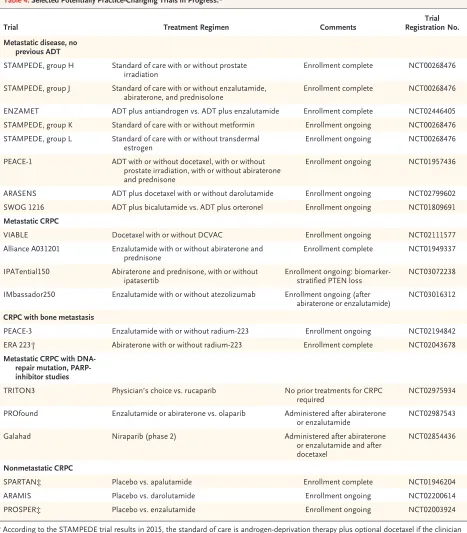
Combination therapy is being explored clini-cally on several fronts (Table 4). Both enzalu-tamide and apaluenzalu-tamide with or without abi-raterone are being evaluated in large, prospective trials. A trial involving patients with disease progression during treatment with enzalutamide with or without abiraterone failed to meet the primary end point.52 Abiraterone with or without
radium-223 and enzalutamide with or without radium-223 are both being evaluated but without overall survival as the primary end point.
Neuroendocr ine and Sm all-Cell Var iants of Pros tate
Cancer
Prostate cancer is typically adenocarcinoma, al-though small-cell and neuroendocrine variants are described in a minority of cases. The small-cell variant is typically CD56-positive with RB1 deletion, and the usual treatment for this vari-ant, like that for any other small-cell tumor, is usually a platinum-based regimen. The neuroen-docrine variants are now a focus of considerable research, although from a pathological perspec-tive, there is no consensus on definitions of these variants. Some evidence indicates that neuroen-docrine tumors are more likely to arise after ex-treme androgen deprivation, such as that induced by exposure to abiraterone or enzalutamide. Trials evaluating treatments for neuroendocrine tumors (variously defined) are under way but without practice-changing results to date.
Prognos tic and Pr edictive Biom ar k er s
A variety of prognostic schemata have been pro-posed, including many nomograms. Performance status; extent of disease; pain status; location of disease (e.g., bone or liver); levels of hemoglo-bin, serum alkaline phosphatase, lactate dehy-drogenase, albumin, aspartate aminotransfer-ase, circulating tumor cells, and plasma cell-free DNA; neutrophil-to-lymphocyte ratio; and kinet-ics of disease progression contribute to the prognosis.53-55
Predictive biomarkers are being explored. Androgen-receptor aberrations have been linked to resistance in various patient populations. AR-V7–encoding RNA expression in circulating tumor cells is associated with a poor prognosis and resistance to abiraterone and enzalutamide but not to taxanes.56,57 AR-V7 protein in tumor
cells is also correlated with resistance to abi-raterone and enzalutamide but not to taxanes.58
amplifica-Trial Treatment Regimen Comments Registration No.Trial Metastatic disease, no
previous ADT
STAMPEDE, group H Standard of care with or without prostate
irradiation Enrollment complete NCT00268476 STAMPEDE, group J Standard of care with or without enzalutamide,
abiraterone, and prednisolone Enrollment complete NCT00268476 ENZAMET ADT plus antiandrogen vs. ADT plus enzalutamide Enrollment complete NCT02446405 STAMPEDE, group K Standard of care with or without metformin Enrollment ongoing NCT00268476 STAMPEDE, group L Standard of care with or without transdermal
estrogen Enrollment ongoing NCT00268476 PEACE-1 ADT with or without docetaxel, with or without
prostate irradiation, with or without abiraterone and prednisone
Enrollment ongoing NCT01957436
ARASENS ADT plus docetaxel with or without darolutamide Enrollment ongoing NCT02799602 SWOG 1216 ADT plus bicalutamide vs. ADT plus orteronel Enrollment ongoing NCT01809691
Metastatic CRPC
VIABLE Docetaxel with or without DCVAC Enrollment ongoing NCT02111577 Alliance A031201 Enzalutamide with or without abiraterone and
prednisone Enrollment complete NCT01949337 IPATential150 Abiraterone and prednisone, with or without
ipatasertib Enrollment ongoing: biomarker-stratified PTEN loss NCT03072238 IMbassador250 Enzalutamide with or without atezolizumab Enrollment ongoing (after
abiraterone or enzalutamide) NCT03016312
CRPC with bone metastasis
PEACE-3 Enzalutamide with or without radium-223 Enrollment ongoing NCT02194842 ERA 223† Abiraterone with or without radium-223 Enrollment complete NCT02043678
Metastatic CRPC with DNA-repair mutation, PARP-inhibitor studies
TRITON3 Physician’s choice vs. rucaparib No prior treatments for CRPC
required NCT02975934 PROfound Enzalutamide or abiraterone vs. olaparib Administered after abiraterone
or enzalutamide NCT02987543 Galahad Niraparib (phase 2) Administered after abiraterone
or enzalutamide and after docetaxel
NCT02854436
Nonmetastatic CRPC
SPARTAN‡ Placebo vs. apalutamide Enrollment complete NCT01946204 ARAMIS Placebo vs. darolutamide Enrollment ongoing NCT02200614 PROSPER‡ Placebo vs. enzalutamide Enrollment ongoing NCT02003924
* According to the STAMPEDE trial results in 2015, the standard of care is androgen-deprivation therapy plus optional docetaxel if the clinician recommends it. CRPC denotes castration-resistant prostate cancer.
† The ERA 223 trial was unblinded in December 2017 after a recommendation from an independent data monitoring committee regarding safety concerns focused on bone fractures and survival.
‡ Data from the SPARTAN and PROSPER trials will be presented at the American Society of Clinical Oncology Genitourinary Cancers Symposium in February 2018.
tion and certain mutations (positions 702 and 878) are also associated with resistance to abi-raterone and enzalutamide.29,59,60 The clinical
use-fulness of these assays has yet to be ascertained in large, prospective studies, and the assay re-sults may not be assessable in all patients.
Deleterious somatic and germline aberrations in DNA-repair genes are common in men with metastatic, castration-resistant prostate cancer.34
Homologous recombination repair defects, the most common of which is BRCA2, may confer sensitivity to poly(adenosine diphosphate [ADP]– ribose) polymerase (PARP) inhibitors and platinum-based therapy.61,62 Multiple trials of PARP
inhibi-tors in this patient population are ongoing. Mismatch repair in tumor cells is deficient in 5 to 12% of men with metastatic, castration-resistant prostate cancer.34,37,38 Pembrolizumab,
an antibody that targets programmed death 1 (PD-1), is now approved by the FDA for cancers with defective mismatch repair.63 Further studies
are needed to elucidate the relationship between this disease state and immunotherapy. Prelimi-nary data indicate that not all men with tumors that are deficient in mismatch repair have a re-sponse to immunotherapy, although impressive responses have been reported in some cases. Response rates in the range of 10 to 20% have been reported for molecularly unselected men treated with PD-1 inhibition.64,65
Loss of PTEN expression, which is common in metastatic, castration-resistant prostate cancer (observed in >40% of cases), activates AKT sig-naling.34,66,67 Targeting the AKT kinase may have
therapeutic value in men with PTEN loss.68
Stud-ies of inhibitors of this pathway are ongoing. PSMA is expressed in most tumors, although intrapatient heterogeneity of expression has been reported.69 PSMA ligands or anti-PSMA
antibod-ies can be conjugated to radionuclides (either alpha- or beta-particle emitters) or cytotoxic agents, and multiple PSMA strategies are cur-rently undergoing evaluation.70-73
R esponse and Sur rogate Biom ar k er s
The validation and clinical qualification of im-proved response and surrogate biomarkers are a high priority in research on prostate cancer. Biomarkers, including circulating tumor-cell
counts and cell-free DNA, have shown promise.74
Radiographic evidence of progression-free sur-vival, with the use of CT scans and bone scans, has been evaluated as a response biomarker,75
but surrogacy for an overall survival benefit has not been shown. Clinical deterioration may be more important than radiographic progression,76
but full acceptance of this end point has not been verified.
Unmet Needs, Challenges, and Opportunities
Advanced prostate cancer is a disease that reli-ably progresses and is fatal. Today, the new hormonal agents are typically used for the treat-ment of prostate cancer before chemotherapy, but large, prospective trials involving patients with disease progression while receiving treat-ment with abiraterone or enzalutamide have failed to yield clear evidence that these new hormonal agents provide a clinical benefit. Opti-mal sequencing of the various agents is cur-rently unknown. Furthermore, despite a ratio-nale for combination therapy (which is typically used for most cancers), no large, randomized trials testing combination therapy for advanced prostate cancer have been reported to date.
Though newer studies indicate that a variety of potentially actionable genetic alterations can be detected in prostate cancer, no therapy tar-geting these alterations has yet been shown to have a clinical benefit. Novel forms of immuno-therapy, especially PD-1 inhibitors, are active in a variety of cancers, especially those with high mutational frequencies. Prostate cancer has a lower mutational burden, and the use of PD-1 inhibitors for prostate cancer remains experi-mental (though the activity of these agents may be higher in tumors with defective mismatch repair than in tumors with other genetic altera-tions). Thus, advanced genetics and immunol-ogy, two major drivers of progress in oncolimmunol-ogy, are not routinely incorporated into the care of patients with prostate cancer.
therapy in the first place, and once the disease spreads beyond the control of local therapies, we do not know how best to sequence or combine the expanding number of active therapies.
Dr. Sartor reports receiving fees for serving as chair of the data management center and consulting fees from Bavarian Nordic, Oncogenex, Medivation, Pfizer, Myovant Sciences, Tokai, and Astellas, fees for serving as chair of the data management center, consulting fees, and travel support from Janssen, consulting fees from Endocyte and Advanced Accelerator Applications,
consult-ing fees and travel support from Sanofi, Bayer, and EMD-Serono, and grant support from Bayer, Cougar, Endocyte, Dendreon, Tokai, Sanofi, PSMA Development, Eli Lilly, Merck, Innocrin, and Genentech; and Dr. de Bono, receiving grant support and advisory board fees from AstraZeneca, Genentech, GlaxoSmithKline, Jans-sen, Merck, and Pfizer, advisory board fees from Astellas and Bayer, grant support, advisory board fees, and provision of free drugs from Sanofi-Aventis, and being named as an inventor, with no financial interest, for patent 8,822,438. No other potential conflict of interest relevant to this article was reported.
Disclosure forms provided by the authors are available with the full text of this article at NEJM.org.
References
1. Huggins C, Hodges CV. Studies on
prostatic cancer. I. The effect of castra-tion, of estrogen and of androgen injec-tion on serum phosphatases in metastatic carcinoma of the prostate. Cancer Res 1941; 1: 293-7.
2. Matsuo H, Baba Y, Nair RM, Arimura
A, Schally AV. Structure of the porcine LH- and FSH-releasing hormone. I. The proposed amino acid sequence. Biochem Biophys Res Commun 1971; 43: 1334-9.
3. Sun M, Choueiri TK, Hamnvik OP,
et al. Comparison of gonadotropin-releas-ing hormone agonists and orchiectomy: effects of androgen-deprivation therapy. JAMA Oncol 2016; 2: 500-7.
4. Sweeney CJ, Chen Y-H, Carducci M, et
al. Chemohormonal therapy in metastatic hormone-sensitive prostate cancer. N Engl J Med 2015; 373: 737-46.
5. James ND, Sydes MR, Clarke NW, et al.
Addition of docetaxel, zoledronic acid, or both to first-line long-term hormone therapy in prostate cancer (STAMPEDE): survival results from an adaptive, multi-arm, multistage, platform randomised controlled trial. Lancet 2016; 387: 1163-77.
6. Fizazi K, Tran N, Fein L, et al.
Abi-raterone plus prednisone in metastatic, castration-sensitive prostate cancer. N Engl J Med 2017; 377: 352-60.
7. James ND, de Bono JS, Spears MR,
et al. Abiraterone for prostate cancer not previously treated with hormone therapy. N Engl J Med 2017; 377: 338-51.
8. Lecarpentier J, Silvestri V,
Kuchen-baecker KB, et al. Prediction of breast and prostate cancer risks in male BRCA1 and BRCA2 mutation carriers using polygenic risk scores. J Clin Oncol 2017; 35: 2240-50.
9. Tannock IF, de Wit R, Berry WR, et al.
Docetaxel plus prednisone or mitoxan-trone plus prednisone for advanced pros-tate cancer. N Engl J Med 2004; 351: 1502-12.
10. de Bono JS, Logothetis CJ, Molina A,
et al. Abiraterone and increased survival in metastatic prostate cancer. N Engl J Med 2011; 364: 1995-2005.
11. Beer TM, Armstrong AJ, Rathkopf DE,
et al. Enzalutamide in metastatic prostate cancer before chemotherapy. N Engl J Med 2014; 371: 424-33.
12. Beer TM, Armstrong AJ, Rathkopf D,
et al. Enzalutamide in men with chemo-therapy-naïve metastatic castration-resis-tant prostate cancer: extended analysis of the phase 3 PREVAIL study. Eur Urol 2017; 71: 151-4.
13. Kantoff PW, Higano CS, Shore ND,
et al. Sipuleucel-T immunotherapy for castration-resistant prostate cancer. N Engl J Med 2010; 363: 411-22.
14. Tran C, Ouk S, Clegg NJ, et al.
Devel-opment of a second-generation antian-drogen for treatment of advanced prostate cancer. Science 2009; 324: 787-90.
15. Petrylak DP, Tangen CM, Hussain
MHA, et al. Docetaxel and estramustine compared with mitoxantrone and predni-sone for advanced refractory prostate can-cer. N Engl J Med 2004; 351: 1513-20.
16. Henriksen G, Breistøl K, Bruland ØS,
Fodstad Ø, Larsen RH. Significant anti-tumor effect from bone-seeking, alpha-particle-emitting (223)Ra demonstrated in an
experimental skeletal metastases model. Cancer Res 2002; 62: 3120-5.
17. Fitzpatrick JM, de Wit R. Taxane
mechanisms of action: potential implica-tions for treatment sequencing in meta-static castration-resistant prostate cancer. Eur Urol 2014; 65: 1198-204.
18. Vale CL, Burdett S, Rydzewska LHM,
et al. Addition of docetaxel or bisphos-phonates to standard of care in men with localised or metastatic, hormone-sensitive prostate cancer: a systematic review and meta-analyses of aggregate data. Lancet Oncol 2016; 17: 243-56.
19. Potter GA, Barrie SE, Jarman M,
Row-lands MG. Novel steroidal inhibitors of human cytochrome P45017 alpha (17 alpha-hydroxylase-C17,20-lyase): potential agents for the treatment of prostatic cancer. J Med Chem 1995; 38: 2463-71.
20. Li Z, Bishop AC, Alyamani M, et al.
Conversion of abiraterone to D4A drives anti-tumour activity in prostate cancer. Nature 2015; 523: 347-51.
21. Attard G, Reid AH, Yap TA, et al.
Phase I clinical trial of a selective inhibi-tor of CYP17, abiraterone acetate, con-firms that castration-resistant prostate cancer commonly remains hormone driv-en. J Clin Oncol 2008; 26: 4563-71.
22. Auchus RJ. Steroid 17-hydroxylase and
17,20-lyase deficiencies, genetic and phar-macologic. J Steroid Biochem Mol Biol 2017; 165: Pt A: 71-8.
23. Gill D, Gaston D, Bailey E, et al. Effi-cacy of eplerenone in the management of mineralocorticoid excess in men with metastatic castration-resistant prostate cancer treated with abiraterone without prednisone. Clin Genitourin Cancer 2017; 15(4): e599-e602.
24. Attard G, Reid AH, A’Hern R, et al.
Selective inhibition of CYP17 with abi-raterone acetate is highly active in the treatment of castration-resistant prostate cancer. J Clin Oncol 2009; 27: 3742-8.
25. Sydes MR, Mason MD, Spears MR, et al.
Adding abiraterone acetate plus predni-sone (AAP) or docetaxel for patients (pts) with high-risk prostate cancer (PCa) start-ing long term androgen deprivation ther-apy (ADT): directly randomized data from STAMPEDE. Ann Oncol 2017; 28: Suppl 5: LBA31. abstract.
26. Bouchelouche K, Turkbey B, Choyke
PL. PSMA PET and radionuclide therapy in prostate cancer. Semin Nucl Med 2016; 46: 522-35.
27. Lecouvet FE, El Mouedden J, Collette
L, et al. Can whole-body magnetic reso-nance imaging with diffusion-weighted imaging replace Tc 99m bone scanning and computed tomography for single-step detection of metastases in patients with high-risk prostate cancer? Eur Urol 2012; 62: 68-75.
28. Sun S, Sprenger CC, Vessella RL, et al. Castration resistance in human prostate cancer is conferred by a frequently occur-ring androgen receptor splice variant. J Clin Invest 2010; 120: 2715-30.
29. Wyatt AW, Azad AA, Volik SV, et al.
Genomic alterations in cell-free DNA and enzalutamide resistance in castration- resistant prostate cancer. JAMA Oncol 2016; 2: 1598-606.
30. Lallous N, Volik SV, Awrey S, et al.
Functional analysis of androgen receptor mutations that confer anti-androgen re-sistance identified in circulating cell-free DNA from prostate cancer patients. Ge-nome Biol 2016; 17: 10.
rearrangement and splicing variants in re-sistance to endocrine therapies in prostate cancer. Endocrinology 2017; 158: 1533-42.
32. Xu D, Zhan Y, Qi Y, et al. Androgen
receptor splice variants dimerize to trans-activate target genes. Cancer Res 2015; 75: 3663-71.
33. Barbieri CE, Baca SC, Lawrence MS,
et al. Exome sequencing identifies recur-rent SPOP, FOXA1 and MED12 mutations in prostate cancer. Nat Genet 2012; 44: 685-9.
34. Robinson D, Van Allen EM, Wu YM,
et al. Integrative clinical genomics of
ad-vanced prostate cancer. Cell 2015; 161:
1215-28.
35. Ku SY, Rosario S, Wang Y, et al. Rb1
and Trp53 cooperate to suppress prostate cancer lineage plasticity, metastasis, and antiandrogen resistance. Science 2017; 355: 78-83.
36. Blattner M, Liu D, Robinson BD, et al.
SPOP mutation drives prostate tumori-genesis in vivo through coordinate regu-lation of PI3K/mTOR and AR signaling. Cancer Cell 2017; 31: 436-51.
37. Pritchard CC, Morrissey C, Kumar A,
et al. Complex MSH2 and MSH6 muta-tions in hypermutated microsatellite un-stable advanced prostate cancer. Nat Commun 2014; 5: 4988.
38. Pritchard CC, Mateo J, Walsh MF,
et al. Inherited DNA-repair gene mutations in men with metastatic prostate cancer. N Engl J Med 2016; 375: 443-53.
39. Na R, Zheng SL, Han M, et al.
Germ-line mutations in ATM and BRCA1/2 dis-tinguish risk for lethal and indolent pros-tate cancer and are associated with early age at death. Eur Urol 2017; 71: 740-7.
40. Pomerantz MM, Spisák S, Jia L, et al.
The association between germline BRCA2 variants and sensitivity to platinum-based chemotherapy among men with metastatic prostate cancer. Cancer 2017; 123: 3532-9.
41. Ryan CJ, Smith MR, de Bono JS, et al.
Abiraterone in metastatic prostate cancer without previous chemotherapy. N Engl J Med 2013; 368: 138-48.
42. Ryan CJ, Smith MR, Fizazi K, et al.
Abiraterone acetate plus prednisone ver-sus placebo plus prednisone in chemother-apy-naive men with metastatic castration-resistant prostate cancer (COU-AA-302): final overall survival analysis of a ran-domised, double-blind, placebo-controlled phase 3 study. Lancet Oncol 2015; 16: 152-60.
43. Scher HI, Fizazi K, Saad F, et al.
In-creased survival with enzalutamide in pros-tate cancer after chemotherapy. N Engl J Med 2012; 367: 1187-97.
44. de Bono JS, Oudard S, Ozguroglu M,
et al. Prednisone plus cabazitaxel or mito-xantrone for metastatic castration-resis-tant prostate cancer progressing after docetaxel treatment: a randomised open-label trial. Lancet 2010; 376: 1147-54.
45. Eisenberger M, Hardy-Bessard AC,
Kim CS, et al. Phase III study comparing a reduced dose of cabazitaxel (20 mg/m2) and the currently approved dose (25 mg/ m2) in postdocetaxel patients with meta-static castration-resistant prostate cancer-PROSELICA. J Clin Oncol 2017; 35: 3198-206.
46. Parker C, Nilsson S, Heinrich D, et al. Alpha emitter radium-223 and survival in metastatic prostate cancer. N Engl J Med 2013; 369: 213-23.
47. Oudard S, Fizazi K, Sengeløv L, et al.
Cabazitaxel versus docetaxel as first-line therapy for patients with metastatic cas-tration-resistant prostate cancer: a random-ized phase III trial — FIRSTANA. J Clin Oncol 2017; 35: 3189-97.
48. Smith MR, Saad F, Rathkopf DE, et al.
Clinical outcomes from androgen signal-ing-directed therapy after treatment with abiraterone acetate and prednisone in pa-tients with metastatic castration-resistant prostate cancer: post hoc analysis of COU-AA-302. Eur Urol 2017; 72: 10-3.
49. Noonan KL, North S, Bitting RL,
Armstrong AJ, Ellard SL, Chi KN. Clinical activity of abiraterone acetate in patients with metastatic castration-resistant pros-tate cancer progressing after enzaluta-mide. Ann Oncol 2013; 24: 1802-7.
50. Schrader AJ, Boegemann M, Ohlmann
CH, et al. Enzalutamide in castration-resistant prostate cancer patients pro-gressing after docetaxel and abiraterone. Eur Urol 2014; 65: 30-6.
51. de Bono JS, Smith MR, Saad F, et al.
Subsequent chemotherapy and treatment patterns after abiraterone acetate in pa-tients with metastatic castration-resistant prostate cancer: post hoc analysis of COU-AA-302. Eur Urol 2017; 71: 656-64.
52. Attard G, Borre M, Gurney H, et al.
A phase IV, randomized, double-blind, placebo (PBO)-controlled study of contin-ued enzalutamide (ENZA) post prostate-specific antigen (PSA) progression in men with chemotherapy-naive metastatic cas-tration-resistant prostate cancer (mCRPC). J Clin Oncol 2017; 35: Suppl: 5004. abstract.
53. Halabi S, Lin CY, Kelly WK, et al.
Up-dated prognostic model for predicting overall survival in first-line chemotherapy for patients with metastatic castration-resistant prostate cancer. J Clin Oncol 2014; 32: 671-7.
54. Guinney J, Wang T, Laajala TD, et al.
Prediction of overall survival for patients with metastatic castration-resistant pros-tate cancer: development of a prognostic model through a crowdsourced challenge with open clinical trial data. Lancet Oncol 2017; 18: 132-42.
55. van Soest RJ, Templeton AJ, Vera-
Badillo FE, et al. Neutrophil-to-lympho-cyte ratio as a prognostic biomarker for men with metastatic castration-resistant prostate cancer receiving first-line
chemo-therapy: data from two randomized phase III trials. Ann Oncol 2015; 26: 743-9.
56. Antonarakis ES, Lu C, Wang H, et al.
AR-V7 and resistance to enzalutamide and abiraterone in prostate cancer. N Engl J Med 2014; 371: 1028-38.
57. Antonarakis ES, Lu C, Luber B, et al.
Androgen receptor splice variant 7 and ef-ficacy of taxane chemotherapy in patients with metastatic castration-resistant pros-tate cancer. JAMA Oncol 2015; 1: 582-91.
58. Scher HI, Lu D, Schreiber NA, et al.
Association of AR-V7 on circulating tu-mor cells as a treatment-specific bio-marker with outcomes and survival in castration-resistant prostate cancer. JAMA Oncol 2016; 2: 1441-9.
59. Romanel A, Gasi Tandefelt D,
Conte-duca V, et al. Plasma AR and abiraterone-resistant prostate cancer. Sci Transl Med 2015; 7: 312re10.
60. Conteduca V, Wetterskog D,
Sharabi-ani MTA, et al. Androgen receptor gene status in plasma DNA associates with worse outcome on enzalutamide or abi-raterone for castration-resistant prostate cancer: a multi-institution correlative bio-marker study. Ann Oncol 2017; 28: 1508-16.
61. Mateo J, Carreira S, Sandhu S, et al.
DNA-repair defects and olaparib in meta-static prostate cancer. N Engl J Med 2015; 373: 1697-708.
62. Cheng HH, Pritchard CC, Boyd T,
Nel-son PS, Montgomery B. Biallelic inactiva-tion of BRCA2 in platinum-sensitive meta-static castration-resistant prostate cancer. Eur Urol 2016; 69: 992-5.
63. FDA grants accelerated approval to
pembrolizumab for first tissue/site agnos-tic indication. Silver Spring, MD: Food and Drug Administration, May 30, 2017 (https:/ / www .fda .gov/ drugs/ information ondrugs/ approveddrugs/ ucm560040 .htm).
64. Graff JN, Alumkal JJ, Drake CG, et al.
Early evidence of anti-PD-1 activity in enzalutamide-resistant prostate cancer. Oncotarget 2016; 7: 52810-7.
65. Hansen A, Massard C, Ott PA, et al.
Pembrolizumab for patients with advanced prostate adenocarcinoma: preliminary re-sults from the KEYNOTE-028 study. Ann Oncol 2016; 27: Suppl 6: 725PD. abstract.
66. Whang YE, Wu X, Suzuki H, et al.
In-activation of the tumor suppressor PTEN/ MMAC1 in advanced human prostate can-cer through loss of expression. Proc Natl Acad Sci U S A 1998; 95: 5246-50.
67. Carver BS, Chapinski C, Wongvipat J,
et al. Reciprocal feedback regulation of PI3K and androgen receptor signaling in PTEN-deficient prostate cancer. Cancer Cell 2011; 19: 575-86.
68. de Bono JS, De Giorgi U, Massard C,
cancer. Ann Oncol 2016; 27: Suppl 6: 7180. abstract.
69.Mannweiler S, Amersdorfer P,
Tra-janoski S, Terrett JA, King D, Mehes G. Heterogeneity of prostate-specific mem-brane antigen (PSMA) expression in pros-tate carcinoma with distant metastasis. Pathol Oncol Res 2009; 15: 167-72.
70.Will L, Sonni I, Kopka K, Kratochwil
C, Giesel FL, Haberkorn U. Radiolabeled prostate-specific membrane antigen small-molecule inhibitors. Q J Nucl Med Mol Imaging 2017; 61: 168-80.
71. Rahbar K, Ahmadzadehfar H,
Kratoch-wil C, et al. German multicenter study investigating 177Lu-PSMA-617 radioligand
therapy in advanced prostate cancer pa-tients. J Nucl Med 2017; 58: 85-90.
72. Kratochwil C, Bruchertseifer F, Rathke
H, et al. Targeted α-therapy of metastatic castration-resistant prostate cancer with 225Ac-PSMA-617: dosimetry estimate and empiric dose finding. J Nucl Med 2017; 58: 1624-31.
73.Tagawa ST, Milowsky MI, Morris M,
et al. Phase II study of Lutetium-177- labeled anti-prostate-specific membrane antigen monoclonal antibody J591 for metastatic castration-resistant prostate cancer. Clin Cancer Res 2013; 19: 5182-91.
74.Scher HI, Heller G, Molina A, et al.
Circulating tumor cell biomarker panel as
an individual-level surrogate for survival in metastatic castration-resistant prostate cancer. J Clin Oncol 2015; 33: 1348-55.
75.Morris MJ, Molina A, Small EJ, et al.
Radiographic progression-free survival as a response biomarker in metastatic castra-tion-resistant prostate cancer: COU-AA- 302 results. J Clin Oncol 2015; 33: 1356-63.
76.Ryan CJ, Kheoh T, Scher HS, et al.