ISSN: 2231-5381
http://www.ijettjournal.org
Page 501
Relevant Feature Selection Model Using Data
Mining for Intrusion Detection System
Ayman I. Madbouly#1, Amr M. Gody#2, Tamer M. Barakat#31
Department of Research and Consultancy, Deanship of Admission and Registration, King Abdulaziz University Jeddah, Saudi Arabia
2, 3
Electrical Engineering Department, Faculty of Engineering, Fayoum University Fayoum, Egypt
Abstract— Network intrusions have become a significant threat
in recent years as a result of the increased demand of computer networks for critical systems. Intrusion detection system (IDS) has been widely deployed as a defense measure for computer networks. Features extracted from network traffic can be used as sign to detect anomalies. However with the huge amount of network traffic, collected data contains irrelevant and redundant features that affect the detection rate of the IDS, consumes high amount of system resources, and slowdown the training and testing process of the IDS. In this paper, a new feature selection model is proposed; this model can effectively select the most relevant features for intrusion detection. Our goal is to build a lightweight intrusion detection system by using a reduced features set. Deleting irrelevant and redundant features helps to build a faster training and testing process, to have less resource consumption as well as to maintain high detection rates. The effectiveness and the feasibility of our feature selection model were verified by several experiments on KDD intrusion detection dataset. The experimental results strongly showed that our model is not only able to yield high detection rates but also to speed up the detection process.
Keywords— Intrusion detection system, traffic classification, network security, supervised learning, feature selection, data mining.
I. INTRODUCTION
With the increment use of networked computers for critical systems and the widespread use of large and distributed computer networks, computer network security attention increases and network intrusions have become a significant threat in recent years. Intrusion detection system (IDS) has been widely deployed to be a second line of defense for computer network systems along with other network security techniques such as firewall and access control. The main goal of intrusion detection system is to detect unauthorized use, misuse and abuse of computer systems by both system insiders and external intruders. There are various approaches to build intrusion detection systems. Intrusion detection systems can be classified into two categories based on the technique used to detect intrusions: anomaly detection and misuse detection [1], [2], [3]. Anomaly detection approach establishes the profiles of normal activities of users, operating systems, system resources, network traffic and services using the audit trails generated by a host operating system or a network scanning program. This approach detects intrusions
ISSN: 2231-5381
http://www.ijettjournal.org
Page 502
scale networks there is a large amount of features' data to be observed for detection. To improve the detection accuracy and optimize the computational time and resources usage, intrusion detection system need to collect and study only the most relevance features that best distinguish between normal and attack traffic. An efficient data mining and machine learning techniques should be implemented on existing intrusion detection dataset to select best relevance features subset which provides the best accuracy and removes distractions [16]–[20].
The rest of the paper is organized as follows: Section II presents some related researches on intrusion detection which cover the feature selection and data mining. Section III briefly describes the KDD dataset used in this research. Section IV explains the details of the dataset pre-processing phase of the proposed model. The proposed model is presented in Section V. Finally, the experimental results and analysis are presented in Section 6 followed by some conclusions in the final section.
II. RELATED WORK
Anomaly detection approaches have been extensively
developed and researched. Many algorithms and
methodologies have been suggested for anomaly detection [21]
–
[27]. These include machine learning [28]–
[30], data mining [31]–
[35], statistical [36], [37], neural networks [38], [39], information flow analysis [40], and approaches inspired from human immunology [26], [41], [42]. Recently, Data mining and machine learning have been widely used to solvemany IDS classification problems. Many effective
classification algorithms and mining techniques have been employed including traditional classification [43], [44], and hybrid classification [45]
–[
49].Despite the existence of such different algorithms and approaches, it was found that none of them is able to detect all types of intrusion attacks efficiently in terms of the detection accuracy and classifier performance. As a result, recent researches aim to combine the hybrid classification strategy and features selection approaches using data mining to enhance the detection accuracy of models built for intrusion detection and to make smart decisions in determining intrusions. Siraj et al. [50] presented a hybrid intelligent approach for automated alert clustering and filtering in intrusion alert analysis in terms of classification accuracy and processing time. Panda et al. [48] proposed a hybrid intelligent approach using combination of data filtering along with a classifier to make intelligent decision that enhance the overall IDS performance. The proposed approach used combining classifier strategy in order to make intelligent decisions, in which data filtering is done after adding supervised classification or unsupervised clustering to the training dataset. Then the filtered data is applied to the final classifier methods to obtain the final decision. Agarwal et al. [47] proposed hybrid approach for anomaly intrusion detection system based on combination of both entropy of important network features and support vector machine
ISSN: 2231-5381
http://www.ijettjournal.org
Page 503
their proposed system by several experiments on NSL-KDD benchmark network intrusion detection dataset. Results obtained showed that the proposed approach could effectively increase the detection accuracy and minimize the timing speed. By reducing the number of features from 41 to 11, the detection performance was increased to 99.17% and the time was speeded up to 11.65 sec. They also compared PSO feature selection method with a well-known method Genetic Algorithm (GA), results showed that the proposed PSO-DT intrusion detection system gives better detection performance than GA-DT and also less model building time. In another study, Chung et al. [55] proposed a new hybrid intrusion detection system by using intelligent dynamic swarm based rough set (IDS-RS) for feature selection and simplified swarm optimization for intrusion data classification. IDS-RS is proposed to select the most relevant features that can represent the pattern of the network traffic. In order to improve the performance of SSO classifier, a new weighted local search (WLS) strategy incorporated in SSO is proposed. The purpose of this new local search strategy is to discover the better solution from the neighbourhood of the current solution produced by SSO. The performance of the proposed hybrid system on KDD Cup 99 dataset has been evaluated by comparing it with the standard particle swarm optimization (PSO) and two other most popular benchmark classifiers. The testing results showed that the proposed hybrid system can achieve higher classification accuracy than others with 93.3% and it can be one of the competitive classifier for the intrusion detection system. Suthaharan et al. [56], suggested an approach that analyzed the intrusion datasets to evaluate the most relevant features to a specific attack, and determined the level of contribution of each feature and eliminate it from the dataset automatically. They adopted the Rough Set Theory (RST) based approach and selected relevance features using multidimensional scatter-plot automatically. Gradually feature removal method was proposed by Yinhui Li et al. [57] to choose the critical features that represent various network attacks, 19 features were chosen. With the combination of clustering method, ant colony algorithm and support vector machine (SVM), they developed an efficient and reliable classifier to judge a network visit to be normal or not with an accuracy of 98.6249%. Yang Li et al. [58] proposed a new wrapper-based feature selection algorithm using search strategy based on modified random mutation hill climbing (RMHC) with linear support vector machine (SVM) as evaluation criterion to obtain the optimum features subset from KDD dataset features. Results showed that the proposed approach could be used to build lightweight IDS with high detection rates and low computation cost. Olusola et al. [59] discussed the selection of relevance of each feature in the KDD-99 where rough set degree of dependency and dependency ratio of each attack type were employed to determine the most discriminating features for each attack type. Results showed that two features (20, 21) are not relevant to any attack type, i.e. have no relevance in intrusion detection process. Also, results showed that features (13, 15,
17, 22, 40) are of little significant in the intrusion detection.
Naming significant and important features relevant to specific attack class have been discussed in [60]–[63]. In their study, S. Zargari, and D. Voorhis [64] attempted to explore significant features in intrusion detection in order to be applied in data mining techniques. They examined the effect of samples sizes on the performance of intrusion detection by selecting five random samples with various sizes with the same distribution of the attacks in the samples as the distribution of the attacks in the KDD-dataset. They used a voting system to propose a subset of 4-features (3, 5, 6, 39) based on results summarized from five previously published papers that named the significant features relevant to the four types of attacks in the KDD. This proposed subset was compared with other subset selected using different attribute selection evaluators and methods using Weka. The conclusions drawn from comparing the results showed that the proposed four features improved the detection rates better than the other four features suggested by Weka methods when only a subset of four features are considered in the data mining, and can be used in instead of 41 features in the KDD-dataset to reduce the dimensionality of the dataset while the detection rate is not much affected.. Also they concluded that a higher rate of detection is achieved if the information gain method with ten features (5, 3, 23, 24 + 33, 35, 36, 34, and 6) is used.
III. DATASET DESCRIPTION
ISSN: 2231-5381
http://www.ijettjournal.org
Page 504
Fig. 1 DARPA LAN setup, simulating a typical U.S. Air Force LAN [65]In KDD'99 dataset each TCP Connection is represented by 41 Features. Here, TCP connection refers to a sequence of TCP packets transmitted over a well-defined protocol from a source IP address to a target IP address well-defined starting and ending times. About five million TCP connection records of raw training data (four gigabytes of compressed binary TCP dump) were processed from TCP dump data during seven weeks of network traffic. Similarly, around two million connection records of test data were processed from during two weeks. Each TCP connection was labeled as "normal" or "attack" with a specific attack type; the length of each connection record is 100 bytes. Simulated attack types fall in one of the following four categories [66]:
A. Denial of Service Attack (DOS):
Is an attack in which the attacker makes some computing or memory resource too busy or too full to handle legitimate requests, or denies legitimate users access to a machine.
B. User to Root Attack (U2R):
Is a class of exploit in which the attacker starts out with access to a normal user account on the system (perhaps gained by sniffing passwords, a dictionary attack, or social engineering) and is able to exploit some vulnerability to gain root access to the system.
C. Remote to Local Attack (R2L):
Occurs when an attacker who has the ability to send packets to a machine over a network but who does not have an account on that machine exploits some vulnerability to gain local access as a user of that machine.
D. PROBE Attack:
It's any attempt to gather information about a network of computers for the apparent purpose of circumventing its security controls.
Attacks could be classified based on the combination of these 41features. To understand how each of these features contributes to this classification problem, features were gathered into four groups [67], [66], as follows:
Basic features: features that identify packet header properties which represent connection critical metrics.
Content features: features represent useful information extracted from the packets that help experts to identify known forms of attacks.
Time based traffic features: features that are computed with respect to a 2-seconds time interval window. These could be divided into two groups, same host features and same service features.
Host based traffic features: features that are computed with respect to a connection window of 100 connections. Statistics are calculated from a historical data that is estimated from the last hundred used connections to the same destination address. These are useful to detect slow probing attacks that scan hosts or ports using at much larger time interval than 2 seconds.
IV. DATASET PRE-PROCESSING
KDD'99 is actually composed of three datasets:
1) 'Whole KDD': this is the original dataset created out of the data collected by using the implemented sniffer, and it's the largest one, it contains about 4 million registers.
2) '10% KDD': to reduce the computational cost of the processed data the amount of data to be processed need to be reduced as must as possible. Thus this subset contains only 10% training data that is randomly taken from the original dataset. This is usually used to train IDS systems.
3) 'Corrected KDD': this is a testing dataset that has different distribution of probability of attacks compared to the other two data set. This data set includes specific attack types that are not included the training data attack types. It includes 14 new types of attacks and usually used to test IDS systems. These new types of attacks included in the test dataset allow this dataset to be more realistic while using it to evaluate intrusion detection systems.
The complete dataset contains a total of 24 attack types inside the training dataset, and an additional 14 attack types in the test dataset. As mentioned by [66], [68], [69], KDD dataset has some problems that cause the evaluation results unreliable. One important problem is the large number of redundant records that bias learning algorithm to the classes with large repeated records. While less repeated records such as U2R and R2L usually more harmful to network will not be learned. Also, more repeated records results in biased evaluation results.
To solve this issue, all repeated records in the '10% KDD' train dataset and 'Corrected KDD' test set were deleted, and kept only non-redundant records. Table 1 and Table 2 show the class distribution and statistics of the reduction of repeated records in the KDD train and test datasets, respectively.
Out of the reduced training dataset four class-based datasets have been constructed: DOS, PROBE, R2L, U2R each of these four datasets contains the attack type records + the
Simulated Machines Simulated Machines
Router
outside Inside
Linux Solaries Sun OS Sniffer
ISSN: 2231-5381
http://www.ijettjournal.org
Page 505
NORMAL class records. These four datasets were used along with the ALL classes dataset to find the best relevant features as will be explained later. During our early experiments it was noticed that most of the classification error of the PROBE class happened because of these instances that were misclassified as DOS class type and of course as NORMAL class type. For this another dataset that contains only DOS+PROBE classes was constructed. This will be used to find the best features that can be used to distinguish the two classes.
TABLE I
10%KDDTRAINING DATASET CLASS DISTRIBUTION
Class Number of Instances
Before Removing Duplicate Instances
After Removing Duplicate Instances
% of Reduction
% To Total # of Instances
Normal 97278 87832 9.7% 60.33%
DOS 391458 54572 86.1% 37.48%
PROBE 4107 2131 48.1% 1.46%
R2L 1124 997 11.3% 0.68%
U2R 54 54 0.0% 0.04%
Total Number
of Instances
494021 145586 70.5%
TABLE II
CORRECTED KDDTEST DATASET CLASS DISTRIBUTION
Class Number of Instances
Before Removing Duplicate Instances
After Removing Duplicate Instances
% of Reduction
% To Total # of Instances
Normal 60593 47913 20.9% 61.99%
DOS 229855 23570 89.7% 30.50%
PROBE 4166 2682 35.6% 3.95%
R2L 16345 3056 81.3% 3.47%
U2R 70 70 0.0% 0.09%
Total Number
of Instances
77291 311029 75.1%
V. PROPOSED MODEL
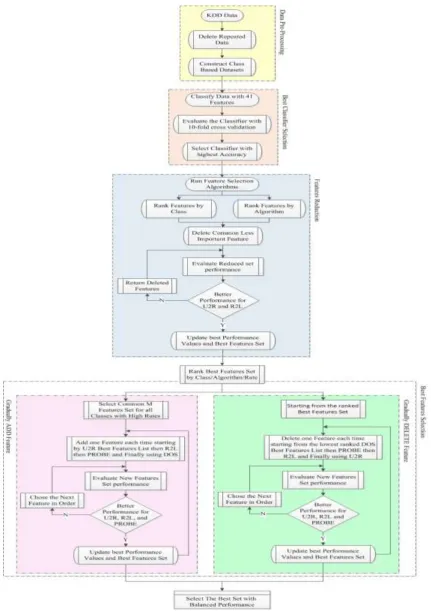
A model that consists of four stages has been proposed as shown in Fig. 3. The first stage, Data Pre-Processing, is the stage in which data was prepared as discussed in the previous section.
The second stage, Best Classifier Selection, is the stage in which the classifier that has the best performance and accuracy has been chosen to be our model classifier. Actually, machine learning has been attempted by many researchers to innovate complex learners that optimize detection accuracy over KDD'99 dataset [66]. Out of these machine learning
techniques, there are many widely used. For example, Naive Bayes (NB) [70], Random Forest Tree (RFT) [71], Random Tree (RT) [72], J48 decision tree learning [73], NBTree [74], Multilayer Perceptron (MLP) [75], and Support Vector Machine (SVM) [76]. However, researches showed that using meta-classifiers/ensemble selection give better performance [77].
In our experiment, performance and accuracy results of four learning techniques recently mentioned by many researches as best classifiers approaches were compared. Our ensemble classifier consists of a boosting algorithm, Adaboost M1 method [78], with four different learning techniques: Naive Base, Random Forest, SVM and J48. Learning and classification were done using the KDD training dataset resulted from the previous stage with the 41 features exist. The best classifier selected in this stage was used in the next stages to evaluate the selected features set and to measure the detection accuracy and performance using this selected best set.
The third stage, Feature Reduction, was implemented to reduce the 41 features set by deleting redundant features that have no importance in the detection process. Two ranked features lists have been deduced, one for features that are mostly selected by different algorithms, as shown in Table 4. And, the other one for features that are most important to all attack classes, as shown in Table 5. Common features that came at the end of these two ranked lists are then excluded one by one. These less important features were deleted one by one and after deleting each feature the rest of features were used to re-evaluate the detection system again to make sure that deleting these features did not affect the overall detection accuracy and performance.
The fourth stage, Best Features Selection, consists of two separate phases; Gradually ADD Feature and Gradually DELETE Feature. The idea here is to use two different techniques to select the best features.
ISSN: 2231-5381
http://www.ijettjournal.org
Page 506
In the second phase, Gradually DELETE Feature, the reduced features set deduced from third stage was used as the start features set. By ranking this features set, and delete one of the low importance feature each time from the bottom of the ranked list then re-evaluate the detection performance and accuracy, it was decide to keep or to remove that feature from the features set. Deletion was started by deleting the lowest feature from the DOS most important features set. Same Process is repeated for PROBE, R2L and U2R important feature set in order.
Comparing results from both phases, it was concluded that the best features set that achieved an optimized detection performance and accuracy compared to the full 41 features set was the following 11 features set {1, 3, 4, 5, 6, 10, 14, 23, 25, 30, 35}.
To implement the last two stages, feature selection process was conducted. Feature selection process involves searching through all possible combinations of features in our dataset to find the best subset of features works best for attack prediction and classification process.
WEKA 3.7.7 machine learning tool [79] was used to calculate the best feature subset. In Weka, it's needed to setup two objects, an attribute evaluator and a search method. The attribute evaluator determines what method is used to assign a worth to each subset of features, while the search method determines what style of search is used to search through the space of feature subsets. In our experiments, seven different search methods were used as shown in Table 4. This gives us a preliminary overview of the most important features out of the 41 features. To find the minimum subset of features that works best for attack detection and the classification process compared to the full 41 feature subset, Correlation-based Feature Subset Selection (CFS) was used as the attribute evaluator with the seven search method algorithms. Results are shown in Table 4. All experiments were performed using Windows® 7- 32 bit operating system platform with core i7 processor 2.4 GHz, 4.0 GB RAM.
VI. EXPERIMENTAL RESULTS AND ANALYSIS
A. Performance Measure
The detection effectiveness of the proposed detection system is measured in terms of Specificity, Sensitivity orTrue Positive Rate (TPR), FPR (False Positive Rate), Negative Predictive Value (NPV), Precision or Positive Predictive Value (PPV), F-Measure, Matthews correlation coefficient (MMC), and the Classification Accuracy as defined by the following equations and equations shown in Table 3:
F-Measure = (2 * TP) / ((2 * TP) + FP + FN) (1)
MMC = (2)
Accuracy = (3)
These measures are calculated based on the confusion matrix that shows the four possible binary classification outcomes as shown in Table 3.
Where:
TN (True Negatives): Indicates the number of normal events successfully labeled as normal.
FP (False Positives): Refer to the number of normal events being predicted as attacks.
FN (False Negatives): The number of attack events incorrectly predicted as normal.
TP (True Positives): The number of attack events correctly predicted as attack.
TABLE III CONFUSION MATRIX
Classified Class Actual Class Normal Attack
Normal TN FP Specificity [1-PR]
Attack FN TP Sensitivity TPR
NPV= PPV=
TABLE IV
BEST FEATURES SELECTED BY ALL ALGORITHMS FOR EACH CLASS OF ATTACK
Rank Search (Gain Ratio)
All 3,4,5,6,11,12,14,22,26,29,30,38,39,9,33,3
5,37,23,34
DOS 3,4,5,6,12,25,26,29,30,37,38,39
PROBE 25,27,29,37,17,30,4,5,26,38
R2L 5,10,11,18,22,26,9,39
U2R 14,17,1,18,29,39,9,11,13,32,33
Best Features by Algorithm
3,4,5,6,9,11,12,14,17,18,22,25,26,29,30,3 3,37,38,39
Rank Search (Info Gain)
All 3,4,5,6,12,14,23,25,26,29,30,33,34,35,38
,39,37,9,32
DOS 3,4,5,6,12,23,25,26,29,30,33,34,35,37,38
,39
PROBE 3,4,5,6,12,23,25,27,29,30,33,34,35,37,40
,38,36,41
R2L 3,5,6,10,22,33,36,9,26,16,37
U2R 3,14,17,18,29,39,11
Best Features by Algorithm
3,4,5,6,9,12,14,23,25,26,29,30,33,34,35, 36,37,38,39
Best Frist
All 3,4,8,10,12,25,29,30,37,9,32
DOS 4,5,12,29,30,37,26,6,25
PROBE 25,27,29,37,5,17,30,38
ISSN: 2231-5381
http://www.ijettjournal.org
Page 507
U2R 1,14,17,18,29,39,11Best Features by
Algorithm 4,5,9,10,12,17,25,26,29,30,37,39
Evolutionary Search
All 3,4,12,25,29,30,37,6,38,8,10,11,5,31,39,9
,14,15,16,18,32,33,36
DOS 5,12,26,29,30,37,6,25,3,4,8,23,32,33,39,1
0,18,34,38,41
PROBE 25,27,29,37,30,38,5,4,17,26,2,6,10,33,34,
39,41
R2L 10,5,26,39,9,16,22,11,36
U2R 13,14,17,18,32,29,33,39,4,5,6,23,31,37
Best Features by Algorithm
3,4,5,6,8,9,10,11,12,14,16,17,18,23,25,26 ,29,30,31,32,33,34,36,37,38,39,41
Greedy Stepwise
All 5,6,12,22,25,26,29,30,35,37,39,23,4,9,17,
31,18,14,11,38
DOS 3,6,12,29,30,37,38,4,5,23,25,26,17,39
PROBE 25,29,4,37,27,30,38,5,6
R2L 10,11,22,6,9,26,16,5,39
U2R 13,14,29,17,18,32,33,11
Best Features by Algorithm
4,5,6,9,11,12,14,17,18,22,23,25,26,29,30, 37,38,39
PSO Search
All 3,4,8,10,12,25,29,30,37,9,32
DOS 4,5,12,29,30,37,26,6,25,11
PROBE 25,27,29,37,17,5,3
R2L 5,10,39,9,26,16
U2R 1,14,17,18,29,39,11
Best Features by
Algorithm 3,4,5,9,10,11,12,17,25,26,29,30,37,39
Tabu Search
All 3,4,8,10,12,25,29,30,37,9,32
DOS 5,12,29,30,37,26,25,6,11
PROBE 25,27,29,37,17,5,3
R2L 5,10,39,9,26,16
U2R 1,14,17,18,29,39,11
Best Features by
Algorithm 3,5,9,10,11,12,17,25,26,29,30,37,39
TABLE V
COMMON IMPORTANT FEATURES FOR EACH ATTACK CLASS
Common Important Features
All 3,4,5,6,10,12,14,23,25,26,29,30,32,33,35,37,38,39
DOS 3,4,5,6,12,23,25,26,29,30,37,38,39
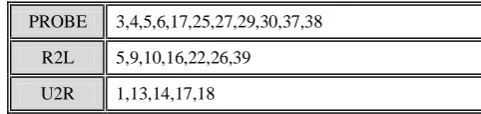
PROBE 3,4,5,6,17,25,27,29,30,37,38
R2L 5,9,10,16,22,26,39
U2R 1,13,14,17,18
B. Results Analysis and Discussion
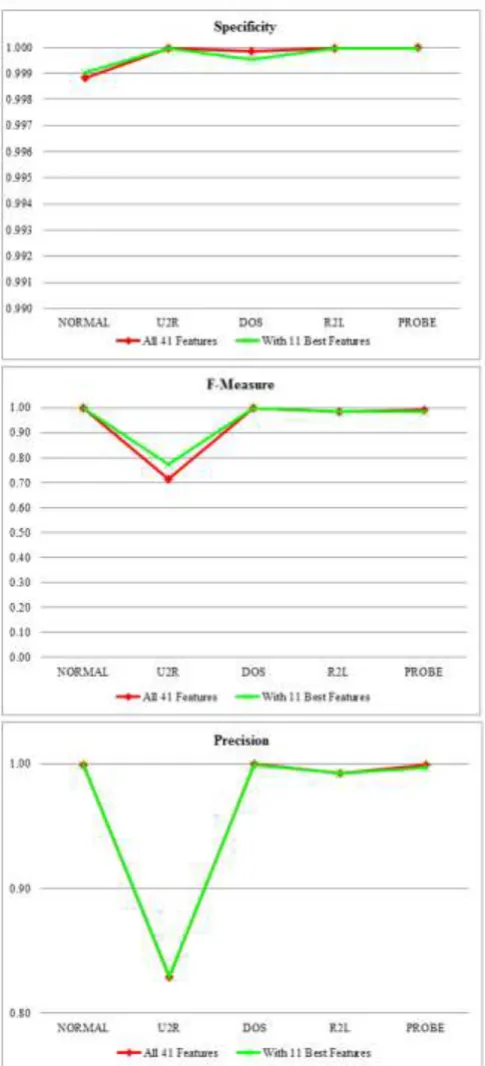
In the proposed model, firstly our feature selection algorithm to select the best features set for all attack types (DOS, PROBE, R2L, U2R, and NORMAL class) was used. Then, a lightweight intrusion detection system using the selected best features set was built. All performance measures mentioned above are used to compare detection performance of our proposed system using the selected best features set with those using all 41 features set. Also, the performance of the proposed best features set in detecting known and new attacks compared to the all 41 features set were evaluated. The confusion matrix and time taken to build the classification model are also given for comparison.
The classification performance is measured by using ensemble classifier consists of a boosting algorithm, Adaboost M1 method [78], with Random Forest learning techniques. The classification was performed using a full training set and 10-fold cross-validation for the testing purposes. In 10-fold cross-validation, the available dataset are randomly divided into 10 separate groups of approximately equal size subsets. Nine subsets of these groups are used to build and train the classifier model and the 10th group is used to test the built classifier model and to estimate the classification accuracy. The whole operation is repeated 10 times so that each of the 10 subsets is used as test subsets once. The accuracy estimate of the 10-fold cross-validation method is the mean of the estimates for each of the 10 classification processes. 10-fold Cross-validation method has been used and tested extensively and has been found to work well in general when adequate and sufficient dataset is available [80], [81].
ISSN: 2231-5381
http://www.ijettjournal.org
Page 508
set the classifier could detect (2076) instances correctly,(31) instances was misclassified as DOS attack, (1) instance misclassified as U2R attack, and (23) instances were misclassified as NORMAL. However, using the 41-features set the classifier could detect (2094) instances correctly, (10) instances was misclassified as DOS attack, and (27) instances were misclassified as NORMAL, i.e. an addition of (4) attack instances are classified as NORMAL traffic while using the full 41- features set.
Fig. 2-a Comparison between different performance measures using the best 11-features set and 41-features set
ISSN: 2231-5381
http://www.ijettjournal.org
Page 510
VII.CONCLUSION
In this paper, relevant feature selection model was proposed to select the best features set that could be used to design a lightweight intrusion detection system. Feature relevance analysis is performed on KDD 99 training set, which is widely used by machine learning researchers. Seven different feature evaluation methods were used to select and rank relevant features. The proposed model has four different stages, Data Pre-Processing, Best Classifier Selection, Feature Reduction, and Best Features Selection. Redundant records existed in the train dataset that bias learning algorithm to the classes with large repeated records are deleted. Out of the reduced training dataset four class-based datasets have been constructed: DOS, PROBE, R2L, U2R each of these four datasets contains the attack type records + the NORMAL class records. Important features for each attack type have been determined. Our results indicate that certain features have no relevance or contribution to detect any intrusion attack type. Some features are important to detect all attack types, and certain features are important to detect certain attack types. A set of best 11- features have been proposed and tested against the full 41- features set. This reduced features set can be used to build a faster training and testing process, less resource consumption as well as maintaining high detection rates. The effectiveness and the feasibility of our feature selection model were verified by several experiments on KDD intrusion detection dataset. The experimental results strongly showed that our model is not only able to yield high detection rates but also to speed up the detection process.
REFERENCES
[1] Axelsson, S., “Intrusion Detection Systems:A Taxonomy and Survey,”
Technical Report No 99-15, Dept. of Computer Engineering, Chalmers University of Technology, Sweden, March 2000.
[2] Lunt, T. F., “Detecting Intruders in Computer Systems,” in proceeding
of 1993 Conference on Auditing and Computer Technology, 1993.
[3] Sundaram, A., “An Introduction to Intrusion Detection,” The ACM
Student Magazine, Vol.2, No.4, April 1996. Available at
http://www.acm.org/crossroads/xrds2-4/xrds2-4.html
[4] Porras, P. A., “STAT: A State Transition Analysis Tool for Intrusion Detection,” MSc Thesis, Department of Computer Science, University of California Santa Babara, 1992
[5] Dorothy E. Denning, “An Intrusion Detection Model,” In IEEE
Transactions on Software Engineering, Vol.SE-13, Number 2, page 222-232, February 1987.
[6] Lunt, T. F., et al., “A Real-time Intrusion Detection Expert System (IDES),” Technical Report SRI-CSL-92-05, Computer Science Laboratory, SRI International, Menlo Park, CA, April 1992.
[7] Mykerjee, B., Heberlein, L. T. and Levitt, K. N., “Network Intrusion Detection,” IEEE Network, Vol.8, No.3, pp.26-41, 1994.
[8] Ilgun, K., Kemmerer, R. A., and Porras, P. A., “State Transition
Analysis: Rule-Based Intrusion Detection Approach,” IEEE
Transactions on Software Engineering, Vol. 21, No. 3, pp.181-199, March 1995.
[9] Kumar, S., “Classification and Detection of Computer Intrusions,” PhD
Thesis, Department of Computer Science, Purdue University, August 1995.
[10] Ingham, K.L., Somayaji, A., Burge, J., Forrest, S., “Learning DFA
Representations of HTTP For Protecting Web Applications,” Computer Networks 51(5), 1239–1255 (2007)
[11] Özyer, T., Alhajj, R., Barker, K., “Intrusion Detection By Integrating Boosting Genetic Fuzzy Classifier and Data Mining Criteria for Rule
Pre-screening,” Journal of Network and Computer Applications 30(1), 99–113 (2007)
[12] Wang, W., Guan, X.H., Zhang, X.L., Yang, L.W., “Profiling Program
Behavior for Anomaly Intrusion Detection Based on The Transition and Frequency Property of Computer Audit Data,” Computers & Security 25(7), 539–550 (2006)
[13] Julisch, K., “Clustering Intrusion Detection Alarms to Support Root
Cause Analysis,” ACM Transactions on Information and System Security 6(4), 443–471 (2003)
[14] Lee, W., Stolfo, S., Kui, M., “A Data Mining Framework for Building
Intrusion Detection Models,” In IEEE Symposium on Security and Privacy, Oakland, pp. 120–132 (1999)
[15] Shin, M.S., Jeong, K.J, “An Alert Data Mining Framework for
Network-based Intrusion Detection System,” in Song, J., Kwon, T., Yung, M. (eds.) WISA 2005. LNCS, vol. 3786, pp. 38–53. Springer, Heidelberg (2006)
[16] A.H. Sung, S., “Mukkamala, Identifying important features for
intrusion detection using support vector machines and neural networks,” in Proc. SAINT, 2003, pp. 209–217.
[17] A.H. Sung, S. Mukkamala, “The feature selection and intrusion
detection problems,” in Lecture Notes in Computer Science, Springer, 2004.
[18] H. Liu, H. Motoda, “Feature Selection for Knowledge Discovery and
Data Mining,” Kluwer Academic, 1998.
[19] D. Mladenic, M. Grobelnik, “Feature selection on hierarchy of web
documents,” Decision Support Systems 35 (2003) 45–87.
[20] Z.-J. Lee, “An integrated algorithm for gene selection and classification
applied to microarray data of ovarian cancer,” International Journal Artificial Intelligence in Medicine 42 (2008) 81–93.
[21] S.X. Wu, W. Banzhaf, “The use of computational intelligence in
intrusion detection system: a review,” Applied Soft Computing Journal 10 (January (1)) (2010) 1–35.
[22] S.X. Wu, “Sequential anomaly detection based on temporal-difference
learning principles, models and case studies,” Applied Soft Computing 10 (2010) 859–867.
[23] Garcia-Teodoro, Pedro, et al. “Anomaly-based network intrusion
detection, “ Techniques, systems and challenges,” computers & security 28.1 (2009): 18-28.
[24] Wu, Shelly Xiaonan, and Wolfgang Banzhaf. “The use of
computational intelligence in intrusion detection systems: A review,” Applied Soft Computing10.1 (2010), 1-35.
[25] Tsai, Chih-Fong, et al., “Intrusion detection by machine learning: A review,” Expert Systems with Applications 36.10 (2009):11994-12000.
[26] Aickelin, Uwe, Julie Greensmith, and Jamie Twycross, “Immune
system approaches to intrusion detection–a review,” Artificial Immune Systems. Springer Berlin Heidelberg, 2004. 316-329.
[27] Liao, Hung-Jen, et al., “Intrusion Detection System: A Comprehensive
Review,” Journal of Network and Computer Applications (2012).
[28] Y. Li, L. Guo, “An active learning based TCM-KNN algorithm for
supervised network intrusion detection,” Computers and Security 8 (December) (2007) 459–467.
[29] Jiang, Z., Luosheng, W., Yong, F., & Xiao, Y. C. Intrusion detection based on density level sets estimation,” In Proceedings of international conference on networking, architecture, and storage, (2008) (pp. 173– 174).
[30] Lauria, E. J.M., & Tayi, G. K. (2008), “Statistical machine learning for network intrusion detection: a data quality perspective,” International Journal of Services Sciences, 1(2), 179–195.
[31] H.A. Nguyen, D. Choi, “Application of data mining to network
intrusion detection classifier selection model,” in LNCS, vol. 5297, Springer-Verlag, Berlin Heidelberg, 2008, pp. 399–408.
[32] Liu, Y., Cai, J., Huang, Z., Yu, J., & Yin, J., “Fast detection of database system abuse behaviors based on data mining approach,” In ACM international conference proceeding series, Vol. 304. Proceedings of the
2nd international conference on scalable information systems,
InfoScale ’07 (pp. 1–7).
[33] Prasad, G., Dhanalakshmi, Y., & Kumar, V., “Modeling an intrusion detection system using data mining and genetic algorithms based on fuzzy logic,” IJCSNS International Journal of Computer Science and Network Security, 8(7), 319–325.
ISSN: 2231-5381
http://www.ijettjournal.org
Page 511
random forests for network-based anomaly detection at active routers,”In Proceedings of international conference on signal processing communications and networking, ICSCN ’08 (pp. 93–96).
[35] Su-Yun Wu, Ester Yen, “Data mining-based intrusion detectors,”
Expert Systems with Applications, Volume 36, Issue 3, Part 1, April 2009, Pages 5605-5612, ISSN 0957-4174, 10.1016/j.eswa.2008.06.138
[36] M. Asaka, T. Onabura, T. Inoue, S. Okazawa, S. Goto, “A new
intrusion detection method based on discriminant analysis,” IEICE Transactions on Information and System 5 (May) (2001) 570–577.
[37] Ho, Cheng-Yuan, et al., “Statistical analysis of false positives and false
negatives from real traffic with intrusion detection/prevention systems,” Communications Magazine, IEEE 50.3 (2012), 146-154.
[38] Chen, Rung-Ching, Kai-Fang Cheng, and Cheng-Chia Hsieh, “Using
Fuzzy Neural Networks and rule heuristics for anomaly intrusion detection on database connection,” Machine Learning and Cybernetics, 2008 International Conference on. Vol. 6. IEEE, 2008.
[39] Tian, D., Liu, Y., & Li, B., “A distributed hebb neural network for network anomaly detection,” In Lecture notes in computer science: Vol. 4742. Parallel and distributed processing and applications (pp. 314– 325). (Including subseries Lecture Notes in Artificial Intelligence and Lecture Notes in Bioinformatics).
[40] Masri, Wes, and Andy Podgurski, “Application-based anomaly
intrusion detection with dynamic information flow
analysis,” Computers & Security 27.5 (2008): 176-187.
[41] Powers, Simon T., and Jun He, “A hybrid artificial immune system and
Self Organising Map for network intrusion detection,” Information Sciences 178.15 (2008): 3024-3042.
[42] Aickelin, U., Bentley, P., Cayzer, S., Kim, J., & McLeod, J., “Danger theory: The link between AIS and IDS?” In Artificial Immune Systems (pp. 147-155). Springer Berlin Heidelberg.
[43] P. Srinivasulu, D. Nagaraju, P.R. Kumar, K.N. Rao, “Classifying the network intrusion attacks using data mining classification methods and their performance comparison,” International Journal of Computer Science and Network Security 9 (June (6)) (2009) 11–18.
[44] S.Y. Wu, E. Yen, “Data mining-based intrusion detectors,” Expert
Systems with Applications 1 (April) (2009) 5605–5612
[45] S. Srinoy, “Intrusion detection model based on particle swarm
optimization and support vector machine,” in Proceedings of the 2007 IEEE Symposium on Computational Intelligence in Security and Defence Applications, 2007.
[46] Chung, Yuk Ying, and Noorhaniza Wahid, “A hybrid network intrusion
detection system using simplified swarm optimization (SSO),” Applied Soft Computing (2012).
[47] Agarwal, Basant, and Namita Mittal, “Hybrid Approach for Detection
of Anomaly Network Traffic using Data Mining Techniques,” Procedia Technology 6 (2012), 996-1003.
[48] Panda, Mrutyunjaya, Ajith Abraham, and Manas Ranjan Patra, “A
Hybrid Intelligent Approach for Network Intrusion Detection,” Procedia Engineering 30 (2012), 1-9.
[49] Singh, Shailendra, and Sanjay Silakari, “An ensemble approach for
feature selection of Cyber Attack Dataset,” arXiv preprint arXiv, 0912.1014 (2009).
[50] Siraj MMd, Maarof MdAand Hashim SZ Md., “ A hybrid intelligent
approach for automated alert clustering and filtering in intrusion alert analysis,” Intl. Journal of computer theory and engineering, 2009; 1(5), 539-45
[51] Mukherjee, Saurabh, and Neelam Sharma, “Intrusion detection using
naive Bayes classifier with feature reduction,” Procedia Technology 4 (2012), 119-128
[52] Alhaddad, Mohammed J., et al., “A study of the modified KDD 99
dataset by using classifier ensembles,” IOSR Journal of Engineering, May. 2012, Vol. 2(5) pp: 961-965.
[53] Kumar, G. Sunil, and C. V. K. Sirisha, “Robust Preprocessing and
Random Forests Technique for Network Probe Anomaly Detection.,” International Journal of Soft Computing and Engineering (IJSCE) ISSN: 2231-2307, Volume-1, Issue-6, January 2012.
[54] Elngar, Ahmed A., A. El A. Dowlat, and Fayed FM Ghaleb, “A Fast
Accurate Network Intrusion Detection System,” International Journal of Computer Science 10 (2012).
[55] Chung, Yuk Ying, and Noorhaniza Wahid, “A hybrid network intrusion
detection system using simplified swarm optimization (SSO),” Applied
Soft Computing (2012).
[56] Suthaharan, Shan, and Tejaswi Panchagnula, “Relevance feature
selection with data cleaning for intrusion detection
system,” Southeastcon, 2012 Proceedings of IEEE. IEEE, 2012. [57] Li, Yinhui, et al., “An efficient intrusion detection system based on
support vector machines and gradually feature removal
method,” Expert Systems with Applications 39.1 (2012), 424-430. [58] Y. Li, J. Wang, Z. Tian, T. Lu and C. Young, “Building lightweight
intrusion detection system using wrapper-based feature selection mechanisms,” Computer and Security, vol. 28, pp.466-475, 2009.
[59] A. A. Olusola, A. S. Oladele and D. O. Abosede, “Analysis of KDD '99
Intrusion Detection Dataset for Selection of Relevance Features,” Proceedings of the World Congress on Engineering and Computer Science, vol. 1, Oct-2010.
[60] Chebrolu S., Abraham A., and Thomas J., “Feature deduction and
ensemble design of intrusion detection systems,” ELSEVIER Computer and Security, V.24, pp. 295-307, 2005
[61] Kayacik, H. Günes, A. Nur Zincir-Heywood, and Malcolm I. Heywood,
"Selecting features for intrusion detection: a feature relevance analysis on KDD 99 intrusion detection datasets,” Proceedings of the third annual conference on privacy, security and trust. 2005.
[62] Amiri F., Yousefi M., Lucas C., Shakery A., and Yazdani N., “Mutual
information-based feature selection for intrusion detection systems,” ELSEVIER, Journal of Network and Computer Applications, V. 34, pp. 1184-1199, 2011.
[63] Tang P., Jiang R., and Zhao M., “Feature selection and design of
intrusion detection system based on k-means and triangle area support vector machine,” Second International Conference on Future Networks, IEEE, pp. 144-148, 2010.
[64] Zargari, Shahrzad, and Dave Voorhis, “Feature Selection in the
Corrected KDD-dataset,” Emerging Intelligent Data and Web
Technologies (EIDWT), 2012 Third International Conference on. IEEE, 2012.
[65] Lippmann, Richard, et al., “The 1999 DARPA off-line intrusion
detection evaluation,” Computer networks 34.4 (2000): 579-595.
[66] Mahbod Tavallaee, Ebrahim Bagheri, Wei Lu and Ali A. Ghorbani, “A
Detailed Analysis of the KDD CUP 99 Data Set,” In Proceedings of the 2009 IEEE Symposium Computational Intelligence for Security and Defense Applications, CISDA’09, July 2009.
[67] MIT Lincoln Labs, “1998 DARPA Intrusion Detection Evaluation,”
Available at:
http://www.ll.mit.edu/mission/communications/ist/corpora/ideval/index .html, February 2008.
[68] L. Portnoy, E. Eskin, and S. Stolfo, “Intrusion detection with unlabeled
data using clustering,” Proceedings of ACM CSS Workshop on Data Mining Applied to Security, Philadelphia, PA, November, 2001.
[69] K. Leung and C. Leckie, “Unsupervised anomaly detection in network
intrusion detection using clusters,” Proceedings of the Twenty-eighth Australasian conference on Computer Science-Volume 38, pp. 333–342, 2005.
[70] G. John and P. Langley, “Estimating continuous distributions in
Bayesian classifiers,” in Proceedings of the Eleventh Conference on Uncertainty in Artificial Intelligence, pp. 338–345, 1995.
[71] L. Breiman, “Random Forests,” Machine Learning, vol. 45, no. 1, pp. 5–32, 2001.
[72] D. Aldous, “The continuum random tree. I,” The Annals of Probability,
pp. 1–28, 1991.
[73] J. Quinlan, “C4.5: Programs for Machine Learning,” Morgan
Kaufmann, 1993.
[74] R. Kohavi, “Scaling up the accuracy of naive-Bayes classifiers: A
decision-tree hybrid,” in Proceedings of the Second International Conference on Knowledge Discovery and Data Mining, vol. 7, 1996.
[75] D. Ruck, S. Rogers, M. Kabrisky, M. Oxley, and B. Suter, “The
multilayer perceptron as an approximation to a Bayes optimal discriminant function,” IEEE Transactions on Neural Networks, vol. 1, no. 4, pp. 296–298, 1990.
[76] C. Chang and C. Lin, “LIBSVM: a library for support vector
machines,” 2001. Software available at: http://www.csie.ntu.edu.tw/ cjlin/libsvm
[77] Caruana, Rich, Niculescu, Alex, Crew, Geoff, and Ksikes, Alex,
ISSN: 2231-5381
http://www.ijettjournal.org
Page 512
Conference on Machine Learning (ICML'04), 2004.[78] Yoav Freund, Robert E. Schapire, “Experiments with a new boosting
algorithm,” In: Thirteenth International Conference on Machine Learning, San Francisco, 148-156, 1996.
[79] Mark Hall, Eibe Frank, Geoffrey Holmes, Bernhard Pfahringer, Peter
Reutemann, Ian H. Witten, “The WEKA Data Mining Software: An Update,” SIGKDD Explorations, Volume 11, Issue 1.
[80] Borra S, Ciaccio AD. (2010), “Measuring the prediction error. A
comparison of cross-validation, bootstrap and covariance penalty methods,” Computational Statistics and Data Analysis 54, 2976-2989. [81] Rodriguez, J.D.; Perez, A.; Lozano, J.A., “Sensitivity Analysis of
k-Fold Cross Validation in Prediction Error Estimation,” Pattern Analysis and Machine Intelligence, IEEE Transactions on , vol.32, no.3,
![Fig. 1 DARPA LAN setup, simulating a typical U.S. Air Force LAN [65]](https://thumb-us.123doks.com/thumbv2/123dok_us/8601382.1724171/4.595.45.293.69.199/fig-darpa-lan-setup-simulating-typical-air-force.webp)