http://www.sciencepublishinggroup.com/j/ijse doi: 10.11648/j.ijse.20170101.12
Integration Strategy for the Realization of an Adaptive
Hypermedia System of Natural Dyes
Badraddine Aghoutane
1, *, Khalid El Fazazy
2, Omar El Bannay
3, Noureddine El Makhfi
41
Polydisciplinary Faculty of Errachidia, Moulay Ismaïl University, Meknes, Morocco
2
Polydisciplinary Faculty of Ouarzazzate, Ibn Zohr University, Agadir, Morocco
3
National School of Applied Sciences, Hassan 1 University, Khouribga, Morocco
4
Higher School of Technology, Moulay Ismail University, Khenifra, Morocco
Email address:
*Corresponding author
To cite this article:
Badraddine Aghoutane, Khalid El Fazazy, Omar El Bannay, Noureddine El Makhfi. Integration Strategy for the Realization of an Adaptive Hypermedia System of Natural Dyes. International Journal of Systems Engineering. Vol. 1, No. 1, 2017, pp. 10-16.
doi: 10.11648/j.ijse.20170101.12
Received: March 14, 2017; Accepted: April 14, 2017; Published: May 24, 2017
Abstract:
This work aims to develop a system allowing production, storage, management and dissemination of XML (eXtensible Markup Language) documents as well as chemical and analytical data (molecules, spectra, etc.) obtained within MED-COLOR-TECHNOLOGY project. Based on the study of user needs, modalities and systems for information access and retrieval, we have adopted a navigation system mode with the adaptive hypermedia systems. We have integrated and adapted the existing tools with new developed functionalities to ensure the full targeted functionality. Indeed, we have opted a component-based integration strategy using the plug-in mechanism and the Eclipse RCP (Rich Client Platform) framework. This architecture encompasses concepts that facilitate the adaptation of presentation, navigation, and content. Thus, the developed system is rich in functionality, extensible, portable, adaptable and evolves with user’s needs, preferences, and knowledge.Keywords:
XML Documents, Adaptive Hypermedia Systems, Component-Based Application, Integration, Eclipse RCP, Plug-ins, Natural Dyes1. Introduction
In the framework of the Med-Color-Tech Euro-Mediterranean project (INCO CT 2005 014506), a vast amount of information on natural organic dyes has been produced and disseminated in various formats (Word, PDF,...). On the one hand, this study says the set of electronic documents provided by the various partners (reports, standards and experimental protocols, etc.) and on the other hand, the needs of users (students, researchers,...) and in particular their objectives, we note the abundance and the heterogeneity of the data as well as the diversity of the needs of the users.
Our objective is to structure, organize this information and choose the possibilities of presentation, processing and dissemination of information, the most adapted to the user
and the textual and graphical material offered by the documents in question. We have developed an adaptive hypermedia system based on the plug-in mechanism and adopting adaptation techniques and processes to provide an application that adapts to the user and evolves with its needs and knowledge.
2. Adaptive Hypermedia System
2.1. Hypermedia System
Hypertext facilitates and simplifies the consultation and navigation in a network of electronic documents. It is suitable for documents, which can be approached in several ways and whose choice of reading or consultation paths depends on the prior knowledge and needs of the user. However, the use of hypermedia systems has faced several problems, such as disorientation [1], cognitive overload [2], ambiguous research [3]... In response to these difficulties, researchers regularly Solutions. The proposed improvements [4] focused on three main areas: presentation, content and navigation. The accumulation of all these practices has given birth to a new system: The Adaptive Hypermedia System (AHS).
2.2. Adaptive Hypermedia System
"By hypermedia adaptive systems we mean any hypermedia and hypertext system that reflects certain characteristics of the user in the user model and applies this model to adapt visible and varied aspects of the user system." According to [5], adaptive hypermedia is useful when the system is to be used by people with different knowledge or purposes. An adaptive hypermedia must satisfy three criteria: It must be an information system whose interface is a hypermedia, contain a user model and use this model to adapt the hypermedia. Three types or designs of adaptive hypermedia systems [6]: Adapted system, adaptive system and adaptive or intelligent system.
3. Conception and Realization of AHS
To provide our partners with an easy to use, customizable system and taking into account the capabilities of each user. we will develop a hypermedia system:
a.Adapted: Each user (chemist, analyst, biologist, conservator,...) finds in the system the profile adapted to his needs.
b.Adaptable: The user has the possibility to adapt the proposed profile by specifying his choices and preferences.
c. Adaptive or intelligent: The system can deduct from the user's behavior, preferences and choices, save and present them later.
In the following sections, we will present the structure of our adaptive hypermedia system and the dimensions that can be considered in the adaptation process.
3.1. Structure of AHS
3.1.1. Domain Model
In a hypermedia application, we are interested in the information nodes and the structure of the links linking these nodes. This representation constitutes the domain model [7]. Our domain model organizes and structures our data in collections (biological sources, coloring components, artwork, chemical and analytical data). Each collection
contains a set of nodes (documents). Each node contains several elements (attributes / values) and can link it to other nodes in other collections. We have chosen the XML standard and its XML-Schema recommendation to define this model [8]. Another model is studied in this model: that of the links [9].
3.1.2. User Model
"A user model is knowledge about user explicitly or implicitly encoded, used to improve its interaction" [10]. This knowledge concerns the cognitive gains of the user, his profile, his goals, his preferences [11]... Several types of user models have been defined [12].
To define our user model, we used the intermediate approach (between canonical model and individual model) by defining group models (stereotypes) that can be refined individually by each user [13]. Stereotypes or defined profiles are: Dye Specialist, Biologist, Chemist, Analyst and Fine Art Professionals.
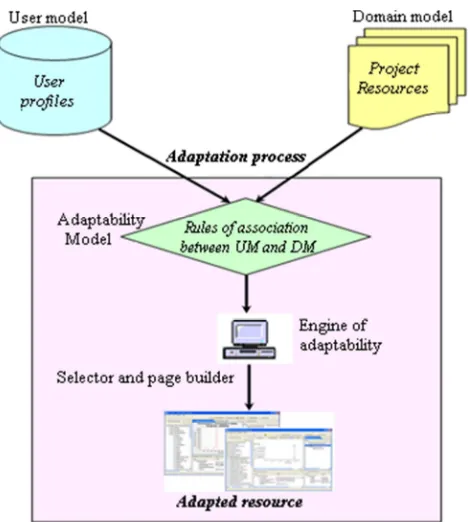
3.1.3. Adaptability Model
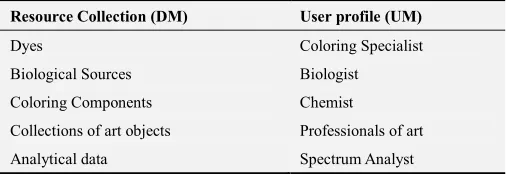
The adaptation model (AM) contains the set of adaptation rules that form the connection between the DM and the UM to make the presentation that is most adapted to user profiles.
Table 1. Correspondence between user profiles and resource collection.
Resource Collection (DM) User profile (UM)
Dyes Coloring Specialist
Biological Sources Biologist
Coloring Components Chemist
Collections of art objects Professionals of art
Analytical data Spectrum Analyst
According to this table, each resource collection is specific to a user profile. Thus, if Access to a Resource of the "Dyes" type then the user profile "Dye Specialist" is activated. In this case, the system automatically adapts to provide the user with adequate representation of the information on the selected dye. If this user decides to visualize the molecular structure in 2D or 3D (not part of the current profile), a second rule can be applied: If Access to Resource of type "Molecule" then the user profile "Chemist" is activated, thus allowing the system to switch to the Chemist profile.
In case the user does not want to change the profile, the system displays a message specifying how to add the window (view) concerned.
3.1.4. Engine of Adaptability
Figure 1. Structure of SAH Med-Color-Tech.
3.2. Adaptations Dimensions
3.2.1. Navigation Adaptation
The adaptation of navigation is to act on how the links are presented to users to ensure quick and easy access to relevant information. Several techniques are used such as direct guidance, link annotation, link scheduling, link masking and adaptive maps [16]. We opted for those that give the user the responsibility of choosing the techniques of link annotations, more specifically those of a visual nature:
a. Use a specific color to indicate that it is a text link. This color changes when the link is visited,
b.Linking an icon or keyframe (molecule, spectrum, biological source...) to indicate the content of the target page. A sign is added to the icon when the link is activated.
c. Adaptive maps, organize hyperspace (all resources), in the form of graphical and hierarchical trees.
3.2.2. Adaptation Content and Presentation
The content adaptation [11] and the presentation consists in proposing information that better corresponds to the knowledge of the user while adapting the layout characteristics [13]. As part of the Med-Color-Tech project, we chose to show by default all the information contained in each resource, for all users. However, the user has the ability to hide / remount one or more concepts in a resource type (collection) using filtering technique (conditional text, stretchtext).
In the case of chemical data, molecular structures are presented in three ways (image, 2D structure and 3D structure). 2D and 3D presentations are complex and are of interest only to chemists. Thus, we used the alternative content technique (page variants, fragment variants) [17] for:
a. Display default 2D and 3D structure of Chemist profile, b. Display the molecular structure as an image for the
other profiles,
We have also used the explanation variant technique to display information to users in several ways, in different regions (view or editor fields) [11] of the page:
a. Region 1: displays the text content as a table, b. Region 2: Displays images,
c. Region 3: Displays content (text and image) in a web page.
3.3. Realization of the Adaptive Hypermedia System Based on Plugins
Component programming [18] is designed to deal with the increasingly evident complexity of current applications by promoting the reusability of existing components. It reduces the time and cost of software projects and improves the quality of the applications produced by taking advantage of the experiences of other developers. Thus, based on the OSGI model and using the Eclipse RCP Framework, we developed an application based on plug-ins composed of:
a. Existing plug-ins, adapted and integrated for manipulating chemical and analytical data [19] (plug-ins in light blue).
b. new plug-ins, developed within the framework of the project (plug-in in yellow), to ensure production and management of project-specific data (eg coloring components, biological sources, art objects...).
The architecture of our application is shown in Figure 2
4. Results Achieved
4.1. Perspectives
The perspectives are a customizable grouping of editors and iews arranged in the application window. We created for each user profile (UM) a specific perspective with specific views and editors.
Figure 2. Med-Color-Tech Application Architecture.
Figure 3. Biological sources perspective.
4.2. Views
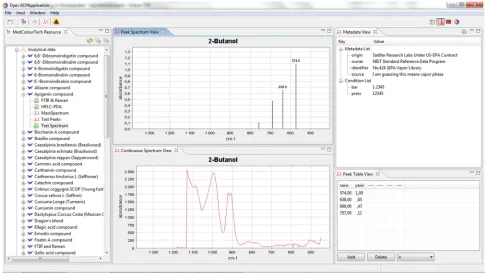
It is an area for displaying information and possibly navigating it. Figure 4 shows the customizable layout of views from Spectrum perspective.
4.3. Editor
It is an area to modify an object (molecule, spectrum, text file...). There can be only one active editor at a time, this one
adds its contribution to the Menu bar and to the toolbar of the application. Figure 5 shows the JChemPaint editor and its contribution to the Chemist perspective toolbar and toolbar.
Figure 5. JChemPaint editor of the Chemist perspective.
4.4. Filtering Information
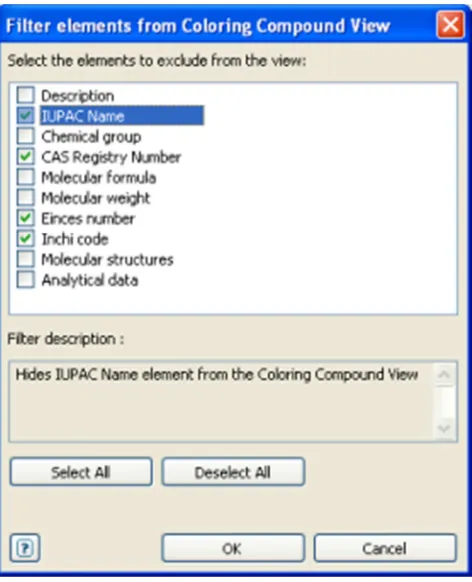
The filtering system allows users to specify the information to be displayed / hidden. Thus, the view displays only the specified data, by the user when setting the filter. Figure 6 shows an example of using a filter, making it
possible to select the information to be masked when displaying the data on coloring components.
Figure 7 shows the Coloring compound view displaying data on the Alizarin staining component after applying the filter. Note that the view hides the information (IUPAC Name, CAS Registry, Einecs number et InchiCode).
Figure 7. Data displayed after filter setting.
4.5. Preference Management
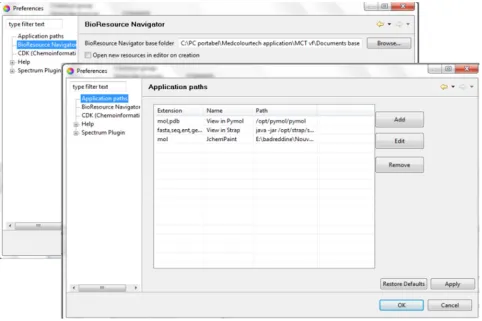
Preferences allow users to manage the settings of an application. We have created preference pages to control and
adapt the look and function of the Med-Color-Tech application. Each plug-in application adds its own preference pages. Figure 8 shows examples of preferences pages.
5. Conclusion
This work is part of the Med-Color-Tech Euro-Med project. It consists in creating a system for the management and distribution of documents on the natural organic dyes of the Mediterranean area. In order to provide our partners with an easy to use, customizable system that takes into account the needs of each user, we have adopted the navigation mode with the Adaptive Hypermedia System (AHS). To realize this system, we have opted for a component-based application, integrating already existing ins and creating new plug-ins. The developed system is adapted to users according to previously established profiles, adaptable by users according to their needs and preferences and adaptive according to their habits and their reactions.
References
[1] Cartonnet, Huchette. Difficultés d’étudiants à trouver des archétypes de machines lors d’une recherche dans un hypertexte. Actes du 5ème colloque Hypermédias & Apprentissage, 2001, Grenoble, 2001.
[2] Mohamed Ben Romdhane. Navigation dans un espace textuel: Accès à l’information scientifique. Rapport de thèse de l’Université Jean Moulin Lyon 3, 2001.
[3] Daniel-Vatonne M-C. Hypertexte: general principales and variations. Technique et Science Informatiques, Vol. 9, N° 6, P. 475-492, 1990.
[4] Raad, Causse. Modelling of an Adaptive Hypermedia System Based on Active Rules. In Proceedings of the 6th International Conference on Intelligent Tutoring Systems (ITS), 2002, Biarritz, France.
[5] Brusilovsky, Eklund, Schwarz. Web based education for all: A tool for developing adaptive courseware. In Computer Networks and ISDN Systems. Proceedings of the 7th International World Wide Web Conference (WWW7), 1998.
[6] Benadi Sofiane. Structuration des données et des services pour le télé-enseignement. Thèse de doctorat de l’Institut National des Sciences Appliquées de Lyon, 2004
[7] Wu, Houben, De Bra, P., “Authoring Support for Adaptive Hypermedia”, Proceedings ED-MEDIA, 1999, Seattle.
[8] Aghoutane, Benslimane, Chenfour, El Bannay, Meknassi. DyeML: XML-based format for handling natural organic
dyes. Online Journal of Bioinformatics (OJB), pp. 156 – 164, 2009.
[9] Aghoutane, Benslimane, El Fazazy. DyeML1.1: Nouveau modèle XML de colorants organiques naturels. Revue africaine de la recherche en informatique et mathématiques appliquées, 2016 [unpublished]
[10] Höök, Karlgren, Waern, et al.. A glass box approach to adaptive hypermedia. User Models and User Adapted Interaction, 1996, vol. 6, 1996
[11] Mammar. Habieb. EDPHA: un Environnement de Développement et de Présentation d’Hyperdocuments Adaptatifs. Thèse de doctorat de l’Institut National des Sciences Appliquées de Lyon, 2004.
[12] Giry Marcel, Lucien Jean-Claude. Navigation en hypermédia et/ou multimédia et construction du savoir. In Hypermédias et apprentissages 3: Actes des troisièmes journées scientifiques CREPS, 1996, Châtenay-Malabry.
[13] Koch. Software Engineering for Adaptative Hypermedia Systems – Reference Model, Modelling Techniques and Development Process. Thèse de Doctorat, faculté de mathématique et informatique, université Ludwig-Maximilians, München, 2000.
[14] Wu, De Bra, Aerts, Houben. Adaptation Control in Adaptive Hypermedia Systems. Proceedings of the Adaptive Hypermedia Conference, Lecture Notes in Computing Science, 2000.
[15] Ghedira. Modélisation et Méthode de conception de systèmes de navigation adaptative dans les hypermédias. Rapport de thèse de l’Institut National des Sciences Appliquées de Lyon, 2002.
[16] Brusilovsky. Adaptive navigation support in educational hypermedia: The role of student knowledge level and the case for meta-adaptation. British Journal of Educational Technology, vol. 34, n°4, pp. 487-497, 2003.
[17] Benadi, Ramel, Prevot. AHXEL: Adaptive Hyperdocument using XML for E-Learning. 5th Int. Conf. on Information Technology Based Higher Education and Training: ITHET04, 2004.
[18] Grondin. MADCAR-AGENT: un modèle d’agents auto-adaptables à base de composants. Rapport de thèse de l’Ecole Nationale Supérieure des Mines Saint-Etienne, 2008.