ISSN 2307-4531
http://gssrr.org/index.php?journal=InternationalJournalOfComputer&page=index
Diminution of Real Power Loss by Using Hybridization of
Bat Algorithm with Harmony Search Algorithm
K. Lenin
a*, Bhumanapally Ravindhranath Reddy
b, M. Surya Kalavathi
ca
Research Scholar,
b
Deputy Executive Engineer,
c
Professor of Electrical and Electronics Engineering,
a,b,c
Jawaharlal Nehru Technological University Kukatpally, Hyderabad 500 085, India.
a
b
c
Abstract
In this paper, a new Hybridization of Bat algorithm with Harmony search algorithm (BAHS) is proposed for
solving reactive power dispatch problem. The enhancement includes the addition of pitch modification
procedure in HS serving as a mutation operator during the procedure of the bat updating with the aim of
speeding up convergence, thus making the approach more feasible for a wider range of real-world applications.
The proposed Hybridization of Bat algorithm with Harmony search algorithm (BAHS) algorithm has been
tested on standard IEEE 30, IEEE 57 bus test systems and simulation results show clearly the superior
performance of the proposed algorithm in reducing the real power loss.
Keywords: Optimal Reactive Power, Transmission loss, harmony search, bat algorithm.
---
* Corresponding author.
E-mail address: [email protected].
1. Introduction
Optimal reactive power dispatch (ORPD) problem is mainly to reduce the real power loss and to keep the
voltage profile within the limits. Various mathematical methods like the gradient method [1-2], Newton method
[3] and linear programming [4-7] have been implemented to decipher the optimal reactive power dispatch
problem. Both the gradient and Newton methods have the complication in managing inequality constraints.
Also the problem of voltage stability and collapse play a major role in power system planning and operation
[8]. Evolutionary algorithms such as genetic algorithm have been already projected to solve the reactive power
flow problem [9-11]. In [12], Hybrid differential evolution algorithm is proposed to perk up the voltage stability
index. In [13] Biogeography Based algorithm is projected to solve the reactive power dispatch problem. In [14],
a fuzzy based method is used to solve the optimal reactive power scheduling method. In [15], an improved
evolutionary programming is used to solve the optimal reactive power dispatch problem. In [16], the optimal
reactive power flow problem is solved by integrating a genetic algorithm with a non linear interior point
method. In [17], a pattern algorithm is used to solve ac-dc optimal reactive power flow model with the generator
capability limits. In [18], F. Capitanescu proposes a two-step approach to calculate Reactive power reserves
with respect to operating constraints and voltage stability. In [19], a programming based approach is used to
solve the optimal reactive power dispatch problem. In [20], A. Kargarian et al present a probabilistic algorithm
for optimal reactive power provision in hybrid electricity markets with uncertain loads. This paper proposes a
new Hybrid of Bat algorithm with Harmony search algorithm (BAHS) to solve the optimal reactive power
dispatch problem. Echolocation is a significant feature of bat behavior and it produce a sound pulse and listens
to the echo bouncing back from obstacles whilst flying. This happening has been inspired Yang [21] to build up
the Bat Algorithm (BA). The harmony search algorithm [22] is one of the newly developed optimization
algorithm and at a same time, it is one the most competent algorithm in the field of combinatorial optimization
[23]. This algorithm is attracted by several researchers from various fields particularly those working on solving
optimization problems. We merge two approaches to propose a new hybrid meta heuristic algorithm according
to the principle of HS and BA. The proposed algorithm Hybrid - BAHS has been evaluated in standard IEEE 30
and IEEE 57 bus test systems. The simulation results demonstrate that our proposed approach outperforms all
the entitled reported algorithms in minimization of real power loss.
2. Problem Formulation
The optimal power flow problem is mathematically formulated as follows:
Minimize f(x, u) (1)
subject to g(x,u)=0 (2)
and
h(x, u)≤0 (3)
where f(x,u) is the objective function. g(x.u) and h(x,u) are respectively the set of equality and inequality
constraints. x is the vector of state variables, and u is the vector of control variables.
The state variables are the load buses (PQ buses) voltages, angles, the generator reactive powers and the slack
active generator power:
x =�Pg1,θ2,. . ,θN, VL1, . , VLNL, Qg1, . . , Qgng�T (4)
The control variables are the generator bus voltages, the shunt capacitors and the transformers tap-settings:
u =�Vg, T, Qc�T (5)
or
u =�Vg1, … , Vgng, T1, . . , TNt, Qc1, . . , QcNc�T (6)
Where ng, nt and nc are the number of generators, number of tap transformers and the number of shunt
compensators respectively.
3. Objective Function
3.1. Active power loss
The objective of the reactive power dispatch is to minimize the active power loss in the transmission network,
which mathematically formulated as follows:
𝐹𝐹=𝑃𝑃𝑃𝑃=∑𝑘𝑘∈𝑁𝑁𝑁𝑁𝑁𝑁𝑔𝑔𝑘𝑘�𝑉𝑉𝑖𝑖2+𝑉𝑉𝑗𝑗2−2𝑉𝑉𝑖𝑖𝑉𝑉𝑗𝑗𝑐𝑐𝑐𝑐𝑐𝑐𝑐𝑐𝑖𝑖𝑗𝑗�(7)
or
𝐹𝐹=𝑃𝑃𝑃𝑃=∑𝑖𝑖∈𝑁𝑁𝑔𝑔𝑃𝑃𝑔𝑔𝑖𝑖− 𝑃𝑃𝑑𝑑 =𝑃𝑃𝑔𝑔𝑐𝑐𝑔𝑔𝑔𝑔𝑐𝑐𝑘𝑘 +∑𝑁𝑁𝑔𝑔𝑖𝑖≠𝑐𝑐𝑔𝑔𝑔𝑔𝑐𝑐𝑘𝑘𝑃𝑃𝑔𝑔𝑖𝑖 − 𝑃𝑃𝑑𝑑 (8)
wheregk: is the conductance of branch between nodes i and j, Nbr: is the total number of transmission lines in
power systems. Pd: is the total active power demand, Pgi: is the generator active power of unit i, and Pgsalck: is the
generator active power of slack bus.
3.2.Voltage profile improvement
For minimizing the voltage deviation in PQ buses, the objective function becomes:
𝐹𝐹=𝑃𝑃𝑃𝑃+𝜔𝜔𝑣𝑣 ×𝑉𝑉𝑉𝑉 (9)
Where ωv: is a weighting factor of voltage deviation.
VD is the voltage deviation given by:
𝑉𝑉𝑉𝑉=∑𝑁𝑁𝑁𝑁𝑁𝑁𝑖𝑖=1|𝑉𝑉𝑖𝑖−1| (10)
3.3.Equality Constraint
The equality constraint g(x,u) of the ORPD problem is represented by the power balance equation, where the
total power generation must cover the total power demand and the power losses:
𝑃𝑃𝐺𝐺=𝑃𝑃𝑉𝑉 +𝑃𝑃𝑃𝑃 (11)
3.4.Inequality Constraints
The inequality constraints h(x,u) reflect the limits on components in the power system as well as the limits
created to ensure system security. Upper and lower bounds on the active power of slack bus, and reactive power
of generators:
𝑃𝑃𝑔𝑔𝑐𝑐𝑔𝑔𝑔𝑔𝑐𝑐𝑘𝑘𝑚𝑚𝑖𝑖𝑚𝑚 ≤ 𝑃𝑃𝑔𝑔𝑐𝑐𝑔𝑔𝑔𝑔𝑐𝑐𝑘𝑘 ≤ 𝑃𝑃𝑔𝑔𝑐𝑐𝑔𝑔𝑔𝑔𝑐𝑐𝑘𝑘𝑚𝑚𝑔𝑔𝑚𝑚 (12)
𝑄𝑄𝑔𝑔𝑖𝑖𝑚𝑚𝑖𝑖𝑚𝑚 ≤ 𝑄𝑄𝑔𝑔𝑖𝑖 ≤ 𝑄𝑄𝑔𝑔𝑖𝑖𝑚𝑚𝑔𝑔𝑚𝑚 ,𝑖𝑖 ∈ 𝑁𝑁𝑔𝑔 (13)
Upper and lower bounds on the bus voltage magnitudes:
𝑉𝑉𝑖𝑖𝑚𝑚𝑖𝑖𝑚𝑚 ≤ 𝑉𝑉𝑖𝑖 ≤ 𝑉𝑉𝑖𝑖𝑚𝑚𝑔𝑔𝑚𝑚 ,𝑖𝑖 ∈ 𝑁𝑁 (14)
Upper and lower bounds on the transformers tap ratios:
𝑇𝑇𝑖𝑖𝑚𝑚𝑖𝑖𝑚𝑚 ≤ 𝑇𝑇𝑖𝑖 ≤ 𝑇𝑇𝑖𝑖𝑚𝑚𝑔𝑔𝑚𝑚 ,𝑖𝑖 ∈ 𝑁𝑁𝑇𝑇 (15)
Upper and lower bounds on the compensators reactive powers:
𝑄𝑄𝑐𝑐𝑚𝑚𝑖𝑖𝑚𝑚 ≤ 𝑄𝑄𝑐𝑐≤ 𝑄𝑄𝐶𝐶𝑚𝑚𝑔𝑔𝑚𝑚 ,𝑖𝑖 ∈ 𝑁𝑁𝐶𝐶 (16)
Where N is the total number of buses, NT is the total number of Transformers; Ncis the total number of shunt
reactive compensators.
4. Bat Algorithm
Bats utilize sonar echoes to sense and keep away from obstacles. They use time delay from emission to
reflection and utilize it for navigation. They typically release short loud, sound impulse and the rate of pulse is
usually 10 to20 times per second. Bats uses inbound frequencies (20,500) kHz. By execution [24-25], Pulse rate
can be determined fro range (0-1). Pulse rate can be simply determined from range 0 to 1, where 0 means there
is no emission and by 1, bats are emitting maximum , By utilizing above actions new bat algorithm can be
formulated. The three comprehensive rules for bat algorithm are:
a) All bats utilize echolocation to sense distance, and they also guess the difference between food and
background barriers in some magical way.
b) Bats fly arbitrarily with velocity ϑi at position xi with a predetermined frequencyfmin, varying wavelength λ
and loudness A0 to search for prey. They can routinely adjust the wavelength of their emitted pulses and
regulate the rate of pulse emission r ∈ [0; 1], depending on the propinquity of their target.
c) Even though the loudness can vary in many ways, we presume that the loudness varies from a large (positive) A0 to a minimum constant valueAmin.
Bat Algorithm
a: Objective function f(x), x = (x1, . . , xd)T
b: Initializing the bat population xi and vi for i = 1…n
c: Delineate pulse frequency Qi∈[Qmin, Qmax]
d: Initialize pulse rates ri and the loudness Ai
e: while (t <Tmax) // number of iterations
f: Breed new solutions by adjusting frequency, and
g: Renew velocities and locations/solutions
h: if (rand (0; 1) >ri )
i: Choose a solution among the best solutions
j: Create a local solution around the best solution
k: end if
l: Create a new solution by flying randomly
m: if (rand (0; 1) < Ai and f(xi) < f(x))
n: Recognize the new solutions
o: Augment ri and reduce Ai
p: end if
q: Categorize the bats and find the current best
r: end while
The creation of new solution has been performed by moving virtual bats according the following equations:
Qi(t)= Qmin + (Qmax −Qmin)∪(0,1),(17)
vi(t+1) = vit+ (xit−best)Q(t)i , (18)
xi(t+1)= xi(t)+ vi(t)(19)
Where U (0; 1) is a uniform distribution.
An arbitrary walk with straight exploitation is used for local search that modifies the current best solution
according to equation:
x(t)= best +ϵA i
(t)(2U(0,1)−1), (20)
Where ϵis the scaling factor, and A(t)i the loudness. The local explore is launched with the propinquity
depending on the pulse rate ri and the new-fangled solutions established with some propinquity depending on
parameter. In natural bats, where the rate of pulse production ri augments and the loudness Ai diminishes when a
bat finds a prey. The above characteristics can be written by the following equations:
A(t+1)i = αA(t)i , r(t)i = ri(0)[1−exp(−γϵ)], (21)
Where α and γ and are constants.
5. Harmony Search Algorithm
Harmony search (HS) is a new-fangled population-based metaheuristic optimization algorithm, that imitates the
music inventiveness process where the musicians manage their instruments’ pitch by searching for a ideal state
of harmony. HS imitates the natural occurrence of musicians’ behavior when they assist the pitches of their
instruments together to achieve a fantastic harmony as measured by artistic standards. This musicians’ extended
and intense method led them to the ideal state. It is a very successful metaheuristic algorithm that can explore
the search space of a given data in parallel optimization environment, where every solution (harmony) vector is
created by intelligently exploring and exploiting a search space . It has many features that make it as a
preferable technique not only as standalone algorithm but also to be combined with other metaheuristic
algorithms.
The similarity between improvisation and optimization is likely as follows :
1. Every musician corresponds to every decision variable;
2. Musical instrument’s pitch range corresponds to the decision variable’s value range;
3. Musical harmony at a certain time corresponds to the solution vector at certain iteration;
4. Audience’s aesthetics corresponds to the objective function.
Just like musical harmony is improved time after time, solution vector is enhanced iteration by iteration.
In general, HS has five steps and they are described as follow:
The optimization problem is defined as follow:
minimizef (a),
Subject toai∈Ai, i= 1,2,..,N (22)
where f (a) is an objective function; a is the set of each decision variable(ai );Ai is the set of possible range of
values for each decision variable,𝑃𝑃𝑔𝑔𝑖𝑖 ≤ 𝐀𝐀𝑖𝑖 ≥Uai; andN is the number of decision variables.
Then, the parameters of the HS are initialized. These parameters are:
1. Harmony Memory Size (HMS)
2. Harmony Memory considering Rate (HMCR), where HMCR ∈ [0, 1];
3. Pitch adjust Rate (PAR),
Where PAR ∈ [0, 1];
4.Stopping Criteria (i.e. number of improvisation (NI));
5.1. Initialize harmony memory
The harmony memory (HM) is a matrix of solutions with a size of HMS, where every harmony memory vector
represents one solution. In this step, the solutions are arbitrarily constructed and rearranged in a reversed order
to HM, based on their objective function values such as
f( a1 ) ≤ f( a2 ) ... ≤ f ( a HMS ) . HM = ⎣ ⎢ ⎢ ⎢
⎡ 𝑔𝑔11 ⋯ 𝑔𝑔
𝑁𝑁
1
⋮ ⋱ ⋮
𝑔𝑔1𝐻𝐻𝐻𝐻𝐻𝐻 ⋯ 𝑔𝑔𝑁𝑁𝐻𝐻𝐻𝐻𝐻𝐻�
� 𝑓𝑓(𝑔𝑔1)
. . . 𝑓𝑓(𝑔𝑔𝐻𝐻𝐻𝐻𝐻𝐻)⎦⎥ ⎥ ⎥ ⎤ (23)
This step is the heart of the HS algorithm and the foundation stone that has been building this algorithm. In this
step, the HS generates a new harmony vector,
𝑔𝑔′= ( 𝑔𝑔
1,′𝑔𝑔2′ … . .𝑔𝑔𝑁𝑁′ ) . It is based on three operators: memory consideration; pitch adjustment; or arbitrary
consideration. In the memory consideration, the values of the new-fangled harmony vector are arbitrarily
inherited from the historical values stored in HM with a probability of HMCR. Therefore, the value of decision
variable(𝑔𝑔1′)is selected from (𝑔𝑔11 ,𝑔𝑔12, … … .𝑔𝑔1𝐻𝐻𝐻𝐻𝐻𝐻)that is (𝑔𝑔2′) is selected from (𝑔𝑔21 ,𝑔𝑔22, … … .𝑔𝑔2𝐻𝐻𝐻𝐻𝐻𝐻) and the
other decision variables, (𝑔𝑔3′,𝑔𝑔4′,𝑔𝑔5′, … . . ),are selected consecutively in the same manner with the probability of
HMCR ∈ [0, 1]. The usage of HM is similar to the step where the musician uses his or her memory to produce
an exceptional tune. This collective step ensures that high-quality harmonies are considered as the elements of
new-fangled Harmony vectors. Out of that, where the additional decision variable values are not selected from
HM, according to the HMCR probability test, they are arbitrarily chosen according to their possible range,a1′ ∈ Ai . This case is referred to as arbitrary consideration (with a probability of (1−HMCR)), which augments the diversity of the solutions and drives the system further to explore various diverse solutions so that global
optimality can be attained. The following equation summarized these two steps i.e. memory consideration and
arbitrary consideration.
𝑔𝑔𝑖𝑖′← �𝑔𝑔𝑖𝑖 ′∈ �{𝑔𝑔
𝑖𝑖
1,𝑔𝑔
𝑖𝑖
2, … … . .𝑔𝑔
𝑖𝑖
𝐻𝐻𝐻𝐻𝐻𝐻�𝑤𝑤 .𝑁𝑁.𝐻𝐻𝐻𝐻𝐶𝐶𝐻𝐻
𝑔𝑔𝑖𝑖′ ∈ 𝐴𝐴𝑖𝑖𝑤𝑤 .𝑁𝑁. (1− 𝐻𝐻𝐻𝐻𝐶𝐶𝐻𝐻)
(24)
Furthermore, the additional search for high-quality solutions in the search space is achieved through tuning each
decision variable in the new-fangled harmony vector,𝑔𝑔′= ( 𝑔𝑔1,′ 𝑔𝑔2′ … . .𝑔𝑔𝑁𝑁′ ) inherited from HM using PAR operator. These decision variables(𝑔𝑔𝑖𝑖′ ) are examined and to be tuned with the probability of PAR ∈ [0, 1] as in Eq. (25).
𝑔𝑔𝑖𝑖′← � 𝐴𝐴𝑑𝑑𝑗𝑗𝐴𝐴𝑐𝑐𝐴𝐴𝑖𝑖𝑚𝑚𝑔𝑔𝑉𝑉𝑐𝑐𝑖𝑖𝑚𝑚𝑔𝑔𝑁𝑁𝑐𝑐𝐴𝐴ℎ𝑖𝑖𝑚𝑚𝑔𝑔𝑁𝑁𝑖𝑖𝐴𝐴𝑐𝑐ℎ𝑤𝑤.𝑁𝑁𝑤𝑤. (1.𝑁𝑁.− 𝑃𝑃𝐴𝐴𝐻𝐻𝑃𝑃𝐴𝐴𝐻𝐻 ) (25)
If a createdarbitrary number rnd ∈ [0, 1] within the probability of PAR then, the new decision variable (a′i ) will
be adjusted based on the following equation:
(𝑔𝑔𝑖𝑖′) = (𝑔𝑔𝑖𝑖′) ± rand () ∗ bw (26)
Here, bw is an arbitrary distance bandwidth used to perk up the performance of HS and (rand()) is a function
that produces anarbitrary number ∈ [0, 1]. Actually, bw determines the amount of movement or changes that
may have occurred to the components of the new-fangled vector. The value of bw is based on the optimization
problem itself i.e. continuous or discrete. In general, the way that the parameter (PAR) modifies the components
of the new-fangled harmony vector is an analogy to the musicians’ behavior when they slightly change their
tone frequencies in order to get much superior harmonies. Consequently, it explores more solutions in the search
space and perk up the searching abilities.
5.2. Update the harmony memory
In order to update HM with the new produced vector𝑔𝑔′ = (𝑔𝑔1′,𝑔𝑔2′, … …𝑔𝑔𝑁𝑁′),,the objective function is computed for each new-fangled Harmony vector f (a′). If the objective function value for the new vector is better than the
worst harmony vector stored in HM, then the worst harmony vector is replaced by the new vector. Otherwise,
this new vector is ignored.
𝑔𝑔′∈ 𝐻𝐻𝐻𝐻˄𝑔𝑔𝑤𝑤𝑐𝑐𝑁𝑁𝑐𝑐𝐴𝐴 ∉ 𝐻𝐻𝐻𝐻(27)
However, for the diversity of harmonies in HM, other harmonies can be considered. Also, the maximum number
of identical harmonies in HM can be considered in order to prevent premature HM.
5.3.Check the stopping criterion
The iteration procedure is terminated when the maximum number of improvisations (NI) is reached. Finally, the
best harmony memory vector is chosen and is considered to be the best solution to the problem under
investigation.
5.4.Harmony search characteristics
The other important strengths of HS are their improvisation operators, memory consideration; pitch adjustment;
and arbitrary consideration, that play a key rule in attaining the preferredequilibrium between the two major
extremes for any optimization algorithm, Intensification and diversification . Fundamentally, both pitch
adjustment and random consideration are the key components of achieving the preferred diversification in HS.
In arbitrary consideration, the new-fangled vector’s components are produced at arbitrary mode, has the similar
level of efficiency as in other algorithms that handle randomization, where this property permits HS to discover
new regions that may not have been visited in the search space. While, the pitch adjustment adds a new way for
HS to augment its diversification aptitude by tuning the new-fangled vector’s component within a given
bandwidth. A littlearbitrary amount is added to or subtracted from an existing component stored in HM. This
operator, pitch adjustment, is a enhancement process of local solutions that ensures that good local solutions are
retained, while it adds a novel room for exploring new solutions. Further to that, pitch adjustment operator can
also be considered as aninstrument to support the intensification of HS through controlling the probability of
PAR. The amplification in the HS algorithm is represented by the third HS operator, memory consideration.
Anelevated harmony acceptance rate means that good solutions from the memory are more likely to be selected.
This is equivalent to a certain degree of superiority. Observably, if the acceptance rate is too low, solutions will
converge more slowly.
5.5.Variants of harmony search
Harmony search algorithm got the awareness of many researchers to solve many optimization problems such as
engineering and computer science problems. Consequently, the interest in this algorithm led the researchers to
perk up and expand its performance in line with the requirements of problems that are solved. These
developments primarily cover two aspects: (1) development of HS in term of parameters setting, and (2)
development in term of hybridizing of HS components with other meta heuristic algorithms. This section will
emphasize these developments and improvements to this algorithm in the ten years of this algorithm’s age.
5.6.Variants based on parameters setting
The suitable selection of HS parameter values is considered as one of the exigent task not only for HS algorithm
but also for other metaheuristic algorithms. This difficulty is a consequence of different reasons, and the most
significant one is the lack of general rules governing this aspect. Actually, setting these values is problem
dependant and therefore the investigational trials are the only guide to the best values. However, this matter
guides the study into new variants of HS. These variants are based on adding some additional components or
idea to make part of these parameters energetically adapted. The projected algorithm includes dynamic
adaptation for both pitch adjustment rate (PAR) and bandwidth (bw) values. The PAR value is linearly increased
in each iteration of HS by using the following equation:
PAR(gn)= PARmin +
𝑃𝑃𝐴𝐴𝐻𝐻𝑚𝑚𝑔𝑔𝑚𝑚−𝑃𝑃𝐴𝐴𝐻𝐻𝑚𝑚𝑖𝑖𝑚𝑚
𝑁𝑁𝑁𝑁 х𝑔𝑔𝑚𝑚 (28)
WherePAR(gn)is the PAR value for each generation, PARmin and PARmax are the minimum pitch adjusting rate
and maximum pitch adjusting rate respectively. NI is the maximum number of iterations and gn is the
generation number. The bandwidth (bw) value is exponentially decreased in each iteration of HS by using the
following equation:
bw(gn) = bwmin+
𝑁𝑁𝑤𝑤𝑚𝑚𝑔𝑔𝑚𝑚−𝑁𝑁𝑤𝑤𝑚𝑚𝑖𝑖𝑚𝑚
𝑁𝑁𝑁𝑁 х𝑔𝑔𝑚𝑚 (29)
where bw (gn)is the bandwidth value for each generation, bwmax is the maximum bandwidth, bwmin is the
minimum bandwidth and gn is the generation number.
6. Hybrid-BAHS
The Hybrid bat algorithm with harmony search (BAHS) alters the solutions with poor fitness in order to add
diversity of the population to perk up the search efficiency. In general, the standard BA algorithm is dexterous at
exploiting the search space, but at times it may ensnare into some local optima, so that it cannot achieve global
search well. For BA, explore depends entirely on arbitrary walks, so a rapid convergence cannot be guaranteed.
In order to increase the diversity of the population for BA so as to keep away from trapping into local optima, a
key enhancement of adding pitch adjustment operation in HS serving as a mutation operator is made to the BA
with the aim of speeding up convergence, thus making the approach more practicable for a wider range of
realistic applications while preserving the attractive characteristics of the basic BA. In this paper, a hybrid meta
heuristic algorithm by inducing the pitch alteration operation in HS as a mutation operator into bat algorithm,
so-called hybrid of Bat algorithm with Harmony search algorithm (BAHS), is used to solve optimal reactive
power dispatch problem. The difference between BAHS and BA is that the mutation operator is used to perk up
the original BA generating a new solution for each bat. In this way, this technique can explore the new search
space by the mutation of the HS algorithm and exploit the population information with BA, and therefore can
stay away from trapping into local optima in BA. In the following, we will show the algorithm BAHS which is
an enhancement of HS and BA. The noteworthy operator of BAHS is the hybrid harmony search mutation
operator, which composes the inventiveness of harmony in HS with the BA. The core idea of the projected
hybrid mutation operator is based on two considerations.
Firstly, poor solutions can take in many new-fangled used features from good solutions. Secondly, the mutation
operator can perk up the exploration of the new-fangled explore space. In this way, the muscular exploration
abilities of the original HS and the exploitation abilities of the BA can be fully developed. For bat algorithm, as
the search relies entirely on random walks, a fast convergence cannot be guaranteed. Described here for the first
time, a key progress of adding mutation operator is made to the BA, including three minor improvements, which
are made with the aspire of speeding up convergence, thus making the method more practical for a wider range
of applications, but without losing the striking features of the original method.
The first enhancement is that we use fixed frequency 𝑓𝑓and loudness 𝐴𝐴instead of various frequency 𝑓𝑓𝑖𝑖and𝐴𝐴𝐴𝐴𝑖𝑖.
Alike to BA, in BAHS, each bat is defined by its position 𝑚𝑚𝑖𝑖𝐴𝐴, velocity𝑣𝑣𝑖𝑖𝐴𝐴, the emission pulse rate 𝑁𝑁𝑖𝑖𝐴𝐴and the
predetermined frequency𝑓𝑓, and loudness 𝐴𝐴in a 𝑑𝑑-dimensional search space. The new solutions 𝑚𝑚𝑖𝑖𝐴𝐴and velocities 𝑣𝑣𝑖𝑖𝐴𝐴at time step 𝐴𝐴are given by,
𝑣𝑣𝑖𝑖𝐴𝐴 =𝑣𝑣𝑖𝑖𝐴𝐴−1+ (𝑚𝑚𝑖𝑖𝐴𝐴− 𝑚𝑚∗)𝑓𝑓 , (30)
𝑚𝑚𝑖𝑖𝐴𝐴=𝑚𝑚𝑖𝑖𝐴𝐴−1+𝑣𝑣𝑖𝑖𝐴𝐴 (31)
Where 𝑚𝑚∗is the current global best location which is located after comparing all the solutions among all the 𝑚𝑚bats. In our investigation, we make 𝑓𝑓 = 0.5. The second progress is to add mutation operator in an effort to augment diversity of the population to perk up the search efficiency and to speed up the rate of convergence. For
the local search part, once a solution is selected among the current best solutions, a new solution for each bat is
generated locally using arbitrary walk. When 𝜉𝜉is larger than pulse rate 𝑁𝑁, that is, 𝜉𝜉>𝑁𝑁, where 𝜉𝜉∈ [0,1] is a
arbitrary real number drawn from a uniform distribution; while when 𝜉𝜉 ≤ 𝑁𝑁, we use pitch modification operation
in HS serving as a mutation operator updating the new-fangled solution to augment diversity of the population
to perk up the search efficiency.
Hybrid – BAHS algorithm for solving reactive power dispatch problem.
Commence
Step 1: Initialize. Set the generation counter 𝐴𝐴 = 1; initialize the population of NP bats 𝑃𝑃arbitrarily and every
bat corresponding to a budding solution to the given problem; define loudness 𝐴𝐴; set frequency 𝑄𝑄, the initial
velocities V, and pulse rate 𝑁𝑁; set the harmony memory consideration rate HMCR, the pitch modification rate
PAR and bandwidth bw; set utmost of elite individuals retained KEEP.
Step 2: calculate the quality 𝑓𝑓for each bat in 𝑃𝑃determined by the objective function (𝑚𝑚).
Step 3: While the termination criterion is not satisfied or 𝐴𝐴<Max Generation do
Arrange the population of bats 𝑃𝑃from most excellent to nastiest by order of quality 𝑓𝑓for every bat.
Stockpile the KEEP best bats as KEEPBAT.
for𝑖𝑖 = 1:NP (all bats) do
𝑣𝑣𝑖𝑖𝐴𝐴 =𝑣𝑣𝑖𝑖𝐴𝐴−1+ (𝑚𝑚𝑖𝑖𝐴𝐴− 𝑚𝑚∗)𝑄𝑄
𝑚𝑚𝑖𝑖𝐴𝐴 =𝑚𝑚𝑖𝑖𝐴𝐴−1+𝑣𝑣𝑖𝑖𝐴𝐴
if(rand >𝑁𝑁) then
𝑚𝑚𝐴𝐴𝐴𝐴 =𝑚𝑚∗+𝛼𝛼𝜀𝜀𝐴𝐴
end if
for𝑗𝑗 = 1:𝑉𝑉(all elements) do //Mutate
if(rand <HMCR) then
r1 =[NP ∗rand]
𝑚𝑚𝑣𝑣(𝑗𝑗) =𝑚𝑚𝑁𝑁1(𝑗𝑗)𝑤𝑤ℎ𝑒𝑒𝑁𝑁𝑒𝑒𝑁𝑁1𝜖𝜖(1,2, . . ,𝐻𝐻𝐻𝐻𝐻𝐻)
if(rand <PAR) then
xv (j) = xv(j) + bw× (2 × rand − 1)
end if
else
xv(j) = xmin,j+ rand × (xmax,j– xmin,j)
end if
end for j
Calculate the fitness for the off springs 𝑚𝑚𝐴𝐴𝐴𝐴,𝑚𝑚𝑖𝑖𝐴𝐴,𝑚𝑚𝑣𝑣𝐴𝐴
choose the offspring 𝑚𝑚𝑘𝑘𝐴𝐴with the best fitness among the off springs 𝑚𝑚𝐴𝐴𝐴𝐴,𝑚𝑚𝑖𝑖𝐴𝐴,𝑚𝑚𝑣𝑣𝐴𝐴
if(rand< A) then
𝒙𝒙𝒓𝒓𝒓𝒓𝒕𝒕 =𝒙𝒙𝒌𝒌𝒕𝒕 ;
end if
Reinstate the KEEP worst bats with the KEEP best bats KEEPBAT stored.
end for i
t = t + 1;
Step 4: end while
7. Simulation Results
At first Hybrid-BAHS algorithm has been tested in IEEE 30-bus, 41 branch system. It has a total of 13 control
variables as follows: 6 generator-bus voltage magnitudes, 4 transformer-tap settings, and 2 bus shunt reactive
compensators. Bus 1 is the slack bus, 2, 5, 8, 11 and 13 are taken as PV generator buses and the rest are PQ load
buses. The considered security constraints are the voltage magnitudes of all buses, the reactive power limits of
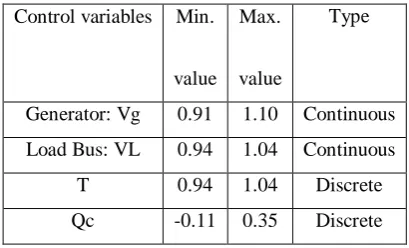
the shunt VAR compensators and the transformers tap settings limits. The variables limits are listed in Table 1.
Table 1: Initial Variables Limits (PU)
Control variables Min.
value Max.
value
Type
Generator: Vg 0.91 1.10 Continuous
Load Bus: VL 0.94 1.04 Continuous
T 0.94 1.04 Discrete
Qc -0.11 0.35 Discrete
The transformer taps and the reactive power source installation are discrete with the changes step of 0.01. The
power limits generators buses are represented in Table 2. Generators buses are: PV buses 2,5,8,11,13 and slack
bus is 1 and the others are PQ-buses.
Table 2: Generators Power Limits in MW and MVAR
Bus n° Pg Pgmin Pgmax Qgmin
1 98.00 51 202 -21
2 81.00 22 81 -21
5 53.00 16 53 -16
8 21.00 11 34 -16
11 21.00 11 29 -11
13 21.00 13 41 -16
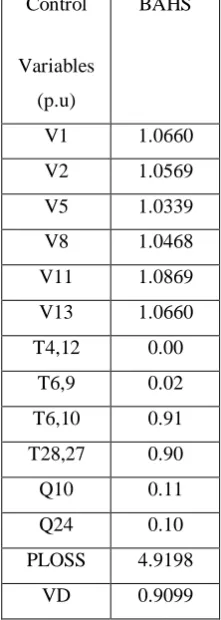
Table 3 summarizes the Values of Control Variables after Optimization and Active Power Loss by BAHS
method.
Table 3: Values of Control Variables after Optimization and Active Power Loss
Control
Variables
(p.u)
BAHS
V1 1.0660
V2 1.0569
V5 1.0339
V8 1.0468
V11 1.0869
V13 1.0660
T4,12 0.00
T6,9 0.02
T6,10 0.91
T28,27 0.90
Q10 0.11
Q24 0.10
PLOSS 4.9198
VD 0.9099
The proposed approach succeeds in keeping the dependent variables within their limits.
Table 4 summarizes the results of the optimal solution obtained by PSO, SGA and BAHS methods. It reveals
the reduction of real power loss after optimization.
Table 4: Comparison Results of Different Methods
SGA[26] PSO[27] BAHS
4.98 Mw 4.9262Mw 4.9198 Mw
Secondly the proposed hybrid BAHS algorithm for solving ORPD problem is tested in standard IEEE-57 bus
power system. The IEEE 57-bus system data consists of 80 branches, seven generator-buses and 17 branches
under load tap setting transformer branches. The possible reactive power compensation buses are 18, 25 and 53.
Bus 2, 3, 6, 8, 9 and 12 are PV buses and bus 1 is selected as slack-bus. In this case, the search space has 27
dimensions, i.e., the seven generator voltages, 17 transformer taps, and three capacitor banks. The system
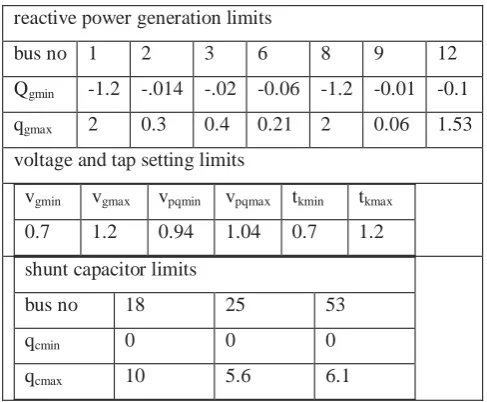
variable limits are given in Table 5. The initial conditions for the IEEE-57 bus power system are given as
follows:
Pload= 12.419 p.u. Qload = 3.346 p.u.
The total initial generations and power losses are obtained as follows:
∑ 𝑃𝑃𝐺𝐺 = 12.7737 p.u. ∑ 𝑄𝑄𝐺𝐺 = 3.4567 p.u.
Ploss= 0.27479 p.u. Qloss = -1.2265 p.u.
Table 5: Variables limits for IEEE-57 bus power system (p.u.)
reactive power generation limits
bus no 1 2 3 6 8 9 12
Qgmin -1.2 -.014 -.02 -0.06 -1.2 -0.01 -0.1
qgmax 2 0.3 0.4 0.21 2 0.06 1.53
voltage and tap setting limits
vgmin vgmax vpqmin vpqmax tkmin tkmax
0.7 1.2 0.94 1.04 0.7 1.2
shunt capacitor limits
bus no 18 25 53
qcmin 0 0 0
qcmax 10 5.6 6.1
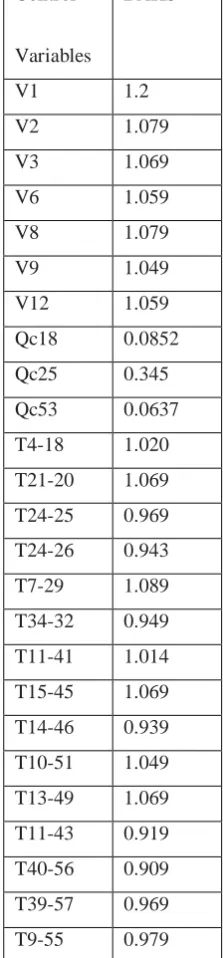
Table 6 shows the various system control variables i.e. generator bus voltages, shunt capacitances and
transformer tap settings obtained after BAHS based optimization which are within their acceptable limits. In
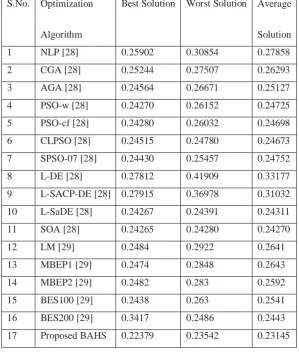
Table 7 comparison of optimum results obtained from proposed BAHS with other optimization techniques for
ORPD mentioned in literature for IEEE-57 bus power system is given. These results indicate the robustness of
proposed BAHS approach for providing better optimal solution in case of IEEE-57 bus system.
Table 6: control variables obtained after optimization by BAHS method for IEEE-57 bus system (p.u.)
Control
Variables
BAHS
V1 1.2
V2 1.079
V3 1.069
V6 1.059
V8 1.079
V9 1.049
V12 1.059
Qc18 0.0852
Qc25 0.345
Qc53 0.0637
T4-18 1.020
T21-20 1.069
T24-25 0.969
T24-26 0.943
T7-29 1.089
T34-32 0.949
T11-41 1.014
T15-45 1.069
T14-46 0.939
T10-51 1.049
T13-49 1.069
T11-43 0.919
T40-56 0.909
T39-57 0.969
T9-55 0.979
Table 7: Comparative Optimization Results for IEEE-57 Bus Power System (P.U.)
S.No. Optimization
Algorithm
Best Solution Worst Solution Average
Solution
1 NLP [28] 0.25902 0.30854 0.27858
2 CGA [28] 0.25244 0.27507 0.26293
3 AGA [28] 0.24564 0.26671 0.25127
4 PSO-w [28] 0.24270 0.26152 0.24725
5 PSO-cf [28] 0.24280 0.26032 0.24698
6 CLPSO [28] 0.24515 0.24780 0.24673
7 SPSO-07 [28] 0.24430 0.25457 0.24752
8 L-DE [28] 0.27812 0.41909 0.33177
9 L-SACP-DE [28] 0.27915 0.36978 0.31032
10 L-SaDE [28] 0.24267 0.24391 0.24311
11 SOA [28] 0.24265 0.24280 0.24270
12 LM [29] 0.2484 0.2922 0.2641
13 MBEP1 [29] 0.2474 0.2848 0.2643
14 MBEP2 [29] 0.2482 0.283 0.2592
15 BES100 [29] 0.2438 0.263 0.2541
16 BES200 [29] 0.3417 0.2486 0.2443
17 Proposed BAHS 0.22379 0.23542 0.23145
8. Conclusion
Hybrid –BAHS algorithm has been efficiently applied for ORPD problem. The Hybrid - BAHS based ORPD is
tested in standard IEEE 30, IEEE 57 bus system. Performance comparisons with well-known population-based
algorithms give positive results. Hybrid – BAHS emerges to find high-quality solutions when compared to that
of other algorithms. The simulation results presented in previous section prove the ability of Hybrid -BAHS
approach to arrive at near global optimal solution.
References
[1] O.Alsac,and B. Scott, “Optimal load flow with steady state security”,IEEE Transaction. PAS -1973, pp.
745-751.
[2] Lee K Y ,Paru Y M , Oritz J L –A united approach to optimal real and reactive power dispatch , IEEE
Transactions on power Apparatus and systems 1985: PAS-104 : 1147-1153.
[3] A.Monticelli , M .V.F Pereira ,and S. Granville , “Security constrained optimal power flow with post
contingency corrective rescheduling” , IEEE Transactions on Power Systems :PWRS-2, No. 1,
pp.175-182,1987.
[4] Deeb N ,Shahidehpur S.M ,Linear reactive power optimization in a large power network using the
decomposition approach. IEEE Transactions on power system 1990: 5(2) : 428-435
[5] E. Hobson ,’Network consrained reactive power control using linear programming, ‘ IEEE Transactions on
power systems PAS -99 (4) ,pp 868-877, 1980
[6] K.Y Lee ,Y.M Park , and J.L Oritz, “Fuel –cost optimization for both real and reactive power dispatches” ,
IEE Proc; 131C,(3), pp.85-93.
[7] M.K. Mangoli, and K.Y. Lee, “Optimal real and reactive power control using linear programming” ,
Electr.Power Syst.Res, Vol.26, pp.1-10,1993.
[8] C.A. Canizares, A.C.Z.de Souza and V.H. Quintana , “ Comparison of performance indices for detection of
proximity to voltage collapse ,’’ vol. 11. no.3, pp.1441-1450, Aug 1996.
[9] S.R.Paranjothi, and K.Anburaja, “Optimal power flow using refined genetic algorithm”, Electr. Power
Compon.Syst , Vol. 30, 1055-1063,2002.
[10] D. Devaraj, and B. Yeganarayana, “Genetic algorithm based optimal power flow for security
enhancement”, IEE proc-Generation. Transmission and. Distribution; 152, 6 November 2005.
[11] A. Berizzi, C. Bovo, M. Merlo, and M. Delfanti, “A ga approach to compare orpf objective functions
including secondary voltage regulation,”Electric Power Systems Research, vol. 84, no. 1, pp. 187 – 194,2012.
[12] C.-F. Yang, G. G. Lai, C.-H.Lee, C.-T. Su, and G. W. Chang, “Optimal setting of reactive compensation
devices with an improved voltage stability index for voltage stability enhancement,” International Journal of
Electrical Power and Energy Systems, vol. 37, no. 1, pp. 50 – 57,2012.
[13] P. Roy, S. Ghoshal, and S. Thakur, “Optimal var control for improvements in voltage profiles and for real
power loss minimization using biogeography based optimization,” International Journal of Electrical Power and
Energy Systems, vol. 43, no. 1, pp. 830 – 838, 2012.
[14] B. Venkatesh, G. Sadasivam, and M. Khan, “A new optimal reactive power scheduling method for loss
minimization and voltage stability margin maximization using successive multi-objective fuzzy lp
technique,”IEEE Transactions on Power Systems, vol. 15, no. 2, pp. 844 –851, may 2000.
[15] W. Yan, S. Lu, and D. Yu, “A novel optimal reactive power dispatch method based on an improved hybrid
evolutionary programming technique, ”IEEE Transactions on Power Systems, vol. 19, no. 2, pp. 913 –918, may
2004.
[16] W. Yan, F. Liu, C. Chung, and K. Wong, “A hybrid genetic algorithm interiorpoint method for optimal
reactive power flow,” IEEE Transaction son Power Systems, vol. 21, no. 3, pp. 1163 –1169, aug. 2006.
[17] J. Yu, W. Yan, W. Li, C. Chung, and K. Wong, “An unfixed piece wise optimal reactive power-flow model
and its algorithm for ac-dc systems,”IEEE Transactions on Power Systems, vol. 23, no. 1, pp. 170 –176,
feb.2008.
[18] F. Capitanescu, “Assessing reactive power reserves with respect to operating constraints and voltage
stability,” IEEE Transactions on Power Systems, vol. 26, no. 4, pp. 2224–2234, nov. 2011.
[19] Z. Hu, X. Wang, and G. Taylor, “Stochastic optimal reactive power dispatch: Formulation and solution
method,” International Journal of Electrical Power and Energy Systems, vol. 32, no. 6, pp. 615 – 621,2010.
[20] A. Kargarian, M. Raoofat, and M. Mohammadi, “Probabilistic reactive power procurement in hybrid
electricity markets with uncertain loads,”Electric Power Systems Research, vol. 82, no. 1, pp. 68 – 80, 2012.
[21] X.S. Yang. Bat algorithm for multi-objective optimisation. International Journal of Bio-Inspired
Computation, 3(5):267– 274, 2011
[22] Geem Z (2006) Improved harmony search from ensemble of music players. In: Gabrys B, Howlett RJ, Jain
L (eds) Knowledge-based intelligent information and engineering systems. Springer, Heidelberg, pp 86–93.
[23] Geem Z (2007a) optimal scheduling of multiple dam system using harmony search algorithm. In:
Computational and ambient intelligence. Springer, Berlin, pp 316–323
[24] P.W. Tsai, J.S. Pan, B.Y. Liao, M.J. Tsai, and V. Istanda. Bat algorithm inspired algorithm for solving
numerical optimization problems. Applied Mechanics and Materials, 148:134–137,2012.
[25] X.S. Yang. Review of meta-heuristics and generalised evolutionary walk algorithm. International Journal of
Bio-Inspired Computation, 3(2):77–84, 2011.
[26] Q.H. Wu, Y.J.Cao, and J.Y. Wen. Optimal reactive power dispatch using an adaptive genetic algorithm. Int.
J. Elect. Power Energy Syst. Vol 20. Pp. 563-569; Aug 1998.
[27] B. Zhao, C. X. Guo, and Y.J. CAO. Multiagent-based particle swarm optimization approach for optimal
reactive power dispatch. IEEE Trans. Power Syst. Vol. 20, no. 2, pp. 1070-1078, May 2005.
[28]Chaohua Dai, Weirong Chen, Yunfang Zhu, and Xuexia Zhang, “Seeker optimization algorithm for optimal
reactive power dispatch,” IEEE Trans. Power Systems, Vol. 24, No. 3, August 2009, pp. 1218-1231.
[29] J. R. Gomes and 0. R. Saavedra, “Optimal reactive power dispatch using evolutionary computation:
Extended algorithms,” IEE Proceedings on Generation Transmission Distribution. Vol. 146, No. 6. Nov. 1999.
K. Lenin has received his B.E., Degree, electrical and electronics engineering in 1999 from
university of madras, Chennai, India and M.E., Degree in power systems in 2000 from
Annamalai University, TamilNadu, India. At present pursuing Ph.D., degree at JNTU,
Hyderabad,India.
Bhumanapally. Ravindhranath Reddy, Born on 3rd September,1969. Got his B.Tech
in Electrical & Electronics Engineering from the J.N.T.U. College of Engg., Anantapur
in the year 1991. Completed his M. Tech in Energy Systems in IPGSR of J.N.T.
University Hyderabad in the year 1997. Obtained his doctoral degree from JNTUA,
Anantapur University in the field of Electrical Power Systems. Published 12 Research
Papers and presently guiding 6 Ph.D. Scholars. He was specialized in Power Systems,
High Voltage Engineering and Control Systems. His research interests include Simulation studies on
Transients of different power system equipment.
M. Surya Kalavathi has received her B.Tech. Electrical and Electronics Engineering from
SVU, Andhra Pradesh, India and M.Tech, power system operation and control from SVU,
Andhra Pradesh, India. she received her Phd. Degree from JNTU, hyderabad and Post doc.
From CMU – USA. Currently she is Professor and Head of the electrical and electronics
engineering department in JNTU, Hyderabad, India and she has Published 16 Research
Papers and presently guiding 5 Ph.D. Scholars. She has specialised in Power Systems, High Voltage
Engineering and Control Systems. Her research interests include Simulation studies on Transients of
different power system equipment. She has 18 years of experience. She has invited for various lectures in
institutes.