
Published online January 19, 2015 (http://www.sciencepublishinggroup.com/j/ijmsa) doi: 10.11648/j.ijmsa.20150401.14
ISSN: 2327-2635 (Print); ISSN: 2327-2643 (Online)
Synthesis and characterization of the peroxo complexes of
uranium (VI) containing organic acids and amine bases
ligands
Jahanara Nasrin
Department of Materials Science and Engineering, Faculty of Engineering, Rajshahi University, Rajshahi, Bangladesh
Email address:
To cite this article:
Jahanara Nasrin. Synthesis and Characterization of the Peroxo Complexes of Uranium (VI) Containing Organic Acids and Amine Bases Ligands. International Journal of Materials Science and Applications. Vol. 4, No. 1, 2015, pp. 20-25. doi: 10.11648/j.ijmsa.20150401.14
Abstract:
Several new peroxo complexes of U(VI) have been synthesized and characterized by element analyses and various physico-chemical techniques. A number of organic and amine ligands were used to form the complexes having compositions, [UO(O2)amH2L], where, [amH=amino acids, such as glycine, phenylalanine, leucine ; L= ligands such as pyridine, 2-picoline,4-picoline, quinoline, iso-quinoline. The analytical data are in good agreement with the proposed empirical formulae of the U(VI) complexes. The molar conductance values indicate all the complexes of U(VI) are non-electrolyte in DMF revealing that the anions are covalently bonded in all the cases. The disappearance of the v(O-H) mode observed in the free amino acid molecule clearly indicate the loss of protons from O-H group coordination, revealing that acids are dinegative bidentate ligand coordinating through the carboxylate anion. The characteristic v1(O-O) mode of the complexes appeared in the region 842-916
cm-1, indicating that the dioxygen moieties are bonded on “side–on” fashion with the U(VI). The magnetic moment values indicated that these complexes were diamagnetic in nature suggesting no changes in the oxidation states of the metal ions upon complexation. These data also consistent with eight fold coordination of U(VI). The electronic spectral data of the complexes showed bands in between 315-380 nm due to the charge transfer band only.
Keywords:
Synthesis, Characterization, Peroxo Complexes, Uranium (VI)1. Introduction
Metal peroxo complexes have been the object of intense investigation for the past several years, for a variety of reasons including their role as oxidation catalyst [1] and biochemical relevance [2]. They are widely used in stoichiometric as well as catalytic oxidation in organic and biochemistry [3], for example in the oxidation of thioanisole [4], methyl benzenes [5], tertiary amines, alkenes, alcohols [6], bromide [7] and also in olefin epoxodations [8]. Peroxo complexes of uranium are attracting interest as oxidants in organic synthesis [9]. As uranium somewhat resembles the group VIB elements, it was of interest to discover whether it would form analogous peroxo complexes which contain organic moieties. Various peroxo complexes of uranium have been reported with organic ligands [10]. The coordination number for metal chelates of UO3 has been reported [11]. The chemistry of heteroligand
peroxo-metallates possesses a fascinating and worthwhile area of investigation [12]. The synthesis of well defined heteroligand peroxo-metal complexes therefore is an
important prerequisite for a heuristic approach in this field of chemistry. It is imperative to note that in recent years a commendable progress has been made in this aspect of lighter metals and a good amount of newer information as well as materials has emerged thereof [13-15].
Studies on the peroxo complexes have received considerable attention due to their application in synthetic organic chemistry [16-20]. Peroxo complexes of transitional metals are sources of active oxygen atoms and many of these complexes can be used as efficient stoichiometric as well as catalytic oxidants for organic and inorganic substrate [19,20]. It has been observed that the reactivity of the peroxo complexes depend on the nature of other auxiliary ligands used. Peroxo complexes containing monodentate and bidentate auxiliary ligands were found to be undergoes oxygen transfer reactions [21-23], those containing tridenate and quadridenate ligands were inert towards oxidation reaction [24].
some organic acids and amine bases ligands. The structures of ligands are given in scheme.
2. Materials and Methods
General method for the preparation of the complexes of the type [U(O2)(amH).L]NO3 [ where amH= deprotonated
glycine, alanine, phenylalanine and leucine; L= quinoline, isoquinoline, pyridine, 2-picoline or 4-picoline]
A solution of amH namely glycine (0.150g, 0.002 mol) or alanine (0.1782g, 0.002mol) or phenylalanine (0.330g, 0.002mol) or leucine (0.2623g, 0.002mol) in water (20 ml) was added with stirring to a solution of Uranyl nitrate (1.005g, 0.002 mol) in water (20 ml). A solution of ‘L’ (0.01 mol) in ethanol was then added with continuous stirring to the above mixture followed by the addition of 30% H2O2 (2 ml). The
precipitate appeared which was filtered, washed several times successively with ethanol. It was then dried and stored in
Vacuo over P4O10.
2.1. Reaction of the Complexes of 4 & 5 with Allyl Alcohol
Complexes 4 and 5 (0.002 mol) were suspended in 30 ml of THF and a stoichiometric amount of allyl alcohol was added. The mixture was added. The mixture was stirred under reflux at 60°C for 48 hours, but failed to produce any epoxy product, complexes 4, 5, 8 & 11 were recovered unchanged. Refluxing complexes 4 & 5 with allyl alcohol in a 1:1 molar ratio in THF medium in 48 hours also failed to produce any epoxy product.
2.2. Reaction of the Compounds 6 with Allyl Alchohol (Reaction A)
A stoichiometric amount of allyl alcohol was added to a suspension of complex 6 or 7 in THF (30ml). The mixture was stirred under reflux at 65°C for 36 hours. Microdistillation under reduced pressure (19mm Hg) yielded glycidol (75% yields) at 145-150°C. The glycidol was identified by means of its phenylurethan derivative, m.p. 58-60°C (m.p. 60°C) [25, 26].
2.3. Reaction of 1 and 3 Complexes with Triphenylphosphine (Reaction B)
Triphenyl phosphine (1.321g, 0.005 mol) was dissolved in THF (50ml) which was relux with an equimolar quantity of the complexes (0.005 mol) suspended in the same solvent (30 ml). The progress of the reaction was monitored using TLC indicating complete oxidation of triphenyl phosphine in 7 hours of reaction time. The solution was filtered and the residue was collected. The product was recovered from the filt rate and was identified as OPPh3, m.p. 154-155°C (m.p. 157°C)
[27].
Reaction of the compounds 2 with triphenylarsine (Reaction C): Triphenylarsine (0.90g, 0.005 mol) in THF (50ml) added to a suspension of above compounds in the same solvents (50ml). The mixture was refluxed for 60 hours. The progress of the reaction was monitored using TLC, indicates that triphenylarsine was converted completely into
triphenylarsine oxide. The reaction mixture was filtered and the residue was stored. Evaporation of the filtrate yielded the product, m.p. (m.p. 190-192°C) [27 -29].
3. Results and Discussion
The complexes were prepared from the reaction of the Uranylnitrate with organic acids and amine bases. The reaction may be represented as follows:
UO2(NO)2 + amH + 2L + H2O2→ [UO(O2) (amH)2 L] + H2O
+ HNO3
Where, amH= deprotonated glycine, alanine, phenylalanine and leucine; L= quinoline, isoquinoline, pyridine, 2-picoline or 4-picoline.
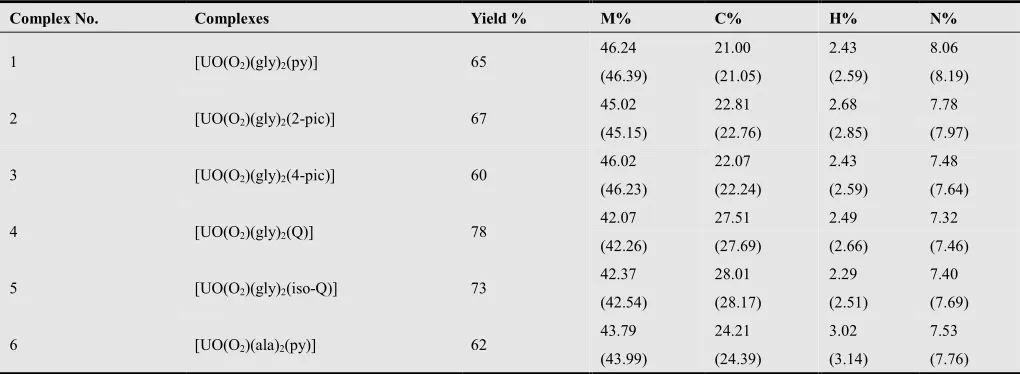
Elemental analysis and conductivity measurement: The analytical data and their physical properties of the complexes are shown in Tables 1 and 2 respectively. The analytical data are in good agreement with the proposed emperical formulae of the present complexes. Their structures have been proposed on the basis of conductivity and magnetic measurements (Table 2) and electronic spectral data (Table 4).
The molar conductance of 10-3 M solutions of the complexes in DMSO was measured at 30°C. The molar conductance values (Table 2) indicate all the complexes are non-electrolytes in DMF revealing that the anions are covalently bonded in all the cases.
3.1. IR Studies
Infrared spectral data are represented in table 3 and figures 1 & 2. The complexes display v(C=O) bands at ∼1683cm-1 and
v(C-O) bands at ∼1575cm-1 significantly lower than the values of amino acid (∼1690cm-1 and ∼1586cm-1). These indicate the coordination of amino acid through their carboxylate anion. The uranium (VI) complexes display v(M=O) modes in the region 903-994cm-1. Further, the presence of M-N and in the complexes are evident from the appearance of v(M-N) modes at 423-464cm-1 in the spectra of the complexes [ 26,30]. The complexes display v(N-H) modes in the region of 3105-3316cm-1.
The metal peroxo grouping gives rise to three IR active vibrational modes. These are predominantly O-O stretching v1,
the symetric M-O stretch v2 and the antisymmetric M-O
stretch v3. The characteristics of v1(O-O) modes of the
complexes appear at 797-882cm-1. It is observed that the v1
mode decreases with the increase atomic number of the metal in particular group. In the present complexes, the v3 and v2
modes appear at 600-668cm-1 and 510-599cm-1 respectively.
3.2. Magnetic Moment and Electronic Spectra
The observed values of effective magnetic moment (µeff) at
The electronic spectral data (Table 4) of the complexes 1-6 showed bands between 230-370 nm regions due to the charge
transfers band only [31].
Table 1. Analytical data and physical properties of U(VI) complexes.
Complex No. Complexes Yield % M% C% H% N%
1 [UO(O2)(gly)2(py)] 65
46.24 21.00 2.43 8.06
(46.39) (21.05) (2.59) (8.19)
2 [UO(O2)(gly)2(2-pic)] 67
45.02 22.81 2.68 7.78
(45.15) (22.76) (2.85) (7.97)
3 [UO(O2)(gly)2(4-pic)] 60
46.02 22.07 2.43 7.48
(46.23) (22.24) (2.59) (7.64)
4 [UO(O2)(gly)2(Q)] 78
42.07 27.51 2.49 7.32
(42.26) (27.69) (2.66) (7.46)
5 [UO(O2)(gly)2(iso-Q)] 73
42.37 28.01 2.29 7.40
(42.54) (28.17) (2.51) (7.69)
6 [UO(O2)(ala)2(py)] 62
43.79 24.21 3.02 7.53
(43.99) (24.39) (3.14) (7.76)
Figure in the parenthesis indicate the calculated values
Table 2. Physical properties of U(VI) complexes.
Complex No. Complexes Colour Melting point (±0.5ºC) Molar conductance
Ω-1cm2Mole-1 Magnetic Moment µeff (B.M.)
1 [UO(O2)(gly)2(py)] Pale yellow >250 7.8 -0.539
2 [UO(O2)(gly)2(2-pic)] Light yellow 198 10.4 -0.522
3 [UO(O2)(gly)2(4-pic)] Pale yellow 192 1.9 -0.625
4 [UO(O2)(gly)2(Q)] Yellow >250 5.7 -0.324
5 [UO(O2)(gly)2(iso-Q)] Yellowish green >250 3.5 -0.426
6 [UO(O2)(ala)2(py)] Yellow 188 4.1 -0.725
Table 3. IR spectral data of U(VI) complexes.
Complex No. υ (N-H) cm-1 υ (C=O) cm-1 υ (C-O) cm-1 υ (M=O) cm-1 υ (M-N) cm-1 υ
1 (O-O) cm-1
υ3
(M O O )
cm-1 υ 2
(M O O )
cm-1
1 3197 br 1652 w 1576 m 903 vs 430 w 850 w 665 w 530 w
2 3202 br 1653 m 1584 s 809 s 433 m 797 m 668 s 523 w
3 3208 br 1683 w 1575 m 903 s 426 w 804 s 665 m 529 s
4 3235 br 1610 w 1560 m 918 s - 849 s 655 w 510 w
5 3229 br 1575 w 1521 vs 936 vs - 845 m 665 w 531 s
6 3240 br 1645 s 1508 w 921 vs 428 w 855 s 605 w 514 w
Related band intensities are denoted by vs, s, m, w and br representing very strong, strong, medium, weak and broad band respectively.
Table 4. Electronic spectral data of U(VI) complexes.
Complex No. Complexes λmax (nm)
1 [UO(O2)(gly)2(py)] 298, 345
2 [UO(O2)(gly)2(2-pic)] 245, 315
3 [UO(O2)(gly)2(4-pic)] 256, 345
4 [UO(O2)(gly)2(Q)] 261
5 [UO(O2)(gly)2(iso-Q)] 300, 340
Figure 1. Spectral data of the complex [2] [UO(O2)(ala)2(2-pic)].
Figure. 2. The infrared data of the complex 5 [UO(O2)(gly)2(iso-Q)].
Reactivity: The present peroxo complexes were found to liberate iodine within 1-2 minutes on treatment with aqueous potassium iodide. Base on this observation, the possible reactivity of the complexes towards olefinic compounds could be explored. A stoichiometric mixture of compounds 4 and 5 with allyl alcohol did not exhibit any reaction. However, compound 6 reacts stoichiometrically with allyl alcohol (Reaction A) producing glycidol as indicated by IR band at 1060 cm-1 due to the C-O-C stretching mode [ 32, 33]. A possible reaction path is shown in scheme 1.
In reaction B, compound 6 was used to catalyze the oxidation of allyl alcohol by H2O2 and in this case the product
isolated was glycerol. The IR spectrum of this product was identical with that of an authentic sample. A possible reaction path is shown in scheme 2. The reaction C and D produced triphenylphosphine oxide and triphenylarsine oxide respectively. The products display IR bands at 1193 and 880 cm-1 due to v(P=O) and v(As=O) modes, respectively. The IR spectra of the residue of reaction C and D showed the disappearance of v1(O-O) bands which indicate the transfer of
Scheme 1: A possible reaction path is shown
Scheme 2: A possible reaction path is shown
Scheme 3: A possible reaction path is shown.
On the basis of IR spectroscopic and other physical interpretation the molecular structure of (4) could be illustrated as shown in Figure 3.
Figure 3. Proposed structure of complex (4). [UO(O2)(gly)2(Q)].
4. Conclusion
It is concluded that the analytical data were in good agreement with the proposed emperical formulae of the complexes. The molar conductance values indicated the complexes are non-electrolytes in DMF revealing that the anions are covalently bonded in all the cases.
Acknowledgements
The author is grateful to Prof. M. Saidul Islam for fruitful suggestions and also to the Chairman, Department of Chemistry and Department of Pharmacy, Rajshahi University, for extending laboratory facilities.
References
[1] Nasrin J, Islam MS. Synthesis, structural characterization and biological activity of peroxo complexes of Zirconium (IV) containing organic acid and amine bases. J. Appl. Sci. 2007a; 7(3): 434-441.
[2] Singh B, Simpy M, Sheikh HN, Sharma M, Kalsotra BL. Peroxo complexes of uranium(VI) containing nitrogen and oxygen donor ligands. Russian J. Inorg. Chem. 2012; 57(8): 1079-1088.
[3] Bagherzadeh Mehdi M, Mojtaba H, Derakhshandeh APG. Molybdenum oxo–peroxo complex: A very fast catalyst for oxidation and reduction of sulfur-based compounds. Catalysis Commu. 2012; 23(5): 14-19.
[4] Cho J, Samuel SJA, Lei W, Liu V, Eun, Kang J, Bray, Lim MH, Hedman B, Hodgson OK, Valentine JS, SolomonEI, Nam W. Structure and reactivity of a mononuclear non-haem iron(III)–peroxo complex. Nature, 2011; 478(7370): 502-505. [5] Cenini S, Porta F, Pizzotti M. Reactions of amines and related species with transition metal peroxo complexes. J. Organomet. Chem. 1985; 296: 291-300.
[6] Islam MS, Islam MQ, Tarafder MTH. Pakistan J. Sci. Ind. Res. 1990; 33: 205.
[7] Mugesh G, Singh HB, Butcher RJ. 2-(49,49-Dimethyl-39,49-dihydrooxazol-29-yl)phenol: Some First-Row Transition Metal Complexes of This Naturally Occurring Binding Group. Eur. J. Inorg. Chem. 2001; 40: 669-778.
[8] Islam MS, Masir MU. The synthesis and reactivity of some mixed ligand peroxo complexes of zirconium (IV) and thorium (IV). Synth. React. Inorg. Met. Org. Chem. 1992; 22: 893. [9] Westland AD, Tarafder MTH. Nobel peroxo complexes of
Uranium containing organic ligands. Inorganic Chem. 1981; 20: 3992-95.
[10] Nasrin J, Islam MS. Metallurgical and biological activity of peroxo complexes of Molybdenum (VI) containing organic acid and amine bases. J. Appl. Sci. 2007b; 7(4): 597-603. [11] Kovaleva EG, Lipscomb JD. Versatility of biological non-heme
[12] Mimoun H. In S. Patai (ed.), The Chemistry of Functional Groups, Peroxides, Wiley, New York, 1983.
[13] Burlakov VV, Usatov AV, Lyssenko KA, Antipin MY, Novikov YN, Shur VB. Synthesis and Structure of the First Fullerene Complex of Titanium Cp2Ti(η2-C60). Eur. J. Inorg. Chem. 1999; 11: 1855-1857.
[14] Pfletschinger A, Schmalz HG, Koch G. Structural and energetical characterization of the methylbutadiene-Fe(CO)3 isomers and related reactive intermediates with quantum chemical methods. Eur. J. Inorg. Chem. 1999; 11: 1869-1880. [15] Bochmann M, Green MLH, Powell AK, Sassmannshausen J,
Triller MU, Wocadlo S. Cationic zirconocene complexes with benzyl and Si(SiMe3)(3) substituted cyclopentadienyl ligands. J. Chem. Soc.-Dalt.Trans. 1999; 43-49.
[16] Thuéry P, Nierlich M, Vicens J, Masci B, Uranyl ion complexation by medium and large homooxacalixarenes: from mono- to poly-uranate complexes. J. Chem. Soc., Dalton Trans. 2001; 867–874.
[17] Min ES, Suh MK. Construction of Various Supramolecules by ð2ð Interactions: Self-Assembly of Nickel (II) Macrocyclic Complexes Containing Pyridine Pendant Arms with Bidentate Ligands. Eur. J. Inorg. Chem. 2001; 40: 449-455.
[18] Kovaleva EG, Lipscomb JD. Crystal Structures of Fe2+ Dioxygenase Superoxo, Alkylperoxo, and Bound Product. Intermediates Science. 2007; 316: 453-457.
[19] Bonchio M, Licini G, Modena G, Bortolini O, Moro S, Nugent WA. Enantioselective Ti(IV) Sulfoxidation Catalysts Bearing C3-Symmetric Trialkanolamine Ligands: Solution Speciation by 1H NMR and ESI-MS Analysis. J. Am. Chem. Soc. 1999; 121: 6258-626
[20] Bonchio M, Calloni S, Furia FD, Licini G, Modena G, Moro S,
Nugent WA.
Titanium(IV)-(R,R,R)-Tris(2-phenylethoxy)amine-Alkylperox o Complex Mediated Oxidations: The Biphilic Nature of the Oxygen Transfer to Organic Sulfur Compounds. J. Am. Chem. Soc. 1997; 19: 6935-6936.
[21] Hahn C, Morvillo P, Vitagliano A. Olefins coordinated at a highly electrophilic site 2 dicationic Palladium(II) complexes and their equilibrium reactions with nucleophiles. Eur. J. Inorg. Chem. 2001; 41: 924-929.
[22] Flores-Alamo M, Sosa-Torres ME, Toscano RA, Camarillo E, Hernández JM, Murrieta H. Crystal structure and energy transfer of trans-RSSR-[CrCl2(cyclam)]3[Cr(CN)6] 14H2O. Inorg. Chem. Com. 2004; 7: 1087-1090.
[23] Hagenbach A, Abram U. Tetrahydrothiophene complexes of technetium (IV). Inorg. Chem. Com. 2004; 7: 1142-1144. [24] Lemp E, Valencia C, Zanocco AL. Solvent effects on reactions
of singlet molecular oxygen, O2 (1∆g), with antimalarial drugs. J. Photochem. Photobiol A: Chem. 2004; 168: 91-96.
[25] Islam S, Begum M, Roy HN, Pal SC, Ahmed SU. Preparation and Reactivity of some Peroxo Complexes of Zirconium (IV) and Uranium (VI). Syn. React. Inorg. Met.-Org. Chem. 1997; 27(1): 17-18.
[26] Ji Y, Kilner JA, Carolan MF. Electrical conductivity and oxygen transfer in gadolinia-doped ceria (CGO)–Co3O4−δ composites. J. Eur. Ceramic Soc. 2004; 24(14): 3613-3616. [27] Chang CJ, Chang MCY, Damrauer NH, Nocera DG.
Proton-coupled electron transfer: a unifying mechanism for biological charge transport, amino acid radical initiation and propagation, and bond making/breaking reactions of water and oxygen. Biochimica et Biophysica Acta (BBA) – Bioenergetics. 2004; 1655: 13-28.
[28] Brown DA, Clarkson GJ, Fitzpatrick NJ, Glass WK, Hussein AJ, Kemp TJ, Müller-Bunz H. Complexation and proton transfer by hydroxamic acids in model inhibited metallohydrolases: formation of metal hydroxamate trimers. Inorg. Chem. Comm. 2004; 7: 495-498.
[29] Xie X, Jalbout AF, Cao H. Theoretical study on the reaction of the 1∑+ ground state of ScS+ with oxygen-transfer reagent: ScS+ + CO2 → ScO
+
+ COS in the gas phase. Chem. Phys. Lett. 2004; 386: 111-117.
[30] Durón S, Rivera-Noriega R, Nkeng P, Poillerat G, Solorza-Feria O. Kinetic study of oxygen reduction on nanoparticles of ruthenium synthesized by pyrolysis of Ru3(CO)12. J. Electroanal. Chem. 2004; 566: 281-289. [31] Schmidt H, Andersson I, Rehder D, Pettersson LA.
Potentiometric and 51V NMR Study of the Aqueous H+/H2VO4-/H2O2/l-α-Alanyl-l-histidine. Chaudhuri, M. K. 1986. Proc. Indian Natl. Sci. Acad., Part A. 2001; 52: 996. [32] Eagle AA, Gable RW, Thomas S, Sproules SA, Young SG.
Sulfur atom transfer reactions of tungsten (VI) and tungsten(IV) chalcogenide complexes. Polyhed. 2004; 23: 385-394. [33] Löfberg A, Boujmiai S, Capoen E, Steil MC, Pirovano C,
![Figure 1. Spectral data of the complex [2] [UO(O2)(ala)2(2-pic)].](https://thumb-us.123doks.com/thumbv2/123dok_us/8470061.1710998/4.595.46.553.71.592/figure-spectral-data-of-the-complex-uo-pic.webp)
![Figure 3. Proposed structure of complex (4). [UO(O2)(gly)2(Q)].](https://thumb-us.123doks.com/thumbv2/123dok_us/8470061.1710998/5.595.90.246.655.740/figure-proposed-structure-complex-uo-o-gly-q.webp)
