http://www.sciencepublishinggroup.com/j/ijae doi: 10.11648/j.ijae.20180301.11
ISSN: 2575-3851 (Print); ISSN: 2575-3843 (Online)
Review Article
Cocoa Production in Cameroon: A Socioeconomic and
Technical Efficiency Perspective
Ngoe Mukete
1, *, Zhou Li
1, Mukete Beckline
2, Bobyeg Patricia
31
College of Economics and Management, Nanjing Agricultural University, Nanjing, China
2
College of Forestry, Beijing Forestry University, Beijing, China
3
School of Economics and Management, Shijiazhuang Tiedao University, Shijiazhuang, China
Email address:
[email protected] (N. Mukete)
*
Corresponding author
To cite this article:
Ngoe Mukete, Zhou Li, Mukete Beckline, Bobyeg Patricia. Cocoa Production in Cameroon: A Socioeconomic and Technical Efficiency Perspective. International Journal of Agricultural Economics. Vol. 3, No. 1, 2018, pp. 1-8. doi: 10.11648/j.ijae.20180301.11
Received: December 12, 2017; Accepted: December 22, 2017; Published: January 16, 2018
Abstract:
Understanding the technical efficiency of smallholder farmers is primordial in appraising their farming skills especially for cocoa farmers. In this paper, we examine the technical efficiency of small scale farmers across Africa particularly Cameroon. The study also explores the cocoa sector, its impacts on the Cameroonian economy and the challenges it currently faces. To achieve this, we carried out a comprehensive survey of published scientific literature obtained through Web of Science, Research gate, Mendeley, and Google Scholar. Using this approach, we observed that cocoa is vital in Cameroon’s economic development and that it is a sector dominated by smallholdings with inadequate access to economic and social resources. We also observed that provision of appropriate technical skills and financial access, would sustainably and enormously contribute to the growth of the cocoa sector, improve rural livelihoods and achieve food security.Keywords:
Technical Efficiency, Cameroon,Cocoa Farmers, Poverty Alleviation, Sustainable Development1. Introduction
Agricultural production at the micro level strives to assist individual farmers or farming groups to attain their objectives [1]. This is more often achieved through efficient intra-farm allocation of resources at a particular time or over a period. This efficiency is achieved either by maximizing output from given resources or by minimizing the resources required for producing a given output [2]. Thus increasing productivity and efficiency among small-scale producers requires a good knowledge of the current efficiency or inefficiency inherent in the sector or drivers of this level of efficiency or inefficiency [2, 4].
According to [5-7], production efficiency comprises technical and allocative efficiencies. Here, technical efficiency refers to the ability of maximizing output for a given set of resource inputs while allocative or factor price efficiency, involves the ability to use the inputs in optimal proportions given their respective prices and production
technology [8]. In addition, technical efficiencies are derived from production function or production possibility frontiers where it refers to the ability to avoid wastage. This ability is either by producing as much output such as technology and input usage or by using as little input as required by technology and output production. Technical efficiency has, therefore, both an input conserving and output promoting argument [8].
output. A producer is fully efficient on the basis of available evidence if and only if the performance of other producers do not show that some inputs or outputs can be improved without worsening some of its other inputs or outputs [10].
In Cameroon, the efficient allocation of resources at the farm level has great implication for overall national development and a rise in Gross National Products (GNP) and per capita income. Therefore, measuring efficiency on the farm may act as a success indicator, and performance measure. This is because, when the sources of inefficiency are identified, policy formulations to improve farmers’ performance may be effectively done.
With the goal of Cameroon to maintain a sustainable cocoa production, this objective can only be realized if the sources of inefficiency are identified and by improving the technical efficiency of the cocoa producers. Hence, measuring the technical efficiency of cocoa farmers, and identifying the factors that affect it may provide useful information for the formulation of economic policies likely to improve producer technical efficiency. Moreover, identifying the factors that may improve farm profitability is of major significance because by using information derived from such studies, farms may become more productive [4, 11].
In this study, we carry out a comprehensive literature review to examine the technical efficiency of smallholder cocoa farmers in Cameroon. This paper is divided into two sections with the first looking at technical efficiency of small scale farmers across Africa particularly Cameroon. Here, we review studies that have been undertaken and bring out their major findings. In the second section, we describe the cocoa sector and its impacts on the Cameroonian economy. In this second section, we also stress the challenges currently facing the cocoa sector and highlight ways in which they could be improved.
2. Technical Efficiency of Small-Scale
Farmers
Studies on technical efficiency of small-scale farmers have associated variables like farmer age, farmer educational level, access to extension, access to credit, land holding size, ownership of dwelling, family size, gender, market access, as well as access to improved technologies. Access to improved technologies includes variables such as fertilizer, agro-chemicals, tractor and improved seeds which positively impact on technical efficiency [12-14].
In Cameroon, several studies have examined cocoa production in relation to technical efficiency. For instance and according to [15], gender disparity with regards to land occupation is one of the problems affecting the multiplicity and increasing harvest in the cocoa growing communities of Southern Cameroon. In a similar study, [16] examined the degree to which socio-economic determinants influence the performance of cocoa production in Meme Division, South West Cameroon. Using the Generalized Method of Moments (GMM) and Trend analyses for cocoa output, they observed
that socio-economic variables such as labour, capital, price, political influence and gender affect cocoa production in Meme Division, Cameroon. They affirmed that the degree and direction to which each variable affects output varied.
Similarly, [17] examined the effect of climate variability on cocoa production using the four point likert scale survey. Here, the coefficient of variation (CV) revealed that the CV for rainfall (15.1%) and temperature (11.0%) all exceeded the variability threshold of 10% indicating that they exhibited significant variability.
Using Arabica coffee (Coffea arabica) as an example, [18] analyzed the factors influencing the technical efficiency of farmers in Cameroon. He used a translog stochastic production frontier function in which technical inefficiency effects were specified to be functions of socio-economic variables and estimated through the maximum likelihood function. The found some increasing returns to scale in coffee production with mean technical efficiency index estimated at 0.896%. The study also observed that over 32% of the farmers surveyed had technical efficiency indexes of less than 0.91%. This analysis also revealed educational level of the farmers and access to credit facilities to be major socio-economic variables influencing the technical efficiency of coffee farmers.
For instance, In Ethiopia, [19] employed A Cobb-Douglas stochastic frontier production analysis approach with the inefficiency effect model to estimate technical efficiency and identify the determinants of efficiency of teff producing farmers. The maximum likelihood parameter estimates showed that teff output was positively and significantly influenced by area, fertilizer, available labour and number of oxen. Here, it is possible to obtain additional output from existing inputs used, if resources are properly used and efficiently allocated. Relatedly, using the stochastic production function to estimate smallholder cocoa farmer’s technical efficiency and their determinants [20] revealed that using farm resources, farmers experienced decreasing but positive returns to scale. With efficiency level ranging from 0.20 to 0.93 and a mean of 0.69, these generalized Likelihood Ratio (LR) tests also confirmed that, the cocoa farmers in Edo State of Nigeria were technically inefficient. They concluded that, age of farmers, sex, farm size, farm age and level of education, were major determinants of this inefficiency [20].
extension contact, household sizes or credit schemes.
In Ghana, [22] used the stochastic frontier production function to analyze technical efficiency of cocoa farmers. Their study showed the average technical efficiency of farming households to be about 47.82%, here diversified households produced more efficiently than non-diversified households. They observed that age and gender of the household head, hired labour, crop diversification and production significantly increased technical efficiency of households. Meanwhile migratory activities, equipment ownership indicator and size of households reduced household technical efficiency. Similarly, [23] used the stochastic frontier production function analysis to examine the production efficiency of cocoa farmers in Bibiani-Anhwiaso-Bekwai District in Ghana. They found that, cocoa farmers exhibited increasing returns-to-scale (RTS=1.26) with technical efficiency levels in cocoa production ranging between 3 and 93% and a mean technical efficiency of 49%. Therefore, they concluded that farmer experience in cocoa production, participation in the Cocoa Disease and Pest Control (CODAPEC) programme, and household size significantly affected farming technical efficiency. Furthermore [24] used the Heckman two-stage model for both the discrete decision to adopt fertilizer and intensity of fertilizer use while the stochastic frontier framework was used to estimate the productivity and technical efficiency of cocoa farming households, Western Ghana. Using the regression on propensity score to evaluate the effect of fertilizer adoption on technical efficiency, the study found 75% of the cocoa farmers in the study area to have adopted fertilizer use. From the Heckman two stage model, results revealed that fertilizer adoption and intensity of adoption were significantly influenced by various household conditions, socioeconomic, farm-specific and institutional factors.
In South Africa, [25] used Cobb-Douglas production function and Logistic regression model to determine the level of technical efficiency and analyze the variables that influence the technical efficiency of maize production in Ga-Mothiba Rural Community of Limpopo Province. They revealed that small-scale farmers experienced technical inefficiency due to decreasing returns to scale. The Logistic regression results indicated that the level of education, monthly household income of the household, farming experience, farm size, cost of tractor hours, fertilizer application, purchased hybrid maize seeds, membership to farmer organizations to be significant whereas gender, age and hired labour were non-significant.
Using the Cobb-Douglas production function and logistic regression approach, [26] analyzed the technical and allocative efficiency of small-scale maize farmers in Tzaneen municipality, Limpopo Province of South Africa. She espoused that small-scale maize farmers in Tzaneen municipality were technically efficient in the production of maize with the highest mean technical efficiency value of
0.71%. The study further revealed that farmers were allocatively inefficient with a mean allocative efficiency value of 0.39%. The logistic regression analysis showed level of education (1.05), experience in farming (2.74), access to irrigation water (0.59), purchase of hybrid seed (0.74), access to credit (2.13) and extension visits (0.85) to be positively significant towards the efficiency of farmers. Variables such as gender of the farmer (-1.79) and off-farm income (-2.72) were found to be negatively significant towards the efficiency of small-scale maize farmers.
According to [3] smallholder maize farmers in Zambia experience very low levels of technical and allocative efficiency. The average technical efficiency stood at 15% with only 0.23% of the farmers being efficient while allocative efficiency stood at 12% with only 0.27% of the farmers being efficient. The study also posited that, use of hybrid seed, farm size, household size, access to extension services and education attainment of the household head were significant determinants of economic efficiency.
In Tunisia, [27] used data envelopment analysis (DEA) to assess the farm-level technical efficiency measures and sub-vector efficiencies for water use of a sample of irrigated farms based on surface wells in Smar watershed (south-eastern Tunisia). They observed under Constant Returns to Scale (CRS) and Variable Returns to Scale (VRS) specification, substantial technical inefficiencies, of 26% and 15% among farmers. In addition using critical determinants of sub-vector efficiency through a Tobit model, they found farm size, age of the household head, the number of year of schooling, the type of irrigation scheme, crop choice and the irrigation methods applied to significantly impact efficiency of water use among the farmers.
In this section we affirm that several studies have been carried out across Africa in relation to the technical efficiency of smallholder farmers. These studies employed various models such as the Cobb-Douglas production function, data envelopment analysis and the stochastic frontier production function model. These studies spanned across different farm products such as maize, cocoa, cocoyam and groundnuts. Though not very exhaustive, the mean technical efficiencies of farmers, their technical and allocative efficiencies as well as factors influencing these efficiencies across different study areas and crop varieties have been shown.
3. Cocoa Sector in Cameroon
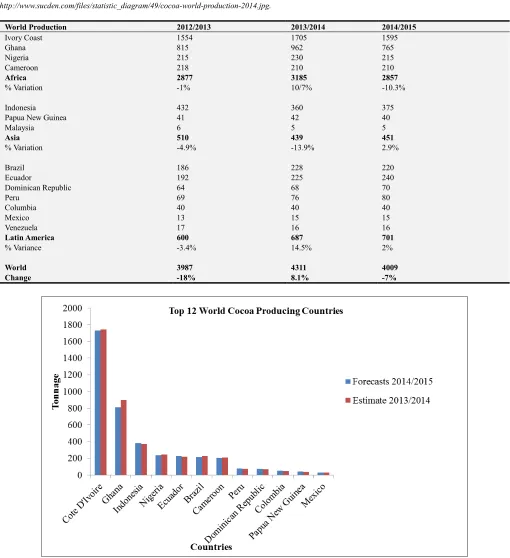
Table 1. Illustrates global cocoa beans production by country per year in metric tons. Sourced from http://www.sucden.com/files/statistic_diagram/49/cocoa-world-production-2014.jpg.
World Production 2012/2013 2013/2014 2014/2015
Ivory Coast 1554 1705 1595
Ghana 815 962 765
Nigeria 215 230 215
Cameroon 218 210 210
Africa 2877 3185 2857
% Variation -1% 10/7% -10.3%
Indonesia 432 360 375
Papua New Guinea 41 42 40
Malaysia 6 5 5
Asia 510 439 451
% Variation -4.9% -13.9% 2.9%
Brazil 186 228 220
Ecuador 192 225 240
Dominican Republic 64 68 70
Peru 69 76 80
Columbia 40 40 40
Mexico 13 15 15
Venezuela 17 16 16
Latin America 600 687 701
% Variance -3.4% 14.5% 2%
World 3987 4311 4009
Change -18% 8.1% -7%
Figure 1. Depicts major cocoa producing countries and production quantity in 2013/2014 and forecasts for 2014/2015. Sourced from http://www.confectionerynews.com/Commodities/What-is-the-future-of-cocoa-growing-in-Asia.
Cocoa production was introduced in the coastal zones of Cameroon in the late 19th century from Latin America (28, 29]. Ever since, it has long played a vital role in Cameroon’s economic development [30]. Cocoa belts occupy about 37% of total area under cultivation and annual production has grown from 120619 tons in 2000 to 232530 tons in 2014 with an annual export of about198130 tons in 2014 [31]. At this
of 1215622 FCFA (2055USD) per year, with annual average revenue of 145933 FCFA (247USD) per person. This annual average revenue varies according to production zone and ranges from 53504 FCFA (110USD) per year and per person in the South Region to 228263 FCFA (386USD) per year and per person in the South West Region [4, 33].
Cocoa is cultivated on an estimated total surface area of 450000 hectares (ha) by smallholders who usually farm on 1 to 3 ha of land [32]. Farms are created by cutting down large expanse of forests to plant food crops for subsistence purposes and cocoa for cash on the same piece of land [11, 17]. It is mostly cultivated in 7 of the 10 regions of Cameroon, with the Centre Region producing some 90000 tons per year. This is followed by the South with 48000 tons, the South West 46000 tons, the East with 25000 tons and the Littoral, West and the North West all contributing about 1000 tons each [31]. These production zones extend from the coastal zone around Mount Cameroon through the western highlands upto the central plateau of the Adamawa Region. The altitude is generally between 400m to 850m especially in areas around mount Cameroon and the western highlands. Mean annual rainfall patterns vary between cultivation zones and ranges from 1500mm in the western highlands to about 5000mm around Mount Cameroon. Average annual temperatures vary from 22°C in the western highlands to about 29°C around Mount Cameroon region.
Compared to other agricultural activities, cocoa has been a leading sub-sector in Cameroon’s economic growth and development and it remains the main cash crop to more than 75% of the population [4, 34]. The sector plays a preponderant role in the economy of rural communities in particular and nation in general. It is a pillar of the national export economy and one main activity that guarantees employment for the bulk of the rural population [29]. In growing areas, the overwhelming majority of the rural community derives at least 90% of their income from this activity.
The cocoa sector is dominated by smallholdings or peasant farmers with an average size of 1-3ha who, even though they are the main producers of the high demand crop, do not earn sufficient income to meet their needs and maintain a moderate standard of living [4, 34]. Here, farm labour and entrepreneurship in smallholdings are supplied by the family [35]. A smallholder is a farmer with limited resource endowment compared to other farmers in the same sector and may differ between countries and agro-ecological zones while resource could be in terms of land, capital or skill [36]. Smallholders differ across time and according to the significance attributed to smallholder agriculture in societies [37]. In most Asian and African countries for instance, a smallholder may have a farm size of 2 hectares and less as opposed to smallholders in Brazil with up to 50 hectares of farmland while smallholders in USA are farmers whose total volume of sales does not exceed 250000US$ [38].
3.1. Setbacks to Technical Efficiency and Cocoa Production
Lack of education in all forms has been very devastating in cocoa producing communities, rendering almost every family
helpless. Consequently these communities depend on their traditional lifestyles and they remain voiceless in decision making about their own resources. Issues of poor knowledge go beyond education alone and cover all activities from production through to marketing. Poor knowledge includes knowledge of privatization and how it affects the cocoa producer; poor marketing knowledge that would allow producers to search for better markets; poor technical knowledge of pest and pesticides application; poor knowledge to engage in alternative income generating activities; lack of education on modern farming methods; poor knowledge of processing and marketing of cocoa and cocoa products; poor knowledge of their rights to land and the environment [34, 39].
Due to recurrent poverty, smallholder cocoa famers suffer immensely from inadequate access to economic and social resources which endanger the cocoa sector and their entire livelihood. Farmers also lack adequate access to inputs such as fungicides, pesticides alongside a lack of transportation and production resources such as trucks to convey cocoa from farms to homes, and homes to market, diggers, vessels, tarpaulins, and ovens. In addition, these farmers lack proper storage facilities such as warehouses to store dried cocoa. There is absence of proper sound market knowledge to avoid prices; as such prices are being dictated to farmers by buyers. These local prices fell from 450 FRS to 150 FRS in 1997 and from 1200FCFA cfa to 400 FCFA in 2004 [4, 34, 39].
The government has neglected the sector since its privatization without necessarily educating farmers on privatization. This led to the collapse of the National Produce Marketing Board (NPMB) due to embezzlement of funds and corruption of the Board of Directors and stakeholders. In many instances, government officials tend to collaborate with stakeholders in the sector to impose prices on the farmers and use fake scales. Farmers no longer receive any assistance from the tax control department of the ministry of finances. These controls were used to effectively monitor and trap merchants using illegal spring balances and scales to purchase cocoa and cocoa products. Additionally, the government has failed to recognize the problems of these communities like lack of farm to market roads, social facilities like hospitals, schools and teachers.
3.2. Consequences of These Setbacks
labour force and lack of adequate fungicides to combat the black pod disease (Phytophthora megakarya). This disease requires constant and adequate application during heavy rains which is very common in the equatorial rainforest of Cameroon [41, 42].
Damages and wastes in cocoa production accounts for over 30% in annual losses and insect pests like the capsides bugs (Miridae spp) cause ripening of immature cocoa pods [43]. Other damages arise from parasites such as mistletoe (Loranthus parasiticus) which cause death of cocoa trees and tillage from cassava cultivators who cut the roots of cocoa trees. Damages are also known to result from overheating and stress when trees are exposed to direct sunlight.
In addition, many families then prefer to grow other crops like cassava (Manihot esculenta), yams (Dioscorea cayenensis) and cocoyam (Colocassia esculenta) instead of cocoa trees, hence deteriorating soils. These crops are staple foods and do not grow well among other trees and as such leads to the complete clearance of the vegetation. The resultant vegetation loss, causes rapid land degradation, loss of top soil quality, erosion, drought with negative impacts on biodiversity [44]. The tubers absorb many nutrients from the soil and do not produce much biomass for replenishing the soil.
3.3. Towards Sustaining Cocoa Production in Cameroon
Cocoa research is handled by the Institute for Agronomic Research (IRAD) which is the sole research Institute that researches on perennial crops such as (cocoa, coffee, fruit, oil palm and rubber) and marketable tubers such as (root tuber, market gardening crops, and plantains). In Cameroon there are specialized cocoa research Institutes which handle everything concerning cocoa research. These include Farmer Field Schools to train farmers on integrated pest management through the sustainable tree crop program and the newly created Agriculture Training High School in Yabassi around the Littoral Region. The European Union also provided over 2500 Samoan Ovens to the South West Cocoa Farmers within a period of eight years which benefitted some 20% of the farmers.
In collaboration with the International Labour Organization, local and national Non-Governmental Organizations are sensitizing the population on child labour issues in cocoa farms. This campaign is also aided by the American Embassy in Cameroon’s yearly exhibition on the fight against child labour. Similarly, the United States Department of Agriculture sponsored a tree crop production, marketing and livelihoods project in the Centre and South West Regions of Cameroon. This project executed by the International Institute of Tropical Agriculture (IITA), is being implemented under four major components namely Production Activities, Income Generating activities, Capacity building activities, and Micro credit activities. Furthermore, the launching of the cocoa fund by the Government of Cameroon shall have a great impact on the sustainability of the cocoa economy. In order to facilitate transactions in internal markets and to guarantee a healthy and fair competition within the cocoa sector, the National Cocoa and Coffee Board of Cameroon was created. It aims at checking on cocoa quality, collect statistics, facilitate export,
and represent the interests of the cocoa industry within and without Cameroon.
4. Conclusion
In this study, we tried to examine the technical efficiency of smallholder cocoa farmers in Cameroon by drawing on examples from Cameroon and Africa. We found that cocoa production offers significant opportunities for poverty alleviation and sustainable development if the necessary infrastructure and support are provided and facilitated. In addition, we also observed that there are three main factors which affect the cocoa sector in Cameroon including poor knowledge on the part of farmers, community poverty and government influence. These smallholdings are compromised by ageing cocoa trees and aging farmers, lack of adaptive capacities, low levels of technical efficiency, lack of government subsidies and credit schemes.
References
[1] Weekley, J., Gabbard, J and Nowak, J (2012). Micro-level management of agricultural inputs: emerging approaches. Agronomy 2: 321-357.
[2] Figurek, A (2015). Information Base for Decision-Making at the Micro and Macro Levels in Agriculture. RJOAS, 2(38). file:///F:/information-base-for-decision-making-at-the-micro-a nd-macro-levels-in-agriculture.pdf. Accessed 30th April, 2017. [3] Chiona, S (2011). Technical and allocative efficiency of
smallholder maize farmers in Zambia. Master of Science Thesis. University of Zambia, Lusaka, Zambia.
[4] Ngoe, M., Jing, Z., Mukete, B., Tabi, G., Kimengsi, J and Aniah, D (2016). Analysis of the technical efficiency of smallholder cocoa farmers in south west Cameroon. American Journal of Rural Development 4(6): 129-133.
[5] Akazili, J., Adjuik, M., Chatio, S., Kanyomse, E., Hodgson, A., Aikins, M and Gyapong, J (2008). What are the technical and allocative efficiencies of public health centers in Ghana? Ghana Medical Journal 42(4): 149–155.
[6] Wautabouna, O (2012). Economic efficiency analysis in Côte d’Ivoire. American Journal of Economics 2(1): 37-46. [7] Onumah, J., Ramatu, M and Onumah, E. (2013). Productivity
and Technical Efficiency of Cocoa Production in Eastern Ghana. Journal of Economics and Sustainable Development 4(4): 106-117.
[8] Rodriguez-Alvarez A., Tovar, B and Trujillo, L (2007). Firm and time varying technical and allocative efficiency: an application to port handling firms », International journal of production economics 109(1-2): 149 – 161.
[9] Alvarez, A and Arias, C (2004). Technical efficiency and farm size: a conditional analysis. Agricultural Economics 30 (3): 241–250.
[11] Tabi, G., Su, Q and Ngoe, M (2017). The economic analysis of resource used efficiency for cocoa production in Cameroon: the case study of Lekie Division. American Journal of Rural Development 5(5), 123-137. DOI: 10.12691/ajrd-5-5-2.
[12] Cobbina, J (2014). Technical Efficiency of Cocoa Production in Ghana, a case study of Upper Denkyira East Municipality. Master of Philosophy Thesis, Nkwame Nkrumah University of Science and Technology, Ghana.
[13] Tchale, H and Sauer, J (2007). The efficiency of maize farming in Malawi. A bootstrapped translog frontier. Cahiers d'Economie et Sociologie Rurales 82-83: 33-56.
[14] Basnayake, B and Gunaratne, L (2011). Estimation of technical efficiency and it's determinants in the tea small holding sector in the mid country wet zone of Sri Lanka. Sri Lankan Journal of Agricultural Economics 4: 137–150. [15] Wokia-azi, N., Bisseleua, H and Klasen, S (2010).
Opportunities and constraints in agriculture: A gendered analysis of cocoa production in Southern Cameroon. Discussion Papers 27 in Poverty, Equity and Growth in Developing and Transition Countries: Statistical Methods and Empirical Analysis. Courant Research Centre. Georg-August-Universität Göttingen, Germany. https://www.academia.edu/9859357/Opportunities_and_constr aints_in_agriculture_A_gendered_analysis_of_cocoa_producti on_in_Southern_Cameroon. Accessed 23rd October, 2016. [16] Tosam, J and Njimanted, G (2013). An analysis of the
socio-economic determinants of cocoa production in Meme Division, Cameroon. Greener Journal of Business and Management Studies 3 (6): 298-308.
[17] Kimengsi, J and Tosam, J (2012). Climate variability and cocoa production in Meme Division of Cameroon: agricultural development policy options. Greener Journal of Agricultural Sciences 3 (8): 606-617.
[18] Nchare, A (2007). Analysis of factors affecting the technical efficiency of Arabica coffee producers in Cameroon. African Economic Research Consortium (AERC) research paper 163, Nairobi, Kenya. Available at
https://opendocs.ids.ac.uk/opendocs/bitstream/handle/123456 789/2675/RP%20163.pdf?sequence=1&isAllowed=y. Accessed 11th September, 2016.
[19] Dessale, M (2017). Technical efficiency in teff production: the case of smallholder farmers in Jamma District, South Wollo Zone, Ethiopia. Master of Science Thesis. Haramaya University, Haramaya Ethiopia
[20] Agom, D., Susan, O., Itam, K and Inyang, N (2012). Analysis of technical efficiency of smallholder cocoa farmers in Cross River State, Nigeria. International Journal of Agricultural Management and Development 2(3): 177-185.
[21] Onyenweaku, C and Okoye, C (2005). Trends in cassava output, area and productivity in Nigeria, 1960/61-2003/04. In: Orheruata, A. M., Nwokoro, S. O., Ajayi, M. T., Adekunle, A. T. and Asumugha, G. N. (eds). Agricultural rebirth for improved production in Nigeria. Proceeding of the 39th Annual Conference of the Agricultural Society of Nigeria, October 9-13, 2005. University of Benin, Benin City, Nigeria. pp. 19-21. [22] Besseah, F and Kim, S (2014). Technical Efficiency of Cocoa
Farmers in Ghana. Journal of Rural Development 37 (2): 159-182.
[23] Danso-Abbeam G., Aidoo R., Agyemang K and Ohene-Yankyera,
K (2012). Technical efficiency in Ghana’s cocoa industry: evidence from Bibiani -Anhwiaso-Bekwai District. Journal of Development and Agricultural Economics 4(10): 287-294. [24] Ali, E (2017). Inorganic fertilizer adoption and technical
efficiency of cocoa farmers in the western Region of Ghana. Master of Science Thesis. University for Development Studies, Tamale Ghana.
[25] Baloyi, R., Belete, A., Hlongwane, J and Masuku, B (2011). Technical efficiency in maize production by small-scale farmers in GaMothiba, Limpopo Province, South Africa. African Journal of Agricultural Research 7: 5478-5482. [26] Makgalabone, S (2015). Analyzing the technical and
allocative efficiency of small scale maize farmers in Tzaneen Municipality of Mopani District. A Cobb-Douglas and Logistic regression approach. Master of Science Thesis. University of Limpopo, South Africa.
[27] Mahdi, N., Mongi S and Bachta, S (2009) in El Moujabber M. (ed.), Mandi L. (ed.), Trisorio-Liuzzi G. (ed.), Martín I. (ed.), Rabi A. (ed.), Rodríguez R. (ed.). Technological perspectives for rational use of water resources in the Mediterranean region. Options Méditerranéennes: Série A. Séminaires
Méditerranéens 88: 289-300. Available at
http://ressources.ciheam.org/om/pdf/a88/00801204.pdf. Accessed 30th April, 2013.
[28] Fule, B (2014). Small-scale versus large-scale cocoa farming in Cameroon. Which farm type is more ready for the future? Master of Science Thesis. Swedish University of Agricultural Sciences, Uppsala, Sweden.
[29] Nkelle, N (2010). The Sustainability of Cameron Cocoa Economy. https://www.icco.org/sites/www.roundtablecocoa.org/docume nts/3%20Mr.%20Ngo%20Nkelle%20Victor%20-%20Camero on.pdf. Accessed 1st November, 2016.
[30] Armathé, J., Mesmin, T., Unusa, H and Soleil, B (2013). A comparative study of the influence of climatic elements on cocoa production in two agro-systems of bimodal rainfall: Case of Ngomedzap forest zone and the contact area of forest-savanna of Bokito. Journal of the Cameroon Academy of Sciences 11(1).
[31] NCCB (2014). (National Cocoa and Coffee Board). Cocoa Statistics. NCCB. Retrieved from www. oncc.com.
[32] ICCO (2014). (International Cocoa Organization). Cocoa year in Cameroon 2013/2014. Quarterly Bulletin of Cocoa Statistics, XL (1).
[33] Folefack, P (2010). Pauvreté et répartition des revenus en zone cacaoyère du Cameroun. TROPICULTURA 2891: 5-9. [34] Nfinn, T (2005). COCOA PRODUCTION IN CAMEROON.
AFTA 2005 Conference Proceedings. Available at http://www.worldagroforestry.org/treesandmarkets/inaforesta/ documents/agrof_cons_biodiv/cocoa%20cameroon.pdf Accessed 11th October, 2015.
[35] Lipton, M., Ellis, F and de Klerk, M (1996). Introduction to land, labour and livelihood in rural South Africa. Western Cape. Indicator Press. South Africa.
[36] Dixon J, Tanyeri-Abur, A and Wattenbach, H (2004). Framework for analyzing impacts of globalization on smallholders. FAO Agricultural Management, Marketing and Finance Occasional Paper.
[37] IFAD (2012). International Fund for Agricultural Development. Land Tenure and Poverty Reduction, IFAD factsheet, available at
http://www.ifad.org/pub/factsheet/land/e.pdf. Accessed 7th October, 2017.
[38] HLPE. (2012). High Level Panel of Experts of the FAO on Food Security and Nutrition. Key elements, Rome. Available at:
http://www.fao.org/fileadmin/user_upload/hlpe/hlpe_documen ts/HLPE-Key-elementsonline-2012-05-30.pdf. Accessed 11th September, 2017.
[39] Mukete, B and Monono, S (2014). Assessing the impact of consumer behaviour on food security in south west Cameroon. Journal of Food Security 2 (3): 87-91.
[40] Mukete, B., Sun, Y., Ayonghe, S., Ojong, L., Itoe, C and Tamungang, R (2017a). Adaptation of women to climate
variability in the southern slopes of the Rumpi hills of Cameroon. Agriculture, Forestry and Fisheries 5(6): 272-279. [41] Guest, D (2007). Black Pod: Diverse pathogens with a global
impact on cocoa yield. Phytopathology 97: 1650–1653. [42] Opoku, I., Akrofi, Y and Appiah, A (2002). Shade trees are
alternative hosts of the cocoa pathogen Phytophthora megakarya. Crop Protection 21: 629–634.
[43] Tamanjong, E and Neena, R (2014). Insect threat to Cameroon cocoa crop. Sap-sucking bug infests African Nation as demand for chocolate ingredient is set to outstrip supply. http://www.wsj.com/articles/sb1000142405270230379590457 9433041249679608. Accessed 4th January, 2016.