http://www.sciencepublishinggroup.com/j/am doi: 10.11648/j.am.20170605.15
ISSN: 2327-2503 (Print); ISSN: 2327-252X (Online)
Biosorption of Cd(ll), Cu(ll) and Ni(ll) Ions from Aqueous
Solution Using Jatropha Curcas Seed Pod
Onwu Francis Kalu
*, Nwokedi Chizoba Bridget
Department of Chemistry, Michael Okpara University of Agriculture, Umudike, Nigeria
Email address:
[email protected] (O. F. Kalu)
*Corresponding author
To cite this article:
Onwu Francis Kalu, Nwokedi Chizoba Bridget. Biosorption of Cd(ll), Cu(ll) and Ni(ll) Ions from Aqueous Solution Using Jatropha Curcas Seed Pod. Advances in Materials. Vol. 6, No. 5, 2017, pp. 77-84. doi: 10.11648/j.am.20170605.15
Received: March 13, 2017; Accepted: April 15, 2017; Published: October 24, 2017
Abstract:
Batch adsorption studies were conducted to determine the extent and nature of adsorption of Ni(ll), Cu(ll) and Cd(ll) ions from aqueous solutions onto JatrophacurcasSeed pod. The effects of pH, initial metal ion concentration and presence of co-ions were studied. Results showed that the adsorption process was dependent on pH, having optimum pH for adsorption of Ni(ll) at 7.0 and with maximum amount adsorbed as 9.23 mg/g. That of Cu(ll) occurred at pH 8.0 with maximum amount adsorbed as 9.65 mg/g while for Cd(ll), the pH for optimum adsorption occurred at pH 6.0 with maximum amount of 9.99 mg/g adsorbed. Evaluation of percentage removal shows that the percentage of Ni(ll), Cu(ll) and Cd(ll) adsorbed at their optimum pH corresponded to 92.30%, 96.50% and 99.90% respectively. Increasing the initial concentration of the metal ions was also found to increase the adsorption capacity for the metal ions by the adsorbent. The experimental data were interpreted using three isotherm models viz; the Langmuir, Freundlich and Dubinin-RadushKevich isotherms. Results showed that the Freundlich isotherm provided the best fit to the experimental adsorption data. The mean free energy values, E (which ranged from 1.343 to 2.275 kJ mol-1) calculated from the Dubinin-RadushKevich (D-R) isotherm equation suggests weak interaction between the metal ions and the adsorbent, thus revealing that the mode of the adsorption process follows physisorption. Assessment of competitive adsorption of the metal ions from mixed metal ions solutions shows that the presence of foreign ions in the solution diminished the adsorption density of the metal ion under consideration. The results generally showed that the order of adsorption of the metal ions onto the biosorbent follows the trend Cd(ll) > Cu(ll) > Ni(ll).Keywords:
Adsorption Isotherms, Biosorbent, Heavy Metals, JatrophaCurcas, Wastewaters1. Introduction
Heavy metals have been excessively released into the environment due to rapid industrialization and have created a global concern. Copper, lead, zinc, cadmium, nickel, mercury and chromium are often detected in industrial wastewaters which originate from metal plating, mining activities, smelting, battery manufacturing, tanneries, petroleum refining, paint manufacturing, pesticides, pigment manufacturing, printing and photographic industries [1-4]. Unlike organic wastes which are biodegradable, most of the heavy metals are non-biodegradable and can accumulate in living tissues, causing various diseases and disorders. It is therefore imperative to treat heavy metal contents in wastewaters before discharge into water bodies because of
concentrations to very low level. This can be achieved either by decreasing the influx of heavy metals to the receiving water bodies (rives, lakes, dams etc.) or by removing them from contaminates media. If heavy metal pollution arises from anthropogenic activities, then it can be prevented but if it is of natural origin then it is unavoidable.
Some of the conventional methods that have been applied for removing heavy metals from wastewater include: ion exchange, chemical precipitation, reverse osmosis, evaporation and membrane filtration. Most of these methods suffer from some drawbacks such as high capital and operational cost, and difficulty in the disposal of the residual metal sludge and as a result make the applications of these techniques unsuitable for small scale industries [6]. Beside the aforementioned drawbacks, these conventional methods have inadequate efficiencies when low concentrations of the metal ions are involved, particularly in the range of 1-100mg/L [7, 8]. Adsorption has proven a more promising and efficient method for heavy metal removal from aqueous solutions and is found suitable even when the ions are present in concentration as low as 1 mg/L [9, 10].
Research interests into the production of cheaper adsorbents to replace costly wastewater treatment methods are now attracting attention of scientists [11-13]. An adsorbent can be considered as cheap or low cost if it is abundant in nature, requires little processing and is a by-product of waste material from industry. Plant wastes are inexpensive as they have little or no economic values and therefore meet these requirements.
The present research work is concerned with the evaluation of the potential of Jatropha curcas seed pod as adsorbent for the removal of cadmium(ll), copper(ll) and nickel(ll) ions from aqueous solution. In this study, the effects of some major parameters affecting adsorption such as pH, initial metal ion concentration and presence of co-ions were investigated and experimental data were interpreted using different adsorption isotherm models.
2. Materials and Methods
2.1. Preparation of the Adsorbent
The Jatropha curcas seed pod used as adsorbent in the present study was obtained from Umuariaga community in Ikwuano, Abia State. The fruits were harvested from the plant stems. The pods were obtained from the seeds and were washed copiously with water to remove impurities. They were sun dried for six days and later oven dried at 90°C for 2 h and then blended using grain mill blender and sieved to obtain a particle size of 80 m, which were kept for the adsorption study.
The adsorbents were activated by soaking them in a 0.3M HNO3 solution, stirred for 30 min and then kept undisturbed
for 24 h at a temperature of 30°C. They were filtered and air dried. The adsorbents were finally oven-dried at 105°C for 6 h and then stored in different vesselsin readiness for the adsorption study. The activation of the adsorbent aids in opening up the micropores of the adsorbent, which is
expected to enhance the surface performance of the biosorbent.
2.2. Preparation of Heavy Metal Solutions
Stock solutions of 1000 mg/L of each of the metal ions Cd(ll), Cu(ll) and Ni(ll) used for the adsorption study were prepared from the salt of the individual ions namely; cadmium(ll) chloride, copper(ll) chloride and nickel(ll) sulphate respectively. From the stock solutions, various working concentrations of 10 mg/L, 20 mg/L, 30 mg/L, 40 mg L-1and 50 mg/Lof each of the metal ions were prepared by serial dilution. Equilibrium adsorption of the metal ions onto the biosorbent was studied as a function of pH, initial metal ion concentration and presence of co-ions.
The effect of pH on adsorption of the metal ions was studied by varying the pH of the metal solution using 0.1M solutions of HC land NaOH to adjust the pH to the required pH and pH values of 2.0, 4.0, 6.0, and 8.0 were obtained. Exactly 25cm3 portions of 50mg L-1of each of the metal ion solutionswere introduced into different 100 cm3Erlenmeyer flasks containing 0.125 g of the biosorbent of particle size 80 µm. The mixtures were shaken intermittently in a thermostated mechanical shaker maintained at 30°C for 2 h and then filtered. The residual metal ion concentration of each filtrate was finally determined by atomic absorption spectrophotometer AAS (Unicam model 966).
The effect of initial metal ion concentration on equilibrium adsorption of the Cu(ll), Ni(ll) and Cd(ll) ions by the Jatropha curcas seed pod was carried out by introducing 25cm3 of various concentrations (10 mg L-1, 20 mg/L, 30 mg/L, 40 mg/L and 50 mg/L) of the metal ions into different 100 cm3Erlenmeyer flasks containing 0.125 g of the adsorbent of particle size 80 µm. The flasks were shaken for 2 h in a thermostated mechanical shaker maintained at a temperature of 30°C and at a pH 6.0. At the end of the contact time (2 h), the mixtures were filtered rapidly into separate sample bottles. The residual metal ion concentration in the filtrate was determined using atomic absorption spectrophotometer. Concentration of blank solution (without adsorbent) was also measured.
Generally, the described procedure for each parameter was carried out in triplicates and mean residual concentration taken. The amount adsorbed (mg/g) and percentage adsorption were both calculated from the average residual metal ions concentration in solution.
The same procedure was repeated to evaluate competitive effect of adsorption of binary mixtures of the metal ions by combining two metal ions of equal molar concentration (i.e. 25 cm3of 50 mg L-1of each of the metal ions) and adding 0.25 g of the adsorbent. After shaking for 2 h, the content of each flask was filtered and the filtrate collected into sample bottles. The equilibrium concentrations ofCu(ll) as a single metal ion after adsorption and in the presence ofco-ions were determined using AAS.
3. Results and Discussion
3.1. Effect of pH on Adsorption of the Metal Ions by the Adsorbent
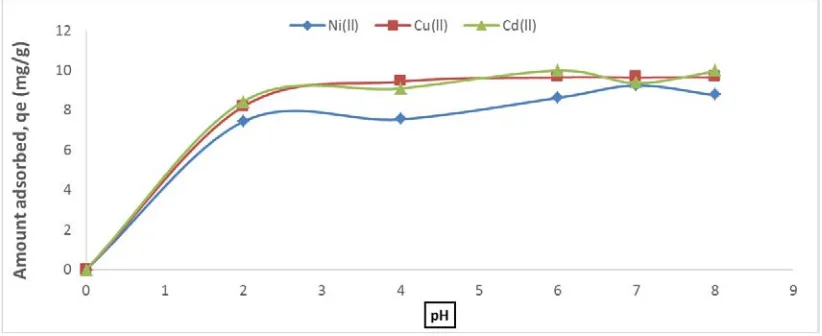
The pH of a solution is one of the most important variable factors governing metal ion adsorption. This is because the pH of a solution affects both the surface binding sites of the adsorbent and the solution chemistry. Figure 1 shows the plots of amount of metal ions adsorbed onto the Jatropha curcas seed pod as a function of pH.
From Figure 1, it could be seen that the amount of metal ions adsorbed by Jatropha curcas seed pod increased as the initial pH of the solution increased from 2-8. Maximum amount of 9.99 mg/g (corresponding to 99.90% removal) was obtained at pH 6 for Cd(II) ion. That of Cu(ll) has its maximum amount adsorbed as 9.65 mg/g (corresponding to 96.50% removal) at a pH 8.0 while optimum pH for adsorption of Ni(ll) occurred at pH 7 and with maximum amount adsorbed as 9.23 mg/g corresponding to 92.30% removal. The increase in the amount of metal ions adsorbed with pH is attributed to the fact that decreasing solution pH increases H+concentration in solution, which may compete with the metal ions for active sites on the adsorbent surface and will consequently cause a decrease in the adsorption
capacity of the adsorbent for the metal ions under study. The trend of adsorption of the metal ions by the adsorbent at their optimum pH follows: Cd(ll) > Cu(ll) > Ni(ll), indicating that the adsorbent has high affinity for cadmium(ll) ions.
The degree of adsorption of metal ions usually depend on such factors as ionic radii of the metal ions, their hydration energies and nature of salt of the anion of the metal under study. The trend of adsorption of the metal ions in this study may have depended on the ionic radii of the metal ions and the stability of the aquo ion complex formed during the adsorption process. Since the dynamics of an adsorption process is dependent on the ease of displacement of water molecules from aquo ion complex, the stability of the aquo ion complex may therefore play a vital role in the adsorption process. The ionic radius and hydration energy of cadmium(ll) ions are 0.97 Å and -1806 kJ mol-1 respectively while Cu(ll) and Ni(ll) ions have ionic radii and hydration energies as 0.73 Å, -2279.7 kJ mol-1and 0.72 Å,-2983 kJ mol
-1
respectively. The stability of aquo ion complex of metal ions has been observed to depend on their hydration energies, which is further observed to be dependent on the size of the ions [14, 15]. Ions with a relative large size (having low hydration energies) will attach less strongly to the water molecules than those with smaller size (and of course relatively high hydration energy). This idea could have led to a better anchorage of the Cd(ll) ions onto the binding sites than the other metal ions. It could therefore be suggested that an ion with a large size may interact with the active sites on the adsorbent surface much more easily than those with smaller sizes because of ease of displacement of water molecules from the aquo ion complex during anchorage. This idea may have contributed to the greater removal of Cd(ll) ions from solution as against Cu(ll) and Ni(ll) ions.
Figure 1. Variation of amount adsorbed with pH for the adsorption of Ni(ll), Cu(ll) and Cd(ll) ions onto Jatropha curcas seed pod.
3.2. Effect of Initial Metal ion Concentration on the Adsorption Process
The determination of the effect of initial concentration on the adsorption of metal ions is important as it affords the metal ions sufficient driving force required to surmount all
shows the plots of percentage adsorption of the metal ions as a function of initial metal ion concentration. From Figure 2, it could be seen that the amount of metal ions adsorbed increased as the initial concentration increased from 10 mg L
-1
to 50 mg L-1. Examination of the plots in figure 3 shows that the percentage of metal ions adsorbed increased first upto initial concentration of 20 mg/Land then decreased progressively as the initial concentrations of the metals ions increased above 20 mg L-1. This decrease in percentage adsorption with increasing metal ion concentration could attributed to the fact that at lower metal ion concentrations,
almost or greater part of the ions are adsorbed by the adsorbent but as the initial concentration increased (at a given mass of the adsorbent), most of the metal ions are left unadsorbed due to saturation of the available binding sites and this consequently leads to a decrease in percentage metalion adsorbed. The results generally showed that the affinity of the Jatropha curcas for the metal ions followed the trend: Cd(II) > Cu(II) > Ni(II) ions, indicating that the adsorbent has a high affinity for Cd(ll) in preference to Cu(ll) and Ni(ll) ions.
Figure 2. Variation of amount adsorbed with initial metal ion concentration for the adsorption of Ni(II), Cu(II) and Cd(II) ions onto Jatrophacurcas seed pod.
Figure 3. Variation of percentage metal adsorption with initial metal ion concentration for the adsorption of Ni(II), Cu(II) and Cd(II) ions onto Jatrophacurcas seed pod.
3.3. Adsorption Isotherms
An adsorption isotherm presents a distinct picture of equilibrium distribution of adsorbates between the liquid and the solid (adsorbent) phases at a given temperature. Each adsorption isotherm is characterized by certain constant values, which aid in the explanation of the surface properties and affinity of the adsorbates for the adsorbents. Three different isotherm models were applied to the adsorption study in order to assess their correlation with the experimental data and these include: Langmuir, Freundlich
and Dubinin-Radushkevich isotherm models.
3.3.1. The Langmuir Adsorption Isotherm
The Langmuir Isotherm assumes that adsorption is only restricted to monolayer coverage and that there are no lateral interactions between the adjacent adsorbed molecules.
The linearized Langmuir isotherm equation is expressed as:
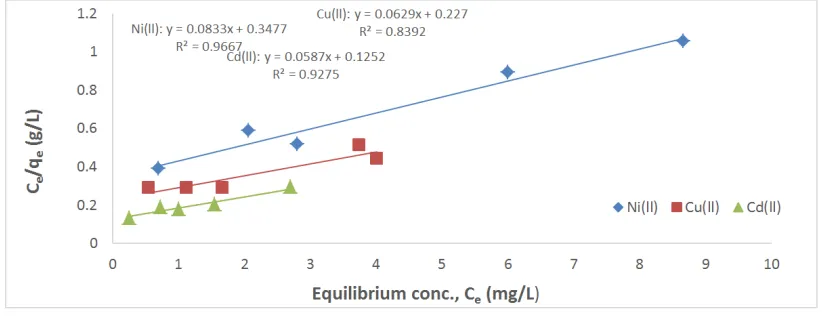
Where is the equilibrium adsorption capacity (mg/g), is maximum adsorption upon complete saturation of the adsorbent, isresidual (equilibrium) concentration of the metal ions after adsorption (mg/L), while is the Langmuir constant relating to the adsorption/desorption energy. The experimental data were fitted into equation (1) by plotting / versus . The linear plots obtained are shown in Figure 4. From the slopes and intercepts of the linear plots, the Langmuir isotherm parameters, and were calculated and presented in Table 1.
From Table 1, it could be seen that values obtained for adsorption of the metal ions onto the Jatropha curcas seed pod followed the trend Cd(II) > Cu(II) > Ni(II) ions. The Langmuir constant, , which is related to the apparent energy of adsorption followed the same trend i.e., Cd(II) > Cu(ll) > Ni(ll), revealing further that the adsorbent showed better removal for Cd(II) than Cu(II) and Ni(II) ions. Hanet al. [16] had stated that a high value indicates a high adsorption intensity for the metal ions onto the adsorbent. The correlation coefficients (R2 values) obtained from the Langmuir plots in
this study ranged from 0.8392 to 0.9667 (Table 1) indicating that the adsorption data fitted well into the Langmuir Isotherm. The dimensionless equilibrium parameter (separation factor), RL which explains the favourability of the adsorption systems
was evaluated using equation (2):
= (2)
Where Co is the initial concentration of the metal ions in
solution (mg/L). Other parameters have their usual meanings. In using the dimensionless equilibrium parameter, RL for
assessment of suitability of Langmuir Isotherm, the isotherm is described as: unfavorable when RL > 1, linear when RL =
1, favourable when 0 < RL < 1 and irreversible when RL = 0.
The RL values obtained for the adsorption of the three metal
ions by Jatropha curcas in the present study were all less than unity (Table 1) for all the initial concentrations studied, indicating that the isotherm was favourable under the conditions of the present study.
Figure 4. The Langmuir isotherm plot for adsorption of Ni(II), Cu(II) and Cd(II) ions onto Jatropha curcas seed pod.
Table 1. Langmuir Isotherm Parameters.
Parameters Metal ions
Ni(ll) Cu(ll) Cd(ll)
qmax(mg/g) 12.00 15.90 17.04
(L//g) 0.2397 0.2771 0.4687
RLvalues
at 10 mgL-1 0.2943 0.2652 0.1758
20 mgL-1 0.1726 0.1529 0.0964
30 mgL-1 0.1221 0.1074 0.0664
40 mgL-1 0.0944 0.0828 0.0506
50 mgL-1 0.0770 0.0673 0.0401
R2 0.9667 0.8392 0.9275
3.3.2. The Freundlich Adsorption Isotherm
This is commonly used to describe the adsorption characteristics on heterogeneous surfaces [17]. The linearized Freundlich equation is expressed as equation (3):
= + (3)
Where is the equilibrium adsorption capacity (mg/g), is theresidual (equilibrium) concentration of metal ions in solution after adsorption (mg/L), and n are Freundlich constants which are characteristic of the sorbent-sorbate
system. The value of n indicates the affinity of the metal ions towards the adsorbent while the constant gives an approximate indicator of the adsorption capacity. Also, the value of gives an insight into the strength of adsorption in
the adsorption process [18]. If the value of is below one, it
indicates a normal adsorption and value above one indicates cooperative adsorption [19]. Generally, if n values lie between one and ten, then it indicates a favourable adsorption process while n= 1 shows that the partition between the two phases are independent of the concentration.
A plot of versus gave straight lines showing the correlation of the Freundlich adsorption isotherm to the experimental adsorption data and the plots are shown in Figure 5. The Freundlich parameters, n and were evaluated from the slope and intercept of the linear plots and are presented in Table 2. From table 2, n-values were found to range from 1.3959 to 1.6683, indicating favourable adsorption for the process under consideration. The linear correlation coefficients (R2 values) which ranged from 0.9506 to 0.9793 indicate that the Freundlich Isotherm provided the best fit for the equilibrium adsorption data.
suggesting that Jatropha curcas adsorbent has greater affinity for Cd(II) ions than Cu(II) and Ni(II) ions.
Figure 5. The Freundlich isotherm plots for adsorption of Ni(II), Cu(II) and Cd(II) ions onto Jatropha curcas seed pod.
Table 2. FreundlichIsothermParameters.
Parameters Metal ions
Ni(ll) Cu(ll) Cd(ll)
2.4056 3.3009 5.1572
n 1.6683 1.3959 1.4162
R2 0.9677 0.9506 0.9793
3.3.3. The Dubinin-Radush Kevich Isotherm Model
The Dubinin-Radushkevich(D-R) isotherm is generally applied to express the adsorption mechanism with a Gaussian energy distribution onto a heterogeneous surface [20]. The linearized D-R isotherm model is expressed as equation (4):
ln = !− #!$% (4)
Where is the amount of metal ions adsorbed at equilibrium (mg/g), ! isthe theoretical isotherm saturation capacity (mg/g),#is a constant relating to the mean free energy of adsorption (mol2/kJ2) while ε is called the Polanyi potential, which is related to the equilibrium concentration as expressed in equation (5).
$ = RT (1+1/ ) (5)
R in eqn. (5) is the molar gas constant (8.314 J/mol/K), T is the study temperature (K) while is the equilibrium concentration of the metal ions (mg/L). The D-R isotherm is applied here to assess the mode of adsorption, i.e., whether
physical or chemical adsorption. The mean free energy, E per mole of the metal ion solutions as the metal ions are removed from solutions onto the adsorbent phase from infinite distance in the solution is computed by the relation:
E =
&%' (6)
The Dubinin-Radushkevich (D-R) plots are shown in figure 6. The constants ! and # were determined from the intercepts and slopes of the linear plots and their values presented in Table 3. The magnitude of E gives an idea of the nature of the adsorption process. With E values in the range 1-8 kJ/mol, it shows that physisorption is the predominant mode of adsorption while values in the range of 9-16 kJ/mol, show chemical adsorption [21-23]. From table 3, the mean free energy values E, for the adsorption process ranged from 1.343-2.275 kJ mol-1, implying that physical adsorption (physisorption) may play a major role in the adsorption process.
Table 3. Dubinin-RadushkevichIsotherm Parameters.
Parameters Metal ions
Ni(ll) Cu(ll) Cd(ll)
# (mol2/kJ2) 2.774 X 10⁻⁷ 2.193 X 10⁻⁷ 9.66 X 10⁻⁸
(mg/g) 6.631 8.113 8.229
E (kJ/mol) 1.343 1.510 2.275
R2 0.8705 0.9466 0.9011
3.4. Effect of Co-ions on Adsorption of the Metal Ions
The study on effect of co-ions on the adsorption process becomes more relevant when the selective adsorption of the metal ions occurs from an aqueous system. Since the pollution of the environment with toxic metals results from some human (anthropogenic) activities such as mining and metallurgy, battery manufacturing, paints industries etc., it means that effluents from these processes would carry varying mixtures of metal ions. Investigation into the competitive adsorption of the metal ions Ni(ll), Cd(ll) and Cu(ll) in a mixed metal ion system was carried out to assess the adsorption behaviour of these metal ions in an industrial effluents.
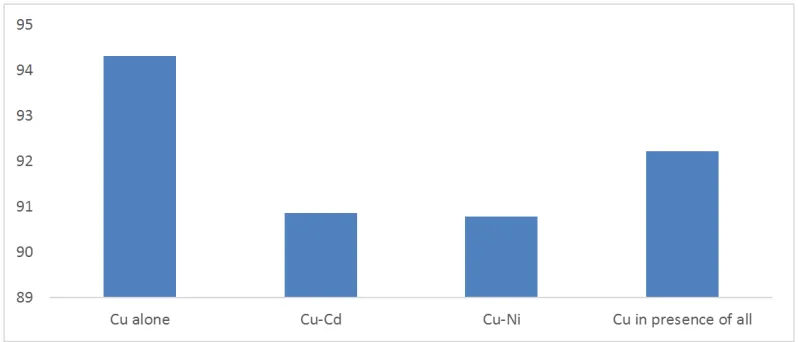
Figure 7 shows the variation of amount of Cu(ll) ions adsorbed as a single metal ion, as a binary mixture and as a
mixture of the three ions i.e., Cd(ll), Cu(ll) and Ni(ll). From the plots, it is observed that the presence of Ni(ll) and Cd(ll) as binary mixtures with Cu(II) depressed or inhibited the adsorption density of the Cu(ll) ions under consideration. Maximum inhibition of the Cu(ll) adsorption was found in its combination with Cd(ll) ion as a binary mixture. This reveals that Cd(ll) strongly competed with Cu(ll) ion for the active sites of the Jatropha curcas seed pod. These results show that in the adsorption of metal ions from a mixed metal ions systems, there are bound to be competition of the metal ions for active sites on the adsorbent surface and the ability of a particular metal ion to approach the active site faster may depend on such factors as ionic radii, hydration energies and nature of the salt of the anions which greatly affect the solubility of the salt.
Figure 7. The influence of co-ions Ni(ll) and Cd(ll) on adsorption of Cu(ll) onto Jatropha curcas seed pod.
4. Conclusion
The impact of heavy metal contamination and pollution on the environment must be controlled for an environmental-friendly habitation. There is therefore a need for the treatment and removal of heavy metals from solutions and industrial effluents.
In the present research work, Jatropha curcas seed pod was used as an adsorbent to remove Ni(ll), Cu(ll) and Cd(ll) ions from aqueous solution. The effects of pH, initial metal ion concentration and presence of co-ions were investigated. The adsorption of the metal ions was found to be pH dependent with optimum pH for adsorption of Ni(ll) occurring at pH 7.0, that of Cu(ll) at 8.0 and Cd(ll) at pH 6.0. Increasing initial concentrations (10 mg/L – 50 mg/L) of the metal ions was found to increase the adsorption capacity of the adsorbent for the metal ions. The experimental data were interpreted using three isotherm models viz; the Langmuir, Freundlich and Dubinin-Radushkevich isotherms and the experimental equilibrium data were best fitted by the Freundlich isotherm. The mean free energy values of adsorption, E calculated from Dubinin-Radushkevich isotherm plots suggest that the adsorption process followed
physical adsorption. Competitive adsorption of the metal ions from the synthetic wastewater (i.e., mixture of the metal ions) reveals that the presence of foreign ions in solution diminished the adsorption density of the metal ions under consideration. Results generally showed that the adsorption of the metal ions by the adsorbent, Jatropha curcas seed pod followed the trend: Cd(ll) > Cu(ll) > Ni(ll) ions, indicating a higher affinity for Cd(ll) than the other metal ions by the adsorbent.
References
[1] J. F. Amaku and F. K. Onwu “Effect of co-ions on the biosorption of Cr(lll) from aqueous solutions using Luffa cylindrical fibre: Equilibrium consideration” Der ChemicaSinica, Vol. 6, no. 4, pp. 114-124, 2015.
[2] K. Kadirvelu, K. Thamaiselviand C. Namasivayam “Adsorption of nickel (ll) from aqueous solution onto activated carbon prepared from coirpith” Separation and Purification Technology, Vol. 24, pp. 495- 505, 2001.
[4] A. K. Nasim, S. Shaliza and S. Piarapakaran “Elimination of Heavy Metals from Wastewater Using Agricultural Wastes as Adsorbents” Malaysian Journal of Science, Vol. 23, pp. 43-51, 2004.
[5] De Ak, Environmental Chemistry, 2nd edition, Wiley Easter ltd, New Delhi, 1992.
[6] M. Kobya, E. Dermibas, E. Senturk andM. Ince “Adsorption of heavy metal ions from aqueous solutions by activated carbon prepared from apricot stone. Bioresource Technol., Vol. 96, no. 13, PP. 1518-1521, 2005.
[7] A. Kapoorand T. Viraraghavan “Fungalbiosorption — an alternative treatment option for heavy metal bearing wastewaters: a review” Bioresource Technology, Vol. 53, no. 3, pp. 195-206, 1995.
[8] F. K. Onwu, C. U. Sonde and J. C. Igwe “Adsorption of Hg2+ and Ni2+ from aqueous solutions using unmodified and Carboxymethylated granular activated carbon (GAC)”
American Journal of Physical Chemistry, Vol. 3, no. 6, pp. 89 -95, 2014.
[9] F. K. Onwu, S. P. I. Ogah and S. O. Ngele “Biosorption of cadmium (ll) ions from aqueous solution by Afzelia Africana”
African Journal of Biotechnology, Vol. 12, no. 32, pp. 5060-5068, 2013.
[10] K. H. Chong and B. Volesky “Description of Two Metal BiosorptionEquilibria by Langmuir-Type Models,”
Biotechnology and Bioengineering, Vol. 47, No. 4, pp. 451-460, 1995.
[11] M. M. Khaled, R. S. Abdul andA. E. Azza, “Harnessing of Chemically Modified Rice Straw Plant waste as unique adsorbent for reducing organic and inorganic pollutants”International Journal of Organic Chemistry, 2 (2), 143-151, 2012.
[12] C. Namasivayam and K. Ranganathan “Removal of Pb(II), Cd(II), Ni(II) and Mixture of Metal Ions by Adsorption on Waste Fe(III)/Cr(III) Hydroxide and Fixed Bed Studies”Environ. Technol., Vol. 16, pp. 851–860, 1995. [13] A. A. Abia, M. Jnr. Horsfall and O. Didi “Studies on the use of
Agriculture Bi-product for the removal of trace metals from aqueous solution” Journal of Applied Science and Environmental management, Vol. 6, no. 2, pp. 89-95, 2002.
[14] A. A. Abia, M. Jnr. Horsfall and O. Didi “The use of Chemically modified and unmodified cassava waste for the removal of Cd, Cu and Zn ions from aqueous solution” Bioresource Technology, Vol. 90, no. 3, pp. 345-348, 2003.
[15] S. A. Odoemelam, F. K. Onwu and C. M. Ngwu, “Synergistic Studies on the Sorption of Ni2+ and Pb2+ from aqueous Solutions using Chitosan and granulated activated charcoal: Kinetic Analysis” Journal of Environmental Science, Computer Science and Engineering & Technol., Vol. 4, no. 2, Pp. 396-408, 2015.
[16] R. P. Han, J. Zang, W. Zou, J. Shi and H. Liu H “Equilibrium Biosorption Isotherm for Lead ion on Chaff” Journal of hazardous materials, Vol. B125, pp. 266-271, 2005.
[17] N. D. Hutson and R. T. Yang, “Theoretical basis for the Dubinin–Radushkevich (D–R) adsorption isotherm equation”
Adsorption, Vol. 3, pp. 189-195, 1997.
[18] E. Voudrias, K. FytianosandE. Bozani “Sorption-desorption isotherms of dyes from aqueous solutions and wastewaters with different sorbent meterials”Global Nest, The Int. J, Vol. 4, no. 1, 75-81, 2002.
[19] S. Monah and J. Karthikyeyan “Removal of lignin and tannin color from aqueous solution by adsorption on to activated carbon solution by adsorption on to activated charcoal charcoal”Environ. pollut. Vol. 97, Pp. 183-187, 1997.
[20] A. Dabrowski “Adsorption- from theory to Practice, Review Article:” Advances in colloid and interface Sci. Vol. 93, 135-224, 2001.
[21] A. C. Ogbonna, T. A. Abii and F. K. Onwu “Equilibrium Studies on biosorption of lead, cadmium and nickel ions from aqueous solution using cassava waste biomass” Journal of Chemical and Pharmaceutical Research, Vol. 6, no. 12, pp. 418-432, 2014.
[22] M. A. Argun, S. Dursun, C. Ozdemir and M. Karatas “Heavy metal adsorption by Modified Oak Sawdust, Thermodynamics and Kinetics ”Journal of Harzadous materials, Vol. 141, pp. 77- 85, 2007.