Confidence Management for Learning Ontologies from Dynamic Web
Sources
Gerhard Wohlgenannt
1, Albert Weichselbraun
2, Arno Scharl
3and Marta Sabou
3 1Vienna University of Economics and Business, Augasse 2-6, 1090 Wien, Austria2University of Applied Sciences Chur, Ringstrasse 34, 7004 Chur, Switzerland 3MODUL University Vienna, Am Kahlenberg 1, 1190 Wien, Austria
[email protected], [email protected],{arno.scharl, marta.sabou}@modul.ac.at
Keywords: ontology dynamics, confidence management, ontology learning, evidence integration, trend detection
Abstract: Dynamic environments require effective update mechanisms for ontologies to incorporate new knowledge. In this position paper we present a dynamic framework for ontology learning which integrates automated learning methods with rapid user feedback mechanism to build and extend lightweight domain ontologies at regular intervals. Automated methods collect evidence from a variety of heterogeneous sources and generate an ontology with spreading activation techniques, while crowdsourcing in the form of Games with a Purpose validates the new ontology elements. Special data structures support dynamic confidence management in regards to three major aspects of the ontology: (i) the incoming facts collected from evidence sources, (ii) the relations that constitute the extended ontology, and (iii) the observed quality of evidence sources. Based on these data structures we propose trend detection experiments to measure not only significant changes in the domain, but also in the conceptualization suggested by user feedback.
1
INTRODUCTION
Ontologies are the backbone of the Semantic Web. Due to the highly dynamic characteristics of many domains, it is necessary to keep ontologies up-to-date to ensure their usefulness. A common defini-tion of ontology evoludefini-tion is the “timely adaptadefini-tion of an ontology to the arising changes and the consis-tent management of these changes” (Haase and Sto-janovic, 2005). In this position paper we focus on the timely adaptation of an ontology learning frame-work to changes arising in a heterogeneous set of ev-idence sources in dynamic domains, and touch the consistent management of changes only implicitly. In contrast to other research projects investigating ontol-ogy dynamics, we are not only interested in keeping lightweight ontologies up-to-date, but especially in the management of the fine-grained (regarding the ev-idence sources and time periods) analysis of sources of change, in the detection of trends and patterns, and in making the reasons for change traceable.
We propose an ontology learning system that traces confidence dynamics on the level of (i) evi-dence sources, (ii) the results of the ontology learn-ing algorithms, and (iii) the quality of input sources. For these tasks we use specialized matrix-based data
structures to capture dynamic confidence aspects. On-tology learning literature distinguishes the manage-ment of changes performed by the user (Noy et al., 2006; Vrandecic et al., 2005) and systems that fo-cus on learning and updating ontologies dynami-cally (Alani et al., 2006; Novacek et al., 2007). The proposed framework belongs to the second category, but tightly integrates user input into the learning cycle to validate the results of the learning algorithms and to optimize the performance of these algorithms over time.
Section 2 provides an overview of related work. Section 3 then briefly introduces the ontology learn-ing and confidence dynamics framework. The envi-sioned trend detection experiments and the formal de-scription of the matrix-based data structures follow in Section 4. A discussion of contributions and future work concludes the paper in Section 5.
2
Related Work
learning refers to the (semi-)automatic generation of ontologies, aiming to reduce the effort involved in the expensive task of manual ontology construction. On-tology learning typically involves corpus linguistics to extract semantically similar terms to form clus-ters of meaning (Wohlgenannt et al., 2009), and ap-proaches such as the lexico-syntactic patterns or rules inspired by Hearst (Hearst, 1992).
Similarly to ontology learning, most ontology dy-namics approaches rely on a single source of evi-dence to derive changes, usually text-based sources – as domain text is an abundant resource. Tools such as EVOLVA (Zablith et al., 2010), SPRAT (Maynard et al., 2009) and FLOR (d’Aquin et al., 2008) belong to this category. In contrast to other approaches which focus on just one aspect, EVOLVA aims to cover both to the adaptation of ontologies and the management of changes (Zablith et al., 2009).
Except for initial efforts in the RELExO frame-work (Maynard and Aswani, 2010), which is a tool for semi-automatic ontology refinement based on For-mal Concept Analysis, there are no ontology dynam-ics tools to our knowledge that utilize data from mul-tiple and heterogeneous sources. Ontology dynamics triggered concurrently by heterogeneous sources re-main an open research question. Our proposed system flexibly integrates a large number of evidence sources and methods (based on unstructured, structured and social data) into the learning algorithms.
Dataset dynamics is also a novel research trend in the linked data community. In contrast to our work, which focuses on domain ontologies and only inte-grates and interprets data relevant to the domain, the linked data community monitors the evolution of the linked data cloud as a whole (Popitsch and Haslhofer, 2010; Umbrich et al., 2010).
We propose to use an evidence confidence ma-trix (see Section 4.1), for the integration of evidence from multiple sources, as well as for ontology evo-lution and trend detection experiments. Cimiano et al. (Cimiano et al., 2009) already suggested the use of confidences in Text2Onto. They calculate a confi-dence for each learned object and store it in a Prob-abilistic Ontology Model (POM) to allow more so-phisticated ways of user interaction and visualization. Cimiano’s work has focused on the change manage-ment aspect in ontology evolution, and not on trend detection or advanced pattern analysis, as we aim to.
Flouris et al. (Flouris et al., 2006) use a differ-ent approach by applying the work in belief revision theory to the field of ontology evolution. They stress that automatic and computer-based evolution instead of manual change management is necessary and de-sirable in many contexts, a statement which resonates
well with the approach proposed in this paper. For the ongoing evaluation of the learned ontolo-gies we use crowdsourcing and Games with a Pur-pose (GWAP) (Ahn and Dabbish, 2008) to evalu-ate and optimize the influence of respective evidence sources and extraction methods within the learning algorithms. GWAPs typically solve computational problems that are easy for humans but hard to tackle for machines, and motivate users with the incentive schemes of games. Existing GWAPs in the field of on-tology learning like OntoPronto (Siorpaes and Hepp, 2008) and Guess What ?! (Markotschi and Voelker, 2010) do not offer a similar integration and feedback loop between the games and the learning algorithm.
3
The Ontology Learning
Framework
This section describes the ontology learning frame-work which is the foundation for the trend detection experiments proposed in the paper. We will focus on the components directly related to ontology dynamics and confidence management, but also touch the other aspects for the sake of comprehensibility and com-pleteness.
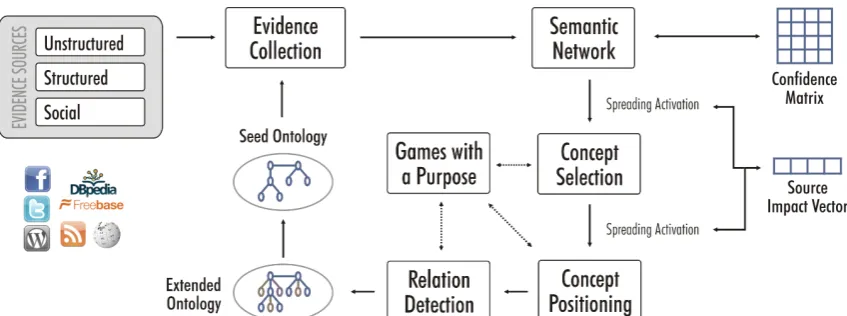
Figure 1 gives a graphical overview of the sys-tem and its workflow. The ontology learning pro-cess starts from a typically small seed ontology (a few concepts and relations). The seed ontology is static, thereby making a comparison of the learned parts and their dynamics more meaningful. The first step in the process is the collection of evidence data for the given seed concepts. We collect evidence data, i.e., terms related to the seed concepts, from a variety of sources (e.g., domain text) with a variety of meth-ods (e.g., co-occurrence statistics or Hearst pattern). Section 4.1 gives more information about evidence sources. To track the dynamics of the domain the doc-uments and other underlying data originate from the period of time in question. We will compare weekly and monthly intervals when building new ontologies. All evidence is collected in a graph data structure called the semantic network. The semantic network includes the seed concepts and all extracted terms connected to the seed concepts with typed links. The type of links reflects the evidence source and the ob-served strength of relation. The evidence confidence matrix (ECM) (see Section 4.1) constitutes an addi-tional representation of the semantic network – the ECM also includes the dimension of time for use in subsequent trend detection experiments.
Figure 1: Ontology Extension Architecture System Diagram.
a search technique inspired by the human brain and its cognitive models. The source impact vector (SIV, see Section 4.2), which reflects user-generated con-fidence into quality of evidence sources, contributes to the link weights in the spreading activation net-work, making high quality sources have more impact on the resulting ontology. The SIV evolves over time according to user feedback harvested from GWAPs. In the next step spreading activation detects the (e.g., 20) most relevant concept candidates to be included in the extended ontology. A round of user feedback via GWAPs (see the paragraph below) accepts or rejects these new concept candidates.
Another run of spreading activation then positions the new concepts in the ontology, i.e., it selects the most related concept from the seed ontology to nect the new concept to. Every new concept gets con-nected to exactly one seed concept. User feedback confirms the position or suggests a better one (see be-low). The spreading activation algorithm outputs the relation strength between every seed concept and ev-ery new concept. We capture this learning algorithm-based confidence information in a relation strength matrix (see Section 4.3) for trend detection exper-iments and to support user selection of relations if needed (see below).
Finally, relation type detection with techniques to identify taxonomic relations as described in (Liu et al., 2005) and methods to label non-taxonomic re-lations (Weichselbraun et al., 2010b) conclude the learning process.
The ontology learning system works in an itera-tive fashion, where the newly generated extended on-tology functions as seed onon-tology in the next learn-ing cycle. The ontology buildlearn-ing process stops when the ontology reaches the desired size and granularity level.
The underlying ontology learning components
have been thoroughly evaluated and published in (Liu et al., 2005), (Weichselbraun et al., 2010a) and (We-ichselbraun et al., 2010b). The framework presented in this paper extends this work by introducing dy-namic data structures for confidence management, the source impact vector (SIV) and through mechanisms for its adaptation according to user feedback, as we detail next.
Low-Overhead Forms of User Feedback
It is evident from the system description (Figure 1) that rapid user feedback captured for example through Games with a Purpose (GWAPs) is a key compo-nent. We will extend our game portfolio with new Facebook-based games similar to the already suc-cessfully deployedSentiment Quiz(Rafelsberger and Scharl, 2009). The Sentiment Quiz addressed major challenges of GWAPs such as how to attract and retain players, how to ensure the generation of high quality data, and how to effectively aggregate results.
In the first game (or first task in an integrated game) players confirm if a new concept candidate is relevant to the domain. If the concept is not relevant (a certain level of agreement among users is needed), the user evaluation terminates and the concept is pruned. Another game indicates if the connection between the seed concept and the new concept is correct. If it is not correct the game lets players suggest the appro-priate seed concept to connect to. For this task, the GWAP ranks the seed concepts to select from by the relation strength from the relation strength matrix.
4
Dynamic Confidence Management
This section introduces the planned confidence man-agement and trend detection experiments as well as three data structures that are crucial for tracking temporal changes and trends: the evidence confi-dence matrix (Section 4.1), the source impact vector (Section 4.2) and the relation strength matrix (Sec-tion 4.3).
4.1
Evidence Confidence Matrix
As already mentioned, our confidence management and ontology dynamics approach is data-driven and relies on evidence extracted from heterogeneous sources, which is then collected into a graph data structure and also the evidence confidence matrix (ECM). We distinguish three basic types of evidence sources: unstructured, social and structured. We have repeatedly and successfully used the webLyzard suite of Web mining tools (www.weblyzard.com) for gen-erating high-quality domain corpora. The result of the mirroring and domain detection process is a number of corpora for the respective period: e.g., a US news media corpus, a British news media corpus, a Fortune 1000 corpus, etc. We will select the level of granu-larity (e.g., all news media from a country vs. single news media) according to the number of documents available. The algorithms apply term extraction meth-ods such as co-occurrence statistics and Hearst pat-terns to the corpora (Liu et al., 2005).
To collect evidence from social media we use the TagInfoService interface of the easy Web Retrieval Toolkit (www.semanticlab.net/index.php/eWRT) to get related terms for the label of a seed concept from sources such as Twitter, Flickr and Del.icio.us (We-ichselbraun et al., 2010a). Querying the DBpedia SPARQL endpoint with the seed concept labels and specific properties such asdcterms:subject, or the use of Scarlet (Sabou et al., 2008), constitute the struc-tured data evidence sources.
The total number of evidence sources relates to the number of extraction methods multiplied by the number of corpora (for text sources). Examples of evidence sources (andevidences) for the seed concept “greenhouse effect” in a climate change ontology are:
• Sentence-level Co-occurrence in Australian News Media
(“greenhouse effect”−→esi “carbon dioxide”),
• Related tags from Twitter
(“greenhouse effect”−→esi “petrol”),
• DBpedia-querydcterms:subject
(“greenhouse effect”−→esi “kyoto protocol”), . . .
The semantic network connects collected terms with the seed ontology via directed weighted links. TheECMis an additional form to store evidence data and includes a temporal dimension. The system gen-erates ECMs to represent all possible relations be-tween a seed conceptCs and a candidate conceptCc.
The ECM contains the observed connection strength between the two concepts for all evidence sources. The second dimension is the temporal one. Equa-tion 1 shows a ECM for seed conceptCs and
candi-date concept (term)Ccwith the dimensions evidence
sourceesand timetand the corresponding confidence valuescesi,tj.
ECMCs,Cc=
ces1,t1 ces1,t2 · · · ces1,tm ces2,t1 ces2,t2 · · · ces2,tm
.. .
cesn,t1 cesn,t2 · · · cesn,tm
(1) The ECM supports a number of trend detection experiments such as: (i) observe patterns in the ev-idence data between two concepts on a fine-grained per evidence source basis, (ii) compare the occurrence patterns for a new concept/term among multiple seed concepts, to see the evidence strength between those and how it evolves, (iii) aggregate evidence sources (e.g., all news media sources) and trace such patterns on a higher level, (iv) compare (aggregated) sources to see which types of sources promote a new concept at what point in time, (v) study the characteristics of evidence sources themselves.
4.2
Source Impact Vector
The source impact vector (SIV) contributes to the weights in the spreading activation network because its values reflect user generated confidence (quality) and suggested impact of an evidence source in the learning process. Evidence sources which tend to pro-vide low quality terminology should have low impact, and vice versa. The initial settings stem from heuris-tics and metrics such as Google PageRank.
User feedback yields an optimized SIV. Neural network learning techniques such as backpropaga-tion allow adjusting the weights of the spreading ac-tivation network to the users’ perception of the do-main and set the corresponding values to optimize the source impact vector. To prevent overfitting to a spe-cific ontology, we plan to keep the SIV within prede-fined intervals.
Equation 2 presents a SIV for a point in timeti. It
contains the impact valuesIfor evidence sourcesesj.
SIVti =
Ies1 Ies2 · · · Iesn
The dynamic adaptation of the source impact vec-tors according to user feedback is novel. By introduc-ing a temporal dimension and storintroduc-ing source impact values over time, we obtain a source impactmatrix. By exploring this temporal aspect, we can study the trends in source impact: (i) patterns in the quality of single evidence sources in a specific domain, (ii) pat-terns in aggregated views on source impact (e.g., all social media sources), (iii) patterns across domains to explore the suitability of specific sources for a certain domain.
The concept selection and concept positioning
phases have different characteristics, and, therefore, an evidence source might be better suited to one than the other. Therefore we plan to experiment with using two separate SIVs corresponding to support values for these two tasks.
4.3
Relation Strength Matrix
Spreading activation in the process of concept po-sitioningyields the relation strength, i.e., the learn-ing algorithm-based confidence, between all seed and new concepts in the extended ontology. Additionally to the application of relation strength values as de-scribed in Section 3, these data also provide the base for interesting trend detection experiments when stud-ied from a temporal viewpoint. The relation strength matrix (RSM) as given in Equation 3 shows the re-lation strength valuesrsfor any relationri j between
seed conceptiwith new concept j.
RSM=
rsr11t1 rsr11t2 · · · rsr11tn rsr12t1 rsr12t2 · · · rsr12tn
..
. ...
rsr21t1 rsr21t2 · · · rsr21tn
..
. ... ...
rsrmnt1 rsrmnt2 · · · rsrmntn
(3)
The RSM can give interesting insights into the dy-namicsof the domain. A permanent change in learn-ing algorithm-based confidence (relation strength) be-tween concepts suggests the meaning of a concept (especially in taxonomic relations), or its relation to other concepts has changed in the outside world. For example, the meaning of the concept “energy source” might have changed when the predominant relation between “energy source” and “fossil fuel” gets weaker over time, and the relation to “alternative energy” intensifies.
It will then be interesting to examine if user feed-back is in line with shifts in terminology as computed by the algorithms, or if users do not perceive these
domain changes. Conversely, if user feedback dif-fers from the past, but the underlying evidence is un-changed, then ashift in user perception and concep-tualization, but not a change in the domain itself, is indicated.
We will also take an overall view on the charac-teristics of relations, e.g., is it common in the domain to have dominant and unambiguous relations between seed and new concepts, or are there mostly connec-tions of similar strength from a seed concept to many new concepts. Experiments will point out if (parts of) a domain are getting more fuzzy and connected or if reverse effects occur.
5
DISCUSSION
This position paper presents a framework for learning lightweight ontologies and studying dynamic confi-dence values assigned to its various elements. In reg-ular - e.g., weekly or monthly - intervals, the frame-work generates ontologies starting from a small seed ontology by integrating heterogeneous evidence ex-tracted in the respective period. Spreading activation algorithms detect new concepts and position them into the ontology. User feedback with games with a purpose validates new concepts and relations, and provides data to manage and optimize the confidence in specific evidence sources. The main contributions of the approach are (i) special data structures that fa-cilitate powerful and fine-grained dynamic confidence management of ontological elements, (ii) trend detec-tion in those data structures, referring to input data (evidence) and the resulting verified ontologies, (iii) the integration of rapid user feedback cycles, (iv) ex-periments to measure ontology dynamics characteris-tics such as change in a domain (because the “world” has changed) or change in conceptualization. Future work will focus on the execution of the proposed con-fidence management and trend detection experiments.
ACKNOWLEDGEMENTS
REFERENCES
Ahn, L. and Dabbish, L. (2008). Designing Games with a Purpose.Communications of the ACM, 51(8):58–67. Alani, H., Harris, S., and O’Neil, B. (2006). Winnowing
ontologies based on application use. In Sure, Y. and Domingue, J., editors,ESWC, volume 4011 ofLecture Notes in Computer Science, pages 185–199. Springer. Cimiano, P., Maedche, A., Staab, S., and Voelker, J. (2009). Ontology learning. In Staab, S. and Rudi Studer, D., editors, Handbook on Ontologies, International Handbooks on Information Systems, pages 245–267. Springer Berlin Heidelberg.
d’Aquin, M., Motta, E., Sabou, M., Angeletou, S., Gridinoc, L., Lopez, V., and Guidi, D. (2008). To-wards a New Generation of Semantic Web Applica-tions.IEEE Intelligent Systems, 23(3):20 – 28. Flouris, G., Plexousakis, D., and Antoniou, G. (2006).
Evolving ontology evolution. In Wiedermann, J., Tel, G., Pokorn´y, J., Bielikov´a, M., and Stuller, J., editors,
SOFSEM, volume 3831 ofLecture Notes in Computer Science, pages 14–29. Springer.
Haase, P. and Stojanovic, L. (2005). Consistent evolution of owl ontologies. InProceedings of the Second Eu-ropean Semantic Web Conference, Heraklion, Greece, pages 182–197.
Hearst, M. A. (1992). Automatic acquisition of hyponyms from large text corpora. InCOLING, pages 539–545, Nantes, France.
Liu, W., Weichselbraun, A., Scharl, A., and Chang, E.
(2005). Semi-automatic ontology extension using
spreading activation.Journal of Universal Knowledge Management, 0(1):50–58.
Markotschi, T. and Voelker, J. (2010). Guess What?! Hu-man Intelligence for Mining Linked Data. In Proceed-ings of the Workshop on Knowledge Injection into and Extraction from Linked Data (KIELD) at the Inter-national Conference on Knowledge Engineering and Knowledge Management (EKAW).
Maynard, D. and Aswani, N. (2010). Bottom-up Evolution of Networked Ontologies from Metadata (NeOn De-liverable D1.5.4).
Maynard, D., Funk, A., and Peters, W. (2009). SPRAT: A Tool for Automatic Semantic Pattern-based Ontology Population. InInternational Conference for Digital Libraries and the Semantic Web (ICSD-2009), Trento, Italy.
Novacek, V., Laera, L., and Handschuh, S. (2007). Semi-automatic integration of learned ontologies into a col-laborative framework. InProceedings of the Interna-tional Workshop on Ontology Dynamics (IWOD 2007) at ESWC 2007, Innsbruck, Austria.
Noy, N. F., Chugh, A., Liu, W., and Musen, M. A. (2006). A framework for ontology evolution in collaborative en-vironments. In Cruz, I. F., Decker, S., Allemang, D., Preist, C., Schwabe, D., Mika, P., Uschold, M., and Aroyo, L., editors,International Semantic Web Con-ference, volume 4273 ofLecture Notes in Computer Science, pages 544–558. Springer.
Popitsch, N. and Haslhofer, B. (2010). Dsnotify: han-dling broken links in the web of data. In Rappa, M., Jones, P., Freire, J., and Chakrabarti, S., editors,
WWW, pages 761–770. ACM.
Rafelsberger, W. and Scharl, A. (2009). Games with a purpose for social networking platforms. InHT ’09: Proceedings of the 20th ACM conference on Hyper-text and hypermedia, pages 193–198, New York, NY, USA. Association for Computing Machinery. Sabou, M., d’Aquin, M., and Motta, E. (2008). Exploring
the Semantic Web as Background Knowledge for On-tology Matching.Journal on Data Semantics, XI. Siorpaes, K. and Hepp, M. (2008). OntoGame: Weaving
the semantic web by online games. In Bechhofer,
S., Hauswirth, M., Hoffmann, J., and Koubarakis, M., editors,5th European Semantic Web Conference (ESWC), volume 5021, pages 751–766. Springer. Umbrich, J., Hausenblas, M., Hogan, A., Polleres, A., and
Decker, S. (2010). Towards dataset dynamics: Change frequency of linked open data sources. In Bizer, C., Heath, T., Berners-Lee, T., and Hausenblas, M.,
ed-itors, LDOW, volume 628 ofCEUR Workshop
Pro-ceedings. CEUR-WS.org.
Vrandecic, D., Pinto, H. S., Tempich, C., and Sure, Y. (2005). The diligent knowledge processes. J. Knowl-edge Management, 9(5):85–96.
Weichselbraun, A., Wohlgenannt, G., and Scharl, A. (2010a). Augmenting lightweight domain ontologies with social evidence sources. In Tjoa, A. M. and Wagner, R. R., editors, 9th International Workshop on Web Semantics, 21st International Conference on Database and Expert Systems Applications (DEXA 2010), pages 193–197, Bilbao, Spain. IEEE Computer Society Press.
Weichselbraun, A., Wohlgenannt, G., and Scharl, A. (2010b). Refining non-taxonomic relation labels with external structured data to support ontology learning.
Data & Knowledge Engineering, 69(8):763–778. Wohlgenannt, G., Weichselbraun, A., and Scharl, A. (2009).
Integrating Structural Data into Methods for Label-ing Relations in Domain Ontologies. In20th Interna-tional Workshop on Database and Expert Systems Ap-plication (DEXA-2009); 8th International Workshop on Web Semantics, pages 94–98, Austria.
Zablith, F., d’Aquin, M., Sabou, M., and Motta, E. (2010). Using Ontological Contexts to Assess the Relevance of Statements in Ontology Evolution. In Cimiano, P. and Pinto, H. S., editors,Proc. of EKAW - Knowledge Engineering and Management by the Masses, volume 6317 of Lecture Notes in Computer Science, pages 226–240. Springer.
Zablith, F., Sabou, M., d’Aquin, M., and Motta, E. (2009).
Ontology evolution with evolva. In Aroyo, L.,
Traverso, P., Ciravegna, F., Cimiano, P., Heath, T., Hyv¨onen, E., Mizoguchi, R., Oren, E., Sabou, M., and Simperl, E. P. B., editors,ESWC, volume 5554 of