Methodology of measurement, documentation and
programming of optimal continuous workload with
variable intensity – applications in sports medicine,
physiotherapy, geriatrics, health-related training and
sport for all
Roman Maciej Kalina
Faculty of Physiotherapy, Department of Health Promotion & Research Methodology, Academy of Physical Education, Katowice,
Poland
Source of support:
Departmental resources
Received:
20 September 2012;
Accepted:
15 November 2012;
Published online:
24 December 2012
Abstract
Background
Continuous effort can be defined as the activity of every muscle since the impulses of any intended movement aiming at implementation of a given goal result in an increase of heart muscle contractions beyond resting heart rate until the end of a given activity. The goal of this paper is the methodology of measurement and documenta-tion of continuous physical effort with variable intensity.Material/Methods:
Methods used in the study included the Delphi method, analysis of the literature and scientific documentation, participant observation, case study and designing elements. The analysis of over 3000 reports of researches per-formed by students of physiotherapy and recreation (n=855) during standard health-related training including those based on the exercises of safe falling and avoiding collisions (participant observation) was conducted in 2008-2012.Results:
The considerable advantage of the methodology of measurement, documentation and programming of the work-load presented herein is the possibility to express this variable with the use of universal index, referred to as LE and based on conventional units. The index can be used at any level of preliminary analysis i.e. from particular ex-ercises and set of exex-ercises, training sessions to microcycles, mesocycles, macrocycles and long-term cycles.Conclusions:
The reduction of health promotion and physical activity mainly to walking, running, cycling or other simple formsof exercise may counterproductive in the longer term. That is, instead of achieving the ultimate goal of common phys-ical activity we will achieve its negation.
Key words: effort safety • intensity zones • judo • supramaximal efforts • test for safe falls
Author’s address: Roman Maciej Kalina, Faculty of Physiotherapy, Department of Health Promotion & Research Methodology, Academy of Physical Education, Mikołowska Street 72A, 40-065 Katowice, Poland; e-mail: [email protected]
B
ackgroundPhysiological perspective
It is no use to create general division of physical effort to continuous and intermittent, if there is no frame of
reference and precise definitions. If professional activi-ty is assumed to be the frame of reference, few positions can be named which require constant muscle activity. It is easy to enumerate occupations with one-time phys-ical effort lasting even several hours e.g. a miner, con-struction worker, truck or tour bus driver, soldier from
and Study Aim:
Authors’ Contribution:
A Study Design B Data Collection C Statistical Analysis D Manuscript Preparation E Funds Collection
particular unit, etc. Such professions usually involve the necessity of repeating even several long-lasting ef-forts during a day.
Sport, health-related training and rehabilitation offer more specific examples. One-time long-lasting sports include e.g. a marathon as well as long-distance cross-country skiing, swimming, race walking, a stage of bicy-cle racing, etc. Athletes perform such efforts only once during a day or even in intervals lasting multiple days or weeks (marathons). Occasionally, there are some ex-ceptions to this rule, e.g. two stages of bicycle racing during a day. On the other hand, numerous sports dis-ciplines involve a one-time continuous physical effort lasting from few seconds to couple of minutes (racing competitions including sprint, swimming, cycling, ski-ing, tobogganski-ing, etc.). However, an athlete is required to repeat the efforts at least twice a day during com-petition. The triathlon represents a typical example of sport involving three continuous efforts performed one after another in various environmental conditions, the longest stage being cycling (standard distance: 1.5 kilo-metres swim ÷40 kilokilo-metres bike ÷10 kilokilo-metres run).
Continuous efforts are recommended as the optimal means of health-related training and rehabilitation (es-pecially cardiac, with necessary precautions taken) main-ly of adults and the eldermain-ly [1–7]. In professional sport they are essential to develop physical fitness (during the preparatory phase of the mesocycle) and to maintain its optimal level by a given athlete during the compet-itive phase of the mesocycle (taking into account the nature of the sport). Some sport theorists group con-tinuous efforts into efforts with constant and variable intensity. In general, such distinction is drawn during the description of training methods and this view has not changed since many years [8–10]. In practice, it is very difficult to maintain an effort with constant inten-sity for a longer period of time. Hence, the division of continuous efforts (for the purposes of workload assess-ment in any activity) into those having relatively con-stant and variable intensity is more accurate.
The author defines continuous effort as every activity of skeletal muscles together with all functional chang-es occurring in the body since the impulschang-es of any in-tended movement aiming at implementation of a given goal result in an increase of heart muscle contractions beyond resting heart rate until the end of a given activ-ity. While assessing the workload according to this def-inition, the extent to which the goal was achieved in praxeological meaning (efficient/inefficient) has been disregarded due to given external criterion e.g. the num-ber of accurate throws to the basket. The association of the physical effort assessment as physiological stimulus
with praxeological assessment or any other assessment may follow from the realisation of specified equivalent goals of a given activity, e.g. with ethical assessment (commendably/disgracefully) if the effort in question is basketball match. This issue, however, falls outside the scope of this paper.
One-time continuous effort may involve moving the wardrobe on the floor even for a few centimetres as well as a 5-kilometer run on the tartan track. In given circum-stances (external e.g. wardrobe weight, slipperiness of the floor and internal e.g. exertional capacity, motivation) moving the wardrobe for a few metres may necessitate multiple dynamic efforts with predominance of isoton-ic contractions and short-lasting isometrisoton-ic contractions or efforts being alternately dynamic and static (longer isometric contractions). If the intervals between succes-sive impulses are short, this would constitute the logical and factual (related to effort biochemistry and physiol-ogy) basis to classify this muscle activity as continuous effort with variable intensity. Basing on the recommen-dations of physiologists, training theorists and experi-enced trainers it can be assumed that continuous effort with variable intensity is every muscle activity lasting for at least several minutes given the fact that the in-terval between active phases of activity consistent with its goal does not exceed one minute during an activity with maximum intensity and 30 seconds during an ac-tivity with vigorous or moderate intensity.
The argumentation based on empirical data may serve as substantiation of this general assumption. Wolkow [11] recommends that the training focused on the endur-ance development of young athletes should involve rests lasting from 60 to 90 seconds between 10 to 20-second exercises with maximum intensity (HR >170 bpm). He also recommends 6–7 repetitions per set in the ‘activity-rest’ training programme. The rest between 20–120 sec-ond exercises with vigorous intensity (HR 151–170 bpm) should last from 30 to 60 seconds (6 to 7 repetitions per set). The same rest is recommended by Wolkow between exercises with moderate intensity (HR 130–150 bpm) lasting 120–180 seconds, however the number of rep-etitions per set should be reduced to 5 or 6. Therefore, the recommendations of Wolkow refer to intermittent effort in contrast to continuous effort with variable in-tensity defined above.
Furthermore, Wolkow have also established that resti-tution dynamics after the effort with maximum inten-sity in females and males aged 10–15 years is character-ized by slight differentiation related to sex and age [12]. Basing on the average results, he has noted significant regularities. HR after the first minute of rest indicates that the state of body stimulation corresponds to the
Continuous training – one continuous, aerobic exercise bout performed at low-to-moderate intensity [6].
Discontinuous training
– several intermittent low- to high-intensity aerobic exercise bouts interspersed with rest or relief intervals [6].
Supramaximal efforts – can be defined as efforts with oxygen demand exceeding VO2max [16].
MET – metabolic equivalent.
Effort safety – is consciousness of the person who starts physical effort or consciousness of the subject who has the right to encourage or even enforce from this person the physical effort of a certain intensity and duration, who it is able to do so without risking life or health [17].
Playing tag – by name – pupil or pupils with name called by the trainer become ‘hunters’ and have the right to slap symbolically the backs of other participants with their hand or the kimono belt – the opponents are to avoid such contact (this goes on until another name is called or the signal ‘stop’ is given) [35, p. 24].
Limping fox – from a ‘burrow’ delimited in the corner of the mat the pupil tries to touch with kimono belt (or hand) one of pupils running away on both legs, while he limps only on one; until the touched person has not reached the burrow, the remaining ones have the right to hit him in a symbolical way only on the back; once he has reached the burrow he assumes the role of the limping fox [35, p. 30].
effort with moderate intensity (HR decreases from 17% to 25% in females and from 20% to 22% in males com-pared to the state immediately after the effort). After second minute of restitution the difference amounts to 27–33% in females and 29–31% in males. According to the classification of workload intensity adopted by Wolkow the stimulation of the body after the second minute of restitution corresponds to low intensity zone.
According to the criteria of constant effort with variable intensity presented in this paper, HR in females and males aged 10–15 years may be assumed to decrease more than 20% during the rests between subsequent phases of mus-cle activity with maximum intensity. Under this assump-tion the generalizaassump-tion can be made that similarity to the metabolism prior to the rest is maintained during short rests between exercises (muscle activity). Both in the the-oretical and practical sense the issue of intensity of the next exercise or specific effort related to any work (paid, rescue, or forced by other circumstances) remains open. However, if the goal of a given training, physical educa-tion class, rehabilitaeduca-tion, etc. is to practice continuous effort with variable intensity, the duration of rest after each effort can no longer remain an open question. It is essential to respect the ‘activity – rest’ criterion.
Since various scientists recommend different scales for estimating the workload and in spite of numerous sim-ilarities, the conclusions drawn in the last paragraph of the paper are justified in so far as the data observed would be referred to specific criteria. For example, dur-ing the observation of physical effort (game involvdur-ing physical movement) in children aged 3–5 years Jaskólski et al. [13] recommend a method for workload estima-tion developed by Japanese professor Kacube, which specifies that 160 bpm HR corresponds to high, 159– 130 to moderate and 129 to low intensity.
It is common to use more workload intensity zones (ex-ercise intensity) for both young people and the adults. The suggestion of Swaim ad Edwards [14] concern-ing young people is based on five zones of HRmax per-centage i.e. (1) 50–60% (under 119 bmp); (2) 61–70% (120–139 bmp); (3) 71–80% (140–159 bmp); (4) 81–90% (160–179 bmp); (5) 91–100% (180 BMP and above). Moreover, average energy expenditure mea-sured in calories per minute was assigned to each zone. It amounts to /5/ /5–8/ /8–10/ /10–15/ /15–20/ respec-tively. As the basis for HRmax calculation Swaim and Edwards recommend the Ball State University formu-la, where the HRmax for females equals 209 – (0.7 × age) and for males equals 214 – (0.8 × age).
The classification of workload intensity in adults devel-oped by Pollock et al. [15] is based on six zones. Both
classifications are useful in the interpretation of con-tinuous efforts with intermittent intensity. However, reasonable recommendations concerning the effective-ness of continuous efforts with intermittent intensity in broadly understood health promotion and prophy-laxis should include not only the exercise intensity but also their duration, frequency, rate of progression, stag-es of progrstag-ession [6] and other factors.
In the general introduction to physiological classifica-tion of physical efforts, Kozlowski et al. [16] emphasize the fact that the description of processes occurring in muscles and other organs operating during the effort is conditioned by the type of muscle contraction, the size of muscle groups active during the effort, the duration of the effort and workload intensity. This statement is complemented by two fundamental observations made by Bullock et al. [4] on physiological consequences of the effort i.e. the influence of the training can be ob-served only in the muscles involved in the activity; it is the isotonic effort only that may prevent cardiovas-cular diseases.
The field of the training theory, praxeology and systems science
From the perspective of thoughtful consideration of all dimensions of health (somatic, mental, social) and the need for survival rather than the training theory, it fol-lows that the influence of training should not be associ-ated only with its physiological aspect. References should be made to other body systems (especially the nervous system) and mental sphere [17,18]. Moreover, the crit-ical analysis of the physcrit-ical efforts classification recom-mended by physiologists leads to conclusion that the variety of indicators and standards applied to the esti-mation of workload may be justified by at least two rea-sons. First of all, the knowledge of the human adaptation to exercise still remains an open question. Secondly, the recommendations are usually grounded on the adopted research assumptions and research methodology applied in relation to the goal of the effort (the zone is broad from the rehabilitation of the hardest cases to extreme sports). Therefore, the significance of optimization of the methods for workload measurement and documentation of the results is still growing. In other words, monitoring of this phenomenon is becoming even more essential.
Since sport became a crucial part of political confronta-tion of two systems and afterwards the possibility of fast enrichment of the athletes, it appears that it needs indi-cators which would enable reliable and accurate work-load monitoring. Long-term career oriented towards success in the atmosphere of growing competitiveness (high number of starts, pressure to establish new records,
Act like a snak – A lies on his back, B lies with his front to him (in a transverse way) and immobilizes movements without possibility of pressure of the hands on his body; at a signal given by the referee B tries to change his position to lying prone, but also cannot exert pressure on the body of A with the hands (Fig. X) – change of roles after three attempts; evaluation criteria: 1 point for each holding of the opponent in lying on the back for 5 seconds [35, p. 32].
Matador – A has arms outstretched in front (hands placed one over the other and directed towards the centre); he takes off for a run over a section of 3–4 metres and tries to touch the chest of B with his hands; B avoids contact for example by shifting the left leg right to the rear, and simultaneously by making a semi-turn on toes of the right leg, to turn to face the direction of the run of A [35, p. 39].
Randori (…)Sparing in jūdō in which both participants practice attacking and defending [50].
Test for safe falls – The test comprises execution of four consequent tasks constituting a series of seven falls: 1. rear fall and rear fall with turn; 2. front fall; 3. fall to the side (left and right); 4. front fall with turn over the shoulder (left and right) [34, 35, see also Safe Falls Academy in Archives of Budo (video)].
Counterproductive action – the action is counterproductive when a doer achieved the opposite of intended goal [51, p. 220].
tempting rewards, etc.) favours mainly people talented at given motor fitness as well as those able to tolerate ex-treme physical efforts, both intensive and frequent (see one of the conclusions from most recent research [19]).
The finding that the necessary condition for obtain-ing the desired form durobtain-ing the most important sports competitions is the ability to accurately determine a re-lationship between performed muscle activity in quanti-tative sense and the intensity of the effort. This was one of the major discoveries made in the mid-1900s. It has forced the necessity to develop the indicator with high-er level of genhigh-erality, but still precise enough to provide reliable data about the relationship in question [20–23]. Intensification of the exercises requires longer rests and thus the reduction of repetitions of a given exercise or exercises during a training determined a priori (usually arbitrarily). On the other hand, the greater number of repetitions is determined by the decrease of isotonic con-tractions. In both cases, programming of the duration of particular training sessions is as essential as respecting safe zones of workload intensity. The control over both factors is a basic procedure to influence safety effort of a particular human being [17]. An increase in the exer-cise duration to reasonable limit and determination of the duration of rests between exercises is limited by indi-vidual capabilities. Therefore, the knowledge about those capabilities, which are highly sensitive to many factors e.g. total effects of training, nutrition, general physical and mental state, momentary or temporary incapacity, etc., should be associated with current effect of the ex-ercises to the body. In the theory of training this indi-cator is referred to as the training load (in broader terms as workload) and is defined as the amount of work per-formed during a training unit (training session) in the mi-crocycle, the mesocycle, the annual cycle and long-term training. In general, quantitative factor is a total evalua-tion of the training components that are distinguishable in a given exercise category. To put it simply, the inten-sity of the effort can be perceived as qualitative factor.
A simple mathematical model of training load can be defined as the product of qualitative and quantitative factor. This reasoning may became unclear whenever the quantitative factor is called ‘workload volume’ or ‘training volume’ [8–10,20–23] interchangeably with ‘volume of physical activity’ [6]. Various units have been adopted as measures i.e. the number of repeti-tions, kilometres, tons, kilocalories, etc. as well as var-ious units of time (seconds, minutes, hours). Although in the training experience and scientific analyses, the time is assumed to be the most general measure of this volume, in academic textbooks, research and method-ological papers the term ‘workload volume’ and its syn-onyms have not been supplanted by any adequate term.
Radoslaw Laskowski goes even further and adopts time as an indicator of training load in long-term judo train-ing of females for three types of efforts: comprehensive (W-), targeted (U-) and special (S- symbols correspond to the Polish names of this terms) [24].
As in the real world nothing happens beyond the time, the basic procedure of improvement of workload mea-surement should logically start with separation of the time factor from the set of phenomena so far classified together as ‘workload volume’. It is difficult to provide a di-rect evidence that this was the fundamental assumption of the creators of training load measurement methods in combat sports and games [23,25–29]. They have usual-ly adopted time as the workload volume indicator. Due to the fact that the heart rate (HR) is commonly accepted as the universal measure of workload intensity, the prod-uct of effort duration and HR seems to be the general indicator of training load defined as the amount of work-load. It is useful in analyses with a high level of general-ity. If it should serve as a tool for many specialists and be a subject to further calculations, detained indicators such as multiplicand and multiplier should be established and accepted. Then what basic indicators are binding for the multiplicand i.e. effort duration? Seconds, minutes, hours? What unit of measurement should be adopted for the multiplier i.e. in what interval should HR be measured (20-, 15-, 10-, 6 seconds)? In current research and train-ing practice the product of effort duration and HR was re-ferred to as ‘conventional units’ [28–30] or further calcu-lations have been made to convert it into points [23,26].
If such assumptions are accepted, the remaining and very important workload indicators should be precise-ly measured and documented in order to use them for the benefit of more detailed analyses. Due to the limit-ed space, the relationship between physical effort and respiratory reactions will not be discussed. This issue had already been widely discussed in scientific literature.
Study Aim
The main goal of this paper is the methodology of mea-surement, documentation and programming of opti-mal, continuous physical effort with variable intensity. Application goal are recommendations for sports med-icine, physiotherapy, gerontology, health-related train-ing, sport for all as well as its use by everyone who cares for their own health and the health of their loved ones.
M
aterialandM
ethodsMethods: the Delphi method, analysis of literature and scientific documentation, participant observation, case study and designing elements.
The Delphi methods has been applied in a way that the author was guided by his practical and research ex-perience. For 40 years he has measured and document-ed physical effort during judo trainings, military train-ings, health-related trainings and while teaching the students of physiotherapy, physical education and rec-reation. The results have been presented in academic publications, during numerous seminars, conferences, academic lectures and classes. The author of this paper has also been the co-author of workload measurement methods for the purpose of judo [28,29] and physio-therapy [30]. Moreover, the issues of exercise biochem-istry and physiology are being consulted with the pro-fessors of this specialties having outstanding scientific and practical achievements.
In 2008–2012 the author has performed the analy-sis of over 3000 research reports which had been con-ducted by the students of physiotherapy and recreation (n=855) during model health-related training including those based on the exercises of safe falling and avoiding collisions (participant observation). Simultaneously, the previous versions of the method presented in this paper has been modified.
The case study is based on the analysis of documented direct physiological, motor and mental effects in two young females (purposive sampling), who have partic-ipated in health-related training based on the exercises of safe falling, avoiding collisions and self-defence. This arrangement of exercises determines the need to mea-sure HR using palpatory methods.
The measurement and documentation method of train-ing load as well as the method for programmtrain-ing the op-timal efforts for a given person were based on the com-ponents of designing method [31]. The full version of training load measurement and documentation meth-od is applicable only to continuous effort with variable intensity (Table 1). The specificity of the issue is re-flected in the structure of the paper which fulfils the editorial standards of the original article and therefore the designing methods are discussed in all parts of the paper. In the Introduction some space has been given to the main information enabling ‘(a) reconstruction of the practical situation [31]’, whereas the Results and Discussion and recommendations provide some complemen-tary statements. The Results discusses the subsequent part of the designing procedure i.e. ‘(b) the formulation of the method to overcome this situation [31]’. In other words, it provides the description of methodology (ob-jectives, methods and methodologies) of measurement, documentation and programming of optimal continu-ous efforts with variable intensity for a given person in a given day and circumstances (e.g. the place where the
activity is performed). The final part of designing pro-cedure i.e. ‘(c) the verification of the hypothesis’ is dis-cussed in the Results and Discussion and recommendations.
r
esultsThe method for workload measurement of a body af-ter a continuous effort with variable intensity is based on the assumption that the only tool used in measure-ment process is a stopwatch (or a stopwatch and timer with a second hand) and the results are noted in a spe-cial protocol (Table 1). The method is applicable in al-most every conditions, especially while registering HR with the use of sport-testers is impossible (during the safe falling exercises involving frequent direct contact as in judo, wrestling, etc.).
The following basic indicators have been measured and noted: the duration of particular measures i.e. given ex-ercises or sets of exex-ercises (TE), the duration of entire training (T), the intensity of the exercises (IE), the in-tensity of the entire training (I).
The duration of the exercises (set of exercises) is mea-sured in minutes. The result should be rounded to the nearest minute (e.g. 5 minutes and 30 or less seconds should be noted as 5-minute effort, while 5 minutes and 31 or more seconds as 6-minute effort). It may be the source of some discrepancies in the duration of en-tire training being the difference between T2 and T1 in comparison with the sum of particular exercises. If a given exercise lasts 20 seconds and afterwards 30-sec-ond rest occurs and the entire set is repeated for many times, the ‘activity-rest’ structure of the exercises and their real performance should be described in ‘Content of exercises’and ‘Scope of exercise’.
The average heart rate recorded accurately to two dec-imal places is the indicator of intensity (IE), calculat-ed after the end of a training. The heart rate should be measured using palpatory method each time during 6 seconds several times during the exercise (at 2 or 3-min-ute intervals) and recorded in ‘HR’ column in appro-priate line. Patient (client) should be instructed that in case of self-measurement of heart rate using palpatory method, if start and end signals are given by other per-son, the count should start with ‘zero’. If there is a pos-sibility for direct observation of the movement of the second hand, the count should start from ‘one’. It may be helpful to mark 6-second intervals on the dial (pref-erably of a big clock) using different colours. This will increase the probability that given person will be able to perform HR measurement during 6–10 seconds af-ter the end of exercise in accordance with recommen-dations in [21].
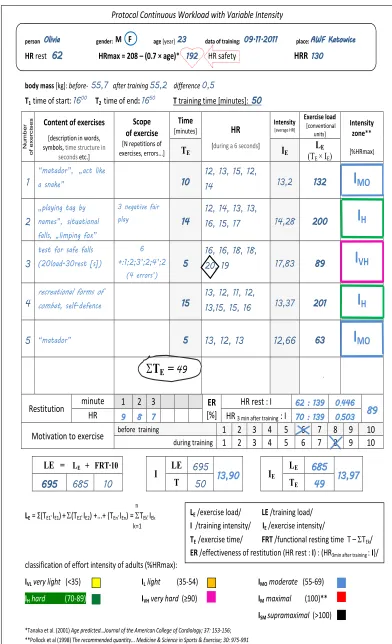
Table 1. Sample documentation of physical effort.
Table 1. Sample documentation of physical effort
Protocol Continuous Workload with Variable Intensity
person Olivia gender:
M F
age [year] 23 data of training: 09.11.2011 place: AWF KatowiceHR
rest
62
HRmax = 208
–
(0.7
×
age)
*
192
HR safety
HRR
130body mass [kg]: before-
55,7
after training
55,2
difference
0,5
T
1time of start:
16
00T
2time of end
:
16
50T
training time [minutes]:
50
Nu
m
b
er
of
e
xe
rci
se
s
Content of exercises
[description in words, symbols, time structure in
seconds etc.]
Scope
of exercise
[N repetitions of exercises, errors...]
Time
[minutes]
HR
[during a 6 seconds]Intensity
[average HR]
Exercise load
[conventional units]
Intensity zone**
[%HRmax]
T
EI
E(T
L
E E×
I
E)
1
“matador”, a snake” „act like10
12, 13, 15, 12,
14
13,2
132
I
MO
2
„playing tag by names”, situational falls, „limping fox”
3 negative fair
play
14
12, 14, 13, 13,
16, 15, 17
14,28
200
I
H
3
test for safe falls (20load-30rest [s])
6
+:1;2;3’;2;4’;2
(4 errors’)
5
16, 16, 18, 18,
20, 19
17,83
89
I
VH
4
recreational forms of combat, self-defence15
13, 12, 11, 12,
13,15, 15, 16
13,37
201
I
H
5
“matador”5
13, 12, 13
12,66
63
I
MO
T
E
=
49
Restitution
minute
1 2 3
[%]
ER
HR rest : I
62 : 139 0.44689
HR
9 8 7HR
3 min after training: I
70 : 139 0.503Motivation to exercise
before training during training1 2 3 4 5 6 7 8 9 10
1 2 3 4 5 6 7 8 9 10
n
L
E= Σ(T
E1
I
E1)
+
(T
E2
I
E2) +…+ (T
En
I
En) =
T
Ek
I
Ekk=1
classification of effort intensity of adults (%HRmax):
I
VLvery light
(<35)
I
Llight
(35-54)
I
MOmoderate
(55-69)
I
Hhard
(70-89)
I
VHvery hard
(≥90)
I
Mmaximal
(100)**
I
SMsupramaximal
(>100)
*Tanaka et al. (2001) Age predicted…Journal of the American College of Cardiology; 37: 153-156; **Pollock et al (1998) The recommended quantity... Medicine & Science in Sports & Exercise; 30: 975-991
LE =
L
E+ FRT∙10
I
LE
695
13,90
I
EL
E685
13,97
695 685 10
T
50
T
E49
L
E/exercise load/
LE
/training load/
I
/training intensity/
I
E/exercise intensity/
T
E /exercise time/FRT
/functional resting time
T
–
T
Ek/
ER
/effectiveness of restitution (HR rest :
I
) : (HR
3min after training:
I
)/
The product of the duration of exercise and its intensity (e.g. TE1×IE1) is a measure of the workload after a giv-en exercise or set of exercises (LE – exercise load). The product of multiplication should be rounded according to the principle that the number after decimal point
≥5, i.e. one should adopt the value of an indicator to be higher by one conventional unit that the number pre-ceding the decimal point. The number ≤4 obligates to round the indicator to the number preceding the dec-imal point (if the indicator is multi-digit, the last one should be rounded.
Conventional units are therefore a measure of workload after a physical effort (a given exercise and the sum of all exercises performed during a given training). The workload (training load) during the entire training is calculated using the formula LE=LE + FRT∙10, where: n LE = S(TE1∙IE1)+S(TE2∙IE2) +…+ (TEn∙IEn) = STEk∙IEk k=1
and FRT refers to the duration of functional rest (T–STE) due to the fact that there are cases when the interval be-tween particular exercises (even though the principles of continuous effort with variable intensity are not violat-ed) will exceed previously set minute or will result from unintentional event (e.g. a need to use a toilet). 10 is an arbitrarily adopted indicator of intensity for functional rest of adults. Because the duration of particular exer-cises is rounded, the situation when TE would exceed T is possible (almost always it is one minute). If so, a cor-rection should be made i.e. the duration of the longest exercise or set of exercises (or two sets, TE is higher than T by two minutes) should be reduced by one minute.
The workload of a continuous effort with variable in-tensity (the entire training session or other physical la-bour) is calculated using the formula I=LE
T , whereas the intensity of exercises (IE) is calculated only if func-tional rest (FRT) has to be determined. In such case LE (SLEk) should be used instead of LE in the numerator of the formula and TE (STEk) instead of T in the denomi-nator of the formula. Both formulas are included in the protocol (Table 1).
Immediately after the end of training (or other phys-ical labour documented with the use of this method), restitution HR should be measured three times during 3 minutes i.e. every 60 seconds – each time by six sec-onds (it should be recorded in ‘Restitution’ line in the protocol – Table 1). Simple restitution efficiency rate (ER; expressed in%) is calculated on the basis of ‘triple proportion’ formula:
ER = HRrest : HR 3min after training I I
We will receive the identical value of the ER dividing HRrest by HR3 min after training. However the mean-ing of usmean-ing fragmentary rates of this formula applies to in-depth analysis. Particular importance is acquiring by
HR 3min after training
I especially when we will compare the
effects of restitution after trainings, when the difference of intensity (I) does not exceed 3%. The following lev-els of analysis, the similarity may also concern session time (T), content and scope of exercises.
The protocol comprises moreover the content of exercises described in words or symbols and the scope of exercise recorded as e.g. the number of repetitions, mistakes or any other relevant information. It also contains a list of symbols used and the classification of workload intensi-ty in adults according to Pollock et al. [15] extended by the supramaximal efforts zone. Each zone was assigned one colour what simplifies the analysis of workload in-dicators after given exercises calculated after the ing (the last column in the report) and the entire train-ing (green part in Table 1 referred to as the hard zone).
The measurement of heart rate for 1 minute should be performed only before starting the exercises (basal heart rate). It provides the basis for calculation of heart rate reserve (HRR) using the formula developed by Karvonen [32] before a particular training (effort) and forming an association between this indicator and HRmax calculat-ed using the formula of Tanaka et al. [33]. These are the steps required prior to the procedure of optimizing the workload during this particular training session (expla-nation is provided below in programming the optimal effort).
If it is possible to measure body weight before and af-ter the training, calculated difference will additional-ly provide information about energy expenditure of training load.
Before training a patient (client) should show or circle a number from 1 to 10 in the line entitled motivation to exercise – before training (assuming that several people par-ticipate in the training session). The number reflects his willingness to undertake the effort (1 – poor motivation, 10 – the strongest motivation). The procedure should be repeated immediately after exercises and the result should be recorded in the line entitled during training.
Case study
Three main effects of health-related training were sub-jects to the observation. They are associated with ex-ercise physiology (response of the body to specif-ic exercise with high functional value), motor skills (correct control of the body during fall and collision with the ground during extremely intense exercise)
and mental sphere (respecting the fair play rules, when competing people accept some forms of physi-cal pressure directed at the competitor and vice versa). Health-related training has constituted an obligatory part of the education of physiotherapy students, how-ever the participation in training has always been vol-untary. Out of six volunteers of trainings (deliberate-ly random selection) on(deliberate-ly Olivia and Kate had similar age (both 23 years old) and high degree of similarity of other characteristics i.e. body weight, motivation to exercise before the training, past motoric experi-ence. Before observed training session they differed in HRR determined immediately before the exercises. In comparison to Olivia, HRR of Kate was 25% low-er (Table 2). The results of Olivia have been set to be the frame of reference for further comparative stud-ies (in the opposite direction HRR of Olivia exceeds HRR of Kate by 34%).
Kate performed the same exercises but had higher ener-gy expenditure: 60% higher weight loss, 16.5% higher
training intensity, 18% higher exercise intensity, 12% higher HRmax in the same intensity zone. If both young females have performed the same set of exercises dur-ing 50 minutes, then higher energy expenditure of Kate would be reflected by the LE indicator (training load), being 16.5% higher than the LE of Olivia and 15.3% higher from LE (Table 2).
Higher degree of Olivia’s adaptation to physical effort is moreover reflected by more efficient restitution. After the first minute of rest Olivia’s HR exceeded her HRrest by 61%, after the second minute by 29% and after the third one by 13%, whereas Kate’s HR by 47%, 37% and 26% respectively. During 3-minute rest Olivia’s heard rate was reduced (regarding I indicator) by 48%, while Kate’s only by 21%. Olivia’s restitution efficiency rate is 16% higher than Kate’s.
Olivia performed exercises with intensity classified to moderate zone for 18 minutes (30% of total duration), for 6 minutes she exercised with very hard intensity and
Variable Indicator Olivia Kate
Total number of “test for safe falls” (plan 6)
Count
6 5
Total number of falls during the “test for safe falls” (7 in test during 20 second) 42 + 14 35
Total number of mistakes (15 or 0 points) 4 –
Table 3. Motor effects of health-related training in two 23 years old females.
Variable Indicator Olivia Kate Variable Indicator Olivia Kate
Body mass: – before
kg
55.7 60 T training time
Minutes
50 50
– after training 55.2 59.2 TE exercise time 49 48
– difference 0.5 0.8 FRT functional resting time 1 2
HRrest
bpm
62 95 I training intensity
bpm 139 162
HRmax 192 192 IE exercise intensity 140 165
HRR 130 97 LE training load
Conventional units
695 810
HR after training:
1 minute 90 140 LE exercise load 685 790
2 minute 80 130 Intensity zone Symbol &%HRmax IH
(72%) (84%)IH
3 minute 70 130 The proportion of
exercise intensity zones [%]
ISM 0.67 2
IM – 6
IVH 10 28
IH 58 60
IMO 30 –
Effectiveness of restitution % 89 73 IL – –
Table 2. Physiological effects of health-related training in two 23 years old females.
for 20 seconds with supramaximal intensity (Table 2). The same programme of training session, in terms of its content but not the number of repetitions planned to stimulate the highest intensity possible, caused Kate’s effort to be more intensive. Altogether 8% of exercis-es (ca. 5 minutexercis-es) were considered as maximal and supramaximal.
During 5 minutes Olivia six times performed the ‘test for safe falls’ (see Table 1, exercise 3), whereas Kate performed it just five times. Moreover, Kate was able to perform only 7 falls during each 20 seconds of the test, i.e. 35 in total in 5 sets. Olivia performed from 1 to 4 falls more during each 20 seconds i.e. 56 in total (Table 3). Only once she was able to perform 11 falls during 20 seconds what was reflected by exercise inten-sity being at supramaximal zone. During this set of ex-ercises Kate’s HR indicated supramaximal effort three times after 20-second test (therefore, she did not per-form the sixth set of exercises).
Olivia performed ‘test for safe falls’ so fast that she com-mitted 4 mistakes (Table 3). In the protocol (Scope of exercise column: apostrophe next to numbers 3 and 4) it is noted that the mistakes were committed during tenth and eleventh fall (Table 1). The mistake was de-fined in a very rigorous manner: 15 points in 25-, 20-, 15-, 0 points scale (‘15 points for execution of the task in an insufficiently dynamic way and with mistakes, which nevertheless do not affect a change in the type of movement’ [34, p.85]).
During the training session it was Olivia who has in-creased her motivation to exercise (Table 4). The effects on mental sphere have been estimated with respect to fair play rules and have been higher in Kate. Olivia has broken three times the rules of kimono belt during rec-reational forms of combat (playing tag – by name and limping fox [35]).
Programming the optimal effort
Quasi theoretical indicator of maximal safety training load (STLmax) has been the basis for calculation of one of several variants of optimal training load for a given per-son in a given day. It is a product of 60-minute effort and HRmax calculated using the formula of Tanaka et al. i.e. 208 – (0.7 × age) [33].
STLmax = 60 × (HRmax × 0.1)
Assuming that the training session should last for 60 minutes, the optimal training load (TLoptimal) is deter-mined by the heart rate reserve (HRR) calculated using the formula of Karvonen [32]: HRR = HRmax – HRrest.
TLoptimal = 60 × (HRR × 0.1)
Coefficient 0.1 in both formulas causes that conventional units (cu) are reduced tenfold facilitating mathematical operations, especially adjusting this indicator to LE in-dicator (training load) and LE (exercise load).
STLmax equals 1152 cu for Olivia and Kate. If the train-ing lasted for 60 minutes that day (!), TLoptimal for Olivia would amount to 780 cu and 582 cu for Kate. Yet, during 50-minute training session Olivia performed 89% of TLoptimal and 60% of STLmax with the training load amounting to 695 cu. Kate performed respective-ly 139% (i.e. the supramaximal training load) and 70% with the training load amounting to 810 cu.
If the training session of both females was not limit-ed by time, with the target training load amounting to 1152 cu the optimal training duration should be calcu-lated using the formula:
TDoptimal = STLmax: (HRR × 0.1)
Olivia should exercise for 89 minutes, while Kate for 119 minutes. It means that Olivia should maintain the intensity of the effort between moderate and hard zones (according to Pollock et al. [15]) to perform approxi-mately 90-minute safe training session in accordance to the STLmax criteria. Kate, on the other hand, should exercise for approximately 120 minutes between light and moderate zones.
In fact, during 50-minute training session Olivia’s heart performed ca. 6 950 beats, whereas Kate’s ca. 8 100 beats (Table 2). If this exercise intensity was maintained, Olivia would reach 1152 cu (i.e. 11 520 heart beats) after 83 minutes, while Kate 12 minutes earlier. These numbers reveal the risk if Kate, stimu-lated internally (by herself) or externally, sought to achieve such goal.
Variable Indicator Olivia Kate
Motivation to exercise: – before training Points
[1–10 scale]
6 6
– after training 8 6
Breaking the rules of fair play („playing tag – by name”, „limping fox”) Count 3 –
Table 4. Mental effects of health-related training in two 23 years old females.
d
iscussionandr
ecoMMendationAdoption of quasi theoretical STLmax indicator has strong theoretical support and is grounded in the prac-tice of training. Most cardiologists, specialists in sports medicine, physiologists and experts in physical train-ing recommend 60 minutes as the time limit of one ses-sion of health-related training [5,6,19,36,37]. Vivian Heyward [6] points out even 70-minute of typical wa-ter-based exercise session and lists four phases: warm-up (20 min.), endurance phase (30 min.), resistance chase (10 min), cool-down (10 min).
Sixty-minute limit together with HRmax constitute the degree of effort safety. Coefficients, by which the age is multiplied, used so far in the formulas reflect recom-mended safe limits of the effort intensity, e.g. 0.8 [14] 0.7 [33], 0.65 [4], and in case of patients with ischaemic heart disease they amount to 0.63 or even to 0.41 [38]. This differentiation is relatively smaller in the determi-nation of final heat rate. Leaving apart the simplest for-mula i.e. 220 – age, the variability of this indicator does not exceed 9%: 214 [14], 210 [4], 209 [14], 208 [33], 205, 199, 198 [38].
Therefore, trained people are able to perform even sev-eral training sessions during a mesocycle lasting many weeks in accordance with STLmax. Being 62 years old, the author had personally fought 5 randori judo separat-ed by 5 to 7-minute rests during 60-minute training ses-sion (his rival was 38 years younger). Each randori was a supramaximal intensity for the author. Immediately after the fights HR amounted to 180-, 180-, , 190-, 200 bpm. HRmax amounting to 165 means exceeding this theoretically safe limit twice by 9%, twice by 15% and once by 21%. The total workload during 60-minute training session (LE) amounted to 941 cu: 10-minute warm-up (120 cu), 25-minute randori (470 cu), 25-min-ute rest before randori (351 cu). Since the STLmax for a person aged 62 equals 990 cu, the author had made the effort accounting for 95% of this standard during the training session.
From the medical perspective the above mentioned ex-ample is only seemingly not worthy to follow. In the laboratory Santos et al. [39] noted in national level ju-dokas HRmax accounting for 200±4.0 bpm, whereas during the specific field test (Santos) it amounted to 201.3±4.1. Apparently, the author who practiced judo for 50 years maintained this specific adaptation. The specificity of randori judo, i.e. a fight one against one, makes one-time effort to be continuous with variable in-tensity. However, a few second rests do not significantly influence the metabolism (reflected by a significant de-crease of HR). Motor activities are directed at the rival
and vice versa, hence quoted physiological effect is un-derstandable with so high fight dynamics. During mul-tiplayer games (the specificity of rivalry in soccer is dif-ferent from judo) the effort intensity decreases together with larger number of players [40]. It seems obvious that the more players, the less one against one fights for ball and less opportunity to intensify efforts in this way.
While practicing randori judo, the author has experi-enced motor, praxeological (the effectiveness of fights) and mental effects, which are worth recommending. Experiencing of the capabilities, deriving satisfaction and motivation from this form of training were enabled by the video recording of the training session. This is-sue is emphasized here because physiological aspect of the effort is highlighter in numerous publications con-cerning health promotion. This results in opinions that favours cyclic efforts, mainly walking, running, cycling, etc. Yet, more sophisticated measures are needed for the improvement of mental and social health as well as maintaining the optimal ability to survive [17,18]. These issues are discussed extremely rarely. Judo prac-tised throughout the entire life in accordance with the concept developed by Jigoro Kano [41] fulfils this cri-terion. Exercised with caution, judo combined with oth-er forms of physical activity may produce the expected physiological results, which are equated with the somat-ic health. As the offer of various forms of exercises is increasing, the individual choice is determined by nu-merous factors. People make choices basing mainly on emotions and underestimating their genetic predispo-sitions and previous motor experience what may turn up as serious threat for health and life.
The limits of adaptation are very broad. The Ethiopian Kenenisa Bekele did not participated in 12-minute Cooper test. However, during 5 kilometre run, when he set the world record, after 12 minutes he was on 4730 meter. It means that he was running with aver-age speed amounting for 24 kilometres per hour. The result of Tirunesh Dibaba, his compatriot, is 4110 me-tres. Polish professional runners cover a distance of over 4000 metres during the Cooper test, while females ca. 3500 metres. Marathon record holder Patrick Musyoki Macau, while establishing it, ran ca. 4 100 metres ev-ery 12 minutes.
This data and the examples of Olivia, Kate and the au-thor indicate on the one hand limited possibilities to accurately interpret training load (LE indicator) even if the analysis is based on determining reliable relation-ship between the duration of the effort (T and TE) and intensity (I and IE). On the other hand, they show that a comprehensive diagnosis should be based on as care-ful analysis as possible of the content of exercises and the
scope of exercises. It is only the accurate analysis and as a consequence training load programming that increase the likelihood of optimal personalization of particular training sessions and progressive increase of the work-load in the subsequent training cycles until the desired effect will be achieved. As far as stabilization of the train-ing load is concerned, cyclic efforts classified as STLmax formula will gain significant importance, even though it is impossible to stop involutional processes. Everyone who has been training for many years will come sooner or after to the conclusion that understating of the train-ing load and exceedtrain-ing the workload (safe and at the same time fitness shaping or maintaining) may be equal-ly unfavourable for a given person. Underestimating and exceeding the safe workload usually occurs when there is lack of reliable information about the condition of the patient (client).
It seems that underestimation of the recommendation to document the content of exercise and scope of exercise as precisely as possible makes it impossible to determine detailed causes of particular adaptative changes. The training load of young females (n=6), who participat-ed in 10-week long health-relatparticipat-ed training basparticipat-ed on safe falling exercises and avoiding collisions [42], document-ed with this method, correlates quite highly (r=0.760 at directional vs. p<0.05) with the results of rotation test, which measures body balance disturbation toler-ance skills. Females, who have performed larger effort (higher total value of LE indicator) in this mesocycle, committed less mistakes during rotation test after this training stage. Three issues are certain: (1) each train-ing session and as a consequence total duration of each session was identical for every person; (2) personal dif-ferences of a total training load (LE) result from differ-ent exercise intensity (19% variability); (3) higher ex-ercise intensity (with the similarity to HRR) arise from a larger number of repetitions of given exercises at the same time.
Only those, who have limited the number of mistakes during rotation test, have exercised with intensity cat-egorized as maximal and supramaximal (they consti-tuted from 3% to 13% of LE). Unfortunately, the most important issue still remains unknown. It is due to the unreliability of the documentation mainly of the num-ber of repetitions of rotation exercises in a given period of time, why there are no grounds to note what is a di-rect reason of these positive adaptative changes. What remains is to construct the explanatory hypothesis that the higher number of exercise repetitions cumulates pro-portionally rotation exercises performed more often (in this programme), stimulating the body balance disturba-tion tolerance skills which can be proved by the test ap-plied. This example is used to show how important and
difficult is to create awareness of future experts in health-related training. It must become a serious challenge to re-develop the awareness of potential patients (client).
The criticism of the method may include the palpative method of HR measurement. It has already been high-lighted that this is the best manner in some exercises. A patient (client), who is professionally prepared to prac-tice health-related training on his own, should be sure that he is able to perform the HR measurement in all circumstances if he has a reliable timer.
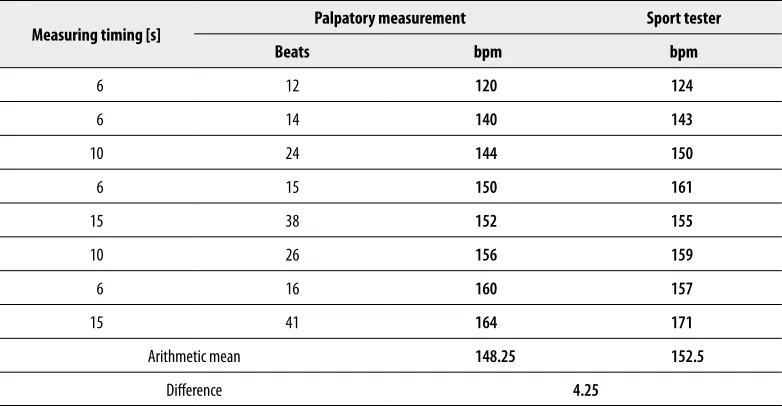
The reliability of HR measurement using palpative meth-od may be proven by a simple experiment. It is enough to perform several measurements controlled by a leader during the training session. A patient (client) equipped with a sport tester measures HR on the carotid artery us-ing the palpatory method in the time set by the leader, and does not confront the results with the sport tester but records the results in the worksheet. Directly after the signal indicating the end of measurement, the lead-er checks the result on the sport testlead-er and records it on his worksheet. The number of measurements is volun-tary, but at least half of them should be performed for 6 seconds, while the other for 10 and 15 seconds. If the difference between measurements made with palpatory methods and the readings of a sport tester for 1 minute does not exceed 10 BPM, it may be assumed that a pa-tient (client) has mastered this activity (Table 5). Hence, acceptable error during HR measurement performed us-ing palpatory method by a patient (client) durus-ing 6 sec-onds and simultaneously by a leader amounts to 1 beat (10 bpm if calculated per minute).
HR measurement with a sport tester is a proven meth-od during numerous regular forms of physical activity or games. GPS opens new possibilities [44,45]. Breaks to measure HR are no longer necessary. Nevertheless, the usefulness of indicators for workload monitoring for the purposes of rehabilitation, health-related train-ing, especially of the elderly, sport for all, etc. instead of the way of HR measurement constitute more serious issue. Aerobics points system, MET and other indica-tors are invaluable. Published compilations of various forms of recreational and sports activity refer to them and facilitate the calculation of weekly planned or exe-cuted energetic cost. Assuming the reasonable increase of the workload it is hard to programming and modify further training sessions basing on those general indi-cators (e.g. 7 MET for skiing, 3 MET for bowling [5]).
There is a high awareness of two phenomena among the specialists [e.g. 6, 13, 33]: (1) in spite of the same age and somatic similarity various people have differ-ent reactions for the same exercise programme; (2) the
necessity to personalise the workload has much broad-er explanation than it would follow from (1).
Progress in optimizing the personalisation of the train-ing load, which is necessitated by the need to use var-ious physical exercises determined by the multiplicity of needs (from rehabilitation to extreme sports), is hin-dered by lack of terminological consistency, sometimes taken to absurd levels. This issue has been tackled in the Introduction (The field of the training theory, praxeology and systems science). Some author identify the same in-dicators with the effort intensity, others attribute them the value of training load measures, etc. Perhaps, this is a main reason for lack of reliable answer for an obvious question of what are the causes of training effects af-ter shoraf-ter and longer cycles documented with scientif-ic accuracy. That ‘cause’ in the most general sense may be defined as the synonym of training load.
It is the easiest to provide examples concerning youth sport. The effects are in fact a consequence of the accu-mulation of training stimuli and factors stimulating the natural biological development during this stage of on-togenesis. For example, the development of fitness capa-bilities of young judo athletes such as speed, endurance, strength is well documented [46,47]. There are no empir-ical data to clearly answer the question about the train-ing load, which determines this conditions. It is easier to infer about the influence of training in comparison with the factors stimulating this natural development of mo-tor skills. There are many scientific researches concerning the biological development of children and adolescents, which are not additionally stimulated by sports training.
Jaskólski et al. [13] have developed the standards of physical preparation of children to various sports
disciplines and well-grounded guidelines for personali-sation of children’ and adolescents’ training in terms of physical development. Many guidelines concern planning of the training load value. Slightly different objectives form the basis for personalized exercise programmes sug-gested by Heyward [6, p. 107–116]. However, in both cases the procedures are finished with determination of training load. This decision is partially based on the same indicators (HR, time, frequency). Both recommendations are linked with another common feature. They consti-tute an example of methods with as high measurement accuracy as possible (and ultimately planning and pro-gramming the training loads) in contrast to very gener-al and hence unreliable methods based on a single indi-cator (MET, Aerobics point system, etc.). This positive assessment, however, does not exempt from the allega-tion that making comparisons of planned or executed training loads requires analysis of numerous indicators and determination of criteria authorizing the conclu-sions with consistent factual value, especially when two different methods are used. Paradoxically, this compar-ative study indicates that solving the same problem by scientists being experts in various politics systems final-ly leads to very similar generalisations. Perhaps, one of the major obstacles hindering the progress in numer-ous applied sciences is a limited access to papers pub-lished in languages of the countries from outside the Iron Curtain [see 49].
The advantage of the methodology of measurement, documentation and programming of the workload pre-sented in this paper is the possibility of expressing this variable using the universal LE indicator, which is based on conventional units. It may be used at every level of preliminary analysis i.e. from particular exercises and set of exercises (LE1…, etc.), through particular training
Measuring timing [s] Palpatory measurement Sport tester
Beats bpm bpm
6 12 120 124
6 14 140 143
10 24 144 150
6 15 150 161
15 38 152 155
10 26 156 159
6 16 160 157
15 41 164 171
Arithmetic mean 148.25 152.5
Difference 4.25
Table 5. The verification of accuracy of palpatory HR measurement based on the comparison of sport tester indications.
sessions (LE1…, etc.) to microcycles, mezocycles, mac-rocycles and long-term cycles (Lweek1…, etc.; LEmonths1…, etc.; LEyear2012…, etc.; LEyears2012–2015…, etc.). The next step of analysis is to decide whether the LE value is the effect: of either the relative balance (in terms of health recommendation, individual diagnosis involving safety effort, etc.) time and the intensity of an exercise (exer-cise); or extending the duration of the exercise with giv-en reduction of intgiv-ensity or vice versa; or compilation or various ‘activity-rest’ systems. Quantity and quality evaluation play more significant role on the next step of the in-depth analysis. For example, the following ques-tions must be answered: whether the exercise intensity is determined by patient’s (client’s) commitment and
whether it is connected with the motivation to exercise declared or estimated by the leader (trainer, physiother-apist, etc.) or with the skill performance or incentives of the leader; whether the same exercise intensity threshold is a derivative from the same number of repetitions. Te number of objectively relevant questions, which can be asked by the leader of health-related training, depends on his skills and sense of responsibility.
Following the algorithm, presented in detail in this pa-per, in accordance with the methodology does not deny the use of recommended quantitative and qualitative in-dicators. Quite the opposite, the more precisely is the training load documented, the more reliable premises Age
[years] HRmax[bpm] STLmax[uc] [bpm]HRR TDoptimal[min] TLoptimal[uc]
%TLoptimal
Recommendations for 70%HRmax Intensity
(HR) Time*
[%] Intensity zone [bpm] [min]
20 194 1,164 104 87 624 54
Light
136 46
30 187 1,120 97 88 582 52 131 45
40 180 1,080 90 90 540 50 126 43
50 173 1,038 83 92 498 48 121 41
60 166 996 76 94 456 46 116 39
70 159 954 69 96 414 44 111 37
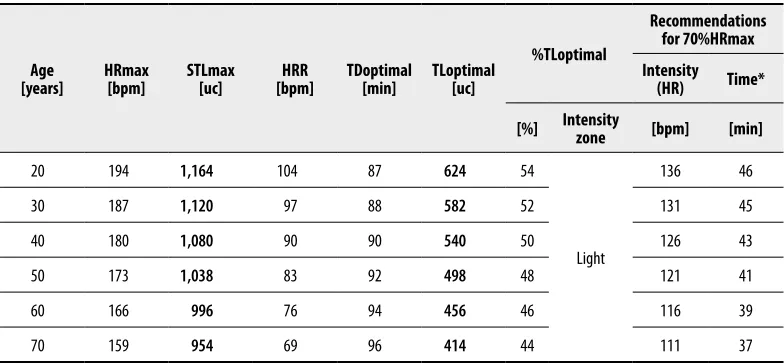
Table 7. Preliminary programming of optimal training load according to patient’s (client’s) age with established HRrest accounting for 90 bpm and recommendation to shorten the duration of training session i.e. TLoptimal (calculated for 60 minutes) assuming the exercise intensity being 70% HRmax (contact point of moderate and hard zones).
* Time = TLoptimal: (0.7 × HRmax) × 0.1. Age
[years] HRmax[bpm] STLmax[uc] [bpm]HRR TDoptimal[min] TLoptimal[uc]
% STLmax
Recommendations for 80%HRmax Intensity (HR) Time*
[%] Intensityzone [bpm] [min]
20 194 1,164 134 87 804 69
Moderate
155 52
30 187 1,120 127 88 762 68 150 51
40 180 1,080 120 90 720 67 144 50
50 173 1,038 113 92 678 65 138 49
60 166 996 106 94 636 64 133 48
70 159 954 99 96 594 62 127 47
Table 6. Preliminary programming of optimal training load according to patient’s (client’s) age with established HRrest accounting for 60 bpm and recommendation for those who declare daily physical activity to shorten the duration of training session i.e. TLoptimal (calculated for 60 minutes) assuming the exercise intensity being 80% HRmax (the middle of hard zone).
* Time = TLoptimal: (0.8 × HRmax) × 0.1.
that the personalisation has been accurate and achiev-ing the health goals is more likely. If a person wants to meet specific sport targets, careful documentation of the training load would be helpful in personalisation of the next training sessions and may protect against the ef-fects of reckless overloads.
The need for training load documentation during cur-rent training session forms the basis of workload opti-misation during subsequent training sessions, especially in rehabilitation of cardiac and type-2 diabetes patients, geriatrics, sport for all of people over 40. Moreover, the self-assessment of the physical effort tolerance may turn out to be very helpful in progressive increase of the next efforts or its reasonable reduction. This may be based on the scale of workload perception developed by Borg [49] or on 10-point scale similar to motivation to ex-ercise scale. Calculations in Tables 6 and 7 are only the clue on how to create a measure (suitable for a person in a given age) which would facilitate the decision mak-ing process about trainmak-ing load durmak-ing the current ses-sion. HRR and the knowledge of effort tolerance dur-ing previous traindur-ing sessions, preferably with the same or similar content, constitute the basis for determina-tion of the training load.
c
onclusionsThe 60-minute effort limit adopted in this methodol-ogy is only the quasi theoretical indicator. There are
people at retirement age, which spend many hours ski-ing, hiking or doing other long efforts. Personal profile of optimal training load for weekly or longer cycles can be determined basing on the methodology presented in this paper. It may serve as a tool to specify the daily safe workload and its implementation. The health ef-fects of these specific records should be verified by the expert in sport medicine. Controlled physical effort is in fact a significant part of the ‘polyhedron of a worthy life’ i.e. rational decision making, respecting the chief values, optimal physical activity, healthy nutrition and habits, friendly work environment and leisure.
The author would like to highlight that the interdisci-plinary issue tackled in this paper exemplifies the need to formulate the new paradigm. The present one can be defined as common belief (consolidated by dozens of academic publications and implementation of the pro-cedures) that physical effort should ensure the proper functioning of the human body in a physiological sense. Physical effort is an essential part of self-development in many fields including art. Physical effort with the spe-cific content is the source of satisfaction and a standard of quality of life, which cannot be provided by univer-sally recognized intellectual achievements. The reduc-tion of health promoreduc-tion and physical activity mainly to walking, running, cycling or other simple forms of ex-ercise may counterproductive in the longer term. That is, instead of achieving the ultimate goal of common phys-ical activity we will achieve its negation.
1. Epstein L, Miller GJ, Stitt FW et al: Physical train-ing bradycardia and autonomic nervous system. Scan J Clin Lab Invest, 1973; 32(3): 251–56 2. Fletcher GF, Balady G, Blair SN et al: Statement on
exercise: benefits and recommendations for phys-ical activity programs for all Americans. A state-ment for health professional by the Committee on Exercise and Cardiac Rehabilitation of the Council on Clinical Cardiology, American Heart Association. Circulation, 1996; 94(4): 857–62
3. Shepard R: Exercise in coronary heart disease. Sport Med., 1986; 3(1): 26–49
4. Bullock J, Boyle J, Wang MB: Physiology. 3rd
edi-tion. New Delhi, BI. Waverly Pvt. Ltd., 1997 5. Kuński H: Trening zdrowotny osób dorosłych.
Poradnik lekarza i trenera. Agencja Wydawnicza Medsportpress. Warszawa, 2002 [in Polish] 6. Heyward VH: Advanced fitness assessment and
ex-ercise prescription. 5th ed. Human Kinetics, 2006
7. Nowak Z: Ocena przydatności prognostycznej kwestionariuszy aktywności ruchowej u chorych z wykonaną przezskórną angioplastyką wieńcową. Akademia Wychowania Fizycznego. Katowice, 2007 [in Polish, summary in English]
8. Naglak Z: Trening sportowy. Teoria i praktyka. Wydanie III poprawione i uzupełnione. Państwowe Wydawnictwo Naukowe. Warszawa–Wrocław, 1979 [in Polish]
9. Mulak J: Trening wytrzymałości a potrzeby człowieka i zawodnika. [In:] Medyczne aspe-kty treningu wytrzymałościowego. Papers of the Karkonosze Scientific Society 38. Jelenia Góra, 1984: 9–34 [in Polish]
10. Płatonow WN: Sistema podgotovki sportsmenov w olimpijskom sporte. Obszczaja teoria i jejo prak-ticzeskie priłożenija. Kijów. Olimpijska literatura, 2004 [in Russian]
11. Wołkow LW: Sportiwnaja podgotowka dietiej i po-drostkow. Wieża. Kijev, 1998 [in Russian]
12. Wołkow LW: Tieorija sportiwnogo otbora: sposob-nosti, odariennost, talent. Wieża. Kijev, 1997 [in Russian]
13. Jaskólski E, Wołkow L, Jagiełło W: Biologiczne i pedagogiczne podstawy systemu szkolenia spor-towego. Centralny Ośrodek Sportu. Warszawa, 2005 [in Polish]
14. Swaim D, Edwards S: Middle School healthy hearts in the zone – a heart rate monitoring program for lifelong fitness. Human Kinetics. USA, 2002
15. Pollock ML, Gaesser GA, Butcher JD et al: The recommended quantity and quality of exercise for developing and maintaining cardiorespiratory and muscular fitness, and flexibility in healthy adults. Med Sci Sports Exerc, 1998; 30: 975–91
16. Kozłowski S, Nazar K, Kaciuba-Uściłko H: Fizjologia wysiłku fizycznego. [In:] Kozłowski S, Nazar K (eds.) Wprowadzenie do fizjologii klinic-znej. Wydawnictwo Lekarskie PZWL. Warszawa, 1995: 143–289 [in Polish]
17. Kalina RM, Barczyński BJ: EKO-AGRO-FITNESS©
original author continuous program of health-ori-ented and ecological education in the family, among friends or individually implemented – the premises and assumptions. Arch Budo, 2010; 6(4): 179–84 18. Kalina RM: The profile of Sense of Positive Health
and Survival Abilities indices (subjective assess-ment) as a diagnostic tool used in health-related training. Arch Budo, 2012; 8(3): 79–188 19. Klukowski K, Klimek A, Jethon Z (eds.): Wybrane
zagadnienia tolerancji wysiłku fizyczneg. Medicina Sportva. Biblioteka. Kraków, 2011 [in Polish] 20. Fidelus K: Propozycje jednolitego pomiaru
obciążenia treningowego. Sport Wyczynowy, 1974; 9: 3–10 [in Polish]
21. Simoescu K: Uwagi o zależności między objętością i intensywnością obciążeń we współczesnym trenin-gu (Relationship Between Work Load Volume and Intensity in Modern Training). Sport Wyczynowy, 1976; 2(134): 65–68 [in Polish, abstracts in English, in Russian]
22. Wałkow NI, Kariagin WM: Z badań nad kryte-riami klasyfikacji obciążeń treningowych (From the Studies on Classification Criteria of Training Loads). Sport Wyczynowy, 1977; 7(151): 11–16 [in Polish abstracts in English]