Published online February 20, 2013 (http://www.sciencepublishinggroup.com/j/aff) doi: 10.11648/j.aff.20130201.11
Effect of nutrient and pre-infested brinjal,
Solanum
melongena
by whitefly and aphid on population dynamics
of whitefly,
Bemisia tabaci
Mohd Rasdi Zaini, Che Salmah Md Rawi, Abu Hassan
School of Biological Sciences, Universiti Sains Malaysia, Penang, Malaysia
Email address:
[email protected] (M. R. Zaini), [email protected] (Che Salmah Md Rawi), [email protected] (Abu Hassan)
To cite this article:
Mohd Rasdi Zaini, Che Salmah Md Rawi, Abu Hassan Ahmad. Effect of Nutrient and Pre-Infested Brinjal, Solanum Melongena by Whitefly and Aphid on Population Dynamics of Whitefly, Bemisia Tabaci. Agriculture, Forestry and Fisheries. Vol. 2, No. 1, 2013, pp. 1-10. doi: 10.11648/j.aff.20130201.11
Abstract:
This study investigated the consequence of nutrient concentration levels and pre-infestation of brinjal (Solanum melongena) plant (by whitefly and aphids) on population of whitefly (Aleyrodidae; Hemiptera) over two cropping periods. Both factors, nutrient levels and pre-infestation by pests could also change plant-pest relationship especially with herbi-vorous insect pests. Variation in nutrient levels applied to the plants could influence different physiological performance of the plants which subsequently affected whitefly population. Populations of whitefly were higher following increasing levels of nutrients in non-pre-infested (control) plants. Lower whitefly populations were observed on whitefly pre-infested brinjal plants compared to aphid pre-infested and control plants. Pre-infested plants were suspected to induce productions of sec-ondary metabolites as a chemical defense system thus lowering the number of whiteflies on them. Considering other man-agement technique in controlling whiteflies on brinjal such as optimum nutrient supplement as plant growth progress and good pest care during seedling stage was proposed.Keywords:
Whitefly, Bemisia tabaci, Pre-Infestation, Nutrient, Population Dynamic, Brinjal1. Introduction
Whitefly (Aleyrodidae: Hemiptera), a pest to more than 500 plant species, have been recorded since 18th century [1]. Whitefly adults oviposit under surfaces of young leaves [2 and 3] and after eclosion, the first instar nymphs (crawlers) move a short distance over the leaf surface to find a suitable feeding site. Once settled, they continue feeding but remain sessile until they grow to adult stage [2]. At high densities, whiteflies are active pests on several host plants such as brinjal (Solanum melongena L.), tomato (Solanum lycoper-sicum) and chillies (Capsicum annum). Brinjal is one of the most popular fruit vegetables grown extensively throughout Malaysia. This fruit vegetable is originated from India but it is currently planted in both tropical and subtropical countries. Applying excessive amount of insecticides and fertilizers has been a common practice to farmers in Malaysia to im-prove yield production. Over use of chemicals is known to cause serious damage to ecological system and to human health [4].
High diversity of plants and insects leads to complex in-teractions in multitrophic systems. Some plants produce
2. Materials and Methods
2.1. Study Area
Malaysia has year round equatorial climate with high rainfall (26 mm to 359.2 mm mean/ month) and relative humidity of 70-85% and temperature of 30±5 ºC (Malaysia Meteorological Department, Bayan Lepas, Penang). This experiment was carried out for 2 cropping periods at Agri-culture Centre, Relau, Pulau Pinang, Malaysia with three months sampling period from August to October 2010 and between February and May 2011 for first and second crops respectively. Brinjal plants are planted in polybags con-taining burnt rice husk (soilless medium) under a rain shelter to protect brinjal (Solanum melongena L) plants from ha-zardous effect of rainfall. The rain shelter was equipped with a fertigation system.
2.2. Stock Culture of Whiteflies and Aphids
Whitefly adults were collected from honeydew melon (Cucumis melo var. Cantalupensis) planted under a rain shelter at Agriculture Centre, Relau, Penang and maintained in the USM Entomology laboratory on brinjal plants at an ambient temperature of 26±2oC, 80%±5 Relative Humidity, and a photoperiod of ± 12:12 (L:D). A brinjal plant with fifty whitefly adults were placed in each of two wooden rearing cages (50cm×45cm×60cm) covered by wire netting (0.5cm×0.5mm) to provide ventilation as well as to prevent the escape of the insects. Aphids were collected from brinjal plants planted by farmers around Penang Island. Approx-imately two hundreds aphids were also placed in a cage for mass rearing. The cages were lighted (12-14 hours daily) with a 12 volt fluorescent light on top of each cage.
2.3. Preparation of Brinjal Plants
Standard agronomic practices such as drip irrigation, seed germination, fertilization, pruning and harvesting were em-ployed in this study for ideal growth of brinjal plants and normal distribution of Bemisia tabaci and its natural ene-mies. Selected F1-hybrid brinjal seeds were sown in seedl-ing trays covered by pieces of wire nets to avoid undesirable insect infestations. The trays were placed in the nursery at the School of Biological Science, Universiti Sains Malaysia. After three weeks, 180 brinjal seedlings were selected and divided into three groups; (1) the first group was infested by whitefly (60 plants), (2) the second group was infested by aphid (60 plants) and (3) the third group of seedlings (60 plants) were not infested with any pest and used as a control. A week after the infestation, 15 brinjal seedlings were cho-sen from each group with a total of 45 plants. The seedlings (4-week-old) were transplanted carefully into polybags (each measuring 30cm×30cm), containing burnt rice husk. The poly bags were arranged in five blocks at one meter apart between plants and one meter between blocks under the rain shelter equipped with a fertigation system.
2.4. Treatments of Brinjal Plants
Two combinations of treatments applied to the brinjal plants; (1) application of three concentrations of nutrients, 50 ppm, 150 ppm and 300 ppm and (2) Infestation of brinjal seedlings (pre-infestation of plants) by whitefly and aphids. The combination treatments were defined as N1TC (N1=50ppm; TC=Non pre-infested/control); N2TC (N2=150ppm; TC=Control); N3TC (N3=300ppm; TC=Control); N1TW (N1=50ppm; TW=pre-infested by whitefly); N2TW (N2=150ppm; TW=pre-infested by whi-tefly); N3TW (N3=300ppm; TW=pre-infested by whiwhi-tefly); N1TA (N1=50ppm; TA=pre-infested by aphid); N2TA (N2=150ppm; TA=pre-infested by aphid); N3TA (N3=300ppm; TA=pre-infested by aphid) [11].
2.5. Treatment 1 (Nutrient Levels)
2.5.1. Preparation and Application of Nutrients to Brinjal Plants
All raw materials for nutrients mixture were supplied by the Department of Agriculture (DOA), Relau, Penang. The nutrient compositions and concentrations used in this study were based on common practices recommended by Malay-sian Agricultural Research and Development Institute (MARDI) and Department of Agriculture Malaysia. Two sets of nutrient mixtures were prepared. Set A consisted of 900 g Calcium nitrate (Cn-46%) and 41.6 g Iron EDTA (Fe-2.15%). Set B was made of 152g potassium nitrate (Pn-7.87%), 500g magnesium sulphate (MgSO4-25.89%), 320g potassium chloride (16.57%), 13.6g phosphoric acid (0.7%), 0.1g zinc sulphate (0.05%), 0.1g cuprum sulphate (0.05%), 0.4g ammonium molibdate (0.02%), 2g manganese sulphate (0.103%), and 1.4g boric acid (0.072%). Due to differential solubility in water, each of set A and B was di-luted with 50 liters of water in two small reservoir tanks. Then set A and B were mixed and diluted in 1000 liters water. This nutrient mixture was diluted with water in separate tanks to 50 ppm (N1), 150 ppm (N2) and 300 ppm (N3). Three dosages of nutrients (N1=50ppm=0.05g/L, N2=150ppm=0.150g/L, N3=300ppm=0.300g/L) at pH of 5.8-6.8 were applied to brinjal plants, to examine their effect on population of whiteflies. A valve attached to each nutrient tank was set up to automatically release all concentrations of nutrients for five minutes at three times daily; 0900 a.m, 1200 p.m and 1700 p.m. Nutrient concentration was moni-tored daily by a portable Electric Conductor (EC) tester, DiST 3® (Hanna® Instrument) and pH of the solution was monitored by a pH Scan1® to maintain an optimum level of pH for plant growth (at 5.5 to 7.0).
2.6. Treatments 2 (Pre-Infestation)
2.6.1. Infestation (Pre-Infestation) of Brinjal Plants by Whitefly
gently every day to ensure homogenous infestation by whi-tefly adults. The infested brinjal seedlings were inspected for the presence of immature stages of whitefly on the underside of leaves. After a week, 15 fully infested seedlings were randomly selected for the experiment.
2.6.2. Infestation (Pre-Infestation) of Brinjal Plants by Aphid
A tray of 3-week-old brinjal seedlings was kept in a cage. Ten adult aphids from the stock culture were carefully in-troduced manually on leaves of each brinjal seedling. After one week of infestation, a total of 15 fully infested brinjal seedlings were taken to the experimental plot.
2.6.3. Control (Non-Pre-Infested) Brinjal Plants
Several healthy 3-week-old brinjal seedlings free from pest infestations were placed in a cage. The plants were watered daily. After a week, 15 plants were selected for the experiment.
2.7. Experimental Plot under Rain Shelter
Four week-old brinjal seedlings; a) pre-infested by whi-tefly (TW), b) pre-infested by aphid (TA) and c) non-infested seedlings (control) were transplanted into white polyethylene bags (30 cm x 30 cm) containing burnt rice husk as planting media, and placed under a rain shelter. All pre-infested plants were inspected individually under dissecting microscope to ensure successful infestation by respective pests before transplantation. Ten of each of pre-infested plants by whitefly and aphids were randomly examined. There were 5.1 larvae/leaf and 2.7 nymphs/leaf (mean number) of whitefly (immature) and aphid respec-tively prior to the experiment in the first crop. In the second crop, there were 4.3 larvae/leaf and 3.9 nymphs/leaf of whitefly and aphids respectively. All polyethylene bags were arranged in a Randomized Complete Block Design (RCBD) with five replications (blocks).
2.8. Sampling of Whiteflies
Sampling of whiteflies was conducted at biweekly inter-val in the morning (0900 h to 1000 h) starting from the second week after transplanting (WAT) (6 week-old plants) until the end of harvesting (12 WAT). Forty five samples were collected (3 nutrient levels x 3 pre-infestation treat-ments × 5 replicates) at every sampling occasion. A leaf from the middle stratum [13] of each plant was carefully inserted into a zip-lock plastic bag and the petiole severed. All stages of whiteflies on the leaf were identified and counted under a dissecting microscope in the laboratory.
2.9. Data Analysis
All data were transformed to meet the assumptions of normality and homogeneity of variances (Kolmogo-rov-Smirnov test and Levene test). Differences in biweekly mean abundance of whitefly at different levels of nutrients and different pest pre-infestations were analyzed using one –way and factorial analysis of variance (ANOVA) [14] of
Statistical Package for Social Science (SPSS). Multivariate factorial analysis of variance was carried out to determine the effects of both treatments, nutrient and pre-infestation, and time on whiteflies abundance in two cropping periods. The t-test was carried out to determine the effect of different cropping periods on the abundance of whitefly. All values were presented as means (±) standard errors (S.E).
3. Results
3.1. Influence of Nutrient Concentration and
Pre-infestation of Brinjal Seedlings on Abundance of Whitefly Population
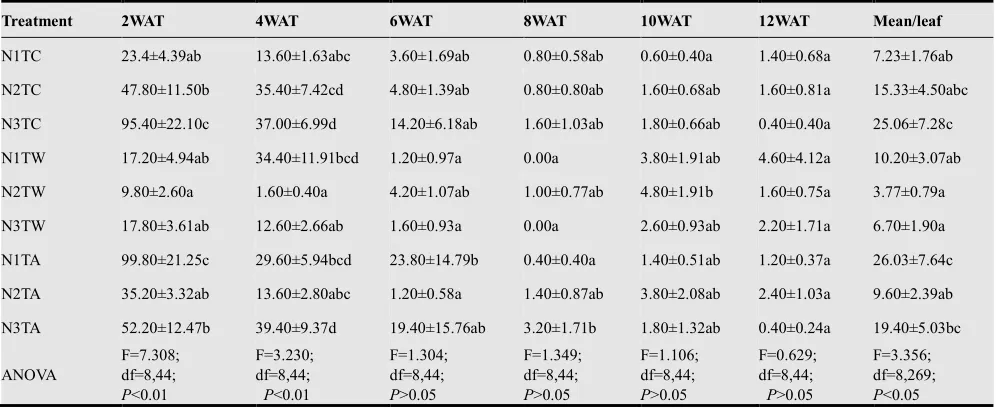
Whitefly has been known to infest vegetable crops planted under rain shelters or in greenhouses severely. In this study heavy infestations were observed on all leaves of all plants (Table 1 and Table 2) as early as 2 WAT in both first and second crops. In both crops, infestations were high in the early stage of plant growth (2 WAT to 4WAT), decreased as the plants entered flowering stage (6 WAT), and very low at the fruiting stage (8 WAT to 12 WAT) when the leaves were less attractive to the pest. There was a low infestation of whiteflies on brinjal plants in the first compared to the second crops. The abundance of whitefly larvae was sig-nificantly different among all nine treatments (F=3.356; df=8,269; P<0.05) (Table 1) in the first cropping period. The highest mean number of whitefly larvae was recorded on aphids pre-infested plants applied with 50 ppm (N1TA) (26.03±7.64 larvae/leaf), followed by control plants applied with 300 ppm nutrient (N3TC=25.06±7.28/leaf). The lowest larval population was recorded on whitefly pre-infested brinjal plants applied with 150 ppm nutrient (N2TW). Within the period of study, the whitefly abundance was significantly different among the nine treatments at 2 WAT (P<0.01). At this time, whitefly pre-infested plants applied with 150 ppm nutrient (N2TW) had the lowest population (9.80±2.60/leaf), but no significant difference was observed with whitefly pre-infested plants applied with 300 ppm nutrient (N3TW). Meanwhile, N1TA and N3TC had the highest number of whitefly on the underside of their leaves. Based on Duncan Multiple Range Test (DMRT),the number of whiteflies infesting N2TW plants was different from those on N1TA, N3TA, N3TC and N2TC but no difference was detected with N2TA and N1TC.
(F=3.230; df=8,44; P<0.01) (Table 2). The DMRT con-firmed that N2TW had the lowest number of whiteflies among all treatments except N3TW. Populations of whitefly declined drastically after 6 WAT in all treatments. No sig-nificant difference (P>0.05) was recorded in mean number of whiteflies among treatments at 6 WAT (P>0.05), 8 WAT (P>0.05), 10 WAT (P>0.05) and 12 WAT (P>0.05). At 10 and 12 WATs, population of whitefly fluctuated slightly in
all treatments. Population of whitefly sharply decreased after 4 WAT to the end of sampling period, particularly at nutrient concentrations of 150 ppm. Overall, the lowest population of whitefly was observed on pre-infested plants by whitefly at all sampling dates. Generally, the plants treated with the highest concentration of nutrient (300 ppm) had been infested with high number of whiteflies.
Table 1. Effects of three concentrations of nutrients and pre-infested plants on biweekly populations (means±SE) of larval whitefly in the first cropping period.
Treatment 2WAT 4WAT 6WAT 8WAT 10WAT 12WAT Mean/leaf
N1TC 23.4±4.39ab 13.60±1.63abc 3.60±1.69ab 0.80±0.58ab 0.60±0.40a 1.40±0.68a 7.23±1.76ab
N2TC 47.80±11.50b 35.40±7.42cd 4.80±1.39ab 0.80±0.80ab 1.60±0.68ab 1.60±0.81a 15.33±4.50abc
N3TC 95.40±22.10c 37.00±6.99d 14.20±6.18ab 1.60±1.03ab 1.80±0.66ab 0.40±0.40a 25.06±7.28c
N1TW 17.20±4.94ab 34.40±11.91bcd 1.20±0.97a 0.00a 3.80±1.91ab 4.60±4.12a 10.20±3.07ab
N2TW 9.80±2.60a 1.60±0.40a 4.20±1.07ab 1.00±0.77ab 4.80±1.91b 1.60±0.75a 3.77±0.79a
N3TW 17.80±3.61ab 12.60±2.66ab 1.60±0.93a 0.00a 2.60±0.93ab 2.20±1.71a 6.70±1.90a
N1TA 99.80±21.25c 29.60±5.94bcd 23.80±14.79b 0.40±0.40a 1.40±0.51ab 1.20±0.37a 26.03±7.64c
N2TA 35.20±3.32ab 13.60±2.80abc 1.20±0.58a 1.40±0.87ab 3.80±2.08ab 2.40±1.03a 9.60±2.39ab
N3TA 52.20±12.47b 39.40±9.37d 19.40±15.76ab 3.20±1.71b 1.80±1.32ab 0.40±0.24a 19.40±5.03bc
ANOVA
F=7.308; df=8,44;
P<0.01
F=3.230; df=8,44;
P<0.01
F=1.304; df=8,44;
P>0.05
F=1.349; df=8,44;
P>0.05
F=1.106; df=8,44;
P>0.05
F=0.629; df=8,44;
P>0.05
F=3.356; df=8,269;
P<0.05
* Means in the column with the same letters are not significantly different at P= 0.05 based on Duncan Multiple Range Test (DMRT). ** Week After Transplanting.
In the second cropping period, the abundance of whitef-lies was significantly different among all nine treatments during the entire sampling period (P<0.01) (Table 2). The highest number of whitefly larvae was recorded on control brinjal plants particularly those applied with 300 ppm nu-trient concentration (N3TC) (26.03±5.92/leaf), followed by N1TC (20.63±5.37/leaf). Similar to the first crop, the lowest
larval population was observed on whitefly pre-infested plants at 150 ppm nutrient (N2TW) with an average of 5.97±1.12 larvae/leaf. At the beginning of the second crop-ping period, similar trend of whitefly infestation in the first crop was observed when more whiteflies were found on control plants. All treatments affected the abundance of whiteflies at 2 WAT (P<0.01) and 4 WAT (P<0.01).
Table 2. Effects of three concentrations of nutrients and pre-infested plants on biweekly populations (means±SE) of larval whitefly in the second cropping period.
2WAT 4WAT 6WAT 8WAT 10WAT 12WAT Mean/Leaf
N1TC 67.40±15.49d 33.20±6.41bc 9.20±2.35ab 6.40±1.69ab 4.20±0.73ab 3.40±0.75a 20.63±5.37bc
N2TC 40.40±8.29bc 9.40±3.03ab 6.00±1.70a 15.00±3.29b 5.60±0.87abc 4.40±1.29a 13.47±2.75ab
N3TC 62.20±13.67cd 66.20±15.22d 8.80±2.52ab 6.80±0.73ab 7.00±1.52bcd 5.20±1.39a 26.03±5.92c
N1TW 12.80±2.99a 2.80±0.97a 9.20±2.76ab 8.60±3.75ab 8.00±2.30bcd 3.40±0.51a 7.47±1.41a
N2TW 10.40±2.54a 6.00±1.37ab 7.40±2.77a 3.80±1.32a 4.80±1.28ab 3.40±1.03a 5.97±1.12a
N3TW 16.60±5.02ab 47.00±17.31cd 8.60±1.50ab 11.60±3.53ab 0.60±0.24a 6.20±1.66a 15.10±3.96ab
N1TA 15.20±3.23ab 15.40±2.98ab 9.80±2.75ab 12.40±2.79ab 6.00±2.51bcd 3.40±1.03a 10.77±2.76a
N2TA 3.40±1.02a 12.80±3.30ab 7.40±2.69a 8.60±3.09ab 10.40±2.01cd 5.80±1.50a 8.07±1.21a
N3TA 16.60±4.33ab 6.00±1.87ab 16.80±3.72b 10.80±2.60ab 10.80±1.80d 6.60±2.36a 11.27±1.60ab
ANOVA
F=6.416; df=8,44;
P<0.01
F=5.103; df=8,44;
P<0.01
F=1.095; df=8,44;
P>0.05
F=1.057; df=8,44;
P>0.05
F=3.151; df=8,44;
P>0.05
F=0.931; df=8,44;
P>0.05
F=3.800; df=8,269;
P<0.01
* Means in the column with the same letters are not significantly different at P= 0.05 based on Duncan Multiple Range Test (DMRT). ** Week After Transplanting.
(pre-infested plants by whitefly supplied with 150 ppm nutrient) recorded the lowest number of whiteflies (10.40±2.54) in both cropping periods. Meanwhile, both N1TC and N3TC had the highest abundance of whitefly. However, there was no significance difference of whitefly abundance in N2TW compared to whitefly or aphid pre-infested plants receiving various nutrient concentra-tions.
At 4 WAT, the population of whitefly decreased consi-derably in most treatments, except on plants that received 300 ppm nutrients concentration such as N3TC and N3TW. Low whitefly infestation were observed mostly on pre-infested plants by whiteflies particularly N1TW (50 ppm; 2.80±0.97) and N2TW (150 ppm; 6.00±1.37), followed by N3TA (300 ppm; aphid pre-infested) (6.00±1.87). N2TC and N2TA also suffered low infestations with 9.40±3.03 and 12.80±3.30 larvae per leaf respectively (Table 2). The pop-ulations of whitefly were considerably low after 6 WAT in all treatments and the population abundances were not sig-nificantly different (P>0.05) among treatments at 6 WAT (P>0.05), 8 WAT (P>0.05), 10 WAT (P>0.05) and 12 WAT (P>0.05). Whitefly populations fluctuated slightly in most treatments from 8 WAT to the end of sampling period (12WAT). Similar to the first cropping period, populations of whitefly sharply decreased from 4 WAT to the end of study, especially those applied with 150 ppm nutrient concentra-tions. Whitefly pre-infested plants consistently suffered the lowest infestations by whitefly. In general, plants applied with the highest (300 ppm) nutrients concentrations were strongly preferred by whiteflies at initial growing stages (up to 4 WAT) in both cropping periods. In this study, the effects of various treatments on whitefly infestation on brinjal plants were assessed for two cropping periods. The result shows that the whitefly populations are significantly dif-ferent (P<0.05) in the two cropping periods. Whitefly pop-ulations were not significantly different in the two cropping periods which implied consistent population abundances on brinjal plants receiving similar treatments in both crops. Treatments N2TW and N3TC had the lowest and highest whitefly populations in both cropping periods respectively.
Based on multivariate analysis of variance (MANOVA) in the first cropping period, there was no difference in abun-dance of whiteflies infesting brinjal plants applied with 50, 150 ppm and 300 ppm nutrient concentrations at P>0.05. Differences in plants vigor as they responded to increasing amount of nutrients during the cropping period did not in-fluence the abundance of whitefly infesting the plants (Nu-trient concentration * time, P=0.737). In this case the null hypothesis of equal mean of whitefly abundances among the three nutrient levels applied to the plants was accepted. The plants responded to pre-infestations by whiteflies and aphids differently as whiteflies abundances on plants infested by the two pest species varied significantly (F=5.919; df=2,216; P<0.01). In relation to time of plant growth (phenology) effect, the abundances of whiteflies also varied significantly as brinjal plants were growing from vegetative to flowering and fruiting phases (from 2 WAT to 12 WAT) (F=29.501;
df=5,216; P<0.01). Whitefly abundances showed no signi-ficance difference in response to compounded interactions of nutrient levels and pre-infestations of brinjal seedlings as plants grew to maturity (time).
In the second crop, mean abundances of whitefly popula-tion were significantly different in plants receiving different concentrations of nutrients (F=9.068; df=2,216; P<0.01) and whitefly as well as aphids pre-infested brinjal seedlings (F=18.508; df=2,216; P<0.01). The abundances also varied as plants grew to maturity (bearing fruits) at the end of the cropping period (F=22.624; df=5,216; P<0.01). Except for no interaction between the concentrations of nutrients ap-plied to the plants and pest pre-infestations of the seedlings, other interactions were observed thus consequently affecting the abundances of whitefly infesting the plants.
3.2. Effect Different Concentrations of Nutrients on Ab-undance of Whitefly Population on Brinjal Plants (Control)
The effect of nutrient concentrations applied to brinjal plants on whitefly population was examined in the control brinjal plants (TC) which were not infested by any of the two pests, whitefly or aphid. During the first cropping period, whitefly populations varied significantly among treatments (P<0.05) at 2 WAT. However, at 4 WAT until 12 WAT, the population did not show any significance difference (P>0.05) among all nutrient concentrations. Further investigation by the multiple mean comparisons showed that whitefly ab-undance was lower in N1TC compared to N3TC but there was no difference with N2TC. Meanwhile, population in N2TC was different from N3TC. N3TC harbored the highest number of whitefly larvae (25.06±7.28) and the population decreased corresponding to decreasing in nutrient concen-trations from N2TC to N1TC. Whitefly populations were constantly higher on plants receiving higher nutrient con-centration (300 ppm) particularly at 2 WAT and 4 WAT. Nevertheless the populations decreased to very low level from 6 WAT onwards in all nutrient concentrations (N1TC, N2TC and N3TC) with less than 5.0 larvae/leaf. In the second crop, abundance of whitefly was significantly dif-ferent among the plants receiving three nutrient concentra-tions (P<0.01) at 4 WAT. From then on no difference of whitefly abundance was detected until the end of sampling week. Similar to the first crop, the highest abundance of whitefly was recorded on plants applied with 300 ppm nu-trient concentration (N3TC) (26.03±5.92/leaf), followed by N1TC (20.63±5.37/leaf) and the least was on N2TW (13.47±2.75). Meanwhile, at 2 WAT, N1TC had the highest number of whitefly compared to other treatments. At 4 WAT, N2TC recorded the lowest number of whitefly with 9.40±3.03/leaf. From 6 WAT onwards, the population of whitefly decreased in all treatments.
In general, the infestation of whitefly on whitefly pre-infested brinjal plants did not vary very much in all nutrient treatments throughout the study. However, the ab-undances of whitefly populations were significantly differ-ent at 4 WAT in the first (P<0.05) and second cropping pe-riods (P<0.05) as well as at 10 WAT of the second cropping period (F2,14=5.903, P<0.05). Among the three levels of
nutrient concentrations applied to the plants (N1TW=50 ppm, N2TW=150 ppm and N3TW=300 ppm) in the first cropping period, N2TW had the lowest population of whi-tefly (3.77±0.79 larvae per leaf) and the highest was rec-orded on N1TW (10.20±3.07) especially at 2 WAT (9.80±2.60), (although not significantly different at P<0.05), 4 WAT (1.20±0.49), followed by N3TW (12.60±2.66). In-terestingly, the population of whitefly declined as early as 6 WAT and continued onwards in all nutrient concentrations. Similar to the first cropping period, the lowest larval popu-lation in the second crop was also observed on plants re-ceiving 150 ppm nutrient (N2TW) but the highest was in N3TW with an average of 5.97±1.12 larvae/leaf and 15.10±3.96/larvae/leaf respectively. At initial stage of sam-pling (2 WAT), N2TW (150 ppm) had the lowest number of whiteflies (10.40±5.19). At 4 WAT, whitefly populations started to decline in all nutrient treatments except in N3TW. The populations dropped during the subsequent weeks until the end of sampling week (12 WAT).
3.4. Effect of Different Concentrations of Nutrients on Abundance of Whitefly Population on Aphid
Pre-Infested Brinjal Plants (N1TA, N2TA and N3TA)
Whitefly populations were significantly different among aphid pre-infested plants at different level of nutrient con-centrations in the first cropping period particularly at 2 WAT (P<0.05) and 4 WAT (P=0.05). For the entire sampling pe-riod (WAT 2 to 12), the Table 1 shows that the highest number (mean) of whitefly larvae was recorded on plants applied with 50 ppm (N1TA) followed by 300 ppm (N3TA) with total mean of 26.03±7.64 larvae/leaf and 19.40±5.03 larvae/leaf respectively. At 150 ppm nutrient application, the number of whitefly was the lowest (9.60±2.39 larvae/leaf). The population of whitefly was more dominant with the highest number recorded on N1TA (99.80±21.25 larvae/leaf) and the least in N2TA. Whitefly population sharply de-creased in all treatments (N1TA, N2TA and N3TA) from 4 WAT to 6 WAT. Tremendous declined in whitefly population was observed at 8 WAT and maintained at very low level until the end of study. There was no significance difference in the number of whitefly among nutrient treatments at every sampling occasion in the second cropping period except on 6 WAT. Table 2 shows that N3TA was the most preferred by the whiteflies (11.27 larvae/ leaf) when compared among the three treatments for the entire cropping period. The whitefly population was very low compared to the first crop. How-ever, relatively high number of whitefly infested N3TA at 2 WAT. Small fluctuations of whitefly population were ob-served throughout the cropping period which led to the assumption that early infestation of aphid on brinjal plants
did not affect whitefly infestation on the plants.
4. Discussion
Brinjal plant is one of 500 host plants for whitefly which provides good oviposition site as well as food sources for the pest. High abundances of whiteflies were recorded on brinjal plants just after the plants were transplanted (at 2 WAT). More pests were found on plants receiving higher amount of nutrients. Good plant growth and high plant quality (vigor) attracted more pests to the plants [7]. Plants that contain different compositions of varied amount of nutrients [15] absorb these nutrients from the planting medium. Availabil-ity of nutrients from the planting medium is very crucial for plant growth [16]. Whitefly, B. tabaci, infestation is influ-enced by different nutrient contents provided by the host plants that affect its oviposition, longevity, developmental time (from egg to adult) and mortality rates [17]. Bogran and Heinz (2000) [18] found that whiteflies select the plants with higher amounts nutrients and their population multiplies faster due to high fecundity (66 and 400 eggs) and longer longevity (10 to 60 days) of the females. High numbers of whitefly immature (such as eggs, larvae and pupae) were found scattered all over the underside of leaves [2] particu-larly during early growth of the plants. Simiparticu-larly, in this study, the amount of nutrients supplied to the plants signif-icantly influenced the populations of whiteflies at very early stages of plant growth (2WAT and 4 WAT). However, after these periods, its effect was negligible regardless whether the plants suffered from early infestations of other pests or by whitefly itself. This study also demonstrated that infes-tation of whiteflies was more restricted to early growth of brinjal plants and the pest was less harmful at other stages of plant growth.
[19]. Moreover, according to William et al. (2002) [6], sur-vival of herbivory insects improves when the nitrogen con-tent in their bodies was approximately 15% lower than the amount available in the host plants.
However, whitefly population levels decreased in all treatments starting from 6 WAT (plants starting to flower) until end of sampling period. Several factors could cause the decline in whitefly population such as increasing number of natural enemies, poor weather condition and development of plant chemical defense [12] when plants react towards in-sects’ feeding [11]. Similar trend was reported by Zurina et al. (2010) [8] that whitefly population was significantly higher during early season and gradually declined as the crop growth progressed. Naturally, plant vulnerability to insect-pest attack changes as it ages [20]. According to Prabhu et al. (2009) [10], brinjal plants are able to induce effective chemical defense that affect the pest population when the infested plants reach mature stage. On the other hand, the whiteflies might be attacked by their natural ene-mies that have established their populations in the field during the later periods of plant growth. As a response to pest infestation, the plant has the ability to induce direct and indirect defense mechanism which provides specific signals or cues to attract predators and parasite [21] to the plants. The population dynamics of whitefly was highly influenced by pre-infestation of brinjal plants by whiteflies during their seedling stage. They quickly reacted and responded against whiteflies thus dampened whitefly population as the plants’ maturity increased. In relation to chemical defense produced by plants, many studies have also reported that leaves of different ages differ in their degree of herbivore’s infestation [22]. This is because the production pathogenesis related proteins (PR) (chemical defense) are closely related to the development and leaf age of the plants [23]. According to Hamady et al. (2011) [22] mature leaves of Solanum lyco-persicon have exhibited high activity of plant defense pro-tein after infested by whiteflies. However, the infection of Tomato Yellow Leaf Curl Virus (TYLCV) is not influenced by leaf age. Fagoonee and Toory (1983) [24] also reported that leaves of various ages had different degree of herbi-vore’s infestation as well as oviposition preference.
Excessive amount of nutrients applied to the plants en-couraged more whiteflies to the host plants. As observed in this study, application of nutrient concentration at a rec-ommended rate (150 ppm) showed less whitefly infestation while plants were still able to grow healthily. Most herbi-vorous insects prefer highly nutritious food when they have choices [25] although such tendency was not clearly ob-served in Diaprepes abbreviates [26]. For this matter, doses and concentrations of fertilizer application need proper consideration for prevention of severe pest attack. The ef-fects of various treatments on populations of whiteflies infesting brinjal plants were not detected in the first crop-ping period. However significant influence and interactions of nutrient concentrations, pest pre-infested plants and plant growth were observed in the second crop. A couple of fac-tors were presumed to take effect in the second cropping
period. Firstly, the presence of high competitor aphids pop-ulation in the second crop, could affect the whitefly popula-tion directly and indirectly [7]. Secondly, differential pro-duction of secondary metabolites in both cropping periods as plant defense mechanisms [10] led to variation in pest-plant interactions. Other factors such as differential activities of natural enemies could contribute to variations of pest-plant responses [29].
Brinjal plants supplied with the highest (300 ppm) nu-trient concentration were found to be more preferred by whiteflies and the lowest number was recorded on plants receiving lower nutrient concentration especially during early stage of plant growth (2 WAT and 4 WAT). Similar trend of whitefly population was reported by Bi et al. (2001) [30] in his study on whiteflies infesting cotton. Higher whitefly populations are observed on cotton plants receiving high nitrogen fertilization. As mention previously, plants respond to higher amount of nutrients by producing more leaves, branches and bigger size of leaves, and preferable pH of leaf sap [31] thus providing more food resources to the pest. Close-hairy characteristics of young leaves is a favorable condition for female whiteflies to lay their eggs [3] as this will secure the progeny from hazardous effect of heavy wind and rainfall. At initial stage of plant growth, flushing of young leaves support active feeding by voracious immature whiteflies which is crucial for establishment of whitefly population.
When the brinjal plants were exposed to early infestation by its pest (whitefly), most plants consistently recorded lower number of whiteflies on them especially at the early part of plant growth. This was more obvious on plants that received 150 ppm (optimum nutrient concentration) which consistently recorded the lowest number of whitefly in both cropping periods. Whitefly inserts enzymes into the host plant while feeding which affects the normal physiological growth processes of the host plants [2] and subsequently triggers chemical defense. This indicated that plants with early infestation by whitefly may have produced chemical defense [38] earlier than the control plants (without pre-infestation). Whitefly infestation rate was high on pre-infested plants that received high nutrient concentration (300 ppm). In this case, nutrient concentration supplied to the plants probably influenced plants’ volatiles by either increasing or decreasing their amounts in the plants after infestation. Ibrahim et al. (2007) [39] reported that the in-duction of plant volatiles such as (Z)-3-hexen-1-ol, (Z)-3-hexenyl acetate and b-elemene was significantly higher in infested plants grown in a high-nutrient soil com-pared to infested plants in a low-nutrient soil. Generally, this study found that early infestation by whitefly and dif-ferent levels of nutrient applied to brinjal plants in the field had contributed to the changes of whitefly population trend [9]. Whitefly population declined early in plants pre-infested by whitefly than in control plants with higher number at early stage of plant growth. Takabayashi et al. (1991) [40] reported that brinjal plants produced mixtures of volatiles and stimulated chemical defense after being infested by whitefly [22] for at least 7 days [12]. However, after eight weeks (WAT), all plants in all treatments in-cluding control plants had very low abundance of whiteflies but more drastic decrease was observed in plants pre-infested by whitefly than in control plants as plant grew from vegetative stage to fruiting stage. Some forcing fac-tors, for instance, modifications of nutrient management [41], trophic interaction especially natural enemy and competitor pest [42] could play roles in regulating the whi-tefly populations.
Aphids pre-infested brinjal plants treated with 50 ppm nutrient concentration were found to have the highest number and were more preferred by whiteflies at early stage of plant growth (2 WAT and 4 WAT) in both cropping pe-riods. There was no clear relationship between nutrient concentration and whitefly infestation at three levels of nutrients applied to the plants in aphid pre-infested plants. The result had an agreement with Borowicz et al. (2003) [26] who reported that different levels of fertilizer supplied to the host plants did not influence herbivore’s performance.
Interestingly, this study found that whitefly less preferred the plants receiving optimum amount of nutrient supply (150 ppm). While, on low nutrient plants pre-infested by aphid, whitefly infestation was higher and they showed high competitive activity. Good performance and very healthy plants that could resist pest infestation was observed at this optimum nutrient level (150 ppm). This is supported by
previous findings [45] who reported that the pest feeding rates and infestation change in response to different nutrient rates applied to the plant (peas).
This study indicated that early infestation by aphid did not affect whitefly population on the aphid pre-infested plants especially at early stage of plant growth. It also can infer that early aphid infestation on the brinjal plants, may or may not trigger chemical defense but it seems not affecting the whi-tefly infestation. Furthermore, Dicke and van Loon (2000) [43] reported that the quantity and composition of volatiles released by plants could be different for different pest spe-cies [20]. Generally, whitefly tends to compete with aphids [10] for oviposition site on aphid pre-infested plants. At the same time, whitefly prefers to co-exist with its competitor (aphids) for its survival and security against parasitoids. Previous study reported that aphids are more preferred preys by whitefly’s parasitoids such as Encarsia formosa [44]. Principally, whitefly is considered as a major pest of brinjal since it is highly capable to compete, resistant to aphid pre-infestation effect and having a good strategy in reducing parasitism activity on itself to sustain its population
5. Conclusions
Plant growth, nutrient concentration and early infestation by whitefly on the brinjal plants could affect whitefly pop-ulation considerably. Poppop-ulations of whitefly were higher following increasing levels of nutrients in non-pre-infested plants, however, the lowest populations were observed on whitefly pre-infested brinjal plants. It can be concluded that whitefly was more dominant and able to resist whitefly infestation to some extent.
Acknowledgements
We were grateful to the School of Biological Sciences, Universiti Sains Malaysia (Research grant: 1001/PBIOLOGI/844053) and Department of Agricultural Station, Relau in Penang for providing the experimental sites and other facilities to undertake this study. Thanks to anonymous referees who had tremendously improved the earlier version of the manuscript.
References
[1] Gennadius P (1889) Disease of tobacco plantations in the Trikonia. The Aleyrodid of tobacco, Ellenike Georgia 5. 1-3. [2] McDonough MJ, Daniel G and Mark EA (2003) Whiteflies in Commercial Greenhouse Poinsettia Production. Reagents of the University of Minnesota. 1-12.
[3] Mohd Rasdi Z (2005) Biology, distribution and effect of selected insecticides against whiteflies (Trialeurodes vapo-rariorum Westwood and Bemisia tabaci Gennadius) on brin-jal (Solanum melongena). Thesis; Universiti Teknologi MARA, Malaysia.
consequences of pesticide use in paddy production in the Mekong Delta, Vietnam. Research Report: 1-39.
[5] Swain T (1977) Secondary compounds as protective agents. Annual Review of Plant Physiology, 28: 479-501.
[6] William FF, Evan S, Charles M, Robert FD, Andrea FH, Athur WH and James JE (2002) Nitrogen in insects: Impli-cations for trophic complexity and species diversification. The American Naturalist, Vol.160 (6) Dec 2002.
[7] Teja T and Bradford AH (2000) Multitrophic level interac-tions: an introduction. Cambridge University Press.
[8] Zurina M, Mohamad Roff MN and Idris AB (2010) Effect of nitrogen rates on the whitefly Bemisia tabaci) population infesting chilli (Capsicum annum L.). Sains Malaysiana, 39(6): 913-920.
[9] Yolanda HC and Stepen CW (2005) Crop domestication disrupts a native tritrophic interaction associated with the sunflower, Helianthus annuus (Asterales: Asteraceae). Eco-logical Entomology (2005) 30: 673–683.
[10] Prabhu M, Natarajan S, Veeraragavathatham D and Puga-lendhi L (2009) The biochemical basis of shoot and fruit borer resistance in interspecific progenies of brinjal (Sola-num melongena). EurAsian Journal of BioSciences, 3: 50-57. [11] Mohd Rasdi Z and CheSalmah MR (2011) Multitrophic system: Effect of different concentration of nutrient and pre-infested brinjal (Solanum melongena) on whitefly (Be-misia tabaci) population. 2011 3rd International Symposium & Exhibition in Sustainable Energy & Environment, 1-3 June 2011, Melaka, Malaysia. 236-242.
[12] Inbar M, Doostdar H, Leibee GL and Mayer RT (1999) The role of plant rapidly induced responses in asymmetric in-terspecific interaction among herbivores. Journal of Chemi-cal Ecology, Vol. 25, No. 8, 1999.
[13] Mohd Rasdi Z, Fauziah I, CheSalmah MR, Fairuz K, Saiful Akbar MS, Md Jamaludin B and Kamaruzaman J (2009). Population ecology of whitefly, Bemisia tabaci, (Homoptera: Aleyrodidae) on brinjal. Journal of Agricultural Science (CCSE). Vol. 1 (1): 27–32.
[14] Sandra DS, Ramon CL (1987) SAS System for Elementary Statistical Analysis. SAS Institute Inc. 418 pp.
[15] Schoonhoven LM, van Loon JJ A and Dicke M (2005) In-sect-plant biology. Oxford: University Press. pp. 421. [16] Gershenzon J and Croteau R (1991) Terpenoids. In:
Rosen-thal GA and Berenbaum MR, Herbivores: Their Interaction With Secondary Plant Metabolites. CRC Press, Boca Raton, FL: 165–219.
[17] Lenteren JC, Van LP and Noldus JJ (1990) Whitefly-plant relationships: Behavioural and ecological aspects. In: Whi-teflies: Their bionomics, pest status and management, D. Gerling (ed.). Intercept, Hants, United Kingdom, pp. 47-90. [18] Bogran CE and Heinz KM (2000) Whiteflies: House and
landscape pests. Texas Cooperative Extension; B-6127. [19] Spencer TB (2008) Insect herbivore nutrient regulation.
Annual Rev. Entomol.2009. 54:165-187.
[20] Gibson RW (1971) The resistance of three Solanu species to Myzus persicae, Macrosiphum euphorbiae and Aulacorthum solani (Aphididae: Homoptera). Ann. Appl. Biol. 68. pp.
245-251.
[21] Walling LL (2000) The myriad plant responses to herbivores. Department of Botany and Plant Sciences, J Plant Growth Regul (2000) 19:195-216.
[22] Hamady D, Tomomitsu S, Ahmad Abu, Al Thbiani A, Ro-nald EM, Suhaila AH, Fumio M and Sazaly A (2011) Pe-roxidase activity after viral infection and whitefly infestation in juvenile and mature leaves of solanum lycopersicum. Journal Phytopathol©2011 Blackwell Verlag GmbH. [23] Cevahir G, Yentu¨ r S, Yazgan M, U¨ nal M and Yilmazer N
(2004) Peroxidase activity in relation to anthocyanin and chlorophyll content in juvenile and adult leaves of ‘‘mini-star’’ Gazania splendens. Pak J Bot 36:603–609. [24] Fagoonee I and Toory V (1983) Preliminary investigation of
host selection mechanisms by the leafminer Liriomyza trifolii. Insect Sc. Application 4: pp. 337-341.
[25] Bernays EA, Bright KL, Gonzales N and Angel J (1994) Dietary mixing in a generalist herbivore: tests of two hypo-theses. Ecology 75:1997-2006.
[26] Borowicz VA, Albrecht U and Mayer R.T (2003) Effects of nutrient supply on citrus resistance to root herbivory by Di-aprepes abbreviatus L.(Coleoptera: Curculionidae). Envi-ronmental entomology 32, 1242-1250.
[27] Horowitz AR, Podoler H and Gerling D (1984) Life table analysis of the tobacco whitefly Bemisia tabaci (Gennadius) in cotton fields in Israel. Acta Ecological/Ecologia Applicata 5. pp. 221-233.
[28] Dyer LA (2007) Tropical tritrophic interactions: Nasty hosts and ubiquitous cascades. Tropical forest community ecology: 275-293.
[29] Chen Luo and Tong-Xian Liu (2011) Fitness of Encarsia sophia (Hymenoptera: Aphelinidae) parasitizing Trialeu-rodes vaporariorum and Bemisia tabaci (Hemiptera: Aleyro-didae). Insect science, 18: 84-91.
[30] Bi JL, Ballmer GR., Hendrix DL, Henneberry TJ and Tos-cano NC (2001) Effect of cotton nitrogen fertilization on Bemisia argentifolii populations and honeydew production. Entomologia experimentalist et applicata, 99 (1), 25-36. [31] Berlinger MJ (1986) Host plant resistance to Bemisia tabaci.
Agric. Ecosystems Environ. 17. pp. 69-82.
[32] Reddy AS and Venugopal Rao N (1989) Cotton whitefly (Bemisia tabaci Genn.) A review. Indian Journal of Plant Protection 17: 171- 179.
[33] Jauset AM (1997) Cytology and physiology of silverleaf whitefly-induced squash silverleaf. Exp. Appl. 46: 227-242. [34] Bentz JA, Reeves J, Barbosa P and Francis B (1995) Nitrogen
fertilizer effect on selection, acceptance and suitability of Euphorbia pulcherrima (Euphorbiaceae) as host plant to Bemisia tabaci (Homoptera: Aleyrodidae). Environmental Entomology 24: 40-45.
[35] Rote NB and Purr SN (1992) Effects of fertilizer application on incidence of whitefly on diffe different cotton cultivars. Journal of Maharashtra Agricultural Universities 17: 45-48. [36] Mattson, W. J. Jr., (1980) Herbivory in relation to plant
[37] Liu, T. X. & Stansly, P. A. (1995) Oviposition by Bemisia argentifolii (Homoptera: Aleyrodidae) on tomato: effects of leaf factors and insecticide residues. J. Econ. Entomol. 88: 992-997.
[38] Mayer RT, McCollum TG, McDonald RE, Polstan JE and Doostdar H (1996) Bemisia feeding induces pathogene-sis-related proteins in tomato. Taxonomy, biology, damage, control and management. Androver: Intercept Ltd. 179-188. [39] Ibrahim MA, Stewart-Jones A, Pulkkinen J, Poppy GM and
Holopainen JK (2007) The influence of different nutrient levels on insect-induce plant volatiles in Bt and conventional oilseed rape plants. Plant Biology. 10: 97-107.
[40] Takabayashi J, Dicke M and Posthumus MA (1991) Variation in composition of predator-attracting allelochemicals emitted by herbivore-infested plants: relative influenced of plants and herbivore. Chemoecology 2: 1-6.
[41] Luong Minh C, Hoang Due C, Phan Thi B, Luong Thi P, Jiaan C and Heong KL (2003) Impacts of nutrient
manage-ment on insect pests and diseases of rice. Journal Omonrice 11:93-102.
[42] Miller TEX (2008) Bottom-up, top-down, and within-trophic level pressures on a cactus-feeding insect. Journal Ecological Entomology, 33: 261-268.
[43] Dicke M and Joop van Loon JA (2000) Multitrophic effects of herbivore-induced plant volatiles in an evolutionary con-text. Entomologia Experimentalis et Applicata 97: 237-249. [44] Sanderson JP (1996) Management of aphids and whiteflies.
Proceedings for the Twelfth Conference on Insect and Dis-ease Management on Ornamentals, San Francisco, CA. So-ciety of American Florist, Alexandria, VA. pp. 109-124. [45] Mittler TE (1967) Effect of amino acid and sugar