Volume 3, Issue 2, February 2014
Page 12
ABSTRACT
The Hydrothermal growth of crystals is mathematically modeled as the onset of double diffusive magneto-marangoni convection in a two-layer system comprising an incompressible two component, electrically conducting fluid saturated porous layer over which lies a layer of the same fluid in the presence a vertical magnetic field. The upper boundary of the fluid layer is made free at which act the surface tension effects depending on both the temperature and species concentration and the lower boundary of the porous layer is rigid. Both the boundaries are insulating to both heat and mass. At the interface the velocity, shear stress, normal stress, heat, heat flux, mass and mass flux are assumed to be continuous conducive for Darcy-Brinkman model. The resulting eigenvalue problem is solved by regular perturbation technique. The critical thermal Rayleigh number, which is the criterion for stability of the system is obtained. The effects of different physical parameters on the onset of double diffusive magneto-marangoni-convection are investigated in detail which enables to control convection during the growth of crystals in order to obtain pure crystals.
Key words: Double Diffusive Magneto Marangoni Convection, Darcy Brinkman model, Regular Perturbation Method
1. INTRODUCTION
Hydrothermal growth is a crystal growth from aqueous solution at high temperature and pressure. Even under hydrothermal conditions most of the materials grown have very low solubilities in pure water. Thus to achieve reasonable solubilities large quantities of other materials called mineralizers are added which do not react with the material being grown. The apparatus in which the hydrothermal growth is carried out consists of an autoclave which has two layers. The bottom layer consists of nutrient chips along with the suitable mineralizer to increase solubility of the nutrient in a suitable solvent. The bottom layer is heated to obtain the hydrothermal conditions. In the top layer the seeds of the crystals to be grown are suspended by means of a metal frame. A perforated metal disc called a baffle is often placed within the autoclave separating the two layers to aid in localizing the temperature differential. Convections carries hot saturated fluid from nutrient zone to the growth zone, where the fluid relieves its super saturation by deposition onto the crystal, which grows on the seed crystals placed in that region. This situation exactly simulates double diffusive convection in a composite layer. The idea of using magnetic field is to dampen melt turbulence and thereby improve microscopic homogeneity of the crystal has been first introduced independently byUtech and Flemings [13] and Chedzey and Hurle [1]. In addition to damping out the turbulence and thereby removing the dopant striations, the magnetic field can be used to control the growth conditions at various stages in the growth process.
Single component convection in composite layers is investigated by Many of the researchers started by Nield[5] Rudraiah [7], Taslim and Narusawa [12], McKay [4] and Chen [3]. Shivakumar et al [8] investigated the onset of surface tension driven convection in a two layer system comprising an incompressible fluid saturated porous layer over which lies a layer of the same fluid . The critical Marangoni number is obtained for insulating boundaries both by Regular Perturbation technique and also by exact method. They also have compared the results obtained by both the methods and found in agreement. Recently Sumithra and Manjunatha (2012) have discussed the problem of surface tension driven single component magneto convection in a composite layer and obtained an exact solution of the problem.
Multicomponent convection in composite layers is prominent in crystal growth and solidification of alloys. Chen and Chen [2] have considered the problem of onset of finger convection using BJ-slip condition at the interface. The problem of double diffusive convection for a thermohaline system consisting of a horizontal fluid layer above a saturated porous bed has been investigated experimentally by Poulikakos and Kazmierczak [6]. Venkatachalappa et al [14] have investigated the double diffusive convection in composite layer conducive for hydrothermal growth of crystals with the lower boundary rigid and the upper boundary free with deformation. Here, in the present investigation the onset of double diffusive convection in a composite layer horizontally bounded by rigid walls in the presence of vertical magnetic field is considered. Recently Sumithra [10] has investigated the onset of double diffusive magnetoconvection in a
DOUBLE DIFFUSIVE
MAGNETO-MARANGONI CONVECTION IN A
COMPOSITE LAYER
Dr. R. Sumithra
Department of Mathematics, Government Science College Bangalore-560 001,Karnataka
Volume 3, Issue 2, February 2014
Page 13
composite layer with the both the walls bounded by rigid boundaries by using the regular perturbation technique, also considered the problem (Please see [9]) of triple diffusive convection in a composite layer in the absence of magnetic field and the resulting eigenvalue problem is solved exactly. The problem considered here also has many engineering applications like the moisture migration in thermal insulation and stored grain, underground spreading of chemical pollutants, waste and fertilizer migration in saturated soil and petroleum reservoirs.2. FORMULATION OF THE PROBLEM
We consider a horizontal two - component , electrically conducting fluid saturated isotropic sparsely packed porous layer of thickness
d
munderlying a two component fluid layer of thickness d with an imposed magnetic field intensityH
0 in the vertical z – direction. The lower surface of the porous layer is bounded by a rigid wall and the upper surface of the fluid layer is made free without deformation, at which the surface tension effects depending on both temperature and species concentration (salinity) are considered. Both the boundaries are kept at different constant temperatures and salinities. A Cartesian coordinate system is chosen with the origin at the interface between porous and fluid layers and the z – axis, vertically upwards. For the fluid layer, the continuity, solenoidal property of the magnetic field, momentum, energy, species concentration, magnetic induction and the equation of state respectively are,0
q
(1)
0
H
(2)
2
0
ˆ
pq
q
q
P
q
gk
H
H
t
(3)
2T
q
T
T
t
(4)
2C
q
C
D
C
t
(5)
2 m
H
q
H
H
t
(6)
0
1
tT
T
0 sC
C
0
(7)The corresponding equations for the porous layer are,
0
mq
m
(8)0
m
H
(9)
20 2
1
m1
ˆ
m m m m m m m m
q
q
q
P
q
q
gk
t
K
mp m b m m
q
H
H
C q q
K
(10)
2m
m m m m m m
T
A
q
T
T
t
(11)
2m
m m m m m m
C
q
C
D
C
t
(12)
2
m m m em m m
H
q
H
H
t
(13)
m
0
1
tm
T
m
T
0
sm
C
m
C
0
(14)Where the symbols in the above equations have the following meaning.
q
u v w
, ,
is the velocity vector,H
is themagnetic field,
t
is the time,
is the fluid viscosity,2
2
p
H
Volume 3, Issue 2, February 2014
Page 14
is the acceleration due to the gravity,
p is the magnetic permeability,
0 p m
p f
C
A
C
is the ratio of heat capacities,p
C
is the specific heat, K is the permeability of the porous medium, T is the temperature,
is the thermal diffusivityof the fluid, C is the concentration or the salinity field, D is the solute diffusivity of the fluid, m
1
p
is themagnetic viscosity,
is the electrical conductivity,,
1
t
P T
T
, ,1
s
P C
C
.
is theporosity,
em
m
is the effective magnetic viscosity and the subscripts m and f refer to the porous medium and the fluidrespectively.
The basic steady state is assumed to the quiescent and we consider the solution of the form,
0
, , , , , ,
0, 0, 0,
b,
b,
b,
u v w P T C H
P z T
z C
z
H
z
(15)
in the fluid layer.
In the porous layer
u v w P T C
m,
m,
m,
m,
m,
m
0, 0, 0,
P
mb
z
m,
T
mb
z
m,
C
mb
z
m
(16)Where the subscript ‘b’ denotes the basic state. The temperature and species concentration distributions
T z
b
,
,
mb m
T
z
andC
b
z
,
C
mb
z
m,
respectively are found to be
0
0
u b
T
T
z
T
z
T
d
in0
z
d
(17)
0
0
l m
mb m
m
T
T z
T
z
T
d
in0
z
m
d
m (18)
0
0
u b
C
C
z
C
z
C
d
in0
z
d
(19)
0
0
l m
mb m
m
C
C
z
C
z
C
d
in0
z
m
d
m (20)Where 0 m u m l
m m
d T
dT
T
d
d
and 0m u m l
m m
Dd C
D dC
C
Dd
D d
are the interface temperature and species concentration respectively.In order to investigate the stability of the basic solution, infinitesimal disturbances are introduced in the form,
0
, , , ,
0,
b,
b,
b,
,
, , ,
q P T C H
P z T
z C
z
H
z
q P
S H
(21)
And
0
,
,
,
,
0,
,
,
,
,
,
,
,
m m m m mb m mb m mb m m m m m m
q
P T C
H
P
z
T
z
C
z
H
z
q
P
S
H
(22)
Where the primed quantities are the perturbed ones over their equilibrium counterparts. Now (21) and (22) are substituted into (1) to (14) and are linearised in the usual manner. Next, the pressure term is eliminated from (3) and (10) by taking curl twice on these two equations and only the vertical component is retained. The variables are then
nondimensionalised using
d
,2
d
,d
Volume 3, Issue 2, February 2014
Page 15
species concentration and the magnetic field in the fluid layer andd
m,2 m m
d
, m md
,
T
l
T
0,C
l
C
0 as thecorresponding characteristic quantities in the porous layer. Note that the separate length scales are chosen for the two layers so that each layer is of unit depth.
In this manner the detailed flow fields in both the fluid and porous layers can be clearly obtained for all the depth
ratios
d
ˆ
d
md
. Thus obtained dimensionless equations for the perturbed variables are then subjected to normal modeexpansion in the usual manner to get an eigenvalue problem given consisting of the following ordinary differential equations, (for details see Sumithra [10] )
In
0
z
1
,
2 2 2 2 2 2 2 2
Pr s fm
n
D a D a W Ra R a Q D a H
(23)
2 2
0
D a n W (24)
D2 a2
n W 0
(25)
2 2
0 fm D a n H DW
(26)
In
0
z
m
1
2 2
ˆ 2 2 1
2 2
2 2Pr
m
m m m m m m m m sm m m
m
n
D a D a W R a R a
2 2 2
m mm m m m m
Q D D a H
(27)
2 2
0m m m m m
D a n W (28)
2 2
0
pm Dm am nm m
(29)
2 2
0 mm Dm am nm Hmz DWm
(30)
Where, for the fluid layer Pr
is the Prandtl number,
3 0
t u
g T T d
R
is the Rayleigh number,
3 0
s u
s
g C C d
R
is the Solute Rayleigh number, p 02 2
fm
H d Q
is the Chandrasekhar number, fm mv
and
D
are the diffusivityratios. For the porous layer,
Pr
m mm
is the Prandtl number, 2 2m
K
Da
d
is the Darcy number,
ˆ
m
is theviscosity ratio, t
0 u
m mm
g T T d K
R RDa
is the Rayleigh – Darcy number, sm s
l 0
m s mg C C d K R R Da
is the
Solute Rayleigh – Darcy number, p 02 m2 ˆ2
m
m mm
H d Q Q d
is the Chandrasekhar number mm em m
, and pm mm
D
arethe diffusivity ratios in the porous layer,
a
anda
m are the nondimensional horizontal wavenumbers,n
andn
m are the frequencies. Since the dimensional horizontal wavenumbers must be the same for the fluid and porous layers, we musthave m
m
a
a
d
d
and henceˆ
m
a
da
.D
andD
m denote the differential operatorsz
andz
m
Volume 3, Issue 2, February 2014
Page 16
form of steady convection and accordingly we taken
n
m. And eliminating the magnetic field in (23) and (27) from (26) and (30) we get, in0
z
1
2 2
2 2 2 2s
D a WRa R a QD W (31)
2 2
0
D a W (32)
2 2
0
D a W
(33)
In
0
z
m
1
2 2
ˆ 2
2 2
2 2 21
m m m m m m m m sm m m m m m
D a D a W R a R a Q D W
(34)
2 2
0
m m m m
D a W (35)
2 2
0pm Dm am m Wm
(36)
Thus we note that, in total we have a sixteenth order ordinary differential equation and we need sixteen boundary conditions to solve it.
3. BOUNDARY CONDITIONS
All the sixteen dimensionless boundary conditions are subjected to normal mode expansion and are given by
2 2 2
(1) 0, (1) (1) s (1) 0, (1) 0, (1) 0
W D W Ma M a D D
ˆ
ˆ (0) (1), ˆ (0) (1),
m m m
TW W TdDW D W
2 2 2 2 2
ˆ
ˆ (0) ˆ m m m(1)
Td D a W D a W
2 2 3 2 2 3 2
ˆ
ˆ (0) 3 (0) m m 1 ˆ m m 1 3 m m m 1
Td D W a DW D W D W a D W
ˆ
(0) T m(1), D (0) Dm m(1),
ˆ
(0) S m(1), D (0) Dm m(1),
(0) 0, (0) 0, (0) 0, (0) 0,
m m m m m m m
W D W D D (37)
Where
T0 T du
M T
is the thermal Marangoni number, 0 u
s
C C d
M C
is the solutal Marangoni number,
0
0
ˆ l
u
T T
T
T T
and 0
0
ˆ l
u
C C
S
C C
.
The Eqs.(31) to (36) are to be solved with respect to the boundary conditions (37).
4. SOLUTION BY REGULAR PERTURBATION TECHNIQUE
For the constant heat and mass flux boundaries, convection sets in at small values of horizontal wavenumber ‘a’, accordingly, we expand
2 20 0
ˆ
j m mj
j j
j m mj
j j
j m mj
W W W W
a and da
(38)Substituting (38) into (31) to (36) and into the boundary conditions (37) yields, a sequence of equations for the unknown functions W zi
,i
z ,i
z ,Wmi
zm ,mi
zm ,mi
zmfor
i
0,1, 2,...
At the leading order in
a
2, (31) to (36) and the corresponding Boundary conditions are, for the fluid layer4 2
0 0
0
Volume 3, Issue 2, February 2014
Page 17
2
0 0
0
D
W
(40)2
0 0
0
D
W
(41) for the porous layer,2 4 2 2
0 0 0
ˆ
D W
m mD W
m mQ D W
m m m0
(42)2
0 0
0
m m m
D
W
(43)
mD
m2
m0
W
m0
0
(44) The corresponding boundary conditions are,2
0(1) 0, 0(1) 0, 0(1) 0, 0(1) 0
W D W D D
0 0 ˆ 0 0
ˆ (0) (1), ˆ (0) (1),
m m m
TW W TdDW D W
2 2 2
0 0
ˆ
ˆ
(0)
ˆ
(1)
m m
Td D W
D W
2 2 3 2 3
0 0 0
ˆ
ˆ (0) 1 ˆ 1
m m m m
Td D W D W D W
0(0) Tˆ m0(1), D 0(0) Dm m0(1),
0(0) Sˆ m0(1), D 0(0) Dm m0(1),
0
(0)
0,
0(0)
0,
0(0)
0,
0(0)
0
m m m m m m m
W
D W
D
D
(45)The solution to the zeroth order of equations (39) to (44) subjected to the Boundary conditions (45) is given by
0
0,
0ˆ
,
0ˆ
,
m0 m0,
m0 m1,
m0 m1.
W z
z
T
z
S W
z
z
z
(46)At the first order in
a
2, (31) to (36), using the solution of zero order (46) reduces to,4 2
1 1 ˆ sˆ 0
D W QD W RTR S (47)
2
1 ˆ 1 0
D TW (48)
2
1 ˆ 1 0
D S W
(49)
2 4 2 2 2
1 1 1
ˆ D Wm m D Wm m Qm D Wm m Rm Rsm 0
(50)
2
1 1 1 0
m m m
D W (51)
2
1 1 0
mDm m m Wm
(52)
The corresponding boundary conditions are,
2
1(1) 0, 1(1) 0(1) s 0(1) 0, 1(1) 0, 1(1) 0,
W D W M M D D
2
1 ˆ 1 1 ˆ 1
ˆ (0) (1), ˆ (0) (1),
m m m
TW d W TDW dD W 2 2
1 1
ˆ (0) ˆ (1), m m
TD W D W
2 2 3 2 3
1 1 1
ˆ
ˆ (0) 1 ˆ 1 ,
m m m m
Td D W D W D W
2 2
1(0) Tdˆˆ m1(1), D 1(0) d Dˆ m m1(1),
2 2
1(0) Sdˆˆ m1(1), D 1(0) d Dˆ m m1(1),
Wm1(0)0,D Wm m1(0)0, Dmm1(0)0, Dmm1(0)0. (53)
The solutions of (47) and (52),
W
1 andW
m1 respectively are important in obtaining the eigen values and they are found to be,
2
1 1 2 3 4 ˆ ˆ
2 s
z W z a a z a Cosh Q z a Sinh Q z RT R S
Q
(54)
2
1 1 2 3 4 2
2 1
m
m m m m m m sm
m
z W z b b z b Cosh z b Sinh z R R
Q
Volume 3, Issue 2, February 2014
Page 18
Where 2
2 1 ˆ m Q
and
a a a a
1,
2,
3,
4 andb b b b
1, , ,
2 3 4 are constants to be determined using the velocity boundaryconditions of (53) and are as follows,
3 5 2 6 1
2 4 1 5
b
,
3 4 1 6
22 4 1 5
b
,
b
3
b
1, 2 4 b b
,
2 2 2 21 3 4
ˆ 1 ˆ
ˆ ˆ
2
,
ˆ ˆ ˆ ˆ
d Cosh d Sinh R Cosh Sinh
a b b
Q TQ T TQ T
2 3 4
ˆ
ˆ ˆ ( 1) 2
,
ˆ ˆ ˆ
m
R d
d Sinh d Cosh
a b A Q b B Q C Q
T T T
2 2
3 3 4
ˆ
2
2
,
ˆ
mR
a
b
Cosh
b
Sinh
R
Q
TQ
a
4
b A b B C
3
4
,
2 2
2 ˆ 1 , ˆ ˆ Sinh A
Td Q Q
2 2
2 ˆ 1 , ˆ ˆ Cosh Cosh B
Td Q Q
2 2 . ˆ ˆ m R C
TdQ Q
4.1 Solvability condition
Integrating (48) with respect to z between the limits z = 0 and 1 and integrating (51) with respect to
z
m between thelimits
z
m
0
and 1 and adding the resulting equations and using the Boundary conditions
53
10, we get1 1
2 2
1 1
0 0
ˆ ˆ ˆ
m m
W dzd W dz Td
(56)Similarly integrating (49) with respect to z between the limits z = 0 and 1 and integrating (52) with respect to
z
mbetween the limits
z
m
0
and 1and adding the resulting equations and using the Boundary conditions
53
12, we get
1 1
2 2
1 1
0 0
ˆ ˆ ˆ
pm W dz d W dzm m pm S d
(57)Now adding (56) and (57) we obtain the solvability condition
1 1
2 2 2
1 1
0 0
ˆ ˆ ˆ ˆ ˆ
1pm
W dz 1 d
W dzm mTd pm Sd (58)Substituting the expressions
W
1 andW
m1 into (58) and integrating, the thermal critical Rayleigh number is obtained in the form,
26 27 30 29 28
29 27 30
ˆ ˆ ˆ
2 2
ˆ 2
s s s
c
Q R R S MT M S
R T Q (59) And are given by
2
2 2
2 1 2 ˆ 1 1 ˆ ,
ˆ ˆ ˆ
Sinh
d Cosh
Cosh d Sinh
TQ T TQd T
2 2
2
2 2
ˆ 1
ˆ
ˆ ˆ ˆ
Cosh Cosh
Sinh
TQ TQd Q
2
ˆ ˆ 1
ˆ ˆ
d Sinh d Cosh
T T
Volume 3, Issue 2, February 2014
Page 19
2
3 2
ˆ ˆ
ˆ
2 2 2
,
ˆ ˆ ˆ ˆ ˆ
m s m m m
R MT M S R d R d R
R Q
TQ T TQd T
2 2
2
4 2
ˆ 1
ˆ
,
ˆ ˆˆ
QSinh Q Sinh
Cosh Cosh Q
T Td Q Q
2 2
2
5 2
ˆ 1
ˆ
,
ˆ ˆ ˆ
Cosh Cosh QSinh Q Sinh Cosh Q
T TQd Q
6 2 ˆ 2 2
2 2 ,
ˆ ˆ ˆ
m m
s
R Cosh Q R QSinh Q
RCosh Q R M T M S
T TQd Q
2 7 2
2 2 2
,
d d T
TQ T d Q T
8
2
2 2
, ˆ ˆ
QSinh Q Cosh Q
T TQ Q d
2 9 ˆ 1 ˆ , ˆ ˆ d Cosh Cosh TQ T
2 2 10 ˆ , ˆ ˆ d Sinh Sinh TQ T 11 , d Sinh A Q T
12 1 , d Cosh B Q T 13 2 4 1 5
,
5 1 14 13 2 1 , Cosh Q
4 1 15 13 2 1 , Cosh Q 7 5 8 1 16 13 ,
1 8 4 7
17 13
,
5 1 18 13,
Q
4 1 19 13Q
2 11 20 9 1 , 2A Cosh Q Sinh QCosh Q TQ Q
2 12 21 10 1 , 2B Cosh Q Sinh QSinh Q TQ Q 22 1 , 2
Cosh
23 1, Sinh 24 2 2 1 3 Sinh Q Q Q Q
2
25 2 2 2
2 1 2 2 1 , ˆ ˆ Cosh Q Sinh Q d d TQd
TQ T T TQ Q T d Q
2
2
26 T d pm S d ,
227 25 16 20 17 21 17 22 16 23
2
28 19 21 18 20 19 22 18 23
2
29 24 14 20 15 21 15 22 14 23
30 2
1
1 1 ,
3
1 1 ,
1 1 ,
1 . 2 1 pm pm pm m d d d Q
5. RESULTS AND DISCUSSION
Volume 3, Issue 2, February 2014
Page 20
parameters. The fixed values of the parameters areT
ˆ
S
ˆ
ˆ
1.0
,
pm
1.0
,Da
0.1
,R
s
10,
5.0,
10.0,
Q
M
M
s
10.
The effects of the parametersDa M M
,
,
s, , ,
ˆ
Q R
,
s, ,
pm on the criticalthermal Rayleigh number are obtained and portrayed in the figures 1 to 9 respectively.
0 2 4 6 8 10
0 100 200 300 400 500 600
Fig.1. The effects of Darcy number
Da
on the Critical Thermal Rayleigh numberR
c. The effects of the Darcy number2
m
K Da
d
on the critical thermal Rayleigh number
R
c is exhibited in the Figure 1.The graph has three diverging curves. The line curve is for
Da
0.01
, the big dotted curve is for 0.1 and the small dotted line curve is for 100.0. Since the curves are drastically diverging, it indicates that the increasing values ofDa
will affect the onset of convection only for larger values of the depth ratio
d
ˆ
d
md
, that is for porous layer dominantcomposite systems. From the curves it is evident that for a fixed value of
d
ˆ
, increase in the value ofDa
is to increasethe value of the critical thermal Rayleigh number
R
c i.e., to stabilize the system, so the onset of double diffusive magneto-marangoni convection is delayed. In other words increasing the permeability of the porous matrix one can stabilize the fluid layer system, this may due to the presence of both the species concentration and magnetic field.Figure 2 displays the effects of thermal Marangoni numberM
T0 T du
T
on the Critical Rayleigh number
R
c.
Thegraph has three curves. The line curve is for
M
0.0
, the big dotted curve is forM
10.0
and the small dottedline curve is for
M
20.0
. From the curves it is evident that for a fixed value ofd
ˆ
, increase in the value ofM
is todecrease the value of the critical thermal Rayleigh number
R
c i.e., to destabilize the system, so the onset of double diffusive magneto-marangoni convection is faster.2 4 6 8 10
0 50 100 150 200 250
Volume 3, Issue 2, February 2014
Page 21
2 4 6 8 10 0
50 100 150 200 250
Fig.3. The effects of Solutal Marangoni number
M
s on the Critical Thermal Rayleigh numberR
cFigure 3 displays the effects of thermal Marangoni number
0 u
sC C d M
C
on the Critical Rayleigh number
R
c.
The effects are same as that of thermal Marangoni number. The graph has three curves. The line curve is for
0.0
s
M
, the big dotted curve is forM
s
10.0
and the small dotted line curve is forM
s
20.0
. From the curvesit is evident that for a fixed value of
d
ˆ
, increase in the value ofM
s is to decrease the value of the critical thermalRayleigh number
R
c i.e., to destabilize the system, so the onset of double diffusive magneto-marangoni convection isfaster.
2 4 6 8 10
0 50 100 150 200 250
Fig.4. The effects of viscosity ratio
ˆ
on the Critical Thermal Rayleigh numberR
cThe effects of the viscosity ratio
ˆ
m
which is the ratio of the effective viscosity of the porous matrix to the fluidviscosity are displayed in Figure 4. The line curve is for
ˆ
1
, the big dotted curve is for 1.5 and the small dotted linecurve is for 2. From the curves it is evident that for a fixed value of
d
ˆ
, increase in the value of
ˆ
is to increasee thevalue of the critical thermal Rayleigh number
R
c i.e., to stabilize the system, so the onset of double diffusiveVolume 3, Issue 2, February 2014
Page 22
2 4 6 8 10
0 50 100 150 200
Fig.5 . The effects of Porosity
on the Critical Thermal Rayleigh numberR
cThe effects of the porosity
, which is the ratio of the void volume to the total volume of the porous layer, on the criticalthermal Rayleigh number
R
c is exhibited in the Figure 5. The graph has three diverging curves. The line curve is for
0.8
, the big dotted curve is for
0.9
and the small dotted line curve is for
1.0
Since the curves are diverging, it indicates that the increasing values of
will affect the onset of convection only for larger values of thedepth ratio
d
ˆ
d
md
, that is for porous layer dominant composite systems. From the curves it is evident that for a fixedvalue of
d
ˆ
, increase in the value of
is to increase the value of the critical thermal Rayleigh numberR
c i.e., tostabilize the system, so the onset of double diffusive magneto-marangoni convection is delayed.
1.5 2.0 2.5 3.0 3.5 4.0 4.5 5.0 0
100 200 300 400 500
Fig.6. The effects of by the Chandrasekhar number
Q
on the Critical Thermal Rayleigh numberR
cFigure 6 exhibits the effects of the magnetic field on the critical Rayleigh number
R
cby the Chandrasekhar number2 2 0
p
fm
H d
Q
. The line curve is for
Q
5
, the big dotted curve is for 10 and the small dotted line curve is for 20. Asthe curves are widely diverging the effect of the magnetic field is very large for even a small change in the value of the
depth ratio. From the curves it is evident that for a fixed value of
d
ˆ
, increase in the value ofQ
is to increase the valueVolume 3, Issue 2, February 2014
Page 23
The effects of the second diffusing grandients on the onset of convection are recorded by the Solute Rayleigh number s 0 u 3s
g C C d
R
which is the balance between the generation of energy by the solute gradients and the energy
dissipation due to viscosity and heat are given in Figure 7. The line curve is for
R
s
10
, the big dotted curve is for 50 and the small dotted line curve is for 100. It is very important to note that all the three curves are converging. So for larger values of the depth ratio, there is no effect of any variation in the values ofR
s. The effect ofR
s is prominent for fluid layer dominant composite systems. For a fixed value of depth ratio the increase in the value of the solute Rayleigh number is to increase the value of the critical thermal Rayleigh numberR
c. Increasing values of solute Rayleigh numbers
R
makes the system stable and hence delay convection.2 4 6 8 10
0 50 100 150 200 250
Fig.7. The effects of
R
s on the Critical Thermal Rayleigh numberR
cThe effects of the diffusivity ratio
D
, which is the solute to thermal diffusivity ratio of the fluid, are shown inFigure 8. The graph has three diverging curves. The line curve is for
0.25
, the big dotted curve is for 0.5 and the small dotted line curve is for 1.0. Since the curves are diverging, it indicates that the increasing values of
willhave effect only for larger values of the depth ratio
d
ˆ
d
md
, that is for porous layer dominant composite systems. Fromthe curves one can see that for a fixed value of
d
ˆ
, increase in the value of
is to increase the value of the critical thermal Rayleigh number i.e., to stabilize the system by delaying the onset of convection.2 4 6 8 10
0 50 100 150 200
Volume 3, Issue 2, February 2014
Page 24
2 4 6 8 10
0 50 100 150 200
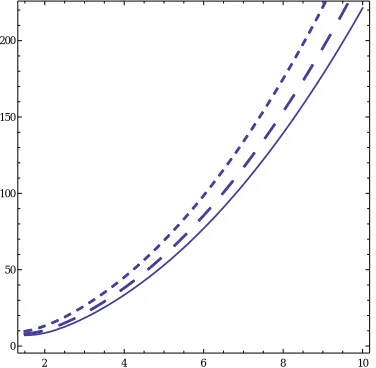
Fig.9 . The effects of
pm on the Critical Thermal Rayleigh numberR
cFigure 9 displays the effects of variations of the value of pm m
m
D
, which is the ratio of the solute diffusivity tothermal diffusivity ratio of the porous layer. The graph has three slightly diverging curves. The line curve is for
0.25
pm
, the big dotted curve is for 0.5 and the small dotted line curve is for 1.0. Since the curves are diverging, itindicates that the increasing values of
pm will have effect only for larger values of the depth ratiod
ˆ
d
md
, that is forporous layer dominant composite systems. From the curves one can see that for a fixed value of
d
ˆ
, increase in the valueof
pmis to increase the value of the critical thermal Rayleigh numberR
c i.e., to stabilize the system, so the onset of the convection delayed.
6. CONCLUSIONS
1. For Porous layer dominant composite systems, increasing the values of
Da
,
,
Q
,
,
pm one can delay the convection during the growth of crystals2. For Fluid layer dominant composite systems, it is possible to control convection by increasing the values of
R
s. 3. For any composite layer systems, by increasing the values of the viscosity ratio and decreasing the values ofM
ands
M
, convection can be controlled.4. By suitably choosing the parameters one can control the convection during the growth of crystals and hence avoid turbulence during the process and obtain pure crystals.
Acknowledgements
I express my gratitude to Prof. N. Rudraiah and Prof. I.S. Shivakumara, UGC-CAS in Fluid mechanics, Bangalore University, Bangalore, for their help during the formulation of the problem.
References
[1] H.A. Chedzey, and D.T.J. Hurle, Journal of Applied Physics, 210, 933,1966 (journal style)
[2] F. Chen and C.F. Chen, “Onset of Finger convection in a horizontal porous layer underlying a fluid layer” J. Heat transfer, 110, 403,1988.(journal style)
[3] F. Chen , “Throughflow effects on convective instability in superposed fluid and porous layers”, J. Fluid mech., 23, 113,-133,1990. (journal style)
[4] Mc Kay, “Onset of buoyancy-driven convection in superposed reacting fluid and porous layers”, J. Engg. Math., 33, 31-46,1998.(journal style)
[5] D.A. Nield “ Onset of convection in a fluid layer overlying a layer of a porous medium”, J. Fluid Mech., 81, 513-522,1977. (journal style)
Volume 3, Issue 2, February 2014
Page 25
[7] N. Rudraiah “Flow past porous layers and their stability in sullry flow Technology”, Encyclopedia of Fluidmechanics (Ed. Cheremisinoff, N. P.), Gulf Publishing Company, USA, Chapter 14, 567,1986. (Book style)
[8] I.S. Shivakumara, Suma, B. Krishna “ Onset of surface tension driven convection in superposed layers of fluid and saturated porous medium”, Arch. Mech., 58, 2, pp. 71-92, Warszawa, 2006. (journal style).
[9] R. Sumithra Exact solution of Triple diffusive Marangoni convection in a composite layer International Journal of Engineering Research & Technology (IJERT) Vol. 1 Issue 5, July – 2012. (online)
[10]R. Sumithra, “ Mathematical modeling of Hydrothermal growth of crystals as double diffusive convection in composite layer bounded by rigid walls”, International Journal of Engineering Science and Technology, Vol.04,No.02, 2012, 779-791, 2012.(online)
[11]R. Sumithra and N. Manjunatha, “Analytical study of Surface tension driven Magnetoconvection in a composite layer bounded by Adiabatic Boundaries”, International Journal of Engineering and Innovative Technology (IJEIT) Volume 1, Issue 6, June 2012.(Online)
[12]M.E. Taslim and V. Narusawa, “Thermal stability of horizontally superposed porous and fluid layers” , ASME J. Heat Transfer, 111, 357-362, 1989. (journal style).
[13]H.P. Utech and M.C. Flemings, Journal of applied Physics,37, 2021,1966. (journal style).
[14]M. Venkatachalappa, M, Prasad, V., I.S. Shivakumara and R.Sumithra, (1997), Hydrothermal growth due to double diffusive convection in composite materials, Proceedings of 14 th National Heat and Mass Transfer Conference and 3rd ISHMT –ASME Joint Heat and Mass transfer conference, December 29-31, 1997.