R E S E A R C H
Open Access
Simplified sequence-based method for
ATP-binding prediction using contextual
local evolutionary conservation
Chun Fang
1,2*, Tamotsu Noguchi
2,3and Hayato Yamana
1Abstract
Background:Identifying ligand-binding sites is a key step to annotate the protein functions and to find applications in drug design. Now, many sequence-based methods adopted various predicted results from other classifiers, such as predicted secondary structure, predicted solvent accessibility and predicted disorder probabilities, to combine with position-specific scoring matrix (PSSM) as input for binding sites prediction. These predicted features not only easily result in high-dimensional feature space, but also greatly increased the complexity of algorithms. Moreover, the performances of these predictors are also largely influenced by the other classifiers.
Results:In order to verify that conservation is the most powerful attribute in identifying ligand-binding sites, and to show the importance of revising PSSM to match the detailed conservation pattern of functional site in prediction, we have analyzed the Adenosine-5'-triphosphate (ATP) ligand as an example, and proposed a simple method for ATP-binding sites prediction, named as CLCLpred (Contextual Local evolutionary Conservation-based method for Ligand-binding
prediction). Our method employed no predicted results from other classifiers as input; all used features were extracted from PSSM only. We tested our method on 2 separate data sets. Experimental results showed that, comparing with other 9 existing methods on the same data sets, our method achieved the best performance.
Conclusions:This study demonstrates that: 1) exploiting the signal from the detailed conservation pattern of residues will largely facilitate the prediction of protein functional sites; and 2) the local evolutionary conservation enables accurate prediction of ATP-binding sites directly from protein sequence.
Keywords:ATP-binding site, Sequence-based, Local evolutionary conservation
Background
Identification of ligand-protein binding sites is a key step to annotate the protein functions and find applications in drug design. Since physical experimental methods are expensive and time consuming, computational methods are indis-pensable for guiding the physical experimental analysis.
So far, several computational methods have been pro-posed for identifying protein functional sites [1-17]. These methods can be categorized into three groups: 1) ap-proaches that focus on molecular docking with known protein structures [1-5]; 2) methods that predict putative interacting sites based on protein sequences [6-17]; 3)
methods that identify interacting sites based on the hybrid features of protein structure and sequences [15]. Due to the structures of most proteins are not available, the structure-based methods cannot be generally used. Here, we focus on the sequence-based methods of ligand-binding sites prediction. The inputs of previous sequence-based methods also can be categorized into three groups: (i) direct output of PSSM [6-10]; (ii) combination of PSSM with other sequence features, including amino acid distance and physicochemical prosperity [11] ; (iii) combination of PSSM with other predicted structural information, such as predicted secondary structure [12,16,17], predicted solvent accessibility [12,16,17], predicted disorder probabilities [16,17], predicted dihedral angles [16] and predicted B-factors. Of course, analyzing the various features of the binding partner is important for understanding the ligand-binding behavior. However, incorporating many other * Correspondence:[email protected]
1Department of Computer Science, Engineering of Waseda University, Tokyo, Japan
2Computational Biology Research Center (CBRC), Tokyo, Japan Full list of author information is available at the end of the article
features, especially some predicted feature as input for binding sites prediction has some potential shortcom-ings: 1) multi-features easily result in high-dimensional feature space. In machine learning, if the training sam-ples are limited, high-dimensional feature space easily leads to over fitting to noise data and then cause a deg-radation in performance; 2) incorporating predicted re-sults from other predictors greatly increases the complexity of the algorithm. Many studies even pro-vided no Web services because of the complexity in their design; 3) the performance of the predictors which employed other predicted results are also largely af-fected by other classifiers. Thus, more simple and high efficient method for identifying interacting residues is indispensable.
Evolutionary information included in PSSM has been considered to be the most effective feature for functional site predication. Nearly all the sequence-based methods adopted PSSM as an input feature for prediction. Raghava’s group has used the standard PSSMs for various functional sites predication [7-10]. John A. C. et al. [13] also found that conservation features was highly predictive in identi-fying ligand-binding sites and catalytic sites compared to identify other functional site. Ke Chen et al. [18] proved that the exclusion of PSSM profile leads to a larger de-crease in prediction performance than the exclusion of other input features, which suggests that the evolution-ary information plays a key role in determination of the nucleotide-binding residues.
Here, we developed a novel sequence-based predictor for ATP-binding sites prediction. In our approach, only the high local evolutionary conservation scores in the PSSMs are considered as input. We employed no other predicted results as input features. Our method is based on the as-sumptions that: 1) the most effective features for predicting functional sites are embedded in the sequence itself; 2) the local evolutionary conservation is distinct enough to enable an accurate prediction of ATP-binding sites directly from amino acid sequence, without requiring any additional dicted structural information. In order to assess the pre-dictive quality, we compared our method with 9 other existing methods which adopted various predicted struc-tural features. The Support Vector Machine (SVM) was adopted to build the classifiers.
Methods
Benchmark datasets
We took ATP as an example of ligands. For facilitating comparison, we collected 2 data sets from the existing pa-pers [10,16,17].
Dataset 1: It is extracted from the reference [10], which was also used in the reference [17]. This data set includes 168 binding protein chains, that contain 3,104 ATP-interacting residues (AIRs) and 59,226 non-ATP ATP-interacting
residues (non-AIRs), named as ATP168. It is available at http://www.imtech.res.in/raghava/atpint/.
Dataset 2: It is extracted from the reference [16], which was also used in the reference [17]. This data set includes 227 ATP-binding protein chains that contain 3,393 AIRs and 80,409 non-AIRs, named as ATP227. It is available at http://biomine.ece.ualberta.ca/ATPsite/.
Continuous binding residues analysis
In order to conform whether ATP-binding sites are clustered closely together in sequence, the 168 ATP-binding protein chains in Dataset 1 were analyzed as example. As shown in Figure 1, 68% of binding-sites appear alone, 22% of them appear in two consecutive residues, and the others appear continuously with lengths distribution between 3 to 5 residues. This result suggests that, the ATP-binding sites have certain inde-pendence, and meanwhile are affected by their flanking regions to some extent.
Composition and physicochemical properties analysis
We next analyzed the composition and physicochemical properties of the ATP-binding proteins. Sequences were di-vided into 3 regions: the ATP-interacting residues (AIRs), regions flanking the AIRs, and general non-ATP interacting regions (non-AIRs). Regions flanking on either side of the interacting sites with 15-residue long were analyzed.
Difference between the flanking regions and general non-AIRs regions (percentage of flanking - percentage of non_AIRs) with respect to 20 amino acids composition is shown in Figure 2. The Pearson product-moment correl-ation coefficients between the flanking length and the composition difference for each amino acid were also cal-culated (Table 1 for the left flanking side and Table 2 for the right flanking side). For both the flanking regions, the
Figure 2Differences with respect to amino acids composition between AIRs and non-AIRs.The values at position 0 on the horizontal axis mean the values for AIRs, L means the left flanking side and R means the right flanking side.
Table 1 Correlation coefficients between the left flanking length and composition difference (left ATP_flanking–non_ATP) for each amino acid
I L V C A G M F Y W
Correlation coefficient 0.436261 -0.69187 0.205958 -0.44066 5.56E-05 0.89866 -0.4487 -0.03841 -0.37415 0.182664
p-value 9.12E-02 2.98E-03 0.4441 0.08756 -0.83563 2.24E-06 8.13E-02 8.88E-01 1.53E-01 4.98E-01
H K R E Q D N S T P
Correlation coefficient -0.19525 -0.449 -0.18163 -0.84979 -0.86288 0.279555 0.042733 0.833508 0.911421 -0.16532
p-value 4.69E-01 0.08105 0.5008 3.08E-05 1.69E-05 0.2944 0.8751 6.05E-05 9.05E-07 0.5406
Table 2 Correlation coefficients between the right flanking length and composition difference (right ATP_flanking– non_ATP) for each amino acid
I L V C A G M F Y W
Correlation coefficient -0.1635 0.791152 0.410819 0.531454 0.665265 -0.7964 0.163617 0.485453 -0.04779 0.510287
p-value 5.45E-01 2.62E-04 0.1139 0.03413 0.004918 0.000223 5.45E-01 5.66E-02 8.61E-01 4.34E-02
H K R E Q D N S T P
Correlation coefficient -0.38939 0.074529 -0.2761 0.807045 0.746647 -0.47301 -0.60543 -0.89214 -0.92875 -0.19277
correlation coefficients related to Leu, Gly, Glu, Gln, Ser, and Thr have absolute value > 0.69 at the p-value <0.001. It illustrates that, composition of these amino acids in the flanking regions and in the general non-binding regions is significantly different.
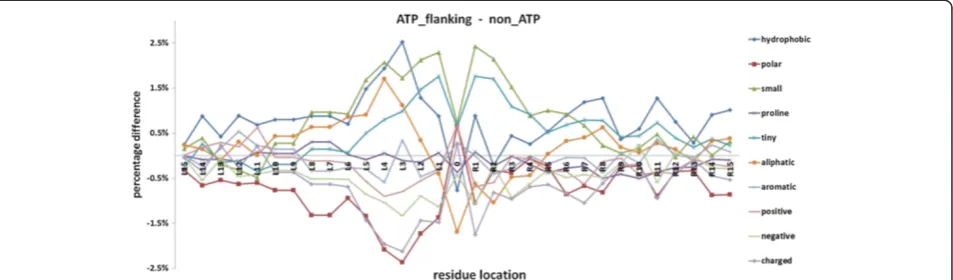
Difference between the flanking regions and general non-AIRs regions with respect to 10 physicochemical properties is shown in Figure 3. The corresponding Pearson correlation coefficients between the flanking length and each physicochemical property difference are shown in Table 3 (for the left flanking side) and Table 4 (for the right flanking side). For the left flank-ing side, correlation coefficients related to small, tiny, negative and charged have absolute value > 0.60 at the
p-value < 0.001; for the right flanking side, correlation
coefficients related to small, tiny and aliphatic have absolute value > 0.73 at the p-value < 0.001. This phenomenon illustrates that, these physicochemical properties of flanking regions are very different from those of general non-AIRs regions.
The above analyses of the composition and physico-chemical properties for the three regions illustrated that flanking regions are highly relevant to the ATP-binding sites. Therefore, we assumed that the ATP-ATP-binding sites in protein sequences are highly contextual. Because ATP-binding sites are found to be more conserved than surrounding residues [7-10,13,18], we considered in-corporating contextual information of residues with local evolutionary conservation to improve the prediction of ATP-binding sites.
Figure 3Differences in physicochemical properties between AIRs and non-AIRs.The values at position 0 on the horizontal axis mean the values for the AIRs, L means the left flanking side and R means the right flanking side.
Table 3 Correlation coefficients between the left flanking length and each physicochemical property difference (left ATP_flanking - non-ATP)
Hydrophobic Polar Small Proline Tiny Aliphatic Aromatic Positive Negative Charged
Correlation coefficient 0.20548 -0.35369 0.803793 -0.20618 0.802904 -0.07958 -0.30385 -0.44621 -0.72413 -0.60791
p-value 4.45E-01 1.79E-01 0.000176 0.4436 0.000181 7.70E-01 2.53E-01 8.32E-02 1.51E-03 1.25E-02
Table 4 Correlation coefficients between the right flanking length and each physicochemical property difference (right ATP_flanking - non-ATP)
Hydrophobic Polar Small Proline Tiny Aliphatic Aromatic Positive Negative Charged
Correlation coefficient 0.523796 -0.39506 -0.76834 -0.12863 -0.75009 0.732382 0.299015 -0.13031 0.570493 0.322113
Prediction model
Our approach focuses on using high local evolutionary conservation scores in the PSSMs for prediction. The prediction model is shown in Figure 4.
Evolutionary information (PSSM)
Evolutionary information was obtained from PSSMs generated by PSI-BLAST [19] with searching against NCBI non-redundant (nr) database [20] by three times iteration with an e-value of 0.001. Evolutionary infor-mation for each amino acid was encapsulated in a vec-tor of 20 dimensions. The size of PSSM of a protein with N residues is 20 × N, where N is the length of a protein. 20 dimensions were considered as a standard amino acid size.
Masking and filtering the PSSM
The modified PSSM is used to describe the local evolu-tionary information of each residue in a protein. It is converted from a standard PSSM according to formula (1) and (2).
Firstly, a masking sliding window with appropriate size is used to calculate the mean conservation score for each residue in a standard PSSM, and then, scores in PSSM are converted to local conservation scores according to formula (1). After that, the local conservation scores below the average scores are changed to 0 according to formula (2). This can strengthen the high conservative information while filtering out the low ones.
MaskingCi¼Ci− 1
2nþ1
Xiþn
i−n
Cj ð1Þ
FilteringCi¼ MaskingCi;ðMaskingCi>0Þ
0;ðMaskingCi≤0Þ
ð2Þ Masking_Ciis the mean conservation score of residue
i,Ciis the standard conservation score in PSSM,2n+1is the masking window size. Figure 5 illustrates an example of a masked and filtered PSSM.
Smoothing the modified PSSM
Every value in a standard PSSM is calculated based on the assumption that the position of each value in the matrix is independent from the others. However, ligand-binding residues tend to appear continuously. The flank-ing regions also largely affect the bindflank-ing behavior. In order to incorporate the dependency on surrounding neighbors of a central residue, we adopt the same smoothing method as Cheng-Wei C’s group [21], firstly, in order to deal with the N-terminal and C-terminal of a protein sequence, m (m is an odd number) ZERO vec-tors are appended to the head and the tail of a standard PSSM profile, where 2 m+1 is the size of a smoothing sliding-window. Then the smoothing sliding-window is used to incorporate the evolutionary information from upstream and downstream residues. Each row vector of an amino acid residue Ci is smoothed according to for-mula (3).
SmoothingCi¼ Xiþm
i−m
FilteringCj ð3Þ
Finally, each value in the smoothed PSSM matrix is scaled to the range of [-1, 1] according to a certain ratio. Procedure of preparing feature sets for the predictor is shown in Figure 5.
Support vector machines (SVM) and 5-fold cross-validation
Identification of ATP-binding sites can be addressed as a two-classification problem, i.e., determining whether a given residue is binding residue or not. In this study, like the other researches, we adopted SVM to build the binary
classifier. The prediction models were trained by the libSVM software package which was written by in Chih-Jen [22,23]. Here, the Radial Basis Function (RBF kernel) was adopted to construct the SVM classifiers. The grid search method [22,23] was used to search for the best parameters c and g for training. The negative samples were selected randomly with an equal number of positive samples. 5-fold cross-validation was used to evaluate the performance of the developed models, that is, the patterns were randomly divided into five sets. Four sets were used for training and the remaining one set was used for testing. The process was repeated until each set was used once for testing.
Evaluation criteria
We adopted the evaluation criteria used in CASP10 [24]. The area under the corresponding ROC curve (AUC), MCC, and the accuracy (ACC) were adopted to evaluate
the performance of the classifiers. The ROC plots with the AUC values were created by using the R statistical package [25]. The sensitivity, specificity, true positive rate (TPR), false negative rate (FPR) and ACC are defined as follows:
Specifity¼TNTNþFP ð4Þ
TPR¼Sensitivity¼TPTPþFN ð5Þ
FPR¼1−Specificity¼ FP
TNþFP ð6Þ
ACC¼1
2ðSensitivityþSpecificityÞ ð7Þ
Where TP, TN, FP and FN represents true positive, true negative, false positive and false negative respectively.
Results and discussion
Window sizes
For developing the CLCLpred model, 3 window sizes are necessary; the masking-window size which is used to calculate average local conservation scores, the out-side sliding-window size which would finally decide the dimensions of feature vectors, and the inside smoothing-window size which is used to strengthen the local conservation features. Here, for a fair com-parison, we chose the same size 17 with the researches [10,16,17] as the outside-sliding window size. The masking-window size has the similar meaning with the outside sliding-window size. Both of them indicate the length of flanking regions that would be considered to affect a central residue. So, 17 was also adopted as our masking window size. With an outside sliding-window and a masking-window size of 17, the CLCLpred model was further tested according to different smoothing window sizes. The relative best ROC plots would be chosen to represent the performance of the related models.
Effectiveness of the feature extracting methods
Effectiveness at the individual protein level
To confirm the effectiveness of our feature extracting method in distinguishing AIRs from non-AIRs and to determine how this might benefit the predication, we selected the protein [PDB: 2B6F] as an example. It has a continuous ATP-binding region of“G-G-C-H-R” lo-cated at residues 81~ 85 in the A chain.
Because the binding region“G-G-C-H-R”contains two residues of ‘G’, we extracted the‘G’column of position-specific scores from the standard PSSM (there are a total of 20 columns, corresponding to the 20 standard amino acids). Then, the distribu-tion of the scores in the standard PSSM, masked PSSM, and smoothed PSSM were counted (Figure6). In the standard PSSM, the distribution of scores between the AIRs and non-AIRs showed no distinct difference. The AIR region contains both highly conserved residues (‘G’) and highly variable residues (other amino acids). In the
masked PSSM, scores below the average have been filtered out, thereby discarding the noise data (low conservative scores), that are undesirable for pre-diction. In the smoothed PSSM, scores of residues that are surrounded by conserved residues have been enhanced after smoothing, and scores of dues that are surrounded by poorly conserved resi-dues have been weakened. Since AIRs are found to be more conserved than surrounding residues and flanked by less conserved residues [7-10,13,18], they are easy to appear as highly conserved peaks compared to the non-AIR regions. We have shown the results for just the‘G’column, similar results
were obtained for‘C’,‘H’and‘R’columns of the PSSM (data not shown).
Effectiveness at the whole dataset level. We next analyzed the distributions of local conservation scores for all residues in the data set ATP168 in three stages: in the standard PSSM, after masked and filtered, and after smoothed. We assumed that the summation of scores in each row in the corresponding PSSM represented the local conservation of the related residues Ci. Then the local
conservation score in each stage is able to be calculated according to formula (8~10).
Figure 8ROC plots of CLCLpred with different smoothing window sizes applied on ATP168 (A) and ATP227 (B) (W indicates the flanking window length).
Figure 9The best ROC plot of the CLCLpred method tested on ATP168 (A) and ATP227 (B).
Table 5 Performance comparison with other three PSSM-based methods on ATP168
Dataset Method ACC TPR FPR AUC
ATP168 CLCLpred 0.824 0.785 0.137 0.894
PSSM 0.755 0.700 0.191 0.823
Smooth_PSSM 0.811 0.770 0.149 0.879
SumMaskingCi¼ X20
j¼1
MaskingCj ð8Þ
SumFilteringCi¼ X20
j¼1
FilteringCj ð9Þ
SumSmoothingCi¼ X20
j¼1
SmoothingCj ð10Þ
Distribution of summation score related to The AIRs and non-AIRs was compared (Figure 7). In the standard PSSM, more non-AIRs showed stronger conservation than the AIRs. However, that, after fil-tered, the percentage of the AIRs with high local con-servation scores increased significantly (Figure 7(B)). This can illustrate that, most of filtered out scores were belonging to the non-AIRs. Finally, after smoothed, more AIRs showed stronger local conser-vation than the non-AIRs (Figure 7(C)). Unsurpris-ingly, most of the AIRs and their flanking residues have stronger local conservation than the general non-AIRs. Because in order to maintain certain func-tion, the functional sites of proteins must maintain a high degree of conservation. Figure 7 shows that, our feature extracting method can effectively extract the local conservation information of residues to distin-guish the AIRs from non-AIRs.
Performance of the CLCLpred and comparison with other PSSM-based methods
ROC plots of the CLCLpred method apply to the ATP168 and ATP227 with different masking window sizes are shown in Figure 8. The respective best plots are shown in Figure 9.
Performance comparison with other PSSM-based methods
In order to verify the importance of revising PSSM to match the detailed conservation pattern of ATP-binding sites, we have compared the CLCLpred method with three other PSSM-based methods on the ATP168 dataset: 1) the‘PSSM’method, which uses the direct output of PSSMs for prediction; 2) the ‘Smooth_PSSM’ method, which uses smoothed PSSMs without masking and fil-tering; and 3) the ‘Mask_PSSM’ method, which uses
Figure 10ROC plots of the four PSSM-based methods verified on ATP168.
Table 6 Performance of CLCLpred and the existing predictors tested on the ATP168 and ATP227
Dataset Method ACC TPR FPR AUC
ATP168 CLCLpred (our proposed method) 0.824 0.785 0.137 0.894
PSSM (reference [10]) 0.752 0.700 0.196 0.823
binary (reference [10]) 0.663 0.655 0.330 0.725
PSSM (reference [17]) 0.757 0.757 0.243 0.841
LogisticPSSMa (reference [17]) 0.765 0.763 0.234 0.849
LogisticPSSM+ Bipro-aa (reference [17])
0.770 0.769 0.228 0.855
LogisticPSSM+ Bipro-dis (reference [17])
0.769 0.766 0.229 0.854
LogisticPSSM+ Bipro-sa (reference [17])
0.772 0.770 0.225 0.856
LogisticPSSM+ Bipro-ss (reference [17])
0.775 0.774 0.224 0.858
LogisticPSSM+ Bipro-allb (reference [17])
0.772 0.770 0.227 0.857
ATP227 CLCLpred (our proposed method) 0.828 0.789 0.133 0.899
ATPsite (reference [16]) 0.675 0.361 0.012 0.854
Rate4site (reference [16,26]) 0.658 0.446 0.130 0.749
PSSM (reference [17]) 0.782 0.783 0.218 0.861
LogisticPSSMa (reference [17]) 0.794 0.792 0.204 0.873
LogisticPSSM+ Bipro-aa (reference [17])
0.798 0.798 0.201 0.877
LogisticPSSM+ Bipro-dis (reference [17])
0.798 0.797 0.201 0.876
LogisticPSSM+ Bipro-sa (reference [17])
0.800 0.800 0.199 0.880
LogisticPSSM+ Bipro-ss (reference [17])
0.802 0.801 0.197 0.881
LogisticPSSM+ Bipro-allb (reference [17])
masked and filtered PSSMs without smoothing. Perfor-mances of the four methods are shown in Table 5, and the ROC plots of them are shown in Figure 10. The re-sults demonstrate that, although all the four methods are based on PSSM of sequence, the CLCLpred method achieves the best performance.
We speculate that the reasons for the above results include: 1) the direct outputs of PSSMs contain redun-dant features, because the‘Mask_PSSM’method which filters out the low local conservation scores achieves nearly the same performance with the ‘PSSM’method; 2) ATP-binding sites in protein sequences are highly contextual, and incorporating the conservation infor-mation from sequentially neighboring residues results in improved performance. As can be seen from Figure 10, the methods with the smoothing step (‘Smooth_PSSM’ and CLCLpred) significantly outper-form the methods without the smoothing step (‘Mask_PSSM’and ‘PSSM’); and 3) although the
ATP-binding sites are affected by neighboring residues, they maintain a certain degree of independence (Figure 1 also shows that 68% of binding-sites appear alone). This kind of functional site with their flanking regions usually contains both highly conserved residues and highly variable residues and is highly locally conserved on the whole. Without the masking and filtering steps, the predictive power of highly conserved residues will be weakened by noise data (low conservation scores from the neighboring residues) after smoothing. On the contrary, if the noise data are discarded by masking and filtering, the predictive power of intensively highly conserved residues will be strengthened after smooth-ing. Therefore, the CLCLpred method outperformed the ‘Smooth_PSSM’ method. The above results also confirmed the previous analysis [13] that, better exploiting the signal from sequentially neighboring residues would largely facilitate ligand-binding sites prediction.
Figure 11Detailed comparison of ACC and AUC for all the predictors on ATP168.
Performance comparison with other existing predictors
Since we have extracted the data set ATP168 and ATP227 from the research papers [10,16,17], here, we also listed them out for the comparison. All the methods were trained and tested on the same data sets. Results are shown in Table 6. Detailed compari-son of ACC and AUC among all the methods on ATP168 and ATP227 are shown in Figures 11 and 12 respectively. As shown in Table 6, Figures 11 and 12, the CLCLpred predictor achieved the best ACC and AUC.
Feature dimensions comparison
Previous researches [10,16,17] combined many pre-dicted features with PSSM as their input for the ATP-binding prediction. These predicted features not only increased the complexity of the algorithm, but also increased the dimensions of feature vectors. We summarized them in Table 7 for a comparison. Table 7 demonstrates that, the vector dimension of CLCLpred is lower than those of the methods which incorporated other predicted features, such as pre-dicted secondary structure (ss), prepre-dicted solvent accessibility (sa), predicted disorder probabilities (dis) and predicted dihedral angle. In machine lean-ing, if the number of training samples is limited, in-creasing the feature dimensions will be harmful for the classification.
Conclusions
In this study, we proposed a simple method which adopted a modified PSSM encoding scheme for ATP-binding predication. In this approach, only the high local evolutionary conservation scores in PSSMs are consid-ered as input, without employing any predicted fea-tures from other classifiers. By means of masking, filtering and smoothing, the modified PSSM com-bines predictive features which can distinguish the AIRs from non-AIRs effectively. When comparing with 10 other existing methods that used direct out-put of PSSMs or incorporated various predicted structural features as their input on the same data-sets, our method achieved the best performance be-sides its minimum feature dimensions, i.e., achieving an ACC of 4.9%~16.1% and an AUC of 0.036~0.169 higher than other methods when tested on ATP168; achieving an ACC of 2.6%~17.0% and an AUC of 0.018~0.15 higher than other methods when tested on ATP227. These results demonstrate that, the local evolutionary conservation is distinct enough to en-able an accurate prediction of ATP-binding sites dir-ectly from amino acid sequence, and incorporating other predicted features for prediction is not always help-ful. A free Web server has been developed (http://webapp. yama.info.waseda.ac.jp/fang/LigandPred.php), which al-lows users to identify ATP-binding residues in a given se-quence using the model trained on our data sets. Our CLCLpred model can be also used for identifying other ligand-binding sites of proteins.
Abbreviations
ATP:Adenosine-5'-triphosphate; AIRs: ATP-interacting residues; non-AIRs: non-ATP interacting residues; PSSM: Position-specific scoring matrix; SVM: Support vector machine; ROC: Receiver operating characteristic; AUC: Area under the corresponding ROC curve; (PDB): Protein data bank; TPR: True positive rate; FPR: False negative rate.
Competing interests
The authors declare that they have no competing interests.
Authors’contributions
CF carried out the implementation and drafted the manuscript, TN and HY read and revised the final manuscript, all authors read and approved the final manuscript.
Acknowledgment
We would like to thank Prof. TOMINAGA of Computational Biological Research Center (CBRC) providing a lot of convenience for our study. We also thank an anonymous reviewer for his/her helpful comments, which improved the manuscript.
Author details 1
Department of Computer Science, Engineering of Waseda University, Tokyo, Japan.2Computational Biology Research Center (CBRC), Tokyo, Japan.3Meiji Pharmaceutical University, Tokyo, Japan.
Received: 31 October 2013 Accepted: 5 March 2014 Published: 11 March 2014
Table 7 Summarization of feature types and number of vector dimensions
Method Feature types Dimensionality
CLCLpred Modified PSSM 340
PSSM PSSM 340
binary Binary amino acid composition
340
ATPsite PSSM+predicted dihedral angle+ss
NA
Rate4site 3D-structure NA
LogisticPSSMa LogisticPSSM 340
LogisticPSSM+ Bipro-aa LogisticPSSM+amino acid composition 374 LogisticPSSM+ Bipro-dis
LogisticPSSM+predicted dis 374
LogisticPSSM+ Bipro-sa
LogisticPSSM+predicted sa 374
LogisticPSSM+ Bipro-ss
LogisticPSSM+predicted ss 374
LogisticPSSM+ Bipro-all
LogisticPSSM+predicted dis+sa+ss
References
1. Nayal M, Honig B:On the nature of cavities on protein surfaces: application to the identification of drug-binding sites.Proteins Struct Funct Bioinformatics2006,63:892–906.
2. Perola E, Walters WP, Charifson PS:A detailed comparison of current docking and scoring methods on systems of pharmaceutical relevance.
Proteins Struct Funct Bioinformatics2004,56:235–249.
3. Ghersi D, Sanchez R:Improving accuracy and efficiency of blind protein-ligand docking by focusing on predicted binding sites.Proteins Struct Funct Bioinformatics2009,74:417–424.
4. Thangudu RR, Tyagi M, Shoemaker BA, Bryant SH, Panchenko AR, Madej T: Knowledge-based annotation of small molecule proteins.BMC Bioinforma
2010,11:365.
5. Laurie ATR, Jackson RM:Methods for the prediction of protein-ligand binding sites for structure-based drug design and virtual ligand screening.Curr Protein Peptide Sci2006,7:395–406.
6. Kumar M, Gromiha MM, Raghava GPS:Prediction of RNA binding sites in the protein using SVM and PSSM profile.Proteins2008,71:189–194. 7. Ansari HR, Raghava GPS:Identification of NAD interacting residues in
proteins.BMC Bioinforma2010,11:160.
8. Mishra NK, Raghava GPS:Prediction of FAD interacting residues in a protein from its primary sequence using evolutionary information.
BMC Bioinforma2010,11:S48.
9. Chauhan JS, Mishra NK, Raghava GPS:Prediction of GTP interacting residues, dipeptides and tripeptides in a protein from its evolutionary information.BMC Bioinforma2010,11:301.
10. Chauhan JS, Mishra NK, Raghava GPS:Identification of ATP binding residues of a protein from its primary sequence.BMC Bioinforma2009,10:434. 11. Xuewen C, Jong cheol J:Sequence-based prediction of protein interaction
sites with an integrative method.Bioinformatics2009,25(5):585–591. 12. Ofran Y, Mysore V, Rost B:Prediction of DNA-binding residues from
sequence.Bioinformatics2007,23(13):347–353.
13. John AC, Mona S:Predicting functionally important residues from sequence conservation.Bioinformatics2007,23(15):1875–1882.
14. Terribilini M, Lee JH, Yan C, Jernigan RL, Honavar V, Dobbs D:Prediction of RNA binding sites in proteins from amino acid sequence.RNA2006, 12(8):1450–1462.
15. Capra JA, Laskowski RA, Thornton JM, Singh M, Funkhouser TA:Predicting protein ligand binding sites by combining evolutionary sequence conservation and 3D structure.Plos Comput Biol2009,5:e1000585. 16. Ke C, Marcin JM, Lukasz K:ATPsite: sequence-based prediction of
ATP-binding residues.Proteome Sci2011,9(Suppl 1):S4.
17. Ya-Nan Z, Dong-Jun Y, Shu-Sen L, Yong-Xian F, Yan H, Hong-Bin S:Predicting protein-ATP binding sites from primary sequence through fusing bi-profile sampling of multi-view features.BMC Bioinforma2012,13:118.
18. Ke C, Marcin JM, Lukasz K:Prediction and analysis of nucleotide-binding residues using sequence and sequence-derived structural descriptors.
Bioinformatics2012,28(3):331–341.
19. Stephen FA, Thomas LM, Alejandro AS, Jinghui Z, Zheng Z:Gapped BLAST and PSI-BLAST: a new generation of protein database search programs.
Nucleic Acids Res1997,25(17):3389–3402. 20. NR.ftp://ftp.ncbi.nih.gov/blast/db/fasta/nr.gz.
21. Cheng-Wei C, Emily CY S, Jenn-Kang H, Ting-Yi S, Wen-Lian H:Predicting RNA-binding sites of proteins using support vector machines and evolutionary information.BMC Bioinforma2008,9(Suppl 12):S6. 22. Chih-Chung C, Chih-Jen L:LIBSVM: a library for support vector machines.
ACM Trans Intell Syst Technol2011,2:27:1–27:27.
23. A library for support vector machines.http://www.csie.ntu.edu.tw/~cjlin/libsvm/. 24. CASP10: http://predictioncenter.org/casp10/index.cgi.
25. R statistical package.http://www.r-project.org/.
26. Tal P, Rachel EB, Mayrose I, Glaser F, Ben-Tal N:Rate4Site: an algorithmic tool for the identification of functional regions in proteins by surface mapping of evolutionary determinants within their homologues.
Bioinformatics2002,18(suppl 1):S71–S77.
doi:10.1186/1748-7188-9-7
Cite this article as:Fanget al.:Simplified sequence-based method for ATP-binding prediction using contextual local evolutionary conservation.
Algorithms for Molecular Biology20149:7.
Submit your next manuscript to BioMed Central and take full advantage of:
• Convenient online submission
• Thorough peer review
• No space constraints or color figure charges
• Immediate publication on acceptance
• Inclusion in PubMed, CAS, Scopus and Google Scholar
• Research which is freely available for redistribution