Downloaded from: http://insight.cumbria.ac.uk/id/eprint/3403/
Usage of any items from the University of Cumbria’s institutional repository ‘Insight’ must conform to the following fair usage guidelines.
Any item and its associated metadata held in the University of Cumbria’s institutional repository Insight (unless stated otherwise on the metadata record) may becopied, displayed or performed, and stored in line with the JISC fair dealing guidelines (available here) for educational and not-for-profit activities
provided that
• the authors, title and full bibliographic details of the item are cited clearly when any part of the work is referred to verbally or in the written form
• a hyperlink/URL to the original Insight record of that item is included in any citations of the work • the content is not changed in any way
• all files required for usage of the item are kept together with the main item file. You may not
• sell any part of an item
• refer to any part of an item without citation
• amend any item or contextualise it in a way that will impugn the creator’s reputation • remove or alter the copyright statement on an item.
The full policy can be found here.
Citation
Diebelius, J. How can I de elop a e pa da le i tellige e usi g Lucas and Cla to s Ho ca I de elop a Expandable
Intelligence usi g Lucas a d Claxto s Expansive Talking Framework i aths?
The STeP Journal Student Teacher Perspectives Copyright © 2017 University of Cumbria Vol 4 (4) pages 105-117
Jade Diebelius
Canterbury Christ Church University
Abstract
This pape is a pe so al efle tio of a stude t tea he s de isio s a d a tio s towards trying to support pupils in developing the belief that their intelligence is expandable through effort and strategy. Using action research in their last year of teacher training I researched my influence over 30, aged 7- , pupils attitudes to a ds aths lea i g o e eeks. Usi g Lu as a d Cla to s Talki g Toolkit f a e o k, hi h lai s to suppo t the de elop e t of E pa da le I tellige e , to p o ote a g o th i dset. This as do e o e a pe iod of eeks. I a efle i e turn it was identified that the Talking toolkit framework tool could not be used in isolation, other st ategies a d app oa hes e e adopted. This esea h illust ates a efle tio o pupils espo ses and my analysis against four habits of mind, chosen from Claxton (2002) Building Learning Power that supports the belief that intelligence is expandable. This research provides an example of a constant reflective log of my findings. The key finding from this research was that attitudes have the potential to be developed in the short term and expandable intelligence is a state of mind that transcends experiences and cannot be seen in just mathematics. This paper concludes with implications for future practice.
Introduction and Background
A i di idual s i d-set is their outlook on events (Dweck, 2006). The mind-set can influence what Lucas et al efe s to as ha its of i d, hi h is your attitude towards a task. I have always been interested in different approaches children adopt with regards to their learning. Can you teach effort and can you create an environment which develops resilience? The idea for my study initially stemmed from conceptual understanding in maths, the notion of deep understanding. I then pondered if children want to learn and if I can influence this. I was pointed in the direction of Lucas a d Cla to s (2010) book: New kinds of smart. This is where I came across the view that intelligence is expandable; it a i ease th ough effo t a d st ateg . I de ided to e ed the Expansive Talking framework (ETF) in to my teaching to create a learning environment where the dispositions to learn and uild lea i g po e (Claxton, 2002) were tackled.
This study focuses upon the impact, and to what degree, teachers have over fostering e pa da le intellige e, i the lass oo e i o e t. The data olle tio as u de take i a t o fo e t Primary school in Essex. The children were predominantly from a White British background with a below average number of children who receive free school meals (DFE, 2014). 31 7-8 year olds were included in this nine week study.
Rationale for my study
106 (Ofsted, 2013). It presented the view that expectations can have more of a negative impact than material poverty. Resnick (1999) states that any maintained environment (learning or home) has the pote tial to affe t the hild e s eha iou , due to e pe tatio s. This p o ides a pla e fo research; as we infer the need to analyse our own actions to increase awareness and effects of interactions with children. If e o side Du k o th s 3) claim that researchers understand the internal and external nature of motivation to learn, but there is no unified approach to achieve this, then my research focus gained credibility as I aimed to assess my impact with critical engagement, in contextual situations. If we want children to value effort then they have to hold the belief that their i tellige e a i p o e, thus p ese ti g the idea of e pa da le i tellige e.
Literature review
Research tells us there is much debate surrounding intelligence. This literature review will explore the field of research around the notio of e pa da le i tellige e: the belief that, through effort and strategy, intelligence is a capacity which can increase (Lucas and Claxton, 2010). My analysis begins with the works of Lucas and Claxton and the concept that intelligence is expandable. From here I touch upon areas of psychological literature, as Lucas a d Cla to s ideals d a upo such fi di gs. Alte ati el , I e plo e opposi g ie s to e pa da le i tellige e a d fi ish fo usi g upo environmental influences; this is where I find a place for my study.
Firstly, the idea that intelligence has the capacity to expand and grow through effort is a concept which Lucas and Claxton (2010) emphasise should be the attitude which drives pedagogy in edu atio . E pa da le i tellige e t a s e ds e o d the t ai i g of skills a d holds the ai of adopti g hat Cla to efe s to as ulti ati g dispositio s. A skill or capacity (skills and strategies) becomes a disposition when it is independently applied. This application is what Perkins (1995) refers to as se siti it to o asio ; a d ill sho hethe the lea e u de sta ds the skills deeply enough to be able to apply them in appropriate learning situations. In turn this involves a de elop e t of attitudes o ha its of i d Lucas et al, 2013), which support children meeting the demands of this world, which extends beyond a testing culture (Lucas, et al, 2013), as ultimately this focus on achievement can oversimplify learning (Stobart and Gipps, 1997). This implies that not only should learning involve depth but a positive attitude; (habits of mind) to support the motivation to achieve a disposition, ultimately stretching beyond superficial teaching and learning.
Furthermore is it important to consider that Lucas and Claxton (2010) draw from the works of Dweck. Dweck adopts a psychological stance to education; her extensive research is based up on the beliefs people have about themselves and the impact they can have. Dweck (1999) identifies two mind sets, which ultimately change the way education is viewed. If you hold a fi ed i d-set individuals believe they have a certain amount of intelligence and therefore this will need to be proven. They have a tendency to opt for easy asks to ensure they are successful (Dweck, 2006). It should be questioned, if the aim is to learn, whether task completion is an appropriate measure of su ess, espe iall if e pa da le i tellige e alues the lea i g p o ess a d exerting effort. A g o th i d-set ho e e ie s i tellige e as so ethi g hi h a i ease th ough effo t a d therefore those who hold it thrive off challenges. This suggests that if it is possible to cultivate the belief that intelligence is expandable then work needs to focus upon creating an environment in hi h the ideals of g o th i d-set are promoted: making mistakes, effort, resilience and learning rather than end product goals (Dweck, 1999).
and luck. This attribution could be reliant on the individual s i d-set (Dweck, 1999). We may speculate that children need to be in an environment he e if the fail thei a ilit is ot compromised, rather a lack of effort. This then places children in control or their learning (Watkins, No Date) and promotes the value of effort.
The ps hologi al lite atu e p ese ts ho lea i g a e affe ted a i di idual s elief s ste . If we refer to Ofsted (2013) that the environment can have a greater impact on confidence that any material poverty, we begin to view that it is those who interact with children that can have an impinging role over the development of a mind-set. We therefore infer the significance of the learning environment. Black and Wiliam (1998) emphasise the importance of formative assessment (a process u de take tea he s a d should e espo si e to the hild s lea i g eeds). It is however only beneficial if focused on the learning process (Clarke, 2005). Lucas et al (2013) question if this assessment involved monitoring of growth in learning dispositions. If learning is viewed as an ongoing process (expandable) then grade only feedback, as a form of assessment, ultimately places emphasis on the end product (Butler et al, 2013). Cla to pla es e phasis o a tea he s language and states it is not only that thoughtful interactions but instinctive responses also contribute to the classroom environment (Lucas et al, 2013). This suggests teachers reflect and e aluate thei p a ti e; espe iall if e pa da le i tellige e e tu es e o d isolated strategies (discussed later).
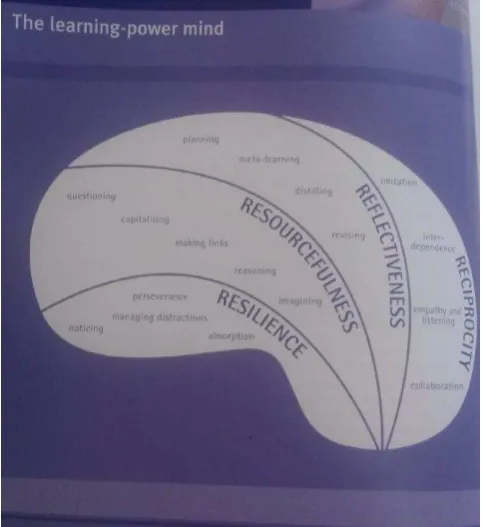
Moreover, Claxton s, (2002) o k o Buildi g Lea i g Po e BLP li ks ith the idea of ulti ati g attitudes. These attitudes arguably require an environment which supports them. He prioritises resilience, resourcefulness, efle ti e ess a d e ip o it The fou ‘ s as opti u ha its of i d. This fostering of attitudes sends a message that everyone is capable of improvement. Piaget (1950) states: intelligence is the capacity to respond and act when you do not know what to do. This suggests intelligence is contextual as every situation is different and therefore we arguably need to
e e pa di g i tellige e to help u de sta d e situatio s. Without a g o th i d-set ie the e ill e less e phasis o the fou ‘ s a d positi e attitudes to learning. Fletcher and Hattie, (2011) argue that e e if g o th i d-set and fi ed i d-set are not reliable, an environment which adopts the ideals of a g o th i d-set will help to foster the attitudes needed to develop a disposition to learn (Lucas, et al, 2013).
Alternatively, some pieces of literature and theory focus on intelligence not as a complex process but simplify it to increase understanding. Ga d e eated a list of Multiple I tellige es, which without intention of the creator, led to the belief that you are intelligent in certain areas. This categorisation may lead to demotivation and a lack of effort as you are labelled as being skilful in certain areas and therefore not in others. This could result in children attributing learning outcomes to therefore a lack of ability (Bandura, 1993. Weiner, 1972); which places the emphasis on the fact that intelligence is a fixed capacity. Coffield et al (2004) also simplified intelligence but in how is it obtained. Individuals are diagnosed with how they learn best (visual, audio, and kinaesthetic). Even though this helps children recognise their areas of development and their strengths, it may segregate children (Stahl, 1999) and reduce their effort in the areas of development. This does not have the aim of encapsulating the children in an environment where expectations are that everyone can improve.
108 placed on what is fixed then the current level becomes a structural limitation (Claxton, 2007), rather than a starting point for intelligence to be expanded.
Significantly, this is where we reach the place for my research. E pa si e i tellige e depe ds greatly on the external environment which creates implications for me as a student teacher. This increases the validity of Lucas et als (2013) claim that teaching should be evaluative, to increase awareness of habitual and instinctive behaviour (Brookfield, 1995), and adapt it in light with what it valued (Hodgkinson cited in Denzin and Lincoln, 2005). Self-study becomes necessary to ensure that I a p o oti g e pa da le i tellige e, a d ot tokenistic views (Perkins, 1995). I circle back to the works of Lucas and Claxton to support my goal of creating a suitable classroom environment, one which views intelligence in light of what will best benefit childrens lea i g. It is a gua l as Robinson (2013) states; children are waiting for optimum conditions to grow: teaching is a matter of climate control.
Methodology
My methodology was within the research frame of teacher enquiry. I was aiming therefore to develop my teaching practice (Thomas, 2009). Whitehead and McNiff (2009) state that teacher enquiry combines diagnosis, action and reflection; this then places my study in an interpretivist paradigm (Thomas, 2009), as my position was valued in the process. My decisions therefore were driven by my main focus of self-study; analysing my actions with regards to developi g expandable i tellige e. I decided to use the ETF (Lucas and Claxton, 2010) to generate and suppo t hild e s reflection as Lucas and Claxton refer to this strategy, under the idea that intelligence is expandable. Importantly, Denzin and Lincoln (2005) argue that teacher enquiry has the potential to explore theories which claim to achieve a goal – this ultimately provided the basis for developing my own critical insight, allowing decisions to be made with regards to application of theory while also keeping hild e s lea i g e pa si e at the hea t of the stud ‘uddi k a d Hopki s, 1985).
Figure 1. The learning power mind (Claxton, 2002).
Furthermore, I also documented findings outside of the context of discussion (Whitehead and McNiff, 2009). This was important as it provided insight into my i flue e o hild e s eha iou ; it is this effect that Loughran (1996) states teachers have responsibility over. I therefore kept a reflective log of maths lesson evaluations. This was important as teacher enquiry aims to show developments over time rather than an end result (Whitehead and McNiff, 2009). These reflections were completed after the lesson, which allowed for more objectivity (Schön, 1991) as there would be time to reflect upon developments and then the implications for actions. This is diagrammatically sho th ough Ke is a d M Tagga t s spirals of thi ki g (cited in Hopkins, 2008). Observations therefore provided increased scope to further understand the situation (Thomas, 2009). This is relevant as, without observation, an occurrence may go unnoticed (Cohen et al, 2011. Mason, 2002). My observations were semi-structured (Thomas, 2009) as I adopted changes throughout the nine weeks and wanted to keep the data collection the same to ensure consistency. I then drew on Whitehead a d M Niff s 2009) idea of living theory, as I continually referred to theory and embedded this in to practice, whilst evaluating my findings to inform my next actions.
Analysis and Discussion of Finding
Throughout my engagement with teacher enquiry I was able to analyse and evaluate my effectiveness regarding my strategies, approaches and responses to then make appropriate adaptio s. M a al sis is e apsulated ithi the idea of e pa da le i tellige e, a d ill therefore draw on its ideals.
110 ha a te isti s of Cla to s ha its-of- i d throughout the analysis to make it easier to identify when I li ked the hild e s eha iou s.
Early stages of using the expansive talking framework
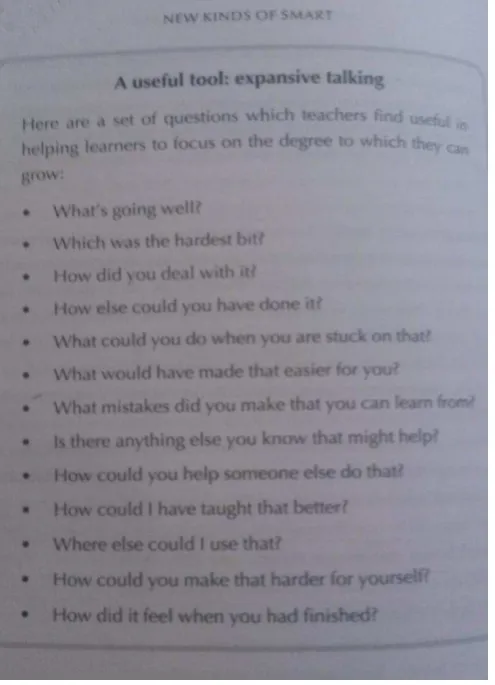
Initially, the ETF was implemented while the children were in the learning process I asked questions from the template (Figure 2). This aimed to initiate thought about approaches and attitudes to tasks, and allowed them to adapt their strategies while they were in the learning process. This linked to La ge s 1997) situational focus encouraging children to look at their learning as a matter of steps.
Figure 2: A useful tool: expansive talking (Lucas & Claxton, 2010).
Despite this, the ETF provided the children with focused questions to think about what was involved i thei lea i g. E e though the hild e stated that the alued thei pee s support, at this stage, we could consider to what extent the children answered the question on par with what they thought I expected, especially if I did not question the children further. This was something I began to identify. This may become useful in preventing superficial responses with little critical engagement. Interestingly, the hild e i te p eted helpi g so eo e edu i g the task s o ple it , portraying a lack of resilience, and therefore indicating a fixed view of intelligence. Dweck (1999) argues that children who value learning (growth mind-set) see challenge and difficulty as part of the learning process. In order to present this to the children they may need to explore difficulties and obstacles to then overcome them, aiming to increase perseverance. Potentially the ETF laid foundations for this through reflection on overcoming difficulty. If it is then supported with probing questions encapsulated in discussion.
Using the expansive talking framework in the context of whole class discussion
Consequently, in response to previous observations I began to use the ETF in plenary sessions, with the whole class to stimulate, lead and model reflection. The previous application asking the children the questions and scribing their responses, arguably separated the ETF from its primary aim: talk. This may have limited the potential depth modelled and criticality of reflection to the children. It therefore ould e less likel to eate a lass e i o e t p o oti g e pa da le i tellige e. This adaption enabled ideas to be linked and articulation regarding the value of effort and learning from peers. For example, Hannah identified a strategy to support her learning. Due to the nature of discussion the ETF allowed this development to be drawn upon to help Jessie see the value of applying what she already knew to support her; and demonstrate the value of reciprocity and within this imitation through listening. Ha ah s e gage e t sho ed that she was able to identify where she needed support. She demonstrated an initial stage of resourcefulness. This interaction supported me in modelling and articulating the behaviours and attitude I expected.
Development of my thinking
112 Figure 3. Traffic light assessment tool.
Furthermore, children were beginning to show increased signs of resilience. This was revealed through children articulating their experiences with regards to overcoming barriers within the process of learning. This suggests that they monitored their learning. They then responded to their a al sis a kt a ki g to a poi t he e the , felt like the e e o the ight t a ks. I sta ted to show consistency with probing and responding to the children in light of the learning process. This may indicate that, through refle tio , I ha e uilt upo the hild e s responses and the positivity of certain behaviours and attitudes. An example of this was when I emphasised the positivity of Mega s eha iou , th ough sha i g he st ategy with the class. Megan, without prompting acted out behaviour which arguably was influenced by the ETF and therefore my influence. This may show a realisation in Megan that she can rely on what she knows to help her. She may be showing initial signs of resourcefulness. I began to find it useful to explicitly share with the children my expectations and the behaviour I expected.
I found this especially powerful when I modelled to the children that I was also a learner. This was in the form of asking them how I could improve. This arguably not only stimulated thinking about their learning in terms of what support they needed but I demonstrated that I was also part of the learning environment. Considering that I did not start off asking the question straight away this also suggests a development in my confidence to be open to criticism. Especially when we consider that few people have the confidence to open up to criticism (Brookfield, 1995). This created a powerful essage fo e pa da le i tellige e, sho i g that anyone, even the teacher, can increase their intelligence and improve.
A supportive environment
Remarkably, in just three weeks, Sam began to show signs of perseverance, revision and mounting up to a sign or resilient behaviour. He identified an area where he struggled. Even though he was not able to articulate how he tackled the problem, maybe because he did not address the difficulty, he was accurate in his self-reflection. From this I observed the progress Sam made as he did not get frustrated when he struggled instead showing perseverance through monitoring his learning. In later examples Sam became more open in his responses. This suggests that he has become more confident in the classroom environment and is not as nervous about being wrong. I would not conclude that Sam has developed a disposition to learn; but he may be beginning to view himself as a learner.
Consequently, a few of the children began to model this attitude. This did not mean that I su essfull foste ed a elief i e pa da le i tellige e. But it did portray that I started to create an environment in which effort and encouragement were valued. Additionally, it should be considered that this might have been achieved through actions beyond the ETF. For example I became more articulate of the behaviour I was looking for, in this case perseverance. To begin with Hannah portrayed that she was recognising her mistakes as learning opportunities. Furthermore, Appendix 1 shows that Hannah extends further and demonstrated she would help her peers through promoting a positive view of effort. She also viewed challenges as learning opportunities possibly portraying a GMS (Dweck, 1999). She arguably became more reflective on the attitude and approach she had to tasks. The ETF gave her opportunities to think about the specific parts of her learning, with a positive attitude. This might not show behaviours as far as capitalising but she made links to other skills to aid her.
Significantly, near the end of my research I found more children engaged with whole class discussions. Rosie was confident enough to articulate her learning. This was similar with Victoria (who was part of the traffic light self-assessment group). She not only volunteered a response to the ETF, which portrays the development in the inclusiveness of the classroom environment; but she focused on the steps in learning which presents a beginning stage of reflectiveness. Engagement with the ETF within an inclusive environment has possibly has helped her articulate her learning and reflect on the process.
Valuing learning process over the end product
Furthermore, the emphasis I placed on the learning process rather than the end product could be a gued to ha e a i pa t he e o side Ale s espo ses to the ETF. At the beginning of the practice Alex showed that he only valued obtaining the right answer, which showed a lack in perseverance and absorption as well as collaboration. He interacted with someone but was not engaging in the process of learning. However, Alex supported his peer by explaining how they reached the answer. This could portray how the ETF and focus on the process of learning has demonstrated the value of helping others. It may have challenged their thinking and made them think critically about their learning and experience how their intelligence can be increased through time and effort (Lucas and Claxton, 2010).
My learning
114 responses. It gave me a focus and structure – and made me realise the importance of the environment beyond what you thoughtfully say. Through reflection I became more aware of my habitual behaviour and made a conscious effort to think about what I say to the children outside of the ETF as this also o t i utes to the lea i g e i o e t. I ould a gue that i B ookfield s (1995) terms, I have become more critical.
Concluding Remarks
From this experience I adopt the view of Denzin and Lincoln (2005): I may not have changed everything but I may have improved something. The benefits from this study present themselves in the realisation of the impact I obtained o e foste i g hild e s positi e attitudes to a d lea i g. A teacher is a model in the classroom, I now have a more secure rationale for the model I am going to be and the environment I am going to create. This is reliant on my engagement with teacher enquiry.
Out of my data I arguably found common themes, which were developed throughout the nine weeks, it was these themes which led to the last section of my analysis: the creation of a supportive environment. I found that through my emphasis on the learning process. The children became more reflective on the learning process. They also began to collaborate more but with more focus on understanding rather than achieving the end result. Encompassing all of these I fou d the hild e s resilience increased and this arguably could not be achieved without a supportive environment which was built upon the foundations of my responses and behaviour. I based my analysis on Cla to s fou ‘ s of lea i g po e . E e though I identified elements; I would not go as far to say the children have obtained these attitudes. As Resnick (1999) states: an environment needs to be maintained if behaviour is to change, therefore this process has arguably been a starting point in developing the belief that intelligence can be expandable.
Despite the success it should be appreciated that there were flaws throughout the study. With regards to my data collection I did not include any measure of change at the beginning or at the end to show clear developments. My conclusions were drawn solely from my reflections. To increase the validity of my results in the future I would include a questionnaire at the beginning and end to dete i e if the hild e s ie of i tellige e ha ged. It should be considered if my actions altered a mind-set or if they drew out ideals already innate within the child. However even it is the latter this is still a positive move; as the children will have explored an environment where effort can change outcomes, providing a better chance of confidence, self-belief and determination to be instilled.
Implications for the future
Upon reflection I could have e edded the otio of e pa da le i tellige e further. This could have been through, encouraging the children to independently engage with the ETF. Prompt cards (with questions from the ETF) could be used to stimulate discussions, possibly in the middle of a lesson to get the children reflecting and thinking what their next step in there learning could be. Additionally, the ETF questions could be embedded in marking schemes to create a reflective dialogue between teacher and learner. It is these ideas which may require a whole school approach. Expansive Education Network (no date) refer to the necessity of sharing research and findings. This e phasises the i po ta e of de elopi g a lass oo e i o e t hi h p o otes e pa da le i tellige e. This arguably is the way forward: to encourage criticality and improvement of practice in line with what will e efit a hild s attitude to learning.
children with all the need to not survive but thrive. The nature of the unknown calls from a mind-set hi h o pli e ts a de elop e t of the ha its-of- i d (Claxton, 2002) which encourage a disposition to learn; as your actions are underpinned by how you view yourself and the world D e k, . This is h ti e eeds to e take to efle t as e pa da le i tellige e is e u h a out lea i g as it is the hild e s.
I finish here with a few last words on the reflective journey I have experienced. Engagement with this study enabled me to realise that you may think you have a certain outlook/mind-set, but do you actually practice it, or do you fall in line with the expected norms? Experience therefore has shown me the importance of self-reflection and the value adopting a critical approach. I would question if before this process I was aware of what mind-set I was promoting. I would question if I was aware of the i pli atio s o i pa t espo ses ould pote tiall ha e o hild e s attitudes a out themselves. I see self-study as something ongoing, something which has potential to change attitudes; and a process which results in you viewing yourself, others and the world from different perspectives because the results may be surprising and ultimately life changing.
References
Ba du a, A. Pe ei ed self-efficacy in cognitive develop e t a d fu tio i g i Educational Psychologist. 28(2) p117-148.
Bla k, P. Wilia , D. I side the Bla k Bo –‘aisi g sta da ds th ough lass oo assess e t. The Phi Delta Kappan Vol. 80, No. 2 (Oct., 1998), pp. 139-144, 146-148
Brookfield, S, D. (1995) Becoming a critically reflective teacher. San Francisco. Jossey-Bass.
Butler, A. C., Godbole, M., Graesser, E., J, A thu C. Explanation Feedback Is Better Than Co e t A s e Feed a k fo P o oti g T a sfe of Lea i g . in Journal of Educational Psychology.105(2), pp.290-298
Clarke, S. (2005) Formative assessment in action: weaving the elements together. London: Hodder Murray.
Claxton, G. (2002) Building Learning Power. Bristol: TLO Limited.
Cla to , G. E pa di g ou g people s apa it to lea , i British Journal of Educational Studies. 55 (2) p115-134.
Coffield, F. Moseley, F. Hall, E, Ecclestone, K. (2004) Should we be using learning styles.: Wiltshire: LSRC.
Cohen, L. Manion, L. Morrison, K (2011) (7th edition). Research methods in education. Atington: Routledge.
Denzin, N, K. Lincoln, Y, S. (2005) The Sage Handbook of Quantitative Research. London: Sage publications.
DFE, (2014) School Performance Tables. Available at: http://www.education.gov.uk/cgi-bin/schools/performance/school.pl?urn=115063 (Accessed: 16 April 2013)
Duckworth, A, L (2013) The key to success? Grit. Ted Talks Education. (Accessed on: 08.05.2017) [Accessed at:] http://www.ted.com/talks/angelalee duckworth the key to success grit
Dweck, C.S. (1999) SELF-THEORIES: Their Role in Motivation, Personality, and Development. United States of America: Taylor and Francis Group.
Dweck, C, S. (2006) Mindset: How you can fill your potential. London: Constable and Robinson.
Expansive Education Network (no date) [Accessed as]:http://expansive-education.net/ (Accessed on, 16.05.14).
Fletcher, R. Hattie, J, (2011) Intelligence and intelligence testing. Oxon: Routledge.
Gardner, H. (1993) (2nd edition). Frames of Mind: The theory of Multiple Intelligences. Fontana Press. Hopkins, D. (2008) (4th edition). Teacher’s guide to classroo research. Berkshire: Open University
Press.
116 Loughran, J. (1996). Developing Reflective Practice: Learning about teaching and learning through
modelling. London: Falmer Press.
Lucas, B, Claxton, G. (2010) New Kinds of Smart: How the science of learnable intelligence is changing education. Berkshire, Open University Press.
Lucas, B. Claxton, G. Spencer, E. (2013) Expandable Education: Teaching learners for the real world. Berkshire: Open University Press.
Mason, J. (2002) Researching your own practice: The Discipline of noticing. London: Routledge Falmer.
Ofsted (2013) Unseen children: access and achievement 20 years on. [Accessed at: http://www.crec.co.uk/docs/Unseen.pdf] Accessed on: 02.05.14
Perkins, D. (1995) Outsmarting IQ: The emerging science of learnable intelligence. USA. Piaget, J. (1950). The Psychology of Intelligence. London: Routledge and Kegan Paul. Resnick, L. (1999) Making America Amarter, Education Week Century Series. 18 (40): 38-40.
Robinson, K. (2013) How to escape Educatio ’s Death Valley. TED Talks Educatio . (Accessed o :
08.05.2017) [Accessed at:]
http://www.ted.com/talks/kenrobinsonhowtoescapeeducationsdeathvalley
Ruddick, J. Hopkins, D. (1985) Research as a basis for teaching: Readings from the work of Lawrence Stenhouse. London: Heinemann Educational Books Ltd.
Schön, D A. (1991) The Reflective Practitioner: How Professionals think in action. Great Britain: Ashgate Publishing Ltd.
Stahl, S. (1999) Different strokes for different folks? A critique of learning styles. American Educator. Stobart, G. Gipps, C. (1997) Assessme t: A teacher’s guide to the issues. London: Hodder and
Stoughton.
Thomas, G. (2009) How to do your research project. London: Sage publications.
Watkins C, (NO DATE). Research Matters: Learning performance and improvement, London: IOE.
Watkins, C. (200 Lea i g a out lea i g. i School leadership today. 1(3) 27-30.
Whitehead, J. McNiff, J, (2006) Action Research Living Theory. London: SAGE