pain patients in a multidisciplinary setting
Rocco C Guerriero, BSc, DC, FCCSS(C), FCCRS(C)*
Moez Rajwani, DC**
Edward Gray, BSc, DC
Howard Platnick, MD
Roberta Da Re, DC
Paul Dodsworth, DC
Objectif : La présente étude vise à évaluer l’efficacité des programmes de réadaptation physique menés en milieu multidisciplinaire chez des patients souffrant de lombalgie.
Conception : Il s’agit d’une étude rétrospective dans laquelle ont été analysées des données objectives sur des patients ayant été soumis à un programme de
réadaptation mené en milieu privé multidisciplinaire. Patients : 147 patients souffrant de lombalgie ont fait l’objet d’une évaluation.
Population : L’échantillon se composait surtout de patients souffrant de lombalgie à la suite d’un accident d’automobile ou de blessures subies en milieu de travail. La lombalgie était aiguë ou chronique.
Principaux outils de mesure : Deux principaux outils de mesure ont servi à évaluer les résultats : l’indice d’Oswestry (ODI) et l’échelle analogique visuelle (VAS). L es mesures secondaires comprenaient l’élévation des jambes tendues, l’épreuve d’atteinte des orteils en position assise, la force de préhension, la force
d’élévation des jambes et l’amplitude des mouvements. Résultats : Les mesures ont révélé des résultats statistiquement significatifs (p < 0,05). Des améliorations cliniques ont été observées dans l’évaluation de la douleur sur la VAS, l’ODI, l’élévation des jambes et l’épreuve d’atteinte des orteils en position assise. Quatre-vingt-dix pour cent des patients ont été déclarés aptes au travail après avoir suivi le programme.
Conclusion : Il faudrait poursuivre l’évaluation de la
May 8, 1998 – Originally submitted for publication. February 18, 1999 – Resubmitted for publication.
* Associate Professor, Division of Clinical Sciences, Canadian Memorial Chiropractic College, 1900 Bayview Avenue, Toronto, Ontario M4G 3E6.
Contact: Dr. Rocco Guerriero, c/o North York Rehabilitation Centre, 2040 Sheppard Avenue East, Suite 202, North York, Ontario M2J 5B3. Phone (416) 497-4477. Fax (416) 497-4662. E-mail [email protected]
** Tutor, Division of Clinical Sciences, Canadian Memorial Chiropractic College, 1900 Bayview Avenue, Toronto, Ontario M4G 3E6. © JCCA 1999.
Objective: To evaluate the effectiveness of physical rehabilitation of low back pain patients in a
multidisciplinary setting.
Design: A retrospective study profiled and analysed objective data from patients seen through a rehabilitation program in a private multidisciplinary facility.
Patients: 147 patients with low back pain were analysed.
Population: The sample consisted mainly of patients with motor vehicle accident-related or work-related injuries to the lower back. They ranged from acute to chronic in nature.
Main outcome measures: The primary measures were the Oswestry Pain Disability Index (ODI) and the Pain Visual Analogue Scale. Secondary measures included SLR, sit and reach test, grip strength, leg lift strength and ranges of motion.
Results: The outcome measures used in the study showed statistical significance (p < 0.05). Positive clinical trends were shown in pain VAS, ODI, leg lift and sit and reach tests. Ninety percent of patients were cleared to return to work upon discharge from the program.
Introduction
Lost productivity due to low back pain results in major costs to employers and the economy.1–8 Lengthy
times-to-recovery result in additional costs to the health care system and ultimately to the taxpayer.2,9–12 With both the
Cana-dian economy and health care system suffering financial constraints, lowering these costs is currently a real concern and high priority amongst governments and employers.
The objective of this study is to retrospectively examine the effectiveness of a multidisciplinary physical rehabilita-tion program. The results will be compared with other studies on rehabilitation programs found in the literature, and added to the information base regarding physical reha-bilitation in general. Another objective of this study is to create a sample size estimate for future research in this area.
The null hypothesis for this study is that the time and degree of recovery for patients in a multidisciplinary physical rehabilitation setting is not statistically signifi-cantly different from that in traditional rehabilitation pro-grams (p < 0.05).
Of the 64 potentially relevant articles that were cited in a search of the Medline (1990 to 1995) and Index of Chiropractic Literature, 29 studies could be dismissed as not directly concerned with the rehabilitation of low back pain.1,4,6–8,13–36 Several studies reported success with
their rehabilitation,2,10,28,37–40 but sample sizes were
small10,28,39 and drop-out rates were sufficiently
problem-atic2,28,39,41 to cast doubt on whether these success rates the statistical analysis provided by this study, a minimum sample size of 53 subjects per intervention group would be required.
(JCCA 1999; 43(2):89–103)
K E YW O R D S: multidisciplinary, rehabilitation, outcomes,
low back pain.
réadaptation physique active au moyen, cette fois, d’une étude prospective, contrôlée sur échantillon aléatoire. L’étude devrait également comporter un volet de suivi pour s’assurer que les patients continuent bel et bien à travailler après la fin du programme. Comme l’indique une analyse statistique fournie dans l’étude, chaque groupe de traitement devrait compter au moins 53 patients.
(JACC 1999; 43(2):89–103)
M O T S C L É S : milieu multidisciplinaire, réadaptation,
résultats, lombalgie.
apply to typical low back pain patients. Some of the studies did not involve randomized controlled trials,28,37,39,40,42 or
did not involve an interdisciplinary approach with active physical rehabilitation.37,42 In other recent studies it has
been found that in order to prevent back pain from becom-ing disablbecom-ing, an interdisciplinary approach is required.43
It has also been found that lower cost secondary rehabilita-tion can be effective, and high cost tertiary care may be unnecessary, if deconditioning, severity of physical symp-toms, surgical equivocation, or psychosocial barriers to recovery are not present.44 Frost et al.45 found that
moder-ately disabled patients with chronic low back pain who attend a back school and fitness program benefit more in the short and long term than patients who attend a back school and exercise independently at home.
A study by Vernon et al.42 on chiropractic rehabilitation
of spinal pain patients described an active rehabilitation program which demonstrated high levels of clinical im-provement and patient satisfaction. However comparisons to this study are limited since it investigated all regions of the spine, whereas the present study focused on low back pain patients which used an interdisciplinary approach.
Definition of terms
Low back pain can be defined as pain, ache, or discomfort
experienced in the lumbar or sacral regions of the back with or without radiating pain.46
Acute Injury refers to a problem which has a rapid onset,
short course (< 4 weeks), and pronounced symptoms.
Sub-acute condition refers to a disease or pathological
process, intermediate in character between acute and chronic (4 to 12 weeks).
Chronic injury refers to a problem which persists for more
than three months (> 12 weeks).
Interdisciplinary/multidisciplinary team refers to an
as-sembly of professionals (Chiropractors, Medical Doctors, Psychologists, Kinesiologists, Physiotherapists, and Oc-cupational Therapists) who work together to solve prob-lems beyond any one discipline’s specific knowledge base.21 It involves communication and coordination
among team members to achieve comprehensive rehabili-tation of the patient.47
Rehabilitation is a progressive, dynamic, goal-oriented
and often time-limited process which enables an indi-vidual with an impairment to identify and reach his/her optimal physical, mental, cognitive, functional and/or so-cial and economic status.29
Illness behaviour is a sick role the patient may adopt to
express his/her own perception of disturbed health.34 It
involves preoccupation with pain. Illness behaviour is of-ten reinforced by concern from a spouse or physician, as well as secondary gain and return to an unpleasant work situation.10
Impairment – any loss or abnormality of psychological,
physiological or anatomical structure or function.62 Disability – any restriction or lack (resulting from
impair-ment) of ability to perform an activity in the manner or within the range considered normal for the human being.62
Methods
Design
This pilot study utilized a preliminary retrospective cohort design using a sample size of one hundred and forty-seven (147) patients in the interdisciplinary treatment group. A power analysis was performed post data-gathering to de-termine if this sample size had 80% power; and if not, what the minimum sample size would have to be in order to yield 80% power at the 0.05 significance level.3
Sample profile
The sample consisted mainly of patients with motor vehi-cle accident-related and industrial accident-related injuries to the lower back. They ranged from acute to chronic in nature. The inclusion criteria used in this study required patients who had received a minimum of four weeks of active treatment at the North York Rehabilitation Centre.
Description of the program
The four phase physical rehabilitation program was com-prised mainly of supervised active progressive exercise and patient education. The exercise program involved stretching, aerobic conditioning and strengthening. Patient education was ongoing throughout all four phases. The main goals of the program were to achieve full functional recovery, return to work or normal ADL and prevent pa-tient deconditioning and chronic pain. During Phase 1, all patients still received some passive treatments which may have included soft tissue therapy, Chiropractic manipula-tive therapy, electrotherapy, and/or ultrasound/TENS. The
active program in Phase 1 consisted of cardiovascular
ex-ercise (i.e., treadmill or stationary bicycle) and a compre-hensive stretching program. Phase 2 began approximately one to two weeks into the program, which included the above but added some isometric strength training. Ini-tially, the patients began with resistive tubing exercises, isometric exercises, and gradually progressed to resistive weight training (Phase 3). The educational component taught patients contemporary rehabilitation principles, such as the difference between “hurt versus harm”, proper back education, postural sparing techniques, independent pain coping strategies, relaxation exercises, and the impor-tance of leading an active lifestyle. Phase 4 consisted of a continuation of the previous phases with the introduction of sports specific training or work conditioning/ sim-ulation.
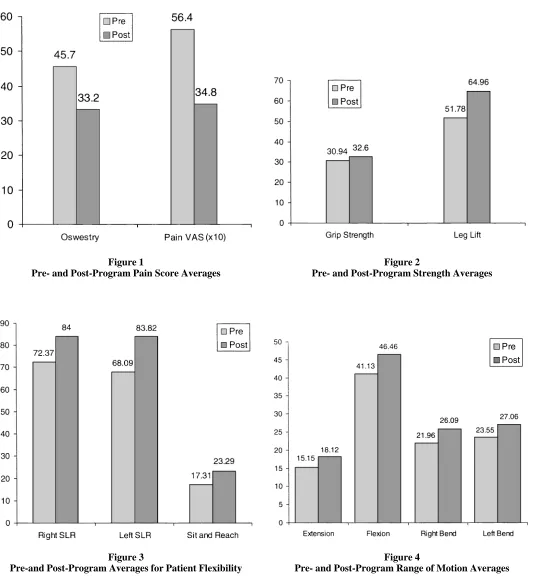
Figure 1
Pre- and Post-Program Pain Score Averages
Figure 2
Pre- and Post-Program Strength Averages
Figure 3
Pre-and Post-Program Averages for Patient Flexibility
Figure 4
Pre- and Post-Program Range of Motion Averages
exercise portion of the program was directly supervised by a kinesiologist. The multidisciplinary team consisted of a chiropractor, physiotherapist, kinesiologist, occupational therapist and a behavioural therapist (Masters in psychol-ogy).
Outcome measures
Several outcome measures were used, including: measur-ing strength, flexibility, as well as subjective measures for assessing changes in quality of life and pain.48 Pain VAS
and the Oswestry Disability Index have been shown to be acceptably reliable subjective measures.49–52
Straight Leg Raising has also demonstrated acceptable reliability as a diagnostic tool.53 Other variables such as
age, sex, third party payer, length of time since injury, and length of time in treatment will be studied.
Lumbar range of motion was measured using a digital Dualer inclinometer. This provides a simple technique for assessing ranges of motion.56 The same apparatus
was used to measure SLR. The accuracy and repeatability are ± 1°.
For low back flexibility, the sit and reach test was used. The sit and reach test was performed as described in the Canada Fitness Testing procedure. The mean of the three tests was calculated. The test has been shown to be reliable in measure of flexibility, with an inter-class test-retest agreement coefficient of 0.83.55
For grip strength, the Jamar (five position) hand grip dynamometer was utilized. Standardized patient position-ing as set forth by the American Society of Hand Therapist was followed.65 Accuracy was measured at ± 3% with a
test-retest reliability (using the Pearson Product Moment Correlation Coefficient) of r = 80.66 Fike et al. concluded
that this device was useful for establishing a baseline and for monitoring progress assessments.67
Isometric force produced by the musculature of back and leg was tested by the Jamar Back-Leg Dynamometer. It has an accuracy of 100 kg ± 0.5 kg. The leg lift test was performed three times.
Clinical significance was considered to be a change greater than or equal to: 2 cm for pain VAS, 10% for Oswestry Disability Index, 10% of entry level grip strength, 10% of entry level leg lift strength, 20 degrees for straight leg raising, 5 cm for sit and reach, 5 degrees for lumbar extension, 10 degrees for lumbar flexion and 5 degrees for left and right lateral lumbar bending.
Data for the interdisciplinary rehabilitation group was collected from patient files. Since the data collection meth-ods from the Rehabilitation Centre are similar to those in an epidemiological study wherein individual patient names are not recorded, it was not necessary to obtain informed consent from the patients. Data for the control group included summary frequency counts, means and standard deviations obtained from the literature.
Clearance for return to work/disability test
1 A primary health care practitioner (chiropractor)
as-sessed clearance for return to work at the end of the program.
2 The final physical/functional assessments confirmed
whether or not the patient was substantially able to per-form the essential tasks of their pre-accident occupation or activities of daily living. This was the disability test that was used.
Statistical analysis
These data are both quantitative and ordinal in nature. Therefore, the within treatment group data (i.e. flexibility, strength, and subjective measure of pain and quality of life, etc.) were analyzed using the one-tailed paired t-test and Pearson’s correlation coefficient. Although a pilot study was not used to determine which direction the sam-ples (positive or negative) would be going, the review of previous data from similar study population allowed us to hypothesize the direction and have allowed us to use this test. However, since some of these data were compared with control data from other studies, the Confidence Inter-val (95%) calculations for proportions and means were employed for these analyses.
Results
A total of 147 subjects were considered for this study, 75 (51%) were female and 72 (49%) were male. The average age upon entry into the rehabilitation program was 38.9 years (female average was 38.8, male average was 38.9). For 102 cases the insurance type was recorded: 51 (50%) were motor vehicle accidents (MVA), 41 (40%) were worker’s compensation board claims (WCB), and 10 (9.8%) were private patients.
average was 202.2 days with a standard deviation of 355.8 days). See Table 1. Of these 79 patients, 27 (34.2%) were acute, 17 (21.5%) were sub-acute, and 35 (44.3%) were chronic cases.
Pain and perceived disability were measured with the pain visual analogue scale (VAS)23,49,54 and the Oswestry
Disability Index, respectively, upon entry and discharge from the program. The average VAS was 5.6 cm upon entry into the program (n = 138) and 3.5 cm upon dis-charge (n = 138). The average individual change in VAS was a decrease of 2.2 cm (n = 135); this decrease was 2.4 cm (n = 70) for females and 1.9 cm (n = 65) for males. A one-tailed t-test proved these results to be statistically sig-nificant at the level of p < 0.01. The average Oswestry score was 45.7% upon entry into the program (n = 141), and 33.2% upon discharge (n = 138). The average indi-vidual change in Oswestry score was a decrease of 12.9% (n = 137). For females this decrease was 14% (n = 71) and for males 11.6% (n = 66). See Table 2. A one-tailed t-test proved these results to be statistically significant at the level of p < 0.01. Pearson’s correlation factors for pre-VAS and pre-Oswestry, post-pre-VAS and post-Oswestry, VAS change and Oswestry change were 0.5, 0.73, and 0.44, respectively.
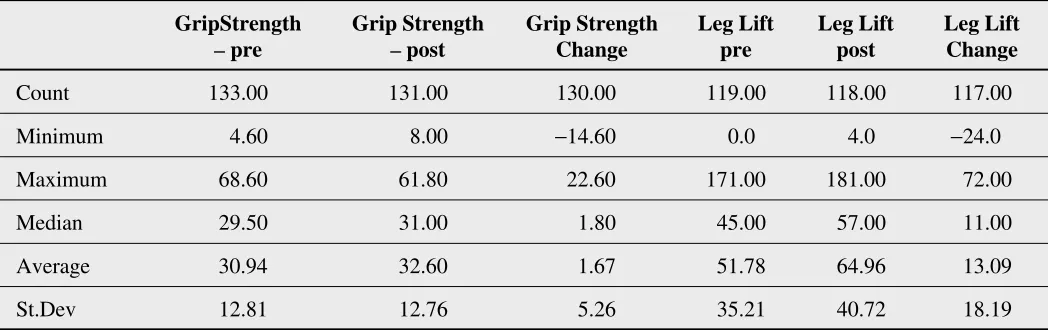
Strength was measured using the Jamar Hand Grip dynamometer and the Jamar Leg Lift dynamometer. The average Grip Strength upon entry was 30.9 kilograms (this was an average of each subject who performed three trials) (n = 133); and on discharge was 32.6 kilograms (n = 131). The average individual grip strength change was an in-crease of 1.7 (n = 130). A one-tailed t-test of pre-program and post-program data was significant at the level of
p < 0.01. The average leg lift upon entering into the
program was 51.8 kilograms (n = 119); and 65 kilograms on discharge (n = 118). The average individual leg lift strength change was an increase of 13.1 kilograms (n = 117); statistically significant at p < 0.01. See Table 3. Pearson’s Correlation Coefficient for grip strength and leg lift (pre-, post-, and change data) were 0.67, 0.76, and 0.33, respectively.
Flexibility was assessed by using the Straight Leg Raise and the Sit and Reach tests.55 The average pre-program
Straight Leg Raise (n = 105) were 72.4° (right) and 68.1° (left). The average post-program results (n = 104) were 84° (right) and 83.8° (left). The average individual change (n = 104) was an increase of 11.4° (right) and 15.5° (left).
These results were statistically significant at p < 0.01. Pearson’s Correlation Coefficients for the pre- post- and change data of the right and left Straight Leg Raise were 0.78, 0.81, and 0.66, respectively. The Sit and Reach data revealed an average pre-program measure of 17.3 cm (n = 117), and a post-program average of 23.3 cm (n = 118), with an average increase of 5.8 cm (n = 117), statistically significant at p < 0.01. See Table 4.
The ranges of motion of the lumbar spine assessed were extension, flexion, and left and right lateral bending. The ranges of motion were documented using a digital Dualer inclinometer. This provides a simple technique for as-sessing impairment and measuring progress in the reha-bilitation program.56 Rondinelli et al. determined that
inter-examiner reliability of a double inclinometer was moderate (ICCT = 0.83) and inter-examiner reliability was only fair (ICC = 0.69).63 For the pre-treatment data,
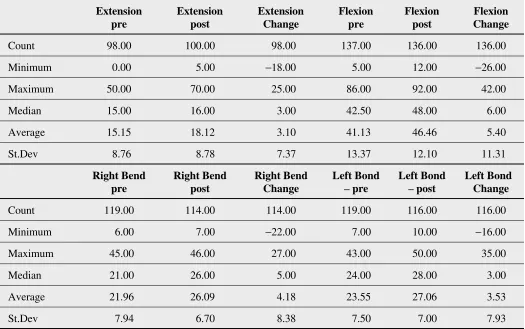
the average extension was 15.2° (n = 98), flexion was 41.1° (n = 137), right bending was 22° (n = 119), and left bending was 23.6° (n = 119). The post-treatment averages were as follows: extension 18.1° (n = 100), flexion 46.5° (n = 136), right bending 26.1° (n = 114), and left bending 27.1° (n = 116). The average individual changes were: ex-tension 3.1° (n = 98), flexion 5.4° (n = 136), right bending 4.2° (n = 114), and left bending 3.5° (n = 116). See Table 5. All comparisons of pre- and post- data were statistically significant at the level of p < 0.01. Pearson’s Correlation Coefficient for comparisons of flexion with Sit and Reach data (pre, post, change) were 0.34, 0.29, and 0.15, respec-tively.
Return to work or pre-accident activities data shows that of the original 147 subjects that were reviewed, 101 were still considered disabled at the time of the initial functional assessment. Ninety-one of the 101 patients (90.1%) were cleared to return to work, either on a modified or unre-stricted basis upon discharge from our program. Forty-six patients were in the program but were not considered disa-bled as they had already returned to work. These subjects still demonstrated objective signs of impairment (i.e., functional deficits).
A comparison of our data with the literature was achieved by calculating 95% Confidence Intervals and yielded the following results:
The age of our subjects was not different from that re-ported in the Di Fabio study,57 but the low back pain
Table 1
Profile of patients in the program
Entry Age Days in Program Program Duration Days Since Injury
Count (147) 123.00 127.00 144.00 79.00
Median 37.00 27.00 8.00 66.00
St.Dev 11.79 15.92 3.27 355.77
“Count” represents the number of data entries available for patients in the category (out of a possible 147).
Table 3
Grip Strength and Leg Lift data for patients in the program
GripStrength Grip Strength Grip Strength Leg Lift Leg Lift Leg Lift
– pre – post Change pre post Change
Count 133.00 131.00 130.00 119.00 118.00 117.00
Minimum 4.60 8.00 -14.60 0.0 4.0 -24.0
Maximum 68.60 61.80 22.60 171.00 181.00 72.00
Median 29.50 31.00 1.80 45.00 57.00 11.00
Average 30.94 32.60 1.67 51.78 64.96 13.09
St.Dev 12.81 12.76 5.26 35.21 40.72 18.19
Table 2
Oswestry and Pain Visual Analogue Scale data for patients in the program
Oswestry Oswestry Oswestry Pain VAS Pain VAS Pain VAS
pre post Change pre post Change
Count 141.00 138.00 137.00 138.00 138.00 135.00
Minimum 2.00 0.00 -64.00 0.00 0.00 -8.00
Maximum 91.00 80.00 22.00 10.00 10.00 4.00
Median 47.00 32.00 -12.00 5.50 3.00 -2.00
Average 45.73 33.20 -12.87 5.64 3.48 -2.16
Table 5
Range of Motion data for patients in the program
Extension Extension Extension Flexion Flexion Flexion
pre post Change pre post Change
Count 98.00 100.00 98.00 137.00 136.00 136.00
Minimum 0.00 5.00 -18.00 5.00 12.00 -26.00
Maximum 50.00 70.00 25.00 86.00 92.00 42.00
Median 15.00 16.00 3.00 42.50 48.00 6.00
Average 15.15 18.12 3.10 41.13 46.46 5.40
St.Dev 8.76 8.78 7.37 13.37 12.10 11.31
Right Bend Right Bend Right Bend Left Bond Left Bond Left Bond
pre post Change – pre – post Change
Count 119.00 114.00 114.00 119.00 116.00 116.00
Minimum 6.00 7.00 -22.00 7.00 10.00 -16.00
Maximum 45.00 46.00 27.00 43.00 50.00 35.00
Median 21.00 26.00 5.00 24.00 28.00 3.00
Average 21.96 26.09 4.18 23.55 27.06 3.53
St.Dev 7.94 6.70 8.38 7.50 7.00 7.93
Table 4
Straight Leg Raise and Sit and Reach Data for the patients in the program
Right Right Right Left Left Left Sit and Sit and Sit and
SLR SLR SLR SLR SLR SLR Reach Reach Reach
– pre – post Change – pre – post Change pre post Change
Count 105.00 104.00 104.00 105.00 104.00 104.00 117.00 118.00 117.00
Minimum 20.00 20.00 -56.00 6.00 25.00 -63.00 0.00 0.00 -18.50
Maximum 115.00 127.00 70.00 120.00 130.00 86.00 45.50 48.00 26.50
Median 74.50 89.00 9.00 68.00 85.00 14.00 15.75 22.50 5.00
Average 72.37 84.00 11.37 68.09 83.82 15.51 17.31 23.29 5.79
score was higher. There was no statistical significant dif-ference between the two programs for the change in Oswestry. See Table 6.
When comparing the results of our study’s program to the Mayer (1986) study,39 the confidence interval
sug-gested a statistically significant lower Straight Leg Raise change and Lumbar Extension change in our study. See Table 7.
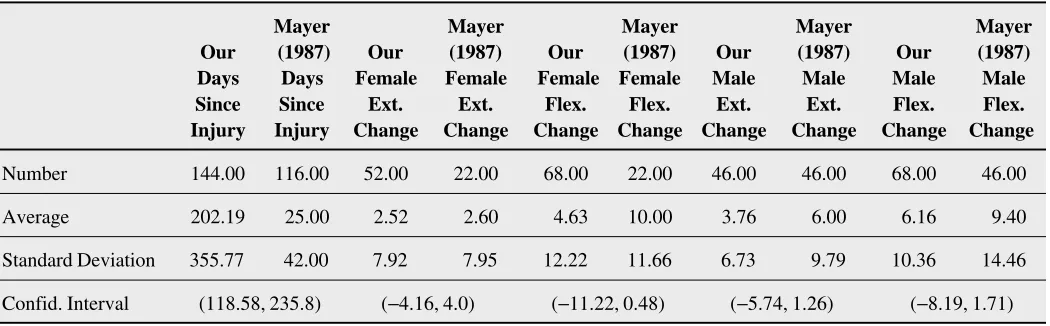
The Mayer (1987) study,40 found no statistically
signifi-cant differences between genders for the outcome meas-ures of extension and flexion, but there was a highly significant difference for duration of injury before entering the program. See Table 8.
Both our study and the Mellin study58 showed a
statisti-cally significant improvement with respect to the exten-sion change, for both males and females. However, the Mellin study showed a greater clinical significance. See Table 9.
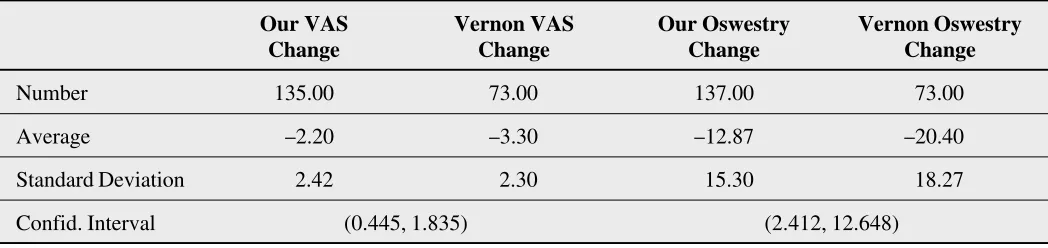
When comparing the results of our study’s program to the Vernon study,42 the confidence interval suggested
sta-tistically significant lower pain VAS and Oswestry changes in our study. See Table 10.
A sample size estimate was performed (at the power level of 80% and alpha level of 0.05) and revealed that a total of 53 patients would be required for each of the con-trol and program groups for future studies involving a randomized controlled trial design. This estimate is based on all participants in the study including the non-disabled group.
Discussion
The goal of this study was to describe the outcomes of active rehabilitation in a multidisciplinary setting for acute, subacute and chronic low back injuries. The out-comes measured include decreases in pain measurements and disability indices as well as increases in strength, flex-ibility, and range of motion which are statistically signifi-cant. Return to work clearance was also considered.
The results of the study indicated an average decrease of 12.9% for the Oswestry Disability Index and an average decrease of 2.2 cm for the Pain VAS. Considering clini-cally significant changes at the level of 10% for the Oswestry Disability scale and 2 cm for the Pain VAS, these show a consistent level of clinical significance. The average Oswestry score upon entry into the program was in the severe disability range (40 to 60%) at 45.7%, while
upon discharge from the program the average score was in the moderate disability range (20 to 40%) at 33.2%. We consider this to be a significant clinical improvement. There was a moderate positive correlation between change in Oswestry and pain VAS. As these are both subjective measures of the patient’s physical status, one would expect a positive correlation as the patient’s perceived level of functional ability is directly reflective of their perceived level of pain. Compared with our 12.9% change in the Oswestry Index, Di Fabio’s results57 showed a decrease of
10% and Vernon’s42 data indicated a decrease of 20.4%.
The Di Fabio study had a program duration which was four times longer than our study, and Vernon’s average number of days from time of injury to the entry into the program was one quarter of that of this study.
The average individual grip strength change was 1.7 kg and 13.1 kg for the leg lift. These were both statistically significant. There was a mild positive correlation between the changes in these outcomes, however only the leg lift achieved clinical significance. Although grip strength is considered a general indicator of strength, the leg lift was more specific to the low back strength and this explains why there was not a greater correlation between the two outcome measures.
The average increase in the lumbar ranges of motion were as follows: flexion 5.4°, extension 3.1°, left lateral bending 3.5°, right lateral bending 4.2°; and left SLR 15.5°, and right SLR 11.4°. While the changes in these ranges of motion are not considered to be clinically signifi-cant, it is important to note that the average discharge range of motion was considered to be within normal limits. Sit and reach flexibility showed an increase of 5.8 cm which was both statistically and clinically significant.
Table 6
A comparison of data from patients in this program with patients in Di Fabio’s57 program
Our Di Fabio
Di Fabio Our Di Fabio Oswestry Oswestry
Our Age Age Duration Duration Change Change
Number 123.00 138.00 144.00 132.00 137.00 28.00
Average 38.87 38.00 9.10 32.00 -12.87 -10.00
Standard Deviation 11.79 10.00 3.27 29.00 15.30 18.56
Confidence Interval (-1.8, 3.54) (-27.93, -17.87) (-10.51, 4.77)
Table 7
A comparison of data from patients in this program with patients in Mayer’s (1986)39 program
Mayer (1986) Mayer (1986)
Our R.SLR R.SLR Our L.SLR L.SLR Our Ext. Mayer (1986)
Change Change Change Change Change Ext. Change
Number 104.00 73.00 104.00 73.00 98.00 73.00
Average 11.37 19.22 15.51 20.57 3.10 6.02
Standard Deviation 17.74 16.54 18.65 18.08 7.37 9.93
Confid. Interval (-13, -2.7) (-10.6, 0.48) (-5.65, -0.19)
Table 8
A comparison of data from patients in this program with patients in Mayer’s (1987)40 program
Mayer Mayer Mayer Mayer Mayer Our (1987) Our (1987) Our (1987) Our (1987) Our (1987) Days Days Female Female Female Female Male Male Male Male Since Since Ext. Ext. Flex. Flex. Ext. Ext. Flex. Flex. Injury Injury Change Change Change Change Change Change Change Change
Number 144.00 116.00 52.00 22.00 68.00 22.00 46.00 46.00 68.00 46.00
Average 202.19 25.00 2.52 2.60 4.63 10.00 3.76 6.00 6.16 9.40
Standard Deviation 355.77 42.00 7.92 7.95 12.22 11.66 6.73 9.79 10.36 14.46
also led to difficulties with analysis of the data. Some pa-tients presented with severe limitations in one outcome measure but no limitations in others. The latter limited the potential to show clinically significant improvements.
There was also a wide variance in the time between injury and entry into the program. Chronic pain patients generally have a poorer prognosis due to psychosocial fac-tors.59 Approximately 44% of our patients were in the
chronic phases of their recovery. Also, all patients were not assessed functionally until having progressed through four to six weeks of chiropractic, massage therapy and/or physiotherapy. Therefore, most patients would have al-ready realized some degree of improvement (both subjec-tively and objecsubjec-tively) prior to entering the active rehabilitation program. This is one of our criteria before entering our multidisciplinary rehabilitation program.
Thus, our results likely would have shown a higher level of improvement if our outcome measures were used right from the beginning of their entry into treatment. This state-ment is based on the fact that most patients presented in an “acute state” initially. Thus, our treatment protocol usually commenced with reassurance, and some form of pain con-trol. Having said this, our study is also unique in that most patients continued to receive some form of passive treat-ment (i.e., chiropractic), one to two times per week throughout the duration of the active rehabilitation pro-gram. The purpose of the continued passive treatments was to provide a smooth transition from passive to active treatments in their continuum of care. The passive treat-ments continued to offer increase in tissue elasticity, in-crease in flexibility, reassurance and pain management. Some people do not like “exercise” or a rehab facility may
Table 9
A comparison of data from patients in this program with patients in Mellin’s40 program
Our Mellin Our Mellin Our Mellin Our Mellin Female Female Female Female Male Male Male Male
Ext. Ext. Flex. Flex. Ext. Ext. Flex. Flex.
Change Change Change Change Change Change Change Change
Number 52.00 87.00 68.00 87.00 46.00 98.00 68.00 99.00
Average 2.52 10.00 10.00 8.00 3.76 9.00 6.16 9.00
Standard Deviation 7.92 11.70 12.22 16.14 6.73 10.12 10.36 13.95
Confid. Interval (-10.78, -4.18) (-7.88, 114) (-8.06, -2.42) (-6.57, 0.89)
Table 10
A comparison of data from patients in this program with patients in Vernon’s42 program
Our VAS Vernon VAS Our Oswestry Vernon Oswestry
Change Change Change Change
Number 135.00 73.00 137.00 73.00
Average -2.20 -3.30 -12.87 -20.40
Standard Deviation 2.42 2.30 15.30 18.27
not be their typical milieu, so they were eased into our program.
One of the basic principles of a good physical rehabilita-tion program is to focus on funcrehabilita-tion and minimize the patient’s pain focused behaviours. The goal is functional restoration and not pain control. It is important to recog-nize their pain is real, but it should not be a limiting factor in the progression of exercises. In keeping with the World Health Organization’s definition of “rehabilitation”,29 our
program is time-limited and goal-oriented. Supervision of exercise is important to ensure compliance and proper techniques, but patient education is just as important. It is important to teach clients the difference between hurt vs. harm, postural sparing techniques, proper lifting tech-niques, independent pain coping strategies and the impor-tant benefits of an active lifestyle. A significant number of patients still have residual pain upon being discharged from the program, so it is important to encourage them to implement independent pain coping strategies such as icing, relaxation, stretching and continued exercise. A home exercise program should be provided upon dis-charge and they should be encouraged to continue exercis-ing independently so they can maintain their functional gains.
One of the most unique features of this study comparing it to others in the literature is that we used an integrat-ed healthcare approach in a multidisciplinary setting. chiropractors, physiotherapists, massage therapists, kinesiologists, occupational therapists, medical doctors, psychologists and behavioural therapists were integrated in one way or another in the care of these patients. As mentioned, the chiropractor or physiotherapist would pre-scribe the proper active physical rehabilitation program tailor-made for each client. The kinesiologist would super-vise each client’s exercises, not allowing the ratio of pa-tient to therapist to reach above six to one. The behavioural therapist teaches relaxation exercises over a period of four sessions and ensures clients are benefiting from this form of independent pain coping strategy. A psychologist may be used if the patient is suffering from a significant psy-chological impairment such as Post Traumatic Stress Disorder, Depression, Anxiety or a Somatoform Pain Dis-order. The occupational therapist’s role is to provide the client some patient education on pacing, work simplifica-tion and energy conservasimplifica-tion. They will also liase with the employer and set up a modified return to work plan in
conjunction with the health practitioner on file, being cog-nizant of the worker’s physical restrictions. It has been our experience that a successful return to work is optimized if the job is available and the employer is flexible and has modified work available.
Motivation and compliance of the claimant is an issue that may present a challenge to service providers when offering rehabilitation programs in the third party payer arena.17,34 The majority of the patients in this study are
motor vehicle and workers’ compensation board cases, and as such, the issue of secondary gain motives should be considered.12,17,60 Consistency of effort and a significant
level of improvement are difficult to demonstrate when patients may be participating in the rehab program for the wrong reasons, i.e., fear losing income replacement ben-efits or being sent back to work. Furthermore, after show-ing a considerable level of objective improvement it is not uncommon for some patients to demonstrate a period of regression prior to discharge.61 Some claimants
demon-strate self-limiting pain behaviour in their final functional assessment (which is supposed to demonstrate their func-tional gains) out of fear of being sent back to work or having their disability benefits discontinued. These factors should be taken into consideration when assessing the ef-fectiveness of active rehabilitation programs for patients with low back pain. Consistency of effort must be assessed whenever functional testing is employed. Coefficient of Variation (C.V.) can be measured in strength testing. Gen-erally a C.V. greater than 15% indicates an inconsistent effort. Therefore, the functional data may not be valid and the results should be interpreted with caution. The C.V. can be assessed with the grip strength (Jamar) testing and the push/pull test using the Chatillon unit. Strength testing is repeated generally three times in order to assess consist-ency of effort.
The optimal design for assessing the effectiveness of this type of program would be a prospective randomized controlled trial. Studies on the clinical efficacy of active rehabilitation of low back pain could be improved by using a more diverse sample population demonstrating an even distribution of private patients and those involved in the third party payer system. Individual outcome measures could be more accurately assessed in studies that limited the sample to patients with deficits in one particular area, i.e., low back.
demonstrate cost effectiveness. Our average active physi-cal rehabilitation program costs between $2,000 to $3,000. This does not include passive forms of therapy or psychol-ogy. If an appropriate physical rehabilitation program can return a patient to their pre-accident lifestyle, significant cost savings can be realized. We are cognizant of the no-tion that our return to work rate seems high. As menno-tioned, this figure is not the “actual” return to work rate and there was no follow-up 3, 6 and 12 months upon discharge from our program. The real success of a program can more accurately be measured if appropriate follow-up is done. Clinical efficacy can more accurately be determined if sur-vival curves are considered.
Conclusion
This study has demonstrated statistically significant im-provements in the Oswestry Disability Index, Pain Visual Analogue Scale, ranges of motion, and strength measure-ments were obtained in a multidisciplinary physical reha-bilitation program for low back pain claimants. Changes in the Oswestry Disability Index, pain VAS, leg lift, and sit and reach were considered clinically significant. Ninety percent of patients were cleared to return back to work or to their normal daily activities upon completion of our Active Rehabilitation Program. The study only evaluated their ability to return to work. We did not measure whether they actually returned to work or whether they were able to stay at work for a significant length of time. This study tends to support the use of multidisciplinary rehabilitation programs for treatment of low back pain even in the chronic pain population. This study showed positive out-come measures and is cost effective. Most of the popula-tion (i.e., 90%) are in a third party payer system, which is typically a challenge to rehabilitate and reach full func-tional recovery.
Further studies of active physical rehabilitation should employ a prospective randomized controlled trial design. As indicated by the power analysis provided by this study, a minimum sample size of 53 subjects per intervention group would be required. Future studies should have ap-propriate follow-ups at 3, 6 and 12 month intervals to de-termine the participants’ long term benefits from the treatment intervention.
References
1 Biering-Sorenson F. Physical measurement as a risk indicator. Spine 1984; 9:106–119.
2 Caruso LA, Chan DE, Chan A. Management of work related back pain. Am J Occ Ther 1987; 41(2):112–117. 3 Cox JM, Feller JA. Chiropractic treatment of low back
pain: a multicenter descriptive analysis of prevention and outcome in 424 consecutive cases. JNMS 1994;
2(4):178–190.
4 Deyo RA, Diehl AK, Rosenthal M. How many days of bedrest for acute low back pain? N Eng J Med 1986; 315:1064–1070.
5 Keith RA. Observations in the rehabilitation hospital: twenty years of research. Arch Phys Med Rehab 1988; 69:625–631.
6 MacKenzie EJ, Shapiro S, Siegel JH. The economic impact of traumatic injuries – one year treatment related expenditures. JAMA 1988; 260:3290–3297.
7 Miller TR. Costs and functional consequences of U.S. roadway crashes. Accid Anal Prev 1993; 25(5):593–697. 8 Ziedler F, Pletschen B, Scheunert D, Mattern B, Alt B,
Miksch T, Eichendorf W, Reiss S. Development of a new injury cost scale. Accid Anal Prev 1993; 25(6):675–687. 9 Burke SA, Harms-Constas CK, Aden PS. Return to work/
work retention outcomes of a functional restoration program. Spine 1994; 19(17):1880–1885.
10 Catchlove R, Cohen K. Effects of a directive return to work approach in the treatment of workman’s compensation patients with chronic pain. Pain 1982; 14:181.
11 Ebrall PS. Residual disability from delayed manipulative treatment for mechanical low back pain: a case review. Chiro J of Austral 1993; 23(2):54–58.
12 Hall H, McIntosh G, Melles T, Holowachuk B, Wai E. Effect of discharge recommendations on outcome. Spine 1994; 19(18):2033–2037.
13 Anderson R, Meeker WC, Wirick BE, Mootz RD, Kirk DH, Adams A. A meta-analysis of clinical trials of spinal manipulation. JMPT 1992; 15:181–194.
14 Assendelft WJJ, Koes BW, Van der Heijden GJMG, Buter LM. The efficacy of chiropractic manipulation for back pain. JMPT 1992; 15:487–494.
15 Beals RK, Hickman NW. Industrial injuries of the back and extremities – a comprehensive evaluation. J Bone Joint Surg 1972; 54A(8):1593.
16 Bettencourt CM, Carlstrom P, Brown SH, Lindau K, Long CM. Using work simulation to treat adults with back injuries. Am J Occ Ther 1986; 40(1):12–18.
18 Cherkin DC, MacCornack FA, Berg AO. Managing low back pain – a comparison of the beliefs and behaviours of family physicians and chiropractors. West J Med 1988; 149(4):475–480.
19 Cherkin DC, MacCornack FA. Patient evaluations of low back pain care from family physicians and chiropractors. West J Med 1989; 150(3):351–355.
20 Dies S, Strapp JW. Chiropractic treatment of patients in motor vehicle accidents: a statistical analysis. JCCA 1992; 36(3):139–145.
21 Diller L. Fostering the interdisciplinary team: fostering research in a society in transition. Arch Phys Med Rehab 1990; 71:275–278.
22 Doran DML, Newell DJ. Manipulation in the treatment of low back pain: a multicenter study. Br Med J 1975; 2:161–164.
23 Fairbank JCT, Couper J, Davies MB, O’Brien JP. The Oswestry low back pain questionnaire. Physiotherapy 1980; 66(8):271–273.
24 Fordyce WE, Roberts AH, Sternbach RA. The behavioral management of chronic pain – a response to critics. Pain 1985; 22:113–125.
25 Gans JS. Hate in the rehabilitation setting. Arch Phys Med Rehabil 1982; 64:176–179.
26. Manceaux GD. Can physical therapists and chiropractors coexist despite differences? JMPT 1987; 10(5):260–263. 27 Matheson LN, Ogden LD, Violette K, Schultz K. Work
hardening: occupational therapy in industrial rehabilitation. Am J Occ Ther 1985; 13(5):314–421. 28 Mayer TG, Gatchel RJ, Kishino N, Keeley J, Capra P,
Mayer H, Barnett J, Mooney V. Objective assessment of spine function. Spine 1985; 10:482–493.
29 Adapted from the World Health Organization for Ministry of Health of Ontario Purposes.
30 Ransford AO, Cairns D, Mooney V. The pain drawing as an aid to the psychologic evaluation of patients with low back pain. Spine 1976; 1(2):127–134.
31 Roland M, Morris R. A study of the natural history of back pain – part one: development of a reliable and sensitive measure of disability in low back pain. Spine 1983; 8(2):141–144.
32 Roland M, Morris R. A Study of the natural history of back pain – part two: development of a reliable and sensitive measure of disability in low back pain. Spine 1983; 8(2):145–150.
33 Selby DK. Conservative care of nonspecific low back pain. Orthopedic Clinics of North America 1982;
113(3):427–437.
34 Waddell G, Main CJ, Morris EW, Di Paola M, Gray ICM. Chronic low back pain, psychologic distress, and illness behaviour. Spine 1984; 9(2):209–213.
35 Waddell G, Main CJ. Assessment of severity in low back disorders. Spine 1984; 9(2):204–208.
36 Waddell G, McCulloch JA, Kummel E, Venner RM. Non-organic physical signs in low back pain. Spine 1980; 5(2):117–125.
37 Brontford G. Chiropractic treatment of low back pain: a prospective survey. JMPT 1989; 9:99–113.
38 Lichter RL, Hewson JK, Radke SJ, Blum M. Treatment of chronic low back pain – a community based
comprehensive return to work rehabilitation program. clinical orthopedics and related research 1984; 194:115–123.
39 Mayer TG, Gatchel RJ, Kishino N, Keeley J, Mayer H, Capra P, Mooney V. A prospective short term study of chronic LBP patients utilizing novel objective
measurements. Pain 1986; 25:53–68.
40 Mayer TG, Gatchel RJ, Mayer H, Kishino ND, Keeley J, Mooney V. Prospective two-year study of functional restoration in industrial low back injury. JAMA 1987; 258(13):1763–1767.
41 Hansen F. Intensive dynamic back-muscle exercises, conventional physiotherapy, or placebo-control treatment of low back pain. Spine 1993; 18(1):99–107.
42 Vernon HT, Piccininni J, Kopansky-Giles D, Hagino C, Fuligni S. Chiropractic rehabilitation of spinal pain patients: principles, practices and outcome data. JCCA 1995; 39(3):147–153.
43 Krause N, Raglund D. Occupational disability due to low back pain: a new interdisciplinary classification based on a phase model of disability. Spine 1994; 19(9):1011–1020. 44 Mayer TG, Polatin P, Smith B, Smith C, Gatchel R,
Herring SA, Hall H, Donelson RG, Dickey J, English W. Contemporary concepts in spine care: spine rehabilitation. Spine 1995; 20(18):2060–2066.
45 Frost H, Klaber JA, Moser JS, Fairbank JCT. Randomized controlled trial for evaluation of a fitness program for patients with chronic low back pain. BMJ 1995; 310:151–157.
46 Berkow R, Fletcher AJ. The Merck Manual – 16th ed. 1992, Rahway, N.J: Merck Research Labs.
47 Keith RA. The comprehensive treatment team in rehabilitation. Arch Phys Med 1991; 72(5):269–274. 48 Mayer TG. Using physical measurements to assess low
back pain. J Musc Med 1985; 6:44–59.
49 Price DD, McGrath PA, Raffi A, Buckingham B. The validation of visual analogue scales as ration scale measures for chronic and experiential pain. Pain 1983; 17:45–56.
51 Gronblad M, Hupli M, Wennerstrand P, Jarvinen E, Lukinmaa A, Kouri JP, Karaharju EO. Intercorrelation and test-retest reliability of the pain disability indew and the Oswestry disability questionnaire and their correlation with pain intensity in low back patients. Clinical J Pain 1993; 9(3):189–195.
52 Love RM, Brodeur RR. Inter and intra examiner reliability of motion palpation for the thoracolumbar spine. JMPT 1987; 10(1):1–4.
53 Goeken LN, Hof AL. Instrumental straight leg raising: results in healthy subjects. Arch Phys Med Rehab 1993; 74(2):193–203.
54 Guyatt GH, Townsend M, Berman LB, Keller JL. A comparison of Likert and visual analogue scales for measuring change in function. J Chronic Disease 1987; 40:1129–1133.
55 Shepard RJ. Measurements of fitness. The Canadian experience. J Spor Med Phys Fit 1991; 31(3):470–480. 56 Mayer TG, Tenier AF, Kristoferson S, Mooney V. Use of
non-invasive techniques for quantification of spinal range of motion in normal subjects and chronic low back dysfunction patients. Spine 1984; 9(6):588–595.
57 Di Fabio RP. Efficacy of manual therapy. Phys Ther 1992; 72(12):853–864).
58 Mellin G. Outcome of a multimodal treatment including intensive physical training of patients with chronic low back pain. Spine 1993; 18(7):825–829.
59 Carosella A. Factors associated with early discharge from a multidisciplinary work rehab program for chronic low back pain. Pain 1994; 57:69–76.
60 McIntosh G, Melles T, Hall H. Return to work after chronic back pain rehabilitation. JNMS 1994; 2(3):112–115.
61 Sandstrom J, Esbjornsson E. Return to work after rehabilitation. Scand J Rehab Med 1986; 18:29–33. 62 World Health Organization 1981.
63 Rondinelli R, Murphy J, Eslera, Marciano T, Cholma Xjuan C. Estimation of normal flexion and surface inclinometry. Am J Phys Med Rehabil 1992; 71:219–224. 64 Livingston T. Dualer electronic inclinometer. Midvale,
UJ:J Tech, 1992.
65 Fess EE, Moran CA. Clinical assessment recommendations. Chicago, IL: The American Society of Hand Therapists, 1991.
66 Mathiowetz V, Weber K, Volland G, Kushman M. Reliability and valid grip and pinch strength evaluation. J Hand Surgery 1984, 9A:222–226.