chiropractic practice
Dr. Paul M. Hinton,
DC, FCCRS(C)*Dr. Randall McLeod,
DC, FCCRS(C), DACRB‡Dr. Blaine Broker,
DC, FCCRS(C)†Dr. C. Elizabeth MacLellan,
BSc, DC, FCCRS(C)§* Corresponding Author: Private practice, Nelson, BC. Tel: 250 352-5135. Email: [email protected] † Private practice, Prince Albert, SK. Tel: 306 922-7028. Email: [email protected]
‡ Private practice, Stony Plain, AB, Tel: 780 963-4608. Email: [email protected] § Private practice, Calgary, AB. Tel: 403 508-7000. Email: offi [email protected] © JCCA 2010.
Objectif : Décrire l’étendue de l’utilisation
d’indicateurs de résultats standardisés et de mesures cliniques variées par les chiropraticiens afi n de documenter systématiquement le niveau de l’état de santé initial des patients et leur réponse au traitement, en mettant l’évidence sur les instruments de mesure des résultats.
Type d’étude : Enquête transversale expédiée par la
poste.
Participants : Chiropraticiens enregistrés en
Saskatchewan.
Méthodologie : Un sondage a été expédié par la poste
à tous les membres de la Chiropractors’ Association of Saskatchewan. Les répondants ont noté leur fréquence d’utilisation de divers instruments papier-crayon standardisés et de tests fonctionnels chiropratiques, orthopédiques et neurologiques standardisés dans les contextes de l’évaluation initiale (« toujours », « souvent », « à l’occasion » ou « jamais ») et au cours du traitement subséquent (après « chaque visite », après « de 9 à 12 visites », « annuellement », lorsque le patient « ne répond pas », lors de l’« abandon », « jamais » ou pour une « autre » raison). Les données ont été totalisées pour tous les articles et toutes les combinaisons de catégories de réponses sous forme de fréquence et de pourcentages en utilisant en tant que dénominateur la taille totale de l’échantillon.
Résultats : Des 164 chiropraticiens enregistrés,
62 (38 %) nous ont rendu un questionnaire rempli. Un diagramme de la douleur était l’outil de mesure subjectif le plus communément utilisé et était administré couramment (soit « toujours » ou « communément »)
Objectives: To describe the extent to which
chiropractors utilize standardized outcome and various clinical measures to systematically document patients’ baseline health status and responses to treatment, with particular consideration being given towards quantifi able outcome instruments.
Study design: Cross-sectional mailed survey.
Participants: Registered chiropractors in the province
of Saskatchewan.
Methods: A survey was mailed to all registrants
of the Chiropractors’ Association of Saskatchewan. Respondents graded their frequency of using various standardized pencil-and-paper instruments and functional chiropractic, orthopaedic and neurological tests in the contexts of both the initial intake assessment (‘always,’ ‘commonly,’ ‘occasionally,’ or ‘never’) and the course of subsequent treatment (after ‘each visit,’ after ‘9–12 visits,’ ‘annually,’ when patient ‘not responding,’ on ‘dismissal/discharge,’ ‘never’ or for some ‘other’ reason). Data were tabulated for all item and response category combinations as frequencies and percentages using the total sample size as the denominator.
Results: Of 164 registered chiropractors, 62 (38%)
Introduction
There is a continuing trend in the health care industry towards a consumer driven market. Government health insurance plans, private health insurance carriers, em-ployers and unions all have a vested interest in controlling
spiraling costs and understanding treatment effi cacy.1,2 To
help them in their decisions, third party payers such as Workers’ Compensation boards and automobile insurance corporations presently require the attending clinician to provide documented evidence of a patient’s response to care over time. There was a time when the expressed opinion of a doctor was all the evidence that was required. par 75 % des répondants, soit lors de la consultation initiale ou au courant de l’une des visites subséquentes. L’évaluation chiffrée et les échelles analogues visuelles étaient moins populaires (couramment utilisées par respectivement 59 % et 42 % des répondants). La majorité des répondants (80 %) utilisaient rarement (« à l’occasion » ou « jamais ») des indices d’invalidité spécifi ques à la douleur de la colonne vertébrale comme le Low Back Revised Oswestry, l’index d’invalidité au cou ou le questionnaire Roland-Morris. De plus, ils n’utilisaient pas d’instruments psychosociaux standardisés tels que l’inventaire de dépression de Beck, ou d’outils servant à évaluer l’état de santé général comme les questionnaires SF-36 ou SF-12. L’évaluation neurologique était l’indicateur des résultats le plus communément utilisé. La plupart des répondants (de 84 % à 95 %) ont indiqué qu’ils surveillaient de façon continue l’état neurologique par l’évaluation au niveau des dermatomes, de la force musculaire manuelle et des réfl exes tendineux. L’amplitude des mouvements était couramment mesurée par 95 % des répondants, habituellement de manière visuelle (96 %) plutôt que de manière goniométrique ou par un autre appareil spécialisé (7 %).
Conclusion : Nos résultats suggèrent que la majorité
des chiropraticiens n’emploient pas de questionnaires psychosociaux ou d’indices d’invalidités spécifi ques au problème afi n de documenter le niveau de base ou les changements subséquents dans l’état de santé. Les chiropraticiens ont plus tendance à se fi er à l’historique médical et aux diagrammes de la douleur lors de l’évaluation initiale, ainsi qu’aux tests neurologiques et à l’amplitude des mouvements estimée à l’œil lors de l’évaluation initiale et des traitements subséquents. (JCCA 2010; 54(2):118–131)
m o t s c l é s : indicateur des résultats, enquête, Saskatchewan, chiropraticien.
indices such as the Low Back Revised Oswestry, Neck Disability Index or the Roland-Morris Questionnaire. As well, they did not use standardized psychosocial instruments such as the Beck Depression Index, or general health assessment measures such as the SF-36 or SF-12 questionnaire. Neurological testing was the most commonly used objective outcome measure. Most respondents (84% to 95%) indicated that they continually monitored neurological status through dermatomal, manual muscle strength and deep tendon refl ex testing. Ranges of motion were routinely measured by 95% of respondents, usually visually (96%) rather than goniometrically or by some other specialized device (7%).
Conclusions: Our fi ndings suggest that the majority of
chiropractors do not use psychosocial questionnaires or condition-specifi c disability indices to document baseline or subsequent changes in health status. Chiropractors are more likely to rely on medical history taking and pain drawings during an initial intake assessment, as well as neurological and visually estimated range of motion testing during both initial intake and subsequent treatment visits.
(JCCA 2010; 54(2):118–131)
However, as health care moves forward, there is an ever increasing challenge facing every health profession to provide (quantifi able) documented evidence of biological as well as psychosocial dysfunction and to provide proof that these factors improve more favorably with care than without.3
The use of outcome assessments is essential in modern
health care to assess quality of care and contain costs.1p.147
Usually during the initial consultation a clinician will use various outcome measures to establish baselines and then monitor these defi ned parameters as a gauge of progress. In recent years the Canadian Chiropractic Association has promoted the utilization of outcome measures by provid-ing its membership with specifi c examples and guidelines. There are two general types of outcome measures used in chiropractic practice: (1) patient-administered self-re-porting instruments, and (2) clinician-administered func-tional assessment methods. Self-reporting measures rely on the patient’s own assessment of their current health
status.4 Throughout most of the history of health care the
patient and the health care provider determined whether the patient was making satisfactory improvement through
simple conversation.5p.226 Over the past few decades there
has been a shift towards self-reporting instruments that are practical, reliable, valid and responsive to changes in clinical status. There are an enormous number of patient self-reporting outcome measures available to all health and social science disciplines. The MAPI Research Trust in Lyon France has developed a database which contains descriptions of over 470 validated patient-reporting
out-come and quality of life instruments (PROQOLID).6
Within that database, they are organized into three basic categories: (1) pathology or disease specifi c, (2) popula-tion and (3) generic. The PROQOLID data base was cre-ated to present an overview of existing Patient Reported Outcome (PRO) instruments as well as relevant and updated information on each. The Oswestry Low Back
Disability Index (OLBDI),7 Roland Morris Disability
Questionnaire (RMDQ),8 Neck Disability Index (NDI)9
and the Bournemouth Back Questionnaire (BBQ)10 are
but a few of the instruments that consist of scales covering pain intensity, disability in activities of daily living, and social life and fear-avoidance behavior specifi cally due to neck or back pain. Their utilization is designed to enhance doctor-patient communication and improve goal setting and decision making.
Pain scales and pain drawings are also accepted meth-ods of patient self reporting. Measuring pain intensity can be accomplished by using verbal rating scales, visual ana-log scales and numerical rating scales. The pain drawing or diagram is perhaps the best way to obtain the patient’s
perception of the location of their symptoms.11
Patient self-reporting using standardized question-naires of physical function has clinical usefulness but may not be a valid refl ection of a patient’s actual func-tional status.1p.261 Despite the fact that there is variability
in the reliability between patient-driven subjective meas-ures and clinician-driven objective measmeas-ures there is no
excuse to ignore the utilization of objective measures.12
The physical medicine rehabilitation fi eld has long been the leader in developing clinically sensitive, objective functional outcome measures that can be used in typical clinical settings. A clinician-directed functional outcome measure should provide a baseline by which to measure a physical impairment or loss of some ability of the body as a pathological, anatomical or physiological abnormality
in structure of function.3 Ideally the functional outcome
measure should be quick, simple and most important be able to quantitatively determine a patient’s baseline level of physical function. Established baseline levels are ne-cessary for identifying and classifying the severity of functional defi cits, which in turn help clinicians to de-fi ne subsequent treatment targets and therapeutic goals. A favorable change in status not only reassures patient but also provides diagnostic and treatment justifi cation
for both the clinician12 and third party payors. Ultimately
functional outcome measures should provide an objective quantifi able baseline that will infl uence treatment deci-sions and provide a meaningful end point of care. The clinician should focus on assessing physical function that identifi es movement diffi culties that relate to activities of daily living (ADL).
One of the most basic functional assessments is sim-ply measuring the patient’s active and passive range of
motion.13,14 The presence or absence of normal motion
of future back pain, recent work by McGill suggested that the balance of endurance among the torso fl exors, exten-sors and lateral musculature better discriminates those
who have had back problems from those who have not.15
There are standardized performance tests that provide normative values for strength and endurance, which al-low practitioners to more accurately assess each patient’s performance in relation to other members of the general population who are similar in terms of age, gender and vocation (blue collar versus white collar).1p.229,16,17
The combined usage of patient-administered and clin-ician-administered outcome measures should be viewed as the expected standard of care as this protects the patient from ill-defi ned treatment thresholds and needless costs, particularly when there is no established end point of care.
It is not known whether individual chiropractors are in-corporating such outcome measures into their case man-agement. The purpose of this study was to determine the extent to which a range of relatively common outcome instruments applicable to chiropractic practice were being utilized by chiropractors.
Methods
The study design was a cross-sectional mailed survey. The target population was practicing Canadian chiroprac-tors. However, the sample frame was all practitioners cur-rently registered with the Chiropractors’ Association of Saskatchewan (CAS). This frame was chosen as a man-ageable representative sample of Canadian chiropractors. Membership in the CAS is a mandatory requirement for practice in Saskatchewan. For this study, all of the 164 registered members were invited to participate in the sur-vey via a mail-out invitation. Their responses were to be either mailed or faxed back to the researchers.
Questionnaire design
The choice of outcome instruments to inquire about in this survey was challenging. One data base alone yielded several hundred different pen and paper instruments. We elected to inquire about instruments which tended to be commonly cited within the rehabilitation community, and that would also be likely to be familiar to and/or be per-ceived as being a “gold standard” within the chiropractic community at large. As one of the purposes of systematic-ally assessing outcomes is the communication of subse-quently collected data to third parties (both within and
outside of the chiropractic profession) we did not restrict our choice of instruments to those that were necessarily specifi c to chiropractic patients or conditions. Only one lesser known instrument (the Patient-Rated Wrist Evalua-tion [PRWE]) was inquired about in our survey simply because it was going to be described at length at an up-coming Saskatchewan Worker’s Compensation seminar. However, even though this instrument was “on the desk-top” as it were, we do not feel its inclusion biased the results of this study. (We feel this position is supported by the overall lack of utilization of this instrument de-spite it’s having had a current advocate in the SWC.) In general, although we included some common diagnostic procedures, our primary purpose was twofold; principally to see if practitioners were utilizing quantifi able studies and secondly, are they performing regular monitoring (re-evaluations) of their relevant intake fi ndings.
The survey was subdivided into seven categories (Ap-pendix 1). Four of these categories (General Health, Pain Scales, Disability Indexes and Psycho-Social) were con-sidered subjective patient self-reporting measures. The other three (Postural Evaluation, Ranges of Motion and Neurological Assessment) were considered functional outcome measures. Each category included an “other” option for the respondent to specify any additional instrument(s) of their choice.
The fi rst category entitled “General Health” listed the following outcome measure instruments:
• Medical Review (patient history) • SF 36/12
The next category was “Pain Scales,” for which the fol-lowing four methods were listed:
• Patient description
• Visual analogue scale (sliding scale 0 to 100) • Numerical rating scale (Borg digital 0 to 10) • Pain diagram
The third category, “Disability Indexes” consisted of eight instruments.7,8,9,18,19,20,21
• Functional Rating Index
• Disabilities of the Arm Shoulder Hand (DASH) • EPIC Function Hand Sort
• Patient-Rated Wrist Evaluation (PRWE) • Lower Extremity Functional Scale (LEFS)
Under the fourth category, the following “Posture As-sessment” methods were listed:
• Visual inspection/screening • Leg length assessment • Posturometer
• Photographs • X-rays
The fi fth category, ‘Ranges of Motion,’ involved the following assessment methods:
• Clinician/visual estimation
• Goniomet/mechanical inclinometer • Cervical range of motion (CROM) device • Back range of motion (BROM) device • Single digital inclinometer
• Dual digital inclinometer
Neurological testing, the sixth category of measures, involved the following methods:
• Patient-reported pain referral pattern • Sensory dermatomal testing
• Refl ex testing
• Manual muscle testing
• Instrument-based muscle testing • Surface electromyography (EMG) • Thermography
The seventh and fi nal category of methods involved ‘Psychosocial’ measures, of which the following four as-certainment methods were specifi cally asked about:
• Minnesota Multiphasic Personality Inventory (MMPI) • Beck Depression Index II (BDI-II)
• Fear Avoidance Questionnaire • Waddell’s behavioral signs
The respondents were instructed to indicate whether any or all of the listed examples of outcome measure
in-struments were always, commonly, occasionally or never
used at the patient intake. This response was then com-pared to the utilization of the same outcome measure instruments during the course of treatment and the fre-quency of repeat testing was specifi ed by choosing from one or more of the following response items: “each visit,” “every 9–12 visits” (approximately once a month dur-ing active treatment), “annually,” “when patient not re-sponding,” “at dismissal,” or alternatively, “never.”
The survey focused on quantifying the rate of utiliza-tion of various outcome measures at the time of intake assessment and during the course of treatment. A blank space was provided so that survey participants could also characterize their use of other instruments not specifi cally listed in our survey. The questionnaire was kept short so the completion time would be approximately fi ve minutes.
The survey was pilot-tested on 30 chiropractors regis-tered and actively practicing in the province of British Columbia. Twenty-six responded without expressing any concerns about the length or overall acceptability of the survey and therefore no changes were made to the ori-ginal survey. The responses of this sample group were not included in our study results.
The fi rst group of Saskatchewan chiropractors who participated in completing the questionnaire were those attending a Workers’ Compensation Seminar. Two weeks later the survey was mailed out along with other informa-tion being disseminated by the Chiropractors’ Associa-tion of Saskatchewan. The responses were to be mailed or faxed to one of two provided addresses. The collected survey results were tabulated at a chiropractic offi ce in Calgary, Alberta. To ensure the confi dentiality of the re-spondents, survey participants were kept anonymous by blinding the participant tracking and tabulation members from each others data.
Results
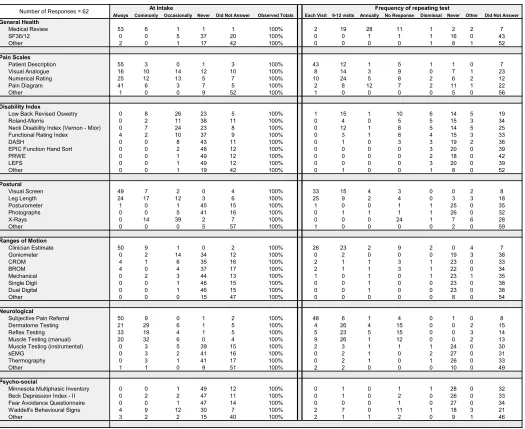
Of the 164 registered chiropractors contacted in person or by a mail-out there were 62 (38%) respondents (Table 1).
Use of General Health Measures
Of the 62 respondents, 85% (n = 53) indicated that at
the patient entry level they always performed a medical
review, 10% performed a medical review commonly and
2% of the respondents occasionally performed a medical
never performed a medical review at the patient entry level. In regard to the frequency at which a medical re-view is repeated 45% (n = 28) indicated that it was done annually (n = 19), 31% indicated they repeated a
med-ical review after 9–12 visits and 18% (n = 11) repeated
a medical review if there was no favorable response to treatment.
The SF 36/12 health status questionnaire was utilized
occasionally by 8% (n = 5) of the respondents. None of
the 62 respondents indicated that they always or
common-ly used the SF 36/12 health status questionnaires. Two
re-spondents of the 62 (3%) indicated that they utilized some other method to assess a patient’s general health.
Use of Pain Scales
At patient entry, the patient’s own pain description was
Table 1 Compilation of survey results received from chiropractic practitioners (N = 62).
Research Paper Survey Results for CMCC Rehabillitation Certification
Always Commonly Occasionally Never Did Not Answer Observed Totals Each Visit 9-12 visits Annually No Response Dismissal Never Other Did Not Answer General Health
Medical Review 53 6 1 1 1 100% 2 19 28 11 1 2 2 7
SF36/12 0 0 5 37 20 100% 0 0 1 1 1 16 0 43
Other 2 0 1 17 42 100% 0 0 0 0 1 8 1 52
Pain Scales
Patient Description 55 3 0 1 3 100% 43 12 1 5 1 1 0 7
Visual Analogue 16 10 14 12 10 100% 8 14 3 9 0 7 1 23
Numerical Rating 25 12 13 5 7 100% 10 24 5 8 2 6 2 12
Pain Diagram 41 6 3 7 5 100% 2 8 12 7 2 11 1 22
Other 1 0 0 9 52 100% 1 0 0 0 0 5 0 56
Disability Index
Low Back Revised Oswetry 0 8 26 23 5 100% 1 15 1 10 6 14 5 19
Roland-Morris 0 2 11 38 11 100% 0 4 0 5 5 15 3 34
Neck Disability Index (Vernon - Mior) 0 7 24 23 8 100% 0 12 1 8 5 14 5 25
Functional Rating Index 4 2 10 37 9 100% 0 3 1 8 4 15 3 33
DASH 0 0 8 43 11 100% 0 1 0 3 3 19 2 36
EPIC Function Hand Sort 0 0 2 48 12 100% 0 0 0 0 3 20 0 39
PRWE 0 0 1 49 12 100% 0 0 0 0 2 18 0 42
LEFS 0 0 1 49 12 100% 0 0 0 0 3 20 0 39
Other 0 0 1 19 42 100% 0 1 0 0 1 8 0 52
Postural
Visual Screen 49 7 2 0 4 100% 33 15 4 3 0 0 2 8
Leg Length 24 17 12 3 6 100% 25 9 2 4 0 3 3 18
Posturometer 1 0 1 45 15 100% 1 0 0 1 1 25 0 35
Photographs 0 0 5 41 16 100% 0 1 1 1 1 26 0 32
X-Rays 0 14 39 2 7 100% 0 0 0 24 1 7 6 28
Other 0 0 0 5 57 100% 1 0 0 0 0 2 0 59
Ranges of Motion
Clinician Estimate 50 9 1 0 2 100% 26 23 2 9 2 0 4 7
Goniometer 0 2 14 34 12 100% 0 2 0 0 0 19 3 38
CROM 4 1 6 35 16 100% 2 1 1 3 1 23 0 33
BROM 4 0 4 37 17 100% 2 1 1 3 1 22 0 34
Mechanical 0 2 3 44 13 100% 1 0 1 0 1 23 1 35
Single Digit 0 0 1 46 15 100% 0 0 1 0 0 23 0 38
Dual Digital 0 0 1 46 15 100% 0 0 1 0 0 23 0 38
Other 0 0 0 15 47 100% 0 0 0 0 0 8 0 54
Neurological
Subjective Pain Referral 50 9 0 1 2 100% 48 6 1 4 0 1 0 8
Dermatome Testing 21 29 6 1 5 100% 4 26 4 15 0 0 2 15
Reflex Testing 33 19 4 1 5 100% 5 23 5 15 0 0 3 14
Muscle Testing (manual) 20 32 6 0 4 100% 9 26 1 12 0 0 2 13
Muscle Testing (instrumental) 0 3 5 39 15 100% 2 3 1 1 1 24 0 30
sEMG 0 3 2 41 16 100% 0 2 1 0 2 27 0 31
Thermography 0 3 1 41 17 100% 0 2 1 0 1 26 0 33
Other 1 1 0 9 51 100% 2 2 0 0 0 10 0 49
Psycho-social
Minnesota Multiphasic Inventory 0 0 1 49 12 100% 0 1 0 1 1 28 0 32
Beck Depression Index - II 0 2 2 47 11 100% 0 1 0 2 0 26 0 33
Fear Avoidance Questionnaire 0 0 1 47 14 100% 0 0 0 1 0 27 0 34
Waddell's Behavioural Signs 4 9 12 30 7 100% 2 7 0 11 1 18 3 21
Other 3 2 2 15 40 100% 2 1 1 2 0 9 1 46
At Intake Frequency of repeating test
the most utilized assessment method that was always re-corded by the practitioner 89% (n = 55). The pain diagram was always used by 66% (n = 41) of the respondents and
numerical rating was always utilized by 40% (n = 25). A
visual analogue scale was used in an ongoing manner by 25% (n = 16) of the 62 respondents. The numerical rat-ing pain scale was the second-most commonly “always” used measure over the course of treatment, again after the patient’s own description.
Use of Disability Indexes
The percentages of respondents who Never utilized each
of these disability indices are as follows: Low Back Re-vised Oswestry: 37%; Roland Morris Questionnaire: 61%; Neck Disability Index: 37%; Functional Rat-ing Index: 60%; Disabilities of the Arm Shoulder Hand (DASH): 68%; EPIC Function Hand Sort: 77%; Patient-Rated Wrist Evaluation (PRWE): 79%; and the Lower Extremity Functional Scale (LEFS):79%.
The only disability index that any of the respondents
used always at entry level was the Functional Rating
Index, however even then, only four out of the 62
re-spondents (6.5%) indicated that they used this particular
instrument so frequently. No other disability indices were routinely utilized at entry level. The Low Back Revised Oswestry and the Neck Disability Index were the two indices that were employed to the greatest extent either commonly or occasionally at patient intake. The
Roland-Morris and Functional Rating Index were utilized
com-monly by only 3% of the respondents and occasionally by 17% of the respondents at patient intake.
During the course of treatment the Low Back Revised Oswestry and the Neck Disability Index were again util-ized to the greatest extent. These two disability indices
were mostly used after 9 to 12 visits. They were less
com-monly used when there was no response to treatment and
they were employed the least at dismissal or discharge.
For many of the disability indexes, more than 25% of
re-spondents indicated that they never used them during the
course of subsequent treatment.
Use of Posture Assessment
At the patient intake entry level 79% of the respondents
indicated that they always documented the fi ndings of a
visual screen assessment of the patient’s posture, and 39%
(n = 24) indicated that they always documented leg length
differences. Also at the entry level, X-rays were
common-ly utilized by 22% of the respondents and occasionally by
63%. Seventy percent of the respondents indicated that
they never used either a posturometer or took photographs
at the intake entry level.
At each visit during the course of treatment visual screening of the patient’s posture was monitored by 53% of the respondents and leg length differences was
mon-itored by 40% of the respondents. When there was no
response to treatment, 39% (n = 24) of the practitioners indicated that they utilized X-rays.
Use of Ranges of Motion Assessment
At the patient intake examination, visual estimation was
used to assess ranges of motion always by 81%,
com-monly by 15% and occasionally by 2% of respondents. In contrast, a goniometer or mechanical inclinometer was
used only occasionally by 23% (n = 14) of respondents at
the initial patient intake. Spinal range of motion devices
(CROM and BROM) were used occasionally by less than
10% of respondents.
Over the course of subsequent treatment visual estima-tion of ranges of moestima-tion was utilized far more than any other method. Twenty-six of the 62 respondents (42%) used this method during each visit and 37% reevaluated ranges of motion visually later in the course of treatment (after 9 to 12 visits). Although the CROM, BROM and digital inclinometer are quite accurate in documenting changes in ranges of motion, they were rarely utilized by this group of practitioners.
Use of Neurological Testing
The vast majority of respondents performed a complete neurological assessment routinely at the patient intake.
The actual percentages of respondents who either always
or commonly utilized each assessment measure are as
fol-lows: patient-reported pain referral pattern: 95%;
derma-tomal testing: 86%; refl ex testing: 83%; and manual muscle testing: 84%.
Instrument-based muscle testing, surface EMG and
thermography were utilized commonly by only 5% of the
respondents at the time of patient intake. A slightly larger
percentage of respondents (8%) occasionally utilized
in-strumental muscle testing at intake.
pa-tient at each visit. Dermatomal testing, refl ex testing and
manual muscle testing were usually performed (by 40%
of respondents) after 9 to 12 visits. Approximately 23% of respondents indicated that they employed these same
three neurological evaluations if there was no response to
their care. A small percentage (4%) of respondents util-ized either instrumental muscle testing, surface EMG or
thermography after 9 to 12 visits.
Use of Psychosocial Measures
Overall, chiropractors seldom used instruments in this category. More than 75% of respondents indicated that
they never used the MMPI, BDI-II or Fear Avoidance
Questionnaire during intake assessments. Waddell’s be-havioral signs was the only specifi cally listed tool that
was used at intake (either always or commonly by 21.4%
and occasionally by 19%), and also the most frequently used measure in this category when patients subsequently
exhibited no response to treatment (18%).
Discussion
We attempted to inquire about a broad spectrum of out-comes or clinical tests that chiropractors are utilizing in everyday practice. It was beyond the scope of this study to assess the actual clinical usefulness of such instruments as our primary focus was to describe patterns of utiliza-tion of the various measures. We also sought to explore how chiropractors assessed the baseline intake status of their patients as well as how they subsequently gauged changes in this baseline status during subsequent manage-ment.
This study also revealed that pain scales were routinely used by chiropractors at patient intake and throughout the course of subsequent care. The three most valid and ac-cepted pain scales – the visual analogue scale, numerical rating scale and the pain diagram – were commonly used. Even so, the patient’s subjective verbal description of pain was still the most widely used method of documenting the patient’s status. While pain scales are a sensitive out-come measure of changes in pain intensity, chiropractors still often require ongoing information as to the pain loca-tion, radiation and quality. Pain is largely subjective and is perceived and interpreted differently by each individual patient, in which case, suffering due to pain is as much an emotional experience as it is a physical experience. A major limitation with unstructured patient self-reports as
well as structured pain intensity scales is that they
inad-equately characterize pain behavior or the psychological
responses to pain.11 Therefore, although chiropractors
ap-pear to favour the use of pain scales and the patient’s ver-bal descriptions of pain to document treatment response, such approaches should be combined with the use of con-dition-specifi c as well as general health status question-naires.4
This study revealed that condition-specifi c disability indices such as the Low Back Revised Oswestry and the Neck Disability Index are being utilized only occasion-ally (by less than half of the respondents). The majority (60%) indicated that these indices are never used at the patient intake entry level in their practices. Usage of the general health questionnaire such as the SF 36 and condi-tion-specifi c disability indices would complete the battery of self-reporting instruments that paint a holistic portrait of a patient.22 Yet, the results of this study show that even
though the majority of respondents reportedly performed a general health medical review during an initial consul-tation, neither the SF-36 nor SF-12 general health status questionnaires were utilized by any of our respondents.
General health status questionnaires are designed to measure the impact of health conditions in general on a
patient’s quality of life.22 They are intentionally broad in
scope so that they can be used to assess patients with vir-tually any health complaint. They are potentially valuable tools for everyday practice as they can provide practition-ers with insights into a patient’s general health percep-tions as well as the limitapercep-tions of health condipercep-tions on
both physical and social functioning.22
The SF 36 is a short form general health questionnaire that consists of 36 questions that measure eight health attributes. Upon completion by the patient, the clinician scores the responses to each of the eight health sections and a numerical value is assigned. By repeating the SF 36 general health questionnaire at a subsequent timepoints, changes in baseline status can be validly obtained. While not completely interchangeable with the SF-36, the SF 12 is similar in scope to the SF-36, but utilizes only 12 of the original questionnaire items with the aim of reducing the burden of completion and assessment on respondents and investigators, respectively.
re-ports and progress rere-ports (on every sixth visit) an injury area-specifi c disability index be completed. The disability indexes which they have chosen are the Roland Morris Questionnaire, Neck Disability Index, Disabilities of the Arm Shoulder and Hand (DASH) Questionnaire, and the Lower Extremity Functional Scale (LEFS). A logical sub-sequent study will be to determine if utilization of these indexes increases among Saskatchewan chiropractors as a result of this new fi nancial incentive. A comparison of the frequency of their use for workers’ compensation claim-ants versus non-workers’ compensation benefi ciaries would also be of interest.
The monitoring of the patient’s functional neurological status was consistently performed by the majority of the respondents at the initial examination and again through-out the course of treatment. The rthrough-outine “low technology” neurological evaluation consisting of deep tendon refl ex-es, manual muscle strength testing, dermatomal pinwheel testing and light touch perception is taught as a funda-mental standard of chiropractic practice. The results from this survey suggest that this conclusion is shared by the majority of respondents. More technologically advanced equipment such as surface EMG and thermograph had relatively low utilization by these respondents.
The assessment of a patient’s posture and the visual-ization of their full spines on a radiograph have mesmer-ized many chiropractors for the past century. Despite little clinical relevance between spinal pain and many structural variants, including leg length differences, such parameters were commonly monitored by respondents. The visual inspection of a patient’s posture when viewed in the context of muscular dysfunctions accords well with the work originated by Alois Brugger and Vladamir Janda, both of whom were European-trained neurologists with keen interests in posture and gait and the effects of CNS central motor regulation on static posture and
loco-motion.23,24 Ideal erect posture (sagittal plane function)
requires the well balanced muscular co-activation of all the deep “intrinsic” stabilizers acting as a functional unit to achieve optimal loading of the spine (Sherrington’s law of reciprocal inhibition). A strictly localized dysfunction does not exist in isolation of its ramifi cations on the tonic postural muscles that stabilize the spine as a whole and the phasic muscles producing motion. An abnormality of the spine in the sagittal plane refl ects faulty CNS control of the tonic postural muscles, which has adverse
conse-quences on the phasic muscles that generate all peripheral
movement patterns.24
The clinician’s visual estimation of range of motion at the patient intake level and throughout the course of treat-ment was the method most favored by the respondents to this survey. Despite the fact that this method has poor reli-ability and validity as an outcome measure, it remains the most utilized approach, probably because of its simplicity and ease of use. The visual estimation of range of motion is adequate if the intent is to test for pain generation or gross asymmetry in regional movements. The chiropractor then garners information as to the location and quality of pain associated with certain movements, especially if there is a painful arc or pain only at end-range. However, measure-ment devices are required to perform an accurate assessmeasure-ment of range of motion when it pertains to reliably documenting improvement, rating permanent impairment or determining a plateau in healing. The trend shown from the current study is that measurement devices to assess ranges of motion are not routinely used by the chiropractors.
Our survey did not address the respondent’s percep-tions as to the clinical relevance of their observapercep-tions. There still exists a trend to continually monitor leg length differences and perform some sort of a visual postural screen assessment during each visit.
Most respondents (75%) indicated that they never use any of the listed psycho-social outcome measures. Wad-dell’s Behavioral Signs was practically the only tool in this category that chiropractors used (18%). There are eight tests that make up the fi ve Waddell signs. Traditionally, the presence of three of fi ve of these signs is interpreted to refl ect the presence of non-organic pain. However results from a relatively recent systematic review of the relevant literature suggest that the association between Waddell’s signs and outright malingering (and secondary gain) are
inconclusive.25 In the meantime, anecdotally at least,
Waddell signs are commonly utilized in the compensation setting.
The Fear-Avoidance Beliefs Questionnaire (FABQ), which was developed by Waddell, also depicts patient’s fears about pain and work, and about pain and physical activity. As a single factor, ‘fear-avoidance beliefs’ appear to best predict the patient’s willingness to partake in any
form of active care.26,27 The fear of pain becomes cyclic
reinfor-ces the notion that pain equates to harm and additional
tis-sue damage.27,28 The detrimental effect of fear avoidance
on patient activity can be substantial and therefore this instrument could be very useful in assisting chiropractors to identify, monitor, and appropriately manage workers with legitimate non-physical return-to-work barriers.
The Beck Depression Index (BDI) is advocated only as a screening (rather than diagnostic) tool for underlying depression. Among respondents in this study, it was not a routinely administered questionnaire at the initial consul-tation. The BDI contains questions concerning very sensi-tive and personal issues. For this reason alone, it should only be administered when an attending chiropractor has gained an appropriate level of trust from the patient. It is beyond the scope of a chiropractor to establish a diagno-sis of depression from the simple administration of the BDI. Again, this inventory is only meant to be a screen-ing tool intended to facilitate discussion between patients and their chiropractor about possible depression and, if necessary, prompt a referral to a mental health profes-sional that will then more accurately assess the patient’s
condition.5,29 Ultimately, by being cognizant of the
poten-tial infl uences of psychosocial dysfunction chiropractors can modify their clinical approach to reduce the impact of such factors on their treatment outcomes.
The Minnesota Multiphasic Personality Inventory (MMPI) is one of the most widely used assessment tools at pain clinics specializing in the treatment of chron-ic pain. In its full length there are 566 true/false items and it can take up to 1 to 2 hours to complete. There is a shorter version of the 168 items however interpretation of either MMPI should be done by someone well trained in a mental health discipline and with specifi c training in
the administration and scoring of the MMPI.30 This
be-ing the case, we were not surprised to fi nd that all but one respondent indicated not using this instrument in any capacity in his/her practice.
Study Limitations
Unfortunately, even though we attempted to minimize selection bias by polling an entire provincial practitioner population, this survey may refl ect an unintentional re-sponder bias in that 164 chiropractors were eligible but only 62 (38%) returned the questionnaires in the allotted time. These respondents may be those with a passing in-terest in the topic of outcome measures and are therefore
unlikely to constitute a representative cross-section of the chiropractic profession in the province of Saskatchewan, let alone across Canada as a whole. Furthermore, as we neglected to collect specifi c demographic and practice pattern data from respondents, we were unable to deter-mine whether utilization of specifi c questionnaires was associated with factors such as the presence or absence of university-affi liated or multidisciplinary-based practice, underlying chiropractic philosophical orientation, pre-ferred technique (e.g. activator).
A further bias is possible in the design of the ques-tionnaire itself. We felt that the time commitment for the respondents needed to be minimal but also that the ques-tionnaire should inquire about a relatively comprehensive spectrum of instruments. The fi nal form included inquiries regarding patient reported information (2 items [medical review being a substantial undertaking]), clinician assess-ments (7 items), pen and paper instruassess-ments (12 items), device instrumentation (13 items) and allowances for “other” entries to be specifi ed by respondents themselves (although this option was seldom selected and perhaps under utilized). These factors not withstanding, all auth-ors/investigators for this study were rehabilitation fellows, and therefore our choice of – and interest in – particular instruments to inquire about may have been infl uenced by our specialty education and/or related clinical experience.
Given our low response rate, our study results do not necessarily represent the prevailing attitudes of the chiro-practic profession in the province of Saskatchewan, let alone the rest of Canada.
Conclusions
im-prove awareness of underlying conditions representing a substantial barrier to recovery and/or warranting a referral
to another health care provider.4,11
Measures conducted most routinely by chiropractors during subsequent treatment are the neurological exam-ination and range of motion assessment. The latter is usu-ally performed only visuusu-ally and not reliably by means of a goniometer or equivalent device. Similarly, visual assessments of posture and leg length are routinely con-ducted despite the lack of validity of their use in everyday practice.
The recently released CCA guidelines regarding the patient centered practice (Section 5) note that “Ongoing treatment of a patient should be based on clinical fi ndings and consideration of objective and subjective improve-ment. The absence of re-assessment renders long term projections of care as conjecture.” While our study is not necessarily generalizable to the chiropractic membership at large in Saskatchewan or other Canadian provinces, our results suggest that chiropractors may not be doing a particularly exemplary job of incorporating objective outcome assessment measures into everyday practice. A broader survey with more representative sampling of members throughout Canada would be an informative follow-up to this study. In the meantime, we are inclined to recommend greater education on and promotion of the use of more objective assessment methods throughout the profession.
Acknowledgements
The authors of this study would like to acknowledge the Chiropractors’ Association of Saskatchewan and the Sas-katchewan Workers’ Compensation Board and thank them for their co-operation in the dissemination of the original questionnaire.
References
1 Liebenson C. Rehabilitation of the Spine 2nd Edition, Lippincott, 2006, p.147.
2 Stoline AM, Weine JP. The New Medical Market Place 2nd Edition, John Hopkins University Press, 1993, p.160. 3 Bryans R. A Practitioner’s Guide to Understanding
Whiplash Associated Disorders, Canadian Chiropractic Association, November 2000, p.109.
4 Bombardier C. Outcome assessments in the evaluation of treatment of spinal disorder: Summary and General Recommendations. Spine. 2000; 25(24):3100–3103.
5 Yeomans SG. The Clinical Application of Outcomes Assessment, Appleton and Lange, 2000, p.226. 6 Emery MP, Perrier LL, Acquadro C. Patient reported
outcome and quality of life instruments database (PROQOLID): frequently asked questions: Health and Quality of Life Outcomes. 2005; 3:12.
7 Fairbank JC, Couper J, Davies JB, O’Brien JP. The Oswestry low back pain disability questionnaire. Physiotherapy.1980; 66(8):271–273.
8 Roland M, Morris R. A study of the natural history of back pain: PART 1: Development of a reliable and sensitive measure of disability in low-back pain. Spine. 1983; 8:141–144.
9 Vernon H. The Neck Disability Index (NDI): a study of reliability and validity. J Manipulative Physiol Ther. 1991; 14(7):409–415.
10 Bolton JE, Breen AC. The Bournemouth Questionnaire: A short-form comprehensive outcome measure. I. Psychometric properties in back pain patients. J Manipulative and Physiological Therapeutics. 1999; 22:503–510 (Appendix 1, page 510).
11 Parker H, Wood L, Main D. The use of the pain drawing as a screening measure to predict psychological distress in chronic low back pain. Spine. 1995; 20(2):236–243. 12 Harcourt T, Wijesinha M, Harcourt GE. Subjective and
Objective Numerical Outcome Measure Assessment (SONOMA). A combined outcome measure tool: fi ndings on a study of reliability. J Manipulative Physiol Ther. 2003; 26:481–492.
13 Clarkson HM. Joint Motion and Function Assessment a Research Based Practical Guide. Lipincott Williams and Wilkins 2005: p. 3.
14 Kessler RM, Hertling D. Management of Common Musculoskeletal Disorders, Harper and Row 1983: p. 83. 15 McGill SM. Low Back Disorders Evidence-Based
Prevention and Rehabilitation, Human Kinetics, 2002, p. 225.
16 Alaranta H, Hurri H, Heliovaara M. Non-dynamometric trunk performance tests. Rehabil and normative data. Scand J Rehab Med. 1994; 26:211–215.
17 McIntosh G, Wilson L, Affl eck M, Hall H. Trunk and lower extremity muscle endurance: normative data for adults. J Rehabil Outcome Measures. 1998; 2:20–39. 18 Feise RJ, Menke JM. Functional Rating Index a new
valid and reliable instrument to measure the magnitude of clinical change in spinal conditions. Spine. 2001; 26(1):78–87.
19 Benton, DE, Wright JG, Katz JN. Development of Quick DASH: comparison of 3 item reduction approaches. J Bone Joint Surgery Am. 2005; 87(5):1038–1046.
20 MacDermid JC. Development of a scale for patient rating of wrist pain and disability J. Hand Therapy 1996. April– June: 178–183.
Extremity Function Scale (LEFS): scale development, measurement properties, and clinical application. Physical Therapy. 1999; 79:371–383.
22 Ware JE. SF-36 Health Survey Update. Spine. 2000; 25(24):3130–3139.
23 Parlu D, Petak-Krueger S, Janda V. Chapter 16 Brügger Methods of Postural Correction in Leibenson C. Rehabilitation of the Spine 2nd Edition 2007 Lippincott Williams and Wilkins
24 Janda V. Chapter 6, Evaluation of muscle imbalance in Liebenson C. Rehabilitation of the Spine: 1st Edition 1996 Williams and Wilkins.
25 Fishbain DA, Cutler RB, Rosmoff HL, Steele R. Is there a relationship between nonorganic physical fi ndings (Waddell Signs) and secondary gain (malingering)? Clin J Pain. 2004; 20(6):399–408.
26 Troup JD, Foreman TK, Baxter CE, Brown D. The perception of back pain and the role of psychophysical tests of lifting capacity. Spine. 1987; 12(7):645–657. 27 Waddell G. Nonorganic physical signs in low back pain.
Spine. 1980; 5(2):117–125.
28 Waddell G, Newton M, Henderson I, Somerville D, Main C. A fear-avoidance beliefs questionnaire (FABQ) and the role of fear-avoidance beliefs in chronic low back pain and disability. Pain. 1993; 52:157–168.
29 Marras WS, Davis KG, Heaney CA, Maronitis AB, Allread WG. The infl uence of psychosocial stress, gender and personality on mechanical loading of the lumbar spine. Spine. 2000; 25(23):3045–3054.
30 de C Williams AC, Richardson PH. What does the BDI measure in chronic pain? Pain. 1993; 55:259–266.
Appendix 1. Survey given to chiropractic practitioners in Saskatchewan.
Approximate time to do survey: 5 minutes
In the view that the evolving practice of chiropractic is moving in the direction of “evidence based” care and/or “best practice” delivery, this survey is being conducted to determine which outcome measures practitioners utilize to determine entry, baseline health status of patients, and to gauge changes from this baseline. The list provides some of the most common instruments but is by no means exhaustive.
Please note all answers will be blinded and absolutely confidential.
Most commonly, and where applicable, I use the following instruments;
At Intake Frequency of repeating test - check all that apply
GENERAL HEALTH
Medical Review
SF36/12
Other ____________________
PAIN SCALES
Patient Description
Visual Analogue
Numerical Rating
Pain Diagram
Other ____________________
Always Commonly Occasionally Never 9-12 visits
(~monthly) Annually Not Responding Dismissal Never Other Each Visit
Each Visit 9-12 visits Annually Not Responding Dismissal
(~monthly) Never Other
Never Occasionally Commonly
Always
______
______
______
______
______
______
______
Appendix 1 Continued.
DISABILITY INDEX
Low Back Revised Oswestry
Roland-Morris
Neck Disability Index (Vernon-Mior)
Functional Rating Index
DASH
EPIC Function Hand Sort
PRWE
LEFS
Other ____________________
POSTURAL
Visual Screen
Leg Length
Posturometer
Photographs
X-Ray
Other ____________________
RANGES OF MOTION
Clinician Estimate
Goniometer
CROM
BROM
Mechanical Inclometer
Single Digital Inclometer
Double Digital Inclometer
Other ____________________
Always Commonly Occasionally Never 9-12 visits (~monthly)
Annually Not Responding Dismissal Never Other Each Visit
______
______
______
______
______
______
______
______
______
Always Commonly Occasionally Never 9-12 visits
(~monthly) Annually Not Responding Dismissal Never Other Each Visit
______
______
______
______
______
______
Always Commonly Occasionally Never 9-12 visits
(~monthly) Annually Not Responding Dismissal Never Other Each Visit
______
______
______
______
______
______
______
Appendix 1 Concluded.
NEUROLOGICAL
Subjective Pain Referral
Dermatome Testing
Reflex Testing
Muscle Testing (manual)
Muscle Testing (instrument)
sEMG
Thermography
Other ____________________
PSYCHO-SOCIAL
Minnesota Multiphasic Inventory
Beck Depression Index - II
Fear Avoidanace Questionnaire
Waddell’s Behavioral Signs
Other ____________________
Always Commonly Occasionally Never 9-12 visits
(~monthly) Annually Not Responding Dismissal Never Other Each Visit
______
______
______
______
______
______
______
______
Always Commonly Occasionally Never 9-12 visits
(~monthly) Annually Not Responding Dismissal Never Other Each Visit
______
______
______
______