Communication
A Validated HPLC Method for the Determination of
Vanillyl Butyl Ether in Cosmetic Preparations
Antonio Alberola *, Joaquin Melendez, Gema Muedra and Francisco Trigo
Suavizantes y plastificantes Bituminosos S.L. Poligono Industrial de Cheste, vial 6. 46380, cheste, Valencia, España
* Correspondence: [email protected]; Tel.: +34-962-512-085
Abstract: A specific HPLC method has been developed and validated for the determination of vanillyl butyl ether in cosmetic products. The extraction procedure with an isopropanol water 1:1 mixture is described. The method uses a RP-C-18 column with isocratic elution and a UV detector. The mobile phase consists of a mixture of acetonitrile and buffer (Na2HPO4 20mM in water) (30:70 v/v) with a variable flow rate. The method was validated with respect to accuracy, precision (repeatability and reproducibility), specificity and linearity. The procedure described here is simple, selective and reliable for routine quality control analysis and stability tests of commercially available cosmetic products.
Keywords: vanillyl butyl ether; HPLC; method validation; cosmetic product
1. Introduction
There are many instances when a cosmetic is required to provide warming sensation and enhance blood circulation in a specific location. Whether it is to provide psychophysical relaxation, pain relief, fat burning sensation or lip plumping, topic application of a warming active ingredient is usually required. Substances known to impart a sensation of warmth upon application include capsicum (red pepper), ginger extract or benzyl nicotinate amongst others. However, these products typically produce side-effects in the form of skin irritation, burning, itching and reddening of the skin. Recently vanillyl alcohol ether derivatives, and specifically vanillyl butyl ether has been proposed as an alternative, milder warming agent for personal care applications [1,2,3].
Quality controls to determine precisely the concentration of the warming agent and its correct dispersion in the bulk formulation are required, to assess the correct dosage of the product before its launch to the market. Moreover, the method should not use complicated and labour-intensive pre-treatment procedures such as distillation, multiphase extractions etc if they have to be used routinely in industry based labs.
It is worthwhile noting that working with cosmetic products presents additional difficulties, due to the presence of many excipients/vehicles (fats, oils, waxes) which are typically present in a very high concentration relative to the active ingredients, further complicating the analytical process.
Therefore, the purpose of the present study was to develop and validate a simple, accurate and robust HPLC method for the determination of vanillyl butyl ether, suitable for the raw material as well as for cosmetics finished products.
2. Materials and Methods
Acetonitrile and Isopropanol used in this study were of HPLC grade (Scharlab, Barcelona, Spain). Vanillyl butyl ether (pure >96%) was purchased from Sigma Aldrich. Distilled water was deionized by using a Milli-Q system (Millipore, Bedford, MA)
An Agilent Infinity 1200 HPLC system (Agilent Technologies, Singapore) equipped with an infinity LC grad ALS Heater was used. RP-HPLC was performed isocratically at 50ºC using a Zorbax Eclipse Plus C-18 (150x4.6mm, 3.5µm) column. The mobile phase consisted of a mixture of Acetonitrile/buffer (20mM Na2HPO4 in deionized water) (30:70,v/v). The flow rate was 1.5mL/min for the first 17 minutes and 4mL/min for the following 14 minutes until the end of the analysis. . Injection volume was 10 µL. The eluent was monitored with a UV detector at 230nm.
Method development Initial trial experiments were conducted, in a view to select a suitable solvent system for the extraction of the vanillyl butyl ether. The suitability of the extraction mixture was decided on the basis of the time required for the extraction, ease of preparation and the use of readily available cost-effective solvents. These included acetonitrile-methanol (75:25%,v/v) acetonitrile-water (70:30%,v/v) isopropanol-water (60:40%,v/v) and isopropanol-water (50:50%, v/v). The latter was found to be the optimum, based on extraction from the complex matrix.
Method validation The linearity test was performed using six different amounts of vanillyl butyl ether in the range 12-100 µg/mL from a stock solution (5000 µg/mL)in isopropanol:water (50:50%,v/v). Dilutions were prepared in isopropanol:water (50:50%,v/v) too. The data of peak area versus active component concentration was treated by linear least-square regression analysis.
Precision of the method was determined by repeatability (intra-day) and intermediate precision (inter-day variation). Repeatibility was analyzed by examining 10 determinations of the same batch of standard material at a known concentration. The samples were stored at 10ºC for 15 days. Intermediate precision (interday variation) was studied by assaying ten samples containing a known amount of vanilyl butyl ether on different days. Solutions corresponding to each concentration level were injected in duplicate.
Accuracy is the measure of how close the experimental value is to the true value. For the recovery studies, a sample was prepared with a known added amount of pure Vanillyl butyl ether. This solution was injected ten times and percent recoveries were calculated.
Analysis of Vanillyl butyl ether on marketed cosmetic products was performed on a comercial tiger balm-like product (balsamo oriental, Deliplus, Mercadona, Spain). The sample was analyzed after being extracted by the following method: in a glass flask 0.5g of sample was weighed out. 25g of isopropanol:water (50:50, v/v) were added for extraction by sonication at 50ºC for 5 minutes. Following this period, the flask was placed in a fridge for 10 minutes, allowing the Vaseline from the formulation to re-solidify. 10g of that first dilution were transferred to a clean flask, and 20g of isopropanol:water (50:50, v/v) were added. The resulting solution was filtered through a 0.45µm filter and analyzed by HPLC.
3. Results and discussion
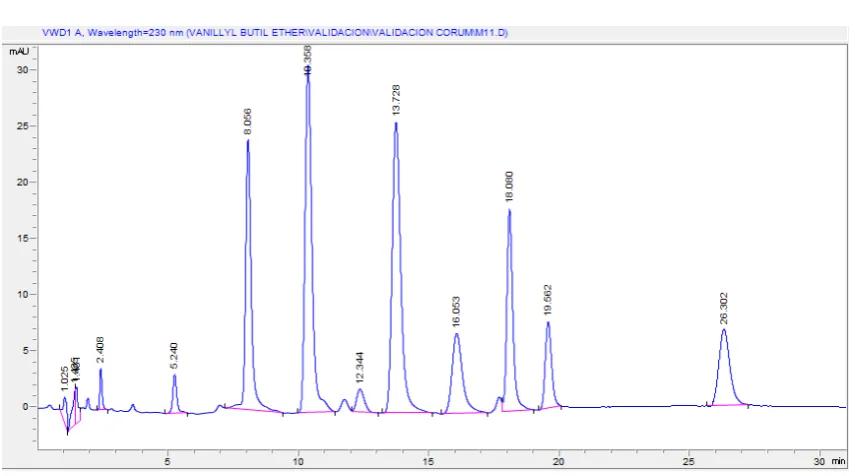
The chromatographic separation of vanillyl butyl ether from the rest of compounds in the comercial product was carried out in the isocratic mode, with a mixture of Acetonitrile/buffer (20mM Na2HPO4 in deionized water) (30:70,v/v) as mobile phase. Under the conditions described in the preceding section the retention time for vanillyl butyl ether was 13.728±0.8min.
should provide a concise and precise description of the experimental results, their interpretation as well as the experimental conclusions that can be drawn.
3.1. Method validation 3.1.1. Linearity
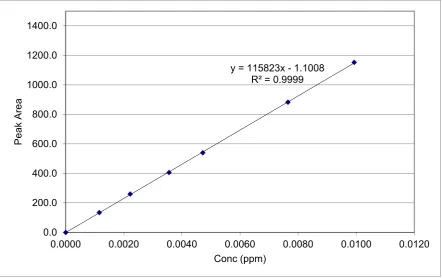
The peak area versus vanillyl butyl ether concentration was plotted to construct a standard curve (Figure 1). The polynomial regression for the calibration plots showed a good linear relationship with a coefficient of correlation of r=0.9999. The range of reliable quantification was set at 12-100 µg/mL as no significant difference was observed in the slope of the standard curve in this range. The linear regression data is indicative of a good linear relationship between the peak area and the concentration over a wide range. The correlation coefficient indicates high significance.
3.1.2 Precision
The %RSD were found to be less than 0.67 and 0.73 for intra-day and inter-day precision respectively indicating that the method is reliable and reproducible (Table 1).
Table 1. Intra and Interday precision data of the analytical method for Vanillyl butyl ether based on prepared and found concentrations (mean±%,RSD)(n=10)
Prepared concentration
(µg/mL)
Intraday
analysis Interday analysis
Found conc. (µg/mL), Mean ± SD, RSD
Found conc. (µg/mL), Mean ± SD, RSD 75 76.24±0.01, 0.67 76.76±0.01, 0.73
3.1.3 Accuracy
For determining accuracy, a sample of known concentration was injected in 10 replicates, and the Student´s t-test was used for acceptance. A tr of 1.62 was obtained, smaller than the theoretical value of 1.833 for 9 degrees of freedom and α=0.05, indicating that the method is accurate.
3.1.4 System suitability tests
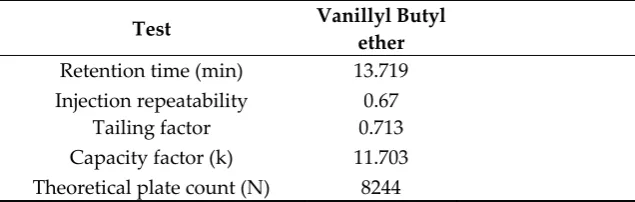
System suitability test was developed for the routine application of the assay method, ensuring the adequacy of the proposed HPLC method. The precision test and the tailing factor studies show good injection repeatability and peak symmetry, respectively. The values of capacity factor (k≥2) indicate that the peak is well resolved with respect to the void volume. The theoretical plate numbers (N≥2000) reflects good column efficiency. The proposed method met these requeriments within the accepted limits [4]
Table 2. HPLC System Suitability Tests for Vanillyl butyl ether
Test Vanillyl Butyl
ether Retention time (min) 13.719 Injection repeatability 0.67
Tailing factor 0.713
3.1.5 Analysis of Vanillyl butyl ether in marketed preparations.
The developed and validated method was applied to the determination of preservatives studied from a cosmetic product. A single sharp peak of Vanillyl butyl ether was observed at the
corresponding retention time when a suitably diluted solution of the tiger balm preparation was injected following extraction (Figure 2). No interactcion was observed between vanillyl butyl ether and the excipients and perfumes present in the formulae. The vanillyl butyl ether content
determined with RSD values of less than 1% indicates the suitability of this method for routine analysis of vanillyl butyl ether in cosmetic preparations.
Table 3. Concentration of Vanillyl butyl ether in commercial cosmetic product
Product Concentration
(%w/w)±SD %RSD
Balsamo oriental 0.7624±0.0051 0.67
3.2. Figures, Tables and Schemes
Figure 1. Calibration curve of Vanillyl butyl ether; Zorbax Eclipse Plus C-18 column. y = 115823x - 1.1008
R² = 0.9999
0.0 200.0 400.0 600.0 800.0 1000.0 1200.0 1400.0
0.0000 0.0020 0.0040 0.0060 0.0080 0.0100 0.0120
Peak Area
Figure 2. Typical chromatogram of vanillyl butyl ether in tiger balm eluted at 13.728 min.
5. Conclusions
A reversed phase HPLC assay method with UV spectrophotometric detection on a C-18 analytical column was successfully developed for the determination of vanillyl butyl ether. The described analytical procedure has been proved to be accurate, precise and suitable for determination of vanillyl butyl ether in cosmetic products. The method can be used for the routine quality control analysis of compounds in cosmetic products containing vanillyl butyl ether.
Conflicts of Interest: The authors declare no conflict of interest.
References
1. L-C Chen, S-J Wu and C Huang, Vanillyl butyl ether to topically induce blood cell flux, warming sensation, Cosm & Toil2010, 12, 34-39.
2. Q. Ashton Acton. Benzyl compounds- Advances in research and application. 2013, Scholarly Editions ISBN: 978-1-481-68561-0.
3. Handbook of Cosmetic Science and Technology, 3rd ed., Informa Healthcare publishers, New York, 2009.
4. US Pharmacopoeia (USP) 32, Chromatography, Section (621) Rockville MD: United States Pharmacopeal Convention; 2009. P.1776.