Classification Practice Test
Modified True/False
Indicate whether the statement is true or false. If false, change the identified word or phrase to make the statement true.
____ 1. An organism may have different common names that vary from area to area and language to language. _________________________
____ 2. Scientists try to organize living things into groups that have economic significance. _________________________
____ 3. In binomial nomenclature, each species is assigned a two-part scientific name. _________________________
____ 4. In the name Ursus maritimus, the word Ursus refers to the species. _________________________
____ 5. Linnaeus’s system of classification has seven taxonomic levels. _________________________
____ 6. An order is a broad taxonomic category composed of similar phyla. _________________________
____ 7. Modern biologists build classification diagrams called cladograms that reflect lines of evolutionary descent. _________________________
____ 8. Cladistic analysis considers derived characteristics that have arisen as lineages have evolved over time. _________________________
____ 9. American vultures are now classified with storks instead of with African vultures because of molecular evidence based on body structure. _________________________
____ 10. To determine degrees of realtedness among very dissimilar organisms, scientists often analyze their DNA. _________________________
____ 11. Genetic evidence can sometimes suggest alternative relationships among organisms than suggested by their physical characteristics. _________________________
____ 12. The six kingdoms of life are Eubacteria, Monera, Protista, Plantae, Fungi, and Animalia. _________________________
____ 13. The kingdom Monera has been split into the kingdoms Eubacteria and Protista. _________________________
____ 14. The kingdom Eubacteria contains the same organisms as the domain Animalia. _________________________
____ 15. One way in which Archaea differ from Bacteria in that the cell walls of Archaea lack peptidoglycan. _________________________
Completion
16. When scientists use a(an) _________________________ for an organism, they can be certain they are all discussing the same organism.
17. The animals Panthera leo (lion) and ____________________ tigris (tiger) belong to the same genus.
18. The use of a two-part scientific name for organisms is called ____________________ nomenclature.
19. In systematics, different classes of organisms might be grouped into a(an) ____________________, which is the next (larger) Linnaean category.
20. In Linnaeus’s system of classification, the two smallest categories are genus and ____________________.
21. In systematics, the class Mammalia is grouped with the classes Aves, Reptilia, Amphibia, and all classes of fishes into the ____________________ Chordata.
22. Traditional classification is based on general similarities and differences among the _________________________ of organisms.
23. In _________________________, groups of organisms were formed on the basis of physical traits rather than evolutionary relationships.
24. Cladistic analysis relies on traits called _________________________ that arise in a common ancestor and are passed on to descendants.
25. DNA analyses show that the ____________________ of many dissimilar organisms show similarities at the molecular level.
26. In cladistic analysis, similar genes that appear in dissimilar organisms, indicate that they share a common ____________________.
27. The six kingdoms of life include bacteria that have cell walls with peptidoglycan, bacteria that have cell walls without peptidoglycan, protists, fungi, animals, and ____________________.
28. Unlike the five-kingdom system of classification, the six-kingdom system breaks ____________________ into two groups.
29. The domain ____________________ contains plants, fungi, protists, and animals—which are all eukaryotes.
30. The domain ____________________ is composed of the kingdom Eubacteria.
Short Answer
31. Why might a particular kind of organism have more than one common name?
32. How do you know that the species Ursus maritimus and Ursus arctos are closely related?
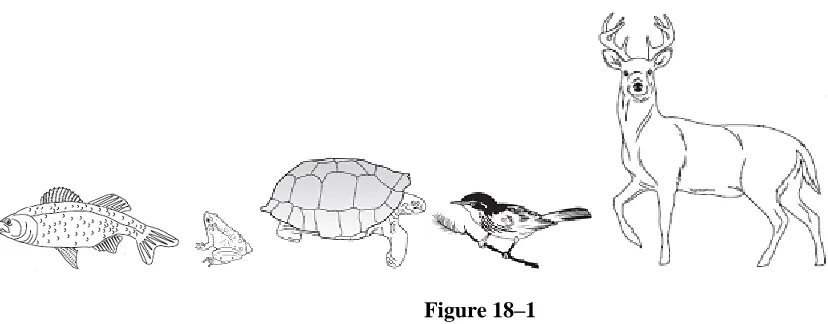
Figure 18–1
34. Look at Figure 18–1. Why are such different animals as fishes, amphibians, reptiles, birds, and mammals grouped into a single phylum?
35. If you know nothing else about an organism except its scientific name, can you immediately determine what genus and family it is in? Explain.
36. What is evolutionary classification? How does it differ from traditional biological classification?
Figure 18–2
37. Which grouping in Figure 18–2, A or B, shows the older, traditional, method of classifying the three animals shown? What kind of evidence was used to support that classification?
38. Which system of grouping in Figure 18–2, A or B, provides information about the evolution of the three animals? What is the name of the diagram used to show that information?
39. According to the cladogram in Figure 18–2, what two characteristics do crabs and barnacles share that limpets do not?
41. How does analysis of DNA help scientists establish an evolutionary classification scheme?
42. What recently developed technology allows scientists to compare the DNA of different kinds of organisms to determine classification?
43. How can DNA help scientists make the classification of similar organisms such as giant pandas and red pandas more accurate?
44. Compare and contrast kingdom Fungi and kingdom Plantae in the six kingdom system.
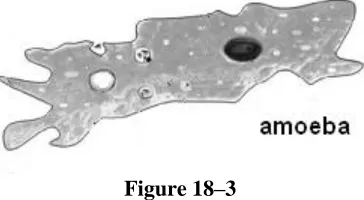
Figure 18–3
45. What characteristic is used to place an organism, such as the amoeba in Figure 18–3, in the domain Eukarya?
Essay
46. In what ways is binomial nomenclature more useful than the descriptive names used by early scientists?
47. How does traditional classification differ from evolutionary classification?
48. How does cladistic analysis determine the order in which a set of related species evolved?
49. How is DNA analysis useful for estimating the relationship between two species?
Classification Practice Test
Answer Section
MODIFIED TRUE/FALSE
1. ANS: T PTS: 1 DIF: L1
REF: p. 510 OBJ: 18.1.1 Describe the goals of binomial nomenclature and systematics. STA: UT.BIO.5.3.b TOP: Foundation Edition
BLM: knowledge 2. ANS: F
biological scientific
PTS: 1 DIF: L2 REF: p. 510
OBJ: 18.1.1 Describe the goals of binomial nomenclature and systematics. STA: UT.BIO.5.3.b TOP: Foundation Edition BLM: comprehension
3. ANS: T PTS: 1 DIF: L1
REF: p. 512 OBJ: 18.1.2 Identify the taxa in the classification system devised by Linnaeus. STA: UT.BIO.5.3.b | UT.BIO.5.3.d TOP: Foundation Edition
BLM: knowledge 4. ANS: F, genus
PTS: 1 DIF: L1 REF: p. 512
OBJ: 18.1.2 Identify the taxa in the classification system devised by Linnaeus. STA: UT.BIO.5.3.b | UT.BIO.5.3.d TOP: Foundation Edition
BLM: application
5. ANS: T PTS: 1 DIF: L1
REF: p. 513 OBJ: 18.1.2 Identify the taxa in the classification system devised by Linnaeus. STA: UT.BIO.5.3.b | UT.BIO.5.3.d TOP: Foundation Edition
BLM: comprehension 6. ANS: F, families
PTS: 1 DIF: L2 REF: p. 513
OBJ: 18.1.2 Identify the taxa in the classification system devised by Linnaeus. STA: UT.BIO.5.3.b | UT.BIO.5.3.d TOP: Foundation Edition
BLM: comprehension
7. ANS: T PTS: 1 DIF: L2
REF: p. 516 OBJ: 18.2.2 Describe how to make and interpret a cladogram. STA: UT.BIO.5.3.c TOP: Foundation Edition
BLM: comprehension
8. ANS: T PTS: 1 DIF: L3
REF: p. 518 OBJ: 18.2.2 Describe how to make and interpret a cladogram. STA: UT.BIO.5.3.c BLM: comprehension
9. ANS: F DNA
PTS: 1 DIF: L2 REF: p. 521
OBJ: 18.2.3 Explain the use of DNA sequences in classification. STA: UT.BIO.5.3.c TOP: Foundation Edition BLM: application
10. ANS: T PTS: 1 DIF: L1
REF: p. 521 OBJ: 18.2.3 Explain the use of DNA sequences in classification. STA: UT.BIO.5.3.c TOP: Foundation Edition
BLM: knowledge
11. ANS: T PTS: 1 DIF: L2
REF: p. 521 OBJ: 18.2.3 Explain the use of DNA sequences in classification. STA: UT.BIO.5.3.c BLM: application
12. ANS: F, Archaebacteria
PTS: 1 DIF: L2 REF: p. 524
OBJ: 18.3.1 Name the six kingdoms of life as they are currently identified. STA: UT.BIO.5.3.b | UT.BIO.5.3.d TOP: Foundation Edition BLM: comprehension
13. ANS: F, Archaebacteria
PTS: 1 DIF: L2 REF: p. 524
OBJ: 18.3.2 Explain what the tree of life represents. STA: UT.BIO.5.3.b | UT.BIO.5.3.c TOP: Foundation Edition BLM: comprehension
14. ANS: F, Bacteria
PTS: 1 DIF: L2 REF: p. 524
OBJ: 18.3.2 Explain what the tree of life represents. STA: UT.BIO.5.3.b | UT.BIO.5.3.c TOP: Foundation Edition BLM: comprehension
15. ANS: T PTS: 1 DIF: L3
REF: p. 524 OBJ: 18.3.2 Explain what the tree of life represents. STA: UT.BIO.5.3.b | UT.BIO.5.3.c TOP: Foundation Edition BLM: analysis
COMPLETION
16. ANS: scientific name
PTS: 1 DIF: L1 REF: p. 510
OBJ: 18.1.1 Describe the goals of binomial nomenclature and systematics. STA: UT.BIO.5.3.b TOP: Foundation Edition BLM: knowledge
17. ANS: Panthera
PTS: 1 DIF: L2 REF: p. 512
OBJ: 18.1.1 Describe the goals of binomial nomenclature and systematics. STA: UT.BIO.5.3.b TOP: Foundation Edition BLM: application
18. ANS: binomial
OBJ: 18.1.2 Identify the taxa in the classification system devised by Linnaeus. STA: UT.BIO.5.3.b | UT.BIO.5.3.d TOP: Foundation Edition
BLM: knowledge 19. ANS: phylum
PTS: 1 DIF: L2 REF: p. 512
OBJ: 18.1.2 Identify the taxa in the classification system devised by Linnaeus. STA: UT.BIO.5.3.b | UT.BIO.5.3.d TOP: Foundation Edition
BLM: application 20. ANS: species
PTS: 1 DIF: L1 REF: p. 512
OBJ: 18.1.2 Identify the taxa in the classification system devised by Linnaeus. STA: UT.BIO.5.3.b | UT.BIO.5.3.d TOP: Foundation Edition
BLM: knowledge 21. ANS: phylum
PTS: 1 DIF: L3 REF: p. 514
OBJ: 18.1.2 Identify the taxa in the classification system devised by Linnaeus. STA: UT.BIO.5.3.b | UT.BIO.5.3.d BLM: application
22. ANS:
body structures appearances
PTS: 1 DIF: L2 REF: p. 516
OBJ: 18.2.1 Explain the difference between evolutionary classification and Linnaean classification STA: UT.BIO.5.3.a | UT.BIO.5.3.c | UT.BIO.5.3.d TOP: Foundation Edition BLM: knowledge
23. ANS:
traditional classification Linnaean classification
PTS: 1 DIF: L2 REF: p. 512
OBJ: 18.2.1 Explain the difference between evolutionary classification and Linnaean classification STA: UT.BIO.5.3.a | UT.BIO.5.3.c | UT.BIO.5.3.d TOP: Foundation Edition BLM: comprehension
24. ANS:
derived characters derived traits
PTS: 1 DIF: L2 REF: p. 518
OBJ: 18.2.2 Describe how to make and interpret a cladogram. STA: UT.BIO.5.3.c BLM: comprehension
25. ANS: genes DNA
PTS: 1 DIF: L2 REF: p. 521
26. ANS: ancestor
PTS: 1 DIF: L3 REF: p. 521
OBJ: 18.2.3 Explain the use of DNA sequences in classification. STA: UT.BIO.5.3.c BLM: comprehension 27. ANS: plants
PTS: 1 DIF: L1 REF: p. 524
OBJ: 18.3.1 Name the six kingdoms of life as they are currently identified. STA: UT.BIO.5.3.b | UT.BIO.5.3.d TOP: Foundation Edition BLM: knowledge
28. ANS: bacteria, monera, or prokaryotes are all acceptable answers
PTS: 1 DIF: L2 REF: p. 524
OBJ: 18.3.1 Name the six kingdoms of life as they are currently identified. STA: UT.BIO.5.3.b | UT.BIO.5.3.d TOP: Foundation Edition BLM: analysis
29. ANS: Eukarya
PTS: 1 DIF: L1 REF: p. 524
OBJ: 18.3.2 Explain what the tree of life represents. STA: UT.BIO.5.3.b | UT.BIO.5.3.c TOP: Foundation Edition BLM: knowledge
30. ANS: Bacteria
PTS: 1 DIF: L1 REF: p. 524
OBJ: 18.3.2 Explain what the tree of life represents. STA: UT.BIO.5.3.b | UT.BIO.5.3.c TOP: Foundation Edition BLM: knowledge
SHORT ANSWER
31. ANS:
The name of an organism is often different in different locations and different languages.
PTS: 1 DIF: L2 REF: p. 510
OBJ: 18.1.1 Describe the goals of binomial nomenclature and systematics. STA: UT.BIO.5.3.b TOP: Foundation Edition BLM: comprehension
32. ANS:
Their scientific names show that they both belong to the same genus.
PTS: 1 DIF: L2 REF: p. 512
OBJ: 18.1.2 Identify the taxa in the classification system devised by Linnaeus. STA: UT.BIO.5.3.b | UT.BIO.5.3.d TOP: Foundation Edition
BLM: application 33. ANS:
A scientific name is composed of two terms that are written in italics, with the first term capitalized.
PTS: 1 DIF: L2 REF: p. 512
BLM: application 34. ANS:
Despite their differences, these groups share some common body-plan features, including a nerve cord along the back, indicating a shared evolutionary history.
PTS: 1 DIF: L3 REF: p. 513 | p. 514
OBJ: 18.1.2 Identify the taxa in the classification system devised by Linnaeus. STA: UT.BIO.5.3.b | UT.BIO.5.3.d TOP: Foundation Edition
BLM: synthesis 35. ANS:
The scientific name provides the organism’s genus in the first of the two words that make up the name, but it does not give information about the organism’s family.
PTS: 1 DIF: L3 REF: p. 512 | p. 513
OBJ: 18.1.2 Identify the taxa in the classification system devised by Linnaeus. STA: UT.BIO.5.3.b | UT.BIO.5.3.d TOP: Foundation Edition
BLM: synthesis 36. ANS:
Evolutionary classification is grouping organisms by lines of evolutionary descent instead of focusing mainly on similarities of body structure, as in traditional classification.
PTS: 1 DIF: L2 REF: p. 516
OBJ: 18.2.1 Explain the difference between evolutionary classification and Linnaean classification STA: UT.BIO.5.3.a | UT.BIO.5.3.c | UT.BIO.5.3.d TOP: Foundation Edition BLM: analysis
37. ANS:
A; comparisons of body structure similarities
PTS: 1 DIF: L3 REF: p. 519
OBJ: 18.2.2 Describe how to make and interpret a cladogram. STA: UT.BIO.5.3.c BLM: evaluation
38. ANS: B; a cladogram
PTS: 1 DIF: L2 REF: p. 519
OBJ: 18.2.2 Describe how to make and interpret a cladogram. STA: UT.BIO.5.3.c TOP: Foundation Edition BLM: analysis
39. ANS:
segmentation and a molted external skeleton
PTS: 1 DIF: L2 REF: p. 519
OBJ: 18.2.2 Describe how to make and interpret a cladogram. STA: UT.BIO.5.3.c TOP: Foundation Edition BLM: application
40. ANS:
Diagram B indicates that the traditional taxonomic grouping shown in diagram A classified less closely related groups together based on overall similarities and differences.
PTS: 1 DIF: L3 REF: p. 519 | p. 520
41. ANS:
DNA comparisons can indicate a common ancestry among different organisms and can also indicate how long they have been evolving separately.
PTS: 1 DIF: L3 REF: p. 521
OBJ: 18.2.3 Explain the use of DNA sequences in classification. STA: UT.BIO.5.3.c TOP: Foundation Edition BLM: synthesis
42. ANS:
the ability to sequence or “read” and compare the information coded in the DNA of different organisms
PTS: 1 DIF: L3 REF: p. 521
OBJ: 18.2.3 Explain the use of DNA sequences in classification.
STA: UT.BIO.5.3.c BLM: synthesis
43. ANS:
DNA analysis can supply further evidence of relatedness. In general, the more derived genetic characters two organisms share, the more closely related they are.
PTS: 1 DIF: L3 REF: p. 498 | p. 522 OBJ: 18.2.3 Explain the use of DNA sequences in classification. STA: UT.BIO.5.3.c TOP: Foundation Edition BLM: synthesis
44. ANS:
Both fungi and plants are eukaryotes, meaning that their cells have nuclei. Most fungi and plants are multicellular. All fungi are heterotrophs; all plants are autotrophs. Fungi have cell walls made of chitin; plants have cell walls made of cellulose.
PTS: 1 DIF: L2 REF: p. 524
OBJ: 18.3.1 Name the six kingdoms of life as they are currently identified. STA: UT.BIO.5.3.b | UT.BIO.5.3.d TOP: Foundation Edition BLM: application
45. ANS:
the presence of a nucleus in its cell(s)
PTS: 1 DIF: L1 REF: p. 526
OBJ: 18.3.2 Explain what the tree of life represents. STA: UT.BIO.5.3.b | UT.BIO.5.3.c TOP: Foundation Edition BLM: comprehension
ESSAY
46. ANS:
Earlier descriptive scientific names were very long, and they were not standardized among all scientists. Binomial names are brief and standardized. Further, each name refers to a single organism.
PTS: 1 DIF: L3 REF: p. 510 | p. 512
OBJ: 18.1.2 Identify the taxa in the classification system devised by Linnaeus. STA: UT.BIO.5.3.b | UT.BIO.5.3.d TOP: Foundation Edition
Traditional classification places organisms into categories based mainly upon similarities and differences of body structure. Evolutionary classification, on the other hand, places organisms into categories that represent lines of evolutionary descent rather than just physical similarities.
PTS: 1 DIF: L2 REF: p. 514 | p. 516
OBJ: 18.2.1 Explain the difference between evolutionary classification and Linnaean classification STA: UT.BIO.5.3.a | UT.BIO.5.3.c | UT.BIO.5.3.d TOP: Foundation Edition BLM: analysis
48. ANS:
Cladistic analysis considers derived characters, which are traits passed to the descendants of a common ancestor. If a specific derived character is present in one species but absent in another species, biologists infer that the species possessing the character evolved second.
PTS: 1 DIF: L3 REF: p. 518
OBJ: 18.2.2 Describe how to make and interpret a cladogram. STA: UT.BIO.5.3.c BLM: synthesis
49. ANS:
A comparison of DNA sequences in two species can indicate their evolutionary relationship and make their evolutionary tree more accurate. DNA analysis examines the base sequences in genes. The DNA sequences of genes in two closely related species will be more similar than in two species that are not closely related. For example, the two kinds of camels will have DNA that is more similar than a camel and a stork.
PTS: 1 DIF: L2 REF: p. 521
OBJ: 18.2.3 Explain the use of DNA sequences in classification. STA: UT.BIO.5.3.c TOP: Foundation Edition BLM: application
50. ANS:
As biologists learned more about the natural world, they realized that Linnaeus’s two kingdoms, Animalia and Plantae, did not adequately represent the full diversity of life. As a result, the original two kingdoms have today become six kingdoms, with two of those groups used just for classifying bacteria—unknown in
Linnaeus’s time!
PTS: 1 DIF: L3 REF: p. 523