PERFORMANCE EVALUATION OF
HYBRID NETWORK USING EIGRP &
OSPF FOR DIFFERENT APPLICATIONS
INDERJEET KAUR1 Deptt. Of Computer Engineering, Pt. J.R Govt. Polytechnic College
Hoshiarpur, Punjab
MANJU SHARMA2 Deptt. Of Information Technology, DAV Institute of Engg. & Technology
Jalandhar, Punjab
Abstract:
Researchers have proposed a number of routing protocols in literature. Each one is based on different characteristics and properties. In this paper, we evaluate the performance of hybrid network using EIGRP, OSPF & BGP routing protocols for different applications in low load campus network. We perform simulations using OPNET IT GURU Academic Edition simulator. In the performance evaluation of the protocol, the protocols are tested under the realistic conditions. Tests are performed against various types of applications (Email, FTP, Remote Login, http & Print Server) in Hybrid Networks. This OPNET simulation shows the impact of IP routing protocol for hybrid networks for different types of applications.
KEYWORDS: Hybrid; Email response time; Traffic Sent Traffic Received; EIGRP; OSPF; BGP; Delay; Throughput.
1. INTRODUCTION
Forwarding of The Internet Protocol (IP) packets is the primary purpose of Internet routers [1]. The speed at which forwarding decisions are made at each router or “hop” places is a fundamental limit on the performance of the network. For Internet Protocol Version 4 (IPv4), the forwarding decision is based on a 32-bit destination address carried out in each packet’s header. The use of Classless Inter Domain Routing (CIDR) complicates the lookup process, requiring a lookup engine to search a route table containing variable-length address prefixes in order to find the longest matching prefix for the destination address in each packet header and retrieve the corresponding forwarding information. In high-performance routers, each port employs a separate LPM search engine. Routing protocols employ one of two basic strategies to communicate/ propagate routing information:
• Distance vector routing protocols work by passing copies of their routing tables to their neighbors.
• Link State routing protocols work by advertising a list of neighbors and the network attachment state to their neighbors until all routers have a copy of all the lists, routers then run the Shortest Path First Algorithm to analyze all paths and determine the best paths available [2].
Distance vector routing are less processor and memory intensive than link state routing, but can have loops because routing decisions are made on incomplete information. Link state routing is loop-proof because routers know all possible routes, but link state routing requires more CPU time and memory. Link-state and distance vector routing is that link-state uses algorithms derived from the Dijkstra’s shortest path algorithm, where distance vector uses distributed Bellman-Ford[3].
state refers to the idea of that OSPF advertise information about each route instead of sending periodic routing table updates like a distance vector protocol. OSPF is also known as hierarchical routing protocol because of its ability to divide the large areas into small multiple areas. This includes the concept of area routers and edge routers. Area routers routes within the area while edge routers provide the facility for routing between the multiple areas. Each area is associated with an area number (also known as autonomous number system). The backbone area is always having area number 0. The areas are also divided into the backbone area, stub area, totally stub area and not-so-stubby area based upon the organization requirements. Extending OSPF to work will allow new heterogeneous networks to exist, encompassing both wired parts and multi-hop wireless parts in the same routing domain [8]. OSPF uses the SPF (Shortest Path First) algorithm to calculate the cost. SPF works in tree structure to calculate the cost from root. Root is the router from which cost is calculated to other routers. This algorithm is known as the DijKstra’s algorithm [9]. OSPF is an intra-domain routing protocol that uses link weights to make routing decisions and compute the shortest paths [10].
II. OUR APPROACH
Among the various simulators available, Optimized Network Engineering Tools (OPNET) IT Guru Academic Edition is a simulator which is comprehensive and technology neutral in its capabilities. OPNET IT Guru [11] enables the network designers to create a virtual network consisting of relevant hardware, protocols, and application software. This virtual network is a pure software entity that can run on an individual workstation. The network devices like routers, switches etc. can be modeled in IT Guru virtual network. This network can be scaled from a small LAN to wide area network. Once a virtual network has been created it can be manipulated according to the need of the application. The network devices can be changed, removed or inserted into the virtual network as desired to find out the most appropriate configuration and also implement the given application. The effects of various manipulations can be quantifiably examined and analyzed. OPNET simulator is built on top of discrete event system (DES) and it simulates the system behavior by modeling each event in the system and processing it through user defined processes. OPNET is very powerful software to simulate heterogeneous network with various protocols. It has several distinct methods of creating topologies. Modeler supports almost all network types and technologies. OPNET runs on top of a C compiler and provides a GUI. OPNET Modeler is based on a series of hierarchical editors that directly parallel the structure of real networks, equipment, and protocols. These editors are Project editor, node editor and process editors. OPNET IT GURU provides the set of complete tools and a complete user interface for topology design and development [12].
III. SCENARIOS AND SETTINGS
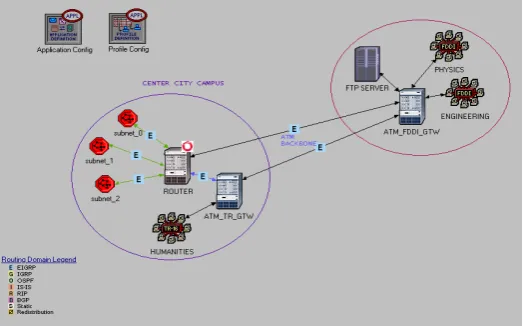
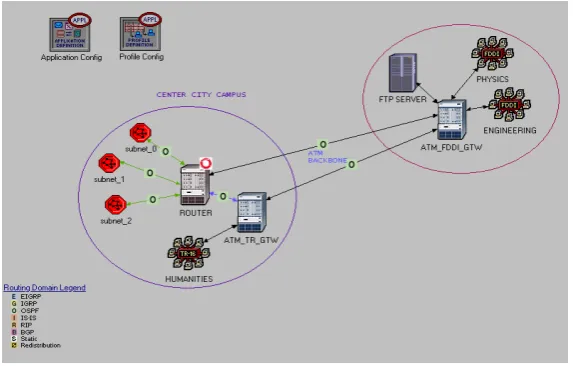
In this section, we will firstly consider the case of connecting multiple LANs and WLANs through a Router by applying EIGRP and OSPF routing protocols to check the performance of Email Download Response Time, Print File Size, CPU utilization, FTP Server Task Processing Time, WLAN Throughput, WLAN Delay, WLAN Load, and WLAN Media Access Delay. EIGRP and OSPF routing protocols are used for both the scenarios. Here, it has been considered that Hybrid Network with EIGRP and OSPF is the combination of wired and wireless network connected with FTP Server, ATM and Router. Two different scenarios & settings have been considered to optimize the network.
Scenario I: Hybrid Network with EIGRP routing protocol Scenario II: Hybrid Network with OSPF routing protocol
Figure 2: SCENARIO I I
Figure 3: Site 1LAN
Figure 5: Site 3 FDDI LAN with Switched Technology
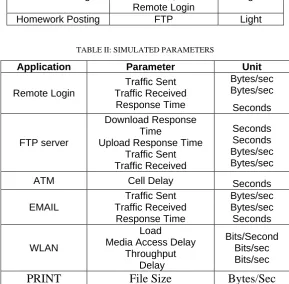
TABLE I: APPLICATION DESCRIPTION
Applications Attribute Load
Web Browsing
FTP server, ATM, Remote Login
Light Homework Posting FTP Light
TABLE II: SIMULATED PARAMETERS
Application Parameter Unit
Remote Login
Traffic Sent Traffic Received Response Time
Bytes/sec Bytes/sec Seconds
FTP server
Download Response Time
Upload Response Time Traffic Sent Traffic Received
Seconds Seconds Bytes/sec Bytes/sec ATM Cell Delay Seconds EMAIL
Traffic Sent Traffic Received Response Time
Bytes/sec Bytes/sec Seconds WLAN
Load
Media Access Delay Throughput
Delay
Bits/Second Bits/sec Bits/sec
PRINT File
Size
Bytes/Sec
IV. SIMULATION EVALUATION & RESULT ANALYSIS
but after some time it varies up to 29.35m. Thus, it is evident tht the use of OSPF routing protocol in hybrid networks is recommended for up linking processes. the two scenarios for following parameters:
• Average FTP download and upload response time (sec)
• ATM global cell delay(sec)
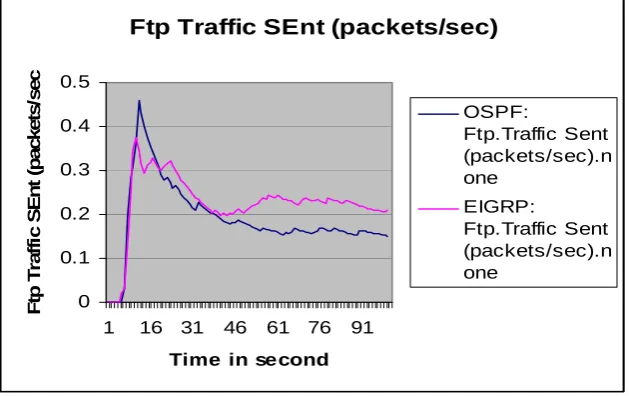
• Average FTP Traffic sent(Bytes/Sec) and received(Bytes/Sec)
Figure 6: Average FTP downloads response time (sec)
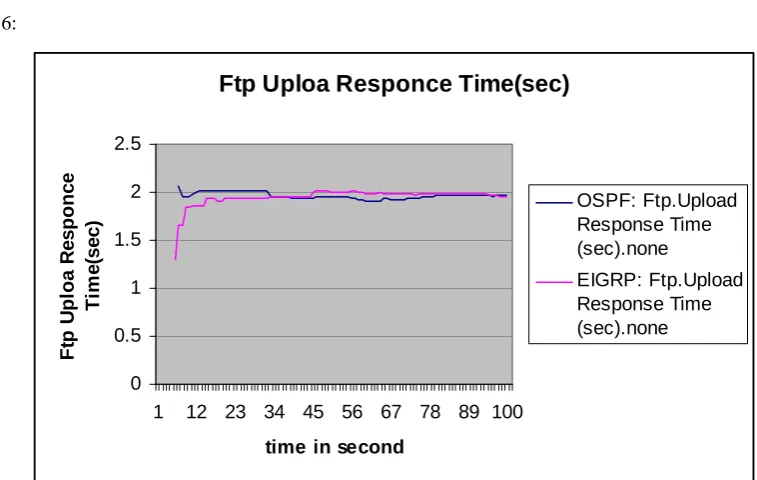
Figure 6:
Ftp Uploa Responce Time(sec)
0 0.5 1 1.5 2 2.5
1 12 23 34 45 56 67 78 89 100
time in second
Ft
p U
pl
oa
R
e
s
ponc
e
Ti
m
e
(s
e
c
)
OSPF: Ftp.Upload Response Time (sec).none
EIGRP: Ftp.Upload Response Time (sec).none
Figure 7: Average FTP uploads response time (sec)
average(in Ftp.Download Responce Time(sec))
0 0.2 0.4 0.6 0.8
1 1.2 1.4 1.6 1.8 2
1 8 15 22 29 36 43 50 57 64 71 78 85 92 99
OSPF: Ftp.Download Response Time (sec).none
EIGRP: Ftp.Download Response Time (sec).none
Ftp Traffic SEnt (packets/sec)
0 0.1 0.2 0.3 0.4 0.5
1 16 31 46 61 76 91
Time in second
F
tp
T
raf
fi
c S
E
n
t (
p
acket
s/
sec
OSPF:
Ftp.Traffic Sent (packets/sec).n one
EIGRP:
Ftp.Traffic Sent (packets/sec).n one
Figure 8: Average FTP Traffic sent (packet/sec)
Figure 8: Average FTP Traffic received (packet/sec)
It has been noticed that in both the cases the difference of ATM Cell delay is less in scenario where OSPF protocol IS used. In Figure 6.15, ATM cell delay with EIGRP varies from 0.0ms to 29.33ms and with OSPF it varies from 0.0ms to 29.25ms.The cell delay slightly increased & decreased in both scenarios as shown in Figure 6.15. Therefore it is concluded that the results are better with OSPF routing protocol. Further in Figure 6.15 it has been pointed out that there is significant improvement in the ATM Cell delay with OSPF.
average(in Ftp.Traffic received(packets/se))
0 0.02 0.04 0.06 0.08 0.1 0.12 0.14 0.16 0.18 0.2
1 8 15 22 29 36 43 50 57 64 71 78 85 92 99
OSPF: Ftp.Traffic Received (packets/sec). none
EIGRP: Ftp.Traffic Received (packets/sec).
average (in ATM.Cell Delay(sec))
0 0.00001 0.00002 0.00003 0.00004 0.00005 0.00006 0.00007 0.00008 0.00009
1 9 17 25 33 41 49 57 65 73 81 89 97
OSPF: ATM.Cell Delay (sec).none
EIGRP: ATM.Cell Delay (sec).none
Figure 10: Average ATM cell Delay(sec)
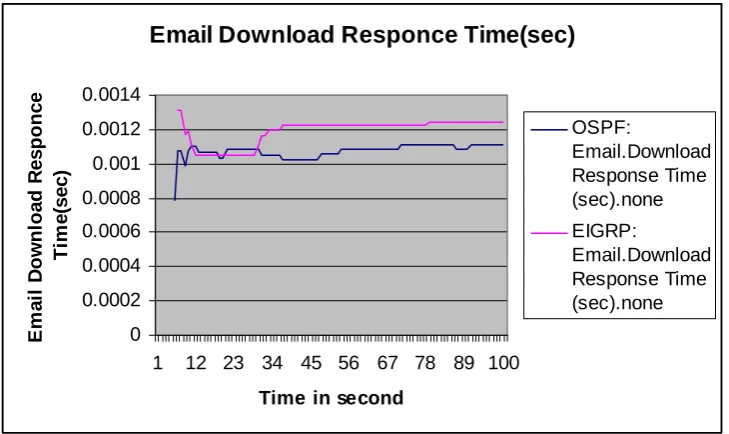
It has been investigated that the average Email Download Response Time with EIGRP is recorded from 1.47ms to 29.39ms. From starting point it started decreasing up to value 3.9ms in network with EIGRP routing protocol & then remains constant up to value 8.22ms in EIGRP network & then it start increasing up to 10.56m and then remains constant. In the Network with OSPF, the Email Download Response Time is recorded between 1.27ms & 29.34ms respectively & from starting points its increases up to 1.57ms in network & then varies time to time and starts increasing again. The two scenarios for following parameters:
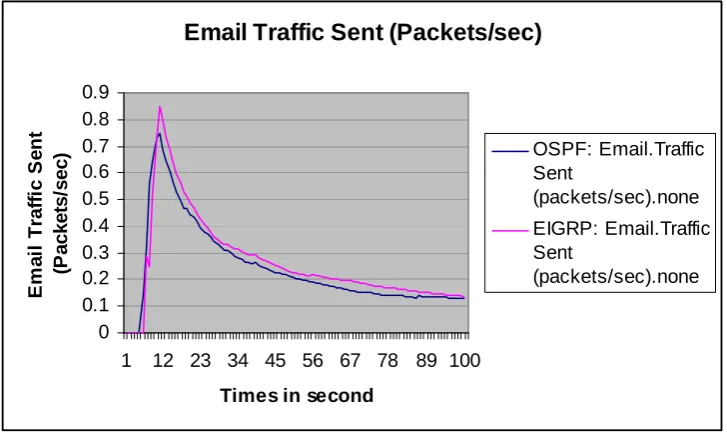
• Average email Traffic sent(Bytes/Sec) and received(Bytes/Sec)
• Average FTP download response time (sec)
Email Download Responce Time(sec)
0 0.0002 0.0004 0.0006 0.0008 0.001 0.0012 0.0014
1 12 23 34 45 56 67 78 89 100
Time in second
E
m
a
il
D
ow
nl
oa
d R
e
s
ponc
e
Ti
m
e
(s
e
c
)
OSPF:
Email.Download Response Time (sec).none EIGRP:
Email.Download Response Time (sec).none
Email Traffic Sent (Packets/sec)
0 0.1 0.2 0.3 0.4 0.5 0.6 0.7 0.8 0.9
1 12 23 34 45 56 67 78 89 100
Times in second
Em
a
il T
ra
ff
ic
Se
n
t
(P
ac
kets
/se
c) OSPF: Email.Traffic
Sent
(packets/sec).none EIGRP: Email.Traffic Sent
(packets/sec).none
Figure 12: Average Email Traffic sent (packet/sec)
Emal Traffic Received (Packets/sec)
0 0.1 0.2 0.3 0.4 0.5 0.6 0.7 0.8 0.9
1 12 23 34 45 56 67 78 89 100
times in seconds
E
m
al
T
raf
fi
c R
ec
ei
v
ed
(P
ac
kets
/se
c) OSPF: Email.TrafficReceived
(packets/sec).none
EIGRP: Email.Traffic Received
(packets/sec).none
Figure 13: Average Email Traffic Received (packet/sec)
average(in client print.file size(bytes))
0 500 1000 1500 2000 2500 3000 3500 4000
1 13 25 37 49 61 73 85 97
Time in seconds
file
s
iz
e
in
b
y
te
s
OSPF: Campus network.ENGINEERIN G.Client Print.File Size (bytes) <Campus Profile / File Print
EIGRP: Campus network.ENGINEERIN G.Client Print.File Size (bytes) <Campus Profile / File Print
Figure 14: Average Print File Size(Bytes)
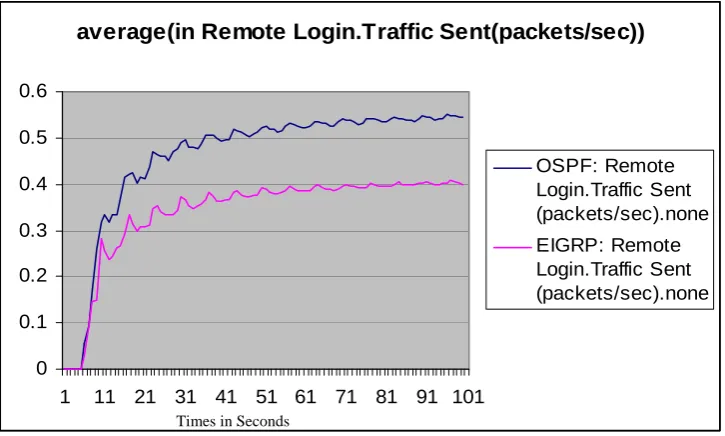
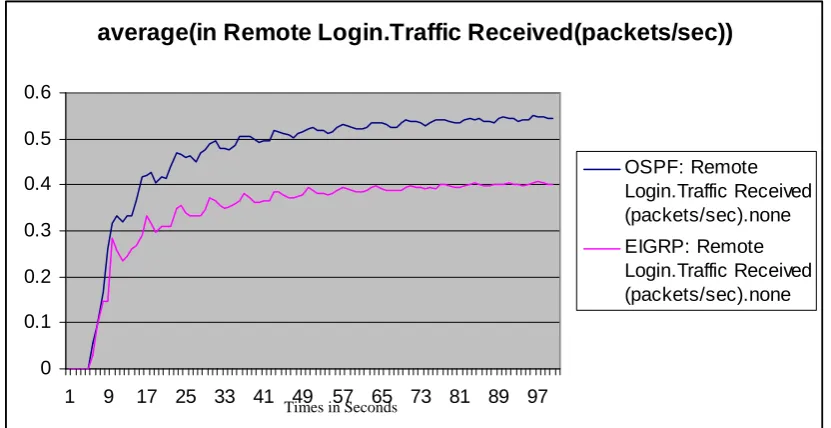
A similar situation is noticed by the traffic received by the Remote Login Response Time. It can be deduced that there is a considerable difference between the Remote Login Response Time in both networks. The Remote Login Response Time with EIGRP routing protocol network is found to be 1.27m initially and then it varies from time to time and gradually decreased up to 29.29m. With OSPF routing protocol response time varies from 1.32ms to 29.29ms. From starting point it increased up to 1.52m but after this it started decreasing up to 6.40ms value and gradually decreased up to 29.29ms (Figure 6.12). In case of Remote Login Request Response Time, the performance is better with OSPF routing protocols.
average(in Remote Login.Traffic Sent(packets/sec))
0 0.1 0.2 0.3 0.4 0.5 0.6
1 11 21 31 41 51 61 71 81 91 101
OSPF: Remote Login.Traffic Sent (packets/sec).none
EIGRP: Remote Login.Traffic Sent (packets/sec).none
average(in Remote Login.Traffic Received(packets/sec))
0 0.1 0.2 0.3 0.4 0.5 0.6
1 9 17 25 33 41 49 57 65 73 81 89 97
OSPF: Remote Login.Traffic Received (packets/sec).none
EIGRP: Remote Login.Traffic Received (packets/sec).none
Figure 16: Average Remote Login Traffic Received (packets/sec)
average(in Remote Login.Responce Time(sec))
0 0.00005 0.0001 0.00015 0.0002 0.00025 0.0003 0.00035
1 12 23 34 45 56 67 78 89 100
OSPF: Remote Login.Response Time (sec).none
EIGRP: Remote Login.Response Time (sec).none
Figure 17: Average Remote Login Response Time
The overall throughput of WLAN with OSPF routing protocol network is better than the network using only EIGRP routing protocol and is of the order of 608.44 bits/sec with EIGRP networks & 1466.05 bits/sec with OSPF networks. Therefore it is concluded that the results are better with OSPF routing protocol in comparison with EIGRP.
wireless LAN.Throughput
0 500 1000 1500 2000
1 12 23 34 45 56 67 78 89 100
Time in seconds
w
ir
e
le
s
s
LA
N
.Th
rough
put
i
n
bi
ts
/s
e
c
OSPF: Wireless LAN.Throughput (bits/sec).none
EIGRP: Wireless LAN.Throughput (bits/sec).none
V. CONCLUSION
This paper investigates campus environment Hybrid Network. In this paper we check the performance investigation for Hybrid Network using OSPF & EIGRP routing Protocols with different applications like Email, Client Print, WLAN throughput and many more. We have Chosen two protocols OSPF & EIGRP for both scenarios & browsing behavior for Email application, and used this model in a simulation study addressing the performance of the Hybrid network. Based on OPNET, we have focused on the Email & WLAN statistics in the Hybrid Network, and the impacts of factors such as Email Download Response Time, WLAN Throughput, and Remote login Response time have been seen. Our investigations reveal that Network having OSPF routing protocols is useful to improve the Email download Response time. Thus, it is evident that the use of OSPF is recommended for downloading processes. The results reveal that in case of Remote Login response time, performance is better with OSPF routing protocol. The observed results indicate that Email download response time with EIGRP is recorded from 1.47ms to 29.39ms with OSPF is recorded between 1.27ms & 29.34ms. The results reveal that in case of Remote Login response time, performance is better OSPF routing protocol. It has also been noticed that there is marginal decrease in overall throughput of WLAN with EIGRP and is of the order of 956.12 bits/sec with RIP networks & 1738.12 bits/sec with OSPF From above investigation we conclude that the overall performance is better with OSPF routing protocol networks.
References:
[1] [1] Hamidreza Mahini; Reza Berangi; Alireza Mahini ‘MLET: A Power Efficient Approach for TCAM Based, IP Lookup Engines in Internet Routers’, Journal: International journal of Computer Networks & Communications Year: 2010 Vol: 2
[2] [2] V.Sunilkumar; CH.V.M.K.Hari; G.Tarakaramarao; M.Jagadeesh ‘LSP Networks - A Mechanism for Loop free and Loss less Convergence and Implementation’, Journal: International Journal of Engineering Science and Technology Year: 2010 Vol: 2 Issue: 6 Pages/ record No.: 1532-1537
[3] [3] R.Kiruthika, ; Dr. R. Umarani ‘An Exploration Of Count-To-Infinity Problem In Networks’ Journal: International Journal of Engineering Science and Technology Year: 2010 Vol: 2 Issue: 12 Pages/record No.: 7155-7159
[4] [4] Valentina Trujillo ; Jesus Exposito ; Eric Gamess ‘An Alternative Way of Teaching the Advanced Concepts of the Diffusing Update Algorithm for EIGRP’ Journal: Lecture Notes in Engineering and Computer Science Year: 2010 Vol: 2186 Issue: 1 Pages/record No.: 107-112
[5] [5] R. Albrightson, J.J. Garcia-Luna-Aceves and J. Boyle, "EIGRP-A Fast Routing Protocol Based on Distance Vectors", Proc.
Networld/Interop 94, Las Vegas, Nevada, May 1994
[6] [6] Xianhui Che ; Lee J. Cobley ‘VoIP Performance over Different Interior Gateway Protocols’ Journal: International Journal of Communication Networks and Information Security Year: 2009 Vol: 1 Issue: 1
[7] [7] Er. Monika Gupta; Virpal Kaur ‘OPEN SHORTEST PATH FIRST SIMULATOR BY USING JAVA RMI’ Journal: International Journal of Engineering Science and Technology Year: 2010 Vol: 2 Issue: 6 Pages/record No.: 2155-2163
[8] [8]Emmanuel Baccelli ; Juan Antonio Cordero ; Philippe Jacquet ‘OSPF Over Multi-Hop AD HoC Wireless Communications’ Journal: International Journal of Computer Networks & Communications Year: 2010 Vol: 2 Issue: 5 Pages/record No.: 37-56
[9] [9] Er. Monika Gupta, ; Virpal Kaur ‘OPEN SHORTEST PATH FIRST SIMULATOR BY USING JAVA RMI’ Journal: International Journal of Engineering Science and Technology Year: 2010 Vol: 2 Issue: 6 Pages/record No.: 2155-2163