The Criteria Require for Cluster Head
Gateway Selection in Integrated Mobile
Ad hoc Network
Ashish Bagwari
(Researcher, IEEE Member)
Electronics and Communication, Graphic Era University Dehradun, 248001, India
Raman Jee
(M.Tech)
Electronics and Communication, Graphic Era University Dehradun, 248001, India
Abstract:
Mobile Ad Hoc Network (MANET) consists of dynamic topology as nodes in the network are mobile, and connected via wireless links. Nodes within the cluster communicate directly. However, nodes communicate outside the cluster through a centralized node that is called a Cluster Head Gateway (CHG) [1] [2]. As one of the most dominant factors in clustered Mobile wireless sensor networks, the selection of Cluster Head Gateway (CHG) can impact the network performance. The selection shall be subject to at least three factors. (i) The Transmission power of CHGs which should be more in order to cover large area and reduce the packet drops. (ii) The Mobility of CHGs should be low i.e. it has to stay in the existing network for longer time period to control and monitor other MANET nodes. AND (iii) The CHGs should provide better QoS to/than other MANET nodes within network. Now here the QoS deals with several parameters like Throughput, End-End Delay, Traffic Received, Traffic Sent and Storage Capacity (Queue/ Memory size) of CHGs. In this paper, we draw attention to propose Cluster Head Gateway Selection criteria approach. Firstly, we optimize the dynamic number of MANET nodes. Then we obtain the suitable CHGs out of the given MANET nodes via the improved selection procedures based on three selection phases mentioned above. Finally, this paper conducts simulation demonstrates the enhanced network performance.
Keywords: Cluster Head Gateway, Throughput, MANET, Node Mobility, End-End Delay.
1. Introduction
A wireless ad hoc network consists of mobile nodes that move freely and communicate with each other using wireless links. Mobile wireless Sensor Networks are widely recognized as one of the most promising technologies in both academia and industry. An Adhoc network is a dynamic multi-hop wireless network established by a group of mobile nodes on a shared wireless channel without any infrastructure. Efficient clustering and routing in Adhoc networks has been a topic of research in the past few years [3], [4], [5], [6]. The literature that deals with Adhoc routing identifies two types of networks viz. hierarchical routed networks and flat routed networks. While the former creates a hierarchy among the nodes, the latter treats all nodes equally. Most hierarchical clustering architectures for mobile radio networks are based on the concept of Cluster Head Gateway (CHG) [I], [4], [5], [7]. In most of the proposed methods in hierarchical networks, some thought has been given for the selection of the CH while none of the thought has been given for the selection of the CHG. In order to design a stable network, we need to look after features that the clusters should satisfy. In [4], CHG is selected based on a node transmission power, node mobility and QoS. Therefore, we intend to address the above mentioned issues and propose to design a novel location-aware clustering strategy. The cluster formation scheme should form clusters based on the spatiotemporal stability of the mobile nodes forming the Adhoc network. The node elected as the CHG should be such that it should satisfy the following constraints:
• Large Storage Capacity i.e. (maximum Queue/ Memory Size).
In view of above constraints, our clustering strategy determines an optimal CHG in a cluster. Using this above mentioned criteria, the nodes in a cluster interact with each other and will select an appropriate CHG.
The rest of the paper is organized as follows: Section II presents the related work. Section III describes our proposed working model. Section IV presents the simulation experiment setup and gives the performance evaluation of our proposed strategy. Section V concludes the paper.
2. Related Work
The existing approaches for selection of Cluster Head in mobile the selection of cluster-head (CH) can impact the network performance. The selection shall be subject to at least two factors. (i) The number of CHs may vary in different periods of the WSN lifetime. And (ii) this number can determine on the performance, in terms of energy consumption and WSN lifetime, etc. Here CHs dominate in the clustered WSNs and determine the network performance. And emphasized on a random distributed network based on the independent homogeneous Poisson process. It proposes an improved CH selection protocol (ICS) [8], by optimizing the number of CHs and scheduling the three-phased based selection procedure. The threshold of Common Energy Consumption Cycle evaluates the lifetime of the network in each Round; furthermore it is used to synchronize the WSN. By the suitable CHs, the performance of the network is enhanced. Simulation results demonstrate that the ICS approach not only prolongs the lifetime but also improve the energy efficiency.
3. Proposed Working Model
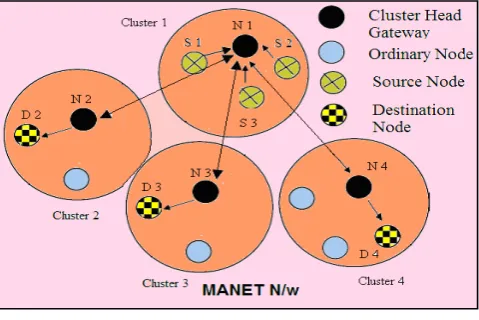
As we know in mobile ad hoc network each and every nodes are free to communicate and move any where. MANET network is combination of multiple Clusters and each cluster has one Cluster Head Gateway (CHG) along with MANET nodes. The CHG is combination of Cluster Head and Gateway, in which all the responsibilities of cluster head and gateway will be perform by the CHG i.e. monitor and control all the MANET nodes present in same cluster. In figure 1, it shows the common MANET network architecture having CHG and MANET nodes. Here we have four clusters; all are having CHG through which MANET nodes are communicating to other MANET nodes existing in different clusters. Previously, we have discussed about the role of CHG in mobile ad hoc network. But the main topic is the selection procedure/criteria of CHG i.e. which node will be acted as a CHG among the existing MANET nodes. We define a wireless network to consist of a set of computers or sensors connected by wireless network links. We consider a wireless network with MANET nodes placed according to a network model, such as random geometric graph [9] and a network growth model [10].
Figure 1. Showing the common MANET Network Architecture
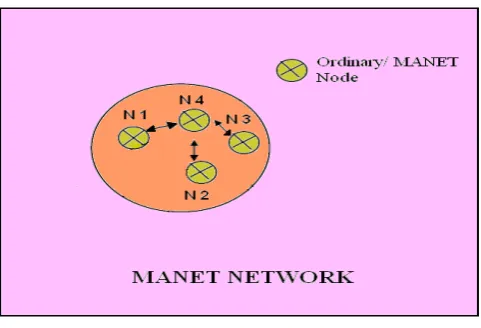
Figure 2. Showing the MANET Nodes within MANET Network
3.1.Criteria for Cluster Head Gateway Selection
We present criteria for choosing potential appropriate Cluster Head Gateway candidates. Our approach supports clustering in unstable networks, i.e. ones obeying a certain mobility rate. The goals are to facilitate more efficient information dissemination in clusters, to reduce the frequency of cluster head gateway re-elections due to mobility. In order to achieve these goals, we identified the following criteria for an appropriate cluster head gateway:
1. Transmission Power: The Transmission power of Cluster Head Gateway should be more in order to cover large area and reduce the chances of link failure.
2. Node Mobility: Cluster Head Gateway should have low mobility. Due to this the CHG will stay in a network for the longer time period and will serve all the MANET nodes. Such that its movement would not cause immediate loss of connections with the nodes in the region.
3. Quality of Service (QoS): CHG should be provided better QoS like good Connectivity, less delay, low data loss, etc.
Here QoS deals with several other parameters mentioning below,
• Throughput: CHG should have High throughput i.e. shows the better connectivity with minimum loss between MANET nodes.
• End-End Delay: The End-End delay means packet delay between nodes which should be as minimum as possible.
• Packet Drop: It is the difference between Sent data and Received Data which should be minimum.
• Queue Size: Means the storage capacity, The CHG should have large storage capacity (Memory size); Large Memory size deals with the more number of requests of other MANET nodes.
4. Simulation Setup and Results Discussion
4.1. Simulation Setup
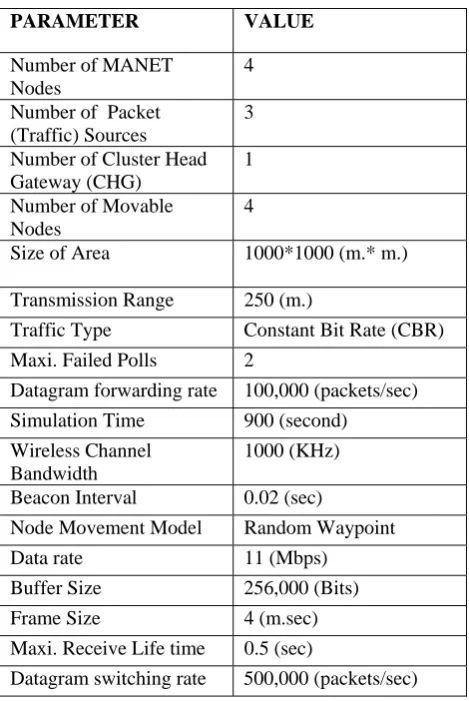
To simulate our Cluster Head Gateway Network, we used Opnet 14.0 v. The simulation parameters and their values are given in Table 1.
Number of MANET Nodes
4
Number of Packet (Traffic) Sources
3
Number of Cluster Head Gateway (CHG)
1
Number of Movable Nodes
4
Size of Area 1000*1000 (m.* m.)
Transmission Range 250 (m.)
Traffic Type Constant Bit Rate (CBR)
Maxi. Failed Polls 2
Datagram forwarding rate 100,000 (packets/sec)
Simulation Time 900 (second)
Wireless Channel Bandwidth
1000 (KHz)
Beacon Interval 0.02 (sec)
Node Movement Model Random Waypoint
Data rate 11 (Mbps)
Buffer Size 256,000 (Bits)
Frame Size 4 (m.sec)
Maxi. Receive Life time 0.5 (sec)
Datagram switching rate 500,000 (packets/sec)
TABLE 1 Simulation Parameters
4.2. Result Discussion
The Performance of the proposed CHG N/w is analyzed with respect to Throughput, End-End Delay, Data Traffic Received, Data Traffic Sent, Queue Size, Node Mobility and Transmission Power for considering Figure 2.
Figure 3 to 9 shows the performance of Four MANET Nodes with respect to the throughput, end-end delay, data traffic received, data traffic sent, Queue size, node mobility and transmission power respectively. The performance is first evaluated by CHG connectivity.
Figure 3. Throughput Vs Time Duration Figure 4. End-End Delay Vs Time Duration
Figure 4 showing End-End Delay Vs time Duration graph. The End-End Delay for Node-4 is 0.02122 sec at 1 min. after that it is drastically increasing up to 0.06445 sec at 2 min. and then constantly varying across 0.06 sec. which is lesser than rest of the MANET Nodes.
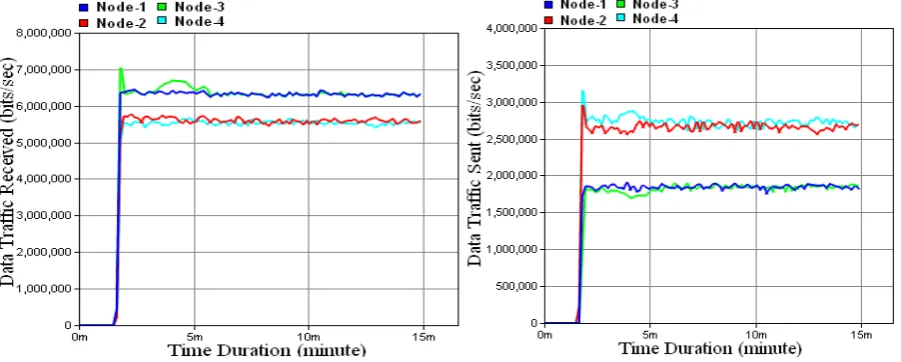
Figure 5 shows Data Traffic Received Vs time Duration graph. Here for Node-3 Traffic received maximum value is 7,042,821 (bits/sec) at 1min. time period, but after increasing the time period it constantly varying between 6,000,000-7,000,000 bits/sec. While for Node-4 Data Traffic received are almost constant and showing approximate values between 5,000,000-6,000,000 bits/sec with respect to time period which is minimum value as compare to other MANET Nodes.
Figure 5. Data Traffic Received Vs Time Duration Figure 6. Data Traffic Sent Vs Time Duration
Figure 6 shows Data Traffic Sent Vs time Duration graph. Here for Node-4 Traffic sent value is 3,159,365 (bits/sec) at 1min. time period which is maximum one than others MANET Nodes, but after increasing the time period it constantly varying between 2,500,000-3,000,000 bits/sec. While for other MANET Nodes Data Traffic Sent value is less than Node-4.
So, after analyze both the Figures 5 & 6 we can conclude that Node-4 has less Packet Drops than other rest MANET Nodes.
Figure 7. Queue Size Vs Time Duration
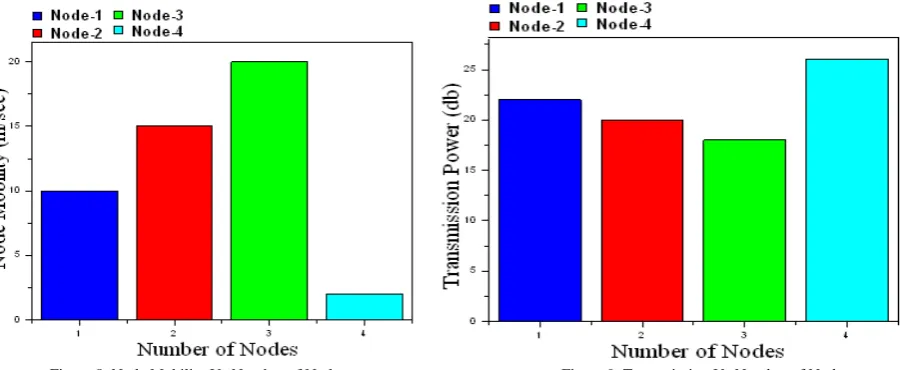
Figure 8 shows Node Mobility Vs Number of Nodes graph. Here Node-3 has maximum Node Mobility i.e. 20 m/sec, while Node-4 has minimum Node Mobility 2m/sec. It means Node-4 will be stay in the existing network for longer time than other Nodes. And other nodes will leave before node-4.
Figure 8. Node Mobility Vs Number of Nodes Figure 9. Transmission Vs Number of Nodes
Figure 9 shows Transmission Power Vs Number of Nodes graph. Here Node-4 has maximum Transmission power 26 db, while Node-3 has minimum Transmission power 18 db. It means Node-4 will cover more area or more nodes in the existing network as compare to the other Nodes.
5.Conclusion
In this paper, we have proposed The Criteria Require for Cluster Head Gateway Selection in Integrated Mobile Ad hoc Network. One of the distinguishing characteristics of our strategy is that, the MANET node is provided a better connectivity with minimum End-End Delay using CHG. In addition, in this approach we are providing the criteria for Cluster Head Gateway (CHG) selection in Mobile Ad hoc network. The CHG is one who will do the work of Cluster Head & Gateway both, and monitor, control the rest of MANET Nodes those who exist in the MANET network.
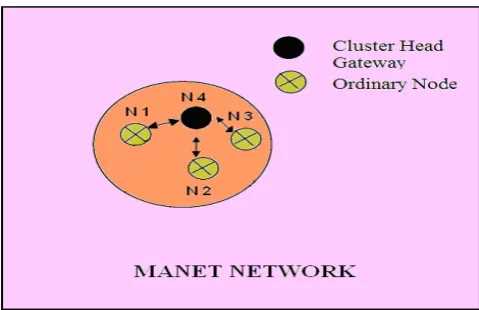
Figure 10. Showing the Cluster Head Gateway with Ordinary/ MANETN Nodes within MANET Network.
6. Acknowledgment
AUTHORS ARE GRATEFUL TO MANAGEMENT OF GRAPHIC ERA UNIVERSITY (INDIA) FOR SUPPORTING AND MOTIVATING US FOR THIS WORK.
References
[1] Ahmad Anzar, Joshi Pankaj, Rathi Vikas, Bagwari Ashish (IEEE Member), “A Cluster Head Gateway Approach for Deciding the Cluster head in Mobile Adhoc Network” Singapore Conference December 2011 ICCNS 2010: \"International Conference on Computer Networks and Security\".
[2] Ashish Bagwari (IEEE Member), Dr. R. Gowri, “A Hierarchical Architecture for Mobile Ad Hoc Network with Internet using Cluster Head Gateway”, IEEE - Katra Conference June 2011 CSNT 2011: \"International Conference on Communication Systems and Network Technology\" pp-100-103.
[3] P. Krishna, M. Chatterjee, N. H. Vaidya and D.K. Pradhan, “A cluster based approach for routing in Ad Hoc Networks”, Proc. USENIX symposium on Mobile and Location independent computing, April 1995.
[4] M. Gerla and J. Tsai, “Multicluster, mobile, multimedia radio network”, ACM Boltzer Journal of Wireless Networks, Vol.1, No. 3, pp- 255-265, July 1995.
[5] D. J. Baker, J. Wieselthier and A. Ephremides, “The architectural organization of a mobile radio network via a distributed algorithm”, IEEE transactions on Communications, pp. 1694-1701, Nov. 1981.
[6] A. J. Goldsmith, S. B. Wicker, “Design Chalienges for Energy Constrained Wireless Ad Hoc Networks”, IEEE Wireless Communications, Aug. 2002.
[7] Gaurav Chopra, Satyam Srivastava and Abhay Karandikar “A Novel Clustering Strategy for Efficient Routing in Adhoc Networks” IEEE-ICPWC, 2005.
[8] Peng Hao, Wanzhi Qiu and Rob Evans “An Improved Cluster-head Selection Approach in Wireless Sensor Networks” IEEE-ISSNIP, 2009.
[9] M. Penrose, Random Geometric Graphs: Oxford University Press, 2003.