INTERACTION
OF YIELD DETERMINING
PARAMETERS
IN LATE SOWN
WHEAT GENOTYPES
N.K. GUPTA), D.S. SHUKLA1, AND P.c. PANDEJ
I.2Division of Plant Physiology and 3Nuc1ear Research Laboratory, Indian Agricultural Research Institute, New Delhi 110 012
Received on 6 Nov., 2001
SUMMARY
In the present study the effect of normal and late sown conditions on the grain growth and yield determining parameters in three contrasting wheat genotypes were determined. Studies revealed that HD 2329 showed maximum yield under normal sown conditions whereas under late sown conditions it was maximum in HD 2285. It was attributed to well poised yield determining parameters developing in vegetative as well as reproductive phases. Kalyansona performed better than HD 2329 under late sown conditions, and this was perceptible in terms of grain weight and not in grain number. Present observations suggests that tolerance for both grain number and grain weight are important under late sowing but grain number is more important for sustaining the growth under these conditions.
Key words: Grain number, temperature stress, test weight, wheat, yield.
INTRODUCTION
Late planting of wheat in India is very common due to the wide spread intensive cropping system which so often delays the sowing of wheat upto the middle of January, particularly, in north west India where it is generally sown after harvest of paddy, sugarcane, pigeonpea etc. As a result, a portion ofthe maturity period ofthe crop is pushed forward and thus has to face higher temperatures of the summer as well as hot spells often occurring at that time. This high temperature at the time of grain development limits the yield and quality of wheat (Alkhatib and Paulsen 1984).
Despite the long standing evidences for the harmful effects of high temperature on wheat yield, concerted
attempts to analyze the parameters contributing yield
undernormal and late sown conditions are meagre (Reynold et al. 1994, Porter and Gawith 1999). Earlier work carried out in this lab by Ritcha (1989) and Kapashi (1991) have
indicated that post anthesis high temperature tolerance under controlled conditions resides in developing grains itself. The environmental conditions of crop growth under
normal and late sown conditions are different for
germination, tillering and reproductive growth processes. The yield of the plant is decided by such changed environmental conditions (Karim et al. 1999).
Temperature has a complex relationship with spikelet formation, maturity and grain yield since there is usually an optimum value of temperature for different plant processes which influence the yield. The adverse effects of high temperature have been found during the grain development
phase (Shukla et al. 1988 a,b). The number of florets
which produced harvestable grains and the weight of these grains at maturity was affected by temperature (Warrington et al. 1977). Ong and Squire (1986) and Shipler and Blum (1986) observed that the most affected yield component due to heat was the number of grains per spikelet and the least affected component was the number of spikelets per
ICorresponding author present address: Department of Plant Physiology, Rajasthan Agricultural University, SKN College of Agriculture,
YIELD COMPONENTS OF LATE SOWN WHEAT
ear. However, interrelationship of yield determining parameters under different environmental conditions has been unknown.
Hence, in the present work an effort has been made to study the responses of grain yield deterrniningparameters
under normal and late sown conditions in three wheat
genotypes recommended for normal (HD 2329) and late sown (HD 2285) conditions as well as a third genotype (Kalyansona) having temperature tolerance in developing grain but is not recommended for late sown conditions.
MATERIALS AND METHODS
Seed material for the present study consisted of three
wheat genotypes viz.Kalyansona-a genotype with wider
adaptability and reported to have high temperature tolerance in developing grain, HD 2285-recommended for late sown conditions andHD 2329 recommended fornormal sowing.
Experiment was conducted during two consecutive rabi
seasons in pot culture of Plant Physiology Division, Indian Agricultural Research Institute, New Delhi. Three hundred earthen pots of 12" diameter were used for these studies. Each ofthese pots was filled with 12 Kg of air dried, well sieved soil mixed with one eighth part by volume of well
decomposed farm yard manure. Two gram urea, two
gram single super phosphate and one gram muriate of potash were added to each pot and mixed well with the soil before sowing. Sowings were done during middle of November and middle of January for normal and late sowings, respectively. One hundred pots were employed for each genotype. Four plants were maintained in each pot. Two gram urea per pot was again supplied at the time of ear emergence.
At anthesis, mother shoots in all the pots were tagged and the date ofanthesis was recorded carefully. The day by which seventy five per cent of the mother shoots of all the pots of a genotype came to anthesis was taken as the mean date of anthesis for that genotype.
Plants were harvested at maturity and post harvest data were recorded for plant height, number of ears, ear length, ear weight, number of spikelets, grain weight per ear, grain number per ear, test weight, harvest index and yield. Separate measurments were done for mother shoot (MS) and whole plant (TE). All the observations were taken in triplicates and analysed for statistical significance.
Indian J.Plant Physiol., Vol. 7, No.3, (N.S.) pp. 264-269 (July-Sept., 2002)
RESULTS AND DISCUSSION
The performance of yield determining parameters of most crop plants depends upon the environmental conditions as well as crop growth period available to them. In our study it was observed that late sowing shortened the total crop duration invariably affecting various yield determining parameters in all the three wheat genotypes. Interactive
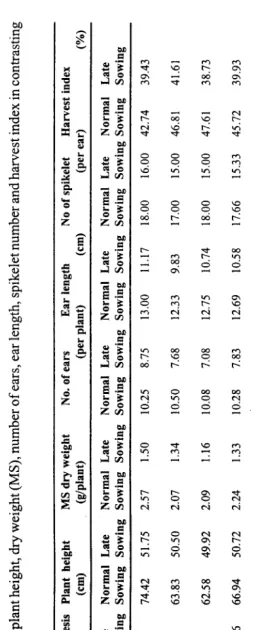
effects of genotype and sowing dates on ear length,
number of ears and spikelets did not show significant
differences in these genotypes under normal sown
conditions. At late sowing, the genotypic differences for these characters were significant and Kalyansona showed minimum reduction in ears and spikelets per plant. The ear length under late sowing reduced maximum in Kalyansona but it still remained higher over other genotypes. The plant height showed a significant variation among three wheat genotypes under normal sowing whereas under late sowing the differences were non significant (Table 1). Earlier reports by Ong and Squire (1986), Slafer and Rawson (1994) and Kenrich and Halloran (1996) support these observations.
Studies have shown that Kalyansona is a widely
adapted genotype under normal sown but varied climatic conditions ofthe country and has been identified as having a post anthesis high temperature tol erant grain sink (Ri tcha 1989, Jenneretal. 1991). However, this genotype has not
been recommended for late sown conditions. The other
two genotypes namely HD 2329 and HD 2285 have been
recommended for normal and late sown conditions,
respectively. A comparison of growth, yield and yield
determining parameters of these contrasting genotypes
under different sowing dates may summarize our findings as follows:
In both the years HD 2329 exhibited maximum
reduction in biomass (MS dry weight) followed by
Kalyansona under late sown conditions. The minimum loss was recorded in the case ofHD 2285 (Table 1). Thus
minimum loss in biomass seems to be an important
contributing factor for better performance ofHD 2285 as
compared to other genotypes. Support of stem reserve
mobilization to grain filling under temperature stress has also been reported by Blum et al. (1994). Data on harvest index reveals better partitioning in HD 2285 follwed by
Kalyansona under late sown conditions. Kalyansona
Table 1. Effect of sowing time on plant height, dry weight (MS), number of ears, ear length, spikelet number and harvest index in contrasting wheat genotypes. Genotype Days to anthesis Plant height MS dry weight No. of ears Ear length No of spikelet Harvest index (em) (g/plant) (per plant) (em) (per ear) (%) Normal Late Normal Late Normal Late Normal Late Normal Late Normal Late Normal Late Sowing Sowing Sowing Sowing Sowing Sowing Sowing Sowing Sowing Sowing Sowing Sowing Sowing Sowing Kalyansona 103.0 71.0 74.42 51.75 2.57 1.50 10.25 8.75 13.00 11.17 18.00 16.00 42.74 39.43 HD 2285 97.0 68.0 63.83 50.50 2.07 1.34 10.50 7.68 12.33 9.83 17.00 15.00 46.81 41.61 HD 2329 96.0 64.0 62.58 49.92 2.09 1.16 10.08 7.08 12.75 10.74 18.00 15.00 47.61 38.73 Mean 98.66 67.66 66.94 50.72 2.24 1.33 10.28 7.83 12.69 10.58 17.66 15.33 45.72 39.93 C.D. at 0.05 P 2.75 0.15 0.30 0.50 NS 3.52 2.25 0.12 0.24 0.41 0.36 2.70 3.89 0.20 0.42 NS NS 4.19 Genotype (G)
---'----YIELD COMPONENTS OF LATE SOWN WHEAT
showed maximum reduction in plant height under late sown conditions. With regards to reproductive phase, the number of days taken for anthesis were highest in case of Kalyansona under both the sowings, although the difference in days between the two sowings was not consistent among the three genotypes (Table 1).
Under late sown conditions there was significant
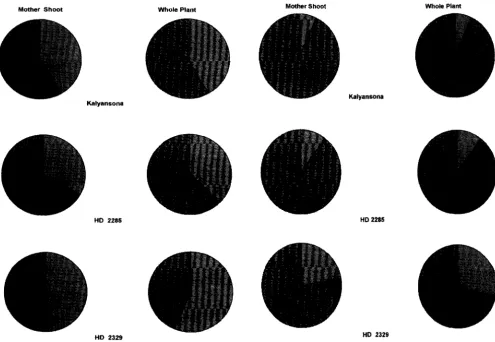
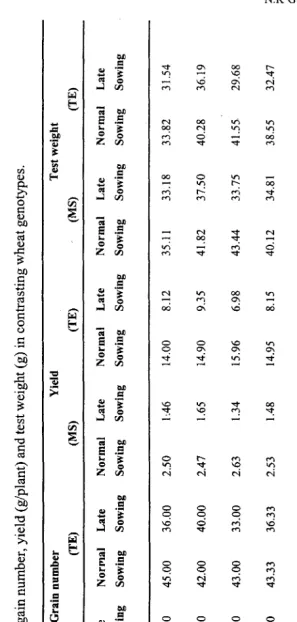
reduction in most yield contributing parameters of all the three genotypes. (Table 2, Fig. 1). Both MS as well as TE suffered significantly under late sown conditions. In case of grain yield HD 2329 suffered maximum whereas HD 2285 suffered minimum. The yield of Kalyansona was at par to HD 2285 under normal sown conditions but under late sown conditions it yielded higher than HD 2329 and lower than HD 2285 (Table 2). There was a significant decrease in 1000 grain weight (MS as well as TE) in HD
2329 compared to Kalyarsona under late sown conditions (Table 2, Fig. 2).The better performance of Kalyansona over HD 2329 reveals the existence of sink tolerance mechanism in this genotype (Jenner et ai. 1991). Ritcha
(1989) reported that Kalyansona is tolerant to higher
temperature as compared to another genotype HD 2428 under controlled environmental conditions. It was observed that grain weight in Kalyansonacould be sustained because of maintenance or increase in starch synthatase activities under high temperature conditions (Ritcha et ai. 1994). In our another study measurement of CO2 assimilation rate,
grain chlorophyll, ion leakage of grain, starch and protein showed that Kalyansona is significantly comparable to HD 2285 (Gupta 1997).
The grain tolerance of these genotypes has also been reflected in the per cent reduction in 1000 grain weight of
Mother Shoot
Kalyaosooa
WholePlaot Mother Shoot
Kalyansooa
Whole Plant
HO 2285
HO 2329
H02285
HO 2329
Fig. 1. Per cent reduction in grain yield in contrasting wheat genotypes under late sown over normal sown conditions
Fig. 2. Per cent reduction in test weight in contrasting wheat genotypes under late sown over normal sown conditions
Table
2.
Effect
of
sowing
time
on
gain
number,
yield
(g/plant)
and
test
weight
(g)
in
contrasting
wheat
genotypes.
Grain
number
Yield
Test
weight
(MS)
(TE)
(MS)
(TE)
(MS)
(TE)
Normal
Late
NorPlal
Late
Normal
Late
Normal
Late
Normal
Late
Normal
Sowing
Sowing
Sowing
Sowing
Sowing
Sowing
Sowing
Sowing
Sowing
Sowing
Sowing
70.00
44.00
45.00
36.00
2.50
L46
14.00
8.12
35.11
33.18
33.82
59.00
45.00
42.00
40.00
2.47
1.65
14.90
9.35
41.82
37.50
40.28
61.00
40.00
43.00
33.00
2.63
1.34
15.96
6.98
43.44
33.75
41.55.
63.33
43.00
43.33
36.33
2.53
1.48
14.95
8.15
40.12
34.81
38.55
Genotype Kalyansona HD
2285
HD
2329
Mean C.D.
at
0.05
P
Genotype
(G)
Sowing(S) GxS
4.50 4.30 5.53
3.45 3.39 5.88
0.14 0.12 0.20
0.98 0.82 1.41
3.00 2.45 3.95
YIELD COMPONENTS OF LATE SOWN WHEAT
MS as well as whole plant which was least affected in Kalyansona under late sown stress (Fig. 2). This further
confirms that the developing grain of Kalyansona are
relatively tolerant to late sown stress. However, on the basis of total grain yield Kalyansona was found second to
HD 2285 which has been recommended for late sowing.
It might be because of poor performance of the vegetative
growth dependent yield determining parameters,
particularly, grain number per plant.
Thus, it may be concluded that both Kalyansona and HD 2285 genotypes have tolerance to late sown irrigated conditions by sustaining higher test weight and grain number, respectively. Kal yansona showed relatively more late sown stress tolerance at reproductive phase yet it has
not been recommended for late sowing because of its
lower yield potential attributed to decrease in grain number. Hence, in a variety recommended for late sown conditions,
a relative tolerance for both grain number and grain
weight is required. However, sustenance of grain number seems to be relatively more important under late sown condition.
REFERENCES
Alkhatib, K. and Paulson, G.M. (1984). Mode of high temperature
injury to wheat during grain development. Physiol. Plant.
61:363-368.
Blum, A., Sinmena, B., Mayer, 1., Golan, G. and Shipler, L. (1994).
Stem reserve mobilization supports wheat grain filling under
heat stress. Aust. J. Plant Physiol. 21:777-78\.
Gupta, N.K (1997). Investigation on grain growth in contrasting
wheat genotypes undernormal and late sown conditions. Ph. D.
Thesis, Indian Agricultural Research Institute, New Delhi.
Jenner, C.F., Ugalda, T.D. and Aspinal, D. (1991). The physiology of
starch and protein deposition in the endosperm of wheat.Aust.
J.Plant Physiol. 18: 211-226.
Kapashi, S.B. (1991). Physiology of grain growth and development in
bold and small seeded wheat genotypes and the influence of
temperature stress. M.Sc. Thesis. Indian Agricultural Research Institute, New Delhi.
Indian 1.Plant Physiol., Vol. 7, No.3, (N.S.) pp. 264-269 (July-Sept., 2002)
Karim, M., Hamid, A. and Rahman, M.S. (1999). Grain growth and
yield performance of wheat under sub-tropical conditions. I
Effect of sowing dates. Cereal Res. Comm. 27: 439-446.
Kenrich, G.C. and Halloran, G.M. (1996). Termperatureeffectson the
duration of spikelet growth phase and spikelet abortion in barley. J. Agro. Crop Sci. 176: 23-29.
Ong, C.K and Squire, G.R. (1986). Response to temperature in a stand
of pearl millet (Penisettum typhoides S&H) VIII Final number
of spike lets and grains. J. Expt. Bot. 35: 1233-1240.
Porter, 1.R. and Gawith, M. (1999). Temperature and the growth and
development of wheat: a review. European J. Agro. 10: 23-26.
Rey.ond, M.P., Balota, M., Dalgado, M.LB., Amani, L. and Fischer,
R.A. (1994). Physiological and morphological traits associated
with spring wheat yield under hot irrigated conditions. Aust. J.
Plant Physiol. 21:717-730.
Ritcha, M.e. (1989). Effect of high temperature exposure on grain
growth in wheat (Triticum aestivum L). M.Sc Thesis, Indian
Agricultural Research Institute, New Delhi.
Ritcha, M.C., Shukla, D.S. and Pande, P .C. (1994). Biochemical basis
of high temperature tolerance in developing grain of wheat
(Triticum aestivum L.).Indian J. Expt. Bioi. 32: 296-298. Shipler, L. and Blum, A (1986). Differential reaction of wheat cultivars
to hot environment. Euphytica. 35: 483-492.
Shukla, D.S., Sirohi, G.S., Tomar, O.P.S., Deshmukh, P.S.,and Wasnik,
KG. (1988a). Solar energy trap: A method for temperature
tolerance studies in crop plants. Ann Plant Physiol. 2: 216-218.
Shukla, D.S., Sirohi, G.S., Tomar, O.P.S., Deshmukh, P.S., and Wasnik,
KG. (198 8b). Temperature effects on growth and development
of wheat L Interaction of nitrogen and moisture on grain
developmentincultivar HD 1981.IndianJ. PlantPhysiol. 31:
57-64.
Slafer, G. A. and Rawson, H. M. (1994). Sensitivity of wheat phasic
development to major environmental factors: A re-examination
of some assumptions made by physiologists and modellers. Aust
J.Plant Physiol. 21:393-426.
Warrington, I. J., Dustone, R. L and Green, L. M. (1977). Temperature
effects at three developmental stages on the yield of wheat ear.
Aust. J.Agric. Res. 28: 11-27.