1549
Volume 63 171 Number 5, 2015
http://dx.doi.org/10.11118/actaun201563051549
INFLUENCE OF HARDENED SURFACE
ON LOW CYCLE FATIGUE CHARACTERISTICS
AT TENSION-COMPRESSION AND BENDING
Artūras Sabaliauskas
1, Sergėjus Rimovskis
1, Petr Dostál
21 Mechanical Engineering Department, Šiauliai University, Vilniaus g. 88, 76285 Šiauliai, Litva
2 Department of Technology and Automobile Transport, Faculty of Agronomy, Mendel University in Brno, Zemědělská 1, 613 00 Brno, Czech Republic
Abstract
SABALIAUSKAS ARTŪRAS, RIMOVSKIS SERGĖJUS, DOSTÁL PETR. 2015. Infl uence of Hardened Surface on Low Cycle Fatigue Characteristics at Tension-compression and Bending. Acta Universitatis Agriculturae et Silviculturae Mendelianae Brunensis, 63(5): 1549–1554.
This paper analyses electromechanical hardening of the steel parts surface, when in the contact area so called “white layer” is formed. The experiments were performed to show the infl uence of “white layer” on strength of the steel C45 specimens under low cycle loading. This paper analyses monotonic and low cycle tension compression and pure bending characteristics of specimens with electromechanically hardened surface. The Performed experiments showed that under monotonic tension strength characteristics (pr, 02, u) are increasing and strain characteristics (eu, ) are decreasing. During cyclic stress limited tension compression at low loading levels both the width of plastic strain hysteresis loop and accumulated plastic strain are decreasing, therefore the lifetime is increasing. Under pure bending this tendencies persist, but in this case the lifetime at all loading levels is larger than the lifetime at tension compression.
Keywords: low cycle fatigue, pure bending, electromechanical treatment
INTRODUCTION
The most common loading mode of operating structures, mechanisms and machinery is cyclic loading, which initiates fatigue damage. The increasing loading velocities of this equipment and the reduction of their dimension made such extreme working conditions. At the same time, it is necessary to eff ect high strength and durability of these equipment. All these purposes cannot be achieved without knowledge of materials low cycle strength and durability characteristics at diff erent loading type. Very o en the durability of the element depends not on the properties of the whole element but only on the properties of its surface. One of eff ective methods, increasing durability of elements, is surface hardening, as in most cases the fracture starts on surface due to overloads, decreased resistance to plastic strains or due to infl uence of operating medium. One of the methods for surface hardening is electromechanical treatment (Barry et al., 2002). Therefore research object of this work is to examine low cycle fatigue characteristics of
the hardened by EMT steel C45 under tension-compression, pure bending and stress concentration by defi ning following problems:
1. to determine and compare the infl uence of electromechanically hardened surface on strength and durability of the parts under low cycle tension-compression and pure bending; 2. to evaluate analytically strength and durability of
the surface-hardened parts.
Methodology of Electromechanical Treatment
surface layer is quite small, so the heat is quickly directed to the depth towards element core. Thus the heated element layer quickly cools down and due to internal structural changes it hardens. In this way the “white layer” is composed (Bagmutov et al., 2005).
For the hardening surface in KTU EMT equipment applied to work on turning lathe was used (Daunys et al., 2004). Treatment tool – hard-fusion T15K6 plate was inserted into pressing device. Tool press force F is controlled using device indicator. Using EMT, simultaneously two processes occur: smoothing of surface roughness and surface layer hardening. During electromechanical hardening the following processing parameters were used: 1. hard-fusion T15K6 plate pressing force F = 400 N; 2. frequency of specimen rotation n = 250 revs/min; 3. processing speed v = 7.85 m/min;
4. feed of instrument s = 0.11 mm/revs; 5. electric current intensity I = 220 A;
6. passing number i = 2 (Daunys and Sabaliauska, 2005).
Methodology of Static and Low Cycle Tension- compression
Low frequency mechanical loading device with electronic-mechanic stress strain curves recording device was used for investigation of the monotonic and low cycle loading. 50 kN and 100 kN testing machines were used for monotonic and low cycle tension-compression experiments (Daunys, 2005).
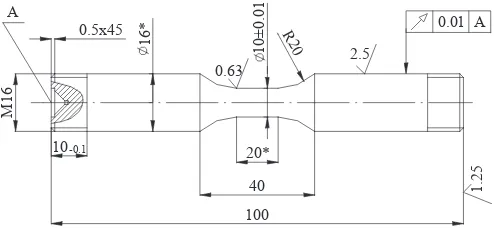
Circular cross-section specimens were used for monotonic tension and low cycle tension-compression experiments were applied. These specimens were machined from bars of rolled C45 steel to the form and dimension shown in Fig. 1.
The monotonic tension curves are presented in Fig. 2. The determined mechanical characteristics of C45 steel and C45 steel a er EMT are presented in Tab. I.
As it can be seen in Fig. 2 and Tab. I, a er electro-mechanic processing diff erences in metal mechani-cal characteristics occur. The proportional limit pr and ultimate strength u for electromechanically hardened specimen are larger but the ultimate strain eu is smaller.
100
M1
6
10
40 20* 0.5x45
A
16* 10±0.01
0.63
R 20
1.25
0.01 A
2.5
-0.1
1: Specimen for monotonic and low cycle tension-compression loading
0 200 400 600 800 1000
0 5 10 15 20 25 30
ı, MPa
e, %
2
1
1 - C45 steel
2 - C45 steel after EMT
2: Monotonic tension stress-strain curves
I: Mechanical characteristics of steel C45 and steel C45 a er EMT
σpr, MPa σ0.2, MPa σu, MPa σf, MPa epr, % e0.2, % eu, % Z, %
Steel C45
375 544 786 882 0.22 0.42 29 65
Steel 45 a er EMA
During low cycle tension-compression stress limited loading was applied. Because under low cycle loading stress strain curves are changed depending on load level and number of semicycle, so it is important to have precisely recorded these curves.
It is known, that the hysteresis loop width for anisotropic material is wider in even semicycle, than in uneven, i.e. ¯2 > ¯1. Therefore the expression of width of hysteresis loop in semicycle k is written (Daunys, 2005):
T k
s
A1,2 e0 k
2
, (1)
here
A1, A2 and ...cyclic characteristics of material, ¯
e0 ...strain of initial semicycle,
¯
sT ...cyclic proportional limit,
k ...number of semicycle.
For determination of constants A1 and A2
according to experimental low cycle stress limited tension-compression data we compose graphical dependence ¯1,2 = f(¯e0) according to which:
T A s e 1,2 1,2 0 2 . (2)
The width of hysteresis loop and accumulation of plastic strain depend on the number of semicycles. A er k semicycle accumulated plastic strain may be written as (Daunys and Rimovskis, 2002):
k k
pk k
e e0 0
1
( 1)
, (3)here ¯
0 ...stress of initial semicycle.
Methodology for Low Cycle Pure Bending
The experimental investigations of low cycle pure bending were performed using the above described equipment. Special set-up for specimen fi xing was used for low cycle pure bending fatigue test. Using this set-up in specimen operational area permanent bending moment Mbwas created (Daunys and Rimovskis, 2002). Fig. 3 shows a sketch of specimen fi xing set-up. It consists of two sections: one (the nut 3 with the pair of ring 4 and supporting rollers 5) is fi xed on machine’s stationary grip 2; the other (the plate 7 with the supports 6 and supporting rollers 8) is screwed on machine’s shi ing grip 1.
At pure bending the requirements for the specimen are the same as for the tension compres-sion specimen (Daunys and Rimovskis, 2006). The scheme of used hardened and non-hardened specimen for pure bending is showed in Fig. 4.
During low cycle pure bending loading with limited stress was also performed, i.e. fi xed load was applied. A er the experiments the changes of hysteresis loops, constants, which evaluate anisotropy, periodically accumulated plastic strains of diff erent load stages were also calculated.
1 6 7 3 2 5 4 9 8
3: Cyclic pure bending tests set – up
10 ±0.05 R15 14 .5 ±0 .1 45° 12 0.63 1.25 1.25 20 1x45° 36 51 160 -0.1 8.8 A A
A - A
RESULTS
In accordance to Eq. (2) the constant A1 and A2 for non-hardened and hardened grade 45 steel are presented in Tab. II.
The obtained results show that a er electro-mechanical treatment, the constants A1 and A2
decrease. This is due to decreasing widths of the hysteresis loops. For experimental low cycle stress limited symmetric loading elastic-plastic strain hysteresis loops variation dependence on semicycle number is presented in Figs. 5 and 6. This data were obtained by performing experiments from ¯0 = 1.01 to ¯0 = 1.95 in case of tension compression and from ¯
0 = 1.04 to ¯0 = 1.8 in case of pure tension. Where:
pr
0 0
, (4)
here
0...stress of initial semicycle for non-hardened steel,
pr ...proportional limit for non-hardened steel.
As it was mentioned above, the width of hysteresis loop for anisotropic materials is larger in even semicycles than in uneven semicycles; therefore during the load of low cycle loading the material receives the increase of plastic strain in the direction of tension. The experimental tension-compression and pure bending curves of accumulated plastic strain ¯epk are presented in Figs. 7 and 8.
The diagrams show that during tension-compres-sion the accumulation plastic strain in the direction of tension in hardened material is slower. And only in a very large stress range (¯0 = 1.95), ¯epk it may reach the value of relative fracture strain ¯eu.
In case of pure bending the plastic strain is accumulated more slowly and for hardened steel, when the loading amplitude is close to proportional limit, this accumulation is very small.
The layer, hardened by EMT, prevents infl uence of the plastics strains. This is extremely obvious when middle and high amplitude tensions are given. As the eu of hardened steel is smaller, so with high amplitude cyclic loading it is reached rather quickly.
II: Values of constants A1 and A2
Non-hardened Hardened
A1 A2 ΔA A1 A2 ΔA
Low cycle tension-compression
1.86 2.0 0.14 0.91 1.15 0.24
Low cycle pure bending
1.26 1.3 0.04 1.07 1.18 0.11
a
)
b
)
5: Dependence of the width of hysteresis loops on semicycle number
k and load level 0, at low cycle tension-compression: a) steel C45;
b) steel C45 after EMT
a
)
b
)
6: Dependence of the width of hysteresis loops on semicycle number k
and load level 0, at low cycle pure bending: a) steel C45; b) steel C45
Therefore the durability of hardened specimen decreases. Having small amplitude loading, the “white layer” blocks accumulates of plastic strain, so the durability of specimen is increasing. This can be seen in Fig. 9 both in case of tension-compression (curves 3, 4) and in case of pure bending (curves 1, 2).
On Fig. 9 curve (7) represents only fatigue damage of stress limited loading only.
a
)
b
)
7: Dependence of accumulated plastic strain epk at
tension-compression on semicycle number k and load level 0: a) steel C45;
b) steel C45 after EMT
a)
b)
8: Dependence of accumulated plastic strain epk at pure bending on
semicycle number and load level 0: a) steel C45; b) steel C45 after
EMT
9: Low cycle fatigue curves for non-hardened (curves 1, 3, 5) and
hardened (curves 2, 4, 6) specimen; analytic fatigue curve of grade 45 steel (curve 7)
CONCLUSION
1. The investigation of low cycle fatigue showed that non-hardened and hardened specimens of steel C45 using EMT are cyclically weakening and accumulating plastic strains. Therefore fatigue and quasi-static damage accumulation occurs.
2. During pure bending the width of histeresis loop of elastic plastic strain and the accumulation of plastic strain in the direction of tension is smaller than these parameters at tension-compression. This decrement is originated from the resistance of elastically strained inner layers of specimen to plastic strain of outer layers during the pure bending.
3. In both tension-compression and pure bending cases the hardened surface layer decreases the width of plastic strain histeresis loop and the accumulation of strain in the direction of tension. 4. Under high loading level electromechanical hardening reduced the ultimate strain eu therefore
has negative infl uence on element lifetime. But at middle and low loading level lifetime due to reduced eu is increasing.
processing experiment results the dependencies of how hardened surface infl uences the change of the width of hysteresis loop, accumulation of plastic strain, and durability of specimens were obtained.
Acknowledgement
The research has been supported by the project TP 4/2014 „Analysis of degradation processes of modern materials used in agricultural technology“ fi nanced by IGA AF MENDELU.
REFERENCES
BAGMUTOV, V., DUDKINA, N., ZAKHAROV, I. 2005. Formation of surface layer structure produced by electromechanical strengthening of carbon steels. Mechanika, 2(52): 55–59.
BARRY, J., BYRNE, G. 2002. TEM Study on the surface white layer in two turned hardened steels. J. Materials Science and Engineering, 325(1–2): 356– 364.
DAUNYS, M. 2005. Ciklinis konstrukcijų stiprumas ir ilgaamžiškumas. Kaunas: Technologija.
DAUNYS, M., MARKAUSKAS, S., STAPONKUS, V. 2004. Investigation of surface quality for small
diameter elements a er electromechanical treatment. Mechanika, 1(45): 63–68.
DAUNYS, M., RIMOVSKIS, S. 2002. Analysis of low cycle loading characteristics at pure bending. Mechanika, 5(37): 5–9.
DAUNYS, M., RIMOVSKIS, S. 2006. Analysis of circular cross-section element, loaded by static and cyclic elastic-plastic pure bending. International Journal of Fatigue, 28: 211–222.
DAUNYS, M., SABALIAUSKAS, A. 2005. Infl uence of surface hardening on low cycle tension compression and bending characteristics. Mechanika, 3(53): 12–16.
Contact information Artūras Sabaliauskas: [email protected]