ACHIEVING SUPPLY CHAIN
COMPETITIVENESS: SOME CRITICAL
ISSUES
Ajay Verma*
Department of Mechanical and Production Engineering, Mualana Azad National Institute of Technology, Bhopal, Madhya Pradesh 462051, India
http://<www.manit.ac.in>
Dr. Nitin Seth
Indian Institute of Foreign Trade, New Delhi, India
http://<www.iift.ac.in>
Abstract:
In today’s global marketplace, competitive priorities have forced organizations to change dramatically due to rising customer expectations, continually increasing competition on a world-wide scale, time and quality based competition and mass customization. The fierce competition in today’s market is led by advances in industrial technology, increased globalization, and tremendous improvement in information availability. With the development of information technology and economic globalization, modern competition has already become the competition among enterprises and their supply chains rather than the competition among enterprises only. In this era, the organizations are forced to rethink their operations, alliances, partnerships and strategies to cope with these and similar changes. Supply chain competitiveness has been emerged as one of the strongest tool for gaining competitive advantages. A company is competitive when it is able to create and deliver value for its customers. A supply chain is competitive if it is able to create and deliver value for its customers and its components. In the growing economy of India, supply chain competitiveness (SCC) is a real solution to the problems faced by organizations in this global environment. This paper identifies some of the supply chain competitiveness issues and presents roles of suppliers, manufacturers and distributors. Some future perspectives are then presented. The paper aims at identifying some critical issues related to supply chain competitiveness and presents roles of the major components of supply chain.
Keywords: Competitiveness; Supply chain; supply chain competitiveness; customer’s satisfaction.
1 Introduction
Supply Chain Competitiveness (SCC) refers, in general way, to gain competitive advantages by one supply chain on the other (competitive supply chain/chains). Supply chain competitiveness can not be thought as a single unit, but it is an integrated effort of the components of supply chain as a whole [Lim et al. (2006), Brotherton (2004)]. The major components of supply chain are suppliers, manufacturers, and distributors. SCC is an integrated effort of the major components which comprise it (Fig. 1).
Figure 1 Components of Supply Chain Competitiveness
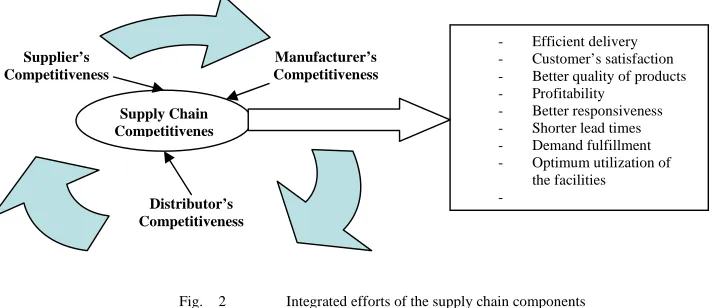
A firm gains competitive advantage by performing strategically important activities more cheaply or better than its competitors. According to Gunasekaran, SCC comprised of competitiveness of all the supply chain components like suppliers, manufacturers, and distributors [Gunasekaran et al. (2003); Felix et al (2003)]. Fig. 2
Supply Chain Competitiveness
Supplier’s Competitiveness Manufacturer’s Competitiveness
Manufacturer Distributors Suppliers
Material Flow
Information
shows a depiction of the importance of different components of supply chain in achieving SCC and the benefits of achieving SCC.
Fig. 2 Integrated efforts of the supply chain components
Many researchers have tried to describe SCC and a wide range of strategies have been considered for the same. Mentzer (2004), argued that competitive advantage con be obtained not just through the products sold, but also through the way in which we manage the flows in a supply chain. He presented twelve drivers of supply chain competitive advantage which are, according to him, necessary for supply chain to be competitive [Mentzer (2004)]. A model of supply chain is shown in Fig. 3.
Fig. 3 A model of supply chain (adopted from Verma and Seth, 2011)
For companies to take competitive advantages at the global level, prime requirement is to have activities like coordination, collaboration, agility, supply chain flow cycles, supply chain synergy, flexibility at all levels, intra-organization and inter-organization information flows and all those activities which will create satisfaction to customers (Verma and Seth, 2011). The paper is organized as: after presenting a review of the concepts of supply chain and supply chain competitiveness, some of the issues related to SCC are presented and roles of different components of the supply chain are identified and lastly some of the future perspectives are also enlightened.
2 Literature Review
The subject of supply chain and SCC have been explored by various researchers and practitioners from various perspectives viz. understanding, models, applications, analysis etc. there is a difference in opinion of different researchers as for as the concept is concerned. Supply chain can be defined in numerous ways. Table 1 presents some of the select definitions of supply chain. While there are few understandings available for SCC. Researchers have tried to identify different activities and strategies to achieve SCC. Different researchers have emphasized on different strategies for SCC.
Table 1 select definitions of supply chain
S.No. Author (year) Definition
Manufacturer’s Competitiveness
Distributor’s Competitiveness Supplier’s
Competitiveness
Supply Chain Competitivenes
- Efficient delivery - Customer’s satisfaction - Better quality of products - Profitability
- Better responsiveness - Shorter lead times - Demand fulfillment - Optimum utilization of
-1 Christopher (1992) The network of organizations that are involved, through upstream and downstream linkages, in the different processes and activities that produce value in the form of products and services delivered to the ultimate consumer.
2 La Londe and Masters (1994)
A set of firms that pass materials forward
3 Lambert et
al.(1998)
The alignment of firms that brings products or services to market including the final customers as part of the supply chain.
4 Mentzer (2004) A set of three or more entities (organizations or individuals) directly involved in the upstream and downstream flows of products, services, finances, and/or information from a source to a customer.
SCC refers, in general way, to gain competitive advantages by one supply chain on the other (competitive supply chain/chains). Achieving SCC is not a simple task. SCC comprised of competitiveness of all the supply chain components like suppliers, manufacturers, distributors and retailers. A firm gains competitive advantage by performing strategically important activities more cheaply or better than its competitors. Many attributes have been defined to explain the determinants of SCC. Many researchers have tried to describe SCC and a wide range of strategies have been considered for the same. Gruen (1997) argued that companies may compete if they develop and manage cooperation and collaboration partnerships. Same is the statement of Lalonde (1997) who emphasizes on inter-firm cooperation to satisfy customers as the power in supply chains has shifted downstream toward the customer or end users. Mentzer, argued that competitive advantage can be obtained not just through the products sold, but also through the way in which we manage the flows in a supply chain [Mentzer (2004)]. He presented twelve drivers of supply chain competitive advantage which are, according to him, necessary for supply chain to be competitive. According to [Chopra and Meindl (2006)], a company’s competitive strategy defines, relative to its competitors, the set of customer needs that it seeks to satisfy through its products and services. The impact of different components of supply chain can be recognized in achieving SCC. The different components of supply chain have to be competitive enough so that the overall competitiveness can be achieved. La londe suggested information and communication as the most profound and influencing changes that affect the companies as well as the SCC [Lalonde and Powers (1993)] He suggested the use of internet and other communication systems for improving SCC According to Lalonde, organizations must be quick, agile, and flexible to compete efficiently, which can not be obtained without coordination of the companies in supply chains [La londe (1997)]. Lalonde (1997) emphasizes on inter-firm cooperation to satisfy customers. Hitt suggested information, intelligence and expertise as the critical organizational sources for competitive advantage [Hitt et al (1999)]. On one hand, Lambert emphasized on the importance of cooperation and coordination for achieving SCC [Lambert and Cooper, (2000)] on the other hand Pine, emphasized on mass customization for gaining competitiveness of supply chains [Pine, (1993)]. Fig. 2 represents efforts to achieve SCC, outcome in the from of achieved SCC and benefits of achieving SCC.
3 SCC issues and roles of different components
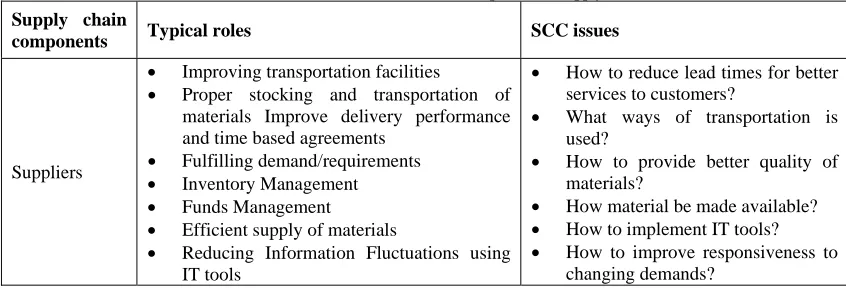
SCC can not be achieved just by one entity but integrated competitiveness of all the entities is required for that viz. suppliers, manufacturers and distributors [Lim et al. (2006); Villa (2001)]. Table 2 shows roles of supply chain components viz. suppliers, manufacturers and distributors and SCC issues.
Table 2 Roles and Issues of different components of supply chain
Supply chain
components Typical roles SCC issues
Suppliers
Improving transportation facilities
Proper stocking and transportation of materials Improve delivery performance and time based agreements
Fulfilling demand/requirements
Inventory Management
Funds Management
Efficient supply of materials
Reducing Information Fluctuations using IT tools
How to reduce lead times for better services to customers?
What ways of transportation is used?
How to provide better quality of materials?
How material be made available?
How to implement IT tools?
Proper communication
Continuous Monitoring
Market know-how’s
How to supply materials in time?
How to fulfill commitments and thus increasing trust and reliability?
How to reduce bullwhip effect?
Manufacturers
Providing high quality products in right quantity
Fulfilling changing needs of the customer
Designing new and quality products
Making of forecasts of requirements
Intra organizational functions
Product scheduling and storage
Training for quality products
Information system
Controlling the operations
Transportation of goods
Implementation of TQM orientation in the organization
Integration of all the resources as well as departments
Using ERP, MRP and other decision support systems
How to be agile and flexible?
How to satisfy customers?
How to manage demand?
How to implement information technology and other expert systems?
How to improve collaboration and cooperation?
How to manage product chain?
How strategic alliances and competitive partnership is achieved?
How to manage supply chain flow cycles?
How to improve product design and quality?
How to achieve competitive advantages?
Distributors
Multiple channel transportation
Improved storages and stocks
Delivery of materials and finished goods in right quantity in right time
Managing Market demands
Proper information and communications
Improve delivery and packaging by IT and other communication systems
Modern material handling systems
Education and training
What are the ways of competitive advantages?
How to reduce lead times?How to distribute products in time?
How to satisfy customers
(retailers)?
How to handle changing
requirements?
How networked distribution is achieved?
From Table 1, it is clear that SCC can be obtained not only by the functions of the basic firm but also from the functions of all the constituent firms.
4 Conclusions
Supply chain management is one of the strongest approaches used to gain competitive advantages by the firms now days. SCC can be obtained by integrated efforts of all the components of the supply chain. This paper emphasized on the requirement of integrated efforts of the components and then throws some light on the roles and issues of the supply chain components. The paper presents an insight of SCC and identified important issues related to it. As a future perspective, these issues are to be explored in the light of some empirical analysis. This paper presents some guidelines to the academicians, researchers and practicing managers to better understand the nature and components of supply chain and their roles and issues to be considered to gain SCC. The future work can be comprised of identifying the variables of supply chain competitiveness and empirically analyzing those variables so as to validate the results.
References
[1] Brotherton, B. (2004), Critical success factors in UK corporate hotels, The Service Industries Journal, Vol.24, No.3, pp.19–42 [2] Chopra S. and Meindl P. (2006), Supply Chain Management – Strategy, Planning and Operation, Prentice Hall International, Third
Edition.
[3] Christopher, M. (1998), Logistics and Supply Chain Management: Strategies for reducing cost and improving services, Financial Times Pitman Publishing.
[5] Gunasekaran, A., Patel, C., and McGaughey, R., C. (2003), A framework for supply chain performance measurement, International Journal of Production Economics, 87, 333–347
[6] Hitt, M.A., Ireland, D.R., and Hoskisson, R.E. (1999), Strategic Management, Cincinnati OH: southwestern College Publishing.
[7] La londe, B.J. and Powers, R.F. (1993), “Disintegration and reintegration: Logistics of the 21st
century”, International Journal of Logistics Management, 4(2), 1-12
[8] La Londe, Bernard J. (1997), Supply Chain Management: Myth or Reality? Supply ChainManagement Review, Vol. 1, spring, pp. 6-7.
[9] La Londe, Bernard J. and James M. Masters (1994), Emerging Logistics Strategies: Blueprints for the Next Century, International Journal of Physical Distribution and Logistics Management, Vol. 24, No. 7, pp. 35-47.
[10] Lambert, D.,M and Cooper, M.,C.,(2000), Issues in Supply Chain Management , Industrial Marketing Management , 29 , 45-56. [11] Lambert, Douglas M., James R. Stock, and Lisa M. Ellram (1998), Fundamentals of Logistics Management, Boston, MA:
Irwin/McGraw-Hill, Chapter 14.
[12] Lancioni, R.,A., Smith, M., and Oliva ,T.,(2000), The role of internet in Supply Chain Management, Industrial Marketing Management, 29 , 57-65.
[13] Lim, R.Y.G., Baines, T., Tjahjono, B., Chandraprakaikul, W. (2006), Integrated strategic supply chain positioning for SMEs: an empirical study, The International Journal of Logistics Management, 17(2), pp. 260-276.
[14] Mentzer J.T. (2004), “Fundamentals of Supply Chain Management-Twelve Drivers of Competitive Advantages”, University of Tennessee, Knoxville, Response books, New Delhi.
[15] Pine B.J., Jr. (1993), Mass Customization: The New Frontier in Business Competition, Boston: Harvard Business School Press. [16] Verma A. and Seth N. (2009), Supply chain competitiveness: Issues and challenges in the new millennium, National Conference on
Business Technology, March, 13-14, 2009, Indore, India
[17] Verma A. and Seth N. (2011), A conceptual framework for Supply Chain Competitiveness, International Journal of Business and Economic Sciences, Vol. 3, No. 2 (Accepted)