Lincoln
University
Digital
Thesis
Copyright
Statement
The
digital
copy
of
this
thesis
is
protected
by
the
Copyright
Act
1994
(New
Zealand).
This
thesis
may
be
consulted
by
you,
provided
you
comply
with
the
provisions
of
the
Act
and
the
following
conditions
of
use:
you
will
use
the
copy
only
for
the
purposes
of
research
or
private
study
you
will
recognise
the
author's
right
to
be
identified
as
the
author
of
the
thesis
and
due
acknowledgement
will
be
made
to
the
author
where
appropriate
you
will
obtain
the
author's
permission
before
publishing
any
material
from
the
thesis.
How to share the potential benefits of REDD+? The case of Nepal
A thesis
submitted in partial fulfilment
of the requirements for the Degree of
Master of Natural Resources Management and Ecological Engineering
at
Lincoln University
by
Doma Tshering Sherpa
ii
Abstract of a thesis submitted in partial fulfilment of the
requirements for the Degree of Master of Natural Resources Management and
Ecological Engineering.
Abstract
How to share the potential benefits of REDD+? The case of Nepal
by
Doma Tshering Sherpa
Reducing Emissions from Deforestation and Forest Degradation (REDD) is an incentive based
measure for climate change mitigation. REDD+ transcends deforestation and forest degradation and includes sustainable management of forests and enhancement of carbon stocks. Advocates suggest that its innovative approach rewards local communities’ efforts in the conservation of forest resources and preventing deforestation, while enabling them to derive benefits from international sources for contributing to mitigating climate change.
The Government of Nepal is currently planning to implement REDD+ activities in community forests already involved in sustainable forest management. However, there are unsolved questions on equitable and efficient sharing of benefits. What are the existing factors that affect the flow and sharing of benefits of REDD+ in Nepal? How can these factors be controlled to promote an equitable allocation and sharing of benefits of REDD+? Similar issues regarding equity have also been observed in community forest management. To investigate these questions, the researcher conducted a case study in one of Nepal’s REDD+ pilot project implemented in community forests to explore issues and concerns related to equity and efficiency that are vital to the adoption of a benefit sharing mechanism.
iii benefits, but who the beneficiaries will be is a question that has not been addressed. Also, much of the research on REDD+ has focused on advancing the technical components of REDD+. By contrast, research on benefit sharing has not been initiated by the government at any level. And questions of how the benefits will be distributed remain.
The research recommends potential mechanisms – including a normative basis for the allocation and distribution of benefits – that could help to advance equity. The issues of needs vs.
contributions in determining what is equitable leads to the formulation of guidelines for how benefits should be shared at two levels in Nepal. First, the vertical distribution of benefits by the central government should be based on the determination of ownership of carbon benefits and on performance criteria. Second, at the community level, horizontal benefit distribution should be determined by the community itself based on its definition of needs. However, at both levels, issues of elite capture, transparency, and accountability must be addressed. In addition, with regard to the issue of trade-offs between the 3 Es (effectiveness, efficiency and equity) in benefit sharing of REDD+, equity was found to be the most important requirement for local acceptance of any REDD+ programme.
iv
Acknowledgements
I have always been inspired by my family; my parents and three brothers who have blessed, supported and encouraged me to be well educated, throughout my life. It is because of them that I am at this point in life. Hence, I start my acknowledgement thanking my family for all their hard work in my upbringing and for all their efforts.
I am very grateful to Mingma Norbu Memorial Scholarship committee for believing in me and granting me with this honourable scholarship to study ‘Master of Natural Resources Management and Ecological Engineering’ in Lincoln University, New Zealand. Having spent one and half years here at Lincoln, I have been fortunate enough to be acquainted to some great people. Specially, Jane Edwards and Sue Bowie who helped me solve all my administrative queries in a short time. I have also come to know many friends who have taught me many things in regards to my personal life as well as with my studies.
I am also grateful to my supervisor, Ton Buhrs, and co-supervisor, Ann Brower, for their thoughtful and rigorous feedbacks and suggestions that brought to the successful completion of the thesis.
Special thanks also goes to Kamal Lamichhane from FECOFUN for locating research participants in the Gorkha District in Nepal; and, all the research participants who gave their valuable time in sharing their knowledge and information to provide insights into the research questions of the thesis.
Last but not the least, I am thankful to my lovable and kind-hearted husband who supported my decision to go for this study. His company during the field trip and assistance in transcribing interviews helped me in completing the thesis.
v
Table of Contents
Abstract ... ii
Acknowledgements ... iv
List of Tables ... viii
List of Figures ... ix
Acronyms ... x
Chapter 1: Introduction ... 1
1.1. Background 1 1.2. Definition of the research problems and research objectives 3 1.3. Thesis organisation 5 Chapter 2: Setting the background - Nepal and REDD+ ... 6
2.1. Introduction 6 2.2. Community Forestry 6 2.3. REDD+ process and institutional arrangements 9 2.4. Chapter summary 12 Chapter 3: Literature Review ... 13
3.1. Introduction 13 3.2. Benefit sharing mechanisms: a review of the literature and discussion of issues 13 3.2.1. Accounting and funding mechanism in REDD+ 14 3.3. Principles of Effectiveness, Efficiency and Equity in benefit sharing 17 3.3.1. Equity in sharing of benefits of REDD+ 18 3.4. Potential benefits and costs 23 3.5. Benefit sharing in community based forest management 26 3.5.1. Benefit flow 27 3.5.2. Benefit sharing 28 3.6. Chapter summary 29 Chapter 4: Methodology ... 31
vi
5.1. Introduction 45
5.2. Should Nepal participate in REDD+? 45
5.3. How important are the 3 Es in the allocation and distribution of the (potential) benefits of REDD+? And what mechanisms could help in achieving or advancing an
equitable sharing of the benefits? 47
5.3.1. Principles of Effectiveness, Efficiency and Equity 48
5.3.2. Potential mechanisms for allocating and distributing benefits 56 5.4. What are the existing contextual factors that affect benefit flow and sharing of
benefits from REDD+ in Nepal? How could these factors be changed to promote an
equitable allocation and sharing of benefits of REDD+? 64
5.4.1. Issues of sharing benefits 64
5.4.2. Carbon price 66
5.4.3. Resource conditions 67
5.4.4. Existing governance arrangements 68
5.4.5. Envisaged institutional arrangements 73
5.4.6. Views of experts to promote an equitable allocation and sharing of benefits
of REDD+ 78
5.5. Chapter summary 80
Chapter 6: Discussion ... 82
6.1. Introduction 82
6.2. Potential effects/implications of REDD+ on communities involved in forest
management (objective 1) 83
6.3. Perspectives on the 3 Es and criteria for equity in the allocation and distribution of
the benefits (objective 2) 84
6.4. Potential mechanisms for sharing benefits equitably (objective 3) 89
6.5. Importance of contextual factors (objective 4) 93
6.5.1. Political, economic and socio-cultural condition 93
6.5.2. Existing governance arrangements 94
6.5.3. Envisaged institutional arrangements 96
6.6. Implications of findings 99
6.6.1. Challenges in benefit sharing mechanisms accommodating other forest
management regime 99
6.6.2. Maintaining the enthusiasm 100
6.6.3. Utilisation of REDD funds 100
6.7. Strategies to promote equitable sharing of benefits (objective 5) 101
6.8. Chapter summary 104
Chapter 7: Conclusions ... 106
7.1. Introduction 106
7.2. Restatement of research objectives 106
7.3. Main findings of the research 107
7.4. Significance and limitations of the findings 108
7.5. Recommendations for future work 109
vii
References ... 111
Appendices ... 115
Appendix 1: Definitions of different forest management regimes in Nepal 115
Appendix 2: Lists of research participants 116
Appendix 3: Interview schedule for REDD+ experts 118
Appendix 4: Interview schedule for REDD Cell officials 122
viii
List of Tables
ix
List of Figures
x
Acronyms
3 Es Effectiveness, Efficiency and Equity
ANSAB Asia Network for Sustainable Agriculture and Bio resources
CBOs Community Based Organisations
CFUGs Community Forestry User Groups
FCPF Forest Carbon Partnership Facility
FECOFUN Federation of Community Forestry Users, Nepal
HIMAWANTI Himalayan Grassroots Women’s Natural Resource Management
Association
ICIMOD International Center for Integrated Mountain Development
INGO International Non-Governmental Organisation
MoFSC Ministry of Forests and Soil Conservation
MRV Monitoring, Reporting, and Verification
NEFIN Nepal Federation of Indigenous Nationalities
NGO Non-Governmental Organisation
Norad Norwegian Agency for Development Cooperation
REDD Reducing Emissions from Deforestation and Forest Degradation
REDD Cell REDD Forestry and Climate Change Cell
UNFCCC United Nations Framework Convention on Climate Change
UN-REDD United Nations collaborative initiative on Reducing Emissions from Deforestation and forest Degradation
1
Chapter 1: Introduction
As Communications and PR Associate at International Centre for Integrated Mountain Development
(ICIMOD), I coordinated a field visit with the ICIMOD team along with media representatives to the
Gorkha District in Nepal during a payment distribution ceremony for the Forest Carbon Trust Fund in
2011. Piloted in three watersheds and implemented within a project on REDD+ at the ICIMOD,
project provided training to monitor carbon sequestration to Community Forestry User Groups
(CFUGs), and their opportunities to claim rewards for carbon sequestration. REDD+, an incentive
based mechanism, is one of the mitigation measures aimed at tackling climate change. It is an
innovative approach involving local user groups in the conservation of forest resources, rewarding
them for their mitigation efforts while assisting them to adapt to the effects of climate change.
The Forest Carbon Trust Fund is the first of its kind in the world rewarding CFUGs for their role in
carbon sequestration. Upon learning about this project, I developed a keen interest to undertake
research on this project and to understand people’s perceptions of REDD+. In addition, during the
payment ceremony I overheard some of the recipients’ conversations wondering “why they were
paid less than others”. My research on how to share the potential benefits of REDD+ originated from
this moment. If not shared equitably, there is a high chance of conflicts emerging among and within
communities about the proclaimed benefits of REDD+, and this may even have negative impacts on
the performance and success of existing community forestry programmes in Nepal.
1.1.
Background
2 financial value for the carbon stored in forests, offering incentives for developing countries to reduce emissions from forested lands and invest in low-carbon paths to sustainable development. “REDD+” goes beyond deforestation and forest degradation, and includes the role of conservation, sustainable management of forests and enhancement of forest carbon stocks1”. Advocates of REDD+ suggest that its innovative approach rewarding local communities’ efforts in the
conservation of forest resources and preventing deforestation will enable them to derive benefits from international sources for contributing to mitigating climate change.
Nepal is implementing REDD+ activities in established community based forest managements, especially community forests. Community forests are national forests handed over in perpetuity to users groups for development, conservation, management, and utilisation for the collective interest (Forest Act (Nepal) 1993). Assuming REDD+ revenues are generated, there is a question about how the benefits should be equitably distributed. The decision on the benefit sharing mechanisms inside the country is left to national government (To et al., 2012). Additionally, no international rules or guidelines for how benefits are to be shared within countries have been established. While much research is focused on getting ready for the implementation of technical requirements (Monitoring, reporting, and verification system; setting up of reference scenario, etc.) of REDD+, it is essential to investigate what kind of benefit sharing mechanism should be set up for political, ethical and practical reasons (UN-REDD & Department of Forestry Viet Nam, 2010).
Although negotiations on REDD+ under the UNFCCC are progressing to the stage of addressing issues associated with the implementation of national programs, how the potential benefits of such schemes will be distributed in the country remains unclear. Further, there are unsolved questions on how benefits should be transferred equitably as well as making benefit sharing mechanism efficient and bring effective outcomes. Therefore, the main aim of the research is to answer the question: how to share the potential benefits of REDD+ within the communities of Nepal.
Qualitative information was collected by interviewing representatives of local community forest user groups, key informants from one of the selected pilot projects being conducted under REDD+
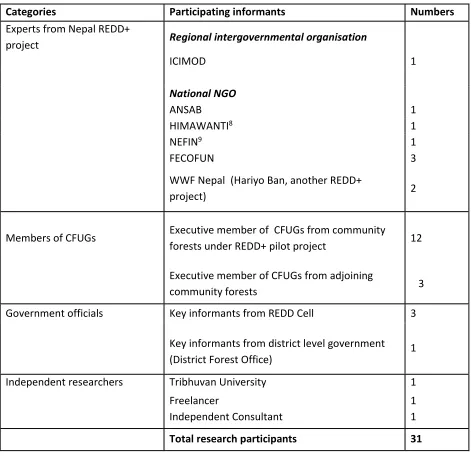
3 in Nepal, experts working in the field of REDD+, and officials from government bodies responsible for implementing REDD+ in Nepal. At the grassroots level, community forestry user groups that were involved in REDD+ pilot project and some that were only involved in community forestry were selected for the collection of primary data. Interviewees were chosen through purposive sampling.
1.2.
Definition of the research problems and research objectives
The community forestry program that started in late 1970s improved the forest conditions
significantly in Nepal, especially in mid-hills (covers 43% of the total land area). However, there are still issues in community based forest management, especially in community forestry in terms of benefit sharing. Issues such as who is eligible to get benefits from community forests would be further complicated if a REDD+ scheme is adopted. How can potential benefits be shared equitably among people involved in this sustainable forest management? Furthermore, it is feared that the adoption of REDD+ could compromise the success of the community forestry program if existing rights to manage and utilise forest products would be controlled by a central actor. With these outstanding issues, participation of communities in REDD+ scheme might aggravate the existing issues of benefit sharing. Questions also remain about what form incentives would take, and how significant the benefits accruing at the grassroots level will be? Can the 3 Es (Effectiveness, Efficiency and Equity) principles be achieved in an acceptable manner when distributing the benefits of REDD+ among local partners?
This study examines these questions about sharing the potential benefits of REDD+ in Nepal. Based on the literature review, a conceptual framework is developed to guide the research that focusses on two main components of benefit distribution systems: benefit flow and benefit sharing in the context of the community forestry of Nepal from REDD+ scheme. The goals of the study are to understand the impact of REDD+ activities on benefit sharing and provide insights into these critical questions by assessing the outcomes of case study in one of the REDD+ pilot project.
4 that could help to achieve or at least advance an equitable sharing of the benefits, the existing factors that affect benefit flow and sharing of benefits from REDD+ in Nepal, and, the way factors can be changed to promote an equitable allocation and sharing of benefits of REDD+.
The overall question of the research is how to share the potential benefits of REDD+ among
communities of Nepal that are involved in the management of forests. The researcher conducted a case study in the Ludikhola watershed, which is one of the pilot projects that received funds from REDD+. More precisely, the following questions were identified to answer the overall research question of this study.
Specific questions:
1. What are the potential effects of the introduction of REDD+ on communities involved in forest management?
2. What are the views from different groups of people working on REDD+ and community forestry on the (relative) importance of the 3 Es (Effectiveness, Efficiency and Equity) in the allocation and distribution of benefits of REDD+ and what can be considered equitable? 3. What mechanisms could help to achieve equity in sharing the benefits of REDD+? To what
extent, have these mechanisms been or likely to be considered and integrated into the design of a REDD+ scheme for Nepal?
4. What are the contextual factors that affect benefit flow and sharing of benefits from REDD+? How do these factors influence equity in the distribution of benefits?
5
1.3.
Thesis organisation
The thesis is divided into seven chapters starting with this introduction. The second chapter explains the background of community forestry program in Nepal providing the contexts for conducting the research. Furthermore, implications of implementing REDD+ in Nepal especially in community managed forests are discussed. Then, existing institutional arrangements formed to implement REDD+ in the country are described, and finally the political context of Nepal is
explained briefly as the change in government might affect the REDD+ process and the institutional arrangements.
Chapter 3 describes the theoretical foundation of the research presenting the review of literatures on accounting and funding mechanisms in REDD+; principles of effectiveness, efficiency and equity in sharing of the benefits of REDD+; potential benefits and costs of REDD+ in general; and the contextual factors that affect the flow and sharing of the benefits of REDD+ in community forest management.
Chapter 4 describes the conceptual framework that guides the research to achieve the objective of this study. This chapter connects the research gaps from the literature review with frameworks and literatures that are adopted and the specific research questions of the study. Further, the selection of research methods for data collection and analysis are described.
Chapter 5 presents the results and findings of the data collected from the case study, and chapter 6 discusses the findings to provide insights into the research questions. Finally, chapter 7 concludes the thesis.
6
Chapter 2: Setting the background - Nepal and REDD+
2.1. Introduction
This chapter describes the background of the community forestry program and its importance in the conservation and management of forests. Implications of implementing REDD+ in Nepal,
especially in community forests are discussed. The chapter is divided into four sections starting with the background of community forestry in Nepal. Section 2.3 describes the existing institutional arrangements formed to implement REDD+, and the political context of Nepal is explained as the frequent change in government might affect the REDD+ process and the institutional arrangements. Finally, section 2.4 summarises the chapter.
2.2. Community Forestry
This section provides the background of community forestry in Nepal. In addition, this section highlights the success factors of community forestry that should be integrated in REDD+ and the existing issues that need to be taken into consideration while participating in REDD+.
The nationalisation of forests in 1950 led to huge deforestation and forest degradation in Nepal due to lack of effective monitoring and enforcement systems in the country (Agrawal & Ostrom, 2001). In the late 1970s, new steps toward decentralisation of forest control led to the launch of
7 regeneration of forests and the increase in availability of forest resources, and due to pressure from forest dependent people, community access and withdrawal rights were increased. Now, the improvement of forest conditions and people’s livelihood go well together in this tenure reform (Dahal, Larson, & Pacheco, 2010).
About 1.45 million households of Nepal are involved in the community forestry programme, and 17,685 CFUGs have been formed covering 1,652,654 (1.65 million) hectares of National forest, which is over 25% of the total forest area of Nepal (Department of Forests, 2012). However, Nepal had an annual rate of 1.4 % of decrease in forest area from 2000 to 2005 (Food and Agriculture Organisation, 2005). Most of the deforestation is taking place in the plains, where high value commercial timbers are available and the success rate of the community forestry program is also low in comparison to hills. The main impulse behind the deforestation and forest degradation in the country are “weak natural resource management and administration, market failure response, rent seeking attitude, and structural socio-economic factors like poverty and limited livelihood options for forest-dependent populations” (Ministry of Forests and Soil Conservation [MoFSC], 2010, p. 40).
Through REDD+, local communities that are engaged in forest management can receive financial incentives and contribute to the global carbon market; however, the question remains whether REDD+ brings more benefits to communities that they are already receiving from the current community forestry regime (Karky & Skutsch, 2010). National actors might make changes to community forests to decrease the annual deforestation rate and forest degradation while participating in REDD+, which is also recommended as a key part of the REDD+ strategy options in the Readiness Preparation Proposal (MoFSC, 2010). However, many poor people in the villages are dependent on forest resources for fodder, fuel wood, and non-timber forest products for
subsistence use. Any change to current forest management regimes may pose risks to poor people, particularly those who have few or no private forest resources to depend on (McDermott &
8 Nevertheless, the study by Karky & Skutch (2010) suggests that the scenario of current system of sustainable harvesting in community forests could be continued and that carbon crediting should be done on what is left after their demands have been met. Also, there is a chance of
recentralisation of forest control in community forests from REDD+, as Monitoring, Reporting and Verification (MRV) of net emissions reductions at the national level are conducted by central actors and the global fund available to the national government for participating in REDD+ would reduce the financial burden that led to decentralisation in many developing countries (Phelps, Webb, & Agrawal, 2010). According to Phelps et al. (2010), “new research is necessary to optimise REDD+ effectiveness through a combination of decentralised and centralised forest governance” in
community forests (p.313). Generally, success factors of community forests should be integrated in REDD+ design to increase effectiveness, efficiency and equity, and provide more co-benefits from the REDD+ projects (Agrawal & Angelsen, 2009). However, several critical questions about
community forests still remain unanswered: “Who benefits from these forests – and who gets left out? How do community forests benefit poor and marginalised people?” (McDermott &
Schreckenberg, 2009, p. 158). These authors explain that benefit distribution in community forests raises “issues of equity” among forest dependent people. A similar question about how can REDD+ benefit local communities working for conservation and enhancement of carbon stocks equitably should also be addressed.
9 as critical issues that should be addressed in order to end inequities in benefit sharing from
community forests. Similarly, McDermott & Schreckenberg (2009) found four fundamental factors that enhance and strengthen social equity in the community forestry program: i) the program can reduce social inequity only when the main target group of the programme are poor and
marginalised people; ii) decision-making space should be expanded to include community members; iii) poor and marginalised people should be provided more space in decision making process; iv) benefit sharing should occur at the individual level rather than the community as a whole, to bring more benefits to poor and marginalised people.
Therefore, Nepal should be very cautious when implementing REDD+ within the existing structure of community forestry. No proper legal framework and mechanism at the global level have yet been established to determine how and to whom rewards (benefits) should be distributed equitably. Yet, “benefit sharing in REDD+ initiatives is necessary to convert the international donor support and any market-based financing into incentives for positive changes at the national and subnational level” (Forest Carbon Partnership Facility [FCPF], 2012). The whole scheme might fail if the benefits from REDD+ are not distributed equitably over the right beneficiaries. Moreover, the existing structure of the community forestry program, which is thriving at the moment, might get disturbed by participating in the ambitious REDD+ scheme without proper mechanisms. The following section explains the REDD+ processes and institutional arrangements to implement REDD+ in Nepal.
2.3. REDD+ process and institutional arrangements
Nepal is one of the partner countries of the UN-REDD programme and participating countries of Forest Carbon Partnership Facility, and at the preliminary stage in implementing a REDD+ scheme in the country. The Government of Nepal has submitted the Readiness Preparation Proposal as a national REDD+ strategy to the World Bank through the mechanism of FCPF in 2010, to be
implemented and reach ‘readiness’ by 2013 and beyond to achieve the vision of REDD+ (Ministry of Forests and Soil Conservation [MoFSC], 2010). The proposal has already been approved by FCPF in October 2010 and the Nepal government has received a readiness grant in March 2011 to
10 decrease in deforestation and forest degradation in the country and it has great potential to
contribute to the enhancement of carbon stocks (MoFSC, 2010). In the community forestry
program, communities have the right to use and manage forests but land tenure rights remain with the government. The carbon rights have not yet been clearly defined in the new structure of carbon forest management. According to the report “Carbon could be treated as a forest product (or service), in which case existing benefit sharing mechanism based on currently prevailing practices would apply (at least for above-ground carbon). However, there are further complications with this” (p.46). The paper lacks concrete information on the forest land tenure rights, carbon rights and the benefit distribution mechanism; and aims to develop more knowledge on these issues in the implementation phase from 2010 to 2013.
11 (responsible for providing technical support in developing and implementing REDD+ programs and policies), ii) Monitoring, Reporting and Verification (Department of Forest Research and Survey will provide technical assistance to conduct MRV, carbon accounting after implementation of REDD+ activities to establish deforestation and forest degradation reference scenario), and iii)
Communication and Outreach (focuses on awareness raising, capacity building and communication of REDD+ pilot projects outcomes).
From 1990, with the introduction of multiparty democracy in the country, there has been an
unstable government led by mostly privileged and high caste people. Consequently, the Communist Party of Nepal (Maoist) with the support of the marginalised and disadvantaged people from the rural part of the country started an insurgency from 1996 which lasted for 10 years. There was a huge loss of resources and lives during this time. The revolt started against the mainstream political parties; however, because of the royal coup in 2005, the Maoist and political parties launched protests together against the autocratic royal regime. The civil war finally came to an end in 2006 as the monarch invited seven party alliances along with Maoist rebels to conduct the election of a constituent assembly to write the new constitution. An interim constitution came into force on 15 January 2007. The election in 2008 brought victory to the Maoists and a new government was formed under their leadership. However, since then several governments from different political parties have run the country, but there is no sign of the adoption of a new constitution. In 2012, the constituent assembly was dissolved because of its inability to adopt a new constitution within the extended deadlines and the government announced to have another election. A second election for a new constituent assembly was held on 19 November 2013. Given this background of great
political upheaval in the country, the current institutional structure of REDD+ governance will be affected when a new constitution is adopted, possibly followed by new forest policies. However, Dahal et al. (2010) argue that even during ten years of insurgency when many things came to a halt and were disturbed, CFUGs, established by tenure reform i.e. the community forestry programme, was running smoothly and unaffected by the political instability and conflict in the country.
12 However, there is no framework under UN-REDD for developing national benefit sharing
mechanisms. Therefore, the Nepalese government has proposed to rely on the existing multi-stakeholder forest management modalities, and the benefit sharing mechanisms that are currently implemented for protected areas and hydropower schemes implementing the REDD+ readiness preparation proposal. Further, the government has proposed to establish a new REDD Trust Fund to channel the funds, which would need separate legislation to ensure transparency, and define the roles and responsibilities of different actors. Likewise, the fund-based approach (explained more in the following chapter) is projected to be implemented in order to channel REDD+ payments in the country. Under this approach, strategic issues (policy, legal and tenure arrangements) are proposed to be dealt with at the national level; and, benefit sharing, financing and monitoring are to be conducted at the subnational level.
2.4. Chapter summary
This chapter described the background of community forest management in Nepal and existing issues in the sharing of the benefits from community forests. Since community forestry is a successful forest management regime in the country, the government proposed to implement REDD+ in community managed forests. Accordingly, institutional arrangements are formed to implement REDD+ in the country, which is explained briefly in this chapter.
13
Chapter 3: Literature Review
3.1. Introduction
This chapter explains the theoretical foundation of this study and how the objectives of the research are framed. The chapter is divided into six sections: Section 3.1 provides a brief introduction of the chapter. Section 3.2 describes the available international pathways in the funding mechanisms, and the features of well-functioning benefit sharing mechanisms. Section 3.3 explains the principles of effectiveness, efficiency and equity that are formally required to assess any legal benefit sharing mechanisms established in the nation. Then, the principle of equity is explained in detail. Section 3.4 describes the potential benefits and costs of REDD+ in community forest management. Then, section 3.5 explains the contextual factors that affect benefit flow and sharing of benefits in community forest management. Finally, section 3.6 concludes the chapter.
3.2. Benefit sharing mechanisms: a review of the literature and discussion of issues
Although negotiations on REDD+ under the UNFCCC are progressing to the stage of addressing issues associated with the implementation of national programs, including the systems for MRV, the distribution of the potential benefits of such schemes remains uncertain (Torres & Skutsch, 2012). Research on this topic is timely and essential for REDD+ schemes to succeed. To address this issue, it is important to know what ideas or proposals regarding the establishment of benefit sharing mechanisms2 exist. What are the available methods to link international sources of funding to the people working at the grassroots level? What costs and benefits are potentially produced under this scheme? What factors affect the sharing of benefits? And finally, how do the proposed benefit sharing mechanism stand up to the criteria of the 3 Es. The following section reviews what the literature has to offeron these questions.
2 In this study, ‘mechanisms’ are rules and processes by which decisions on benefit sharing are to be
14 3.2.1. Accounting and funding mechanism in REDD+
“A benefit-distribution system means a set of rules, regulations, policies, and mechanisms for sharing monetary and non-monetary rewards from policy or market incentives for ecosystem services” (Hoang, Do, Pham, van Noordwijk, & Minang, 2013, p. 49). In this study, only the service of forest-carbon sequestration is emphasized and no other ecosystem services as defined in the Millennium Ecosystem Assessment 2005 or co-benefits from REDD+ are considered. Generally in the context of REDD+, benefits can originate from incentives3 or forest rents4 towards the effort of the local communities/designated beneficiaries to bring positive results in REDD+ program (Forest Carbon Partnership Facility [FCPF], 2012). According to the background note on benefit sharing by FCPF (2012), benefits, associated beneficiaries, mechanism used for recording the benefit, and the mechanism for distribution of the benefits to the beneficiaries are very important dimensions in benefit sharing.
Currently, the funding mechanisms in REDD+ are either donor driven (fund-based approach) or market driven. The fund-based approach is generally a top-down approach where donors at the international level either reward or compensate the national agencies and then benefits are transferred to the local community via sub-national intermediaries or direct project-based funding where locals receive payments directly from donors (Lindhjem, Aronsen, G.Braten, & Gleinsvik, 2010). According to Lindhjem et al. (2010), in the fund-based approach vertical benefit distribution occurs from donor to local level and horizontal distributions of benefits within local and indigenous communities. In the market-driven approach, REDD+ payments are directly paid by buyers of
carbon credits (polluters with high emissions) to the sellers (communities working to achieve REDD+ goals) (Bluffstone, Robinson, & Guthiga, 2013). Some authors argue that in community forestry program, a market-based approach is more appropriate to complement the decentralisation
3 Incentives might be monetary or non-monetary benefits transferred to a stakeholder to enable or
motivate a particular behaviour
4 Forest rent includes distributing the revenues among stakeholders obtained from the management of
15 associated with that program. However, the current trend towards financing REDD+ schemes is moving towards a fund-based approach.
Whether fund-based or market driven, three options to coordinate accounting and reporting related to international financial inflows in the country are under consideration in international negotiations (Costenbader, 2009). They are 1) a national approach (national level accounting), 2) project (or sub-national) accounting, and 3) a hybrid (or nested) approach. These three approaches for accounting REDD+ activities require internationally agreed rules for MRV, a system for payment, and institutional arrangements at both the national and the international level (Angelsen, 2008). Although a national approach is cost effective in terms of transaction costs and MRV, it might recapture the local ownership of user groups of community forests and projects (Costenbader, 2009; Torres & Skutsch, 2012). On the other hand, according to Costenbader (2009), although a subnational approach incorporates wider participation of poor people and attracts more investors, it cannot address broader deforestation drivers and faces the issues of weak government at that level.
Therefore, according to Pedroni, Dutschke, Streck, & Porrúa (2009), countries should adopt a nested approach, which integrates project-level and sub-national REDD+ schemes into a national-level accounting framework. A nested approach is a bottom up approach that would enable the strengthening of government capacities when conducting REDD+ activities at the subnational level. It offers a more flexible approach that allows more countries to participate in REDD+, as it enables countries to start with subnational activities that can be subsequently scaled up. However, a
challenge in this nested approach is to harmonise these two levels (Angelsen, 2008). To address this challenge, Pedroni et al. (2009) have proposed to adopt a double-accounting approach within a nested REDD+ mechanism, by which both subnational activities (projects, programmes, activities, at the district, municipal, or regional level) and national action can start simultaneously. Accordingly, Nepal has proposed a hybrid approach (combining a national approach and a subnational approach) to channel the funds or credits obtained from markets to the grassroots level. This nested
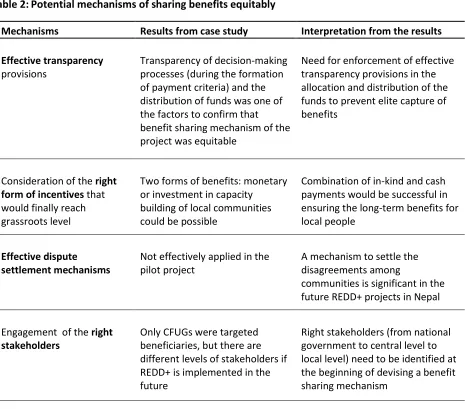
16 Skutsch, 2012). However, To et al (2012) claim that the benefits of having a ‘nested approach’ in REDD+ mechanism outweighs these issues and complexity. In terms of benefit sharing, these authors recommend that greater clarity needs to be created about: 1) possible pathways of incentive flows from international sources; 2) the forms of incentives so that they reach the grassroots level; and 3) the basis of allocation of incentives between different stakeholders. Clarifying these issueswould offset the complexity associated with a nested system.
In addition, Lindhjem et al. (2010) recommend that well-functioning benefit sharing mechanism should have five generic features. They should engage the rightstakeholders, determine the right
forms and level of incentives, create a legitimate mechanism for the management of benefits, enforce effectivetransparency provisions, and develop effective dispute settlement mechanisms. These recommendations are drawn from a study of experiences with benefit sharing mechanisms in a range of countries, and provide lessons for future REDD actions. The report further illustrates some important findings from community forests around the world in benefit sharing: 1)
government procedures are often cumbersome and that only small benefits are transferred to the communities, 2) clear and stable government rules on benefit sharing are important for incentives, and 3) marginal groups should be included in community forestry programs to make benefit sharing more equitable, efficient, and effective while achieving REDD+ goals.
17
3.3. Principles of Effectiveness, Efficiency and Equity in benefit sharing
This section describes the principles of effectiveness, efficiency and equity in sharing the benefits of REDD+.
According to UN-REDD and Department of Forestry Viet Nam (2010), any options for a legal framework at the national level for benefit sharing mechanism should be assessed against the criteria of 3 Es. An equitable benefit sharing mechanism should ensure that the transfer of benefits and costs is inclusive and fair among stakeholders affected by the REDD+ program. Also, effective benefit sharing mechanism should define clear and enforceable rules and processes for the distribution of REDD+ benefits under performance based systems. Under these criteria,
communities receive payments for positive outcomes and no payments for negative outcomes. Further, effective benefit sharing mechanism needs to balance a flexible approach to adapt to the local context and a robust approach to ensure that the objective of performance based system is achieved. Finally, an efficient benefit sharing mechanism includes administrative procedures that complete REDD+ activities in a timely and cost effective manner through minimizing levels of input and funds and maximising the outcomes. However, combining all three criteria in benefit sharing mechanisms often will require trading-off among equity, effectiveness, and efficiency. For instance, “the greater the number of hierarchical levels at which revenue is managed, the less cost-effective the mechanism is likely to be. There will tend to be higher implementation costs and a higher risk of rent-seeking and corruption. On the other hand, fewer hierarchical levels make it harder to ensure efficiency and equity in disbursement because of the ‘distance’ between the source and target of the funds” (UN-REDD & Department of Forestry Viet Nam, 2010, p. 13). Likewise, trade-off between equity and carbon effectiveness can occur when bringing change in behaviour that degrades forests needs to be sufficiently rewarded individually or collectively. Otherwise the change in behaviour will not achieve positive outcomes in the long term. However, “if too many people benefit from
18 Furthermore, Angelsen, Brockhaus, Sunderlin, and Verchot (2012) discuss the question of who should benefit, especially the discourses on effectiveness and efficiency that emphasizes the goal of carbon emission reductions suggesting that benefits should be distributed according to the
contributions of the people or communities that bring reduction in emissions by changing their behaviour or actions. By contrast, ‘equity’ focuses on the question of which actors have the rights to benefits from REDD+ giving less attention to their contributions to reducing carbon emissions. In addition, the overall success of REDD+ depends not only on the amount of carbon emission
reductions but also on the mechanism to ensure that there is no harm done to forest dependent people in communities that do not participate in REDD+ as well as bringing positive outcomes improving their livelihood in participating communities (Jaung & Bae, 2012). To enhance people’s livelihood, REDD+ programs should target to produce durable impact on equity in participating (and other affected) communities, as well as being efficient and cost-effective to attract international investors or donors.
3.3.1. Equity in sharing of benefits of REDD+
While trade-offs might need to be made among effectiveness, efficiency and equity, Angelsen et al. (2012) concluded that “decision to emphasize either effectiveness and efficiency or equity has significant implications for the design of benefit sharing mechanisms” (p.150). In the discussion on the 3 Es most authors suggest that ‘equity’ is the most crucial and challenging component in the design and implementation of benefit sharing mechanism for REDD+. Moreover, Skutsch (2013) suggest that efficiency and effectiveness might not always support each other, but these criteria are generally understood. However, this author argues that equity in REDD+ is controversial and
complicated. Additionally, Gebara (2013) argues that equity in benefit sharing mechanism is a fundamental condition if the objective of REDD+ is to be achieved. This study, therefore, focuses on equity and attempts to gain a better understanding of how the sharing of benefits from REDD+ could achieve equity in the context of Nepal.
19 benefits of REDD+ by Skutsch (2013), concerns on equity are found regarding who should have rights to carbon benefits (who gets the rewards): whether it should go to stakeholders involved in the implementation and facilitation of REDD+ in the country or legal right holders (land tenure), or forest stewards who have been conserving and managing forests, or rural poor populations and forest dependent people. Furthermore, at the international level, there are debates on how to distribute the benefits to REDD+ participant countries. At the national level, the process of achieving the goal of equity is unclear, although most of the REDD+ participating countries have stated the need of acquiring equity in Readiness Preparation Proposal. Likewise, lists of safeguards related to the promotion of social justice and equity and protection of indigenous peoples’ rights and environmental issues are available; however, it is not clear how these safeguards will work on the ground. Furthermore, insecure land tenure and unclear ownership of carbon rights are major problems in devising benefit sharing mechanism in many nations (Skutsch, 2013).
Since equity can be interpreted in different ways, there are uncertainties and controversies around the issues of equity in sharing of benefits of REDD+ (Skutsch, 2013). In addition, there is no
commonly agreed definition of equity and agreement about the process of achieving equity in sharing of benefits of REDD+ or similar programme. There are different views on equity. According to Angelsen et al. (2012), there are four main views regarding who should get benefits i) benefits should go to actors with legal rights; or ii) benefits should go to low-emitting forest stewards; or iii) benefits should go to those incurring costs; or iv) benefits should go to effective implementers. Attempting to address 3 Es in benefit sharing mechanism, there are certainly significant trade-offs to be made.
20 In addition, Mcdermott, Mahanty, and Schreckenberg (2011) identified three inter-related
dimensions of equity: a) Distributive equity, b) Procedural equity, and c) Contextual equity.
a) Distributive equity
Distributive equity is based on several principles: equality, social welfare, merit, and need. Specifically, it looks at policy outcomes in terms of who gets how much and compares those outcomes to the goals. Moreover, this criterion of equity should answer the following questions:
i. Is the distribution of benefits, costs and risks given consideration?
ii. What is the intended basis for the distribution of benefits: equal shares, net social welfare, merit, needs?
iii. What is the observed distribution of benefits and their impacts?
“Distributive concepts of equity address the dilemma of how resources should be fairly allocated within societies, proposing principles for bargaining and negotiation between competing interests” (Mcdermott et al., 2011, p. 17).
b) Procedural equity
Procedural equity is the fairness in the political process that allocates resources and resolves any conflicts among different stakeholders. In particular, it comprises representation,
recognition/inclusion, voice and participation of marginalised people with respect to natural resources (women, the landless and ethnic minorities) in decision-making on the allocation and distribution of benefits. Accordingly, procedural equity in decision-making should answer the following questions:
i. Which marginalised groups are newly recognised? Who is voicing their interests? ii. Who is participating in decision-making and who is left out?
21 This component of equitable distribution links together the other two dimensions: distributive and procedural equity. Additionally, Mcdermott et al. (2011) consider “the pre-existing conditions under which people engage in procedures and benefit distributions – and which limit or enable their capacity to do both” (p. 4). The following questions could be used to analyse and evaluate the contextual equity in any initiatives (policies, projects, or cases) of REDD+.
i. Are marginalised individuals able to enjoy benefits?
ii. Do they have access to the resources (e.g. land, capital) necessary to do so? iii. What new capabilities do they enjoy?
iv. Do decisions reflect the interests (i.e., the effective power) of the marginalised? v. Are the causes of inequity identified?
According to these authors, most of the policy discourses on climate change relate equity only to distribution; however, they argue that all these three dimensions are components of equity. It is not possible to separate how distribution, procedure, and the nature of capabilities, access and power contribute to the degree of (in) equity in the social condition. “All these three factors of equity come together in the normative principle of participatory parity, which insists on fairness, inclusion/representation and democratic decision-making at all levels from the design of a REDD scheme to its operation” (p. 5). Furthermore, distributional, procedural and contextual equity should be understood as interdependent aspects of a multi-dimensional, and multi-scalar
phenomenon. Additionally, the authors concludedthat interventions designed solely to distribute the payments without considering the local decision-making inputs, access to resources and power relations, are unlikely to have equitable consequences.
22 The equity framework, developed by Mcdermott et al. (2011) for the analysis of equity to
determine how local equity is affected by exogenously driven changes in the value of ecosystem services, defines merit based distributive equity as the distribution of benefits on the basis of individual productive contributions or sacrifices made (i.e. opportunity costs). These authors argue that the need based distributive equity should ensure that rewards are distributed proportional to individual needs thereby, reflecting the concern for the least advantaged. Even though the
description of distributive equity by Cattaneo et al. (2010) and Mcdermott et al. (2011) are
compatible, the latter argues that three criteria of equity (procedural, distributive and contextual) should be analysed together.
In summary, this section explained the need of assessing 3 Es criteria against any benefit sharing mechanisms of REDD+ in the country. It is found that trade-offs might need to be made when all these criteria are combined. Furthermore, while there are concerns about equity in sharing of benefits of REDD+ at different levels and accounting approaches, the research concentrates on equity regarding who will be the beneficiaries of carbon benefits. However as discussed above, equity has different definitions and understandings. This research adopts three components of equity (distributive, procedural, and contextual) especially the distributive equity (merit vs. need based) in one of the Nepal’s pilot projects to study how equity has been approached. In addition, the factor of contextual equity such as capabilities, access to resources, and power relations, coherent with the factors of benefit flow and benefit sharing are studied in the research. These contextual factors are explained in section 3.5.
23
3.4. Potential benefits and costs
In benefit sharing mechanism, it is important to know what kind of benefits and costs could be generated from a REDD+ induced forest management regime, and what the potential consequences are for the existing costs and benefits that are already derived from community forests. The overall benefits of REDD+ are determined by costs, demands, and mechanisms set up for sharing (Lindhjem et al., 2010). The overall existing benefits and costs associated with community forestry, according to RECOFTC – The Centre for people and forests (2007, p. 3), are described as follows:
Existing benefits from community forests
Social benefits: These social benefits are mostly qualitative in nature, which ultimately develop the capacity of communities.
Strengthening and development of coordination and governance mechanisms
Relationships and networks (social capital)
Political empowerment
Creation of local work opportunities
Institutional enhancement, tenure, capacities, welfare and security.
Economic benefits: These are quantitative benefits obtained through the sale of non-timber products and timber from community forests.
Access to Non-Timber Forest Products and timber for direct household use
Income from the sale of non-timber forest products, agro-forestry yields, timber and
environmental service markets, and employment in community forestry’s activities.
Environmental benefits:While conducting sustainable forest management, there are other environmental benefits too.
24
Costs associated with community forestry
Below are the costs associated with community forestry in terms of time, money and opportunity foregone while managing the forests.
Negotiating property rights: This cost is related with the time and effort that communities put in while negotiating for the property rights under community forestry.
Gathering information for a management plan: When making a management plan, communities have to collect information to identify the areas that need extra supervision and management.
Regenerating degraded resources and designing management arrangements: After finding degraded areas, communities design arrangements to regenerate those areas.
Monitoring compliance with rules: To implement the management plan effectively, communities spend time and money on forest guards, forest protection, and day to day management works.
Foregoing alternative uses of time and of land/ resources: These costs are associated with opportunity costs of using the land for community forestry instead of other management regimes or for commercial purpose (timber production).
Potential benefits and costs of REDD+
25 scenario 2, potential benefits (monetary and non-monetary) identified are fuel wood, fodder, timber, non-timber forest products, carbon revenue while the potential costs are labour management, forest protection, carbon measurement, project proposal and documentation, marketing of carbon credits, adoption of more formal management system, and employment of more forest guards. However, the study did not consider transaction costs associated with MRV, opportunity costs, and the capacity building of community members. The finding of the study explains that the size of forest area determines the net benefits from carbon trading. Large forests (383 ha is the largest one from the selected three community forests) involve less relative cost of management and produce greater net benefits. Further, it is found that small forests (96 ha is the smallest one) are worse off under scenario 2 and should not participate in REDD+ scheme unless the carbon price is really high to compensate their implementation costs. For instance, authors compared the costs and benefits in economic value among three different forests under three scenarios and showed that two small forests showed lower net benefits under scenario 2 than in scenario 1 when the price of one tonne of CO2 is $1. However, at $5 per tCO2, all CFUGs are found to make a profit.
26
3.5. Benefit sharing in community based forest management
Under REDD+, vertical payment is a system in which investors or donors at the global level pay a national government according to the net amount of carbon emissions reduced in the country. From the national government, funds are then passed on to the sub-national level. Transfer of payments to the local level through benefit distribution, after the payment at the national level, is critical. Since the government of Nepal is set on implementing a REDD+ scheme in the country, especially the community managed forests, it is significant to understand the existing structure of distribution of benefits from community forests at the moment.
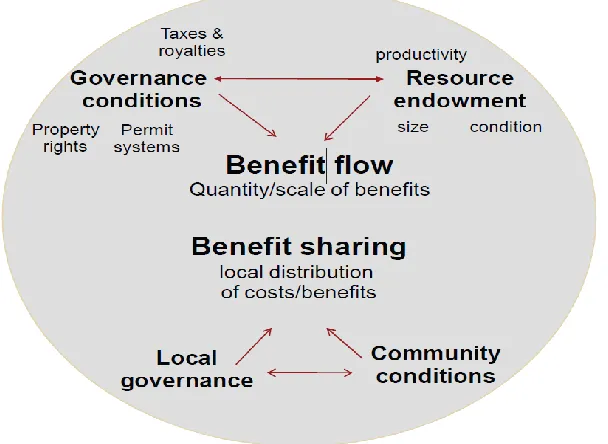
The following figure explains the contextual factors that affect the capture of benefits from community based forest management and the sharing of benefits within the communities.
Figure 1: Factors affecting benefit flow and sharing of the benefits in collaborative forest management (horizontal benefit distribution)
27 Figure 1 identifies the factors that affect how benefits from community forests are distributed. The framework was developed by Mahanty et al. (2009) and is based mostly on research on the
commons. It describes how benefits emerge through an interplay of governance arrangements at various levels, resource conditions, and socio-economic conditions. This framework analyses how the flow of benefits and sharing of those benefits are influenced by certain factors in community based forest management. The framework was revised to analyse benefit sharing in community-based natural resource management in a series of case studies and workshops in Cambodia, Lao PDR and Viet Nam, and was followed by a regional forum to evaluate these experiences. However, according to Mahanty et al. (2009),the framework lacks two fundamental factors: 1) local
government and 2) intermediaries (for instance, non-governmental organisations) in benefit sharing. Although the framework is developed for collaborative forest management, some of the factors that affect benefit flow and sharing are important and deserve consideration in community forests and REDD+ schemes. Thus, this research adopted the following factors from the framework to analyse the benefit sharing of REDD+ in the case study.
3.5.1. Benefit flow
The analysis of benefit flow in the framework attempts to understand the role of resource governance and its influence on the scale, allocation and distribution of benefits reaching communities.
1. Governance arrangements enable communities to capture any benefits from community forests. These are important factors that affect flow of benefits, and comprise i) property rights (the nature of resource rights as an important pre-condition for effective
management of forest resources and affecting people’s incentive, actions, resource
28 revenue is not taxed due to absence of high value timber products). Also, who are involved in making decisions on the matters of governance arrangements is important to study.
i) Property rights: In terms of property rights, the national government of Nepal needs to clarify the situation regarding new carbon rights under the REDD+ programme: Who will be the owner of sequestered carbon?
2. Resource endowment: i) Productivity ii) Size and iii) Condition
High quality forests take a short time to produce benefits whereas degraded forests take long a time and incur high transaction costs while benefits are not produced immediately. Similarly, forest size also determines the scale of benefits to flow from the forest resources; the study of Karky & Skutsch (2010) indicated that small community forests do not generate enough benefits to offset the cost associated with REDD+.
3. Global carbon price: This factor significantly influences the scale of benefits for community forestry generated by REDD+. As mentioned earlier, the level of monetary benefits depends significantly on the carbon price and size of forest.
3.5.2. Benefit sharing
The below factors – local governance and community conditions affect the sharing of the benefits at the local level.
1. Local Governance
29 of quality of forests and its management. Also, rules regarding who participates in decision making is important feature that effect the sharing of the benefits.
Role of local government at the district level is important in mobilising the money/reward received from the global level. Thus, it was included in this study, and because it is also one of the fundamental factors lacking in the framework as stated by Mahanty et al. (2009).
2. Community conditions
Similarly, social rules and norms, internal differentiation within communities affect benefit sharing. Mahanty et al. (2009) mentioned that elite capture in governing bodies is one of the major issues in local benefit distribution, mainly due to “weaknesses in local governance and implementation of collaborative forest management initiatives, including poor
accountability and no systematic monitoring” (p. 277) .
3.6. Chapter summary
Although negotiations on REDD+ under the UNFCCC are progressing to the stage of addressing issues associated with the implementation of national programs, including the systems for MRV, how the potential benefits of such schemes will be distributed remains unclear.
Currently, funding mechanisms in REDD+ are either donor driven (fund-based approach) or market driven. Whether fund-based or market driven, three options to coordinate accounting and
30 Since no detailed design has been devised to implement the proposed hybrid approach to manage the sharing of the benefits of REDD+ within the country, it is important to learn about experiences with benefit sharing mechanisms from other relevant REDD+ participating countries. Consequently, important features that are recommended to be included in a well-functioning benefit sharing mechanism, developed from a study of experiences with benefit sharing mechanisms in a range of countries, are adopted for this research.
Much of the literature on community forestry in Nepal reveals that forest user groups are still facing disparities in benefit sharing; and participating in REDD+ can further complicate these issues. Thus, it is essential to highlight those concerns. For instance, the study “A fair share? Sharing the benefits and costs of collaborative forest management” by Mahanty et al. (2009), which is based mostly on the commons research put forward a framework that identifies the main elements affecting benefit sharing. These include governance arrangements at various levels, resource conditions, and socio-economic conditions. Further, the sharing of benefits is also affected by local governance and community conditions. This study adopted this framework with the addition of the global carbon price as this significantly affects the total revenue derived from REDD+.
As found in the literature review, “issues of equity” remain a major concern in the distribution of benefits in community forestry program in the context of Nepal. These issues require consideration alongside the principles of the 3 Es as criteria for sharing the benefits from REDD+ in community forests. Efficiency and effectiveness might not always support each other, but these criteria are generally well understood. However, equity is controversial and complex. Further, equity in benefit sharing mechanism is a fundamental condition if the objective of REDD+ is to be achieved. There are many discourses and discussions around the principle of equity. The researcher has adopted the view that distributive, procedural, and contextual equity should be analysed and considered
together.
31
Chapter 4: Methodology
4.1. Introduction
This chapter explains the research design and methods. This chapter is divided into the five sections: i) 4.2 details the conceptual framework of the study; ii) 4.3 describes the qualitative research and case study approach; iii) 4.4 further explains the research methods – data collection (study area, selection of research participants, data collection procedures) and analysis procedures, and iv) 4.5 describes the advantages and limitations of the research methods used in the study.
4.2.
Conceptual Framework
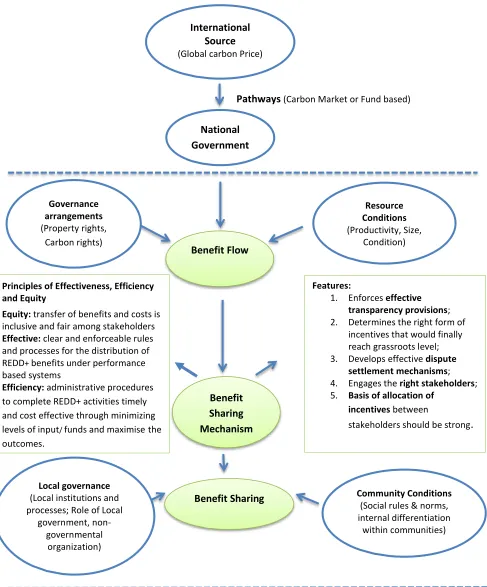
Based on the literature review, a conceptual framework is developed to analyse the flow of
benefits, benefit sharing mechanisms, and sharing of benefits in community forestry from REDD+ in Nepal (See Figure 2).
Assuming that benefits from REDD+ will be generated from international sources through a carbon market or fund based approach, the national government would, in first instance, receive those benefits. This research is mainly focused on how these benefits would and should be allocated and distributed from the national level onwards. More specifically, after the government receives benefits from international sources, the horizontal benefit distribution of benefits are analysed in the study.
33
Pathways (Carbon Market or Fund based)
Features:
1. Enforces effective transparency provisions; 2. Determines the right form of
incentives that would finally reach grassroots level; 3. Develops effective dispute
settlement mechanisms; 4. Engages the right stakeholders; 5. Basis of allocation of
incentivesbetween
stakeholders should be strong. Benefit Sharing Mechanism ource of Fund International Source
(Global carbon Price)
National Government ource of Fund Benefit Flow Benefit Sharing Local governance
(Local institutions and processes; Role of Local
government, non-governmental
organization)
Community Conditions
(Social rules & norms, internal differentiation within communities) Resource Conditions (Productivity, Size, Condition) Governance arrangements (Property rights, Carbon rights)
Principles of Effectiveness, Efficiency and Equity
Equity: transfer of benefits and costs is inclusive and fair among stakeholders
Effective: clear and enforceable rules and processes for the distribution of REDD+ benefits under performance based systems
Efficiency: administrative procedures to complete REDD+ activities timely and cost effective through minimizing levels of input/ funds and maximisethe outcomes.
Equity
34 The following research questions are derived from these factors:
1. What are the potential effects of the introduction of REDD+ on communities involved in forest
management?
For this question, the researcher interviewed the selected respondents if they can identify any potential effects of the introduction of REDD+ on communities involved in forest management.
2. What are the views from different groups of people working on REDD+ and community forestry
on the (relative) importance of the 3 Es (Effectiveness, Efficiency and Equity) in the allocation
and distribution of benefits of REDD+ and what can be considered equitable?
As described in the previous chapter, any benefit sharing mechanism should be assessed against the principles of the 3 Es; this research question is formulated to understand the views from different groups of people working on REDD+ on the importance of the 3 Es in the allocation and distribution of benefits of REDD+. The components of equity -- distributive, procedural, and contextual as defined by Mcdermott et al. (2011) -- is adopted to analyse the sharing of the benefits of REDD+ in the case study. Linked to this, the use of merit (contribution) vs. need based distributive equity criteria identified by Cattaneo et al. (2010) in the allocation and distribution of the benefits of REDD+ is analysed.
3. What mechanisms could help to achieve equity in sharing the benefits of REDD+? To what
extent, have these mechansims been or are likely to be considered and integrated into the
design of a REDD+ scheme for Nepal?