THE STRUCTURED MODEL FOR
FUNCTION ALLOCATION ANALYSIS
SUNG-GYUN OH
Department of Systems Engineering, AJOU University, Suwon, Korea
PEOM PARK
Department of Industrial Engineering, AJOU University, Suwon, Korea
Abstract :
For successful function allocation analysis, there is a need for collaboration of all stakeholders affected by the life cycle of the system. This Article presents the structured design model that can support the functional analysis activities of multidisciplinary team and their communication. We created the human task and system functional model by using the Design Structure Matrix. Also, by using this model, we built the automation model supporting the human perception, decision and Action. For the efficiency of analysis activities, we ensured convertibility with the IDEF-0, the conventional system design modeling language. To validate the effectiveness of the analysis activities using this model, we applied the analysis activities to specific task for safety personnel among the subway station fire response scenarios. Based on the results, we defined the automation function of safety personnel’s task.
Keywords: Interface Management; DSM; MBSE; System of System.
1. Introduction
For the human factor and ergonomics, the Function Allocation was treated consistently as important research theme for half a century[Cummings (2014)]. Historically, the area has focused predominantly on the allocation of physical tasks and on whether a human or a machine is better suited to undertake such tasks[Challenger, Clegg, and Shepherd (2013)]. The Role Allocation approach, called “Men are better at” and “Machines are better at”, has a far-reaching influence on many studies. However, this human-machine task allocation analytical approach has limitations, given that the automation is not “All or none”. That is because complete automation of some functionality of system may sometimes result in failure close to catastrophe[Sarter and Woods (1992);Sarter and Woods (1994);Dornheim (1995);Billings (2007)]. This may be attributed to the excessive human reliance on automation[Parasuraman and Riley (1997)] or attributed to the Situation Awareness that has become lower[Endsley and Kiris (1995)]. The issue of whether the automation should be selected or not and whether it should be selected to what degree requires the approach from various viewpoints, rather than requiring agent’s capability alone[Grote, Weyer, and Stanton (2014)].
This view has also been presented in the same way in the system engineering domain. According to the “HSI” which is published by the NRC in the United States in connection with HSI activities that include the Function Allocation, it would be desirable to push forward with the design activities through system engineering framework applying various tools and methodologies used in HSI sector and it would be necessary to ensure the presentation of common modeling language supporting mutual communication of multidisciplinary HSI organization members. To summarize, multidisciplinary team would need to be formed to ensure approach from wider perspective for successful Function Allocation Analysis[Mavor (2007)].
The support of the modeling language is required to ensure that Project team carries out the Function Allocation analysis tasks effectively. That is because the representations which are shared visually such as models are very effective for the members participating in the design and analysis activities. The models that can be represented visually can improve cognitive ability[Norman (1993); Pasztory (2005)] and reduce the working memory load[Suwa and Tversky (2002)]. Besides, various benefits can be obtained [Oliver (1997)].
This article was aimed to provide structured design model supporting the communication and analysis activities of multidisciplinary team involved in the Function Allocation Analysis
2. Modeling Language: Design Structure Matrix
The model for function allocation analysis task should apply the model which is compatible or used by SE organization, if possible. That aims to reduce the communication error that can occur in the course of the use of different models during the repetitive analysis process, and to ensure the consistency and completeness of information. Moreover, this model should be easily legible by any user. We have selected the Design Structure Matrix as a model for the Function Allocation Analysis.
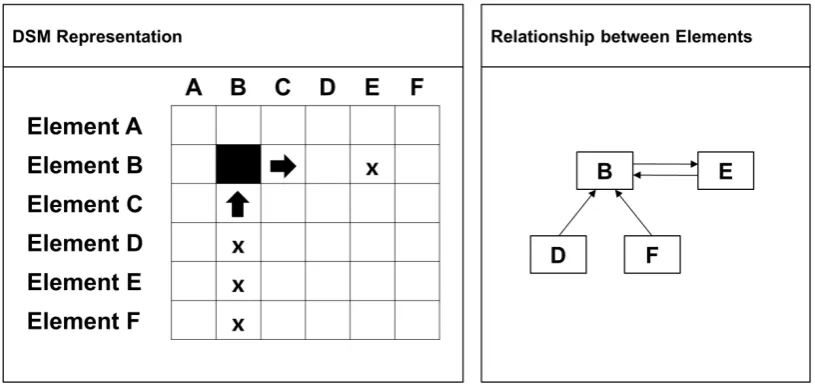
DSM implements the interactions between system components in the form of matrix, checks interaction between the components, and applies the reading method same as that of N2 Chart[Browning (2001)]. This model has the advantage that it can represent the complex static interaction between physical elements or functions in a simplified manner. Especially, this model is applied to the evaluation of human-system interface by leveraging its capability to quantify the strength of interaction between the components for representation.
Fig. 1 Representation Rules of DSM
3. Structured Model for Function Allocation Analysis
3.1. The Structuralization of System CI
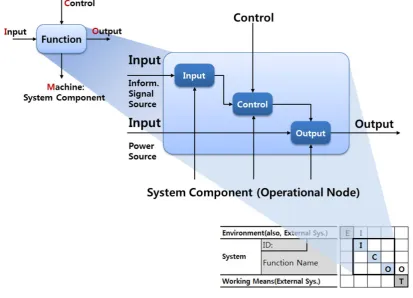
Although the system function has different sub-function structure, depending on the purpose of implementation, the system function mostly includes the Input Element, Control Element, and Output Element. In other words, the system function can be inferred via the external interface of function even if the structure of function is still in the black box state.
As mentioned before, the general function can be classified into 1) input function to convert information necessary for the control after receiving the external signal and data, 2) control function that controls the output of information that has been fed according to the external control(or the rule that has been input beforehand), and 3) output function that implements the intended duties. As shown in the Fig. 2 below, this can be represented as IDEF-0.
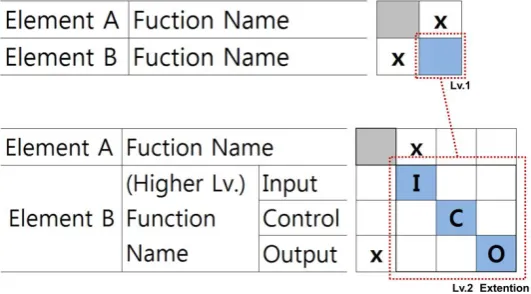
As the upper level functional block is extended to the lower level, the function is found to have broken down into input, control, and output functions. Those abstract functions which have been extended to the lower level can be converted to DSM again. In the Fig. below, the DSM includes the Input, Control, and Output Element. The data or signal fed from the Input Element is defined as the “Input Item”. The signal or data fed from the Control Element is defined as the “Control Item”. Meanwhile, the item output from the Output is defined as “Output Item”.
Fig. 2 Structuralization of CI Model
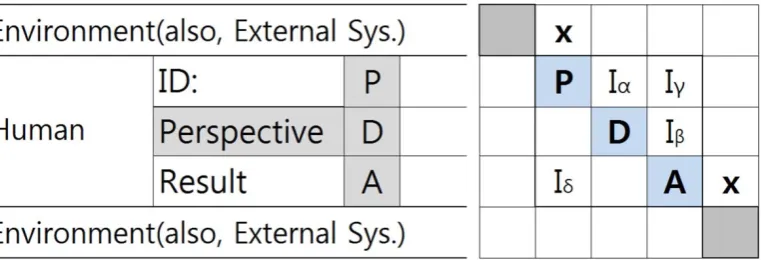
3.2. The Structuralization of Human Task
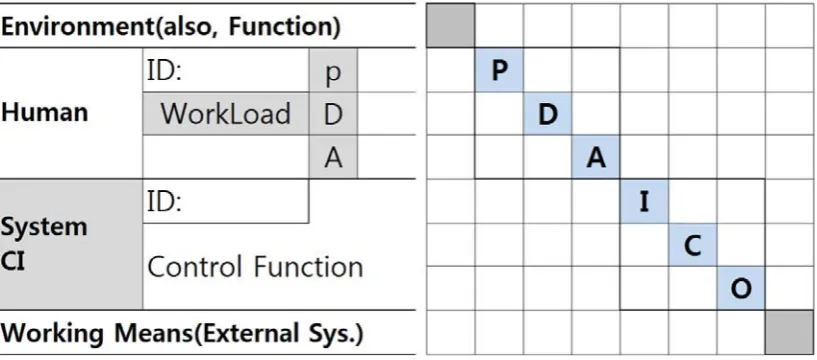
below. This IDEF-0 model was converted into DSM again, and human function includes the Perception, Decision, and Action, i.e., the P-D-A Element.
Figure 1 Structuralization of Human Task
3.3. Extended Model for Configuration Item(CI) of System
The function allocated to the system CI can be extended by using then structured function model as shown in
Error! Reference source not found.. The human model, CI, model, or combination model which are presented above can be used based on the results of function classification.
Fig. 3 Each Element can be Extended to Level.2
represented, no diagram is made for the functions other than the functions, tasks, or environment that have interfaces directly with the target function.
Fig. 4 Representation of structured DSM
The interface items among the internal functional elements of system are defined through the function analysis.
3.4. Extended Model for Human Task
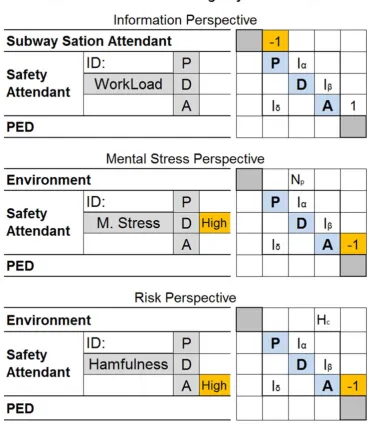
Tasks Allocated to a human can be analyzed from several perspectives. The perspective of the Hazard, Workload, Mental Stress which require evaluation of sub-elements of every human beings, as well as Information Perspective, have independent DSM. The extended human model creates the PDA Score Table on the left side of the Matrix in order to assess the effect of sub-processing elements of human by perspective. Fig. 5 illustrates the extended model of human task for Workload Perspective.
Fig. 5 Extended Model for Human Task
The interface of human task model includes only the Element item P and A. The “item P” is limited to the input of interface items while the “item A” is limited to the output of interface items.
3.5. Extended Model for Human-System CI Integration
Many of the function allocation analysis are carried out based on human-CI implementation rather than independent human or CI implementation. One of the difficulties involved in the function allocation analysis is that the function allocation does not determine whether the system or human will be fully responsible for functionality. It is more desirable to consider “how will the system support the ability of human?” According to the Billing, such perspective is called ‘human-centered automation. Fig. 6 is the model for the implementation of the functions through interaction between human and CI. This model can support the human-centered automation analysis.
Fig. 6 Extended Model for Human-CI Integration
The system function can support the Perspective, Decision or Action which are the 3 human factors or can be substituted. In other words, the new system function should be identified to support this regardless of whether certain ability is supported or substituted or not. In the Fig, the System CI is the support/substitution function that has been defined newly. The following section addresses the method and rule of representation for the model that is identified newly to support or cope with each factor.
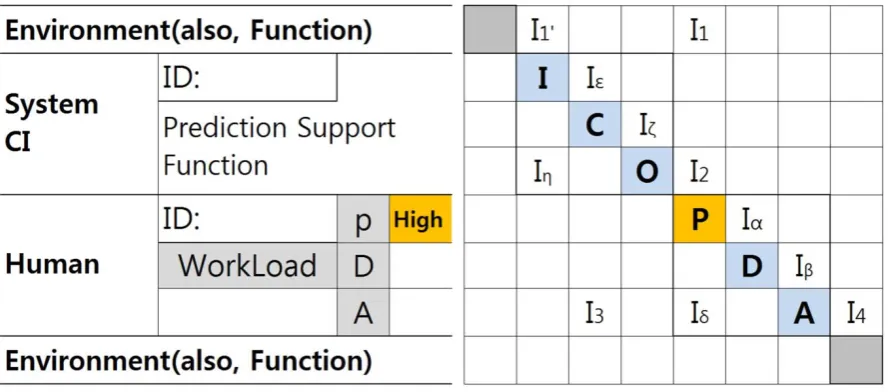
3.6. Rule on Extended Model for Perception
Fig. 7 Extended Model for Perception
In relation to perception ability support function, the system can support the degraded bottom-up process of human when human beings have difficulty in obtaining information from external elements. Alternatively, the system can substitute human perception function to protect humans from external threat elements.
The perception ability support function deals with the information of same attributes as the information that humans acquire from external elements. Thus, analysts can replicate the perception information fed into human and allocate it to the input element of CI expansion model created above the human task. Later, this replicated information can be defined again through the analysis of interface. In Fig. 7 the ‘information I1’ fed into human
has been replicated as I1’ item. The perception support function can be controlled by human as necessary. The
human control can be used to adjust the ‘mode of support function’ or the ‘function’. That can be identified as a result of the following functional analysis. The Information item I3 shown in the Fig. 7 is the control item for the
CI.
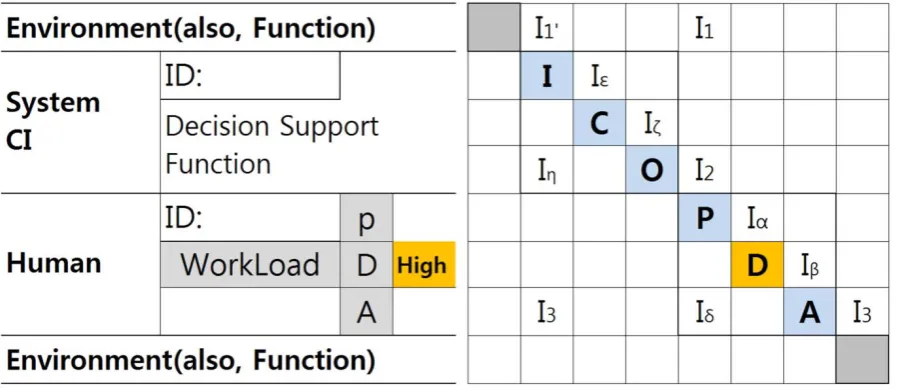
3.7. Rule on Extended Model for Decision Making
Fig. 8 Model for Decision-making
The Decision Support Function can be fed the clues from human to support the decision-making of human, or can be fed the information same as the information that human beings acquire externally when more active support is required. The Decision Support Function can be performed or adjusted by the trigger of operator or can be carried out actively based on the information fed from the outside. In case that the Decision Support Function substitutes human tasks, the output item of Decision Support Function can be used by replicating the output item of human. This function and human tasks are required to perform the same duties, and therefore can have the same output.
3.1. Rule on Expansion Model for Action
Human action support function can carry out functions through the control elements without need for external input element in case of simple amplification or damping of human action. However, the information same as the input information acquired by human externally can be replicated and fed into the system function if more active ability is necessary, for example, when the precise task is supported or when the incorrect action of human is rectified in part. The original output item of human is fed into the control element of CI. Human can receive the feedback for the output of action support function. This information item is important for the correction of action.
4. Case Study
4.1. Overview of Case Study
This chapter presents a case to show the allocation analysis process using the extended model. This case relates to the activities of safety attendants guiding the evacuation of passengers in the system based on fire response scenarios for subway station. The scenario can be described as follows: Fire occurred in certain area within the subway station and spread to an extent that it cannot be extinguished. The fire toxic gas makes it impossible for some passengers on the platform to escape through the ground exit. Therefore, the passengers have to evacuate to the adjacent subway station through rail track from the platform. However, the screen door is closed, making the escape impossible. At this time, the station staff instructs the safety attendants to open the emergency door located at both ends of the platform. However, if the station staffs or safety attendants run away without taking any measure or if they are in a panic and fail to carry out aforesaid task, then the passengers on the platform will suffer fatal damage. Thus, the fire response system at the fire station to be developed should be designed to ensure the support for the activities of station staffs and safety attendants guiding the evacuation of passengers.
The internal elements of safety attendant tasks are identified. As the fire scenario is not in a general state, the automaticity of this task may not be at a high level. Therefore, the information item for the implementation of Rule based Task can be identified. To identify the information items of internal elements, it would be desirable to conduct direct survey of the entities that perform this task. If safety attendants identify the fire alarm in the station building and check the open command of Station Supervisor, the passengers remaining on the platform are checked while the path for the movement toward the PED is secured. In this case, the emotion of passengers gripped by panic may work as noise and disrupt the decision-making. Safety attendant decide to open the PED and controls his body for the action to unlock it. At this time, the flame or smoke may hinder the performance of work or make the work performance impracticable.
From the perspective of mental stress, Safety Attendants may fail to carry out their duties and escape, not making the right choice due to the fear of life. Also, Safety Attendants may fail to move to the platform due to the smoke or flame from the perspective of hazard perspective. Thus, the System CI may support and/or substitute the decision of Safety Attendants from the two perspectives mentioned above. Moreover, System CI may support and/or substitute the activities of Safety Attendants to protect them from hazard elements. The following section covers the human-CI expansion model that supports the decision and action.
4.2. Extended Model for Decision-making & Activity Function
4.2.1. Decision Support Function
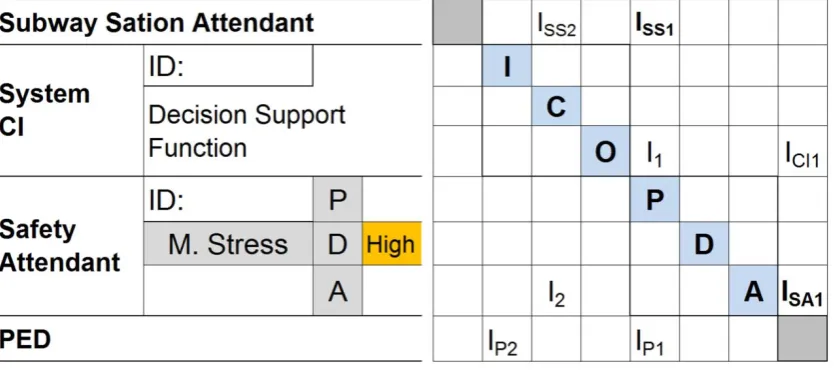
The Decision Support Function can determine automation level through scenario analysis. It is desirable to automate this function to the Monitored AI level, considering that the safety attendants may fail to carry out the task due to the stress. Thus, the Decision Support Function that has been newly identified substitutes the decision-making of Safety Attendant. The Safety Attendant has the veto on the Unlock. Fig. 11 shows the extended model for Safety Attendant-CI.
Fig. 11 Extended model(Decision) for Safety Attendant-CI.
CI Input Item Iss2: According to the rule on the extended model described above, the Iss2 which is the input
item of CI that has been created newly is the item that replicated the Control Item Iss1 of Safety Attendant. Both
items have same information although they may have different physical interface.
CI Output Item I1: Once the control items Iss2 is input, the System CI should ask Safety Attendant whether
he/she would exercise the veto before proceeding with PED Unlock.
CI Output Item ICI1: Safety Attendant can exercise his/her veto to unlock the PED directly. If the Safety
Safety Attendant Item ISA1: ISA1 is the output item allowing the Safety Attendant to open the PED directly.
These interface items can be analyzed more extensively in the analysis of the interface.
4.2.2. Action support function
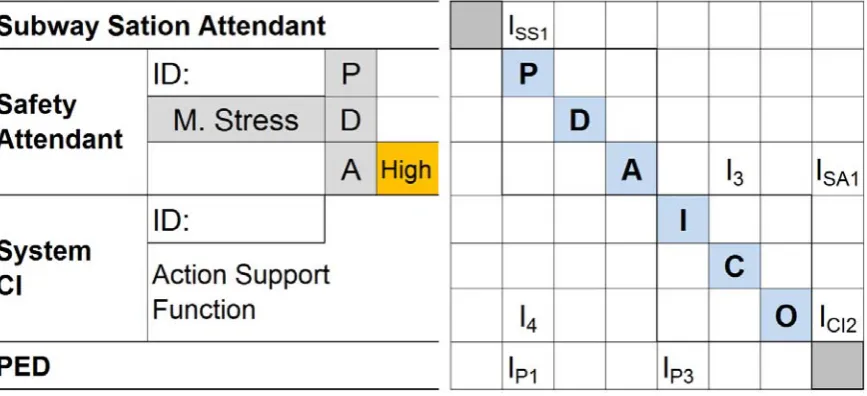
The action support function blocks or reduces hazard elements to protect the action of Safety Attendants. The remote control function using the communication can be an alternative solution allowing the Safety Attendants to unlock the PED without suffering any physical harm. Fig. 12 shows the extended model for Safety Attendant-CI.
Fig. 12 Extended model(Action) for Safety Attendant-CI
CI Output Item ICI2: Output Item ISA1 of Safety Attendant is the Control Item for PED. According to the rule,
the Interface Item ISA1 is replicated as Output Item ICI2 of System CI. Safety Attendant may directly unlock the
PED, but the System CI unlocks it under the control of Safety Attendant if PED cannot be unlocked due to the hazard elements.
CI Control Item I3: System CI receives the PED Unlock command from Safety Attendant.
CI Output Item I4: System CI should be able to provide the status information of PED to Safety Attendant
4.3. Integration of Extended Models
Fig. 13 integration of two models
Fig. 14 shows the results of redeployment of integrated function as Safety Attendant-CI function. I3 and I4 are
the communication Interface between Safety Attendant and CI while I1, I2, and IP3 are the information items. I1,
I2, and IP3 can interact with Safety Attendant through I3 and I4. Thus, the model can be modified as shown in Fig.
15 .
Fig. 14 Modified Model
4.4. Result
The Unlock PED Task can be explained through the model that has been modified finally as follows: First, in case that the fire evacuation guidance command Iss2 is fed into the Decision Support Function, this function
makes request I1 for “Unlock Denied” to the Safety Attendant through the communication interface I4. In
addition, PED Lock/Unlock status information IP3 is transmitted to Safety Attendant. The Unlock command
ICI1 is issued to the PED if no response I2 is made from the Safety Attendant to the denial(refusal) request
through the communication interface I3. Or, Safety Attendant may directly unlock(ICI2) the PED through
Fig. 15 Final Model of "Unlock PED" Task
The two functions that have been identified in this model can be integrated with other functions through the function analysis and allocation analysis and then assigned to previous System CI or any CI that has been created newly. The Unlock PED Task which shows improvement in this case allows the System CI to support the Unlock Decision when Safety Attendant is in a state of panic. In addition, it supports the remote Unlock Perform in case that Safety Attendants cannot approach the platform due to the flame or smoke. Those supportive functions can reduce the risk to this task and enable effective response to extreme stress.
Fig. 16 the conversion of DSM expansion model into IDEF-0
5. Conclusions
This Article presented the DSM as a modeling technique to support Functional Allocation Analysis conducted by multidisciplinary HSI team. DSM is a very useful modeling technique as it is easily legible and can represent the interaction between the components of system in an easy manner and represent various perspectives.
This Article also presents standardization of the function of System CI and human tasks to ensure analysis of the interaction between the functions and tasks to be assigned even when their structure remains unknown. Generally, if the function of specific level is identified, these functions can be allocated after clustering. However, function allocation can be achieved even if the sub-function is not defined specifically. Therefore, the model should be built which can be used commonly through the abstraction of functions and tasks in order to make the analysis easier. Thus, the system functions were abstracted as I-C-O structure while the human tasks were abstracted as P-D-A structure. As they can be used for most functions and tasks, they are used as structured model. This author calls this model “Extended model”.
Quite a lot of functions of the system are achieved by human-system interaction. In other words, the system function supports human tasks and This Article addresses the question of “What human factors should the system support?” instead of the question of “how high automation level should the function support?” in relation to the perspective of analysis. Thus, for the extended model described above, various models were created such as the functional model that supports human perception, the functional model that supports decision-making, the functional model that supports actions, along with several rules for the derivation of interface through this model.
Project team can perform graphical analysis in relation to what should be supported using the extended model in case that the results of allocation analysis have been evaluated through the Human-System Function, instead of the Human Task and System Function. Those models facilitate easier definition of functions and interfaces that need to be defined newly to support human tasks subject to allocation analysis.
This article covered some functions of fire response scenario for subway station as an application example of the extended DSM model. Based on the results of allocation analysis using the extended model, the two functions that support the “Unlock PED” – which is the task of Safety Attendants – were defined. Along with that, the interface between them was identified.
The purpose of this study was to present the Model supporting the Function Allocation. As a result, the scope of this study is limited to the DSM Model and the rule on the use of this model, thus resulting in the limitation that important realms, such as the definition of Function Allocation Assessment Rule, etc., cannot be addressed extensively. The maturity of Function Allocation Assessment Rule, which usually has a considerably significant impact on the results of analysis of extended model, will be addressed by the succeeding studies in the period ahead.
Acknowledgement
This study was conducted with the financial support from the Korea Railroad Research Institute.
References
[1] Billings, C. E. (2007). Aviation automation: The search for a human-centered approach.
[2] Browning, T. R. (2001). Applying the design structure matrix to system decomposition and integration problems: a review and new directions. Engineering Management, IEEE Transactions on, 48(3), 292-306.
[3] Challenger, R., Clegg, C. W., & Shepherd, C. (2013). Function allocation in complex systems: reframing an old problem.
Ergonomics, 56(7), 1051-1069.
[4] Cummings, M. M. (2014). Man versus Machine or Man + Machine? IEEE Intelligent Systems, 62-69.
[5] Dornheim, M. A. (1995). Dramatic incidents highlight mode problems in cockpits. Aviation Week and Space Technology (New York), 142(5), 57-59.
[6] Endsley, M. R., & Kiris, E. O. (1995). The out-of-the-loop performance problem and level of control in automation. Human Factors: The Journal of the Human Factors and Ergonomics Society, 37(2), 381-394.
[7] Grote, G., Weyer, J., & Stanton, N. A. (2014). Beyond human-centred automation–concepts for human–machine interaction in multi-layered networks. Ergonomics, 57(3), 289-294.
[8] Guerlain, S., & Bullemer, P. (1996). User-initiated notification: A concept for aiding the monitoring activities of process control operators. Paper presented at the Proceedings of the Human Factors and Ergonomics Society Annual Meeting.
[9] Harris, D. (1992). Effect of decision making on ultrasonic examination performance: Electric Power Research Inst., Palo Alto, CA (United States); Anacapa Sciences, Inc., Santa Clara, UT (United States).
[10] Lachman, R., Lachman, J. L., & Butterfield, E. C. (1979). Cognitive psychology and information processing: An introduction: Psychology Press.
[11] Mavor, R. W. P. a. A. (2007). Human-System Integration in System Development: A New Look.
[12] Norman, D. A. (1993). Things that make us smart: Defending human attributes in the age of the machine: Basic Books.
[13] Oliver, M. (1997). Engineering of complex systems with models. Aerospace and Electronic Systems, IEEE Transactions on, 33(2), 667-685.
[14] Parasuraman, R., & Riley, V. (1997). Humans and automation: Use, misuse, disuse, abuse. Human Factors: The Journal of the Human Factors and Ergonomics Society, 39(2), 230-253.
[15] Pasztory, E. (2005). Thinking with things: Toward a new vision of art: University of Texas Press Austin.
[16] Roth, E. M. (1994). Operator Performance in Cognitively Complex Simulated Emergencies; Implications for Computer-Based Support Systems. Paper presented at the Proceedings of the Human Factors and Ergonomics Society Annual Meeting.
[17] Roth, E. M., Bennett, K. B., & Woods, D. D. (1987). Human interaction with an “intelligent” machine. international Journal of Man-machine Studies, 27(5), 479-525.
[18] Sarter, N. B., & Woods, D. D. (1992). Pilot interaction with cockpit automation: Operational experiences with the flight management system. The International Journal of Aviation Psychology, 2(4), 303-321.
[19] Sarter, N. B., & Woods, D. D. (1994). Pilot interaction with cockpit automation II: An experimental study of pilots' model and awareness of the flight management system. The International Journal of Aviation Psychology, 4(1), 1-28.
[20] Suwa, M., & Tversky, B. (2002). External representations contribute to the dynamic construction of ideas Diagrammatic representation and inference (pp. 341-343): Springer.