MEAN ACQUISTION TIME
PERFORMANCE ANALYSIS FOR DC
AND NC CODE ACQUISTION FOR
MIMO ASSISTED DS-CDMA WIRELESS
SYSTEMS.
N.Sathish Kumar
Assistant Professor, Department of ECE, Sri Ramakrishna Engineering College, NGGO Colony post,, Coimbatore,Tamil Nadu-641 022,India
Dr.K.R.SHANKAR KUMAR
Professor, Department of ECE, Sri Ramakrishna Engineering College, NGGO Colony post,, Coimbatore,Tamil Nadu-641 022,India
ABSTRACT:
Recent research on wireless communication systems has shown that using multiple antennas at both transmitter and receiver offers the possibility of wireless communication at higher data rates compared to single antenna systems. This paper discuss at developing a MIMO system which maintains the Mean Acquisition Time(MAT) with increase of transmit antennas or the paths ,for Noncoherent (NC) and Differentially Coherent (DC)code acquisition scheme in MIMO assisted Direct Sequence spread spectrum DS -CDMA wireless system when communicated over uncorrelated Raleigh channel. Mat lab tool box is used a simulation tool. .The simulation results brings out some important conclusions .It is understood that the Mean Acquisition Time (MAT)of DC is less than NC code acquisition. As Signal to Interference plus Noise Ratio (SINR) ratio is increased the MAT is reduced considerably for both DC and NC code acquisition methods. For 32 paths the MAT of DC code acquisition is very less or zero. As the number of paths is increased mean acquisition time is reduced. The MAT for DC code acquisition is decreasing as the number of transmission path increases. hence the performance of DC is better than NC code acquisition scheme.
Keywords: MIMO,Mean Acquisition Time(MAT), Noncoherent (NC) ,Differentially Coherent (DC), Direct Sequence spread spectrum DS -CDMA
1. INTRODUCTION:
Multiple antennas at both transmitter and receiver that provides the possibility of higher data rates compared to single antenna systems. The system with multiple antennas at the transmitter and receiver, are commonly referred to as multiple input multiple output (MIMO) systems. know CDMA is a spread spectrum multiple accesstechnique. A spread spectrum technique is one which spreads the bandwidth of the data uniformly for the same transmitted power. Spreading code is a pseudo-random (PN) code which has a narrow pulse codes. In CDMA scheme [6]a locally generated code runs at a much higher rate than the data to be transmitted.Spread spectrum techniques use a transmission bandwidth that is several orders of magnitude greater than the minimum required signal bandwidth.
2.DS-CDMA:
replica of the waveform generated by the PN code sequence generator at the receiver, which is synchronized to the PN code in the received signal.
Synchronous DS-CDMA and Asynchronous DS-CDMA are the two major classifications of DS-CDMA systems. In a Synchronous DS-CDMA, all the user transmissions are synchronized at the chip level, whereas in an Asynchronous DS-CDMA system, transmissions from different users arrive at the receiver at different time instants. The synchronous system model is the best suited for mobile stations because the received signal at the mobile stations is synchronous. The asynchronous system model is well suited for base stations because the transmitted signals from the mobile stations are asynchronous. The convetional reciver has basic problems as given below
If all users transmit with approximately the same power, then beyond some point increasing the power of every user will not decrease the Bit Error Rate (BER).
If the users transmit with widely different powers, the conventional receiver allows the signal from powerful user by suppressing weaker user signal, referred to as the near-far effect.
The detection of the desired signal is limited by the inherent interference suppression capacity of the system. Hence to over come these the next section discusses the analysis of Non Coherent and Different coherent receiver structures.
3.ANALYSIS OF DIFFERENTIALLY COHERENT DETECTION:
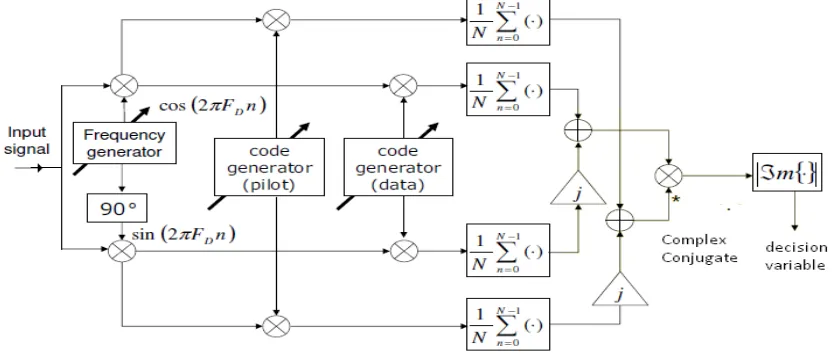
Figure 1 shows a differentially coherent detection scheme employed for signal detection. The “ideal” shape of their autocorrelation functions with side lobes the same as those of maximum length shift registration sequences will be assumed. An Matched Filter (MF)-based and a fixed-sample-size PN code acquisition technique with differentially coherent detection is investigated by means of statistical analyze. It is verified that the proposed techniques can provide lower error probabilities and more rapid acquisition
Fig.1 acquisition of differentially coherent codes
In traditional differentially coherent combining correlations on two consecutive portions of the incoming signal are evaluated and the decision variable is obtained by taking the real part of the product of these two correlations as shown in the fig 2. In this way the phase of the second correlation is used to compensate the phase of the first one. Moreover, since the noise terms on the two correlations are independent, lower noise amplification is expected, with respect to non-coherent combining Differential combining is effective as long as the hypothesis of constant phase on the two subsequent correlations holds; degradations are expected in presence of a time-varying phase.
2
2 2 2
1, ( , , ) 3, ( , , ) 2, ( , , ) 4, ( , , ) , ,
1 1 0 1 1
4
.
P R P R
DC c
k l m n k l m n k l m n k l m n
k l k l m n
m n m n
E
Z
S
W
W
W
W
NI P
(1) where k =k
th chip’s sampling instant( , , ) k l m n
S
=a deterministic value, which depends on whether a signal is present or absent. Furthermore, the definition of
W
1, ( , , )k l m n ,W
2, ( , , )k l m n ,W
3, ( , , )k l m n andW
4, ( , , )k l m n which are mutually independent Gaussian random variables having zero means and unit variances .Let us now introduce a shorthand for the first and second terms of Eq (6.2) as follows
2 2
( ) , , 1, ( , , ) 3, ( , , )
1 1 0
4
.
P R
c
k l k l m n k l m n k l m n m n
E
X
S
W
W
NI P
(.2) And 2 2( ) 2, ( , , ) 4, ( , , ) 1 1
P R
k l k l m n k l m n m n
Y
W
W
(3) Then the final decision variable of Eq(2) is obtained as
( ) ( ) ( , , ) ( , , )
1 1 1 1
P R P R
DC
k l k l k l m n k l m n k l
m n m n
Z
X
Y
X
Y
(.4)
where
X
k l( ) obeys a non central chi-square Probability Density Function (PDF) with 2P.R degreesof freedom and its non centrality parameter
x is either 04
N
E
cP
I
,when the desired signal is deemed to bepresent (x = 1) or 0
4
N
E
cP
I
, when it is deemed to be absent (x = 0) .The effects of both timing error sand thetotal frequency mismatches are encapsulated by the definition of 0 c
E
I
.In the spirit of 0 cE
I
is defined as
2 2 0 0.sin
.sin
c c t c cE
E
c
c N f T
I
I
T
, where the second term of the definition is the square of theautocorrelation function imposed on the timing error,
, the third term of the definition is the signal energy reduction expressed as a function of the total frequency mismatch,
f
tafter the squaring operation and N represents the number of chips accumulated over the duration of
D. Finally,Y
k l( ) is centrally chi-square distributed with 2P.R degrees of freedom. It is also worth noting that the outputs of the squaring operation invoked for both the in-phase and the quadrature branches in Fig 5.1. are modeled as squares of Gaussian random variables, respectively.Accordingly, the decision variable
X
k l m n( , , ) of each path obeys a non-central chi-square PDF with two degrees of freedom, where asY
k l m n( , , ) is centrally chi-square distributed with two degrees of freedom. These PDFs are given by as follows( ) 2
( , , ) 0
1
( |
)
. (
. )
2
x z
k l m n x x
fx
z H
e
I
z
And 2 ( , , )
1
( |
)
2
zk l m n x
fY
z H
e
(6)
respectively, where z ≥ 0, x = 0or 1,
I
0
.
is thezero
th order modified Bessel function of the first kind. Let us now express the PDF of the desired user’s signal at the output of the acquisition scheme conditioned on the presence of the desired signal infx
k l m n( , , )( |
z H
x)
, when communicating over an uncorrelated Rayleigh channel. In this scenarioE
c is multiplied by the square of the Rayleigh distributed fading amplitude, β, whichhas a chi-square distribution with two degrees of freedom:
2 / 2
e
f
, where
2 is the variance of the constituent Gaussian distribution. Then the average pilot signal energy Ec per PN code chip can be expressed as2
c c c
E
E
E
. Therefore first the PDFfz
k l m n( , , )( |
z H
x, )
corresponding to β conditioned on the hypothesis of the desired signal being transmitted over an Additive White Gaussian Noise channel having this specific SINR is weighted by the probability of occurrencef
( )
of encountering β, as quantified by the PDF. The resultant product is then averaged over its legitimate range of
, yielding:
( , , )
( |
)
( ).
( , , )( |
, )
k l m n x k l m n x
fx
z H
f
fx
z H
d
(7)
2 /2 / 0 20
.
2
.
x z
x
e
e
I
z d
(8)
2 / 2 22
x z xe
(9)
/ 22
x z xe
(10)where the corresponding non centrality parameter of
2 x
is either'
0
4
N
E
cP
I
when the desiredsignal is deemed to be present (x = 1) or
'
0
4
N
E
cP
I
when it is deemed to be absent(x = 0). Similarly to thedefinition of
E I
c/
0
'
,
E I
c/
0
'
defined as
2 20 0
/
'
/
.sin
.sin (
)
c c t c
c
E I
E I
c
c N f T
T
Fornotational convenience we also define a new biased non centrality parameter
x
2
x
. Finally, we arrive at the PDF ofX
k l m n( , , ) conditioned on the presence of the desired signal in the form of:
/ ( , , )
1
( |
)
z xk l m n x x
fx
z H
e
The decision variables,
X
k l( ) andY
k l( ) are constituted by the sum of P.R number of independentvariables
( ) ( , , ) ( ) ( , , )
1 1 1 1
,
P R P R
k l k l m n k l k l m n
m n m n
X
X
Y
Y
, each of which has a PDF given by Eq(6.11) orEq(6.6), respectively. Both decision variables constitute independent Gamma variables, leading to:
/ ( . 1)
( ) .
.
( |
)
( . ).
x z P Rk l x P R
x
z
e
fx
z H
P R
(12)
( . 1) /2
( ) .
.
( |
)
( . ).2
P R z
k l x P R
z
e
fY
z H
P R
(13)tot
X
andY
tot follow a Gamma distribution having the shape parameter of P.R and a scale parameter of eitherx
respectively, Then, the PDF of ( ) ( ) ( ) DCk l k l k l
Z
X
Y
can be computed by straight forward convolution of the PDFs of both
X
k l( ) andY
k l( ), which results in the PDF of the difference between two independent Gamma variables. The convolution of the PDFsfx
k l( ) andfy
k l( ) derived for calculating the PDF of ( )DC k l
Z
conditioned on the desired signal being present or absent is formulated:
( )
|
( ).
( )DC
k l x k l k l
fz
z H
fx
fy
z d
(14)
=
12 2
( ) 1
1
. | |
| |
.
.
,
0
1
.2 .
. (
)
2
a a cz b a a ac
z
z
e
K
z
b
b
a
(15)where
a P R
.
0.5
,b
4
x
/
x
2
andc
x
2 /
x
2
as well as
.
a
k
=modified Bessel function of the second kind and of order a.
We note furthermore that
k
a
.
is undefined, when the argument is equal to zero. However, this fact has a negligible impact on calculating the probability of correct detection and false alarm. The probability of correct detection for thel
th path according to x = 1, is expressed as
( ) ( )
( |
1) ,
0
DC DC
D l k l
P
fz
z H dz
(16) where θ = threshold value.
( ) DC D l
P
=probability of correct detection for the lth path. Finally, the false alarm probability in the context of a
H
0 hypothesis is expressed as
( )
( |
0) ,
0
DC DC
F k l
P
fz
z H dz
(17) Where DC F4.ANALYSIS OF NON-COHERENT CODE ACQUISITION SCHEME
Let us consider a pair of orthogonal basis functions that span the 2D signal space as given by
(18)
(19)
In a non-coherent receiver, no assumption of the carrier phase is made by the receiver. While, communication is possible without knowing the carrier signal phase, it will be shown in this section that there is sizable penalty in the required Eb/No in comparison to corresponding coherent receivers.
Tracking the incoming signals carrier frequency and synchronizing the receiver to it requires additional hardware which usually involves analog components those are relatively expensive. Also the DSP portion of the carrier tracking loop will require CPU MIPS which consumes power. However, since DSP Asics are becoming very power efficient this is less of a concern. Secondly, transmitter carrier could be non-coherent. No information content in carrier. Thirdly, close proximity links such as PAN devices; Eb/No performance is not a big issue.Also, sometimes, it is not possible to track the carrier phase. Finally there are Cases where the phase fluctuates randomly in such a manner that it is not practical to track it. In the non-coherent receiver we assume two locally generated basis functions that span the 2D signal space as: Non-coherent detection by
(20)
(21)
Where θ(t)is a random phase that is not known or tracked by the receiver. The subscript “r” denotes the receiver basis functions which are rotated in phase relative to the transmitter basis functions. Note that this random phase can even be a function of time representing some uncertainty in the carrier frequency also. In this discussion it will be assumed that the fluctuations in θ(t )are insignificant relative to the symbol period T.
this is a very reasonable assumption unless the SNR is really poor such that the receiver looses synchronization.
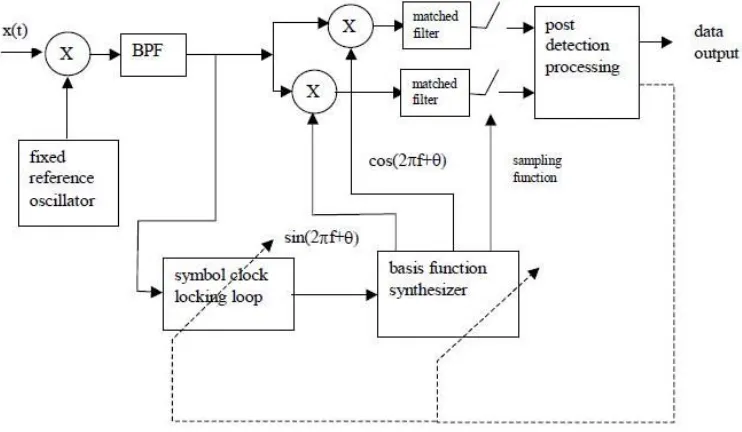
Fig .2 Non coherent receiver architecture
This architecture is common to both the non-coherent and the coherent receiver types. The difference is that coherent receivers track and lock onto the carrier phase of the incoming signal, x (t), such that the locally generated basis functions are synchronized in phase. A non-coherent receiver makes no attempt to synchronize the basis functions to the incoming phase of x (t). a basic model of non coherent reciver is as shown in figure 2 For comparison, the NC counterpart of the previously described DC scheme is characterized here, where the final decision variable of the
l
th path is given by
2
( , , ) , ,
1 1 0
4
1
.
2
P R
DC c
k l m n
k l k l m n
m n
E
Z
S
I
NI P
(22)
where
.
represents the Euclidian norm of the complex valued argument and the factor of1
2
is employedto normalize the noise variance. The NC decision variable ( ) NC K L
z
has exactly the same statistical behavior as ( )
k l
X
described in Section A and hence its derivation follows the same procedures that of
f
Xk l( ) (z|Hx) outlined.S
k l m n( , , )Becomes deterministic whileI
k l m n( , , )is the complex valued Additive White Gaussian Noise having zero means and variances of σ2=2 for both their real and imaginary parts. Finally, the probability of correct detection corresponding to x = 1 for thel
thpath is obtained as
1
. 1 0 ' 0
/
.
( )
k P R
k
NC
P
e
D l
k
( 23) Where k = False locking penalty factor.
θ= threshold value
1
. 1 0 ' 0
/
.
k P R
k
NC
P
e
F
k
(24) Where
X =
2
x
and
x is either' 0
2
N
E
CP
I
_for the hypothesis of the desired signal being present (x =1) or
' 0
2
N
E
CP
I
for it being absent (x = 0).
P
F=False alarm probability5.MEAN ACQUISITION TIME ANALYSIS
In explicit MAT formulas were provided for as single-antenna-aided serial search based code acquisition system. There is no distinction between a single-antenna-aided scheme and a multiple-antenna assisted one in terms of analyzing their MAT performance, except for deriving their Correct detection and the false alarm probability based upon using transmit/receive antennas. We will commence our discourse by analyzing the MAT performance of both DC and acquisition schemes, employed in Single Dwell Serial search (SDSS) and Double Dwell Serial search (DDSS). We assume that in each chip duration
T
C,
number of timing Hypotheses are tested, which are spaced byC
T
. Hence the total uncertainty region is increased by a factor of
. More over, when the L multi-path signals arrive with time delays
lhaving a tap spacing of one chip duration, the relative frequency of the signal being present is increased L-fold. The required transfer functions are defined as follows. The entire successful detection functionH
D
Z
encompasses all the branches of a state diagram, which lead to successful detection. Furthermore,H Z
0
indicates the absence of the desired user’s signal at the output of the acquisition scheme, whileH
M
Z
represents the overall miss probability of a search run carried out across the entire uncertainty region. The related processes are detailed for SDSS and for DDSS. Then, it may be shown that the generalized expression derived for computing the MAT of the serial search based code acquisition scheme is given by
'
'
0'
1
1
1
1
2
1
1
1
1 .
1
2
2
D
ACQ D M D
D
H
E T
H
H
L
H
H
D
H
(25)Where
H
x z'( )|
x D , M or 0 is a derivative ofH
x z( )|
x D , M or 0 and
Ddenotes either the dwell time 3 for the SDSS scenario or the dwell time of the search mode for the DDSS case. If the total number of states
is significantly higher than the number ofH
D states, the exact MAT formula of Eq (25) can be simplified as follows
' 0
1
1 ).
1
. .
.
2. 1
1
M ACQ
M
H
H
E T
D
H
(26) Where,
E[Tacq]= MAT of the serial search based code acquisition scheme.
because the average correct detection probability associated with these two hypotheses is the same, the overall miss probabilities of both the SDSS and the DDSS schemes may be expressed as
2( , ) 1 1
1
L1
M D l
l
H
P
(27) And
2( , ) 1( , ) 2( , ) 1 1
1
L[ 1
. 1
] ,
M D l D l D l
l
H
P
P
P
(28)
Respectively, where PD (l,ζ) represents the correct detection probability of the SDSS scheme and
P
Dx l ,|
x1, or 2 are the correct detection probability of both the search and the verification modes of the DDSS arrangements, respectively. The
' 0
1
H
values of the SDSS and DDSS schemes are expressed as
0
'(1) 1
.
FH
K P
(29)And
0
'(1) 1
.
F1.
F1.
F2,
H
P
K P P
(30)
Respectively, where K denotes the false locking penalty factor expressed in terms of the number of chip intervals required by an auxiliary device for recognizing that the code-tracking loop is still unlocked and
represents the ratio defined as the dwell time for the verification mode over that for the search mode. Furthermore,P
F is the false alarm probability of the SDSS scheme andP
F x x|
1, represent the false alarm probability of both the search and the verification mode of the DDSS scheme, respectively.6. SIMULATION RESULTS AND DISCUSSIONS
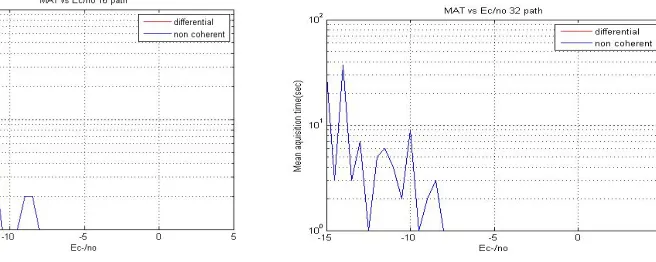
Figure 5: MAT of MIMO-16 paths Figure 6: MAT of MIMO-32 paths
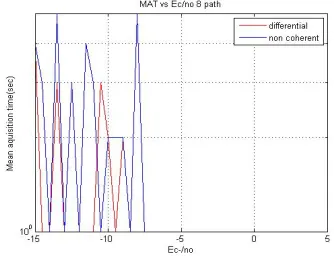
The figure 3,4,5,6 shows the MIMO receiver simulation for M*N (1, 4) = 4path, M*N (2, 4) = 8path,M*N (4, 4) = 16path , M*N (8, 4) = 32path using BPSK modulation respectively .it is observed that the MAT decreases with increase of SINR ratio. This is one of the favorable results for this system. Apart from this comparison between all the figures from 3-6 reveals that the MAT decreases with increase of the paths or the transmit antenna. this analysis is one of the best performance metric.
7.CONCLUSION:
This paper has demonstrated the MAT analysis for DC and NC code acquisition for MIMO assited DSCDMA wireless system.It is inferred that,With reference to above observation it is inferred that
The mean acquisition time of DC is less than NC code acquisition..
As SINR ratio is increased the mean acquisition time is reduced considerably for both DC and NC code acquisition methods.
For 32 paths the MAT of DC code acquisition is very less or zero. Hence, as the number of paths is increased mean acquisition time is reduced.
The MAT for DC code acquisition is decreasing as the number of transmission path increases. ACKNOWLWDGEMENTS:
The authors express their sincere thanks to THE Head of the department ECE, The principal , The Director Academics and our management Sri Ramakrishna Engineering College, coimbatore-22, TN, India for providing the resources to carry out this research with constant support and encouragement.
REFERENCE:
[1] M. K. Simon, J. K. Omura, R. A. Scholtz, and B. K. Levitt,2001,” Spread Spectrum Communications Handbook, chapter 1.Tata
McGraw-Hill Publications , New Delhi, India.
[2] B.-G. Lee and B.-H. Kim,2001, “ Scrambling Techniques For CDMA Communications “, chapters 3 and 4. Kluwer Academic
Publishers.
[3] W. Suwansantisuk and M. Z. Win,2007,“Multipath aided rapid acquisition: optimal search strategies,” IEEE Trans. Inform. Theory,
vol. 53, no. 1,pp. 174–193.
[4] W. Suwansantisuk, M. Z. Win, and L. A. Shepp,2005, “On the performance of wide-bandwidth signal acquisition in dense multipath
channels,” IEEE Trans. Veh. Technol., vol. 54, no. 5, pp. 1584–1594.
[5] H. Holm and M.-S. Alouini,2004,“Sum and difference of two square correlated Nakagami variants in connection with the McKay
distribution,” IEEE Trans. Commun., vol. 52, no.8, pp 1376.
[6] G. E. Corazza, C. Caini, A. Vanelli-Coralli, and A. Polydoros, 2004,“DSCDMA code acquisition in the presence of correlated fading
theoretical aspects,” IEEE Trans. Commun., vol. 52, no. 7, pp.1160– 1168.
[7] D. Gesbert, M. Shafi, D. S. Shiu, P. J. Smith, and A. Naguib, 2003,“From theory to practice: an overview of MIMO space-time
coded wireless systems,” IEEE J. Select. Areas Commun., vol. 21, no. 3, pp. 281–302,.
[8] l.Yang and L. Hanzo,2001,“Serial acquisition of DS-CDMA signals in multipath fading mobile channels,”IEEE Trans.Veh.Tech no l.,
vol. 50, no. 2, pp. 617–628.
papers in national and international journals. He has won ‘Two Best Paper’ awards for his contributions and one cash reward for his research contribution. He is a life member in various professional bodies like IETE, ISTE,MSSI .For the welfare of the student he has authored a book titled “A Course Material with CD Rom on Microprocessor and Micro Controller” Published by Sona Veristy,Salem.
Dr.K.R.Shankar Kumar is currently working as a professor in ECE department at Sri Ramakrishna Engineering College, Coimbatore-22.He completed his masters programme from Madras University in the year 2000.He completed his Ph.D programme in multiuser CDMA technology,from Indian Institute of Science ,Bangalore,India in the year 2004.His research interests includes future broad band wireless Communication systems, MIMO-OFDM, CDMA technologies,Advanced Signal processing for Communication systems.he is having five years of teaching and research experience.He is currently the research coordinator for the institute.He has published 14 research papers in national and international journals.His research work was supported by swarnajayanthi fellowship ,Department of Science and Technology,Government of India.