A Dual Color Image Watermarking Scheme
Based on Non-overlapping Blocks with
Circulation
Hongqin Shi, Fangliang Lv†, Yiqin Cao
School of Software, East China Jiaotong University, Nanchang, Jiangxi, China Email: [email protected]
†Corresponding author. Email address: [email protected]
Abstract—Digital watermarking is a method for protecting copyrighted materials such as digital images. This paper introduces a new color watermarking scheme based on non-overlapping Singular Value Decomposition (SVD) with circulation. First, dual color host image and watermark are decomposed into R, G and B components, respectively. Scrambling the three components of watermark by Arnold chaotic map and divided them into b×b non-overlapping blocks, respectively. The three components of original image are divided into equally-size and non-overlapping blocks. Second, performing an SVD transformation on all of blocks, the singular values (SVs) of each watermarking block are added toeach SVs of original same color block separately with circulation. Extracting any consecutive b rows and b
columns of watermarked image blocks can get complete watermark information. Experimental results show the proposed scheme can effectively resist large degree of geometric attacks and compound attacks, and it is also strongly robust against common image processing attacks.
Index Terms—Copyrighted materials, Circulation, Arnold chaotic map, Singular value decomposition
I. INTRODUCTION
Due to the rapid growth in the use of digital media, there is an increasing concern about unauthorized handling, copying and reuse of information. In general, digital watermark techniques must satisfy the following two requirements. First, the embedded watermark should be perceptually invisible and should not visually distort the host image. Second, the embedded watermark should be hard to remove. Schemes of embedding digital watermarks into grayscale images have been researched and developed greatly [1-3].
In recent years, encryption and hiding for color images have been noticed and developed steadily, since color images provide more information than monochromatic ones [4-5]. Also, to some extent the color information can offer a higher security level than binary and gray images. The watermarking scheme proposed by Kutter was the first work to be explicitly designed for color images [6]. And then many significant works about color image encryption and hiding have been produced [7-10]. Mei et
a1 [11] proposed a scheme of hiding a binary watermark information in the low frequency coefficients of 8×8 discrete cosine transform(DCT) blocks of the red, green and blue components. Banf et a1 [12] proposed a scheme in which the red, green and blue channels were transformed by full frame DCT, and selected to hide watermark. Embedding color watermarks in color images was proposed in reference [13], color watermarks are embedded by modifying quantization indices of color pixels without resulting in perceivable distortion. Only a few information including the specification of color gamut, quantizer step size and color tables are required to extract the watermark. Q.T. Su et a1 [14] proposed a technique in which using the Schur decomposition to embed color image in color image and extract watermark in the blind manner. Since Schur decomposition is an intermediate step in SVD decomposition, the proposed method needs fewer number of computations. A blind dual color images watermarking based on IWT and state coding in [15] was proposed, in which R, G and B components of color watermark are embedded to Y, Cr and Cb of color host image. Although DCT and DWT are the mostly used transform methods, the SVD transform has been significantly used in recent watermarking schemes. Liu et al have proposed an SVD based watermarking scheme in which the watermark is added to the SVs of the whole image or parts of it [16]. A single watermark is used in this scheme which may be lost due to attacks. Mohammad[17] propose an improve algorithm for Liu’s document, which partition the original image into M×M blocks and embed one bit of the watermark in each block. Mohammad’s algorithm, one watermark is distributed into all the blocks of the original image, which is difficult to resist a wide range of cropping.
W0 W1 W2 W3 W4 W5 W6 W7 W8 W9 W10 W11 W12 W13 W14 W15
W4 W5 W6 W7 W8 W9 W10 W11 W12 W13 W14 W15 W0 W1 W2 W3
W8 W9 W10 W11 W12 W13 W14 W15 W0 W1 W2 W3 W4 W5 W6 W7
W12 W13 W14 W15 W0 W1 W2 W3 W4 W5 W6 W7 W8 W9 W10 W11
W0 W1 W2 W3 W4 W5 W6 W7 W8 W9 W10 W11 W12 W13 W14 W15
W4 W5 W6 W7 W8 W9 W10 W11 W12 W13 W14 W15 W0 W1 W2 W3
W8 W9 W10 W11 W12 W13 W14 W15 W1 W2 W2 W3 W4 W5 W6 W7
W12 W13 W14 W15 W0 W1 W2 W3 W4 W5 W6 W7 W8 W9 W10 W11
Figure 1. System of circulation.
performed an SVD on them.Finally, we add SVs of the scrambled watermark block to the SVs of every suiting block obtained from block-SVD on the host image in each identical of RGB channels respectively with circulation.
The rest of this paper is organized as follows. The proposed watermarking scheme is depicted in section 2. The detailed watermark embedding and extraction procedures are presented in Section 3. Subsequently, Section 4 we present our numerical simulations including the robustness to several possible attacks. Finally, conclusions are given in Section 5.
II.RELATED WORK
A. Singular Value Decomposition
SVD is an important tool in linear algebra, which is widely applied in many research fields such as principal component analysis, canonical correlation analysis and data compression. From the viewpoint of image processing applications, there are two main properties of the SVD. First, the SVs of an image have a good stability, i.e., when a small perturbation is added to an image, its SVs do not change significantly. Second, SVs represent intrinsic algebraic image properties.
From the perspective of linear algebra, a digital image can be viewed as a matrix composed of a number of nonnegative scalars, singular value decomposition (SVD) belongs to an orthogonal transformation, it can make the image matrix diagonalization.
Let X R∈ m×n denote an image matrix, two orthogonal matrixes: U=[ u1, u2, u3, ···,um] R∈ m×m and V=[ v1, v2, v3,···, vn] R∈ n×n, there exist a factorization of the form as (1)
T
X =USV (1) Where S R∈ m×n is a matrix of all elements are zero except for its diagonal elements, ui and vi are called the
singular value vectors and the diagonal elements shown as (2)
1 2 3 r r 1 N 0
λ λ≥ ≥λ ≥"≥λ ≥λ+ ="=λ = (2)
Where r is rank of X, λi (i=1, 2, ···, N) is uniquely
determined by the SVD and called the singular values of X. Use of SVD in digital image processing has some advantages. First, the size of the matrices from SVD transformation is not fixed. It can be a square or a rectangle. Second, singular values in a digital image are less affected if general image processing is performed because bigger singular values not only preserve most energy of an image but also resist against attacks. Generally, the matrix has many small singular values. B. System of Circulation
In this work, we propose a novel method to embed and extract watermark information into/from original blocks with circulation. The main procedure includes three steps as follows.
Step1: The watermark image are equally divided into non-overlapping b×b blocks Wt (t=0, 1, 2, ···, b2-1) and b
is a positive integer (b≥2).
Step2: The original image are equally divided into non-overlapping m×n blocks Aij (i=0, 1, 2, ···, m-1) (j=0,
1, 2, ···, n-1), m is an integer multiple of b and n≥b. Step3: performing an SVD transformation on all of blocks, the SVs of each watermarking block is added to one SVs of original block under circulation.
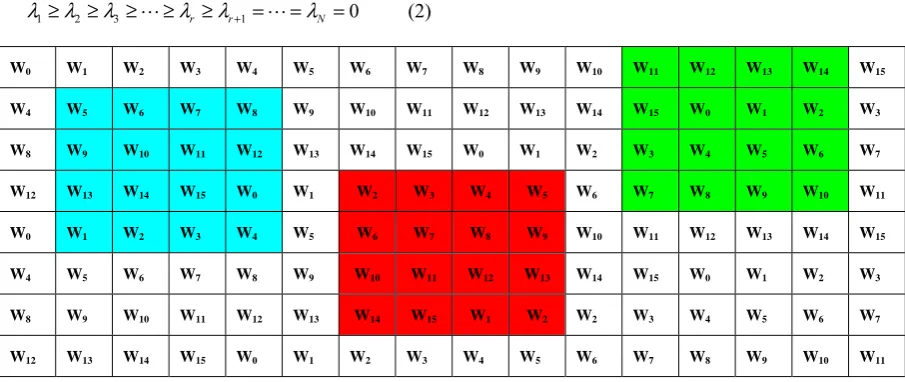
The first column of every row of original image matrix Aij was embedded with Wt (t= (i mod b)×b)) and the next
column was embedded with
W
((t++) modb2). Wherein mod denoting module operation.As an example, the watermark image is divided into non-overlapping 4×4 blocks Wt (t=0, 1, 2…15) and the
original image is blocked to non-overlapping 8×16 blocks Aij, (i=0, 1, 2…7) (j=0, 1, 2…15) (shown as in Fig. 1).
Every box represents one carrier image block and the symbol Wt (t=0, 1, 2…15) denotes watermark block.
Color watermark image W green component Scrambled by Arnold transform red component Scrambled by Arnold transform color original image O Partitioned into R,G and B component Reproduced color watermarked image blue component Scrambled by Arnold transform blue component divided into M×N
non-overlapping blocks Partitioned into R,G and B component green component divided into M×N non-overlapping
blocks
red component divided into M×N
non-overlapping blocks Blocked and added head symbol Blocked and added head symbol Perform SVD on each block
Watermark Embedded with circulation Watermark Embedded with circulation Watermark Embedded with circulation Perform SVD on each block
Perform SVD on each block Perform SVD on each block Perform SVD on each block Perform SVD on each block Blocked and added head symbol
Figure 2. Watermark embedding process.
III.WATERMARK EMBEDDING AND EXTRACTION
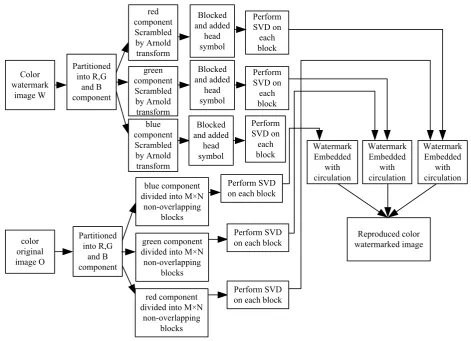
Let O be the original color image of size M×N, W is the watermark color image of size B×B. The relation between original image and the watermark image meets O=2k×W, the sizes of O are integer multiple of W, where k is positive integer. The proposed method in this paper is illustrated in Fig. 2.
The concrete embedding procedure is as bellows: Step1: Based on the theory, that a RGB color image is the composition of R, G and B of three components. The color watermark image W and original image O are partitioned into three components RW, GW, BW and RO, GO, BO by dimension reduction treatment, respectively.
For the sake of simplicity and clarity, only the green component is illustrated as follows.
Step2: Partition the GO into a set of m rows and n columns non-overlapping blocks with size Oij.
( )
ij M N
O = × m n×
(3)
In which m and n are positive integer.
Step3: Performed an SVD on each block Oij. Let the
matrix X, with elements xij, i =0, 1, 2,…, m-1 and j =0,1,
2,…, n-1, represent the block Oij which needs to be
watermarked. We compute the SVD of X as bellows.
T T
X X X X X
X =U S V = A V (4)
Step4: Using the Arnold transformation to change the distribution of GW and make it "mess". The changing number kais as a private key.
( )
' 1 1
m o d
' 1 2
X X P Y Y ⎛ ⎞ ⎛ ⎞ ⎛ ⎞ ⎜ ⎟= ⎜ ⎟ ⎜ ⎟ ⎜ ⎟ ⎝ ⎠ ⎝ ⎠ ⎝ ⎠
(5)
Where (X, Y)are the pixel of green watermark image, ( X′,Y′) are the pixel of corresponding scrambling image and P is the rank of digital image matrix.
Step5: Get encrypted watermark W'G by using (5).
Partition the W'G into a set of equally-size and
non-overlapping blocks b×b with W'Gd and d (d=b2) is the
sum of watermark blocks.
Step6: The encrypted watermark W'Gd, which being
added sequence identification number. Let Q represent the matrix of the W'Gd to be embedded. An SVD for Q as
follows:
T T
Q Q Q Q Q
Q U S V= =A V (6)
Where AX(Q)=UX(Q)SX(Q) are also called the principal components in the language of principal component analysis. Now, we add the scaled eigenvector VQ of
Figure 4. Watermarking image.
Figure 3. Watermark extraction process.
V′ =VX +αVQ (7)
Where α is the scale factor, it is used to control the embedding strength of watermark.
Step7: Then the watermarked block is obtained by
multiplying the matrix AX and V′T. T X
X′=A V′ (8) Repeat step6-step7, until every green original block is embedded with one green watermark block as shown in Fig. 1.
Step8: Doing the same thing to the blue and red
components, we can get the corresponding watermarked image of them.
Step9: Reproduced the watermarked R, G and B to
rebuild the watermarked color image.
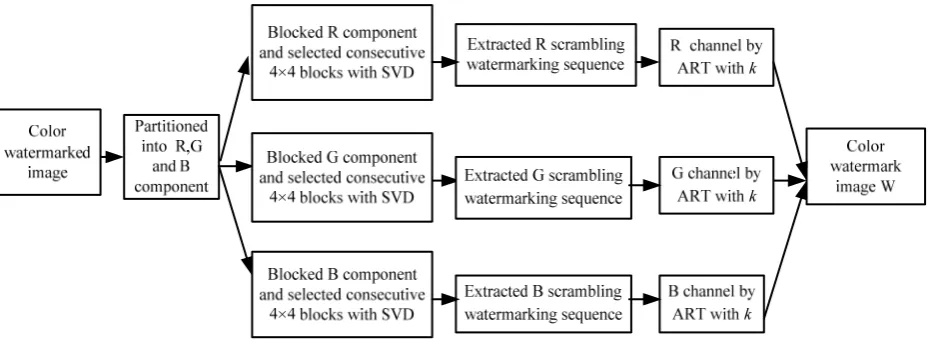
Extraction algorithm is a straightforward reversal of the embedding algorithm (shown as Fig. 3).
Step1: The watermarked color image is first
partitioned into R, G and B components by dimension-reduction treatment.
Step2: Divide the watermarked components into
blocks having the same size used in the embedding process.
Step3: Perform SVD on any consecutive b rows and b columns of three single color watermarked blocks to obtain the SVs of each one.
Step4: Obtains the matrices that contain the
watermark using (4) and extract the possibly corrupted
watermark block using the follows: 1
( )
Q
T
T A XX VX
V′ = − ′− ′ α (9)
T Q Q
Q′=A V′ (10)
Step5: Rearrange watermark block components to
reproduce the scrambling watermark image by the sequence identification number embedded in every W'Rd,
W'Gd andW'Bd.
Step6: The inverse Arnold transformation operation based on the private key ka, we can get the extracted
watermark W'R, W'G andW'B of each component.
Step7: Reconstructthe three components ofW'R, W'G andW'B,whichcanbe available torecoverthewatermark image.
IV.EXPERIMENTAL RESULTS
Figure 5. Original image.
Figure 6. Watermarked image cutting and extracted watermark after cropping.
Normalized correlation (NC), a similarity indicator specified in (11), is used to evaluate the similarity between the original watermarking W and the extracted watermarking W' retrieved from an attacked and watermarked image.
1 1
2
M N
i j
W W NC
M N
= =
′
+ ÷
=
×
∑∑
(11)
Where M and N represent the length and width of the watermark image, respectively, higher NC value stands for high resemblance between W and W'. Additionally, another quantitative index, Peak Signal-to-noise (PSNR) is used to evaluate the quality of the watermarked image to the original image. The higher PSNR value indicates a watermarking method produces few differences between
original image and watermarked image.
For the sake of clarity and simplicity, only one original image blocked by 16×16, F16 is used to analysis in the following discussion.
A. Cropping Attacking
Image cropping is frequently used in real life, which is a lossy operation. Four different cropping attacks are carried out to the watermarked image, respectively. The experimental results are shown in Fig. 6. The watermarked image and extracted watermark from (a) to (d) subjected cutting quarter in center, cutting quarter, cutting half and cutting three quarter, respectively. The proposed algorithm is resistant to a large extent cropping attack, which has wonderful performance in the experiments.
(a) (b)
(c
Figure 7. (a) Enlarged watermarked image and extracted watermark (ratio is 3) Reduced watermarked image and extracted watermark (ratio is 0.4)
Figure 8. (a) Watermarked image (height stretched to 2 times) and extracted watermark (b) Watermarked image (width stretched to 2 times)
B. Scaling Attack
The great majority of watermarking algorithm resist against scaling attack in the interval [0.5, 2], but the proposed algorithm can be resistant to any size scaling attacks. The extracted watermarking images are shown in Fig. 7 after the watermarked image is enlarged or reduced in size.
C. Aspect Ratio Adjustment Attack
In some applications, the watermarked image may be stretched more in one spatial dimension than another. This type of distortion is sometimes referred to as aspect ratio adjustment. The most watermarking algorithms can not resist against aspect ratio adjustment attack, the proposed scheme in this paper has strong robust against that one. Fig. 8 shows the watermarked images stretched by width or height and the extracted watermarks. The results indicate that the extracted watermarks are originally the same as the embedded watermarks, which
have stretched by the same way. D. Filter and Noise Attacks
The most common manipulation in digital image is filtering. The extracted watermarks, after applying median filtering and Gaussian low-pass filtering, are shown in the Fig. 9 (a) and (b). It can be observed that after applying these filters, the extracted watermark is still recognizable.
Addition of noise is another method to estimate the robustness of the watermark. Addition of noise is responsible for the degradation and distortion of the image. The watermark information is also degraded by noise addition and results shown some difficulties in watermark extraction. The embedded watermark can be extracted and detected from the watermarked image of added Pepper-and-Salt noise. It can be observed that extracted watermark is a noisy image, (shown in Fig. 10) which nearly can not be recognizable when adding Pepper-and-Salt noise upon 0.01.
(b) (a)
Figure 9. (a) Watermarked image and retrieved watermark (NC=0.8785) under median filtering attack. (b) Watermarked image and retrieved watermark (NC=0.9757)
under Gaussian low-pass filtering attack.
Figure 10. (a)Watermarked image and retrieved watermark (NC=0.8143) under Pepper-and-Salt noise attack (density=0.005).
(b)Watermarked image and retrieved watermark (NC=0.6927) under Pepper-and-Salt noise attack (density=0.01).
E. Robustness to JPEG Compression
In this experiment, the watermarked images are compressed with different compression factors from 10 to 100 increasing in steps of 10. We show the watermark extracted from JPEG compressed F16 image with various quality factors (QF). Briefly, JPEG quality factor is an indication of the distortion, such that 100% quality factor corresponds to least distortion. Table Ⅰ gives NC values of different QF under JPEG compression. It is variously that the algorithm is strongly resistant to JPEG compression.
(a) (b)
TABLEII.
NCRESULT VALUES OF THREE IMAGES UNDER DIFFERENT ATTACKS
Attack type Waterfall NC Water NC Watch NC
16×16 32×32 64×64 16×16 32×32 64×64 16×16 32×32 64×64
Cutting quarter 0.9999 1.0000 0.9989 0.9994 0.9999 1.0000 0.9957 0.9993 1.0000
Cutting half 1.0000 0.9999 0.9994 1.0000 1.0000 0.9999 1.0000 0.9997 1.0000
Cutting quarter in center 0.9712 1.0000 0.9998 0.9837 0.9989 1.0000 0.9927 0.9984 1.0000
Cutting three quarter 0.9937 0.9999 1.0000 0.9896 0.9979 1.0000 0.9926 0.9921 1.0000
Aspect Ratio Adjustment height to 2 times 1.0000 0.9996 1.0000 1.0000 1.0000 1.0000 1.0000 1.0000 1.0000
Aspect Ratio Adjustment width to 2 times 1.0000 1.0000 0.9994 1.0000 0.9999 0.9999 1.0000 1.0000 0.9999
Scaling Attack ratio is 4 0.9999 1.0000 1.0000 1.0000 0.9999 1.0000 0.9999 1.0000 1.0000
Scaling Attack ratio is 0.3 1.0000 0.9998 0.9999 1.0000 1.0000 1.0000 1.0000 1.0000 0.9999
JPEG QF=90 0.9996 0.9983 0.9983 0.9964 0.9953 0.9942 0.9935 0.9921 0.9961
JPEG QF=30 0.9010 0.8837 0.9032 0.9033 0.9148 0.9101 0.9073 0.9056 0.9205
JPEG QF=20 0.7661 0.7478 0.7675 0.7832 0.7921 0.8001 0.8031 0.7958 0.8015
Median filtering 5×5 0.8811 0.8906 0.8775 0.8784 0.8917 0.8848 0.8927 0.8785 0.8629
Gaussian low pass filtering 5×5 0.9813 0.9821 0.9754 0.9849 0.9778 0.9829 0.9858 0.9779 0.9814
Pepper and Salt noise 0.005 0.8151 0.8139 0.8004 0.8167 0.8202 0.8167 0.8074 0.8207 0.8047
Pepper and Salt noise 0.01 0.7273 0.7118 0.7329 0.7207 0.7027 0.7321 0.7028 0.7172 0.7203
TABLEI
RESULTS OF DIFFERENT QF UNDER JPEG COMPRESSION
QF (%) 100 90 80 70 60
NC 1 0.9996 0.9987 0.9976 0.9961
QF (%) 50 40 30 20 10
NC 0.9879 0.9691 0.9041 0.7602 0.6784
0
10
20
30
40
50
60
70
80
90
0
500
1000
1500
2000
2500
3000
3500
4000
4500
5000
5500
The size of original image
Time spe
nt ba
sed o
n SVD and
the
prop
osed
algorithm)
SVD
The proposed algorithm
Figure 11. The time comparison between SVD algorithm and the proposed algorithm
F. Comparing with the Block DCT for Dual Color Images As mentioned, the method in ref. [18] was a block DCT for dual color images based watermarking algorithm. In which the original watermark image and the original host image in RGB color space are converted to YCbCr color space, and the block DCT is implemented on their Y、 Cb and Cr layer respectively. The watermark sequence is obtained by the operations of spread spectrum and scrambling on the binary sequence, which is embedded into the middle and low frequency coefficients of Y、Cb and Cr layer of the original host color image. Table Ⅲ gives the NC values comparison between Zhang and the proposed method under the common attacks.
The main idea of SVD is to decompose a rectangular matrix into three simple matrices to multiply. The time complexity is O(n3), which takes much time for
we use the same software and hardware, (Operating System Windows XP, CPU Intel Pentium 4, 3.4 GHz processor, PC System Memory 2 GB and Matlab 7.0 simulation platform). Fig.11 shows the time spent in embedding the same watermark into the same original image between SVD algorithm and the proposed algorithm. We can see the Block-SVD method with circulation proposed in this paper has a low computational complexity, and its advantage becomes more conspicuous as the increasing of the size of original image.
V.CONCLUSIONS
In this paper, a color watermark algorithm for color image based on SVD and chaos with circulation is proposed. The proposed scheme takes advantage of image scrambling and blocked with circulation to improve the robustness and security of current watermark schemes. During the embedding procedure, the three decomposed watermark components are divided into small watermarks by b×b and the same components of original image blocked by 16×16, 32×32 and 64×64. Performed SVD on each small watermark block and embedded SVs into one same color Singular Value matrix with circulation. The perceptual quality and the watermarking capacity are greatly improved by this way.
The original image is not needed during the extraction and detection procedure. Experimental results and attacks analysis show that the watermark algorithm is transparent and robust against some image processing operations, such as JPEG compression, median filtering, additive noise and cropping attacks. The deficiency of the algorithm is consistency between extraction and embedment. The blocks must be partitioned in the same way used in the embedding process. Otherwise, the
TABLE Ⅲ
NCRESULT VALUES COMPARISONBETWEENTHE
PROSOSEDMETHODANDZHANG[18] UNDER DIFFERENT
ATTACKS
Attacks parameter this paper Zhang[20]
8×8 8×8
Gauss Low pass Filter 5*5 0.9813 0.9448
7*7 0.9801 0.9448
Geometric Crop 1/4 0.9999 0.9608
1/2 1.0000 0.9563
Salt-pepper Noise 0.0005 0.9715 0.9608
0.0006 0.9682 0.9608
JPEG QF=30 0.9010 0.8991
W0 W1 W2 W3 W4 W5 W6 W7
W4
W51 W52 W61 W62W71 W72 W81 W82
W9 W10 W11
W53 W54 W63 W64W73 W74 W83 W84
W8
W91 W92W101 W102 W111 W112 W121W122
W13 W14 W15
W93 W94W103 W104 W113 W114 W123W124
W12
W131 W132 W141 W142 W151 W152 W161W162
W1 W2 W3
W133 W134 W143 W144 W153 W154 W163W164
W0
W11 W12 W21 W22W31 W32 W41 W42
W5 W6 W7
W13 W14 W23 W24W33 W34 W43 W44
W4 W5 W6 W7 W8 W9 W10 W11
W8 W9 W10 W11 W12 W13 W14 W15
W12 W13 W14 W15 W0 W1 W2 W3
Figure 12. Different partition.
For example, the image to be watermarked is divided into 8×8 blocks and the watermarked image is partitioned into 16×16 blocks before extracted (shown as in Fig. 12). Every embedded watermarking block is partitioned into four pieces when the extraction finished (shown as the yellow region in upper figure). These incomplete fragments of watermark information with no sequence identification number cannot be combined into one recognizable watermarking image.
ACKNOWLEDGEMENT
This work was supported by the National Natural Science Foundation of China under grant no. 61365008, East China Jiaotong University Research Fund no.11RJ04, 13RJ01.
REFERENCES
[1] H.M. Zhao, D. Zhang, “A Video Watermark Achievement Algorithm Based on Content of the Video Sub-Region”, Journal of Software, Vol.8, No.11, pp.2962-2966, 2013. [2] Y.Q. Chen, Y.Q. Zhang, H.P. Hu, H.F.i Ling, “A Novel
Gray Image Watermarking Scheme”, Journal of Software, Vol.6, No.5, pp.849-856, 2011.
[3] Y.Q. Zhang, Y. Bao, Q.P. Wang, H. Xu, “Reversible Watermarking Algorithm of Grid Map Based on Prediction-Error Histogram “, Journal of Software, Vol 8, No 5, 1117-1123, 2013.
[4] N.E. Golea, R. Seghir, R. Benzid, “A Bind RGB Color Image Watermarking Based On Singular Value Decomposition,” 2010 IEEE/ACS International Conference on Computer Systems and Applications (AICCSA). Hammamet, Tunisia, May, 2010.
[5] Y. Xing, J. Tan, “A Color Watermarking Scheme Based on Block-SVD and Arnold Transformation,” in Second Workshop on Digital Media and its Application in Museum and Heritage. IEEE, pp. 3-8, 2007.
[6] M. Kutter, F.D. Jordan, F. Bossen, “Digital signature of color images using amplitude modulation”, In Proceedings of Storage and Retrieval for Image and Video Dabbles, pp.518-526, 1997.
[7] L. Chen, D. Zhao, “Optical color image encryption by
holograms,” Optics Express, vol.14, no.19, pp.8552-8560, 2006.
[8] L. Chen, D. Zhao, “Color information processing (coding and synthesis) with fractional Fourier transforms and digital holography,” Optics Express, vol.15, No. 24, pp.16080-16089, 2007.
[9] Z. Liu, L. Xu, T. Liu, H. Chen, P. Li, C. Lin, S. Liu, “Color image encryption by using Arnold transform and color-blend operation in discrete cosine transform domains,” Optics Communications, vol.284, no.1, pp. 123-128 ,2011.
[10]W. Chen, C. Quan, C.J. Tay, “Optical color image encryption based on Arnold transform and interference method,” Optics Communications, vol.282, No.18, pp.3680-3685, 2010.
[11]R.R.Mei, Z.Q.Lu, W.X.Xie, “An adaptive watermarking algorithm for color images”, Journal of Shenzhen University (Science and Engineering), vol.18, No.3, ppP.l9-27, 2001.
[12]M.Banf, F.Bartolini, A.Piva, “Multichannel watermarking of color images”, IEEE Transactions on Circuits and Systems for Video Technology, vol. 12, No.3, pp.142-156, 2002.
[13]C.H. Chou, T.L. Wu, “Embedding Color Watermarks in Color Images,” Journal on Advances in Signal Processing, Vol.2003, No.1, pp.32-40, 2003.
[14]Q.T. Su, Y.G. Niu, X.X. Liu, Y. Zhu, “Embedding color watermarks in color images based on Schur decomposition,” Optics Communications, vol.285. No.7, pp.1792-1802, 2012.
[15]Q.T. Su, Y.G. Niu, X.X. Liu, Y. Zhu, “A blind dual color images watermarking based on IWT and state coding,” Optics Communications, vol.285, No.7, pp.1717-1724, 2012.
[16]R.Z. Liu, T.N. Tan, “An SVD-Based Watermarking Scheme for protecting rightful ownership,” IEEE Trans. on multimedia, Vol.4, No.1, pp.121-128, March 2002.
[17]A.A. Mohammad, A. Alhaj, S.Shaltaf, “An improved SVD-based watermarking scheme for protecting rightful ownership,” Signal Processing, Vol.88, No.9, pp.2158– 2180, 2008.
[18]Y. Zhang, L.C. Lin, Q.S. Li, “A Blind Watermarking Algorithm Based on Block DCT for Dual Color Images,” 2nd International Symposium on Electronic Commerce and Security (ISECS '09). Nanchang, China, August, 2009.
Hongqin Shi was born in Hebei province of China in 1970. She received her BEng. degree and MEng. degree in electronics in computer science from Hebei University of Science and Technology of China and Haerbin University of Science and Technology of China in 1991 and in 2004, respectively. She has published some 15 papers in journals. She is at present a lector at East China Jiaotong University of China. Her current research interests in digital watermark and information security.
Fangliang Lv born in 1972, engineer of East China Jiaotong University, His main research interests include information security.