An Experimentally Veried Attack on Full
Grain-128 Using Dedicated Recongurable
Hardware
Itai Dinur1, Tim Güneysu2, Christof Paar2,
Adi Shamir1, and Ralf Zimmermann2
1 Computer Science department, The Weizmann Institute, Rehovot, Israel 2 Horst Görtz Institute for IT Security, Ruhr-University Bochum, Germany
Abstract. In this paper we describe the rst single-key attack which can recover the full key of the full version of Grain-128 for arbitrary keys by an algorithm which is signicantly faster than exhaustive search (by a factor of about238). It is based on a new version of a cube tester, which uses an improved choice of dynamic variables to eliminate the previously made assumption that ten particular key bits are zero. In addition, the new attack is much faster than the previous weak-key attack, and has a simpler key recovery process. Since it is extremely dicult to mathemat-ically analyze the expected behavior of such attacks, we implemented it on RIVYERA, which is a new massively parallel recongurable hardware, and tested its main components for dozens of random keys. These tests experimentally veried the correctness and expected complexity of the attack, by nding a very signicant bias in our new cube tester for about 7.5% of the keys we tested. This is the rst time that the main compo-nents of a complex analytical attack are successfully realized against a full-size cipher with a special-purpose machine. Moreover, it is also the rst attack that truly exploits the congurable nature of an FPGA-based cryptanalytical hardware.
Keywords: Grain-128, stream cipher, cryptanalysis, cube attacks, cube testers, RIVYERA, experimental verication.
1 Introduction
keys, we expect the running time of our new attack to be about238times faster
than exhaustive search, using263bits of memory. Our attack is thus both faster
and more general than the best previous attack on Grain-128 [1], which was a weak-key attack on one in a thousand keys which was only215times faster than
exhaustive search. However, our attack does not seem to threaten the security of the original 80-bit Grain scheme.
In order to develop and experimentally verify the main components of the attack, we had to run thousands of summations over cubes of dimension 49 and 50 for dozens of randomly chosen keys, where each summation required the evaluation of 249 or 250 output bits of Grain-128 (running the time-consuming
initialization phase of Grain-128 for about 256 dierent key and IV values).
This process is hardware-oriented, highly parallelizable, and well beyond the capabilities of a standard cluster of PC's. We thus decided to implement the attack on a new type of special purpose hardware consisting of 128 Spartan-3 FPGAs.
Special-purpose hardware, i. e., computing machines dedicated to cryptana-lytical problems, have a long tradition in code-breaking, including attacks against the Enigma cipher during WWII [15]. Their use is promising if two conditions are fullled. First, the complexity of the cryptanalytical problem must be in the range of approximately 250. . .264 operations. For problems with a lower
com-plexity conventional computer clusters are typically sucient, such as the linear cryptanalysis attack against DES [17] (which required 243 DES evaluations),
and more than 264 operations are dicult to achieve with today's technology
unless extremely large budgets are available. The second condition is that the computations involved are suited for customized hardware architectures, which is often the case in symmetric cryptanalysis. Both conditions are fullled for the building blocks of the Grain-128 attack described in this paper.
at-tack an interesting case study about what type of cryptanalysis can be done with university budgets (as opposed to government budgets). As a nal remark, it is worth noting that the same attack implemented on GPU clusters would require an extremely large number of graphic cards, which would not only require a very high budget but would consume considerably more electric energy to perform the same computations.
In the rst part of this paper, we give the necessary background regarding Grain-128 and dynamic cube attacks and describe our new attack on Grain-128. In the second part of the paper, we present our FPGA implementation in detail.
2 Preliminaries
In this section we give a short description of Grain-128 [3], of cube testers (which were introduced in [2]), and of dynamic cube attacks (developed in [1]).
2.1 Description on Grain-128
The state of Grain-128 consists of a 128-bit LFSR and a 128-bit NFSR. The feedback functions of the LFSR and NFSR are respectively dened to be
si+128=si+si+7+si+38+si+70+si+81+si+96
bi+128=si+bi+bi+26+bi+56+bi+91+bi+96+bi+3bi+67+bi+11bi+13+bi+17bi+18+
bi+27bi+59+bi+40bi+48+bi+61bi+65+bi+68bi+84
The output function is dened as
zi=P
j∈Abi+j+h(x) +si+93 , whereA={2,15,36,45,64,73,89}.
h(x) =x0x1+x2x3+x4x5+x6x7+x0x4x8
where the variablesx0, x1, x2,x3,x4, x5, x6,x7 andx8 correspond to the tap
positionsbi+12,si+8,si+13,si+20,bi+95,si+42,si+60,si+79andsi+95respectively.
Grain-128 is initialized with a 128-bit key that is loaded into the NFSR, and with a 96-bit IV that is loaded into the LFSR, while the remaining32LFSR bits
are lled with 1's. The state is then clocked through 256 initialization rounds
without producing an output, feeding the output back into the input of both registers.
2.2 Previous Results on Grain-128
All the previously published single-key attacks ([2], [5], [6], [7] and [8]) on Grain-128 which are substantially better than exhaustive search can only deal with simplied versions of the cryptosystem. In [9] a sliding property was used to speed-up exhaustive search by a factor of two. Related-key attacks on the full cipher were presented in [10]. However, the relevance of related-key attacks is disputed, and in this paper we concentrate on attacks in the single key model. The only signicant known attack on the full version of Grain-128 in the single key model is given in [1], where dynamic cube attacks are used to break a particular subset of weak keys, which contains the2−10fraction of keys in which
in this weak key set by a factor of about215. For the remaining0.999 fraction
of keys, there is no known attack which is signicantly faster than exhaustive search.
2.3 Cube Testers
In almost any cryptographic scheme, each output bit can be described by a mul-tivariate master polynomialp(x1, .., xn, v1, .., vm)over GF(2)of secret variables xi(key bits), and public variablesvj (plaintext bits in block ciphers and MACs,
IV bits in stream ciphers). This polynomial is usually too large to write down or to manipulate in an explicit way, but its values can be evaluated by run-ning the cryptographic algorithm as a black box. The cryptanalyst is allowed to tweak this master polynomial by assigning chosen values to the public vari-ables (which result in multiple derived polynomials), but in single-key attacks he cannot modify the secret variables.
To simplify our notation, we ignore in the rest of this subsection the distinc-tion between public and private variables. Given a multivariate master polyno-mial withn variablesp(x1, .., xn) over GF(2)in algebraic normal form (ANF),
and a term tI containing variables from an index subset I that are multiplied
together, the polynomial can be written as the sum of terms which are supersets ofI and terms that miss at least one variable fromI:
p(x1, .., xn)≡tI·pS(I)+q(x1, .., xn)
pS(I)is called the superpoly ofIinp. Compared top, the algebraic degree of the
superpoly is reduced by at least the number of variables intI, and its number
of terms is smaller.
Cube testers [2] are related to high order dierential attacks [11]. The basic idea behind them is that the symbolic sum over GF(2)of all the derived
poly-nomials obtained from the master polynomial by assigning all the possible 0/1 values to the subset of variables in the termtI is exactlypS(I) which is the
su-perpoly oftI inp(x1, .., xn). This simplied polynomial is more likely to exhibit
non-random properties than the original polynomialP.
Cube testers work by evaluating superpolys of carefully selected terms tI
which are products of public variables, and trying to distinguish them from a random function. One of the natural properties that can be tested is balance: A random function is expected to contain as many zeroes as ones in its truth table. A superpoly that has a strongly unbalanced truth table can thus be used to distinguish the cryptosystem from a random polynomial by testing whether the sum of output values over an appropriate boolean cube evaluates as often to one as to zero (as a function of the public bits which are not summed over).
2.4 Dynamic Cube Attacks
are used in dierential attacks to recover the last subkey in an iterated cryp-tosystem. In static cube testers (and other related attacks such as the original cube attack [18], and AIDA [19]), the values of all the public variables that are not summed over are xed to a constant (usually zero), and thus they are called static variables. However, in dynamic cube attacks the values of some of the public variables that are not part of the cube are not xed. Instead, each one of these variables (called dynamic variables) is assigned a function that depends on some of the cube public variables and on some private variables. Each such function is carefully chosen in order to simplify the resultant superpoly and thus to amplify the expected bias (or the non-randomness in general) of the cube tester.
The basic steps of the attack are briey summarized below (for more details refer to [1], where the notion of dynamic cube attacks was introduced).
A preprocessing stage: We rst choose some polynomials that we want to set to zero at all the vertices of the cube, and show how to nullify them by setting certain dynamic variables to appropriate expressions in terms of the other public and secret variables. To minimize the number of evaluations of the cryptosystem, we choose a big cube of dimensiondand a set of subcubes to sum over during the
online phase. We usually choose the subcubes of the highest dimension (namely
dandd−1), which are the most likely to give a biased sum. We then determine
a set of e expressions in the private variables that need to be guessed by the
attacker in order to calculate the values of the dynamic variables during the cube summations.
Note that these steps have to be done only once for each cryptosystem, and the chosen parameters determine the running time and success probabilities of the actual attack, in the same way that nding a good dierential property can improve the complexity of dierential attacks on a cryptosystem.
The online phase of the attack has two parts:
Online Step 1
1. For each possible vector of values for the esecret expressions, sum modulo
2 the output bits over the subcubes chosen during preprocessing with the
dynamic variables set accordingly, and obtain a list of sums (one bit per subcube).
2. Given the list of sums, calculate its score by measuring the non-randomness in the subcube sums. The output of this step is a sequence of lists sorted from the lowest score to the highest (in our notation the list with the lowest score has the largest bias, and is thus the most likely to be correct in our attack).
Given that the dimension of our big cube isd, the complexity of summing over
all its subcubes is bounded byd2d(using the Moebius transform [12]). Assuming
that we have to guess the values of e secret expressions in order to determine
the values of the dynamic variables, the complexity of this step is bounded by
and memory complexities are bounded by 2d+y (since it is sucient to obtain
an output bit for every possible vertex of the cube and for every possible value of the dynamic variables).
Online Step 2 Given the sorted guess score list, we determine the most likely values for the secret expressions, for a subset of the secret expressions, or for the entire key. The specic details of this step vary according to the attack.
2.5 A Partial Simulation Phase
The complexity of executing online step1of the attack for a single key isd2d+e
bit operations and2d+y cipher executions. In the case of Grain-128, these
com-plexities are too high and thus we have to experimentally verify our attack with a simpler procedure. Our solution is to calculate the cube summations in online step 1 only for the correct guess of theesecret expressions. We then calculate the
score of the correct guess and estimate its expected positiong in the sorted list
of score values by assuming that incorrect guesses will make the scheme behave as a random function. Consequently, if the cube sums for the correct guess detect a property that is satised by a random cipher with probability p, we estimate
that the location of the correct guess in the sorted list will beg≈max{p×2e,1}
(as justied in [1]).
3 A New Approach for Attacking Grain-128
The starting point of our new attack on Grain-128 is the weak-key attack de-scribed in [1] and we repeat it here for the sake of completeness. Both our new attack and the attack described in [1] use only the rst output bit of Grain-128 (with indexi= 257). The output function of the cipher is a multivariate
poly-nomial of degree3 in the state, and its only term of degree3 isbi+12bi+95si+95.
Since this term is likely to contribute the most to the high degree terms in the output polynomial, we try to nullify it. Since bi+12 is the state bit that is
cal-culated at the earliest stage of the initialization steps (compared to bi+95 and si+95), it should be the least complicated to nullify. However, after many
ini-tialization steps, the ANF of bi+12 becomes very complicated and it does not
seem possible to nullify it in a direct way. Instead, the idea in [1] is to simplify (and not nullify)bi+12bi+95si+95, by nullifyingbi−21 (which participated in the
most signicant terms ofbi+12,bi+95andsi+95). The ANF of the earlierbi−21is
much easier to analyze compared to the one ofbi+12, but it is still very complex.
The solution adopted in [1] was to assume that10specic key bits are set to0.
This leads to a weak-key attack on Grain-128 which can only attack a particular fraction of0.001of the keys.
function is a higher degree polynomial which can be more resistant to cube testers compared to [1]. This forces us to slightly increase the dimensiondfrom46to50.
On the other hand, since we choose to nullify state bits that are produced at an earlier stage of the encryption process, their ANF is relatively simple and thus the number of secret expressions ethat we need to guess is reduced from61 to 39. Since the complexity of the attack is proportional tod2d+e, the smaller value
ofemore than compensates for the slightly larger value of d. Our new strategy
thus yields not only an attack which has a signicant probability of success for all the keys rather than an attack on a particular subset of weak keys, but also a better improvement factor over exhaustive search (details are given at the end of this section).
In the new attack we decided to nullifybi−54. This simplies the ANF of the
output function in two ways: It nullies the ANF of the most signicant term ofbi−21 (the only term of degree3), which has a large inuence on the ANF of
the output. In addition, settingbi−54to zero nullies the most signicant terms
ofbi+62 andsi+62, simplifying their ANF. This simplies the ANF of the most
signicant terms of bi+95 and si+95, both participating in the most signicant
term of the output function. In addition to nullifyingbi−54, we nullify the most
signicant term ofbi+12(which has a large inuence on the ANF of the output,
as described in the rst paragraph of this section),bi−104bi−21si−21, by nullifying bi−104.
The parameter set we used for the new attack is given in table 1. Most of the dynamic variables are used in order to simplify the ANF ofbi−54=b203so that
we can nullify it using one more dynamic variable with acceptable complexity. We now describe in detail how to perform the online phase of the attack, given this parameter set. Before executing these steps, one should take the following preparation steps in order to determine the list ofesecret expressions in the key
variables we have to guess during the actual attack.
1. Assign values to the dynamic variables given in table 1. This is a very simple process which is described in Appendix B of [1] (since the symbolic values of the dynamic variables contain hundreds of terms, we do not list them here, but rather refer to the process that calculates their values).
2. Given the symbolic form of a dynamic variable, look for all the terms which are combinations of variables from the big cube.
3. Rewrite the symbolic form as a sum of these terms, each one multiplied by an expression containing only secret variables.
4. Add the expressions of secret variables to the set of expressions that need to be guessed. Do not add expressions whose value can be deduced from the values of the expressions which are already in the set.
When we prepare the attack, we initially get50secret expressions. However,
after removing 11expressions which are dependent on the rest, the number of
expressions that need to be guessed is reduced to39. We are now ready to execute
1. Obtain the rst output bit produced by Grain-128 (after the full 256
ini-tialization steps) with the xed secret key and all the possible values of the variables of the big cube and the dynamic variables given in table 1 (the remaining public variables are set to zero). The dimension of the big cube is50 and we have13dynamic variables and thus the total amount of data
and memory required is250+13= 263bits.
2. We have239possible guesses for the secret expressions. Allocate a guess score
array of239 entries (an entry per guess). For each possible value (guess) of
the secret expressions:
(a) Plug the values of these expressions into the dynamic variables (which thus become a function of the cube variables, but not the secret vari-ables).
(b) Our big cube in table 1 is of dimension50. Allocate an array of250 bit
entries. For each possible assignment to the cube variables:
i. Calculate the values of the dynamic variables and obtain the corre-sponding output bit of Grain-128 from the data.
ii. Copy the value of the output bit to the array entry whose index corresponds to the assignment of the cube variables.
(c) Given the250-bit array, sum over all the entry values that correspond to
the51subcubes of the big cube which are of dimension49and50. When
summing over 49-dimensional cubes, keep the cube variable that is not
summed over to zero. This step gives a list of51bits (subcube sums).
(d) Given the 51 sums, calculate the score of the guess by measuring the
fraction of bits which are equal to1. Copy the score to the appropriate
entry in the guess score array and continue to the next guess (item 2). If no more guesses remain go to the next step.
3. Sort the 239 guess scores from the lowest score to the highest.
To justify item 2.c, we note that the largest biases are likely to be created by the largest cubes, and thus we only use cubes of dimension50and49. To justify
item 2.d, we note that the cube summations tend to yield sparse superpolys, which are all biased towards0, and thus we can use the number of zeroes as a
measure of non-randomness. The big cube in the parameter set is of dimension
50, which has16times more vertices than the cube used in [1] to attack the weak
key set. The total complexity of algorithm above is about50×250+39<295 bit
operations (it is dominated by item 2.c, which is performed once for each of the
239possible secret expression guesses).
Given the sorted guess array which is the output of online step 1, we are
now ready to perform online step 2of the attack (which recovers the secret key
without going through the dicult step of solving the large system of polynomial equations). In order to optimize this step, we analyze the symbolic form of the secret expressions: Out of the39 expressions (denoted bys1, s2, ..., s39),20
contain only a single key bit (denoted by s1, s2, ..., s20). Moreover, 18 out of
the remaining 39−20 = 19expressions (denoted by s21, s22, ..., s38) are linear
combinations of key bits, or can be made linear by xing the values of45more key
the20secret key bits s1, s2, ..., s20. Set 2contains the45key bits whose choice
simplies s21, s22, ..., s38 into linear expressions. Set 3 contains the 18 linear
expressions ofs21, s22, ..., s38after plugging in the values of the20 + 45 = 65key
bits of the rst two sets (note that the set itself depends on the values of the key bits in the rst two sets). Altogether, the rst three sets contain20+45+18 = 85
singletons or linear expressions. Set4contains128−85 = 45linearly independent
expressions which form a basis to the complementary subspace spanned by the rst three sets. Note that given the 128 values of all the expressions contained
in the4 sets, it is easy to calculate the128-bit key.
Our attack exploits the relatively simple form of 38 out of the 39 secret
expressions in order to recover the key using basic linear algebra:
1. Consider the guesses from the lowest score to the highest. For each guess: (a) Obtain the value of the key bits of set1,s1, s2, ..., s20.
(b) For each possible possible values of the45key bits of set2:
i. Plug in the (current) values of the key bits from sets1and2 to the
expressions ofs21, s22, ..., s38 and obtain set3.
ii. Obtain the values of the linear expressions of set 3from the guess.
iii. From the rst 3sets, obtain the 45linear expressions of set4 using
Gaussian Elimination.
iv. For all possible values of the45linear expressions of set4(iterated
using Gray Coding to simplify the transitions between values): A. Given the values of the expressions of the4sets, derive the secret
key.
B. Run Grain-128 with the derived key and compare the result to a given (known) key stream. If there is equality, return the full key.
This algorithm contains 3 nested loops. The loop of item 1 is performedg
times, whereg is the expected position of the correct guess in the sorted guess
array. The loop of item 1.b is performed 245 times per guess. The loop of item
1.b.iv is performed 245 per iteration of the previous loop. The loop of item
1.b contains linear algebra in item 1.b.iii whose complexity is clearly negligible compared to the inner loop of item 1.b.iv, which contains245cipher evaluations.
In the inner loop of step 1.b.iv (in item 1.b.iv.A) we need to derive the128-bit key.
In general, this is done by multiplying a128×128 matrix with a128-bit vector
that corresponds to the values of the linear expressions. However, note that
65key bits (of sets 1 and2) are already known. Moreover, since we iterate the
values of set4using Gray Coding (i. e., we ip the value of a single expression per
iteration), we only need to perform the multiplication once and then calculate the dierence from the previous iteration by adding a single vector to the previous value of the key. This optimization requires a few dozen bit operations, which is negligible compared to running Grain-128 in item 1.b.iv.B (which requires at least1000bit operation). Thus, the complexity of the exhaustive search per guess
is about245+45= 290 cipher executions, which implies that the total complexity
The attack is worse than exhaustive search if we have to try all the 239
possible values ofg, and thus it is crucial to provide strong experimental evidence
that g is relatively small for a large fraction of keys. In order to estimateg, we
executed the online part of the attack by calculating the score for the correct guess of the 39expression values, and estimating how likely it is to get such a
bias for incorrect guesses if we assume that they behave as random functions. We performed this simulation for107randomly chosen keys, out of which8gave
a very signicant bias in which at least50of the51cubes sums were zero. This
is expected to occur in a random function with probability p <2−45, and thus
we estimate that for about 7.5% of the keys, g ≈max{2−45×239,1} = 1and
thus the correct guess of the39secret expressions will be the rst in the sorted
score list (additional keys among those we tested had smaller biases, and thus a larger g). The complexity of online step 2 of the attack is thus expected to
be about 290 cipher executions, which dominates the complexity of the attack
(the complexity of online step 1is about 295 bit operations, which we estimate
as295−10= 285cipher executions). This gives an improvement factor of238over
the 2128 complexity of exhaustive search for a non-negligible fraction of keys,
which is signicantly better than the improvement factor of 215 announced in
[1] for the small subset of weak keys considered in that attack. We note that for most additional keys there is a continuous tradeo between the fraction of keys that we can attack and the complexity of the attack on these keys.
Table 1. Parameter set for the attack on the full Grain-128, given output bit 257.
Cube Indexes {0,2,4,11,12,13,16,19,21,23,24,27,29,33,35,37,38,41,43,44,46, 47,49,52,53,54,55, 57,58,59,61,63,65,66,67,69,72,75,76,78,79,81,82,84,85,87,89,90,92,93} Dynamic Variables {31,3,5,6,8,9,10,15,7,25,42,83,1}
State Bits Nullied {b159, b131, b133, b134, b136, b137, b138, b145, s135, b153, b170, b176, b203}
4 Description of the Dedicated Hardware Used to Attack
Grain-128
Cube attacks and testers are notoriously dicult to analyze mathematically. To test our attack experimentally and to verify its complexity, we had to try dozens of random keys, and thus to run thousands of cube summations of dimension
49and 50for multiple random keys. This is only marginally feasible on a large
cluster of PCs, which are ill-suited for performing computations relying heav-ily on bit-permutations as needed for this kind of attack. We thus decided to experimentally verify our attack on dedicated recongurable hardware.
4.1 Architectural Considerations
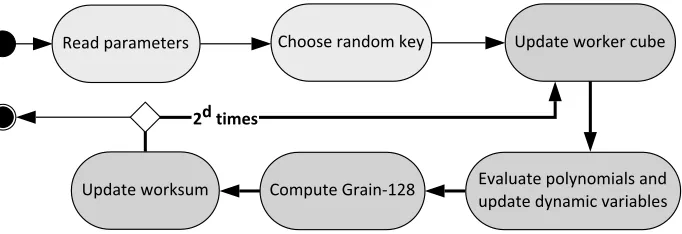
hardware. To get a better understanding of our implementation, we describe the basic work-ow in Figure 1: The software implementation of the attack uses a parameter set as input, e. g., the cube dimension, the cube itself, a base IV and the number of keys to attack. It selects a random key to attack and divides the big cube into smaller worker cubes and distributes them to worker threads running in parallel. Please note that for simplicity the gure shows only one worker. If2wworkers are used, the iterations per worker are reduced from2d to
2d−w.
Choose random key
Read parameters Update worker cube
Evaluate polynomials and update dynamic variables Update worksum Compute Grain-128
2d times
Fig. 1. Cube Attack Program ow for cube dimensiond.
The darker nodes and the bold path show the steps of each independent thread: As each worker iterates over a distinct subset of the cube, it evaluates polynomials on the worker cube (dynamic variables) and updates the IV input to Grain-128. Using the generated IV and the random key, it computes the output of Grain-128 after the initialization phase. With this output, the thread updates an intermediate value the worker sum and starts the next iteration. In the end, the software combines all worker sums, evaluates the result and can chose a new random key to start again.
With a cube of dimension d, the attack on one key (for the correct guess
of the 39 secret expression values) computes the rst output bit of Grain-128
2d times. Thus, in order to speed-up the attack, it is necessary to implement
Grain-128 as eciently as possible. The design of the stream cipher is highly suitable for hardware implementations: It consists mainly of two shift registers and some logic cells. As already proposed for cube testers on Grain-128 in [4], a fast and small FPGA implementation is a very good choice in comparison to a (bit-sliced) software implementation.
To create an independent worker on the FPGA, it is also required to im-plement the IV generation. To estimate the eort of building a full worker in hardware, we need to know how many dynamic inputs we have to consider: While dynamic modications, e. g., iterating over arrays with dynamic step sizes, pose no problems in software, they can be very inecient in hardware.
one of three functions: it is either a value given by the base IV provided by the parameter set, part of the (worker) cube or a dynamic variable. As the function of each bit is modied not only per parameter set, but also when assigning partial cubes to dierent workers, this input also varies. The rst two functionalities are both restricted and can be realized by simple multiplexers in hardware. The dynamic variable on the other hand stores the result of a polynomial. As we have no set of pre-dened polynomials and they are derived at runtime, every possible combination of boolean functions over the worker cube (and thus over the complete 128 bits) must be realized. Even with tight restrictions like a maximum of terms per monomial and monomials per polynomial, it is impossible to provide the recongurable structure in hardware.
As a consequence, a fully dynamic approach leads to extremely large mul-tiplexers and thus to very high area consumption on the FPGA, which is pro-hibitively slow. The completely opposite approach would be to utilize the com-plete area of an FPGA for massive parallel Grain-128 computations without ad-ditional logic. In this case, the communication between the host and the FPGA will be the bottleneck of the system and the parallel cores on the FPGA will idle.
For our attack, we use the RIVYERA special-purpose hardware cluster de-scribed in greater detail in Appendix A. For the following design decisions we re-mark that RIVYERA provides 128 powerful Spartan-3 FPGAs, which are tightly connected to an integrated server system powered by an Intel Core i7 920 with 8 logical CPU cores. This allows us to utilize dedicated hardware and use a multi-core architecture for the software part.
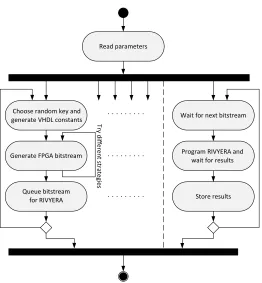
In order to implement the attack on the RIVYERA and benet from its massive computing power, we propose the following implementation. Figure 2 shows the design of the modied attack. The software design is split into two parts: We use all but one core of the CPU to generate attack specic bitstreams, i. e., conguration les for the FPGAs, in parallel to prepare the computation on the FPGA cluster. Each of these generated designs congures the RIVYERA for a complete attack on one random key provided by the host PC. As soon as one bitstream was generated and waits in the queue, the remaining core programs all 128 FPGAs with it, starts the attack, waits for the computation to nish and stores the results.
In contrast to the rst approach, which uses the generic structure realizable in software, we generate custom VHDL code containing constant settings and xed boolean functions of the polynomials derived from the parameter set and the provided key. Building specic conguration les for each attack setup allows us to implement as many fully functional, independent, parallel workers as possible without the area consumption of complex control structures. In addition, only a single 7-bit parameter is necessary at runtime - to split the workspace between all 128 FPGAs - to start the computation and receive ad-bit return value. This
Choose random key and generate VHDL constants
Read parameters
Generate FPGA bitstream
Queue bitstream for RIVYERA
Wait for next bitstream
Program RIVYERA and wait for results
Store results
Tr
y
di
ffer
ent
st
ra
te
gi
es
Fig. 2. Cube Attack using RIVYERA
Please note that in this approach the host software modies a basic design by hard-coding conditions and adjusting internal bus and memory sizes for each attack. We optimized the basic layout as much as possible, but the dierent choices of polynomial functions lead to dierent combinatorial logic paths and routing decisions, which can change the critical path in hardware. As the clock frequency is linked to the critical path, we implemented dierent design strategies as well as multiple fall-back options to modify the clock frequency constraints in order to prevent parameter/key pairs from resulting in an invalid hardware congurations.
4.2 Hardware Implementation Results
In this section, we give a brief overview of the implementation and present results. As the total number of iterations for one attack (for the correct guess of the 39 secret expression values) is2d, the number of workers for an optimal setup has
to be a power of two. Considering the area of a Spartan-3 5000 FPGA, we chose to implement a set of24 independent workers per FPGA.
Cube Attack System
Partial cubesum (System)
Worker
Worker Worker
Worker 7
Grain-128 Grain-128
Grain-128 worksum
control IV generator
partial cube sum
d-11 d-11
d-11 d
FPGA number
FPGA number
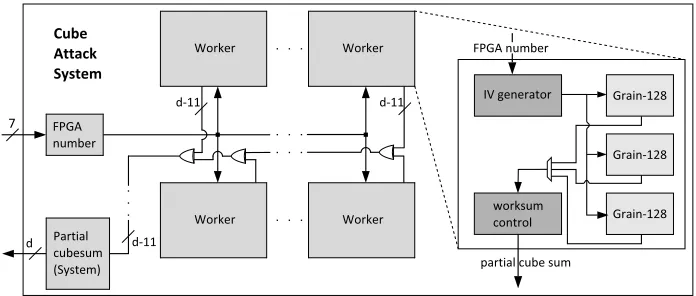
Fig. 3. FPGA Implementation of the online phase for cube dimensiond.
and data paths to a minimum. This is very important as we cannot predict the impact of the (unknown) parameters and need to relax the design as much as possible.
Each of the workers consists of its own IV generator and controls three Grain-128 instances. The IV generator needs three clock cycles per IV and we need a corresponding number of Grain instances to process the output directly. As it is possible to run more than one initialization step per clock cycle in parallel, we had to nd the most suitable time/area trade-o for the cipher implementation. Table 2 shows the synthesis results of our Grain implementation. In comparison, Aumasson et al. used 25 parallel steps, which is the maximum number of
sup-ported parallel steps without additional overhead, on the large Virtex-5 LX330 FPGA used in [4].
Table 2. Synthesis results of Grain-128 implementation on the Spartan-3 5000 FPGA with dierent numbers of parallel steps per clock cycle.
Parallel Steps 20 21 22 23 24 25
Clock Cycles (Init) 256 128 64 32 16 8 Max. Frequency (MHz) 227 226 236 234 178 159 FPGA Resources (Slices) 165 170 197 239 311 418
The resulting attack system for the online phase consisting of the software and the RIVYERA cluster uses 16 workers per FPGA and 128 FPGAs on the cluster in parallel. This means that the number of Grain computations per worker is reduced to2d−11. The design ensures that each key can be attacked at
the highest possible clock frequency, while it tries to keep the building time per conguration moderate.
Table 3. Results of the generation process for cubes of dimension 46, 47 and 50. The Duration is the time required for the RIVYERA cluster to complete the online phase. The Percentage row gives the percentage of congurations built with the given clock frequency out of the total number of congurations built with cubes of the same dimension.
Cube Dimensiond 46 47 50
Clock Frequency (MHz) 100 110 120 120 110 120
Congurations Built 1 7 8 6 60 93
Percentage 6.25 43.75 50 100 39.2 60.8
Online Phase Duration 17.2 min 15.6 min 14.3 min 28.6 min 4h 10 min 3h 49 min
the impact of the unknown parameters is predictable and that fallback strategies are necessary. Please note that the new attack tries to generate congurations for multiple keys in parallel. This process if several strategies are tried may require more than 6 hours before the rst conguration becomes available. Smaller cube dimensions, i. e., all cube dimensions lower than 48, result in very fast attacks and should be neglected, as the building time will exceed the du-ration of the attack in hardware. Further note that the dudu-ration of the attack increases exponentially in d, e. g., assuming 100 MHz as achievable for larger
cube dimensions,d= 53needs 1.5 days andd= 54needs 3 days.
5 Conclusions
We presented the rst attack on Grain-128 which is considerably faster than exhaustive search, and unlike previous attacks makes no assumptions on the secret key. While the full attack is infeasible, we can convincingly estimate its results by running a partial version in which all theeunknown secret expressions
are set to their correct value. Due to its high complexity and hardware-oriented nature, the attack was developed and veried using a new type of dedicated hardware. Our experimental results show that for about7.5%of the keys we get
a huge improvement factor of238over exhaustive search.
Acknowledgements: The authors thank Martin Ågren and the anonymous referees for their very helpful comments on this paper.
A Design and Architecture of the RIVYERA Cluster
ring bus for high-performance communication. The internal ring bus is further connected via PCI Express to a host PC which is also installed in the same 19" housing of the cluster. Figure 4 provides an overview of the architecture of the RIVYERA special purpose cluster.
Backplane XC3S 5000 XC3S 5000 XC3S 5000 XC3S 5000 XC3S 5000 XC3S 5000 XC3S 5000 XC3S 5000 FPGA XC3S 5000 XC3S 5000 XC3S 5000 XC3S 5000 XC3S 5000 XC3S 5000 XC3S 5000 XC3S 5000 FPGA XC3S 5000 XC3S 5000 XC3S 5000 XC3S 5000 XC3S 5000 XC3S 5000 XC3S 5000 XC3S 5000 FPGA
CTL XC
3S50 00 XC3S 5000 XC3S 5000 XC3S 5000 XC3S 5000 XC3S 5000 XC3S 5000 XC3S 5000 FPGA CTL Modu le 1
Modu le 2
Modu le 3
Modu le 16
Host PC PC Ie E th ern et Core i7 920 External Data Ring Bus
Fig. 4. Architecture of the RIVYERA cluster system
References
1. Itai Dinur and Adi Shamir. Breaking Grain-128 with Dynamic Cube Attacks. In Antoine Joux, editor, Fast Software Encryption, volume 6733 of LNCS, pages 167187. Springer, 2011.
2. Jean-Philippe Aumasson, Itai Dinur, Willi Meier, and Adi Shamir. Cube Testers and Key Recovery Attacks On Reduced-Round MD6 and Trivium. In Orr Dunkelman, editor, Fast Software Encryption, volume 5665 of LNCS, pages 1-022. Springer, 2009.
3. Martin Hell, Thomas Johansson, Alexander Maximov, and Willi Meier. A Stream Cipher Proposal: Grain-128. In IEEE International Symposium on Information Theory (ISIT 2006), 2006.
4. Jean-Philippe Aumasson, Itai Dinur, Luca Henzen, Willi Meier, and Adi Shamir. Ecient FPGA Implementations of High-Dimensional Cube Testers on the Stream Cipher Grain-128 In Workshop on Special-purpose Hardware for Attacking Cryp-tographic Systems SHARCS 2009, September 9-10 2009.
5. Simon Knellwolf and Willi Meier and Maria Naya-Plasencia. Conditional Dier-ential Cryptanalysis of NLFSR-based Cryptosystems. In Masayuki Abe, editor, ASIACRYPT, volume 6477 of LNCS, pages 130145. Springer, 2010.
7. Simon Fischer, Shahram Khazaei, and Willi Meier. Chosen IV Statistical Anal-ysis for Key Recovery Attacks on Stream Ciphers. In Serge Vaudenay, editor, AFRICACRYPT, volume 5023 of LNCS, pages 236245. Springer, 2008.
8. Paul Stankovski. Greedy Distinguishers and Nonrandomness Detectors. In Guang Gong and Kishan Chand Gupta, editors, INDOCRYPT, volume 6498 of LNCS, pages 210226. Springer, 2010.
9. Christophe De Cannière, Özgül Kücük, and Bart Preneel. Analysis of Grain's Initialization Algorithm. In Serge Vaudenay, editor, AFRICACRYPT, volume 5023 of LNCS, pages 276289. Springer, 2008.
10. Yuseop Lee, Kitae Jeong, Jaechul Sung, and Seokhie Hong. Related-key Chosen IV Attacks on Grain-v1 and Grain-128. In Yi Mu, Willy Susilo, and Jennifer Seberry, editors, ACISP, volume 5107 of LNCS, pages 321335. Springer, 2008.
11. Xuejia Lai. Higher Order Derivatives and Dierential Cryptanalysis. In "Sympo-sium on Communication, Coding and Cryptography", in honor of James L. Massey on the occasion of his 60th birthday, pages 227233, 1994.
12. Antoine Joux. Algorithmic Cryptanalysis. Chapman & Hall, pages 285-286. 13. Tim Güneysu, Timo Kasper, Martin Novotný, Christof Paar, and Andy
Rupp. Cryptanalysis with COPACOBANA. IEEE Transactions on Computers, 57(11):14981513, November 2008.
14. Tim Güneysu, Gerd Pfeier, Christof Paar, and Manfred Schimmler. Three Years of Evolution: Cryptanalysis with COPACOBANA. In Workshop on Special-purpose Hardware for Attacking Cryptographic Systems SHARCS 2009, September 9-10 2009.
15. Stephen Budiansky. Battle of Wits: the Complete Story of Codebreaking in World War II, Free Press, 2000, ISBN 9780684859323.
16. John Gilmore. Cracking DES: Secrets of Encryption Research, Wiretap Politics & Chip Design, O'Reilly, July, 1998.
17. Mitsuru Matsui. The First Experimental Cryptanalysis of the Data Encryption Standard, In Yvo Desmedt, editor, CRYPTO, volume 839 of LNCS, pages 111. Springer, 1994.
18. Michael Vielhaber. Breaking ONE.FIVIUM by AIDA an Algebraic IV Dierential Attack. Cryptology ePrint Archive, Report 2007/413, 2007.