Image Denoising using SWT 2D Wavelet
Transform
Deep Singh Bedi Pawandeep Kaur
Department of Electronics & Communication Engineering Department of Electronics & Communication Engineering GNDU Amritsar GNDU Amritsar
Abstract
Images undergo deterioration in quality when processed by some means. The Signal strength drops when it undergoes a series of operations. The main deciding factor for this degradation therefore depends on the signal to noise ratio of the processed ima ge with respect to the unprocessed image that is how much loss in the quality of the processed image or how much intervention of noise occurs during processing. Using the SWT 2D denoising technique we compensate for such noise distortions using MATLAB as a platform. The proposed algorithm exhibits promising results from quantitatively and qualitatively points of view. Keywords: Discrete wavelet transform, Image denoising, Wavelet transform, Peak signal to noise ratio, Sea level
Abbreviations: SLR: sea level rise, PSNR: peak signal to noise ratio, DWT: discrete wavelets transform, SWT: stationary wavelet transform
_______________________________________________________________________________________________________
I. INTRODUCTION
Image processing field is a huge field to deal with. It encompasses in the following areas: 1. Image Compression, 2. Image De-noising, 3. Image Enhancement, 4. Image Recognition, 5. Feature Detection, and 6. Texture Classification [1]. Wavelet-based techniques apply to all of these topics.An image is often corrupted by noise in its acquisition and transmission or during its processing. Image denoising is used to remove the additive noise introduced during processing while retaining as much as possible the important signal features. In the recent years a lot of research on wavelet thresholding and threshold selection for signal de-noising [2], [3]-[11] has been done, because wavelet provides an appropriate basis for separating noisy signal from the original image signal which contains the data. This is mainly because wavelet transform is good at energy compaction, the small coefficients are more likely due to noise and large coefficients due to important signal features [8]. These small coefficients can be thresholded without affecting the significant features of the image. Thresholding is a simple non-linear technique, which operates on one wavelet coefficient at a time. Each coefficient is compared against the threshold chosen, if the coefficient is smaller than threshold value it is set to zero value otherwise it is kept or modified. Replacing the small noisy coefficients by zero and taking inverse wavelet transform on the result may lead to the reconstruction with the essential signal characteristics retained and with lesser noise.In the proposed algorithm the image used is the binary conversion of a satellite image that is used to calculate the SLR(Sea level rise)[22]. Since the processing is done in MATLAB as a platform, the processing is quite accurate and very low noise or distortion is present.in the processed binary image. The noise in a binary image can take only the form of adding a ‘1’ in place of ‘0’ or vice versa. If very accurate results are desired which is the case for SLR, image denoising is required to compensate even a little loss of data. Image denoising using SWT 2D wavelet transform is used for denoising the binary part, the PSNR (Peak signal to noise ratio) is calculated for the initial grayscale to binary image and the grayscale to the final denoised image.
II. LITERATURE REVIEW
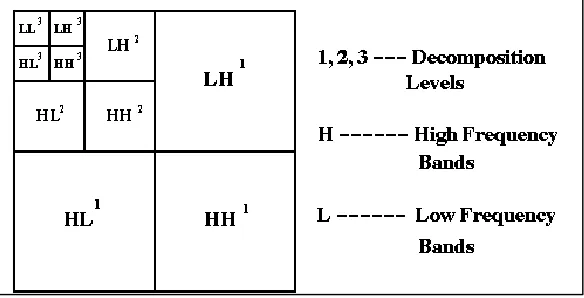
sequence of different spatial resolution images using DWT. In case of a 2D image, an N level decomposition can be performed resulting in 3N+1 different frequency bands namely, LL, LH, HL and HH as shown in figure 1. These bands provide specific information of coefficients which are horizontal, vertical and diagonal coefficient detail and the overall average part of the image coefficients. Computing is done row wise and then column wise. The Gaussian noise will nearly be averaged out in low frequency wavelet coefficients. Therefore, only the wavelet coefficients in the high frequency levels need to be thresholded.
Fig. 1: 2D-DWT with 3-Level decomposition
Wavelet Based Image De-noising:
Digital images are prone to noise due to processing. Image denoising algorithms are proposed which attempt to remove this unwanted noise. De-noising of natural images corrupted by Gaussian noise using wavelet techniques is very effective because of its ability to capture the energy of a signal in few energy transform values. The methodology of the DWT based image de-noising has the following three main steps as shown in figure2. 1. Apply 2D wavelet transform and transform the noisy image into orthogonal domain. 2. Apply hard or soft thresholding to the noisy detail coefficients of the wavelet transform. 3. Perform inverse discrete wavelet transform to obtain the de-noised image. Here, the threshold plays an important role in the denoising process. Finding an optimum threshold is a tedious process. A small threshold value will retain the noisy coefficients whereas a large threshold value leads to the loss of coefficients that carry image signal details. Normally, hard thresholding and soft thresholding techniques are used for such de-noising process. Hard thresholding is a keep or kill rule whereas soft thresholding is a shrink or kill rule that shrinks the coefficients above the threshold in absolute value.
IV. SIMULATION AND RESULT
The processed image is taken from the processing results from [22]. Since the processing of Satellite image from satellite data to its equivalent binary form for the calculation of SLR involves intervention of noise. Though its effect is too less because o f the processing of the image in MATLAB and also the binary processed image could include only the noise corresponding to 1’s in place of 0’s and vice versa. If we require very accurate calculation for SLR and as it does need we need to exclude the effect of noise from the processed binary image which is done in the following points.
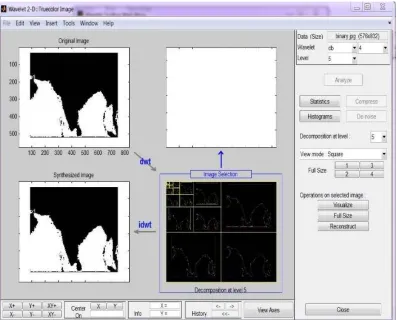
1) Enter WAVEMENU at the MATLAB command prompt. 2) Select SWT Denoising 2D.
3) Load the Binary Noisy image of the Indian peninsula that is processed from its satellite version. 4) Select Wavelet as db-4 and level as 5 and click decompose.
5) Select thresholding method- fixed form thresholding and its Type-Soft. Select noise structure as-unscaled white noise and different threshold levels and click denoise.
6) Save the denoised images (different for different thresholds) and calculate PSNR for each with respect to the initial grayscale image. The same can also be applied using wavelet 2D from the wave menu and following the similar steps as proposed we can infer the results in similar manner and technique.
A table is devised showing the different values of thresholds at different levels to obtain denoised image. Original image is shown for reference with its PSNR. Denoising at minimum intermediate and maximum levels of threshold values has been shown. The increment in PSNR shows denoising effect.
Table – 1
Level 1 Level 2 Level 3 Level 4 Level 5 PSNR
Original Image - - - - - 4.6407
Denoised image 1 0 0 0 0 0 4.6680
Denoised image 2 5 4 3 2 1 4.6687
Denoised image 3 576.8 576.8 422.4 422.4 422.4 4.7222
V. CONCLUSION
In this paper effective denoising technique is applied using SWT 2D denoising in MATLAB. The processed image during image processing [22] causes intervention of noise and cause signal degradation and to compensate for the loss of quality of the image denoising techniques are devised. An efficient denoising technique using thresholding is proposed which compensates the image deterioration due to unwanted noise signal. PSNR gives us the knowledge about the quality of signal and the level of noise present in signal which needs to be maximised.
ACKNOWLEDGEMENT
The authors acknowledge the Department of Electronics Technology for the continuous support for the work by providing the excellent work environment and MATLAB Platform without which this work might not be a success.
REFERENCES
[1] James S. Walker, ―Wavelets Based Image Processing, Department of Mathematics University of Wisconsin Eau Claire. [2] D.L. Donoho, De-Noising by Soft Thresholding, IEEE Trans. Info. Theory 43, pp. 933-936, 1993.
[3] S. Grace Chang, Bin Yu and M. Vattereli, Adaptive Wavelet Thresholding for Image Denoising and Compression, IEEE Trans. Image Processing, vol. 9, pp. 1532-1546, Sept. 2000.
[4] D.L. Donoho and I.M. Johnstone, Adapting to unknown smoothness via wavelet Shrinkage, Journal of American Statistical Assoc., Vol. 90, no. 432, pp. 1200-1224, Dec. 1995.
[18] L. Sendur and I. Selesnick, “Bivariate shrinkage functions for wavelet based denoising exploiting interscale dependency,” IEEE Trans. On Signal Proc., vol. 50, pp. 2744–2756, 2002.
[19] J. Portilla, V. Strela, M. Wainwright, and E. Simoncelli, “Image denoising using scale mixtures of Gaussians in the wavelet domain,” IEEE Trans. on Image Proc., vol. 12, pp. 1338–1351, 2003.
[20] A. Buades, B. Coll, and J Morel. On image denoising methods. Technical Report 2004- 15, CMLA, 2004.
[21] A. Buades, B. Coll, and J Morel. A non-local algorithm for image denoising. IEEE International Conference on Computer Vision and Pattern Recognition, 2005.