ISSN (e): 2250-3021, ISSN (p): 2278-8719
Vol. 09, Issue 10, October. 2019, Series -I, PP 58-65
A Modified M/M/c/K+Flush/K Analytical Model for improving
Delay Aware QoS of MANET
Aleem Ali
1, Neeta Singh
1, Poonam Verma
1 1SoICT, GBU,India-201308Corresponding Author: Aleem Ali
Received 18 September 2019; Accepted 04 October 2019
Abstract:
This research paper is intended to develop a finite queueingmodel M/M/c/K+Flush/Kwhich can help it in designing and implementation in order to obtain an efficient, low cost, and high-speed MANET.In this context, weemphasize on characterizing the average waiting time at the node, queueing delay,node utilization andmaximum achievable throughput per nodeso as to analyze some of the performance measures in order to enhance the QoS of MANET.The paper establishes a Markovian queueing model for MANET andpresents results that have been carried out via MATLAB. Impact of parameters such as the speed, the arrival rate and service rate on a mobile node in a given area using Poisson distribution is investigated.Keywords:
MANET, Markovian queueing model, Node utilization, Quality of Service (QoS).I.
INTRODUCTION
The appearance offast popularization of Mobile Adhoc Network (MANET) can be noticedeverywhere to exchange the information which fulfill the purpose of setting up the network on a very fast pace [1-5]. Therefore, to set up a quick communication is no longer a dream in case to get and exchange the desired information. Its intrinsic capabilities of self-administration and self automation, simple maintenance, better flexibility, independence ofinfrastructure andconsiderable costs advantages enables MANET to becomethe preferable and reliablenetwork for pervasive communication [6]. That’s why the significance of MANET is increasingly acknowledged by the researchers and industry community. MANET are becoming the network of choice everywhere, not only because of flexibility and freedom they offer but also robustness of network and to set up quick communication network [7-8].
Extensive research work is being carried out to find attainable solutions to the sophisticated problems encountered in MANET to develop it more and more efficient, robustand economical[9].Statistical models serve as essentialguiding principle for the development, optimization andexecution of upcoming MANET technologies. Statistical models encourageachieving reasonable performance targets and providing a clear and understandable roadmap to researchers by examining whether or not a performance target is physically attainable. This may lead to the advancementin performance in order to have a better QoSpossibly by means of efforts under the existeddeveloped technologies [10-12].
Queueing approach is aconsiderable statistical depiction of queueing system [13]. A queueing model for the MANET is simply delineate as packet reachingat a node, waititschanceto get serviced if not immediate, afterhaving waited it is serviced by the nodeand then packet leaves the network. It hasfew important assumptions about the probabilistic setting of the entering and servicingactions, the quantity of nodes, their naturein the network and queueing discipline. There may be numerouspossibledifferences in the queueing models, howeverfew models are more generally casted-off [14-17]. Forthe purpose of developing efficient MANET, queueing models may obtainthe new derivations and formulasforthe approximationof performance measures in the MANET. This can assist inanupgrading a servicing model or can design better the current one [18-19].
Queueing approaches aresuitable in anticipating and determining theperformance of the mobile network. Unlike simulation methodologies, they need basic information and lead to comparatively easy derivations for predicting many performance outcomes such as delay, average waiting time and probability of waiting in the network etc. Queueing approaches are essential to evaluate the QoS in network [20-21]. In addition, not only fast to run, but also present easiermeans to perform "what-if" analyses, discover tradeoffs and identifyengaging solutions rather than simply estimating performance in the network [22].
Considering, probability at any time t, let us say, P(t) is the sum ofincoming packets at a node in the network during the time t, if n is considered the inter-arrival time and P(t) follow a Poisson distribution, then Probability {P(t) = n} = e-λt (λt)n / n!
We have proposed an analytical modelto prove that our proposed approach outperforms other approaches mentioned in paper. The paper is prepared with the following sections. Section II gives a brief idea to the existing research on various queueing models for MANETs. Section III provides an explicit description of the proposed queueing model. In Section IV, proposed mathematical model is evaluated in detail, to calculate the performance parameters and performance measurements of the model are determined. Outcomes are shown in Section V and the paper is summarized by conclusions in Section VI.
II.
RELATED WORK
Queueing model in MANET have been studied by numerous researchers. Some of these researches are discussed here.In [24], the authorsstudied the queuing model (G/G/1) for delay measureusing diffusion approximation method. The authors estimated the mean E-2-E delay for multi-hop network. The previous approaches were mainly focused on theoretical work and most of the papers assumed that these networkscontain infinite buffer capacity. Though, node in a real time network contains a restricted buffer, which further tend us to predict the packet drop probability. In [25], a cross-layer approach is proposed for refining the delay of real-time traffics. It was performed bylessening the packets that came after their schedule deadline. This paper was also focused on the theoretical effort.
Inpaper [26], the average throughput per node in the network reducedto 1/√n or 1
√nlgn, say n is sum of
nodes.This was to mean, that the whole network capacity bound to enhance nearly √n. Moreover, in [27] it is shown that mobility can improve the capacity. However, delay is not guaranteed in their approach. Hence, delay increased due to more possiblenumber of hops or queueing in order to increase the throughput. Authors have analyzeda fixed population loss and delay [28] considering the assumptions of interarrival time and service times, manageableincoming rates. In paper [29], a M/M/c/∞ inter-reliant model with controllable incoming rateswasanalyzed. Further, an interdependent model M/M/1/K with manageableincoming rates has been analyzed in [30].
In [31], paper discussed G/G/1 analytical techniqueto evaluate the performance of networkconsidering discreet time. A new model was projected with the help of probability generating function. In this paper, packet delay was determined considering unsaturated traffic and probability distribution function.In [32], for single hop scenarios, markov chain model was presented to get a mathematical expression for delay, along with first moment of the service time.In this paper, a M/G/1 model wasimplemented. The paper furthers improved the queueing method for a single hop network to mapped with a multi-hop wireless network. The authors presented theterminologies for the probabilities of collision and lossrateowing to the hidden node problem. Though, in multi-hop situations, they solely discussed the rough throughput of node and did not consider the delay.
In [33], authors took the work forward introduced in paper [34] to estimate the delay analysis. The authors modeled the multi-hop wireless networkan M/G/1 queue under unsaturated traffic condition. Service time distribution function was determined for each node under hidden and exposed terminal problem. Further, with the assistance of the service time distribution, delay for single hop network was estimated.
III.
PROPOSED M/M/c/K+Flush/K QUEUEING MODEL
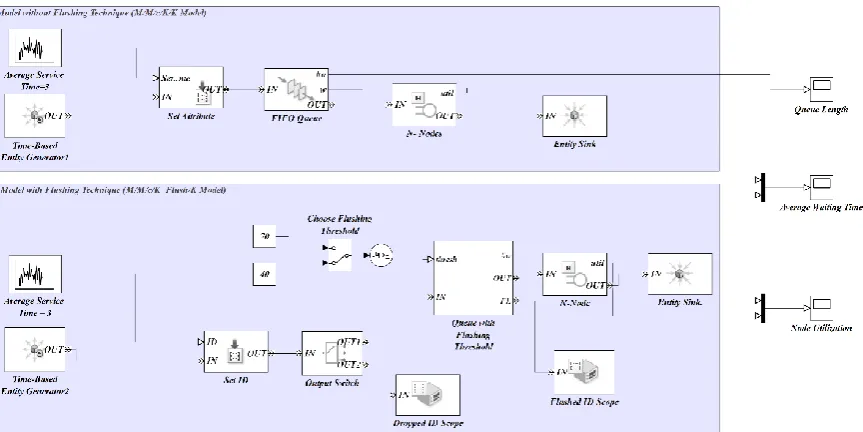
The model described in this paper comprises two sections, firstly, queue with flushing technique and second, queue without flushing technique. This givesadescription to the network behaviour under the impact of flushing technique (Fig. 1).In this paper, the model assumes multiple queues (c) with finite buffer of size K. Each packet reaches at the MANET’s node following Poisson distribution with incoming rate λ per unit time and the service time, which is an exponential distribution,µ with flushing in overloaded queue. This model is considered a population of size K and service discipline at node is served on the basis of First-Come–First-Serves (FCFS).
The actual arrival rate of finite population model with multiple node is given by
𝜆𝑛 = 0 𝑛 > 𝐾 k − n λ0 ≤ 𝑛 ≤ 𝐾 (1)
having their service rate (µn) expressed as,
µn =
n.µ𝑛 < 𝑐 𝑐.µn ≥ c(2)
where, λn Actual incoming rate at the node µn The service rate at a node n Number of packets
1/λ Mean time between two consecutive arrivals.
we know, node in the MANET is prone to failures and at the time it occurs, all the packets are flushed out of the node.
Fig. 1. M/M/c/K+Flush/K Queueing Network Model: Simulink
3.1 Queue with Flushing Technique
In this technique, the queue of the node with flushing threshold containsonly one input port labelled thresh that shows the threshold for flushing the packets from the node. Inthis flushing technique, a FCFS Queue block contains packets, whereas the Control Space Usage subunit (as shown in figure 1)relates the queue length of node to the threshold. If the queue length surpasses the threshold, the Enabled Gate block allow thesufficient packets to leave from the queue until the queue length no longer exceeds the threshold. This technique get aheaduntil the Enabled Gate block's OUT port is not kept blocked.
1.2 Queue without Flushing Technique
In this technique, generally, queue without flushing threshold subsystem needsa signal input port.There is no need of labelling to threshas it was used by earlier one technique forshowing the flushing of the packets in the queue. Consequently, queue can grip the number of packets equal to the maximum population size (K) which may caused the packets loss. The packets still arriving at the queue regardless of the queue is full.
IV.
Performance Metrics forM/M/c/K+Flush/K
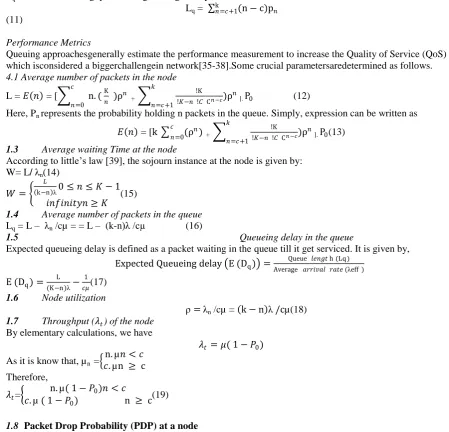
Severalclosed form expressionsfor the performanceparameters of M/M/c/K+Flush/K model are determined. The traffic intensity on the node ρ = λ/cμ, ρ < 1 for the stable queue. Here, ρ indicates the typical proportion of time.
Therefore,
Pn =P0
λ0.λ1.−−−−−−−−λn−1
µ1.µ2.−−−−−−−−−−µ𝑛(3)
Where Pn and P0 is the steady state probabilities of having n packets and zero packet in the system.
Pn= P0
K K−1 −−−−−−−−(K−n+1)λ𝑛
ǃ𝑛µ𝑛 (4)
for n ≥ c Pn =P0
λ0.λ1.−−−−−−−−λ(n−1)
µ1.µ2.−−−µ𝑐 .(µ𝑐+1−−−µ𝑛)(5)
Pn= P0
K K−1 −−−−−−−−(K−n+1)λ𝑛 ǃ𝐶 C𝑛 −𝑐.µ𝑛 (6) Pn = (
ǃK
ǃ𝐾−𝑛ǃ𝐶 C𝑛 −𝑐)P0ρ
𝑛(7)
Using normalizing condition p𝑛
c
𝑛=0 + k𝑛=𝑐+1p𝑛 =1(8)
P0 =
1
( K𝑛
𝑐
𝑛 =0 )ρ
𝑛 + ǃK ǃ𝐾 −𝑛ǃ𝐶 C 𝑛 −𝑐)ρ𝑛 𝑘
𝑛 =𝑐+1
(9)
Where, L denotes the queue’s length at the node. Lq denotes the waiting queue’s length and given by,
Lq = k𝑛=𝑐+1(n − c)p𝑛
(11)
Performance Metrics
Queuing approachesgenerally estimate the performance measurement to increase the Quality of Service (QoS) which isconsidered a biggerchallengein network[35-38].Some crucial parametersaredetermined as follows. 4.1 Average number of packets in the node
L = 𝐸 𝑛 = [ n. ( K
𝑛 𝑐 𝑛=0 )ρ𝑛 + ǃK ǃ𝐾−𝑛 ǃ𝐶 C𝑛 −𝑐)ρ
𝑛 𝑘
𝑛=𝑐+1 ].
P0 (12)
Here, Pn represents the probability holding n packets in the queue. Simply, expression can be written as
𝐸 𝑛 = [k 𝑐 (ρ𝑛)
𝑛=0 +
ǃK ǃ𝐾−𝑛 ǃ𝐶 C𝑛 −𝑐)ρ
𝑛 𝑘
𝑛=𝑐+1 ].
P0(13)
1.3 Average waiting Time at the node
According to little’s law [39], the sojourn instance at the node is given by: W= L/ λn(14)
𝑊 =
𝐿
k−n λ0 ≤ 𝑛 ≤ 𝐾 − 1
𝑖𝑛𝑓𝑖𝑛𝑖𝑡𝑦𝑛 ≥ 𝐾 (15) 1.4 Average number of packets in the queue Lq = L – λn /cµ = = L – (k-n)λ /cµ (16)
1.5 Queueing delay in the queue
Expected queueing delay is defined as a packet waiting in the queue till it get serviced. It is given by, Expected Queueing delay E (Dq) =
Queue 𝑙𝑒𝑛𝑔𝑡 h (Lq)
Average 𝑎𝑟𝑟𝑖𝑣𝑎𝑙 𝑟𝑎𝑡𝑒 (λeff )
E (Dq) = L
(K−n)λ−
1
𝑐𝜇(17)
1.6 Node utilization
ρ= λn /cµ = k − n λ /cµ(18) 1.7 Throughput (𝜆𝑡) of the node
By elementary calculations, we have
𝜆𝑡 = 𝜇( 1 − 𝑃0)
As it is know that, µn =
n.µ𝑛 < 𝑐 𝑐.µn ≥ c Therefore,
𝜆𝑡=
n.µ( 1 − 𝑃0)𝑛 < 𝑐
𝑐.µ ( 1 − 𝑃0) n ≥ c
(19)
1.8 Packet Drop Probability (PDP) at a node
Packet Drop Probability (PDP) is also identified as blocking probability of the node represented when the queue is found full and restricted buffer capacity of K. This probability of rejection (Pk) of anincoming packet at any node in MANET isgiven by,
Pk = P(drop) = P0 ρ𝐾 𝒄!𝑐𝐾 −𝑐(20)
Since this queue is of finite capacity, ρis greater than 1.
V.
SIMULATION RESULTS AND OBSERVATION
The performance of proposed M/M/c/K+Flush/K queueing model is evaluated using MATLAB. Table 1 presents the values of parameters used in the analysis and simulations. Analytical outcomes are given away by simulations which shows better consequences. In fig. 2, comparison are made between traditional and proposed M/M/c/ K+Flush/K queueing model for buffer capacity of the node.
Table 1: Simulation Parameters
Parameter Value
Distribution of Arrival Rate Poisson Distribution Service Rate Exponential
Simulation Time 300 sec
Queue Limit 100 packets
Threshold Upper 70
Threshold Lower 40
Packet Size 512 byte
Number of Nodes 12
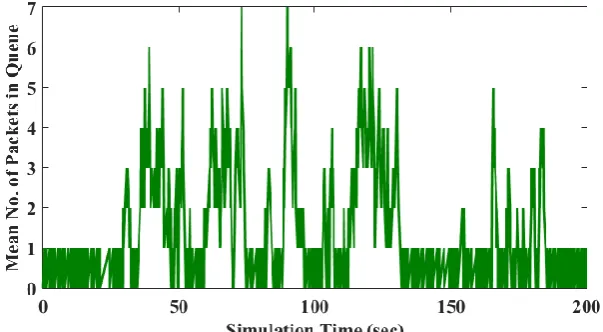
For performance evaluations of the model, we considered QoS that includes delay management, queue length and utilization of the node. It is considered a set of service necessaries to be seen when sending a packet flow from source to destination. Therefore, our performance assessmentsaremade on the three performance metrics concerning QoS requirements. The FIFO queue is considered to have a buffer of finite length. Upper and lower flushing threshold values are set to 70 and 40 respectively. Initially number of nodes are taken 12 for the simulation.Simulation result in Figure 2 shows the average number of packets in the queue at any given time. Mean number of packets are kept same for both the techniques (with flushing and without flushing). It is analysed from the simulation that length of queue at node of this models does not exceed the average length of the queue at any time.
Fig. 2.Quantity of packets for proposed M/M/c/K+Flush/K model
Having the same number of packets in queue, queueing delay and node utilization are compared for both the techniques through simulations. Through simulation consequence, figure 3 presents the comparison between the proposed M/M/c/K+Flush/K model and conventional M/M/c/K/K in terms of queueing delay. It can be observed clearly that each packet has to wait comparatively lesser for the projected modelM/M/c/K+Flush/K. Initially for a small period, the value of queueing delay remains same but in conventional model, at a point of time it upsurgesrapidly and keeps on changingbased on the volume of the queue. The peak value of queueing delay for earlier model is more than 0.7 msec but for M/M/c/K+Flush/K model its 0.35, almost half the delay practiced by traditional l model. This evidently demonstrate that our proposed model outperforms the traditional one.
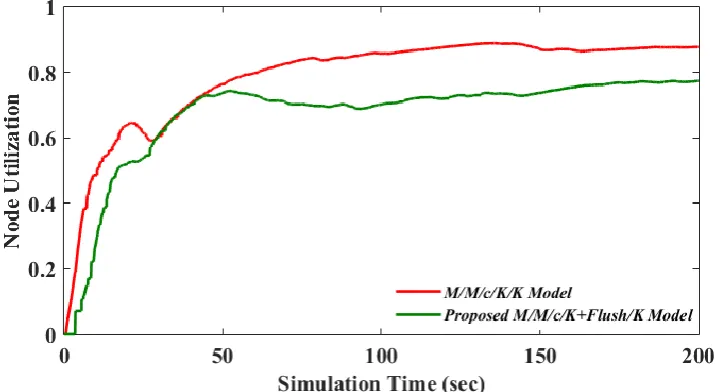
Simulation outcome in Fig. 4illustrate the comparison betweenM/M/c/K+Flush/K model and the conventional M/M/c/K/Kw.r.tnode utilization, which generallyaffected by the arrival rate and service pattern of the packets, queue content. Hence, as the queue content is increased, node utilization also bound to increase and vice-versa, which shows a positive relationship. It can be seen from the figure 4, that ourproposed model outperforms the conventional queueing model in terms of node utilization.
Fig. 4. Node utilization: Proposed M/M/c/K+Flush/K vs conventional M/M/c/K/K
VI.
CONCLUSION
The paper proposed a queuing approachforincreasing theperformance of MANETso as toimprove QoS. We have established the closed form expressions for steady state probabilities with fewkey performance parameters like queueing delay, node throughput,average waiting time, node utilization,queue length and packet drop probability are determined. Further, these analytical outcomes are verified using using MATLAB software. Simulationoutcomeproves that the presented proposed model (M/M/c/K+Flush/K) outperforms the traditional queueing model (M/M/c/K/K). In figure 3 and figure 4, we have found that results of queueing delay and node utilization are far better than the conventional model.
Conflicts of Interest
The authors declare no conflict of interest.
REFERENCES
[1]. Misra, Sudip, Zhang, Isaac, Misra, and S. Chandra, A guide to Wireless Ad hoc Network, London: Springer-Verlag, 2009.
[2]. M. Frodigh, P. Johansson, and P. Larsson. “Wireless Ad hocNetworking: The Art of Networking Without a Network,” Ericsson Review, vol. 4, pp. 248-263, 2000.
[3]. J. Zhao Sun, “Mobile Ad Hoc Networking: An Essential Technology for Pervasive Computing,” MediaTeam, Machine Vision and Media Processing Unit, Infotech Oulu, University of Oulu, Finland, pp. 316-321, 2001.
[4]. Saleh A. K. A. Omari and Putra Sumari, “An Overview of Mobile Adhoc Networks For the Existing Protocols and Application,” International Journal on applications of graph theory in wireless adhoc networks and sensor networks (Graph-Hoc), vol. 2, No 1, March 2010.
[5]. C. E. Perkins, Ad Hoc Networking. Addison-Wesley, Reading, MA, 2001.
[6]. Chip E. and B. Heile, “Self-Organizing, Self Healing Wireless Networks,” IEEE ICPWC 2000, pp. 355-361, Cambridge, MA, 2000.
[7]. J. Zhao Sun, Mobile Ad Hoc Networking: An Essential Technology for Pervasive Computing, MediaTeam, Machine Vision and Media Processing Unit, Infotech Oulu, University of Oulu, Finland, pp. 316-321, 2001.
[9]. Liu, Jiajia, H. Nishiyama, N. Kato, T. Kumagai, and A. Takahara, “Toward Modelling Ad hoc Networks: Current Situation and Future Direction,” IEEE Wireless Communications, vol. 20, no. 6, pp. 51-58, Dec. 2013.
[10]. S. Mangold, S. Choi, G. R. Hiertz, O. Klein, and B. Walke. Analysis of IEEE 802.11e for QoS Support in Wireless LANs. IEEE Wireless Communications Magazine, Special Issue on Evolution of Wireless LANs and PANs, Jul. 2003.
[11]. P. Sinha, QoS Issues in Ad-Hoc Networks, Ad Hoc networks, Springer US pp. 229-247, 2005.
[12]. C. R. Lin and J. S. Liu. “QoS Routing in Ad-hoc Wireless Networks,” IEEE Journal on Selected Areas in Communications, vol. 17, no, 8, pp. 1426-1438, 1999.
[13]. M. Zukerman, Introduction to Queueing Theory and Stochastic Teletraffic Models, EE Department, City University of Hong Kong, 6 June 2016.
[14]. Linda Green, “Queueing Analysis in Healthcare”, Chapter 10,International Series in Operations Research & Management Science, pp. 281-307,USA, 2006.
[15]. G. Bolch, S. Greiner, Hermann D. Meer, Kishore and S. Trivedi, Queueing Networks and Markov Chains: Modeling and Performance Evaluation with Computer Science Applications. John Wiley & Sons, NY, 1998.
[16]. Arnold O. Allen, Probability, Statistics, and Queueing Theory with Computer Science Applications, Academic Press, 1978.
[17]. Andreas Willig, A Short to Queueing Theory, Telecommunication Networks Group, Berlin, July 21, 1999.
[18]. I. Adan and J. Resing, Queueing Systems, Eindhoven University, The Netherlands March 26, 2015. [19]. D. Gross and C. M. Harris, Fundamental of Queueing Theory, 3rd Ed., John Wiley and Sons Inc., NY,
1998.
[20]. R. Bagrodia, W. W. Chu, L. Kleinrock, and G. Popek, “A new model in the use of computer and communication technology- Vision, Issues and Architecture for Nomadic Computing,” IEEE Personal Communications, pp. 14-27, December 1995.
[21]. K. Erciyes, O. Dagdeviren, D. Cokules and Hasan Gumus, Modeling And Simulation Of Wireless Sensor And Mobile Ad Hoc Networks,” Proc. of the International Conference on Modeling and Simulation, Konya, TURKEY Paper No B101, 28-30 August 2006.
[22]. Zeigler,Kim, and Praehofer, Theory of Modeling and Simulation, 2nd Edition, Academic Press, Jan 2000. [23]. A. Sikora and E. N. Szynkiewicz, “MobASim: A Software Platform for Mobile Ad Hoc Networks
Modeling and Simulation,” IEEE International Conference on Wireless and Mobile Computing, Networking and Communications, pp. 625-630 , 12-14 October 2008.
[24]. N. Bisnik, Alhussein Abouzeid, “Queuing Delay and Achievable Throughput in Random Access Wireless Ad Hoc Networks,” IEEE proc. of International Conference of Wireless Communications and Mobile Computing, pp. 773-778, Vancouver, Canada, 2006.
[25]. R. Ell-Khoury, R. El-Axouzi and E. Altman, “Delay analysis for real-time streaming media in multi-hop ad-hoc networks,” In Proc. of the International Symposium on Modeling and Optimization in Mobile, Ad Hoc, Wireless Networks (WiOPT), Germany, 2008.
[26]. P. Gupta and P. R. Kumar, “The Capacity of Wireless Networks,” IEEE Transactions on Information Theory, vol. 46, no. 2, March 2000.
[27]. M. Grossglauser and D. Tse, “Mobility Increases the Capacity of Ad Hoc Wireless Networks,” IEEE/ACM Transactions on Networking, vol. 10, no. 4, August 2002.
[28]. Srinivasan, A., and M. Thiagarajan. “A finite population loss and delay queueing system with interdependent inter-arrival and service times,controllable arrival rates and no passing,” Journal of Applied Statistical Science, vol. 17, no. 1, pp. 47–64, 2009.
[29]. A. Begum, M.I., and D. Maheswari, “The M/M/c/∞ interdependent queueing model with controllable arrival rates,” Opsearch, vol. 39, no. 2, pp. 89-110, 2002.
[30]. Srinivasan, A., and M. Thiagarajan, “The M/M/1/K interdependent queueing model with controllable arrival rates, International Journal of Management and Systems,” vol. 22, no. 1, pp. 23-34, 2006.
[31]. O. Tickoo, and B. Sikdar, “Queueing analysis and delay mitigation in IEEE 802.11 random access MAC based wireless networks,” in Proceedings of the Annual Joint Conference of the IEEE Computer and Communications Societies (NFOCOM ), pp. 1404-1413, 2004.
[32]. G. Bianchi, “Performance analysis of the IEEE 802.11 distributed coordination function,” IEEE Journal on Selected Areas in Communications, vol. 18, no. 3, pp. 535-547, 2000.
International organization of Scientific Research
65 | Page
[34]. F. A. Shabdiz, and S. Subramaniam, “Analytical Models for Single-Hop and Multi-Hop Ad HocNetworks,” Mobile Networks and Applications, vol. 11, no. 1, pp. 75-90, 2006.
[35]. P. M. Ruiz, G. L. Aceves, and J. J, Ad-Hoc, “Mobile and Wireless Networks,” Proc. of 8th International Conference (ADHOC-NOW 2009), Springer, Murcia, Spain, September 22-25, 2009.
[36]. R. Leung, J. Lio, E. Poon, A.-L. C. Chan, and B. Li, “MP-DSR: A qos-aware multi-path dynamic source routing protocol for wireless ad-hoc networks,” In Proc. IEEE Conference on Local Computer Networks (LCN’01), pp. 132-141, 2001.
[37]. S. B. Lee, G.-S. Ahn, X. Zhang, and A. T. Campbell. “INSIGNIA: An IP-Based Quality of Service Framework for Mobile Ad-hoc Networks,” Journal of Parallel and Distributed Computing, vol. 60, pp. 374–406, 2000.
[38]. C. Zhu and M. S. Corson, “QoS routing for mobile ad-hoc networks,” In Proc. IEEE Infocom, pp. 958-967, NY, USA, 2002.
[39]. Donald Gross, John F. Shortle, J. M. Thompson and C. M. Harris, Fundamentals of Queueing Theory, 4th Edi, John Wiley & Sons, 23-Sep-2011.