
ISSN (e): 2250-3021, ISSN (p): 2278-8719
Vol. 10, Issue 1, January 2020, ||Series -I|| PP 25-30
A Review of Machine Learning for Hyperspectral Image
Applications
Vaibhav. J. Babrekar
(1), Dr. S. M. Deshmukh
(2)(1)
Assistant Professor, (2) Professor and Head, Department of Electronics & Telecommunication Engineering,
Prof. Ram Meghe Institute of Technology and Research, Anjangaon Bari Road, Badnera-Amravati, Maharashtra (India) 444701
Received 31 December 2019; Accepted 15 January 2020
Abstract:
The way that information is shared has always been revolved around knowledge sharing. Information is a value for the machine, but is described as an action requiring a reaction for the humans. Any gesture that can be visualized or sound that can be heard is used to convey information or instructions to a machine. The same action that can be stipulated by a machine evolves via machine learning by learning the predefined database or samples. Intelligence that evolves via machine learning is a derived product of an artificial intelligence (AI) that is bundled in a system via a software interface. This research area mainly deals with algorithms that need to access huge amounts of data and provide faster derivations and beyond. An algorithm implemented via a computer vision or a means of computation for processing such huge amount of data requires creation of a classifier. Definition of such a classifier requires training a machine learning model whether it is supervised or unsupervised with ensuing tasks for various directions or domains. These tasks revolve around continuous learning or training leads to classifiers objects being updated and validated continuously. The speed with which such classifier objects help machine learning to grow and provide application based solution is the aspect of research.Keywords:
Hyper-spectral Image Processing, Remote Sensing, Machine Learning, Algorithm classifiers
I. INTRODUCTION
Hyperspectral Image processing is one of the most advance techniques used in remote sensing applications. Hyperspectral image which is different than multispectral imaging is a high dimensional image whose analysis is complex. Hyperspectral image processing is the wide area of research nowadays which is used in remote sensing of data provided by various high frequency images. Machine learning in remote sensing comprises several different paradigms such as classification, regression, clustering, feature extraction, dimensionality reduction and density estimation. These aspects are often interdependent, e.g. before performing a classification one might extract some additional texture features and also reduce the dimensionality of the data set with feature selection techniques. Hence the most commonly undertaken applications in remote sensing are feature reduction, clustering and classification. Remote sensing can be defined as collection and interpretation of available data about an object, area or event without any physical contact with the object. Aircraft and satellites are the common platforms for remote sensing of earth and its natural resources. Aerial photography in visible field of the electromagnetic wavelength was the original form of remote sensing but after technological developments the acquisition of information is possible at other wavelength including near infrared, thermal infrared and microwave. Collection of information over a large numbers of wavelength bands is referred as hyperspectral data.
and monitoring. Hyperspectral imaging data enriches of spectral attributes, which offers users the potential to discriminate more detailed classes with classification accuracy. By using Hyperspectral image classification user can produce thematic maps from remote sensing image.
Hyperspectral Image processing is an important area which derives its roots from remote sensing. Remote sensing is defined as means of gathering information such that no physical contact is required. Such information generally processed on remote site having numerous applications and usefulness in fields like land surveying for agriculture needs, military intelligence, economic and structure planning or to be generous any humanitarian applications to demand. Remote sensing has always been visional to the use if satellite / airborne based sensors capturing information to classify active or passive objects on earth based on electromagnetic radiation in one or multiple locations simultaneously. The data consists of multiple resolutions under electromagnetic spectrum like the spatial, spectral, radiometric and temporal. The quality and category based information collected is used to create sensor based maps or systems that extrapolate sensor data in terms of reference points example distance. The focal point center of an image provides accurate distance but the distortion increases when the reference goes at the edges such error resolution is made possible because of geo-referencing one of the first applications of remote sensing for image processing. [1-3]
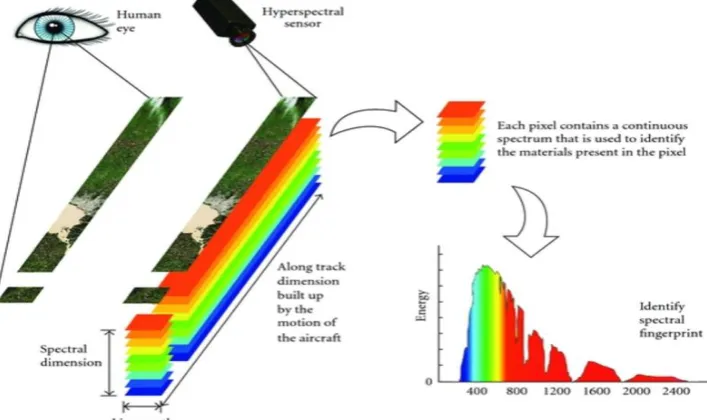
Figure 1: Dimensionality and spectrum in Hyperspectral Image Processing
Spectral imaging acquires multiple bands of information in electromagnetic spectrum where as image processing of images captured from a normal camera involves capturing just the visible spectrum “RED GREEN & BLUE” components. Spectral imaging involves techniques that have helped human to go ahead of “RGB” with the use of infrared, ultraviolet and X-ray or even combination of two / three techniques along with visible light components possible because of optical filters and illumination. Hyperspectral imaging is another subcategory of spectral image processing, which combines some methods such as spectroscopy and digital photography. The “hyper” in hyperspectral means “over” as in “too many” and refers to the large number of measured wavelength bands. Hyperspectral images are spectrally over determined, which means that they provides specific and necessary spectral information to identify and distinguish spectrally unique materials. Over a decade research trends have provided a breakthrough in remote sensing for image processing with the development of hyperspectral sensors and tools that analyze such information at ease [4][5].
II.
HYPERSPECTRAL
DATA
ANALYSIS
Hyperspectral sensors capture the electromagnetic energy which is either reflected or emitted by the objects in the scene. The reflected or emitted data under test has been utilized for various applications yet to simplify the data has been categorized in four distinct groups based on the classification and application coverage. Application comprise of classification, target seeking/detection, physical/chemical parameter fining and spectral filtering. These four distinct groups can been further sub-categorized as highlighted by the image below:
Figure 2: Hyperspectral image analysis tasks [11]
A. In classification each pixel of image leads to material identification where this identification is classified to create a land cover map (land cover segmentation) over an area in the image. Land cover sub classification leads to application coverage like plant species classification, identification of minerals and many more. The advantage that hyper spectral carries over multispectral is that pixel identification is done into more finer class as more physical/chemical properties are captured in hyperspectral [12][13].
B. Target detection also known as anomaly detection comprises of objective labeling in a hyperspectral image for defining the objects variety. As the objects size depends on the target image captured hyper spectral imaging provides the advantage of sub-pixel scale capturing which is not possible with multi-spectrum imaging. This type of application is widely used for surveillance, detection of special species in agriculture and rare mineral in geology [14][15].
C. Process by which scene captured can reveal the physical/chemical parameters that multispectral spectrum could not provide is known as fining. This process provides estimation in reference to size, granularity and mass of particles under test. Example in agriculture it is most widely utilized to provide structural texture and roughness of surface know as absorption features that is plant water stress [16] and soil nutrient [17].
D. Spectral filtering is the trend in research as in hyperspectral imaging the energy captured per pixel by a hyperspectral sensor comprises of various properties as rarely the sensor captures the reflected energy from a single material. As the height of the sensor from epi center plays a key role in classification as the image captured is ranging in meters, therefore, the measured hyper spectrum comprises of various but different materials in the scene. This type of complexity demands various optical filtering tools provided by a phenomenon known as un-mixing the linear or non linear mixture. Hyperspectral filtering for spectral filtering utilizes the advantage of machine learning to the maximum where the end members or material detected are labeled to as supervised un-mixing (learning) and unsupervised un-mixing (learning) in many literature [18] [19]. The type of machine learning used and the type of classifier used is the key aspect that we require in our research for filtering out the noises form the image.
training set is created along with system image under test. Active learning is derived from unsupervised learning but the region of interest is restricted to the object to be searched hence making it faster than unsupervised learning. As machine learning is still a developing domain while transfer learning is the one that adapts the solution of one problem to solve another problem and learns with previous as well as current experiences known as domain adaptation under transfer learning. The motto of the survey is to provide Machine learning-based hyperspectral image analysis methods. They are under classification and development where at every step an algorithm is modified according to the application. The categorization of the machine learning algorithms is derived from Kevin Murphy’s book [20]. All the development in the field of machine learning and the models are well explained in the book. The main aspect of our literature survey is to find the best method adopted for spatial filtering and what are the possibilities that we can suggest to the research. An excellent literature survey [21] that provides all the methods that are deployed till date for hyperspectral image processing is listed in Table 1.
Based on the type of machine learning there are various models utilized from application point of view in analyzing images as shown in above table. As our area of interest is spatial filtering/un-mixing we need to cover all the models and topics in and around the region of interest.
A. Linear Regression: Of many models a model that covers our interest broadly is known as linear regression model. It is most widely used especially for hyperspectral image/data analysis. It has been applied to the domains of un-mixing as well as physical parameter extraction problems where type of classifiers vary according to the number of parameters required for test. Linear regression falls under supervised learning and on training develops a linear relationship between the input and output variables. The main requirement of this model is to calculate the weighted sum of the input variable to model output.
design of a kernel requires a user to define the application coverage so that improvement and possibilities of improvement can be defined and met. Next section defines the possibilities and new directional possibilities for need of our research.
IV. RESEARCH POSSIBILITIES AND CONCLUSION
The inbound curse of dimensionality has been an important aspect in hyperspectral research for imaging in remote sensing from over a decade. Some of the techniques that have improved over a period of time are dimensionality reduction, spatial information reduction for noise filtering, multitask learning and many more, yet the orders of magnitude and possibilities in this domain are infinite and still growing strong. The important aspect that is still left unanswered is the characteristics of intrinsic and virtual dimensionality [28][29]. The biggest challenge is not to explore the unexplored yet to provide models that cover maximum applications. Hence statistical modeling that covers or guarantees maximum application coverage is the topic of current research that provides spatial filtering in all domains. Such modeling needs to cover all factors like the time and season of image acquisition, site, platform, spatial resolution, spectral resolution, band sampling intervals, and sensor technology. Till now studies have been concentrated to work well on a particular type of imaging and never for multiple complexities that is universal models that label out the unlabeled under different sets of conditions.
Some tasks such as sub-pixel un-mixing are only possible using hyperspectral data, not by using other types of optical images highlighting the importance of hyperspectral imaging. Generative multi models or networks could have great impact on reported tasks in the future. As of now Gaussian processes based models seem to be best suited for the task of un-mixing and physical/chemical parameter estimation due to their flexibility, ability to handle uncertainty in data, and capacity to perform well with limited training data.
ACKNOWLEDGEMENT
I would like to express my sincere thanks to my supervisor Dr. S. M. Deshmukh, Professor and Head, Department of Electronics & Telecommunication Engineering, PRMIT&R Badnera for their guidance and support for writing this article. Also I would like to be thankful to my dear friend Dr. Deepak Kushalani who supported me and guided me for the same. This research article writing could not be possible without support of my colleagues, friends and family members who continuously encouraged me for pursuing my research. Last but not least I would like to pay special thanks to my beloved father Lt. Mr. Jayant Babrekar who inspired me for my life achievements.
REFERENCES
[1]. E. Aptoula, M. C. Ozdemir, and B. Yanikoglu. Deep learning with attribute profiles for hyperspectral image classification. IEEE Geoscience and Remote Sensing Letters, 13(12):1970–1974, Dec 2016. J. Clerk Maxwell, A Treatise on Electricity and Magnetism, 3rd ed., vol. 2. Oxford: Clarendon, 1892, pp.68–73.
[2]. Naveen J.P. Anne, Amr H. Abd-Elrahman, David B. Lewis, and Nicole A. Hewitt. Modeling soil parameters using hyperspectral image reflectance in subtropical coastal wetlands. International Journal of Applied Earth Observation and Geoinformation, 33:47 – 56, 2014. K. Elissa, “Title of paper if known,” unpublished.
[3]. A. Banerjee, P. Burlina, and C. Diehl. A support vector method for anomaly detection in hyperspectral imagery. IEEE Transactions on Geoscience and Remote Sensing, 44(8):2282–2291, Aug 2006. Y. Yorozu, M. Hirano, K. Oka, and Y. Tagawa, “Electron spectroscopy studies on magneto-optical media and plastic substrate interface,” IEEE Transl. J. Magn. Japan, vol. 2, pp. 740–741, August 1987 [Digests 9th Annual Conf. Magnetics Japan, p. 301, 1982].
[4]. Elfatih M. Abdel-Rahman, Fethi B. Ahmed, and Riyad Ismail. Random forest regression and spectral band selection for estimating sugarcane leaf nitrogen concentration using EO-1 Hyperion hyperspectral data. International Journal of Remote Sensing, 34(2):712–728, 2013.
[5]. Amir H. Alavi, Amir H. Gandomi, and David J. Lary. Progress of machine learning in geosciences: Preface. Geoscience Frontiers, 7(1):1 – 2, 2016. Special Issue: Progress of Machine Learning in Geosciences.
[6]. Ping Zhong and Runsheng Wang. Modeling and classifying hyperspectral imagery by CRFs with sparse
higher order potentials. IEEE Transactions on Geoscience and Remote Sensing, 49(2):688– 705, Feb 2011.
International organization of Scientific Research 30 | Page [8]. Yanfei Zhong, Xuemei Lin, and Liangpei Zhang. A support vector conditional random fields classifier with a mahalanobis distance boundary constraint for high spatial resolution remote sensing imagery. IEEE journal of selected topics in applied earth observations and remote sensing, 7(4):1314–1330, 2014. [9]. Xiaojin Zhu and Andrew B Goldberg. Introduction to semi-supervised learning. Synthesis lectures on
artificial intelligence and machine learning, 3(1):1–130, 2009.
[10]. A. Zare and P. Gader. PCE: Piecewise convex endmember detection. IEEE Transactions on Geoscience
and Remote Sensing, 48(6):2620–2632, June 2010.
[11]. National ecological observatory network. http://data.neonscience.org. National Ecological Observatory Network, Battelle, Boulder, CO, USA.
[12]. G. Camps-Valls, D. Tuia, L. Bruzzone, and J. A. Benediktsson. Advances in hyperspectral image classification: Earth monitoring with statistical learning methods. IEEE Signal Processing Magazine, 31(1):45–54, Jan 2014.
[13]. M. Dalponte, H.O. Orka, T. Gobakken, D. Gianelle, and E. Naesset. Tree species classification in boreal
forests with hyperspectral data. IEEE Transactions on Geoscience and Remote Sensing, 51(5):2632– 2645, May 2013.
[14]. Stefania Matteoli, Marco Diani, and Giovanni Corsini. A tutorial overview of anomaly detection in hyperspectral images. IEEE Aerospace and Electronic Systems Magazine, 25(7):5–28, 2010.
[15]. Chein-I Chang. Hyperspectral data processing: algorithm design and analysis. John Wiley & Sons, 2013. [16]. L. Surez, P.J. Zarco-Tejada, G. Sepulcre-Cant, O. Prez-Priego, J.R. Miller, J.C. Jimnez-Muoz, and J.
Sobrino. Assessing canopy PRI for water stress detection with diurnal airborne imagery. Remote Sensing of Environment, 112(2):560 – 575, 2008. Soil Moisture Experiments 2004 (SMEX04) Special Issue. [17]. Naveen J.P. Anne, Amr H. Abd-Elrahman, David B. Lewis, and Nicole A. Hewitt. Modeling soil
parameters using hyperspectral image reflectance in subtropical coastal wetlands. International Journal of Applied Earth Observation and Geoinformation, 33:47 – 56, 2014.
[18]. Chein-I Chang and Antonio Plaza. A fast iterative algorithm for implementation of pixel purity index. IEEE Geoscience and Remote Sensing Letters, 3(1):63–67, 2006.
[19]. Kaiguang Zhao, Denis Valle, Sorin Popescu, Xuesong Zhang, and Bani Mallick. Hyperspectral remote sensing of plant biochemistry using Bayesian model averaging with variable and band selection. Remote Sensing of Environment, 132:102 – 119, 2013.
[20]. Kevin P Murphy. Machine learning: a probabilistic perspective. MIT press, 2012.
[21]. Utsav B. Gewali, Sildomar T. Monteiro, and Eli Saber1, “Machine learning based hyperspectral image
analysis: A survey” , arXiv:1802.08701v2 [cs.CV] 10 Feb 2019.
[22]. Bernhard Sch¨olkopf and Alexander J Smola. Learning with kernels: support vector machines,
regularization, optimization, and beyond. MIT press, 2002.
[23]. Gr´egoire Mercier and Marc Lennon. Support vector machines for hyperspectral image classification with
spectral-based kernels. In International Geoscience and Remote Sensing Symposium (IGARSS), volume 1, pages 288–290. IEEE, 2003.
[24]. Mathieu Fauvel, Jocelyn Chanussot, and Jon Atli Benediktsson. Evaluation of kernels for multiclass classification of hyperspectral remote sensing data. In International Conference on Acoustics, Speech and Signal Processing (ICASSP), volume 2, pages II–II. IEEE, 2006.
[25]. Sven Schneider, Arman Melkumyan, Richard J Murphy, and Eric Nettleton. Gaussian processes with OAD covariance function for hyperspectral data classification. In International Conference on Tools with Artificial Intelligence (ICTAI), volume 1, pages 393–400. IEEE, 2010.
[26]. A. Villa, J. Chanussot, J.A. Benediktsson, and C. Jutten. Spectral unmixing for the classification of hyperspectral images at a finer spatial resolution. IEEE Journal of Selected Topics in Signal Processing, 5(3):521–533, June 2011.
[27]. David MJ Tax and Robert PW Duin. Support vector data description. Machine learning, 54(1):45– 66, 2004.
[28]. Dalton Lunga, Saurabh Prasad, Melba M Crawford, and Okan Ersoy. Manifold-learning-based feature extraction for classification of hyperspectral data: A review of advances in manifold learning. IEEE Signal Processing Magazine, 31(1):55–66, 2014.
[29]. Chein-I Chang. A review of virtual dimensionality for hyperspectral imagery. IEEE Journal of Selected
Topics in Applied Earth Observations and Remote Sensing, 2018.
![Figure 2: Hyperspectral image analysis tasks [11]](https://thumb-us.123doks.com/thumbv2/123dok_us/7797740.1659703/3.595.132.468.182.372/figure-hyperspectral-image-analysis-tasks.webp)
