Information Processing Needs and Capabilities of
B2B Systems in Book Publishing Industry
Chien-wen Shen
National Central University, Department of Business Administration, Jhongli City, Taiwan Email: [email protected]
Pao-Yi Peng
National Central University, Department of Business Administration, Jhongli City, Taiwan Email: [email protected]
Hsiu-Heng Lin
National Kaohsiung First University of Science & Technology, Department of Logistics Management, Kaohsiung City, Taiwan
Email: [email protected]
Abstract—This research applied the framework of information processing theory to investigate whether the information processing capabilities and the uncertainties from information processing needs can affect the B2B system performance of the book publishing companies. According to the findings of our empirical study, reduction of the demand uncertainty generally can improve the B2B system performances of cost saving, operational efficiency, satisfaction, and new business opportunity. Meanwhile, we also found that companies with low uncertainty on the factor of supply have better B2B system performances of turnover and market share than the ones with high uncertainty. However, the uncertainty factors of best-selling books, firm investment, and partner investment may not have significant impacts on the B2B system performances. From the perspective of information processing capabilities, enhancement of purchasing/sales/reconciliation functions is critical to the B2B systems if the performances of cost saving, turnover, and satisfaction are the most serious concerns of book publishing companies. On the other hand, the information processing capabilities of procurement/ distribution and enquiries have no significant effects on the B2B system performances. Our results can help book publishing industry not only to evaluate where to start the reduction of uncertainties based on the needs of B2B information processing but also to but also to prioritize the investments of B2B system capabilities in a performance-driven environment.
Index Terms—B2B system, information processing capability, information processing need
I. INTRODUCTION
In today’s dynamic business environment, enterprise has to efficiently handle diversified needs of organizational tasks from the processing of information. How to match company’s information processing capabilities with the needs for information processing is thus important to the design of organizational information structure from the perspectives of information processing theory [8]. This match is especially critical to the book
publishing industry because there is a high degree of uncertainty on information processing needs between business-to-business (B2B) participants such as publishers, printing houses and bookstores. This partnership uncertainty together with the complexity of channel diversification causes the media industry having relatively low e-maturity than the industries of banking, electronics, ICT services, insurance, and transport. According to the report of European Commission [7], only half of the media companies have adopted systems of electronic procurement. Besides, three-fourths of the investigated media companies were making less than 10% of their total sales online. Because the book publishing industry faces daunting challenges in the digital age, the enhancement of their e-maturity plays a strategic role to keep organizations remained competitive and viable.
management systems and enterprise resource planning systems [9][14], there is lack of research using similar viewpoint to analyze the B2B systems of book publishing industry. Hence, two major hypotheses are proposed in section 2 of this paper to investigate the roles of information processing needs and capabilities on B2B system performances. The methodology and data collection methods used in this study are then addressed in section 3. We discuss the empirical findings of our proposed hypotheses in section 4 and conclude our research in section 5. Our results can help book publishing industry not only to evaluate where to start the reduction of uncertainties based on the needs of B2B information processing, but also to prioritize the investments of B2B system capabilities in a performance-driven environment.
II. HYPOTHESES
According to the information processing theory, uncertainties are the causes of information processing needs. The increase of the uncertainties for decision making generally raises the needs for information processing. Hence, companies should manage their business uncertainties through appropriate information processing mechanism for quality decision making [9]. According to the research of Premkumar, Ramamurthy, and Saunders [16], the uncertainties regarding information processing needs include environmental uncertainty and partnership uncertainty. While the environmental uncertainty is caused by the changing and complex surrounding of business, the partnership uncertainty depends on the level of trust and communication. To evaluate the dimensions of environmental uncertainty, this study considered the factors of demand, supply, and best-selling books in book publishing industry. The uncertainty from demand describes the gap of demand forecasting among publishers, printing houses, and bookstores. Because the demand forecasts are usually estimated by experienced managers without reliable historical data, the demand uncertainty leads to the needs of information processing. Meanwhile, supply uncertainty represents “the dynamism in the supply market in terms of availability of supplies, stability of the suppliers, consistency in quality, and prices” [16]. The impact of best-selling books on B2B partners is another important environmental uncertainty of book publishing industry. Companies are difficult to control book inventory and cash flow due to unpredictable selling period and trend of best-selling books. On the other hand, factors of trust, firm investment, and supplier investment are the major concerns of partnership uncertainty examined in this study. Because inter-organizational relationships between partners can affect the degree of trust in supply chain [12], the reduction of trust uncertainty can eliminate the needs of monitoring supply chain partners because each party can conform to other’s expectation with confidence [2]. To deal with the uncertainties of negotiations and transactions with B2B partners, intra-investments and inter-investments regarding infrastructure and process
reengineering can also help the improvement of information processing quality [16]. Because the implementation of B2B systems is supposed to reduce the above mentioned uncertainties for efficient system performances, the first major hypothesis (H1) proposed in this study is:
H1: Book publishing companies with lower uncertainties regarding information processing needs can have better B2B system performances than the ones with higher uncertainties.
Another important perspective of information processing theory is the capabilities of information processing. Balancing a functional fit between system capabilities and organizational needs is possibly the primary determinant of benefits from organization-wide applications of information technology [18]. To obtain the needed information processing capabilities, companies may invest in information systems or create lateral relations [15]. Because the creation of lateral relations involves with the discussion of organizational structure, this study only focuses on the functions of B2B systems for the analysis of information processing capabilities. Generally speaking, the key functions of B2B systems include cataloging, public bidding, e-transactions, e-collaboration, e-procurement, internet-based financial services, delivery and logistics, procurement, private negotiation, workflow management, collaborative project management, and outsourcing services [1]. Accordingly, the features of B2B systems in this study are classified into three major categories: (1) purchasing/sales/reconciliation, (2) procurement/ distribution, and (3) enquiry. Although cost saving may be the only tangible benefits of B2B system implementation, other intangible advantages such as supplier relationships, quality of systems, efficiency of B2B transactions, and employee satisfaction may not be easily assessed [5]. There is also lack of researches addressing how B2B system capabilities affect business performance in book publishing industry. Therefore, the second major hypothesis (H2) of this study is to evaluate the role of B2B system capabilities on business performance. That is,
H2: Book publishing companies with higher information processing capabilities of B2B systems can perform better than the ones with lower capabilities.
H2. Because we classified the information processing capabilities into the factors of purchasing/sales/ reconciliation, procurement/ distribution, and enquiry, capabilities of B2B system should be invested first if they are found to be significantly associated with business performance.
III. DATA COLLECTION AND METHODOLOGY
To collect data for our hypothesis testing, a questionnaire was designed to measure the factors for the dimensions of environmental uncertainty, partnership uncertainty and information processing capabilities. Table I summarizes the measurements and their corresponding references for the factors of environmental uncertainties regarding information processing needs. For example, variables of sales uncertainty (X11), forecast uncertainty (X12), and data complexity (X13) were used to measure the factor of demand uncertainty (C1) [3]. Meanwhile, we adopted the measurements of service variability (X21), sales variability (X22), and supply variability (X23) for the factor of supply uncertainty (C2) [4]. To evaluate the factor of best-selling books (C3), variables of revenue impact (X31) and inventory control (X32) [4] were considered. Questionnaire participants were asked to use a seven-point Likert rating scale, which ranges from strongly disagree (1) to strongly agree (7), to evaluate the above measurements for each factor.
TABLE I. MEASUREMENTS FOR THE FACTORS OF
ENVIRONMENTAL UNCERTAINTIES
Factors Measures Reference Sources
Demand (C1)
Sales uncertainty (X11)
Buvik & John [2] Forecast uncertainty
(X12)
Data complexity (X13)
Supply (C2)
Service variability (X21)
Cannon & Perreault [4] Sales variability (X22)
Supply variability (X23)
Best-selling books (C3)
Revenue impact (X31)
Inventory control (X32)
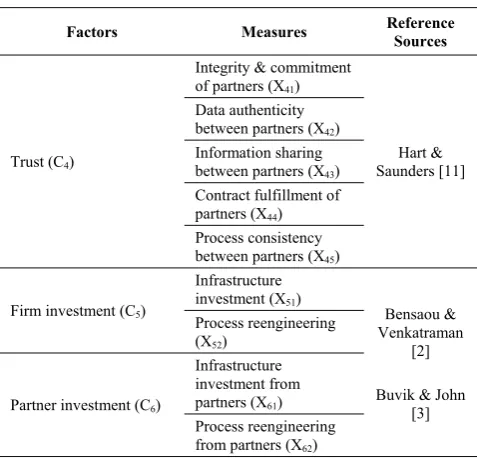
From the perspective of partnership uncertainty, variables of integrity and commitment of partners (X41), data authenticity between partners (X42), information sharing between partners (X43), contract fulfillment of partners (X44), and process consistency between partners (X45) were applied to examine the factor of trust (C4) [11]. Indicators of infrastructure investment (X51) and process reengineering (X52) were adopted to measure the factor of firm investment (C5), while the variables of infrastructure investment from partners (X61) and process reengineering from partners (X62) were used to measure the dimension of partner investment (C6) [2][3]. Table II summarizes the above descriptions. Similarly, seven-point Likert scale was also used to measure the factors of partnership uncertainty.
TABLE II. MEASUREMENTS FOR THE FACTORS OF PARTNERSHIP
UNCERTAINTIES
Factors Measures Reference Sources
Trust (C4)
Integrity & commitment of partners (X41)
Hart & Saunders [11] Data authenticity
between partners (X42)
Information sharing between partners (X43)
Contract fulfillment of partners (X44)
Process consistency between partners (X45)
Firm investment (C5)
Infrastructure investment (X51)
Bensaou & Venkatraman
[2]
Buvik & John [3] Process reengineering
(X52)
Partner investment (C6)
Infrastructure investment from partners (X61)
Process reengineering from partners (X62)
To reflect the practical demands of information processing capabilities for B2B systems, this study collected the experts’ suggestions from the book publishing companies and summarized 9 measurements for the dimension of information processing capabilities, which include the variables of inquiry/quotation (X71), purchase/return (X72), sales information (X73), reconciliation (X74), inventory information (X81), procurement (X82), logistics/distribution (X83), delivery schedule (X91), and catalog/book information (X92) (see Table III). We also adopted the indicators of satisfaction, corporate image, partnership, new business opportunity, cost saving, turnover, market share, and operational efficiency to evaluate the performance of B2B systems [5]. These indicators were also evaluated by a seven-point Likert scale ranging from strongly dissatisfied (1) to strongly satisfied (7).
TABLE III. MEASUREMENTS FOR THE FACTORS OF INFORMATION
PROCESSING CAPABILITIES
Factors Measures
Purchasing/Sales/Reconciliation (C7)
Inquiry/Quotation (X71)
Purchase/Return (X72)
Sales information (X73)
Reconciliation (X74)
Procurement/Distribution (C8)
Inventory information (X81)
Procurement (X82)
Logistics/Distribution (X83)
Enquiry (C9)
Delivery schedule (X91)
Catalog/Book information (X92)
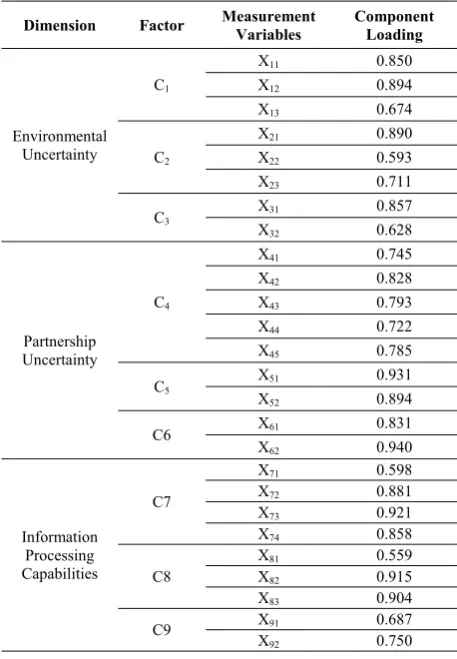
uncertainty, partnership uncertainty, and information processing capabilities). Acceptable minimums for KMO statistic and coefficient α are 0.5 and 0.6 respectively. Then the approach of principal component analysis was applied upon each factor listed in Table I, II and III. An orthogonal linear transformation is used in principal component analysis to convert a set of data of possibly correlated variables into principal components through the eigenvector analysis of either the covariance or correlation matrix. Accordingly, the first principal component was calculated such that it explains the greatest variance in the set of observations. Meanwhile, component loadings of variables for each factor were computed to see the correlations between variables and their corresponding factor. To confirm that measurement variables identified a priori are represented by a particular factor, component loadings should be 0.5 or higher. Those variables with low loadings may be eliminated from their pre-assigned factor [10]. Based on the evaluation of component loadings, principal component scores that represent the transformation of the data set into the new coordinate spaces defined by the principal components were also calculated for each factor. Companies are said to have high uncertainty on the factors of uncertainty regarding information processing needs if their principal component scores of factors are positive. On the other hand, companies having negative principal component scores on the factors of uncertainty regarding information processing needs were classified as the group of low-uncertainty. Accordingly, companies were categorized into high-uncertainty group and low-uncertainty group for the factors of demand, supply, best-selling books, trust, firm investments, and partner investments. Similarly, companies with positive principal component scores on the factors of information processing capabilities were classified as high-capability group, while companies with negative scores were categorized as low-capability group.
To check whether there are performance differences between low-uncertainty group and high-uncertainty group or between low-capability group and high-capability group, the approach of independensample t-test were adopted to examine our proposed hypotheses. Levene's test for equality of variances was also checked to evaluate whether the evaluated groups have equal sample variance. Results of Levene’s tests help us to determine which approach of independent-sample t-test is suitable for our sample data. Significant t-statistics of hypothesis tests in this study indicate that lower uncertainty regarding information processing needs or higher system supporting capability on information capability can yield better performance from B2B systems.
IV. EMPIRICAL FINDINGS
To test the hypotheses proposed in section 2, empirical study was conducted against the companies of book publishing industry in Taiwan. A total of 175 questionnaires were distributed to the companies listed on the memberships of the Chinese Book Marketing
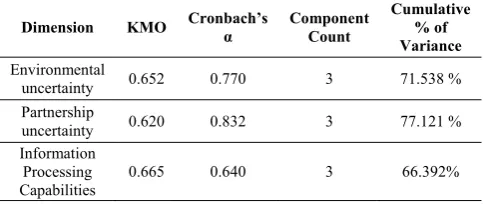
Development Association. To qualify for further analysis, companies should have implemented B2B information system for at least one year. After one month of data collection, we received a total of 100 responses with 57.1% response rate. Returned questionnaires were first examined their suitability for principal component analysis. Table IV summarizes the analysis results of sampling adequacy, internal consistency, and cumulative percentage of variance for the dimension of environmental uncertainty, partnership uncertainty, and information processing capabilities. As all of the KMO values exceed 0.5, principal component analysis is applicable for our samples. The Cronbach’s α of these dimensions also indicate the internal consistency of our observations because all of the statistics are higher than 0.6. In addition, Kaiser’s rule was applied to retrieve 3 components for each risk dimension. Because the cumulative percentage of variance are greater than 60% for all of the dimensions, derived components have sufficient explanation power for each presumed dimension.
TABLE IV. ANALYSIS OF SAMPLING ADEQUACY,INTERNAL CONSISTENCY, AND CUMULATIVE % OF VARIANCE
Dimension KMO Cronbach’s α Component Count
Cumulative % of Variance
Environmental
uncertainty 0.652 0.770 3 71.538 %
Partnership
uncertainty 0.620 0.832 3 77.121 %
Information Processing Capabilities
0.665 0.640 3 66.392%
TABLE V. RESULTS OF COMPONENT LOADINGS
Dimension Factor Measurement Variables Component Loading
Environmental Uncertainty
C1
X11 0.850
X12 0.894
X13 0.674
C2
X21 0.890
X22 0.593
X23 0.711
C3
X31 0.857
X32 0.628
Partnership Uncertainty
C4
X41 0.745
X42 0.828
X43 0.793
X44 0.722
X45 0.785
C5
X51 0.931
X52 0.894
C6 X61 0.831
X62 0.940
Information Processing Capabilities
C7
X71 0.598
X72 0.881
X73 0.921
X74 0.858
C8
X81 0.559
X82 0.915
X83 0.904
C9 X91 0.687
X92 0.750
For the convenience of discussion, the performance indicators are separated into internal performance indicators (cost saving, turnover, and operational efficiency) and external performance indicators (satisfaction, corporate image, partnership, new business opportunity, and market share). Hence hypotheses H1 and H2 can be divided into 3 and 5 sub-hypotheses for internal performance indicators and external performance indicators respectively. In the following discussion regarding hypotheses tests, we only list the results with significant t statistics by employing a 0.1 criterion of statistical significance.
Let’s start with the findings of hypothesis H1 test regarding internal performance indicators. Table VI summarizes the results of hypothesis H1 tests based on Levene's test for equality of variances and independent-sample t-test. For the performance of cost saving regarding B2B systems, only the factor of demand has significant effects on performance. Because the F statistic (12.922) of Levene's test for the demand factor is significant, the variances of low-uncertainty companies and high-uncertainty companies are not equal for the demand factor. By using the unequal variance approach of independent-sample t-test, the positive and significant t statistic 1.663 implies that the book publishing companies with low uncertainty on demand factor generally have better performance of cost saving from their B2B systems than the ones with high uncertainty. For the performance of turnover regarding B2B systems, positive and significant t statistic (1.725) implies that the book
publishing companies with low uncertainty on supply factor generally have better performance of turnover from their B2B systems than the ones with high uncertainty. Furthermore, our findings indicate that the book publishing companies with low uncertainty on demand factor generally have better performance of operational efficiency from their B2B systems than the ones with high uncertainty because the t-test statistic of demand factor is significantly positive (1.817). But lower the uncertainty on best-selling books may not increase the performance of operational efficiency because its t-statistic (-2.121) is negatively significant. In short, only the factor of demand uncertainty can positively affect the performance of cost saving and operational efficiency. Besides, the B2B system performance of turnover can be positively influenced by the factor of supply uncertainty.
TABLE VI. RESULTS OF HYPOTHESIS H1TESTS FOR INTERNAL
PERFORMANCE INDICATORS
Performance Factor F Sig. test t- value
p-Cost saving H1 Demand 12.922 0.001 1.663 0.100
Turnover H1 Supply 0.278 0.599 1.725 0.088
Operational efficiency H1
Demand 5.443 0.022 1.817 0.072
Best-selling
books 4.784 0.031 -2.121 0.036
TABLE VII. RESULTS OF HYPOTHESIS H2TESTS FOR INTERNAL
PERFORMANCE INDICATORS
Performance Factor F Sig. test t- value
p-Cost saving H2
Purchasing /Sales /Reconciliation
0.794 0.375 1.840 0.070
Procurement
/Distribution 0.101 0.751 -1.811 0.073
Turnover H2
Purchasing /Sales /Reconciliation
0.403 0.527 1.709 0.091
Procurement
/Distribution 1.099 0.297 -2.684 0.009 Operational
efficiency H2
Procurement
/Distribution 0.014 0.907 -3.361 0.001
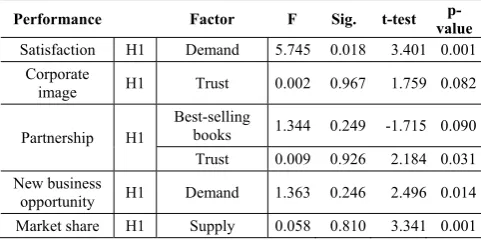
Next, the findings of hypothesis H1 tests for external performance indicators are illustrated in Table VIII. Because we adopted 5 external performance indicators for B2B systems, our proposed hypothesis H1 can be divided into 5 sub-hypotheses. According to our analysis results, the book publishing companies with low uncertainty on demand factor generally have better B2B system performances of satisfaction and new business opportunity than the ones with high uncertainty because the corresponding t-statistics (3.401 and 2.496) are positively significant. Similarly, the findings of equal variance approach of independent-sample t-tests indicate that lower uncertainty on trust factor can yield better performances of corporate image and partnership from B2B systems. Meanwhile, book publishing companies with low uncertainty on the factor of supply generally perform better than the companies with high uncertainty. However, reducing the uncertainty factor of best-selling books cannot increase the performance of partnership because of its negatively significant t-test statistic -1.715. In short, the uncertainty factors of best-selling books, firm investment, and partnership investment do not have influential and positive impacts on the external performance indicators.
TABLE VIII. RESULTS OF HYPOTHESIS H1TESTS FOR EXTERNAL
PERFORMANCE INDICATORS
Performance Factor F Sig. t-test value
p-Satisfaction H1 Demand 5.745 0.018 3.401 0.001
Corporate
image H1 Trust 0.002 0.967 1.759 0.082
Partnership H1
Best-selling
books 1.344 0.249 -1.715 0.090
Trust 0.009 0.926 2.184 0.031
New business
opportunity H1 Demand 1.363 0.246 2.496 0.014
Market share H1 Supply 0.058 0.810 3.341 0.001
Finally, the findings of hypothesis H2 tests regarding external performance indicators are summarized in Table IX. Because only the t statistic for the hypothesis test regarding the performance of satisfaction and the capability factor of purchasing/sales/reconciliation is positive and significant, book publishing companies with high capability on purchasing/ sales/reconciliation usually
have better performance of satisfaction than the ones with low capability. On the other hand, the information processing capability factors of procurement/distribution and enquiry have no positive and significant impacts on the external performance indicators.
TABLE IX. RESULTS OF HYPOTHESIS H2TESTS FOR EXTERNAL
PERFORMANCE INDICATORS
Performance Factor F Sig. t-test value
p-Satisfaction H2 Purchasing /Sales /Reconciliation
4.784 0.031 3.207 0.002
Corporate
image H2
Procurement
/Distribution 0.072 0.788 -2.998 0.003
Partnership H2 Procurement /Distribution 0.315 0.576 -1.880 0.063
Market share H2 Procurement /Distribution 0.106 0.746 -2.219 0.029
V. CONCLUTIONS
This research applied the framework of information processing theory to evaluate the information processing needs and capabilities of B2B systems in book publishing industry. Two major hypotheses were proposed to understand the roles of uncertainties and information processing capability on the performance of B2B systems. To evaluate the dimensions of environmental uncertainty, this study considered the factors of demand, supply, and best-selling books. Meanwhile, the factors of trust, firm investment, and supplier investment are the major concerns of partnership uncertainty in this study. Information processing capabilities of B2B systems were also categorized into enquiry, procurement/distribution, and purchasing/sales/reconciliation. According to the findings of our empirical study, uncertainty reduction of the demand factor generally can improve the performances of cost saving, operational efficiency, satisfaction, and new business opportunity. Because the variable of forecast uncertainty has the highest component loading on demand factor, manager should try to use related tools to enhance the reliability of demand forecast. Meanwhile, we also found that companies with low uncertainty on the factor of supply can have better performances of turnover and market share from B2B systems than the ones with high uncertainty. Managers should find suitable ways to reduce the divergence of book supply service because the measurement of service variability has the highest component loading. However, our investigation shows that the uncertainty reduction of best-selling books does not help the business performances from B2B systems. Hence, best-selling books may not be an important uncertainty factor for the needs of information processing. In short, the uncertainty factors of best-selling books, firm investment, and partner investment may not be the major concerns for the information processing needs of B2B systems.
performances of cost saving, turnover, and satisfaction are the most serious concerns of book publishing companies, purchasing/sales/reconciliation is the most critical function of B2B systems. Among the functions of purchasing/sales/reconciliation, sales information is the most important feature to improve because it has the highest component loading. However, the information processing capabilities of procurement/distribution and enquiries have no significant effects on B2B system performances. Our research provides a practical mechanism for book publishing companies to evaluate where to decrease the uncertainty factors and to improve information processing capabilities in a performance-driven environment. Future research may test our proposed hypotheses in the other countries to see whether the findings of this study are universally applicable. Other methodology such as structural equation modeling may be applied to see how to balance the information processing needs and capabilities for better system performance.
REFERENCES
[1] A. Abraham, “Developing a B2B e-commerce
implementation framework: A study of EDI implementation for procurement,” Information Systems Management, 2007, vol. 24, pp. 373-390.
[2] M. Bensaou, and N. Venkatraman, “Inter-organizational
relationships and information technology: A conceptual synthesis and a research framework,” European Journal of Information Systems, 1996, vol. 5(1), pp. 84-91.
[3] A. Buvik, and G. John, “When does vertical coordination
improve industrial purchasing relationships?” Journal of Marketing, 2000, vol. 64 (4), pp. 52–64.
[4] J. P. Cannon, and W. D. Perreault, “Buyer–seller
relationships in business markets,” Journal of Marketing Research, 1999, vol.36 (4), pp. 439–460.
[5] S. Craig, and L. Chad, “Organizational evaluation of the
benefits, constraints, and satisfaction of
business-to-business electronic commerce,” International Journal of Electronic Commerce, 2007, vol. 11(3), pp. 107-134.
[6] R. T. Dobson, R. Lepnurm, and E. Struening, “Developing
a scale for measuring professional equity among Canadian physicians,” 2005, vol. 2(61), pp. 263-266.
[7] European Commission, “ICT and electronic business in the
publishing & printing industry,” The European e-Business Market Watch Sector Report No. 03-I, 2005.
[8] J. R. Galbraith, Designing Complex Organizations,
Reading, Massachusetts: Addison-Wesley Publishing Company, 1973.
[9] T. F. Gattiker, “ERP systems and manufacturing marketing
interface an information processing theory view,” International Journal of Production Research, 2007, vol. 13(45), pp. 2895-2917.
[10]J. F. Hair, W. C. Black, B. J. Babin, R. E. Anderson, and R.
L. Tatham, “Multivariate data analysis (6th ed.)” New Jersey: Prentice-Hall, 2006.
[11]P. Hart, and C. S. Saunders, “Power and trust: Critical
factors in the adoption and use of electronic data interchange. Organization Science, 1997, vol. 8 (1), pp. 23–42.
[12]P. Hart, and C. S. Saunders, “Emerging electronic
partnerships: Antecedents and dimensions of EDI use from supplier’s perspective,” Journal of Management Information Systems, 1998, vol. 14(4), pp. 87-111.
[13]M. Howard, R. Vidgen, and P. Powell, “Automotive
e-hubs: exploring motivations and barriers to collaboration
and interaction,” Journal of Strategic Information Systems, 2006, vol. 15 (1), pp. 51-75.
[14]K. N. S. Iyer, R. Germain, and C. Claycomb, “B2B
e-commerce supply chain integration and performance: A contingency fit perspective on the role of environment,” Information & Management, 2009, vol. 46, pp. 313-322.
[15]D. Mani, A. Barua, and A. Whinston, “An empirical
analysis of the impact of information capabilities design on business process outsourcing performance,” MIS Quarterly, 2010, vol. 34(1), pp. 39-62.
[16]G. Premkumar, K. Ramamurthy, and C. S.Saunders,
“Information processing view of organizations: An exploratory examination of fit in the context of interorganizational relationships,” Journal of management Information Systems, 2005, vol. 22(1), pp. 257-294.
[17]E. D. Rosenzweig, and A. V. Roth, “B2B seller
competence: construct development and measurement using a supply chain strategy lens,” Journal of Operations Management, 2007, vol. 25, pp. 1311-1331.
[18]P. B. Seddon, C. Calvert, and S. Yang, “A Multi-project
model of key factors affecting organizational benefits from
enterprise systems,” MIS Quarterly, 2010, 34(2), pp.