ISSN(Online): 2320-9801 ISSN (Print): 2320-9798
I
nternational
J
ournal of
I
nnovative
R
esearch in
C
omputer
and
C
ommunication
E
ngineering
(An ISO 3297: 2007 Certified Organization)
Vol. 3, Issue 4, April 2015
Application of Artificial Neural Network
Techniques in Text Recognition from an
Image
Monika
Student, School of Computer Science and Engineering, Galgotias University, Greater Noida, India
ABSTRACT: In this paper, a model is proposed that works on the concept of recognizing text from an image with the help of neural network. Firstly, the text is extracted from the input image. This is one of the most important tasks of this system. Then this extracted text goes through various pre-processing steps that include binarization, normalization, converting text on gray scale, point detection, edge detection, angular rotation etc. After the pre-processing the text is segmented into various sub sections for better functioning of the system and to maintain the accuracy. Important features of the segmented text are extracted in the process of feature extraction. These features helps to differentiate the characters or segments from one another. Finally, the text is classified and is fed to the neural network for the training purpose. Therefore, neural network learns in an unsupervised manner. In the testing phase, the neural network based on the trained data gives the result as recognized text. In this way, the system works in 2 phases i.e. training phase and testing phase and attains state-of-the-art performance.
KEYWORDS: text recognition system; text extraction; text recognition; feature extraction; unsupervised learning;neural network.
I. INTRODUCTION
ISSN(Online): 2320-9801 ISSN (Print): 2320-9798
I
nternational
J
ournal of
I
nnovative
R
esearch in
C
omputer
and
C
ommunication
E
ngineering
(An ISO 3297: 2007 Certified Organization)
Vol. 3, Issue 4, April 2015
thus shows the flexibility of the construction of a complete recognition system that does not depend on hand-engineered features or some prior knowledge. Text Recognition handles the problem of recognizing optically scanned text. Text recognition can be done off-line when the writing of the text is completed, whereas in on-line recognition the system recognizes the text as soon as they are drawn. The system can recognize both, that is, the handwritten as well as the printed documents but the performance of the system is highly dependent on the amount of input given to the system [12]. If the input text is more constrained, the performance of the system will increase. But if the input text is fully unconstrained, the system performance is not too bad [11]. As we all know that the computer is faster and more technically advanced than humans, therefore, this system will bring the performance of computer to an ideal state. Since, in this changing scenario the technology should also get some more advanced.
II. RELATED WORK
A. Scene Text Recognition :
Text recognition is a delinquent in machine learning and computer visualization that dates back some years. At the high level, the common problem of text recognition consists of two main components: text detection and text recognition. First, in text detection, the goal is to locate different words or lines of text. Then, once the areas of text are located in the image, the real words and lines of text in those areas are found out. Over the years, so much time and exertion have been devoted in resolving different modules of the text recognition problem. As a straight result, algorithms exist that attain enormously high performance on dedicated tasks such as digit recognition in unnatural settings. For example, the system in [21] is able to attain near human performance on handwritten digit recognition. Similarly, the system in [22] attains very high precision on the task of recognizing English characters. Despite these advances in the field of text recognition, however, the more general task of detecting and recognizing text in complex scenes still remains an exposed problem. Much of the fiction on scene text recognition tends to focus on a sub-component of the text recognition system. The three main sub systems that have established much of this attention are text detection, word segmentation, and word recognition. Below each of these subsystems are described individually.
1. Text Extraction: As mentioned above, the objective of text detection or localization is to find candidate areas of text in a given input image. Normally, the detection task resembles to recognizing a bounding box or rectangle for each word or for each line of text in the image. Many alternative methods have been proposed for text detection. These methods have variety from using simple off-the-shelf classifiers with hand-coded features [23] to much more refined multi-stage pipelines integrating many different algorithms and processing layers [24, 2]. One example of an elaborate multi-stage pipeline is the system proposed by [2], which employs extensive pre-processing stages such as binarization of the input image, followed by connected component analysis through a conditional random field (CRF) to identify lines of text.Still others in the field of text detection have established clever hand engineered features and conversions well suited for the task at hand. For example, the system in [25] exploits the uniformity of stroke width in characters to develop a robust, state-of-the-art text detection system.
ISSN(Online): 2320-9801 ISSN (Print): 2320-9798
I
nternational
J
ournal of
I
nnovative
R
esearch in
C
omputer
and
C
ommunication
E
ngineering
(An ISO 3297: 2007 Certified Organization)
Vol. 3, Issue 4, April 2015
example, a language model might encode the fact that certain bigrams, or sequences of two characters, occur more frequently than others in the English language.
B. Feed Forward Network:
Consider a supervised learning scenario where we are given a set of labeled data {x(i),y(i)}. Here, x(i) and y(i) denote the features and label, respectively of the ith training example. At a elevated then, neural networks deliver a way of representing a composite, non-linear function hW (x) of our input variable x. The function hW (x) is parameterized by a
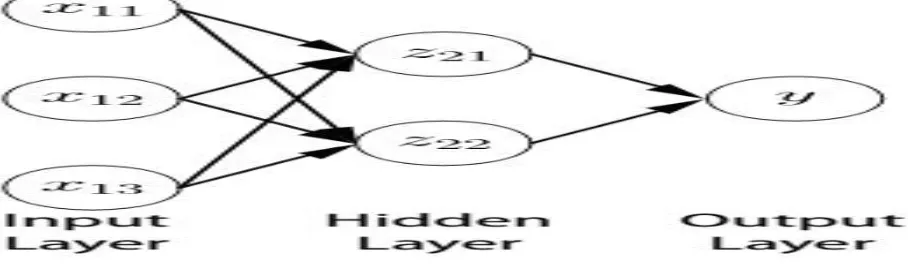
weights matrix W that we can tune to fit our data. Figure 1 shows a simple neural network consisting of three input units or neurons, denoted x11, x12, and x13, and one output unit y = hW (x11, x12, x13).
Figure 1: A simple feed-forward neural network.
A neural network is usually organized into multiple coats. For instance, the network in Figure 1 consists of three layers: the input layer, the hidden layer, and the output layer. Aside from the neurons in the input layer, each neuron xi in the
neural network is a computational component that takes in as input the ethics of the neurons from the earlier layer that feed into xi. As a tangible example, the inputs to the neuron branded z21 in the sample neural network is x11, x12, and x13
and the input to y is z21 and z22. Given its inputs, a neuron first computes a weighted linear combination of those inputs.
More precisely, let x1, . . . ,xn denote the inputs to a neuron zj. Then, we first compute
wherewji is a parameter describing the interface between zj and the input neuron xi. The bj term is a prejudice or
intercept term related with neuron zj. Then apply a nonlinear start function [39] to aj. Some common start functions
include the sigmoid and the hyperbolic tangent purposes. In specific, the activation or value of the neuron zj is defined
to be
where h in this case is our nonlinear start purpose. Given a set of input variables x, and weights W (one term for all edge and a bias term for all node without the ones in the input layer), calculate the activation of each neuron by next the above steps. Since the start of each neuron depends only upon the standards of neurons in previous layers, we compute the starts starting from the first unseen layer (which depend only upon the input values) and continue layer-wise through the network. This procedure where info spreads through the network is called the forward-propagation step. At the end of the forward-propagation step, we obtain a set of outputs y = hW (x). In the case where we are execution
ISSN(Online): 2320-9801 ISSN (Print): 2320-9798
I
nternational
J
ournal of
I
nnovative
R
esearch in
C
omputer
and
C
ommunication
E
ngineering
(An ISO 3297: 2007 Certified Organization)
Vol. 3, Issue 4, April 2015
difference between the predicted label ˆy = hW (x) and the true label y). The normal approach to learning the parameters
W in order to minimalize the desired objective is the fault back-propagation algorithm [37].
III. PROPOSED WORK
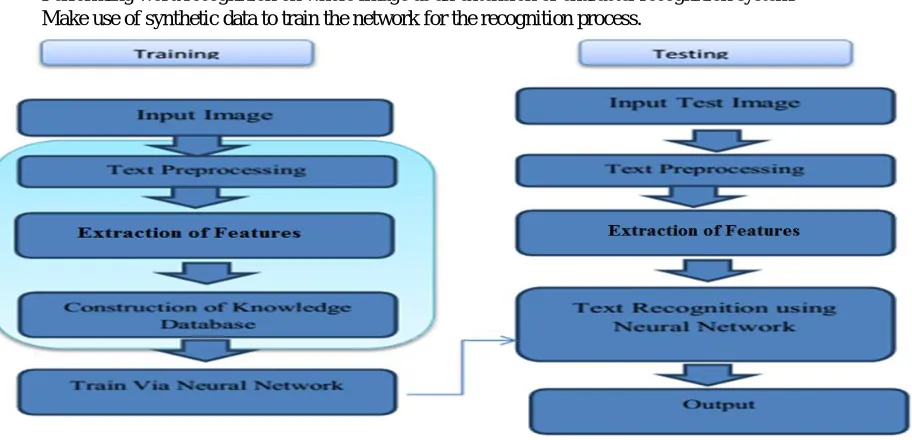
In this framework the word recognition task is done comprehensively on the whole image and it does not require and labelled data as in other character recognition techniques. The framework is implemented with the help of artificial neural network which is being trained on synthetic data. Synthetic data is of a kind that replaces original data in the most realistic data and gives huge amount of training data which uncovers more chances for recognition systems. This system deals with three major tasks:
Extraction of text from a scene.
Performing word recognition on whole image as an extension of character recognition system.
Make use of synthetic data to train the network for the recognition process.
Figure 2: Proposed Model Modules of the System:
A. Binarization:
It converts any image into a series of black text written on white background. Effects like contrast, sharpness etc. can also be easily handled once the image has been binarized. If an image has had its background normalized to a constant value, it can be binarized by a global value chosen to be less than the background by an appropriate amount. Important tasks performed in binarization:
Noise removal:
Noise removal is used to enhance the image. It is used to remove any type of unwanted bit-patterns that may affect the output. Various filtering operations can be applied to remove noise e.g. Median Filter, Weiner filter etc. Here we have used median filter. Filtered Image = Median Filter (Original Image, Filter Size). Here we have taken filter size (5, 5).
ISSN(Online): 2320-9801 ISSN (Print): 2320-9798
I
nternational
J
ournal of
I
nnovative
R
esearch in
C
omputer
and
C
ommunication
E
ngineering
(An ISO 3297: 2007 Certified Organization)
Vol. 3, Issue 4, April 2015
Edge Detection:
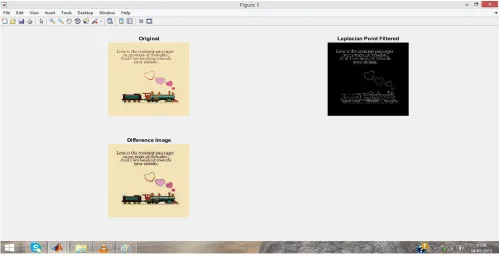
The Edge/boundary detection of image is done for easier detection and extraction of applicable features of the image as shown in figure 4. After finding the edges the image, it undergoes the process of dilation. In this process, the holes present in the image are filled. These operations performed on the input image makes the image suitable for segmentation [15].
Smoothing:
Objective of smoothing is to smooth the edges and the shape of broken/distorted images. In this process, some bits can be added/removes from the input text in order to attain accuracy.
B. Segmentation:
It is integral part of text recognition system. Segmentation assures efficiency of classification and recognition. Accuracy of character recognition heavily depends upon segmentation phase. Incorrect segmentation leads to incorrect recognition. Segmentation phase include line segmentation, character and word segmentation. It is important to obtain complete segmented character without any noise to ensure quality feature extraction. Firstly in this process, each line of the text image is segmented and then each character is separated from the segmented lines. If the text is mixed with some images then we require a candidate block to segment text from the image.
C. Feature Extraction:
The main aim of feature extraction is to make improvement in the accuracy and speed of the classifier for the pattern recognition. The extraction of the features of the characters is done is such a way that the complete portion of binary image covered and there is a distinct property associated with the each position. So we can say that feature extraction is a precise way in which a pattern can be described. It is one of the most important parts of this system [42].
Method used for feature extraction:
Here the method used is zoning. Zoning is one of the feature most popular and simple to implement feature extraction method. An (n*m) grid is superimposed on the character image and then for each zone average value is computed giving a feature vector of length (n*m), if required further we can compute the average on this zone again in row wise and column wise respectively.
Algorithm for feature extraction using zoning method (as in [43]): Input: Preprocessed numeral image
Output: Features for Classification and Recognition Method Begins
Step 1: Compute the input image centroid Step 2: Divide the input image into n equal zones.
Step 3: Compute the distance between the image centroid to each pixel present in the Zone.
Step 4: Repeat step 3 for the entire pixel present in the zone. Step 5: Compute average distance between these points.
Step 6: Compute the zone centroid
Step 7: Compute the distance between the zone centroid to each pixel present in the Zone.
Step 8: Repeat step 7 for the entire pixel present in the zone. Step 9: Compute average distance between these points. Step 10: Repeat the steps 3-9 sequentially for the entire zone.
Step 11: Finally, 2*n such features will be obtained for classification and recognition. Method Ends
D. Recognition:
ISSN(Online): 2320-9801 ISSN (Print): 2320-9798
I
nternational
J
ournal of
I
nnovative
R
esearch in
C
omputer
and
C
ommunication
E
ngineering
(An ISO 3297: 2007 Certified Organization)
Vol. 3, Issue 4, April 2015
important tool in this system. A multilayer feed-forward back-propagation network is created and is trained on synthetic data in the training phase. For testing phase, multilayer perceptron network is implemented.
Dataset Used:
Dataset used for training and recognition is same. Here street view text images and some images of natural scene with text as well are used. Images are all in jpeg format.
Figure 5: Some images from the dataset
IV. RESULTS
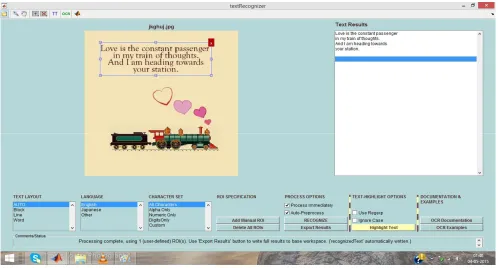
A text recognition system that work in two phases, that is, text detection and text recognition is prepared. Text detector extracts text from the input image and apply various noise removal, smoothing, skewness removal, binarization edge detection, segmentation and feature extraction methods on the extracted text. These feature vectors are used as dataset for classification of the vectors into their respected classes. After this the network is trained and hence when an input image is given to the network it recognizes text using the various recognition algorithms and gives recognized text as output.
ISSN(Online): 2320-9801 ISSN (Print): 2320-9798
I
nternational
J
ournal of
I
nnovative
R
esearch in
C
omputer
and
C
ommunication
E
ngineering
(An ISO 3297: 2007 Certified Organization)
Vol. 3, Issue 4, April 2015
Figure 7: Result after performing segmentation.Since the text and image are mixed, therefore, we need candidate box for segmentation. This will help to extract text from the input image.
ISSN(Online): 2320-9801 ISSN (Print): 2320-9798
I
nternational
J
ournal of
I
nnovative
R
esearch in
C
omputer
and
C
ommunication
E
ngineering
(An ISO 3297: 2007 Certified Organization)
Vol. 3, Issue 4, April 2015
V. CONCLUSION AND FUTURE WORK
The model described in this paper presents an alternative approach for solving the problem of text recognition using artificial neural network techniques with the help of unsupervised learning methodology. For training, the same architecture as for recognition is used to attain high accuracy and robustness of the text detection and text recognition modules and thus the system has become different from the previous such systems. As the evidence of the high performance of the system, the state-of-the-art results of text recognition in images with text are shown. Hence, the system have shown state-of-the-art performance after being compared to various standard benchmarks.Few limitations of the text recognition system are also highlighted and future work is proposed. First limitation is the gap between the performances of the proposed system in different types of recognition tasks because the frame that bounds/extracts text from the image for text detection were not perfectly cropped. Hence, this decreases the performance of the text recognition system because of the poorer quality of the cropped text provided by the text detector. Second limitation is the fact that the text recognition system is highly dependent on text detection system. Thus, the system needs to be improved so that it might become less dependent on the text detector and become autonomous. Third limitation of the text recognition system was that the detection system is aimed on finding only horizontal lines of text in the image. This restriction became particularly challenging in cases where the text was slightly skewed, and thus acted to extent upon multiple lines. In these cases, the text detector did not to provide a perfectly-cropped bounding box for the whole word or line. Thus, providing a direction to the recognition system so that it is able to perform in cases where the text is vertically aligned. These limitations give direction for future work.
REFERENCES
[1] Michele Merler, Carolina Galleguillos, and Serge Belongie. Recognizing groceries in situ using in vitro training data. In CVPR, 2007. [2] Yi-Feng Pan, XinwenHou, and Cheng-Lin Liu. Text localization in natural scene images based on conditional random field. In ICDAR, 2009. [3] K. Wang, B. Babenko, and S. Belongie. End-to-end scene text recognition. In ICCV, 2011.
[4] Jianchao Yang, Kai Yu, Yihong Gong, and Thomas S. Huang. Linear spatial pyramid matching using sparse coding for image classification. In CVPR, 2009.
[5] Quoc V. Le, Will Y. Zou, Serena Y. Yeung, and Andrew Y. Ng. Learning hierarchical invariant spatio-temporal features for action recognition with independent subspace analysis. In CVPR, 2011.
[6] Y. LeCun, B. Boser, J. S. Denker, D. Henderson, R. E. Howard, W. Hubbard, and L. D. Jackel. Backpropagation applied to handwritten zip code recognition. Neural Computation, 1:541–551, 1989.
[7] D. C. Ciresan, U. Meier, J. Masci, L. M. Gambardella, and J. Schmidhuber. High performance neural networks for visual object classification. Technical Report IDSIA-01-11, DalleMolle Institute for Artificial Intelligence, 2011.
[8] I. J. Goodfellow, Y. Bulatov, J. Ibarz, S. Arnoud, and V. Shet. Multi-digit number recognition from street view imagery using deep convolutional neural networks. arXiv:1312.6082, 2013.
[9] ZohraSaidane and Christophe Garcia. Automatic scene text recognition using a convolutional neural network. In Workshop on Camera-Based Document Analysis and Recognition, 2007.
[10] Handwritten Optical character recognition http://en.Wikipedia.org/wiki/Optical_ character _recognition.
[11] A. Rajavelu, M. T. Musavi and M. V. Shirvaikar, “A Neural Network Approach to Character Recognition”, Neural Networks, vol. 2, (1989), pp. 387-393.
[12] Anita Pal &DayashankarSingh,“Handwritten English Character Recognition Using Neural Network” International Journal of Computer Science & Communication Vol. 1, No. 2, July-December 2010, pp. 141-144.
[13] Kauleshwar Prasad, Devvrat C. Nigam, AshmikaLakhotiya: Character Recognition Using Matlab’s Neural Network Toolbox, International Journal of u- and e-Service, Science and Technology Vol. 6, No. 1, February, 2013.
[14] M. Hanmandlu, K. R. M. Mohan and H. Kumar, “Neural-based Handwritten character recognition”, in Proceedings of Fifth IEEE International Conference on Document Analysis and Recognition, ICDAR’99, Bangalore, India, (1999), pp. 241-244.
[15] T. V. Ashwin and P. S. Sastry, “A font and size-independent OCR system for printed Kannada documents using support vector machines”, in Sadhana, vol. 27, Part 1, (2002) February, pp. 35–58.
[16] R. C. Gonzalez, R. E. woods and S. L. Eddins, “Digital Image Processing using MATLAB”, Pearson Education, Dorling Kindersley, South Asia, (2004).
[17] Anita Pal &DayashankarSingh,“Handwritten English Character Recognition Using Neural Network” International Journal of Computer Science & Communication Vol. 1, No. 2, July-December 2010, pp. 141-144.
[18] R. G. Casey and E. Lecolinet, “A Survey of Methods and Strategies in Character Segmentation”, IEEE Transactions on Pattern Analysis and Machine Intelligence, vol. 18, no. 7, (1996) July, pp. 690-706.
[19] S. V. Rajashekararadhya and P.Vanajaranjan, “Efficient zone based feature extraction algorithm for handwritten numeral recognition of four popular south-Indian scripts”, Journal of Theoretical and Applied Information Technology, JATIT, vol. 4, no. 12, (2008), pp. 1171-1181.
[20] H Demuth, Neural Network Toolbox 7 User’s Guide, TheMathWorksInc, 1992.
[21] D. C. Ciresan, U. Meier, and J. Schmidhuber. Multi-column deep neural networks for image classification. Technical Report IDSIA-04-12, DalleMolle Institute for Artificial Intelligence, 2012.
ISSN(Online): 2320-9801 ISSN (Print): 2320-9798
I
nternational
J
ournal of
I
nnovative
R
esearch in
C
omputer
and
C
ommunication
E
ngineering
(An ISO 3297: 2007 Certified Organization)
Vol. 3, Issue 4, April 2015
[23] Xiangrong Chen and A.L. Yuille. Detecting and reading text in natural scenes. In Computer Vision and Pattern Recognition, volume 2, 2004. [24] Yi-Feng Pan, XinwenHou, and Cheng-Lin Liu. A robust system to detect and localize texts in natural scene images. In International Workshop on Document Analysis Systems, 2008
[25] B. Epshtein, E. Oyek, and Y. Wexler. Detecting text in natural scenes with stroke width transform. In CVPR, 2010.
[26] X. Fan and G. Fan. Graphical Models for Joint Segmentation and Recognition of License Plate Characters. IEEE Signal Processing Letters, 16(1), 2009.
[27] Jerod Weinman, Erik Learned-Miller, and Allen R. Hanson. Scene text recognition using similarity and a lexicon with sparse belief propagation. In Transactions on Pattern Analysis and Machine Intelligence, volume 31, 2009.
[28] Jerod J. Weinman, Erik Learned-Miller, and Allen R. Hanson. A discriminative semimarkov model for robust scene text recognition. In Proc. IAPR International Conference on Pattern Recognition, Dec. 2008.
[29] L. Neumann and J. Matas. A method for text localization and recognition in real-world images. In AACCV, 2010.
[30] Xiangrong Chen and A.L. Yuille. Detecting and reading text in natural scenes. In Computer Vision and Pattern Recognition, volume 2, 2004. [31] Adam Coates, Honglak Lee, and Andrew Y. Ng. An analysis of single-layer networks in unsupervised feature learning. In AISTATS, 2011. [32] Andrew L. Maas, Raymond E. Daly, Peter T. Pham, Dan Huang, Andrew Y. Ng, and Christopher Potts. Learning word vectors for sentiment analysis. In ACL, pages 142–150, 2011.
[33] G.E. Hinton, S. Osindero, and Y.W. Teh. A fast learning algorithm for deep belief nets. Neural Computation, 18(7):1527–1554, 2006. [34] A. Krizhevsky. Learning multiple layers of features from Tiny Images. Master’s thesis, Dept. of Comp. Sci., University of Toronto, 2009. [35] I.J. Goodfellow, Q.V. Le, A.M. Saxe, H. Lee, and A.Y. Ng. Measuring invariances in deep networks. In NIPS, 2009.
[36] Marc’AurelioRanzato, Christopher Poultney, S. Chopra, and Y. LeCun. Efficient learning of sparse representations with an energy-based model. In NIPS, 2007.
[37] Christopher M. Bishop. Pattern Recognition and Machine Learning. Springer, New York, NY, USA, 2006.
[38] Monika, Prabha S. Nair. Text recognition from an image using artificial neural network. In IJAESTR, volume 3, issue 1, Mar 2015
[39] BekirKarlik and A. VehbiOlgac. Performance analysis of various activation functions in generalized mlp architectures of neural networks. In International Journal of Artificial Intelligence and Expert Systems, 2010.
[40] R.Yogamangalam, B.Karthikeyan, “Segmentation Techniques Comparison in Image Processing”, International Journal of Engineering and Technology (IJET), Volume 5, No 1, 307-313, 2013.
[41] Ireyuwa. E. Igbinosa, “Comparison of Edge Detection Technique in Image Processing Techniques”, International Journal of Information Technology and Electrical Engineering, Volume 2, Issue 1, 25-29, 2013.
[42] RajbalaTokas and ArunaBhadu. A comparative analysis of feature extraction techniques for handwritten documents. In IJATER, volume 2, issue 4, Jul 2012.
[43] P. Pohankar, N.Taralkar, S. Karmare and S. Kulkarni. In IJECCE, volume 5, issue 4 Jul, 2014.
BIOGRAPHY