WWJMRD 2018; 4(5): 95-101 www.wwjmrd.com
International Journal Peer Reviewed Journal Refereed Journal Indexed Journal UGC Approved Journal Impact Factor MJIF: 4.25
E-ISSN: 2454-6615
Adel Mahmood Saleh
Mechanical Eng. Department, University of Technology, Baghdad, Iraq
Dina S. M. Al-Zubaidi
Al-Khawarimi Eng. Collage, Baghdad University, Iraq
Correspondence: Adel Mahmood Saleh Mechanical Eng. Department, University of Technology, Baghdad, Iraq
Engine Performance and Emission Fueled With
Blends of Bioethanol-Gasoline
Adel Mahmood Saleh, Dina S. M. Al-Zubaidi
Abstract
Bioethanol is a promising alternative to gasoline. It has a high Octane number and its combustion in spark ignition engines gives lower pollutants compared to gasoline. In this study, bioethanol was added to gasoline at 10% and 20% volume fractions to assess the effect of this addition on the performance and contaminants of the single cylinder drive. The experiments were carried out using conventional Iraqi gasoline (has an octane number= 82). The results showed that the addition of 10% ethanol to gasoline increases the useful compression ratio from 8: 1 in the case of gasoline separately, to 9.5: 1 with this addition, leading to better performance of the engine, Adding 10% bioethanol led to decrement in CO and CO2 concentrations significantly.
Keywords: bioethanol, spark ignition engine, brake power, CO, CO2
1. Introduction
The phenomenon of air pollution is harmful to human health, and this problem has increased with the increase of factories and different modes of transport [1]. Studies have shown that the
greatest part of this phenomenon is the result of human activities, which are burning fossil fuels (coal, oil and natural gas) to produce energy [2, 3]. Providing the required amount of
energy has become a vital necessity that cannot be waived in any society around the world [4].
Electric power illuminates and provides comfort conditions for cities, villages and even remote areas [5]. The use of oil in the movement of vehicles is inevitable despite its hazards
on the economic safety of the communities due to its prices fluctuations in the last decade [6].
So far, the movement of vehicles consumes about 40% of the oil produced around the world
[7]. If we add to all this, some countries such as Iraq where the citizens there cannot live
without the operation of small personal or medium capacity generators to compensate the lack of government processing [8]. Pollution is rising, causing insurmountable environmental
problems such as global warming and climate change [9, 10].
Switching to environmentally friendly alternative fuels is a goal of all researchers since the 1970s [11]. Fuel that gives equal performance to diesel or gasoline with less exhaust pollutants
is a promising alternative [12]. So, the researchers tried to use natural gas to run the petrol
engines and found that this gas could be a substitute for gasoline [13, 14]. But, this fuel has a
low flame speed and low heating value, which requires changes in the design of the engine such as increasing the compression ratio to take advantage of the higher octane number of the gas [15, 16]. Some researchers have also tried to use liquefied petroleum gas (LPG) as this
gas has a slightly higher flame velocity than gasoline and has a good thermal value and can be used without major engine modifications, and its octane number is high [17, 18]. Both gases emit fewer exhaust pollutants than gasoline, but liquefied petroleum gas emits a slightly higher NOx than gasoline [19, 20].
Many researchers have found hydrogen, which is considered the cleanest fuel ever, as if its combustion emits only water vapor and a small fraction of NOx [21]. However, the
specifications for burning this fuel differ somewhat from the hydrocarbon gases above [22].
The burning velocity of this gas is at higher than any other fuel known ever [23, 24]. Also, the
energy needed to ignite it is very low, which makes dealing with this fuel must be carefully [25]. Studies have shown that
hydrogen works at very low equivalence rates (Ø= 0.2) and gives high thermal efficiency at lean equivalent ratios [26].
The addition of hydrogen by volume fractions to natural gas and liquefied petroleum gas as well as gasoline improves the quality of combustion and increases the efficiency of the thermal engine but reduces its volumetric efficiency [27, 28, 29].
Alcohols are an acceptable alternative fuel, especially if it is from bio sources [30]. Alcohols have a high octane
number and are characterized by the presence of oxygen and hydrogen in their chemical composition at a high rate, which improves combustion and reduces pollutants [31, 32].
However, the availability of oxygen with the good combustion quality makes the emission of NOx at high rates possible [33]. Ethanol and bioethanol have been widely
used in Brazil, Sweden, and other parts of the world and are produced from corn, sugarcane, or dates as in Iraq [34].
Methanol is produced from the interaction of natural gas, particularly methane, with the water steam to produce this high-octane alcohol [35]. These two types of alcohol are the
most important types of alcohols currently used around the world [36]. These alcohols have been added to diesel engines
as well as to gasoline engines [37, 38, 39]. In all cases, the
maximum benefit was to provide additional oxygen for the combustion, while the biggest negative is to reduce the heating value of the resulting mixture [40]. Ethanol and
methanol are best used in spark ignition engines because of their high octane numbers [41]. It is not recommended to use
them in diesel engines due to their low cetane number compared to biodiesel fuels [42, 43, and 44].
Ref. [45] experimented the performance of an engine run at a
compression ratio of CR = 9: 1 and a constant motor speed (1800 rpm) using ethanol as fuel. The engine output was 6% greater than that of isooctane. When methanol was used the increase was about 12%. Ethanol (C2H5OH) is a pure substance, while gasoline is a hydrocarbon compound in which the number of carbon atoms in it is C4-C12 and has wider transition properties. Ethanol contains an oxygen atom in its chemical structure so hydrocarbon can be considered partially oxidized and is fully mixed with water and all ratios. The combustion temperature is higher than that of gasoline, making it safer for transport and storage, and the evaporative heat of ethanol is three to five times higher than that of gasoline [46]. This causes low input
manifold and increases volumetric efficiency. The thermal value of ethanol is less than that of gasoline, so we need 1.6 kilos of alcohol to maintain the same capacity, and the correct chemical air to fuel ratio is about two-thirds the right amount of gasoline, so the amount of air required to complete combustion when ethanol is used is less than that required in the case of gasoline [47].
Ref. [48] tested ethanol mixing ratios of 10%, 20%, 30% and
40% in a variable compression engine, and found that the ethanol content increased by octane, but reduced the heating value of the mixture. The addition of 10% ethanol has the greatest effect observed in the increase in the octane number, and when the engine worked variable compression ratios, the researchers found that the best mixing rate was 10% ethanol and 90% gasoline.
Ref. [49] studied different mixing rates for ethanol-gasoline
blends in the engine and found that the use of ethanol could reduce CO and unburnt hydrocarbons to a certain degree.
The reduction of CO pollutants is clearly caused by ethanol specifications in terms of broader and oxidative exposure limits. In his study, Ref. [49] added 10% ethanol to gasoline
and found that this addition can reduce CO concentrations up to 30%.
Ref. [50] experimented three engine operation cases: the
engine operates with gasoline only, the second case the engine operated by gasoline -ethanol-water. The last case was the use of gasoline-ethanol in variable mixing methods. The engine performance at constant speed and optimum spark timing was studied. The author found that thermal efficiency (ηth) was improved by increasing the
proportion of water in the mixture of (gasoline-ethanol-water) from the engine operation with gasoline. NOx was increased by increasing the volumetric ratio of water, due to low combustion temperature.
Ref. [51] found that adding 10% water to methanol reduces
thermal efficiency by 1%, abrasion by 2-3% and reduces NOx concentrations. Ref. [52] experimented with the
single-cylinder TD-110 different temperatures of the incoming charge (10, 20, 30, 40, 50, 60 & 70ºC). The article found that increasing the charge temperature leads to an increase in the low limit A/F= 20 at (50 ºC). The qualitative consumption and the thermal efficiency improved by 14 to 16%. Also, the authors found that increasing the octane number more than required does not give an improvement in the performance coefficients equal to the cost.
Ref. [53] studied the effect of design and operational factors
theoretically and practically on the performance and contaminants of the spark ignition engine. By increasing the compression ratio, the bending power increases from 16.92 to 26.57 kW theoretically and from 6.5 to 10.5 kW in practice. The increase in the octane of fuel from 75 to 95 increases the capacity of the piston engine by 13.22 to 38.78%. This increase also resulted in a reduction of HC & CO of 51.12%. In addition to 10% methanol and ethanol, the capacity increases by (21.62 - 27.32), respectively, and low concentrations of CO and HC were achieved.
The aim of this study is to study the possibility of improving Iraqi gasoline by adding a small percentage of locally produced bioethanol, and the effects of this addition on the performance and emitted pollutants of the engine. Iraqi gasoline is characterized by a low octane number and high sulfur content. By adding ethanol, the sulfur proportion in resulting blend will reduce and the octane number will increase, which is expected to improve the combustion and gives a promising alternative.
2. Materials and methods
Experiments were carried out using an internal combustion engine with a single cylinder, four strokes with variable compression ratio type (GR0306 / 000 / 037A, Prodit company, Italy). The air supplied to the engine is measured by a nozzle scale. The air processing system is composed of: air intake pipe, damping chamber, and differential power switch. A hydraulic dynamometer is used to measure the torque of the engine. The exhaust gas temperatures were measured using thermocouples type B installed at the beginning of the exhaust pipe.
experiments with all its accessories.
The following equations were used to calculate important engine variables as follows:
1. Brake power bp = Wb * N / 348.067 Where: Wb-load Newton N-speed motor cycle / sec 2. Equivalent ratio
Ø = (A / F) stoichiometric / (A / F) actual 3. Specific consumption of fuel
bsfc = mo
f * 3600 / bp
Where: mo
f - fuel consumption rate (ethanol + gasoline)
4. Volumetric efficiency ηvol = (ma)act/(ma)theo. * 100
Where: (ma)act. - Air mass flowing inside the engine
practically.
(ma)Theo. - The air mass flowing in the engine theoretically.
1. Electronic computer and its connectors 2. Control panel 3. Engine 4. Engine cooling unit 5. Fuel engine unit 6. Air
processing system.
Fig. 1: Illustration of the system used in the research
Tests Procedure
The first set of tests was conducted to determine the higher useful compression ratio for a range of air/fuel ratios (from A/f = 14.7 to A/f = 15.9), which represented the leaner mixture after that the extinguishing of the flame due to the fuel shortage happens, to the richest mixture after it the combustion will be failed due to insufficient oxygen for combustion. The variation of air/fuel ratio and velocity impact on the resulting pollutants was studied. The tests were conducted in the beginning on gasoline alone and then by using 10% ethanol-90% gasoline blend. At last the blend of 20% ethanol and 80% gasoline was tested at the same conditions. Table 1 lists some of the fuels used in the recent study specifications.
Table 1: some properties of fuel used in research
E10 Gasoline Ethanol
Properties
790 790
789 Density (kg/m3 at 20°C)
89.9 80
110 RON
35.0 44.0
27.0 Heating value (MJ/kg)
79.8 86.6
52.2 Carbon (wt %)
13.28 13.3
13.1 Hydrogen (wt %)
3.5 0,03
34.7 Oxygen (wt %)
350 305
840 Evaporation heating value (kJ/kg)
9.33 14.42
8.94 A/F stoichiometric
35 58.8
17 Vapor pressure (kPa)
3. Results & Discussion
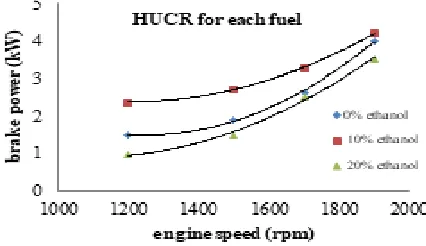
Fig. 2 shows the effect of the addition of ethanol by volume to gasoline on the resulted brake power of a number of velocities. It appears from the figure that the brake power increased with the speed as a typical shape of the relationship between the brake power and engine speed. Also, bp increased with 10% ethanol compared to its value when gasoline was used. Engine performance was improved by increasing speed due to improvements in the volumetric efficiency. As the turbulence increased in the combustion chamber, the combustion chamber temperature increased that improved the spread of the mixture and its preparation for igniting, resulting in higher output bp. The addition of ethanol (which has octane number=110) improved the fuel resistance of knock and increased the octane number of the mixture and improved its volumetric efficiency because of the presence of an OH molecule in its structure. In addition, ethanol has drawn heat from the mixture during combustion (840 kJ / kg). Compared with the heat of evaporation of gasoline (305 kJ / kg), thus cooling the mixture and giving it an opportunity to withdraw more air, which increased its bp. All these reasons increased when 10% ethanol was added. However these parameters were reduced when 20% ethanol was added due to the large amount of ethanol. Ethanol has lower heating value than gasoline (the heating value of ethanol is 21.3 MJ/l). The reduction of brake power at this mixing ratio is obvious in the figure. Table 1 gives some of the fuel properties used in this work.
Fig.2: The impact of ethanol addition to gasoline on resulted engine brake power
Fig.3: The impact of ethanol addition to gasoline on resulted engine bsfc
Fig. 4 shows the increase in the exhaust gas temperatures as the speed of each fuel was increased. The exhaust temperature decreased with the addition of 10% ethanol clearly, and the temperature degrees of exhaust gas were reduced by adding 20% ethanol more. The decrease in the exhaust gas temperature when adding alcohol is caused by the lower heating value of ethanol on the basis of weight compared to gasoline and the higher decrement appeared when 20% methanol was added shows the effect of this parameter.
The volumetric efficiency increased with the addition of 10% ethanol to gasoline, for two reasons: the presence of an OH molecule in alcohol chemical composition, which increased the amount of oxygen in the combustion chamber and improved its quality. The second is that the heat required for evaporation of ethanol is high and takes it from the fuel mixture to evaporate, allowing the addition of an additional amount of air, which increases the volumetric efficiency and this is illustrated in Fig 5.
Fig.4: The impact of ethanol addition to gasoline on the exhaust gas temperatures
Fig.5: The impact of ethanol addition to gasoline on resulted engine bsfc
Fig. 6 shows the amount of CO and CO2 in the exhaust gas when the engine operates at 1500 rpm. In addition to 10% ethanol, the pollutant levels are at the lowest level on the weak side. When the equivalence ratio is coming nearer to the stoichiometric ratio and goes far to the rich side, the addition of Ethanol reduces the amount of pollutant produced by improving combustion by two main reasons: improved volumetric efficiency by means of extra oxygen in the ethanol structure, and second, faster flame spread due to this addition.
CO values increased by 32.33% and CO2 values by 16.5%, increasing engine speed to 1700 rpm, due to increased temperature inside the combustion chamber, as Fig. 7 illustrates. Also, increasing engine speed to 1900 rpm as indicated in Fig. 8, which means that the CO and CO2 levels increased by increasing the speed because of the
increase of the combustion temperature, which increased the reactions of dissociation of CO2 to CO. As well as shortening the time required for oxidation of both CO and CO2 because of the lack of oxygen in the rich side.
Fig.6: The impact of 10% ethanol addition to gasoline on the CO and CO2 levels
Fig.7: The impact of 10% ethanol addition to gasoline on the CO and CO2 levels
Fig.8: The impact of 10% ethanol addition to gasoline on the CO and CO2 levels
Fig.9: The CO and CO2 levels For gasoline
reduces pollution. The CO is 39% lower, CO2 pollutants by 26%, the output of these two pollutants is higher without the addition of ethanol. These pollutants are also reduced by low-speed, low temperature inside the engine room and provide the time needed for the CO reaction to CO2, as illustrated in Fig. 10.
Fig.10: The CO and CO2 levels For gasoline
Conclusions
The addition of ethanol (10%) to gasoline improved the fuel octane number, which increases the higher useful compression ratio of the engine from 8: 1 to 9.5: 1, and increases the bp of the engine. The compression ratio of 9.5: 1 is a high compression ratio that is not reached by any of the former researchers who studied this field of science, and distinguish this work from others. The addition of 20% of methanol to gasoline fuel is undesirable, as the resulting bp did not increase and the specific fuel consumption was increased. The addition of 10% ethanol enhanced the engine's volumetric efficiency because of the OH molecule in the chemical structure of ethanol. The addition of ethanol reduced the exhaust gas temperatures. CO and CO2 contaminants in the exhaust gas increased from slow to medium velocity due to the increase in combustion temperature, which increased dissociation reactions and decreased the time required for oxidation. Adding 10% ethanol reduced CO and CO2 pollutants. The addition of 10% ethanol to the gasoline used in Iraq is optimized for engine performance, a booster for the gasoline's low octane number, and reduced the exhaust gas pollutants.
References
1. Chaichan M T, Kadhum A H, Al-Amiery A A, Novel technique for enhancement of diesel fuel: Impact of aqueous alumina nano-fluid on engine's performance and emissions, Case Studies in Thermal Engineering, vol. 10, pp. 611–620, 201
https://doi.org/10.1016/j.csite.2017.11.006
2. Chaichan M T, Abass K I, Mohammed B A,
Experimental Study of the Effect of fuel type on the Emitted Emissions from SIE at Idle Period, Al-Khwarizmi Engineering Journal, vol. 13, No.1, pp. 1-12, 2017.
3. Chaichan M T, Effect of injection timing and coolant temperatures of DI diesel engine on cold and hot engine startability and emissions, IOSR Journal of Mechanical and Civil Engineering (IOSRJMCE), vol. 13, No. 3-6, pp. 62-70, 2016.
4. Al-Maamary H M S, Kazem H A, Chaichan M T, Changing the energy profile of the GCC States: A review, International Journal of Applied Engineering Research (IJAER), vol. 11, No. 3, pp. 1980-1988, 2016.
5. Chaichan M T, Kazem H A, Mahdy A M J &
Al-Waeely A A, Optimal sizing of a hybrid system of renewable energy for lighting street in Salalah-Oman using Homer software, International Journal of Scientific Engineering and Applied Science (IJSEAS), vol.2, No. 5, pp. 157-164, 2016
6. Al-Maamary H M S, Kazem H A, Chaichan M T, The
impact of the oil price fluctuations on common renewable energies in GCC countries, Renewable and Sustainable Energy Reviews, vol. 75, pp. 989-1007, 2017.
7. Chaichan M T and Al-Asadi K A H, Environmental Impact Assessment of traffic in Oman, International Journal of Scientific & Engineering Research, vol. 6, No. 7, pp. 493-496, 2015.
8. Al-Waeely A A, Salman S D, Abdol-Reza W K, Chaichan M T, Kazem H A and Al-Jibori H S S, Evaluation of the spatial distribution of shared electrical generators and their environmental effects at Al-Sader City-Baghdad-Iraq, International Journal of Engineering & Technology IJET-IJENS, vol. 14, No. 2, pp. 16-23, 2014.
9. Al-Maamary H M S, Kazem H A, Chaichan M T, Climate change: the game changer in the GCC region, Renewable and Sustainable Energy Reviews, vol. 76, pp. 555-576, 2017.
http://dx.doi.org/10.1016/j.rser.2017.03.048
10. Al-Maamary H M S, Kazem H A, Chaichan M T, Renewable energy and GCC States energy challenges in the 21st century: A review, International Journal of Computation and Applied Sciences IJOCAAS, vol.2, No. 1, pp. 11-18, 2017.
11. Chaichan M T & Ahmed S T, Evaluation of performance and emissions characteristics for compression ignition engine operated with disposal yellow grease, International Journal of Engineering and Science, vol.2, No. 2, pp. 111-122, 2013.
12. Chaichan M T, Practical investigation of the performance and emission characteristics of DI compression ignition engine using water diesel emulsion as fuel, Al-Rafidain Engineering Journal, vol. 21, N0. 4, pp. 29-41, 2013.
13. Chaichan M T & Al Sheikh S A, Study of SIE performance fueled with methane, Al-Jufra University Journal, vol.1, No.1, pp. 15-27, 2001.
14. Chaichan M T, Study of performance of SIE fueled with Supplementary methane to LPG, The Iraqi Journal for Mechanical and Material Engineering, vol.7, No.4, pp. 25-44, 2007.
15. Chaichan M T, The measurement of laminar burning velocities and Markstein numbers for hydrogen enriched natural gas, International Journal of Mechanical Engineering & Technology (IJMET), vol. 4, No. 6, pp. 110-121, November- December, 2013. 16. Chaichan M T, Evaluation of the effect of cooled EGR
on knock of SI engine fueled with alternative gaseous fuels, Sulaimani Journal for Engineering Science, vol. 1, No. 1, pp: 7-15, 2014
17. Salim A A & Chaichan, M T, Study of NOx and CO emissions for SIE fueled with LPG, Sabha University Journal, vol.1, No.1, pp. 106- 125, 2002.
19. Chaichan M T, Measurements of laminar burning velocities and Markstein length for LPG–hydrogen–air mixtures, International Journal of Engineering Research and Development, vol. 9, No. 3, 2013. 20. Chaichan M T, Characterization of lean misfire limits
of alternative gaseous fuels used for spark ignition engines, Tikrit Journal of Engineering Sciences, vol.19, No.1, pp. 50-61, 2012.
21. Salim A A & Chaichan M T, Study of SIE performance fueled with hydrogen, Sabha University Journal, vol.6, No.3, pp. 32-57, 2004.
22. Chaichan M T, Practical study of compression ratio, spark timing and equivalence ratio effects on SIE fueled with hydrogen. Proceeding to Industrial Applications of Energy Systems, Sohar University, Oman, 2008.
23. Chaichan M T & Saleh A M, Experimental measurements of laminar burning velocities and Markstein number of hydrogen–air mixtures, The 3rd Scientific International
Conference, Technical College, Najaf, Iraq, 2013.
24. Chaichan M T, Practical measurements of laminar burning velocities for hydrogen-air mixtures using thermocouples, Association of Arab Universities Journal of Engineering Science, vol. 17, No. 2, 2010. 25. Chaichan M T and Abaas Q A, Study of NOx
emissions of SI engine fueled with different kinds of hydrocarbon fuels and hydrogen, Al Khwarizmi Eng. Journal, vol. 6, No. 2, pp. 11-20, 2010.
26. Chaichan M T and Saleh A M, Practical investigation of single cylinder SI Engine performance operated with various hydrocarbon fuels and hydrogen, Al Mostaseria Journal for engineering and development, vol. 14, No. 2, pp. 183-197, 2010.
27. Chaichan M T, Study of performance of SIE fueled with Supplementary hydrogen to LPG, Association of Arab Universities Journal of Engineering Science, vol.16, No.1, pp. 125-145, 2009.
28. Chaichan, M. T., Study of NOx and CO emissions for SIE fueled with Supplementary hydrogen to LPG, Association of Arab Universities Journal of Engineering Science, vol. 16, No.2, pp. 32-47, 2009.
29. Chaichan M T, Study of performance of SIE fueled with Supplementary hydrogen to gasoline, Baghdad Engineering Collage Journal, vol.12, No.4, pp. 983-996, 2006.
30. Chaichan M T & Salih A M, Study of compression ignition engine performance when fueled with mixtures of diesel fuel and alcohols, Association of Arab Universities Journal of Engineering Science, Vol. 17, No.1, pp. 1-22, 2010.
31. Chaichan M T, Emissions and Performance
Characteristics of Ethanol-Diesel Blends in CI Engines, Engineering and Technology J, vol. 28, No. 21, pp. 6365-6383, 2010.
32. Chaichan M T, Practical measurements of laminar burning velocities and Markstein Numbers for Iraqi diesel-oxygenates blends, The Iraqi Journal for Mechanical and Material Engineering, vol. 13, No. 2, pp. 289-306, 2013. 33. Chaichan M T & Abass K I, Emissions Characteristics
of Methanol-Diesel Blends in CI Engines, Wassit Journal for Science & Medicine, vol. 5, No.1, pp. 177-189, 2012. 34. Chaichan M T, Salam A Q & Abdul-Aziz S A, Impact
of EGR on engine performance and emissions for CIE fueled with diesel-ethanol blends, Arabic universities Union Journal, vol. 27, No. 2, pp. 2014.
35. Chaichan M T, EGR effect on performance of a spark ignition engine fueled with blend of
methanol-gasoline, Wassit Journal of Engineering Science, vol. 1, No. 2, pp. 93-110, 2013.
36. Chaichan M T, GEM Ternary blends: Testing emitted NOx-smoke trading off when EGR is applied to the engine, International Journal of Applied Science, vol. 13, No. 7, pp. 5014-5021, 2018.
37. Chaichan M T, Ali N M, Experimental investigation of the effect of exhausts gas recirculation (EGR) on NOx-Smoke trade-off for SIE fueled with blends of gasoline/bioethanol, Al-Rafidain Collage Journal, Issue 39, pp. 388-404, 2016.
38. Chaichan M T, GEM Ternary Blends utilization as an alternative to conventional Iraqi gasoline to suppress emitted sulfur and lead components to environment, Al-Khwarizmi Journal, vol. 12, No. 3, pp. 38-51, 2016. 39. Chaichan M T, Abass Q A, Effect of cool and hot EGR on performance of multi-cylinder CIE fueled with blends of diesel and methanol, Al-Nahrain Collage of Engineering Journal, vol. 19, No. 1, pp. 76-85, 2016. 40. Chaichan M T, Improvement of NOx-PM trade-off in
CIE though blends of ethanol or/ methanol and EGR, International Advanced Research Journal in Science,
Engineering and Technology, vol. 2, No. 12, pp. 121-128, 2015.
41. Chaichan M T, The impact of engine operating variables on emitted PM and Pb for an SIE fueled with variable ethanol-Iraqi gasoline blends, IOSR Journal of Mechanical and Civil Engineering (IOSRJMCE), vol. 12, N0. 6-1, pp. 72-79, 2015.
42. Chaichan M T, Evaluation of emitted particulate matters emissions in multi-cylinder diesel engine fuelled with biodiesel, American Journal of Mechanical Engineering, vol. 4, No. 1, pp. 1-6, 2016. DOI : 10.12691/ajme-4-1-1
43. Chaichan M T, Performance and emissions
characteristics of CIE using hydrogen, biodiesel, and massive EGR, International Journal of Hydrogen Energy, vol. 43, pp. 5415-5435, 2018.
https://doi.org/10.1016/j.ijhydene.2017.09.072
44. Chaichan M T, Performance and emission study of diesel engine using sunflowers oil-based biodiesel fuels, International Journal of Scientific and Engineering Research, vol. 6, No. 4, pp. 260-269, 2015.
45. Starkman E S, Newhall H K & Sutton R D,
1980,”Comparative performance of alcohol and hydrocarbon fuels”, Alcohol as motor fuel, SAE selected papers.
46. Walter S R, 2006, Corn ethanol as an alternative fuel: technical and economic issues, SAE paper No. 2006-01-0179.
47. Pikūnas A, Pukalskas S and Grabys J, 2003, Influnce of composition of gasoline-ethanol blends on parameters of internal combustion engins, Journal of KONES Internal Combustion Engines, vol. 10, pp: 3-4. 48. Ceviz M A and Ksel F Yu, 2005, Effects of ethanol- unleaded gasoline blends on cyclic variability and emissions in SI engin, Applied Thermal Engineering Journal, vol. 25, pp: 917-925.
51. Rajan, 1984, “Water – ethanol- gasoline blends,
physical properties, power and pollution
characteristics”, ASME, vol. 106.