
INTERNATIONAL JOURNAL OF ENGINEERING SCIENCES
& MANAGEMENT
PAPR REDUCTION USING PTS, SLM AND CUCKOO SEARCH OPTIMIZED
COMPANDING
Sana Asif Khan, Sachin Singhal
[email protected]
ABSTRACT
The OFDM is a multicarrier modulation technique has proved itself in the field of high-speed communication enabling current technologies to reach a high transmission rate. It is used in most communication standards. One of the major drawbacks of OFDM modulation is the strong PAPR of the resulting signals. This characteristic makes OFDM signals very sensitive to the nonlinearities of analog components, especially those of power amplifiers. Because for a high efficiency, the power amplifier must operate in a so-called non-linear (or saturation) zone, but it is in this zone that nonlinearities occur. The amplifier, sources of distortion of the signals to be transmitted. These effects are all the more annoying as the signals to be amplified are at high PAPR
This paper provides comparative analysis of severalmethods for PAPR reduction namely; Selective Mapping (SLM), Partial Transmit Sequences (PTS) and Companding Transform optimized by Cuckoo Search (CS) algorithm. Simulation results are presented by using CCDF v/s PAPR graph.
Keywords –BER, CCDF, Companding, Cuckoo Search, HPA, OFDM, PAPR, PTS, SDR, SLM.
INTRODUCTION
Telecommunications systems, and more particularly wireless communication systemshave evolved dramatically over the past two decades. This evolution went hand in hand with the achievements made in digital electronics. Wireless communication systems have become almost ubiquitous in our lives. In our pockets, we can find telephones, diaries, satellite positioning systems, all communicating with each other and with the outside. In the office or at home, we are surrounded by data storage devices, computers, multimedia and television centers, alarms and sensors, which also communicate. And all these wireless communications, involving freedom, availability and comfort, can be established through the transfer of information over the airwaves [1].
Despite this spectacular evolution in the field of telecommunications, new challenges are facing manufacturers today [1]. Given the socio-economic factors, the demand of the users in term of communication is precise: to transmit and / or to access a volume of information (of more and more important size), as fast as possible, with the greatest possible flexibility, all with limitless mobility and miniaturized media. Nowadays, we are no longer content to speak with a contact person on the phone, but we demand a good quality of the communication and often we want to see the image in real time of our interlocutor on our communication support (video telephony, teleconference, etc.). Operators of telephony, too, want to maximize the number of subscribers, the quality that is available to them, and the number of calls that are established, and therefore wish to maximize the quantity of information and the capacity of networks. Increasingly greedy users of data, information and capacity on one side; and competing providers to best meet the needs in terms of the quality and quantity of user information.
To respond to this multitude of requests, we have also witnessed a proliferation of communications standards for new types of modulations, and so on. Often, these communications standards have radio parts incompatible with each other. And to answer the problems of incompatibility between communication standards, the concept of Software Defined Radio (SDR) has been introduced [2].
Software Radio implies a multi-standard, multi-modulation, multi-mode, re-configurable radio link context. It is a technology capable of modulating or demodulating any signal anytime, anywhere. This implies a great diversity of bands of frequencies to be treated, modulation techniques and different access to take into consideration.
Before reaching the concept of Software Radio, the OFDM [3] is a sophisticated multi-carrier modulation technique which has proven itself in the field of wireless communication. Current technologies to achieve a high rate of transmission. It is used in most communication standards. In addition, ADSL (Asymmetric Digital Subscriber Line) is a communication technique that makes it possible to use a subscriber line to transmit and receive digital signals. It has high debit rates (high-speed internet), WI-FI, WIMAX (belonging to the IEEE 802.xx standard family and allowing transmission of high-speed wireless data [4, 5].
These technologies based on orthogonal multicarrier modulations have advantages as well as disadvantages. Advantages mainly relate to the robustness of the signal with respect to the multitrajet channel with fading and optimal spectralspace.
This high PAPRmakes the OFDM signals very sensitive to the non-linearity of the analog components, especially those of the power amplifier.
The high power amplifieris a decisive element in a communication chain insofar as it has a preponderant influence on the overall transmission balance in term power, efficiency and distortion. In terms of consumption, the power amplifier is the element that consumes the most energy among all elements of the issuer. It is therefore important to make it work as efficiently as possible, especially for mobile devices where consumption is a decisive factor in determining their autonomy. Unfortunately, for a high efficiency, the power amplifier must operate in a so-called nonlinear (or saturation) zone, or it is in this zone that the non-flax are presented. The effects of the amplifier, sources of distortion (inter-modulation, spectral rise, etc.) of the signals to be transmitted. These effects are all the more annoying as the signals to be amplified are at high PAPR. Often, it is necessary to take a sufficient step back so that the power amplifier does not saturate the signal to be amplified. This amounts to making the power amplifier work in a highly linear zone with a significant deterioration of its efficiency and therefore with an increase in the overall consumption of the mobile terminal for the same coverage area.
It is necessary to optimize the power amplifier's consumption by making it operate as close as possible to its saturation zone, which represents the zone at optimum efficiency. In order to blame itself for the saturation zone without saturating the input signal too much, it is necessary to decrease the envelope fluctuations of the OFDM signal, and thusit’s PAPR. The first extensive studies on the reduction of the PAPR appeared concomitantly with the OFDM modality-based communication standards in the early 1990s. A multitude of techniques for reducing PAPR. Given the large number of these methods, the reader may refer to [7] or a general classification of methods of reducing PAPR and correcting nonlinearities are proposed. Some techniques act on the amplifier to avoid saturation of the input signal and other techniques are based on a processing performed directly at the signal level.
However, acting on a signal to reduce its PAPR is frequently to the detriment of expanding the involvedness of the system and / or the escalation in average power, bit error rate (BER) and / or the secondary lobe rise and / or the decrease of the useful flow. However, it seems that signalingtechniques are being watched more and more closely, particularly because of their strong capacity to reduce the PAPR, and often because they do not degrade the BER and are generally downwardly compatible. A "signal addition" technique is a technique that allows the reduction of the PAPR by adding one or more signals called additional signalsor PAPR reduction signalsor correctionalsignals [8]. These are particularly attractive and promisingPAPR reduction techniques; they have also beenstandardized in DVB-T2.
This paper proposes a three techniques for PAPR reduction:
Selective Mapping
Partial Transmit Sequences
Cuckoo Search Optimized Companding
Section two presents an overview for various techniques or PAPR reduction. Section three describes the performance criteria for PAPR reduction. Section four presents the proposed methodology used for research work followed by the simulation results and conclusion in section five and six respectively.
STATE
OF
THE
ART
OF
PAPR
REDUCTION
TECHNIQUES
As we have seen in the previous heading, in order to get the amplifier the linearity required by the communication standards, the power amplifier can be oversizedwhich amounts to working away from the saturation zone, with a significant decline. On the other hand, the energy efficiency in this case will prove very low, and this, all the more so as the waveforms of the signals will have high PAPRs. However, a high PAPR signal passing through a nonlinear amplifier (with a low recoil, this for a high efficiency) becomes much distorted. Compensation for this distortion in reception involves complex processes. This is why most of the nonlinearity processing techniques proposed in the literature are on the program.
The purpose of this heading is to establish a state-of-the-art of techniques for reducing the PAPR to the program knowing that in this topic we will be interested in more the techniques for reducing the PAPR to the so-called "signal addition" program because they are simple to implement and satisfy the constraints (resource consumption) of the on-board systems. In addition, some of them are downwardly compatible. We will return to the notion of top-down compatibility, which in our view is very fundamental in our analysis and research of the technique of reducing the PAPR to the program.
has become more crucial because the signal has a non-constant envelope. Thus we have seen the first techniques of treatment of nonlinearities from the 1990s.
In [7], a general classification of all the techniques dealing with the problem of non-linear amplification has been proposed, this classification has been repeated and put into practice. Here, in this research work, we propose a classification of techniques for reducing PAPR of OFDM system. This is an extension of the classification proposed by Y. Louet and J. Palicot [7] in which all distortion techniques (Distortion techniques means any reduction technique of PAPR that generates distortions, as is the case in clipping techniques) will be considered as adding techniques of signal.
There is further work in the classification of PAPR reduction techniques. We can cite, among others, the work of [12] where they presented OFDM PAPR reduction techniques by proposing a SLM based technique which is based on computational complexity, bandwidth expansion, transmission rate decrease and the variation of the average signal power to be transmitted.
PERFORMANCE
CRITERIA
FOR
PAPR
REDUCTION
TECHNIQUES
This section defines the different criteria of equity that will allow us to evaluate the performance of a particular program. The technique of reducing PAPR in its operating environment.
Consider the simplified scheme of a transmission chain (Figure 1) incorporating a reduction module of the PAPR.
Figure 1: Simplified scheme of a transmission chain incorporating a PAPR reduction module
A. Performance in Reducing the PAPR
This may seem trivial but it remains despite all the determining criteria. To illustrate the measure of performance in reducing the PAPR of a method, consider Figure 1. The PAPR of the signals 𝑥(𝑡) and 𝑦(𝑡) are defined as follows:
𝑃𝐴𝑃𝑅[𝑥]=
max
0≤𝑡≤𝑇𝑠
|𝑥(𝑡)|2
𝒫x
𝑃𝐴𝑃𝑅[𝑦]=
max
0≤𝑡≤𝑇𝑠
|𝑦(𝑡)|2
𝒫y
(1) Where 𝑇𝑠 denotes the duration of an OFDM symbol and 𝒫x and 𝒫𝑦 respectively represent the average powers of
the signals 𝑥(𝑡) and 𝑦(𝑡). The PAPR is a random variable that can be characterized by its CCDF; 𝑃𝐴𝑃𝑅[𝑥] and
𝑃𝐴𝑃𝑅[𝑦] defined by equation (1) are random variables whose CCDFs are shown in Figure 2. The gain in the reduction of the PAPR is definedat a given φ value of the CCDF, the parameter ΔPAPR (φ) defined by:
𝛥𝑃𝐴𝑃𝑅(𝜙) = 𝑃𝐴𝑃𝑅[𝑥](𝜙) − 𝑃𝐴𝑃𝑅[𝑦](𝜙) (2)
Where 𝑃𝐴𝑃𝑅[𝑥](𝜙) and 𝑃𝐴𝑃𝑅[𝑦](𝜙) are the PAPRs of the signals 𝑥(𝑡) and 𝑦(𝑡) to 𝐶𝐶𝐷𝐹 = 𝜙.
Figure 2: Reduction of the PAPR at a particular value of the CCDF [13]
B. Variation in Average Power
Consider the simplified scheme of the transmission chain given in Figure 1, the variation of the mean power of the signal to be transmitted is written as [14, 15]:
Δ𝐸[𝜏] =𝒫y−𝒫x [dB] (3)
Where 𝜏 is the parameter that controls the reduction performance of the PAPR. The parameter 𝜏can be assimilated to the "cut-off threshold" in the case of "clipping" [15].
PAPR REDUCTION
MODULE HPA
𝑤(𝑡)
𝑧(𝑡) 𝑦(𝑡)
C. Degradation of the BER
For some techniques, the reduction of PAPR is accompanied by the generation of distortions both outside and inside the useful signal band; this is the case of distortion techniques [16, 17, 18, 19, 20]. The reduction of the PAPR is not the only cause of degradation of the BER; indeed, the power amplifier can be a source of degradation of the BER inasmuch as by the need of energy efficiency, the amplification is in (or near) the saturation zone. On the other hand, the total degradation is defined by:
𝑇𝐷[𝜏, 𝐼𝐵𝑂] = Δ𝐸𝑏⁄𝑁0[𝜏, 𝐼𝐵𝑂] + 𝐼𝐵𝑂, [dB] (4)
Where IBO=Input Back-Off. AndΔ𝐸𝑏⁄𝑁0 [τ, IBO] is the reduction of SNR for a given BER. In [71], the authors
have decomposed this degradation of the signal-to-noise ratio into two components: a degradation due to non-linear amplification and a degradation due tothe reduction of the PAPR if the technique used is a distortion technique.
Δ𝐸𝑏⁄𝑁0[𝜏, 𝐼𝐵𝑂] = Δ𝐸𝑏⁄𝑁0[𝐼𝐵𝑂] + Δ𝐸𝑏⁄𝑁0[𝜏],[dB]
(5) Where Δ𝐸𝑏⁄𝑁0[𝐼𝐵𝑂] is the degradation of the signal-to-noise ratio due to non-linear amplification and Δ𝐸𝑏⁄𝑁0[𝜏] is the reduction of SNR due to the reduction of the PAPR. For a non-distorted PAPR reduction technique as is the case for Tone Reservation, there is no degradation of the SNR due to the reduction of the PAPR, i.e., Δ𝐸𝑏⁄𝑁0[𝜏] =
0.
D. Overall Performance
There are studies in the literature [22, 23, 24, 25, 26, 27, 28, 29, 30, 31, 32 and 33] on the performance of PAPR reduction techniques. In general, these studies take into account the reduction of the PAPR, the quality of signal transmission (that is to say the BER reduction and the increase of the AdjacentChannel Power Ratio (ACPR)) and the complexity of the technique. Unfortunately, there is very little study of the overall performance of a PAPR reduction technique in a more "realistic" environment, that is, in the occurrence of a non-linear type power amplifier and an AWGN type propagation channel, for example.
In [34], authors have proposed an overall performance (OP) metricwhich allows to evaluate the overall performance of a system and which takes into account the reduction of the PAPR of the system.The average power variation of the signal to be transmitted due to the reduction of the PAPR and the energy degradation per bit of the system. Since the average power variation and the energy degradation per bit of the system have efficient effects on the generalized performance of the system and only the reduction in the PAPR contributes positively to the performance of the system, we define the metric "OP" by the following relation:
𝑂𝑃[𝜏, 𝐼𝐵𝑂] = Δ𝑃𝐴𝑃𝑅[𝜏] − Δ𝐸[𝜏] − Δ𝐸𝑏⁄𝑁0[𝜏, 𝐼𝐵𝑂]
(6) Where ΔPAPR [τ] is the reduction gain of the PAPR, Δ𝐸[𝜏] is the variation of the mean power of the signal to be transmitted given by the equation (3) and Δ𝐸𝑏⁄𝑁0[𝜏, 𝐼𝐵𝑂] is the energy degradation per bit given by the equation
(5).
In the manifestation of 𝑂𝑃[𝜏, 𝐼𝐵𝑂], one can incorporate the complexity of the system's PAPR reduction module
and the out-of-band power emissions (which are the cause of the increase of the ACPR).
E. Complexity
If a technique is so proficientfor the PAPR reduction but requires a lot of computation resources, this can become prohibitive for some practical applications such as "real-time". The complexity of the algorithms used must thento be studied.
PROPOSED
METHOD
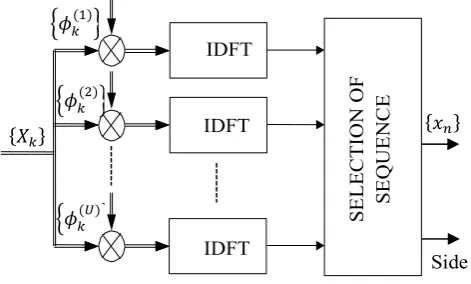
F. Selective Mapping(SLM)
Figure 3: Selective Mapping scheme for PAPR reduction
This method applies to OFDM for any number of subcarriers and for any digital modulation. Let 𝑋 = {𝑋𝑘}, 𝑘 =
0,··· 𝑁 − 1, the OFDM symbol vector in the frequency domain. The idea of the SLM technique is to multiply the vector 𝑋 by a vectorΦ(𝑢)= {𝜙
𝑘
(𝑢)}, 𝑘 = 0, … 𝑁 − 1
. Where, 𝜙𝑘(𝑢)are of the form:
𝜙𝑘(𝑢)= 𝑒𝑗𝜑𝑘 (𝑢)
, 𝜑𝑘(𝑢)∈ [0,2𝜋), 𝑢 = 0, … 𝑈 − 1 (7) The new OFDM signal in the frequency domain after weighting is written as: 𝑋(𝑢)= 𝑋. Φ(𝑢). This givesdifferent
𝑈 signals of 𝑁 components. Finally, the time transmitted OFDM signal is written:
𝑋(𝑢∗)= 𝐼𝐷𝐹𝑇(𝑋(𝑢∗)) (8)
Where 𝑢∗= arg min
𝑢 {max𝑛 |𝑥𝑛
(𝑢)|}
is the index corresponds to the OFDM signal having lowest PAPR. The value
of the index 𝑢∗ will then be transmitted to the receiver for the reconstructionvia an error correcting code. In [36], the authors propose that the number of bits on which this index must be coded is of the order of log2𝑈. The principle of the technique is illustrated in Figure 3.
The SLM performs well in terms of reducing the PAPR. However, the major disadvantage of this technique is its complexity, due to the use of several (𝑈) operations of IDFT. In addition, this method only requires the transmission of information sequences ("Side Information") so that the receiver identifies the sequence that allowed to generate the lowest PAPR. The disadvantage of transmitting information between the issuer and the receiver is twofold: first, because of the risk that this sequence is tainted with errors via the transmission and transmission channel.
G. Partial Transmit Sequences (PTS)
The PTS technique is proposed in [36] by S. Muller and J. B. Huber.
The idea of this method is to shorten the train of the 𝑁 carriers in 𝑉 blocks of 𝑁
𝑉carriers. A carrier used in a particular block will be set to zero in all others. Once these 𝑁
𝑉 blocks are formed, the initial idea of SLM is applied:
a vector Φ(𝑣)= {𝜙 𝑘
(𝑣)}, 𝑣 = 1, … 𝑉
will perform a weighting of each of the 𝑉 blocks after IDFT to form the final signal to the reduced PAPR.
Figure 4: PTSscheme for PAPR reduction
As illustrated in Figures 4, the PTS algorithm is as follows:
{𝑋𝑘}
{𝜙𝑘(1)}
{𝜙𝑘(2)}
{𝜙𝑘(𝑈)}
{𝑥𝑛}
ID FT
ID FT
ID FT
{𝑋𝑘}
{𝜙1}
{𝜙2}
{𝜙𝑣}
Optimizati on
{𝑥𝑛}
Side Informatio
P
A
R
T
IT
IONI
NG
IN
SUB
-B
L
O
C
The frequency OFDM symbol 𝑋 of 𝑁 carriers is shortened in 𝑉 sub-blocks disjoint 𝑋(𝑣)of 𝑁
𝑉 carriers such as 𝑋 =
∑𝑉 𝑋(𝑣)
𝑣=1 .
The frequency OFDM symbol X of N carriers is truncated in V sub-blocks disjoint FRED symbolOFDM is written:
𝑋 = ∑ 𝑋(𝑣). 𝜙(𝑣) 𝑉
𝑣=1
, 𝜙(𝑣)= 𝑒𝑗𝜑(𝑣) 𝑣 = 1, … . . 𝑉
(9)
The temporal OFDM symbol 𝑥 is then written:
𝑥 = 𝐼𝐷𝐹𝑇 (∑ 𝑋(𝑣). 𝜙(𝑣) 𝑉 𝑣=1 ) = ∑ 𝜙(𝑣). 𝐼𝐷𝐹𝑇(𝑋(𝑣)) 𝑉 𝑣=1 = ∑ 𝜙(𝑣). 𝑥(𝑣) 𝑉 𝑣=1 (10) Where the phase shift vector Φ(𝑣) is optimized in the following way:
Φ(𝑣)= {𝜙(𝑣)} arg min
𝜙(𝑣){max𝑛 ∑ 𝜙
(𝑣). 𝑥(𝑣)
𝑉
𝑣=1
}
𝑛 = 0,1, … 𝑁 − 1 (11)
The way in which symbols are partitioned into sub-blocks has an influence on the intricacy of the method. The major disadvantage of the PTS technique lies in the complexity of finding the weightvectors (Φ(𝑣))to minimize the PAPR. Indeed, by considering V in blocks and binary weighting factors (the vectors Φ(𝑣), 𝑣 = 1,2 are only composed of 1 or −1), the number of possible combinations is 2𝑉 which must all be reviewed to determine which vector set minimizes the PAPR. The idea proposed in [38] is then to stop the vector search process Φ(𝑣) when the desired PAPR is reached. Another disadvantage of the PTS technique is that it needs the Side Information (SI) in order for the receiver to identify the sequence that generated the lowest PAPR.
H. The Companding Technique (CT)
TheCompanding method is typically used in voice signals to optimize the number of bits per sample. Because the operation of voice signals and OFDM is analogous, in the sense that high peaks occur infrequently, The objective of the CTs technique is to convert the OFDM signal in the time domaindepending on the power distribution of the signalto ensure that parts of the signal are attenuated with high peaks, while areas with low amplitudes are attenuated. Although the CTs scheme has a good performance in reduction of the PAPR, the BER increases because it introduces distortion in the transmitted signal; In addition, when trying to recover the original signal (decompander) on the receiver side, the channel noise could also be expanded [39].
Figure 5: Companding scheme for PAPR reduction
The μ-law companding was one of the first non-linear techniques of PAPR reduction [40]. The technical μ-law CTs maintains the peaks of the signal, but increases the parts with lower amplitudes, thus obtaining a signal with a lower average power, which leads to a lower PAPR. At the receiver, the signal must be retrieved before demodulation. It is given by:
S / P Rx. Data Input
Data Modulat
ion I F F T S / P P / S . . . . . . . . . . . . Companding D / A & HPA De-Modulat ion F F T P / S . . . . . . . . . . . . De-Companding
𝑦 = 𝑉 𝑙𝑜𝑔[1+𝜇 |𝑥|
𝑉]
𝑙𝑜𝑔(1+𝜇) 𝑠𝑔𝑛(𝑥) (12)
Where 𝑉= peak amplitude of the signal.
𝑥=amplitude of the input signal.
Decompression is achieved by applying the inverse of equation (12).
Here the value of 𝜇 is optimized using the Cuckoo Search algorithm which is explained in the following sub heading.
I. Cuckoo Search (CS)Algorithm
Cuckoo Search is a population-based search techniquefor the optimization of complex problems, non-linear and non-convex optimization.
Figure 6: Representation of solutions in cuckoo search
Cuckoo species practice parasitism by depositing their eggs in the nests of another bird species. Host birds may come into conflict with their unwanted occupants (cuckoos) and, for example, if they discover that the eggs are not theirs, pull them from the nest or just leave the nest and fabricate another one in somewhere else. Some cuckoo species, for example, the Striped Cuckoo have evolved to such an extent that the colour and patterns of the eggs of these species are very similar to the eggs of the host species.
Rules of Cuckoo Search Algorithm:
Each cuckoo deposits one egg at a time and leaves its egg in anarbitrarily chosen nest.
The best nests with high egg quality are maintained for the next iteration.
The number of nests existing in each generation is predefined, and the eggs will be discovered and discarded with a probability 𝑝𝛼∈ [0,1]. For ease a fraction of the total of the nests will be replaced by new nests each generation.
In the Cuckoo Search algorithm,𝑥𝑖 is the 𝑖𝑡ℎ nid and 𝑛 ∈ 𝑁represents problem variables.
A recent study shows that fruit flies explore the environment using a series of straight flight paths with 90 degree turns, following what is called a Lévy flight pattern. This behaviour has been used in optimization and optimization search problems whose results have shown a promising capacity.
The implementation of the Levy flight in the Cuckoo Search algorithm is utilized to create a novel solution during the exploration process [41].
𝑥𝑡+𝜏= 𝑥𝑡+ Φ(𝑡) (13)
𝑥𝑖𝑡 + 1= 𝑥𝑖𝑡+ 𝛼⨁𝐿𝑒𝑣𝑦 (𝜆) (14)
𝐿𝑒𝑣𝑦 = 𝑡−𝜆, (1 < 𝜆 ≤ 3) (15)
Cuckoo Search Algorithm
1. Generate population of n host nests 𝑥𝑖 (𝑖 = 1, . . . , 𝐼); 2. Objective function 𝑓(𝑥), 𝑥 = (𝑥1, 𝑥2, . . . , 𝑥𝑛)𝑇;
3. for k ← 1 to K do
4. Select a cuckoo (Say, 𝑖) at random by means of L'evy flights; 5. Evaluate 𝐹𝑖 quality / performance;
6. Calculate the value of the objective function 𝐹(𝑖); 7. Select a nest 𝑖 between 𝐼 (Say, 𝑗) randomly; 8. if𝐹𝑖> 𝐹𝑗then
9. Replace 𝑗 as the new solution; 10.Leave a fraction 𝑝𝛼 of the worst nests;
11.Build new nests in new locations through L'evy flights; 12.Maintain the best solutions (nests with the best performance); 13.Classify the solutions and find the best current solution; 14.Display results;
SIMULATION
AND
RESULTS
Figure 7: Comparative results of PTS Companding
Figure 8: Comparative results for different techniques
CONCLUSION
This paper presented the importance of OFDM modulation in broadband communications systems and the appropriate treatment that should be given to the signal to reduce PAPR.
We have taken the opportunity to propose an extension of PAPR reduction techniques which ia hybrid of PTS Companding and further PAPR is improved with cuckoo search soft computing method.
REFERENCE
[1] Thompson, John, Xiaohu Ge, Hsiao-Chun Wu, Ralf Irmer, Hong Jiang, Gerhard Fettweis, and Siavash
Alamouti. "5G wireless communication systems: Prospects and challenges [Guest Editorial]." IEEE Communications Magazine 52, no. 2 (2014): 62-64.
[2] Jespersen, Thomas Kølbæk. "Software Defined Radio." (2015).
[3] Stüber, Gordon L. Principles of mobile communication. Vol. 3. Springer, 2017.
[4] Eizmendi, Inaki, Manuel Velez, David Gómez-Barquero, Javier Morgade, Vicente Baena-Lecuyer,
Mariem Slimani, and Jan Zoellner. "DVB-T2: The second generation of terrestrial digital video broadcasting system." IEEE Transactions on Broadcasting 60, no. 2 (2014): 258-271.
[5] Akyildiz, Ian F., David M. Gutierrez-Estevez, and Elias Chavarria Reyes. "The evolution to 4G cellular systems: LTE-Advanced." Physical communication 3, no. 4 (2010): 217-244.
[6] Duanmu, Chunjiang, and Hongtao Chen. "Reduction of the PAPR in OFDM systems by intelligently applying both PTS and SLM algorithms." Wireless personal communications 74, no. 2 (2014): 849-863. [7] Louet, Yves, and Jacques Palicot. "A classification of methods for efficient power amplification of
signals." annals of telecommunications-annales des télécommunications 63, no. 7-8 (2008): 351-368.
[8] Popoola, Wasiu O., Zabih Ghassemlooy, and Brian G. Stewart. "Pilot-assisted PAPR reduction technique
for optical OFDM communication systems." Journal of Lightwave Technology 32, no. 7 (2014):
1374-1382.
[9] Shapiro, Harold S. "Extremal problems for polynomials and power series." PhD diss., Massachusetts Institute of Technology, 1952.
[10]Rudin, Walter. "Some theorems on Fourier coefficients." Proceedings of the American Mathematical Society 10, no. 6 (1959): 855-859.
1 2 3 4 5 6 7 8 9 10
10-2 10-1 100
PAPR[dB]
C
C
D
F
(P
r[
P
A
P
R
>
P
A
P
R
0
])
V=4
Orignal PTS
PTS-COMPANDING
PTS-COMPANDING--Cuckoo search
3 4 5 6 7 8 9 10 11 12
0 0.1 0.2 0.3 0.4 0.5 0.6 0.7 0.8 0.9 1
PAPR0 [dB]
C
C
D
F
(P
r[
P
A
P
R
>
P
A
P
R
0
])
[11]Schroeder, Manfred. "Synthesis of low-peak-factor signals and binary sequences with low autocorrelation (Corresp.)." IEEE Transactions on Information Theory 16, no. 1 (1970): 85-89.
[12]Mhatre, Kavita, and Uday Pandit Khot. "Efficient selective mapping PAPR reduction technique."
Procedia Computer Science 45 (2015): 620-627.
[13]Wang, Y-C., and Z-Q. Luo. "Optimized iterative clipping and filtering for PAPR reduction of OFDM
signals." IEEE Transactions on Communications 59, no. 1 (2011): 33-37.
[14]Zhu, Xiaodong, Wensheng Pan, Hong Li, and Youxi Tang. "Simplified approach to optimized iterative
clipping and filtering for PAPR reduction of OFDM signals." IEEE Transactions on Communications
61, no. 5 (2013): 1891-1901.
[15]Anoh, Kelvin, Cagri Tanriover, and Bamidele Adebisi. "On the optimization of iterative clipping and filtering for PAPR reduction in OFDM systems." IEEE Access 5 (2017): 12004-12013.
[16]Jiang, Tao, Chunxing Ni, Chen Ye, Yiting Wu, and Kai Luo. "A novel multi-block tone reservation
scheme for PAPR reduction in OQAM-OFDM systems." IEEE Transactions on Broadcasting 61, no. 4
(2015): 717-722.
[17]Ivanov, Andrey, and Dmitry Lakontsev. "Selective tone reservation for PAPR reduction in wireless
communication systems." In Signal Processing Systems (SiPS), 2017 IEEE International Workshop on,
pp. 1-6. IEEE, 2017.
[18]Wang, Sen-Hung, Wei-Lun Lin, Bo-Rong Huang, and Chih-Peng Li. "PAPR reduction in OFDM
systems using active constellation extension and subcarrier grouping techniques." IEEE Communications Letters 20, no. 12 (2016): 2378-2381.
[19]Dang, Lele, Hui Li, and Songyun Guo. "PAPR reduction in OFDM with active constellation extension
and hadamard transform." In Intelligent Computer Communication and Processing (ICCP), 2017 13th
IEEE International Conference on, pp. 543-549. IEEE, 2017.
[20]Wang, Wei, Meixia Hu, Yongzhao Li, and Hailin Zhang. "A low-complexity tone injection scheme based
on distortion signals for PAPR reduction in OFDM systems." IEEE Transactions on Broadcasting 62,
no. 4 (2016): 948-956.
[21]Tavares, Caio Henrique Azolini, José Carlos Marinello Filho, Cristiano Magalhães Panazio, and Taufik
Abrão. "Input Back-Off Optimization in OFDM Systems Under Ideal Pre-Distorters." IEEE Wireless Communications Letters 5, no. 5 (2016): 464-467.
[22]Agarwal D, Sharan N, Ponmani Raja M, Agarwal A., “PAPR reduction using precoding and companding
techniques for OFDM systems”, International Conference on Advances in Computer Engineering and Applications (ICACEA), pp. 18-23, March 2015.
[23]Yeh HG, Mutahir Abdul H., “Hadamard SCFDMA-A modified uplink transmission scheme with low
PAPR and SER”, 9th Annual IEEE International Systems Conference (SysCon), pp. 711-715, April 2015.
[24]Pamungkasari PD, Sanada Y., “Time domain cyclic-selective mapping for PAPR reduction using
delayed correlation with matched filter in OFDM system”, IEEE, 22nd International Conference on Telecommunications (ICT), pp. 373-377, April 2015.
[25]Thanigasalam M, Dananjayan P., “Performance analysis of OFDM receiver using modified PTS
combined with interleaving and pulse shaping for different subblocks”, IEEE International Conference on Communications and Signal Processing (ICCSP), pp. 0865-0869, April 2015.
[26]Adegbite SA, McMeekin SG, Stewart BG., “A PAPR Reduction and Data Decoding for SLM Based
OFDM Systems without SI”, IEEE Vehicular Technology Conference (VTC Spring), pp. 1-5, May 2015.
[27]Lozhkin AN, Nagatani K., “Adaptive Peak-to-Average Power Reduction Architecture for Multicarrier
Signals with Mixed Modulations,” IEEE Vehicular Technology Conference (VTC Spring), pp. 1-6, May 2015.
[28]Popoola WO, Ghassemlooy Z, Stewart BG., “Optimizing OFDM based visible light communication for
high throughput and reduced PAPR”, IEEE International Conference on Communication Workshop (ICCW), pp. 1322-1326, June 2015.
[29]Vangala SK, Anuradha S., “Analysis and comparison of clipping techniques for OFDM/OQAM
peak-to-average power ratio reduction”, IEEE International Conference on Applied and Theoretical Computing and Communication Technology (iCATccT), pp. 791-795, October 2015.
[30]Ouyang Y, Ding H., “Peak-to-average power ratio reduction techniques for MIMO-OFDM systems with
STBC/SFBC”, IEEE International Conference on Communication Problem-Solving (ICCP), pp. 540-543, October 2015.
[31]Gupta P, Singh RK., “Highly optimized Selected Mapping based peak to average power ratio reduction
[32]Yadav SP, Bera SC., “PAPR analysis of single carrier FDMA system for uplink wireless transmission”, IEEE 10th International Conference on Information, Communications and Signal Processing (ICICS) pp. 1-5, December 2015.
[33]Lee KS, Cho YJ, Woo JY, No JS, Shin DJ., “Low-complexity PTS schemes using OFDM signal rotation
and pre-exclusion of phase rotating vectors”, IEEE, IET Communications, pp. 540-547, March 2016. [34]Paredes, Martha Cecilia Paredes, and M. Julia Fernández-Getino García. "Performance of OPS-SAP
technique for PAPR reduction in IEEE 802.11 p scenarios." Ad Hoc Networks 52 (2016): 78-88.
[35]Bauml, Robert W., Robert FH Fischer, and Johannes B. Huber. "Reducing the peak-to-average power
ratio of multicarrier modulation by selected mapping." Electronics letters 32, no. 22 (1996): 2056-2057. [36]Muller, Stefan H., and Johannes B. Huber. "OFDM with reduced peak-to-average power ratio by
optimum combination of partial transmit sequences." Electronics letters 33, no. 5 (1997): 368-369. [37]Breiling, Marco, Stefan H. Müller-Weinfurtner, and Johannes B. Huber. "Peak-power reduction in
OFDM without explicit side information." In Proceedings of International OFDM Workshop 2000. 2000.
[38]Jayalath, A. D. S., and Chintha Tellambura. "Adaptive PTS approach for reduction of peak-to-average
power ratio of OFDM signal." Electronics Letters 36, no. 14 (2000): 1226-1228.
[39]Jiang, Yuan. "New companding transform for PAPR reduction in OFDM." IEEE Communications Letters 14, no. 4 (2010).
[40]Hsu, Chau-Yun, and Hsuan-Chun Liao. "PAPR reduction using the combination of precoding and
Mu-Law companding techniques for OFDM systems." In Signal Processing (ICSP), 2012 IEEE 11th International Conference on, vol. 1, pp. 1-4. IEEE, 2012.
![Figure 2: Reduction of the PAPR at a particular value of the CCDF [13]](https://thumb-us.123doks.com/thumbv2/123dok_us/8355026.1668463/3.595.193.400.570.666/figure-reduction-papr-particular-value-ccdf.webp)
![Figure 7: Comparative results of PTS Companding PAPR[dB]](https://thumb-us.123doks.com/thumbv2/123dok_us/8355026.1668463/8.595.205.384.257.399/figure-comparative-results-pts-companding-papr-db.webp)
