Permutation
Ms. Thejangunuo Juline Linyu Mr. B.B. S Kumar
PG Student(M.Tech) Assistant Professor
Department of Electronics & Communication Department of Electronics & Communication RajaRajeshwari College of Engineering, Bangalore RajaRajeshwari College of Engineering, Bangalore
Abstract
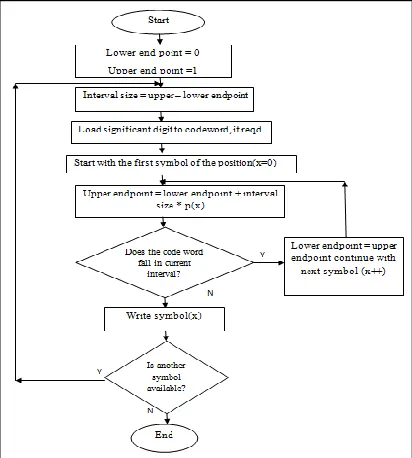
In this paper we present an image encryption and compression system, where encryption of an image is conducted prior to compression. The proposed image encryption operated in the prediction error domain is to provide a reasonably high level of security. Also an efficient lossless compression of the encrypted image is performed by using Arithmetic coding with Run length encoding. We achieved higher compression ratios by using Arithmetic coding with Run length encoding compared to using only Arithmetic coding algorithm. Experimental results illustrated that the proposed system is efficient in terms of compression ratio and Peak signal to noise ratio.
Keywords: Arithmetic Coding, Encryption, Run Length Encoding
________________________________________________________________________________________________________
I.
I
NTRODUCTIONWith the expeditious progression of data exchange in electronic way, information security is becoming more important in data storage and transmission. In many practical scenarios contents of multimedia need both to be compressed as well as protected. The conventional way is to first compress and then encrypt, in some cases it may be desirable to operate the other way around. This is the case, for example of an encrypted content that is transmitted without compression through the internet, but at a certain point needs to be compressed in order to match the characteristics of the transmission link. Compression of an encrypted data seems to be infeasible at first sight, but in [2] it showed that by relying on the theory of source coding it is indeed possible to compress the encrypted data with available side information at the decoder end. . As the multimedia data is transmitted over networks on large scale, we need to have a reliable technique to prevent data getting leaked or attacked. The security mechanism should typically be a reliable method to protect the images as well as videos with same potential. Good encryption makes a source look completely random, traditional algorithms are unable to compress encrypted data. For this reason, traditional systems make sure to compress before they encrypt. We are using the concept of private key encryption, for the encryption and decryption of image. Neither the security nor the compression efficiency will be sacrificed by performing compression in the encrypted domain. Many techniques require the complex computation to be done to encrypt the images and videos but it takes a larger overhead of computing values for non sensitive data too. So the solution to this problem is to do selective encryption. Government, military and private business organizations make use of great deal of confidential images about their patients (in Hospitals), geographical areas (in research processes), enemy positions (in defence and military operations) product, and financial-status [3]. Most of this information is now captured, processed and stored on electronic computers and transmitted across the vast geographical areas network to other computer, if these confidential images about enemy positions ,patient ,and geographical areas fall into the maliciously behaving hands, than such a breach of security could lead to lots of war, wrong treatment etc. So protecting confidential images is an ethical and legal requirement. We store information in computer system in the form of files. File is considered as a basic entity for keeping the information in electronic form.
II.
P
ROPOSED SYSTEM(IJSTE/ Volume 1 / Issue 11 / 061)
Fig. 1: Proposed System at Transmitting End
Fig. 2: Proposed System at Receiving End
III.
I
MAGE ENCRYPTIONEncryption is the process of encoding message or information in such a way only authorized persons can see it. Encryption does not itself prevent interception, but denies the message content to the interceptor. There are various encryption techniques available, out of which we use random permutation in our proposed system.
The input image „I‟ is first fed into Gradient Adjusted Prediction (GAP) [7]. Gradient adjusted prediction is an efficient prediction method for lossless compression of image encryption. By calculating its gradient in vertical and horizontal orientation with the known context, the pixel value can be well estimated. The vertical and horizontal gradient is estimated by using:
dh = | - | +| - | + | - | (1)
dv = | - | +| - | + | - | (2)
We obtained prediction error image by taking the difference of original pixel value and predicted pixel value of the image. Before applying random permutation it is necessary to divide the image into different blocks hence we used clustering techniques to obtained clusters. By using two key-driven cyclic shifting operations random permutation is performed to each cluster. Encrypted image is obtained by assembling back all the clusters.
IV.
I
MAGE COMPRESSIONassembled into different clusters and de-permutation was performed to obtain the decrypted image.
VI.
E
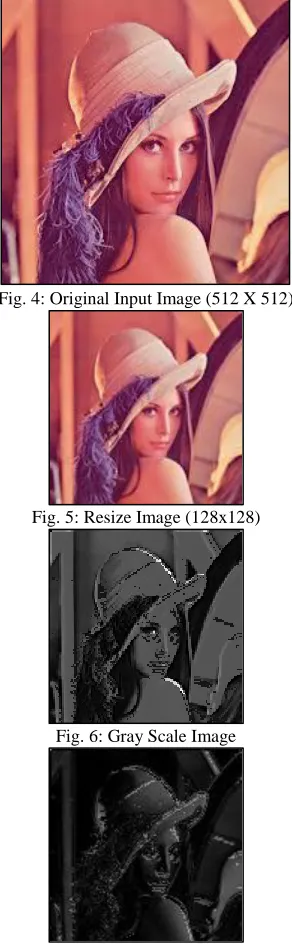
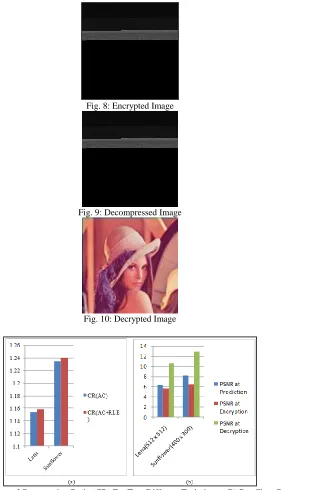
XPERIMENTAL RESULTSThe proposed approach was executed using MATLAB R2012b in windows 7 operating system with 3GB RAM. The experiments are carried out on some standards colour images like lena.jpg, sunflower.jpg of variable size. Input original image of size 512 x 512 jpeg format is shown in figure 4. At the pre-processing stage we converted the colour image to gray scale image after resizing the image to 128 x 128 as shown in figure 5 and 6. Figure 7 shows the prediction error image obtained by using GAP, figure 8 shows the encrypted image obtained after randomly permuting the predicted error image, figure 9 shows the decompressed image at the receiver end and finally the decrypted image is shown in figure 10. The performance evaluation factors such as compression ratio and PSNR at different stages of operation are represented with bar charts in figure 11.
Fig. 4: Original Input Image (512 X 512)
Fig. 5: Resize Image (128x128)
Fig. 6: Gray Scale Image
(IJSTE/ Volume 1 / Issue 11 / 061)
Fig. 8: Encrypted Image
Fig. 9: Decompressed Image
Fig. 10: Decrypted Image
Fig. 11: (A) Bar Chart Representation of Compression Ratio (CR) For Two Different Techniques (B) Bar Chart Representation Of Peak Signal To Noise Ratio (PSNR) At Different Stages Of Operation
VII.
C
ONCLUSIONThe experimental result indicates that it is indeed possible to compress an encrypted image without relying on the secret key. Higher compression ratio infers to higher compression efficiency. We gain 0.5% to 0.52% by using AC in combination with RLE
The secrecy of an image is perfectly achieved and its quality is retained at the receiver end. In future the proposed system can be extended to lossy compression.
R
EFERENCES[1] J. Zhou, X. Liu, and O. C. Au, “On the design of an efficient encryption-then-compression system,” in Proc. ICASSP, 2013, pp. 2872–2876.
[2] M. Johnson, P. Ishwar, V. M. Prabhakaran, D. Schonberg, and K. Ramchandran, “On compressing encrypted data,” IEEE Trans. Signal Process., vol. 52, no. 10, pp. 2992–3006, Oct. 2004.