ISSN (Online): 2320-9364, ISSN (Print): 2320-9356
www.ijres.org Volume 2 Issue 12 ǁ December. 2014 ǁ PP.18-22
Experimental Study of Partial Replacement of Fine Aggregate
with Waste Material from China Clay Industries
Ms. V. H. Lavangare
1, Dr. G. S. Kulkarni
2, Mr. A. B. Sawant
31PG Student, Department of Technology, Shivaji University, Kolhapur 2
Director and Professor, Department of Technology, Shivaji University, Kolhapur 3Assistant Professor, Civil Engineering Department, KIT’s College of Engineering, Kolhapur
ABSTRACT :
The utilization of industrial and agricultural waste produced by industrial process has been the focus of waste reduction research for economical, environmental and technical reasons. This is because over 300 million tones of industrial waste are being produced per annual by agricultural and industrial process in India. The problem arising from continuous technological and industrial development is the disposal of waste material. If some of the waste materials are found suitable in concrete making not only cost of construction can be cut down, but also safe disposal of waste material can be achieved. The cement of high strength concrete is generally high which often leads to higher shrinkage and greater evaluation of neat of hydration besides increase in cost. A partial substitution of cement by an industrial waste is not only economical but also improves the properties of fresh and hardened concrete and enhance the durability characteristics besides the safe disposal of waste material thereby protecting the environment form pollution This paper deals with partial replacement of fine aggregate with the industrial waste from China Clay industries. The compressive strength, split tensile strength and flexural strength of conventional concrete and fine aggregate replaced concrete are compared and the results are tabulated.Keywords
–
China Clay, Compressive strength, Concrete, Fine aggregate, Flexural strength, Industrial waste, Split tensile strength,I.
INTRODUCTION
Portland cement concrete is made with coarse aggregate, fine aggregate, Portland cement, water and in some cases selected admixtures (mineral & chemical). In the last decade, construction industry has been conducting research on the utilization of waste products in concrete, each waste product has its own specific effect on properties of fresh and hard concrete. Conservation of natural resources and preservation of environment is the essence of any development. The problem arising from continuous technological and industrial development is the disposal of waste material. If some of the waste materials are found suitable in concrete making, not only cost of construction can be cut down, but also safe disposal of waste materials can be achieved. The use of waste products in concrete not only makes it economical but also solves some of the disposal problems.
I.1.
O
BJECTIVES ANDS
COPES1. To effectively utilize the waste material from the china clay industries. 2. To reduce the problem of disposal of industrial waste.
3. To prove that the industrial waste from china clay industries can be a replacement for fine aggregate. 4. To study the physical and chemical properties of industrial waste and are the ingredients in concrete. 5. To replace the fine aggregate by industrial waste in different ratio such as 10%, 20%, 30%, 40%, and
50% in M30 mix concrete
6. To determine the compressive strength and Split tensile strength and compare it with the conventional concrete.
II.
TESTING
PROGRAMME
In the present study various tests on material such as cement, fine aggregate, coarse aggregate and the waste material from china clay industries were performed as per the Indian Standards.
II.1.
M
ATERIALU
SEDII.1.1.
FINE AGGREGATE:
Table 1 Properties of fine Aggregate
Sl No. Property Value
1 Specific Gravity 2.8
2 Fineness Modulus 3.1
3 Water Absorption 0.5%
4 Surface Texture Smooth
b) Waste material from China Clay Industry: This material procured from the local china clay products industry was used as partial replacement for river sand. The properties of the material investigated are presented in table 2. The size of the material used is 4.75 mm and down size.
Table 2 Properties of Industrial waste
Sl No. Property Value
1 Specific Gravity 2.7
2 Fineness Modulus 2.7
3 Water Absorption 0.5%
4 Surface Texture Smooth
II.1.2.
COARSE AGGREGATE:
Machine crushed granite obtained from a local quarry was used as coarse aggregate. The properties of the coarse aggregate are shown in table 3
Table 3 Properties of Coarse Aggregate
Sl No. Property Value
1 Specific Gravity 2.8
2 Fineness Modulus 7.5
3 Water Absorption 0.5
4 Particle Shape Angular
5 Impact Value 15.2
6 Crushing Value 18.6
II.1.3.
WATER:
Water used in this project is potable water.
II.1.4.
CEMENT:
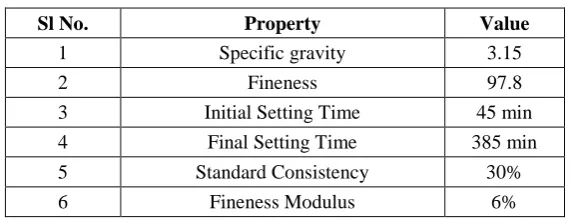
Portland Pozzolanic Cement of 43 grade was purchased from the local supplier and used throughout this project. The properties of cement used in the investigation are presented in table 4.
Table 4 Properties of Coarse Aggregate
III.
PREPARATION
OF
SPECIMENS
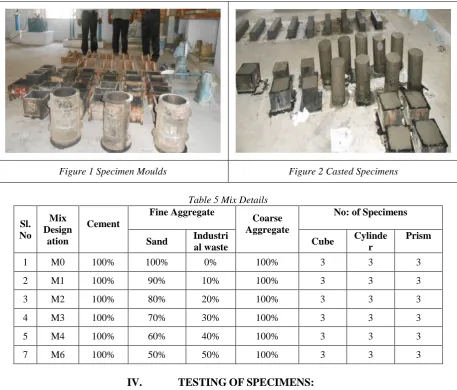
Based on the above results the water quantity, cement, fine aggregate and coarse aggregate required for design mix of M30 were calculated based on the procedure given in IS code method in IS :2009. The final mix ratio was 1:1.462:2.695 with water cement ratio of 0.44. The measurement of materials was done by weight using electronic weighing machine. Water was measured in volume. Concrete was placed in moulds in layers. The cast specimens were removed from moulds after 24 hours and the specimens were kept for water curing. The details of mix designation and specimens used in experimental program are given in table 5.
Figure 1 Specimen Moulds Figure 2 Casted Specimens
Table 5 Mix Details
Sl. No
Mix Design
ation
Cement
Fine Aggregate
Coarse Aggregate
No: of Specimens
Sand Industri
al waste Cube
Cylinde r
Prism
1 M0 100% 100% 0% 100% 3 3 3
2 M1 100% 90% 10% 100% 3 3 3
3 M2 100% 80% 20% 100% 3 3 3
4 M3 100% 70% 30% 100% 3 3 3
5 M4 100% 60% 40% 100% 3 3 3
7 M6 100% 50% 50% 100% 3 3 3
IV.
TESTING
OF
SPECIMENS:
For each batch of concrete, 3 cubes of 150mm x 150mm x 150mm size were tested to determine compressive strength of concrete, 3 cylinders of 150mm diameter and 300 mm length were tested to determine split tensile strength of concrete and three prisms of 100mm x 100mmx 500mm were tested to determine flexural strength of concrete.
Table 6 Experimental Test Results at 28 days curing
Sl.
No
Mix
Designation
Compressive
Strength N/mm
2Split Tensile
Strength N/mm
2Flexural Strength
N/mm
21
M0
31.5
3.35
5.32
2
M1
34
3.42
5.46
3
M2
36
3.63
5.66
4
M3
37.5
3.85
5.74
5
M4
33
3.45
5.28
6
M5
31
3.15
4.88
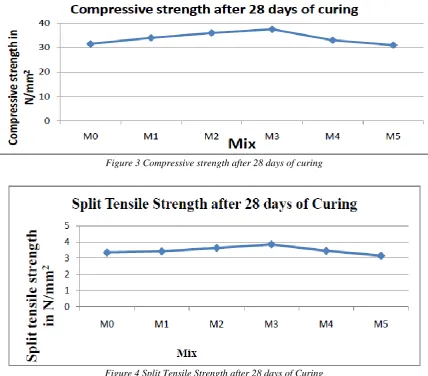
From the above table it is found that the compressive strength of the control concrete was 31.5 N/mm2. The compressive strength was found to be maximum at 30% (37.5N/mm2) replacement of fine aggregate by industrial waste which was greater than the conventional concrete. The compressive strength reduced beyond 30% replacement. Thus it is evident that fine aggregate can be replaced by the waste material from china clay industries up to 30%.
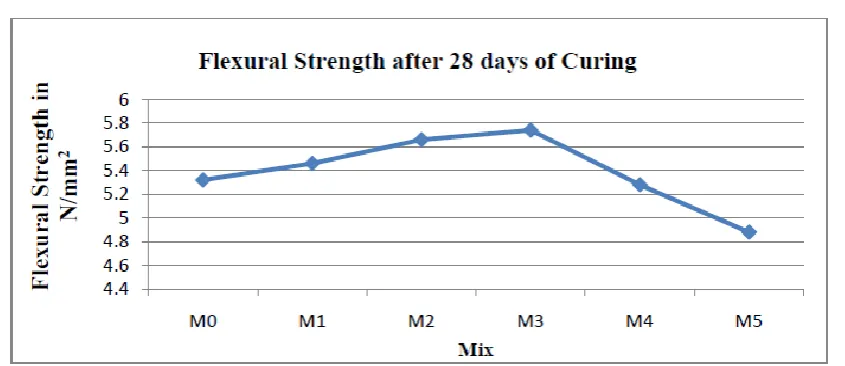
Similarly the split tensile strength and flexural strength was also found to be maximum at 30% (3.85 N/mm2 and 5.74 N/mm2) replacement which was greater than the conventional concrete (3.35 N/mm2 and 5.32N/mm2). The graphs showing the compressive strength, split tensile strength and flexural strength of the different mixes at 28 days of curing are shown in figures 3, 4 and 5 respectively.
Figure 5 Flexural Strength after 28 days of Curing
VI.
CONCLUSION
From the results of experimental investigations conducted it is concluded that the waste material from china clay industries can be used as a replacement for fine aggregate. It is found that 30% replacement of fine aggregate by industrial waste give maximum result in strength and quality aspects than the conventional concrete. The results proved that the replacement of 30% of fine aggregate by the industrial waste induced higher compressive strength, higher split tensile strength and higher flexural strength. Thus the environmental effects from industrial waste can be significantly reduced. Also the cost of fine aggregate can be reduced a lot by the replacement of this waste material from china clay industries.
REFERENCES
[1] Aggarwal.P, Aggarwal.Y, Gupta.S.M [2007] “Effect of bottom ash as replacement of fine aggregate in concrete”, Asian journal of civil engineering [Building and housing] Vol.8, No.1, PP.49-62.
[2] Gurpreet Singh and Rafat siddique [2011] “Effect of waste foundry sand [WFS] as partial replacement of sand on the strength, ultrasonic pulse velocity and permeability of concrete”, International journal of construction and building materials Vol.26, PP.416-422.
[3] IS 10262 - 2009 Recommended guidelines for concrete mix design
[4] John zachar and Tarun R.naikin [2007] “Replacement of fine aggregate with foundry sand”, Milwaukee journal –sentinel Vol.3, PP.18-22.