Dynamic Analysis and Comparative Study of
Three Piles and Four Piles
Kushal M. Panchal Sunil M. Rangari
Research Scholar Professor & Head of Department
Department of Civil Engineering Department of Civil Engineering Saraswati College of Engineering Saraswati College of Engineering
Abstract
This research works gives an idea about the behaviour of the pile foundation which are 3 piles, 4 piles, 3 piles arranged at triangular corners and 4 piles arranged at square corners, against the lateral load induced in this pile due to the dynamic effect of earthquake acting on this pile system. The pile foundation is assumed to be subjected below a bridge pier and enclosed within cohesion-less soil and soil properties are considered randomly and the load applied is using basic data and calculated using IRC 6, 2014. T he models are analysed in the finite element method based software naming STAAD Pro. for deflection, axial force, shear force and bending moment for piles. It is observed that the piles arranged in series shows higher value of deflection, axial force, shear force and bending moment compare to non-series piles.
Keywords: Group Piles, Pile cap, laterally loaded piles, STAAD Pro, Deflection, Axial force, Shear Force, Bending Moment _______________________________________________________________________________________________________
I. INTRODUCTION
A pile is basically a long cylinder of a strong material such as concrete that is pushed into the ground to act as a steady support for structures built on top of it. Pile foundations are used in the situations when there is a layer of weak soil at the surface. Pile foundation is required when the soil bearing capacity is not sufficient for the structure to withstand. This layer cannot support the weight of the building, so the loads of the building have to bypass this layer and be transferred to the layer of stronger soil or rock that is below the weak layer. And also, when a building has very heavy, concentrated loads, such as in a high-rise structure, bridge, or water tank.
In the recent years, a variety of approaches for predicting lateral load behaviour of piles have been developed, including linear subgrade reaction analysis, nonlinear subgrade reaction analysis, elastic continuum analysis and finite element analysis. The subgrade reaction analysis is based on Winkler’s hypothesis, according to which, soil is replaced by a series of infinitely closely spaced, independent and elastic springs. In the elastic continuum analysis, the pile is represented as an infinitely thin linearly elastic strip, embedded in elastic soil media. Shear stresses developed at the pile soil interface are not taken into account. The finite element method enables a more rigorous solution to be achieved comparatively, as the pile is modelled more accurately. Also, heterogeneous soil conditions are readily and correctly modelled.
Lateral loads on piles are developed both by the superstructure and by the wave propagation through the soil. The dynamic loads due to the horizontal movement of the superstructures are mainly generated by wind effects, machine vibrations, impact of vehicles or boats; the loads due to the wave propagation is primarily because of earthquakes. Therefore, the total forces are the result of two types of interaction: an inertial one from the movement of the superstructure and a kinematical one from the soil motion.
II. METHODOLOGY
The primary aim of the present study is to analyse the piles in group under dynamic condition. Data Considered
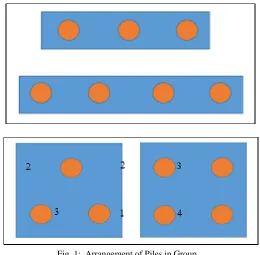
Fig. 1: Arrangement of Piles in Group
The pile diameter is considered as 1 m with spacing between piles as 3 m centre to centre of the piles. The length of pile is considered to be 10m, from the pile – pile cap connection till the end of the pile.
The soil details considered for the analysis of the model is cohesion-less soil and properties considered are Spring coefficient (k) – 3500 KN/m
Density of soil (ρ) – 20 KN/m3 Modelling & Analysis
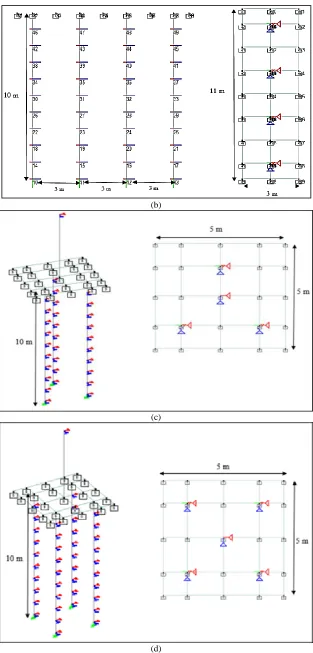
The modelling is performed using a finite element software, STAAD Pro. V8i. The model consists of 3 piles in series, 4 piles in series, 3 piles arranged in triangular corner position and 4 piles arranged in square corner position with pile to pile spacing as 3D, where D is diameter of pile shown in Fig. 2. which shows typical STAAD Pro. model for mentioned cases.
(b)
(c)
(d)
Load Applications
The load application on the model is considered as per IRC - 6, 2014. The loads are considered as Dead load, Live load and Seismic load.
For Dead load, as per clause 203 of IRC – 6, 2014, the various loads considered are self-weight of the sub-structure elements like pile cap, pier and pier cap; self-weight of superstructure girders, deck weight, wearing coat, crash parapet, loading of noise barrier and services.
For Live load, cases considered for analysis is carried on with the help of clause 204 of IRC: 6-2014 which is “Standard specifications and code of practice for road bridges” section II: Loads and Stresses. The load acting between kerb to kerb widths was considered using:
1) Class A - 2 lanes …… (IRC: 6 – 2014, Table 2: Live Load Combination) 2) Class 70R - 1 lanes.
For seismic load the earthquake load in x direction i.e. EQx and earthquake load in y direction i.e. EQy is considered as per clause 219 of IRC – 6, 2014. (As per "Design data")
Following shows the basic considerations for seismic load calculation: Zone = III
Zone factor = 0.16
Importance factor = 1.2 (As per Table 8 of IRC: 6-2014.) Response Reduction Factor= 3
Load Combinations
Following basic load combinations are considered using the above loads. The load combinations are considered form IS 875 - 1987 and IS 456 - 2000
Table – 1
Loads and Loads Combinations
LOAD COMBINATION SELF WEIGHT+DEAD LOAD
LIVE LOAD
SEISMIC LOAD IN (+ X) DIRECTION SEISMIC LOAD IN (+ Z) DIRECTION SELF WEIGHT+DEAD LOAD+LIVE LOAD
SELF WEIGHT+DEAD LOAD+EARTHQUAKE LOAD(+X) DIRECTION SELF WEIGHT+DEAD LOAD+EARTHQUAKE LOAD(+X) DIRECTION SELF WEIGHT+DEAD LOAD+LIVE LOAD+EARTHQUAKE LOAD(+X) DIRECTION SELF WEIGHT+DEAD LOAD+LIVE LOAD+EARTHQUAKE LOAD(+Z) DIRECTION
III. RESULTS & DISCUSSIONS
Results obtained after analysis are mentioned below in graphs and tables format. The results for piles are considered for displacement, axial force, shear force and bending moment. From the load cases in Table - 2 the critical combination obtained that is Self-weight + Dead Load + Live Load + Earthquake Load (+X) direction for analysis to obtain the results.
Deflection Details
Table - 2 and Fig. 3. shows the deflection details of 3 piles arranged in series. The details are explained for central pile and corner piles. The percentage difference between central piles and corner piles is 21%.
Table – 2
Deflection value for 3 piles in series
Length (m) 0 1 2 3 4 5 6 7 8 9 10 Deflection(mm)
Central Pile 0 9.66 16.25 20.37 22.58 23.38 23.19 22.35 21.13 19.73 18.26 Deflection(mm)
Fig. 3: Deflection variation for 3 piles throughout the pile length
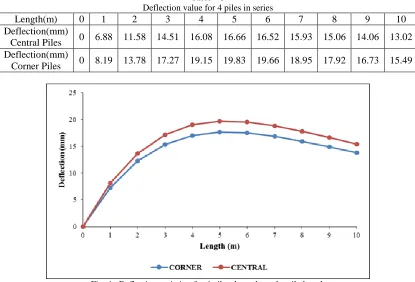
Table - 3 and Fig. 4. shows the deflection details of 4 piles arranged in series. The table shows the details of central piles and corner piles as the piles in centre and corner shows similar deflection value. The percentage difference between central piles and corner piles is 16% respectively.
Table – 3
Deflection value for 4 piles in series
Length(m) 0 1 2 3 4 5 6 7 8 9 10
Deflection(mm)
Central Piles 0 6.88 11.58 14.51 16.08 16.66 16.52 15.93 15.06 14.06 13.02 Deflection(mm)
Corner Piles 0 8.19 13.78 17.27 19.15 19.83 19.66 18.95 17.92 16.73 15.49
Fig. 4: Deflection variation for 4 piles throughout the pile length
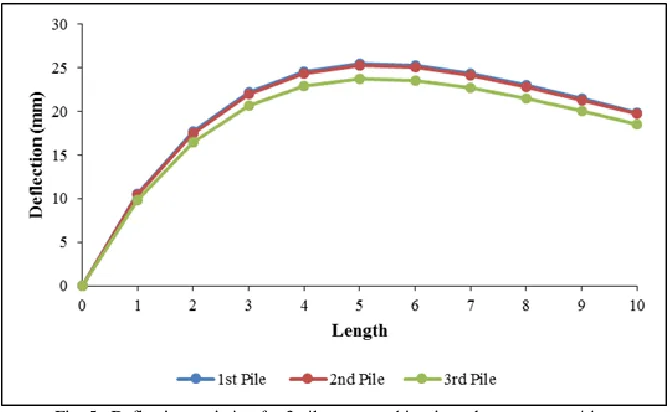
Table - 4 and Fig. 4. shows the deflection of 3 piles arranged in triangular positions with spacing 3D between them. It can be seen that the nature of graph is similar to the graphs of pile connected in series. All the three piles show different deflection values. The 3rd pile shows minimum deflection while 1st pile shows maximum deflection. Difference in deflection between 1st pile and 2nd pile is 1% and between 2nd and 3rd pile is 3% respectively.
Table – 4
Deflection value for 3 piles arranged in triangular corners position
Length (m) 0 1 2 3 4 5 6 7 8 9 10 1st Pile 0 10.52 17.69 22.17 24.58 25.45 25.24 24.33 23.06 21.48 19.88
2nd Pile 0 10.43 17.54 21.99 24.37 25.24 25.04 24.13 22.81 21.29 19.71
Fig. 5: Deflection variation for 3 piles arranged in triangular corners position
Table - 5 and Fig. 6. shows the deflection value for 4 piles arranged in square corner position. The analysis showed that 1st pile and 3rd pile shows the same deflection value while 2nd pile and 4th pile shows same as per pile numbering mentioned in Fig 2.1. Pile 2nd and 4th shows more deflection comparing to that of 1st pile and 3rd pile. The deviation in deflection varies from 10% to 14% throughout the length of the pile.
Table – 5
Deflection value for 4 piles arranged in square corner position
Length(m) 0 1 2 3 4 5 6 7 8 9 10 1st Pile 0 3.912 6.576 8.243 9.138 9.462 9.385 9.046 8.552 7.984 7.391
2nd Pile 0 3.915 6.582 8.25 9.146 9.47 9.393 9.053 8.559 7.99 7.397
3rd Pile 0 3.176 5.34 6.694 7.421 7.684 7.621 7.345 6.945 6.401 5.783
4th Pile 0 3.173 5.335 6.687 7.413 7.676 7.613 7.338 6.937 6.455 5.776
Fig. 6: Deflection variation for 4 piles arranged in square corner position
Deflection Comparison
Axial Force, Shear Force and Bending moment Details
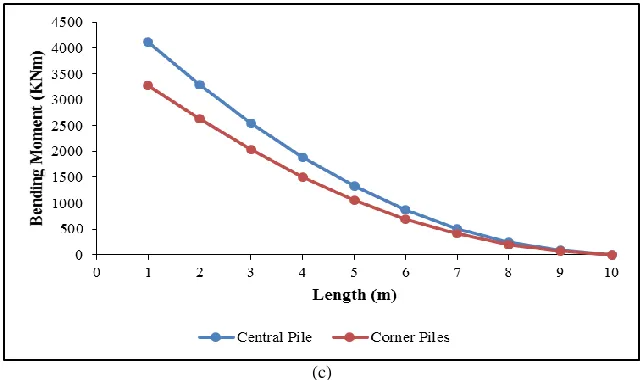
Table - 6 and Fig. 7. shows the Axial force, Shear force and Bending moment details of 3 piles arranged in series. It can be seen that the Axial force, Shear force and Bending moment variation of central pile is more compare to corner piles. The percentage difference of axial force between central pile and corner pile is about 4% to 11%, while that of shear force and bending moment is 20%.
Table – 6
Axial Force, Shear Force and Bending Moment of 3 piles in series
Beam No.
Central Pile Corner Piles
Axial force (KN)
Shear force (KN)
Bending Moment (KNm)
Axial force (KN)
Shear force (KN)
Bending Moment (KNm) 1 116.05 863.688 4115.2 102.776 689.135 3283.635 2 138.256 821.295 3295.137 124.982 655.31 2629.221 3 160.463 750.021 2546.002 147.189 598.44 2031.433 4 182.669 660.683 1885.857 169.395 527.158 1504.674 5 204.875 561.641 1324.432 191.601 448.133 1056.703 6 227.082 459.087 865.288 213.807 366.306 690.354
7 249.288 357.37 507.645 236.014 285.147 405
8 271.494 259.331 247.882 258.22 206.922 197.75
9 293.7 166.639 80.707 280.426 132.963 64.378
10 315.907 80.106 0 302.633 63.918 0
(a)
(c)
Fig. 7: 3 Piles in Series (a) Axial force, (b) Shear Force and (c) Bending Moment
Table - 7 and Fig. 8. shows the Axial force, Shear force and Bending moment details of 4 piles arranged in series. The percentage difference of axial force between central pile and corner pile varies from 10% to 58%, while that of shear force and bending moment is 10%. It can be seen that the Axial force, Shear force and Bending moment variation of central pile is more compare to corner piles.
Table – 7
Axial Force, Shear Force and Bending Moment of 4 piles in series
Beam No.
Central Piles Corner Piles
Axial force (KN) Shear force (KN) Bending Moment
(KNm) Axial force (KN) Shear force (KN)
Bending Moment (KNm) 1 42.405 580.431 2799.15 17.683 519.825 2477.495 2 64.612 551.941 2214.629 39.889 494.309 1983.439 3 86.818 504.042 1710.927 62.095 451.412 1532.254 4 109.024 444.005 1267.146 84.302 397.644 1134.77 5 131.23 377.448 889.794 106.508 338.037 796.803 6 153.437 308.531 581.237 128.714 276.317 520.466 7 175.643 240.176 340.93 150.921 215.1 305.263 8 197.849 174.291 166.424 173.127 156.096 148.998 9 220.056 111.997 54.153 195.333 100.306 48.473
(b)
(c)
Fig. 8. 4 Piles in Series (a) Axial force, (b) Shear Force and (c) Bending Moment
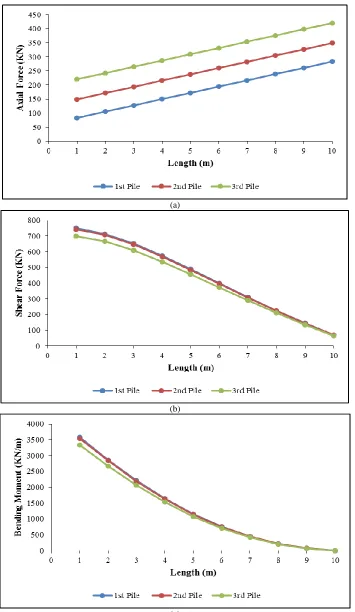
Table - 8 and Fig. 9. shows the details of 3 piles arranged at triangular corner positions spaced at spacing 3D between them. It is observed that the 3rd pile shows the maximum axial force, while the behaviour of 1st pile is maximum in shear force and bending moment.
Table – 8
Axial Force, Shear Force and Bending Moment of 3 piles arranged at triangular corner
Beam no.
1st PILE 2nd PILE 3rd PILE
Axial force
Shear force
Bending moment
Axial force
Shear force
Bending moment
Axial force
Shear force
(a)
(b)
(c)
Fig. 9. 3 piles arranged in triangular corners position (a) Axial Force, (b) Shear Force and (c) Bending Moment
Table – 9
Axial Force, Shear Force and Bending Moment of 4 piles arranged at square corner
Bea m no.
1st PILE 2nd PILE 3rd PILE 4th PILE
Axial force Shear force Bending moment Axial force Shear force Bending moment Axial force Shear force Bending moment Axial force Shear force Bending moment
1 92.618 278.91 2
1329.01
3 93.217
279.14
5 1330.12
140.60 4 226.48 1 1079.03 2 141.20 2 226.24 9 1077.92 3
2 120.37 6 265.22 2 1064.14 9 120.97 5 265.44 3 1065.03 6 168.36 1 215.36
4 864.062 168.96
215.14
4 863.175
3 148.13 4
242.20
4 822.214
148.73 3
242.40
7 822.901
196.11 9
196.67
4 667.672
196.71 8
196.47
2 666.988
4 175.89 2
213.35
4 609.031
176.49 1
213.53
2 609.54
223.87 7
173.24
6 494.599
224.47 6
173.06
9 494.092
5 203.65 181.36
9 427.732
204.24 9
181.52
1 428.09
251.63 5
147.27
4 347.395
252.23 4
147.12
3 347.04
6 231.40 8
148.25
1 279.462
232.00 7
148.37
4 279.697
279.39
3 120.38 226.996
279.99 2
120.25
7 226.764
7 259.16 6
115.40
3 163.967
259.76 4
115.49
9 164.105
307.15
1 93.706 133.201 307.75 93.61 133.066
8 286.92
3 83.743 80.076
287.52
2 83.813 80.143
334.90
9 67.998 65.064
335.50
7 67.928 64.998
9 314.68
1 53.81 26.079 315.28 53.855 26.101
362.66
6 43.692 21.198
363.26
5 43.647 21.176
10 342.43
9 25.867 0
343.03
8 25.889 0
390.42
4 21.003 0
391.02
3 20.981 0
(a)
(c)
Fig. 10. 4 piles arranged in square corners position (a) Axial Force, (b) Shear Force and (c) Bending Moment
Axial Force, Shear Force and Bending Moment Comparison
Comparison of axial force, shear force and bending moment is carried out for 3 piles in triangular corner and 3 piles in series. The maximum axial force of 3 piles in series when compared to that of 3 piles arranged in triangular corner the difference obtained is around 25% to 47%, while when compared to minimum axial force the difference calculated is around 6% to 19%. Shear force and bending moment show similar percentage difference, i.e. when maximum and minimum values of shear force and bending moment of 3 and 4 piles in series compared to 3 piles arranged in triangular corner and 4 piles arranged at square corner, the percentage difference obtained is 13% for maximum and 2% for minimum value respectively.
Comparison of axial force, shear force and bending moment values for 4 piles in triangular corner having 1st, 2nd, 3rd and 4th pile with 4 piles in series having central and corner piles. The percentage difference in minimum axial force of 4 piles in square corners compared to minimum axial force of series in piles is varying from 36% to 81%, while maximum axial force of 4 piles in square corners are compared to maximum axial force value of 4 piles in series, the difference varies from 38% to 70%. Minimum shear force and bending moment for 4 piles in square corners when compared to the minimum shear force and bending moment of 4 piles in series, it shows a percentage difference of 56%. When maximum shear force and bending moment for 4 piles in square corners when compared to the maximum shear force and bending moment of 4 piles in series, it shows a percentage difference of 52%.
IV. CONCLUSION
1) The deflection increases up to certain length and then it decreases for the remaining length.
2) For piles in series, central piles show higher value in Deflection, Axial force, Shear force and Bending moment compare to corner piles.
3) 1st pile in 3 piles arranged in triangular corners and 1st and 2nd pile in 4 piles arranged in square corners shows higher value of Deflection, Axial force, Shear force and Bending moment.
4) From comparison between series piles and non- series piles, it is noticed that piles in series shows higher value compare to non-series piles arrangement.
5) Maximum percentage difference is 14%, when deflection of 3 piles in series compares to 3 piles in triangular corners. 6) Maximum percentage difference is 52%, when deflection of 4 piles in series compares to 4 piles in square corners. 7) Maximum percentage difference is 47%, when axial force of 3 piles in series compares to 3 piles in triangular corners. 8) Maximum percentage difference is 70%, when axial force of 4 piles in series compares to 4 piles in square corners. 9) Maximum percentage difference is 13%, when shear force of 3 piles in series compares to 3 piles in triangular corners. 10) Maximum percentage difference is 52%, when shear force of 4 piles in series compares to 4 piles in square corners.
11) Maximum percentage difference is 13%, when bending moment of 3 piles in series compares to 3 piles in triangular corners. 12) Maximum percentage difference is 52%, when bending moment of 4 piles in series compares to 4 piles in square corners.
REFERENCES
[1] B. Brown and W. Michael (1987),” Cyclic Lateral Loading of a Large-Scale Pile Group”, J.Geotech. Engrg.113:1326-1343.
[4] F. Dezi, S. Carbonari, A. Tombari and G. Leoni (2012),” Soil-structure interaction in the seismic response of an isolated three span motorway overcrossing founded on piles”, Soil Dynamics and Earthquake Engineering, 41:151–163.
[5] G. Anoyatis, R. Laora and A. Lemnitzer (2017),” Dynamic pile impedances for fixed-tip piles”, Soil Dynamics and Earthquake Engineering. 97:454–467.
[6] H. Poulos (1976),” Behaviour of Laterally Loaded Group Piles Near A Cut or A Slop”, Australian Geomechanics Journal.
[7] K. Gaaver (2006), “Behavior of laterally loaded piles in cohesionless soils”, The Tenth East Asia–Pacific Conference on Structural Engineering and Construction.
[8] K. Thadapaneni, S. Venkata and R. Teja Gandhi (2017),” Analysis of pile foundation Simplified methods to analyse the pile foundation under lateral and vertical loads”, International Journal of Engineering Development andResearch, 5(3).
[9] K. Chatterjee, D. Choudhury and H. Poulos (2015),” Seismic analysis of laterally loaded pile under influence of vertical loading using finite element method”,
Computers and Geotechnics. 67:172–186.
[10] L Hazzar, M. Hussien and M. Karray (2017), “Influence of vertical loads on lateral response of pile foundations in sands and clays”, Journal of rock mechanics andgeotechnical engineering, 291-304.
[11] M. Ashour and G. Norris (2002),” Lateral loaded pile/shaft response in liquefied soil and anticipated lateral soil spreading”, D. Frechette, K. Walsh, W. Houston, Review ofdesign methods and parameters for laterally loaded groups of drilled shafts, Deep Found.1261–1274.
[12] M. Naggar and M. Novak (1996),” Nonlinear analysis for dynamic lateral pile response”, Soil Dynamics and Earthquake Engineering, 165(4): 233-244.
[13] M. Khari, K. Kassim, and A. Adnan (2014),” Kinematic bending moment of piles under seismic motions”, Asian Journal of Earth Science. 7(1) 1-9.
[14] M. Khari, K. Kassim, and A. Adnan (2013), “An Experimental Study on Pile Spacing Effects under Lateral Loading in Sand”, The scientific worldjournal.
[15] M. Khari, K. Kassim, and A. Adnan (2014),” Development of p-y Curves of Laterally Loaded Piles in Cohesionless Soil”, ScientificWorldJournal..
[16] M. Sánche and J. Roesset (2012),” Evaluation of models for laterally loaded piles”, Computers and Geotechnics.
[17] M. Hajialilue-Bonab, D. Levacher, J. Chazelas and A. Kaynia (2014),” Experimental study on the dynamic behavior of laterally loaded single pile”, Soil Dynamic Sand Earthquake Engineering. 66:157–166.
[18] M. Murugan, C. Natarajan and K. Muthukkumaran (2011),” Behavior of Laterally Loaded Piles in Cohesionless Soils”, International Journal of Earth Sciences and Engineering, ISSN0974-5904, Volume 04, No 06 SPL, pp. 104-106.
[19] P. Ooi, B. Chang; and S. Wang (2004),” Simplified Lateral Load Analyses of Fixed-Head Piles and Pile Groups”, J. Geotech. Geoenviron. Eng.130:1140-1151.
[20] R. Salgado, F. Tehrani and M. Prezzi (2014),” Analysis of laterally loaded pile groups in multi-layered elastic soil”, Computers and Geotechnics. 62:136– 153.