Iran J Public Health, Vol. 47, Suppl. 1, 2018, pp.65-73
Original Article
Effects of Circuit Training According to the Feedback Type on
Psycho-logical and Physical Health of Workers with Social Anxiety Disorder
Yeon-Ji SHIN, *Joon-Hee LEE
Dept. of Sports Coaching, College of Physical Education, Kyung-hee University, Yongin, Korea
*Corresponding Author: Email: [email protected]
(Received 10 Jan 2018; accepted 19 Mar 2018)
Introduction
Among OECD member countries, Korea, Mexi-co, and Greece have the highest annual working hours of more than 2,000 hours, of which Korea is ranked second, and national happiness is also 33rd among 34 countries (1). In Korea, employ-ees choose their major area at the end of study and engage in economic activities as members of society (2), usually continuing to work until re-tirement. Modern society has become increasing-ly convenient with automation, mechanization, etc. However, various and complicated changes from this have resulted in excessive work for people and weakened their physical and mental
health. Employees are more depressed, anxious, and stressed when exposed to job instability, heavy workload, and dangerous social psycholog-ical factors (3) that negatively impact the perfor-mance and safety of individuals and organiza-tions, resulting in symptoms such as fatigue and loss of concentration (4). Particularly, interper-sonal conflict is one of the main stress factors. Although the Korean society has increased in economic size and stressed the importance of communication, however, considering the aspect of human relations, pre-modern factors remain
Abstract
Background: The effects of circuit training was investigated according to the feedback type on the psychological (social anxiety, anxiety, positive emotion) health and physical (body composition, physical fitness) health of social anxiety disorder workers.
Methods: Sixty male workers in H Company in Seoul, South Korea with social anxiety disorder were divided into four groups (positive, negative, mixed, no feedback) by conducting a circuit training program in sport center of H company dur-ing 3 times per week, total 8 weeks from Feb 1st to Mar 31st, 2017. The results of the pre - test and post - test were analyzed as follows.
Results: 1) In effect of social anxiety, there were significant differences in the positive, negative, and mixed feedback groups. 2) In the effect of anxiety, there were significant differences in the positive, negative, and mixed feedback groups. 3) In the effect of positive emotion, there were significant differences in the positive, negative, mixed, and no feedback groups. 4) In the effect of body composition, body fat mass and body fat percentage have significant differences in the positive, negative, mixed, and no feedback groups. And fat free mass has significant differences in the positive and mixed feedback groups. 5) In the effect of physical fitness, grip strength, wall squat, bending forward have significant differences in positive, negative, mixed, and no feedback groups.
Conclusion: The circuit training program improves the social anxiety disorder and positively affects the psychological health and physical health of participants. To participate in continuous exercise, personal training should be accompanied by the correct feedback of the leader.
(5), that lead to social unrest closely related to interpersonal relations.
This social anxiety is a persistent irrational fear of being exposed to situations that others can look at, a desire for avoidance that cannot be suppressed, and a fear of acting in an embarrassing manner (6). Social anxiety disorder is a common psychiatric problem that affects approximately 7-13% of the U.S. population once in a lifetime (7, 8). In cross-cultural comparative studies, social anxiety level of Oriental countries is relatively higher than in Western countries (9, 10). In the Asian regions, also, many people have social anxiety symptoms (11). Furthermore, given that the core of social anxiety disorder is the anxiety about how others see themselves, it is assumed to be relatively more in a collectivistic Oriental culture than in an indi-vidualistic Western culture (12).
Although many previous studies have reported positive effects on mental health as treatment of treating anxiety disorders (13-16), the initial rate of adults that begin an exercise program is up 50% (17). It is reported that 59% of the adults dropped out diagnosed with depression and pre-scribed exercise and anti-depressants for 4 months (18). Though the positive effect of exer-cise is proven in anxiety disorder, but it is diffi-cult to continue. Three major factors influencing exercise adherence are psychological status, phys-ical characteristics, and sociodemographic back-ground (19-21). In the psychological state, the kind of feedback given by the leader will affect the exercise adherence and the feedback is the important variable for the exercise adherence of the participant through several previous studies (22-24).
This previous studies related to feedback on exer-cise learning have focused on improving the tech-nical skills by acquiring exercise skills. However, participants in daily life sports participate to re-duce the daily life stress and anxiety and strive for psychological stability. Therefore, it is necessary to provide adequate linguistic feedback, including positive and negative feedback effective in (22, 23) interest, pleasure (24), tension relaxation and sus-taining exercise adherence. Researchers in man-agement of organizational behavior also argue that
positive and negative feedback should be provided separately to increase the effectiveness of feed-back. In other areas, combinations of positive and negative feedback should be used, considering the side effects of negative feedback (25). Therefore, the treatment of mixed feedback except the single application of positive and negative feedback is also worthy of verifying the effectiveness of the social anxiety reduction as a method of continuing participation in the exercise.
The purpose of this study was to investigate whether social anxiety was changed by the effect of circuit training program according to feedback type as well as measurement of social anxiety dis-order of employees. This approach may reveal the improvement of social anxiety disorder through circuit training program also the feed-back type as an important variable in psychologi-cal health, physipsychologi-cal health and participation in continuous exercise.
Methods
Research Subject
Table 1: Physical characteristics of subjects
Variable PF (n=15) NF (n=9) MF (n=13) NF (n=11) P
Age (yr) 35.13±2.97 36.22±4.47 36.23±4.02 35.45±3.83 .845
Height (cm) 175.36±4.58 175.84±6.87 176.58±6.01 174.60±3.25 .825
Weight (kg) 75.08±7.96 74.36±5.99 77.44±9.22 74.59±8.12 .774
BMI (㎏·㎡) 24.44±2.74 24.09±2.16 24.88±3.14 24.43±2.12 .918
Social Anxiety Score 27.27±2.81 27.11±2.42 26.08±3.43 27.00±1.84 .688
Dropout rate 0% 40% 13% 27%
PF: Positive Feedback, NF: Negative Feedback, MF: Mixed Feedback, NF: No Feedback
Measurement
The Social Phobia Scale (SPS) was developed al-ready (29) and we used the Korean version of the SPS adapted already (30) assessed on a 5-point scale with a total of 20 items, and the internal consistency of the previous study was .92. The Beck Anxiety Inventory (BAI) was developed by Beck et al. (31) and we used the Korean version of BAI (32) assessed on a 4-point scale with a total of 21 items and the internal consistency was .88. The positive emotional scale was developed
by Watson et al. (33) and we used questionnaires adapted by Lee et al. (34), assessed on a 5-point scale with a total of 10 items and the internal consistency was .88.
Circuit Training Program
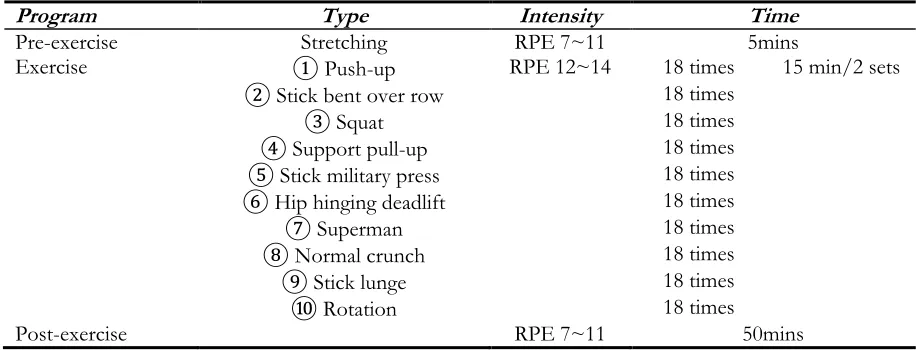
The circuit training program in this study was constructed based on the exercise program ap-plied already (35, 36). As social anxiety workers, the subjects of this study tended to be afraid of others’ evaluation of them (37) (Table 2).
Table 2: Circuit training program
Program Type Intensity Time
Pre-exercise Stretching RPE 7~11 5mins
Exercise ① Push-up RPE 12~14 18 times 15 min/2 sets
② Stick bent over row 18 times
③ Squat 18 times
④ Support pull-up 18 times
⑤ Stick military press 18 times
⑥ Hip hinging deadlift 18 times
⑦ Superman 18 times
⑧ Normal crunch 18 times
⑨ Stick lunge 18 times
⑩ Rotation 18 times
Post-exercise RPE 7~11 50mins
Type of Feedback
Positive Feedback: During the exercise program, the leader emphasized the positive aspect of per-formance and said, “This movement is correctly performed.”, “Please continue it like that.”, and “Very good. Good work.”, and did not mention the insufficient move but provided positive re-sults focused on achievements.
Mixed Feedback: During the exercise program, the leader referred to positive and negative as-pects of performance and gave feedback such as “This movement is correct and incorrect in this way.”. He applauded and pushed for continued efforts in well performed movement, and pointed out the insufficient movement and requested constant revision, and provided information re-lated to achievement and non-achievement rec-ord continuously.
Results
The effect of circuit training on social anxiety according to feedback type
The main effect of group and test was revealed, and the interaction effect between group and test appeared. Social anxiety significantly decreased in all groups except negative feedback, and the posi-tive feedback group showed the greatest decrease (Table 3).
Table 3: The effect of circuit training on social anxiety according to feedback type (Mean±SD)
Variable Group Test ∆% P
Pre Post
Social
Anxiety NF PF
MF NF
2.36±0.14 2.34±0.12 2.29±0.17 2.40±0.17
1.67±0.14 2.34±0.22 1.94±0.08 2.20±0.10
-29.25 -0.44 -15.19
-9.25
***
*** **
Group Test Group×Test
.001 .001 .001
PF: Positive Feedback, NF: Negative Feedback, MF: Mixed Feedback, NF: No Feedback
The effect of circuit training on anxiety ac-cording to feedback type
The main effect of group and test was revealed, and the interaction effect between group and test appeared. Social anxiety significantly decreased in all groups except negative feedback, and the posi-tive feedback group showed the greatest decrease (Table 4).
The effect of circuit training on positive emo-tion according to feedback type
The main effect of group and test was revealed, and the interaction effect between group and test appeared. Positive emotion significantly increased in all groups (Table 5).
The effect of circuit training on body compo-sition according to feedback type
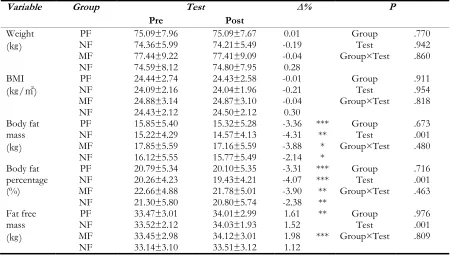
Body fat mass, body fat percentage and fat free mass showed the main effect of test, and body fat mass and body fat percentage significantly de-creased in all groups. In addition, fat free mass significantly increased in positive feedback and mixed feedback (Table 6).
The effect of circuit training on physical fit-ness according to feedback type
All variable showed the main effect of test, and wall squat showed the interaction effect of test and group. In addition, all factors of physical strength, such as grip strength, wall squat, and bending forward, significantly increased in all groups (Table 7).
Table 4: The effect of circuit training on anxiety according to feedback type (Mean±SD)
Variable Group Test ∆% P
Pre Post
Anxiety PF
NF MF NF
2.58±0.37 2.45±0.19 2.48±0.37 2.29±0.30
1.47±0.30 2.34±0.22 1.79±0.28 2.06±0.20
-43.10 -4.54 -27.77 -10.00
***
*** *
Group Test Group×Test
.016 .001 .001
Table 5: The effect of circuit training on positive emotion according to feedback type (Mean±SD)
Variable Group Test ∆% P
Pre Post
Positive
Emotion NF PF
MF NF 1.83±0.62 1.83±0.33 1.64±0.37 1.89±0.54 2.97±0.63 2.63±0.39 2.47±0.50 2.83±0.35 62.18 43.64 50.70 49.52 *** *** *** *** Group Test Group×Test .178 .001 .275
PF: Positive Feedback, NF: Negative Feedback, MF: Mixed Feedback, NF: No Feedback
Table 6: The effect of circuit training on body composition according to feedback type (Mean±SD)
Variable Group Test ∆% P
Pre Post
Weight (㎏) PF NF MF NF 75.09±7.96 74.36±5.99 77.44±9.22 74.59±8.12 75.09±7.67 74.21±5.49 77.41±9.09 74.80±7.95 0.01 -0.19 -0.04 0.28 Group Test Group×Test .770 .942 .860 BMI (㎏/㎡) PF NF MF NF 24.44±2.74 24.09±2.16 24.88±3.14 24.43±2.12 24.43±2.58 24.04±1.96 24.87±3.10 24.50±2.12 -0.01 -0.21 -0.04 0.30 Group Test Group×Test .911 .954 .818 Body fat mass (㎏) PF NF MF NF 15.85±5.40 15.22±4.29 17.85±5.59 16.12±5.55 15.32±5.28 14.57±4.13 17.16±5.59 15.77±5.49 -3.36 -4.31 -3.88 -2.14 *** ** * * Group Test Group×Test .673 .001 .480 Body fat percentage (%) PF NF MF NF 20.79±5.34 20.26±4.23 22.66±4.88 21.30±5.80 20.10±5.35 19.43±4.21 21.78±5.01 20.80±5.74 -3.31 -4.07 -3.90 -2.38 *** *** ** ** Group Test Group×Test .716 .001 .463 Fat free mass (㎏) PF NF MF NF 33.47±3.01 33.52±2.12 33.45±2.98 33.14±3.10 34.01±2.99 34.03±1.93 34.12±3.01 33.51±3.12 1.61 1.52 1.98 1.12 ** *** Group Test Group×Test .976 .001 .809
PF: Positive Feedback, NF: Negative Feedback, MF: Mixed Feedback, NF: No Feedback
Table 7: The effect of circuit training on physical fitness according to feedback type (Mean±SD)
Variable Group Test ∆% P
Pre Post
Grip strength
(Left) NF PF
MF NF 39.65±5.92 37.59±3.04 38.32±4.48 40.05±4.59 42.79±5.93 40.78±3.19 41.38±4.85 42.05±5.20 7.90 8.48 7.99 4.99 ** ** ** ** Group Test Group×Test .709 .001 .558 Wall squat
(Sec) NF PF
MF NF 68.20±20.44 65.11±18.99 66.38±16.33 75.36±22.62 77.33±22.77 76.00±18.87 75.38±15.89 80.82±22.46 13.39 16.72 13.56 7.24 *** *** *** ** Group Test Group×Test .800 .001 .048 Bending forward (cm) PF NF MF NF 4.46±7.71 2.61±5.95 5.15±7.88 5.32±7.14 7.70±6.27 6.22±6.11 8.19±6.92 8.27±6.33 72.65 138.30 58.96 55.56 *** *** *** *** Group Test Group×Test .861 .001 .852
Discussion
According to a study on demographic bases on the effects of regular exercise on anxiety, depres-sion, and personality, regular exercise participa-tion has a significant effect on anxiety reducparticipa-tion (38). It has positive effects on decreasing stress of participants (39). Additionally, according to the results of the study reporting that it is better to accumulate more than 150 minutes of intense physical activity every week to obtain effective health benefits for adults (40), the circuit training program of this study that can perform high in-tensity exercise for a short time is the most suita-ble exercise for the worker with time and space limitation. Moreover, visits to the sport center for exercise participation have an effect of reducing anxiety through social exposure, likely to be ef-fective for workers frequently experiencing social anxiety. In a previous study that examined corre-lations between social anxiety disorder and back, it is difficult to conclude that positive feed-back has a positive or negative impact on social anxiety disorder. Therefore, this study has the possibility of positively affecting social anxiety disorder among positive, negative, mixed, no feedback. In conclusion, positive, mixed, and no feedback were effective in decreasing social anxi-ety disorder and anxianxi-ety, especially positive back was effective. Additionally, negative feed-backs do not show significant change, so it can be predicted that this type of feedback should be avoided for the subject of social anxiety disorder. Therefore, when the leader instructs the exercise to improve the social anxiety disorder, if the feedback using the positive language is applied, the effect of the improvement of the social anxie-ty disorder through the exercise is likely to be high.
Seligman became aware of the neglect of the pos-itive aspect by focusing only on the negative as-pects and argued for positive psychology (41). Positive emotion has been reported to be a pow-erful motivational tool (42-45) for continuing the exercise through a number of prior studies, af-fecting the individual’s well-being and happiness
(41). Because positive feedback leads to positive emotion to the learner in performing the task (46, 47), positive feedback of the leader induces posi-tive emotions of the participants and motivation of continuous exercise, as a result, positive effect is expected to social anxiety disorder employees. This study shows that positive emotion increases significantly in all feedback groups, so that partic-ipation in the exercise program has a significant effect on positive emotion regardless of feedback type.
Body-fat reduction and fat free mass increased by conducting circuit training on 30s obese men with sedentary lifestyle (48). Applying circuit training programs with different intensity, circuit training with higher intensity was more effective in improving body composition than low intensi-ty (49). Thus, physical fitness is closely related to body composition and physical fitness is im-proved by increasing fat free mass including muscle through circuit training program with re-sistance exercise. Conversely, although there was no difference according to the leaders’ feedback type, physical fitness results showed positive im-provement, suggesting that circuit training pro-gram would be useful for improving social anxie-ty disorder. However, since the difference be-tween the exercise of guidance by the learner in providing linguistic feedback and the participa-tion in the personal exercise without feedback cannot be explained through the results of this study, it can be predicted that the circuit training program has a significant effect on improving the physical fitness of the participant.
feedback, inhibiting the motivation of partici-pants. To improve the social anxiety disorder, it is necessary to participate in the exercise contin-uously. However, it can be interpreted that the exercise instruction method through the negative language of the leader is a major obstacle for the participants to continue the exercise. Therefore, for participants to exercise continuously and im-prove social anxiety disorder, a method of providing negative language should be avoided. The circuit training program according to feed-back type has a positive effect on employees with social anxiety disorder. Especially when leaders conducted exercise instruction with positive feedback, it was most effective in improving so-cial anxiety disorder. Considering exercise partic-ipation rate, the leaders’ negative feedback can be classified as the type of excluded guidance as a method for improving social anxiety disorder. Therefore, it should be recognized that the lead-ers’ feedback type is a role that should be consid-ered for the subjects with social anxiety disorder.
Conclusion
The circuit training program has a positive effect on improving social anxiety disorder and con-clude that the leaders’ personal training and cor-rect feedback are needed to combine for the greater effect and continuous exercise participa-tion. In future studies, it will be necessary to fur-ther investigate that distinguish the social anxiety disorder degree according to personal interview and to observe changes through exercise pro-gram. Additionally, based on the effect of posi-tive feedback proved by this study, if we propose a customized circuit training program to improve the social anxiety disorder and verify the effect, it can be the basic data to solve the unstable psy-chological state and train health body.
Ethical considerations
Ethical issues (Including plagiarism, informed consent, misconduct, data fabrication and/or fal-sification, double publication and/or submission,
redundancy, etc.) have been completely observed by the authors.
Conflict of interest
The authors declare no conflicts of interest.
References
1. Kim SH (2016). Measuring and Assessing Well-being in OECD Countries. KIHA-SA, 2016-03.
2. Yoon YK (2013). The relationship between satisfaction based on workers' leisure sports activity participation characteristics and job satisfaction [PhD thesis]. Gradu-ate School, Korea University, Korea; 2013. 3. Edimansyah BA, Rusli BN, Naing L et al (2008). Self-perceived depression, anxiety, stress and their relationships with psycho-social job factors in male automotive as-sembly workers. Ind Health, 46 (1): 90-100. 4. Haslam C, Atkinson S, Brown SS, Haslam
RA (2005). Anxiety and depression in the workplace: effects on the individual and organization (a focus group investigation).
J Affect Disord, 88 (2): 209-15.
5. Korea Neuro Psychiatric Association (2017). Life is happy when spirit is healthy. http://terms.naver.com/list.nhn?cid=510 11&categoryId=51011&so=st4.asc. 6. Petruzzello SJ, Landers DM, Hatfield BD,
Kubitz KA, Salazar W (1991). A meta-analysis on the anxiety-reducing effects of acute and chronic exercise. Outcomes and mechanisms. Sports Med, 11(3): 143-82. 7. Kim EY (2002). Analysis of exercise Factor
Influencing Exercise Participation, Adher-ence and Drop-out [MA thesis]. graduate school , Ewha Women's University, Ko-rea; 2002.
8. Sheline YI, Wang PW, Gado MH, Csernan-sky JG, Vannier MW (1996). Hippocampal atrophy in recurrent major depression. Proc Natl Acad Sci U S A , 93(9): 3908-13. 9. Bremner JD, Narayan M, Anderson ER, Staib
Christie BR (2006). Antidepressant effects of exercise: evidence for an adult-neurogenesis hypothesis? J Psychiatry Neuro-sci, 31(2): 84-92.
11. Broman-Fulks JJ, Berman ME, Rabian BA, Webster MJ (2004). Effects of aerobic ex-ercise on anxiety sensitivity. Behav Res Ther, 42(2): 125-36.
12. Jazaieri H, Goldin PR, Werner K, Ziv M, Gross JJ (2012). A randomized trial of MBSR versus aerobic exercise for social anxiety disorder. J Clin Psychol, 68(7): 715-31.
13. Mather AS, Rodriguez C, Guthrie MF et al (2002). Effects of exercise on depressive symptoms in older adults with poorly re-sponsive depressive disorder: randomised controlled trial. Br J Psychiatry, 180(5): 411-15.
14. Cox RH, Thomas TR, Hinton PS, Donahue OM (2004). Effects of acute 60 and 80% VO2max bouts of aerobic exercise on state anxiety of women of different age groups across time. Res Q Exerc Sport, 75(2): 165-75.
15. Dunn AL, Trivedi MH, Kampert JB, Clark CG, Chambliss HO (2005). Exercise treatment for depression: efficacy and dose response.Am J Prev Med, 28(1): 1-8. 16. Broman-Fulks JJ, Storey KM (2008).
Evalua-tion of a brief aerobic exercise interven-tion for high anxiety sensitivity. Anxiety Stress Coping, 21(2): 117-28.
17. Dishman RK (1988). Exercise adherence: Its im-pact on public health. Champaign, IL: Human Kinetics Book.
18. Blumenthal JA, Babyak MA, Doraiswamy PM et al (2007). Exercise and pharmacothera-py in the treatment of major depressive disorder. Psychosomatic Med, 69(7): 587-96. 19. Dishman RK, Sallis JF, Orenstein DR (1985).
The determinants of physical activity and exercise. Public Health Reports, 100: 158-71. 20. Dishman RK, Sallis JF (1994). Determinants
and interventions for physical activity and exercise. In C. Bouchard, R. J. Shephard, & T. Stephens (Eds.), Physical activity, fitness, and health: International proceedings and consen-sus statement (pp. 214-238). Champaign, IL, England: Human Kinetics Publishers. 21. King AC, Blair SN, Bild et al. (1994).
Deter-minants of physical activity and interven-tions in adults. Med Sci Sports Exerc, 24 (6): S221-36.
22. Kim MJ (2015). The Effect of Physical Edu-cation Teacher’s Feedback Type on Class Participation and Exercise Adherence in High School Students [MA thesis]. Gradu-ate School of Education, Sang Myung University, Korea; 2015.
23. Jung SN (2008). The change of Exercise Self-efficacy and Exercise Decisional Balance According to Feedback in older exercise program participant [MA thesis]. Graduate School of Sport Industry, Kook Min Uni-versity, Korea; 2008.
24. Whitehead JR, Corbin CB (1991). Youth fit-ness testing: The effect of percentile-based evaluative feedback on intrinsic motiva-tion.Res Q Exerc Sport, 62(2): 225-31. 25. Choi EJ, Chae SH, Lee GH, Oh SJ (2014).
Effects of Positive-Positive Feedback and Positive-Negative Feedback on Work Per-formance and Emotional Responses. KPA, 2014(1): 312.
26. Kim KW (2015). The effects of acceptance on reduction of social anxienty : develop-ment and effectiveness of an acceptance-based exposure therapy program for social anxienty [PhD thesis]. Graduate School, Seoul National University, Korea; 2015. 27. Brown EJ, Turovsky J, Heimberg RG, Juster
HR, Brown TA, Barlow DH (1997). Vali-dation of the Social Interaction Anxiety Scale and the Social Phobia Scale across the anxiety disorders. Psycho Assess, 9(1): 21-27.
28. Heimberg RG, Mueller GP, Holt CS, Hope DA, Liebowitz MR (1993). Assessment of anxiety in social interaction and being ob-served by others: The Social Interaction Anxiety Scale and the Social Phobia Scale. Behavior Therapy, 23(1): 53-73.
29. Mattick RP, Clarke JC (1998). Development and validation of measures of social pho-bia scrutiny fear and social interaction anx-iety. Behav Res Ther, 36(4): 455-70.
30. Kim HS (2001). Memory biasing subtypes of social phobia [MA thesis]. Graduate School, Seoul National University, Korea; 2001.
(1988). An inventory for measuring clinical anxiety: psychometric properties. J Consult Clin Psychol, 56(6): 893-7.
32. Kwon SM, Oei TP (1992). Differential causal roles of dysfunctional attitudes and auto-matic thoughts in depression. Cognit Ther Res, 16(3): 309-28.
33. Watson D, Clark LA, Tellegen A (1988). De-velopment and validation of brief measures of positive and negative affect: the PANAS scales. J Pers Soc Psychol, 54(6): 1063-70.
34. Lee HH, Kim EJ, Lee MK (2003). A Valida-tion Study of Korea Positive and Negative Affect Schedule: The PANAS Scales. J Clin Psychol, 22(4): 935-46.
35. Nahm JW, Kim MJ, Kim YA, Kim TK
(2015). The Development of Resistance Exercise Prescription Program Algo-rithmfor Adult Health management on IT Environment. J KSLES, 22(4): 777-85. 36. Nahm JW (2016). Effects of duration of
per-sonal training during smart phone-based resistance exercise intervention on health indices in male employees [PhD thesis]. Graduate School, Kyung Hee University, Korea; 2016.
37. Heimberg RG, Becker RE (2002). Cognitive-behavioral group therapy for social phobia: Basic mechanisms and clinical strategies. Guilford Press.
38. De Moor MH, Beem AL, Stubbe JH,
Boomsma DI, De Geus EJ (2006). Regular exercise, anxiety, depression and personali-ty: a population-based study. Prev Med, 42(4): 273-79.
39. Moses J, Steptoe A, Mathews A, Edwards S (1989). The effects of exercise training on mental well-being in the normal popula-tion: a controlled trial. J Psychosom Res, 33(1): 47-61.
40. Centers for Disease Control and Prevention (2004). Prevalence of no leisure-time phys-ical activity-35 States and the District of Columbia, 1988-2002. MMWR Morb
Mor-tal Wkly Rep, 53(4): 82-6.
41. Lee HM, Song HJ (2010). A Study on the Re-lationship between Behavioral Inhibition and Social Anxiety, Positive Emotion.
Seoul Women’s University. J Psychotherapy, 10(2): 157-75.
42. Maltby J, Day L (2001). The relationship be-tween exercise motives and psychological weil-being. J Psychol, 135(6): 651-60. 43. Yoo JI, Kim SK, Rhim YT (2014). The Role
of Curiosity Prediction of Exercise Behav-ior for Leisure Sport Participant. J KASP,
18(4): 134-54.
44. Lee HK (2014). The relationship between fun factors, class satisfaction and continuous participation intention of university stu-dents attending required physical educa-tion class. JKSCPE, 15(2): 55-67.
45. Moon TY (2012). Impact of Social Maturity on Physical Health and Mental Health among Sustained Sport-for-All Partici-pants. J KAIS, 13(10): 4703-10.
46. Eccles J, Adler TF, Futterman R, Goff SB, Kaczala CM, Meece J et al. (1983). Expec-tancies, values and academic behaviors. In Spence, J. T. (ed.): Achievement and Achieve-ment Motives, W. H. Freeman, San Francis-co.
47. Fishbach A, Finkelstein SR (2011). How feed-back influences persistence, disengagement, and change in goal pursuit. In: H Aarts & A Elliot (Eds.). Goal-Directed Behavior. Psychology Press.
48. Miller MB, Pearcey GE, Cahill F et al. (2014). The effect of a short-term high-intensity circuit training program on work capacity, body composition, and blood profiles in sedentary obese men: a pilot study. Biomed Res Int, 2014:191797.