Emperor International Journal of Finance and Management Research [EIJFMR] Page 83
A STUDY ON INVESTMENT PATTERN
OF HOUSEWIVES IN VELLORE
DISTRICT
Dr. J. RAMOLAPREMALATHA Associate Professor
Department of Commerce VIT University
Vellore Ms.V. KOKILA Department of Commerce
VIT University Vellore Abstract
Now a days investment has become fascinating because
the individual can take part in the decision-making process
and find the results of their choice which can make them
happy. Not all investments are safe as investors will not
have right decisions over the period of years. Even then
every investor should get a positive return out of the
investment. It is one of the major problems in
middle-income class families as their savings of now will meet the
expenses of tomorrow. Everyone i.e. every woman makes
the investment. This study aims to present the general
profile and purpose of investment of housewives in Vellore
District. More specifically an attempt has been made in this
article to find out the decision-making process and the
purpose of investment on the basis of the importance of
parameters identified before an investment is made. The
research also finds the impact of age, educational
qualification and family income on the purpose of investment of the housewives’ on investment.
Keywords: Investment, Housewives, Decision,
Purpose, Influence.
I. INTRODUCTION Introduction
Women take part an extraordinary place in all over the world. Though men are working, earning, supporting the family, they cannot fill the place of
women, because from the ancient era to modern era they are experts in all the fields. In ancient days, women were not allowed to go out. Their work is to look after the family like cooking, taking care of husband and children and doing all the house works. But in this modern era, the scenario of women has been changed. By which means they have given the freedom to come out and work like men in various fields. Still, she is looking after the family once she comes from the work.
Working women are investing as they get the source of money from their salary. But interestingly it is seen that non-working women, housewives are also investing for their future benefit or needs. As we all know that they have the habit of savings which they use to save in their container boxes in the kitchen. Still, this habit of savings exhibits in some housewives at present situation too. They were also some kind of jobs for housewives as they can work and earn from their home so that they can use the earning money for the purpose of their family.
II. REVIEW OF LITERATURE
Emperor International Journal of Finance and Management Research [EIJFMR] Page 84 Sreelatha Reddy.K and Lalitha Narayanan (2015)
analyzed the factors affecting individual investment decision making and studied the difference in perception of investors in the decision of investing on the basis of risk and returns and also examined the impact of risk and returns associated with investments in respect of age, income and profession of individuals.
Rajeshwari Jain (2014) found out the investors’ awareness level, the frequency of investment and avenues preferred by them. They identified the investors’ objectives behind investing in various avenues and also stated the factors which influenced them to invest in these tools.
Deepak Sood and Navdeep Kaur (2015) evaluated the saving habits, investment pattern and also analyzed investment selection behavior of salaried class people at Chandigarh.
Sellappan.R, Jamuna.S, and Kavitha (2013) found out the factors that affect individual investment decision and differences in the perception of investors in the decision of investing on the basis of age and marital status.
TamilSelvi.T (2015) assessed the investors’ attitude towards the investment avenues, offered suggestions for making investments and also found the main objective of the investors in Coimbatore District towards making investments.
Sathiyamoorthy.C and Krishnamurthy.K (2015) covered the level of awareness on the basis of investment pattern, factors motivating investment, factors influencing investment decisions, investment portfolio, problems faced by the investors and risk factors of salaried class investors in Tiruvannamalai district of Tamilnadu.
Muttesha.N and Nagaveni.J.G (2016) analyzed the investment pattern of investors among salaried people in Davangere City. They evaluated the factors influencing the investment decisions of the investors. And identified the problem faced by the investors
while investing and also studied the level of satisfaction by the investors.
Ramprasath.S and Karthikeyan.B (2013) analyzed the behavior of individual investors in Kattumannar Koil taluk while selecting their investment avenues and examined the factors influencing the sample respondents in the study area to choose a particular type of investment.
Harshvardhan and Bhavsar.N (2013) evaluated the saving habits of school teachers in Ahmednagar City, Maharashtra and analyzed the investment pattern, expected rate of return on their investment and offered suggestions based on findings.
The review shows that there are factors influencing the decision of the investment made by the salaried women in the country. No research has been done on housewives in any part of the country. Hence the study is proposed to be done on housewives.
No study has been done in Vellore district on housewives’ investment pattern and especially in rural areas. It is quite interesting to find out whether rural women housewives have any investment ideas for their families. Hence the study is done in the rural area of Vellore district on 100 housewives.
Investment
Emperor International Journal of Finance and Management Research [EIJFMR] Page 85 The word ‘invest’ can be split up into words. ‘In’
means ‘putting present money’ and ‘vest’ means ‘getting extra money’. In brief words, we could tell that investment means investing an amount of money and paying interest to get back a lump sum of money than the invested amount.
Types of Investment
There are two types of investment. It can be described as follows:
1. Fixed Income Investment
One who makes a payment in a fixed amount at a fixed schedule is known as fixed income investment. Example
One can pay the interest once in a year at a fixed rate and repay the principal amount on maturity like in bonds, fixed deposits, and preference shares.
2. Variable Income Investment
One who makes a payment for higher returns is known as a variable income investment.
Example
One who gets profit or loss in an investment like investing in business ownership (equities) or property ownership.
Statement of the Problem
India is in a better position in terms of savings compared to other countries. Savings culture of housewives was taking place from ancient era to modern era. Hence the market for savings is growing every year and there is a need to study about women and their savings pattern in the country especially in rural parts of the country. With this savings, investment habit has also combined with their culture. Even investment pattern was also changing from time to time. The women lag in various areas of investment such as awareness, the purpose of investment and preference for investment. So an attempt has been made to find out the decision in investment and out of what they do invest, the purpose of investment, a period of investment and how much do they invest. Also, the researchers
wanted to find out whether there is any relationship between age, education and family income on the purpose of investment.
Objectives of the Study
1. To know the general profile of housewives in Vellore district.
2. To identify the investment behavior of investors in Vellore district.
3. To find out the significant relationship between age, education and family income on the purpose of investment. Research Methodology
The area of the survey was taken at Arcot which is a rural area in Vellore District. Arcot is situated on the southern banks of Palar River. It is mostly surrounded by agriculture area. It is very famous for edible oil production which focuses on groundnut and gingelly oil production. The certain cast of people is more outstanding in this edible oil business. The study of research is descriptive in nature. This paper used both primary data and secondary data. The primary data was collected through questionnaire as well as interview schedule from 100 respondents. And the secondary data was collected with the help of journals, articles, newspapers and internet etc. Tools for Analysis
The following are the statistical tools used for this study;
1. Simple percentage and, 2. ANOVA Table. Limitations of Study
1. This study was confined only on housewife investors.
Emperor International Journal of Finance and Management Research [EIJFMR] Page 86 Data Analysis and Interpretation
The data collected was analyzed using SPSS 21. The profile of the respondents is given in Table 1.
Table 1: Profile of the Respondents
ITEMS CATEGORIES N %
Age(years) 21-30 6 6.0
31-40 36 36.0
41-50 30 30.0
51 and above 28 28.0 Qualification Illiterate 28 28.0
Primary 8 8.0
High School 34 34.0 Higher Secondary 8 8.0
Degree 22 22.0
Family income (p.a)
<50,000 22 22.0 50,001-1,00,000 34 34.0 Above 1,00,001 44 44.0
Family type Joint 36 36.0
Nuclear 64 64.0
Earning members
1 40 40.0
2 46 46.0
3 6 6.0
More than 3 8 8.0 Level of
awareness
Low 14 14.0
Moderate 38 38.0
High 48 48.0
Source: Primary Data
The above table illustrates that 36% of the sample investors’ fall under the age group of 31-40 years and 34% of them have high school education. 22% of them fall under the group of low income (below Rs. 50,000 p.a), 34% of them fall under middle income group (Rs.50,001-1,00,000), while 44 % of the respondents fall under high-income group (above Rs.1,00,001). From the analysis, it is concluded that most of the respondents fall under the high-income group. They have a nuclear family system where the earning members are only two. 48% of them are highly aware of the investment on various aspects regarding investment
Table 2: Investment Behaviour
FACTORS CATEGORIES N %
Investment decision
Self-decision 22 22.0 Family 56 56.0 Friends 16 16.0
Others 6 6.0
Purpose of investment
Returns 18 18.0 Emergency 24 24.0 Child education,
marriage
58 58.0
Source of investment
Income from family
37 37.0 Inherited wealth 31 31.0 Own savings 32 32.0 Percentage of
savings
<10% 28 28.0 11% -20% 34 34.0 21% -30% 22 22.0 More than 31% 16 16.0 Period of
investment(years)
Short-term(0-1 yr)
4 4.0 Medium-term(2-5
yrs)
70 70.0 Long- term(more
than 6 yrs)
26 26.0
Source: Primary Data
It is witnessed from the above table that 56% of the respondent’s investment decision was taken with their family. 58% of women invest for child’s education and marriage purpose. Also, it is lime lighted that 37% of them invest from their family income and 34% of them save 11%-20% of their family income. 70% of the women save for a period of 2-5 years which is the medium term.
Age and Purpose of Investment
The two-way table has been prepared to show the variation in the purpose of investment with different age groups of investors.
Table 3: Age and Purpose Of Investment
AGE PURPOSE OF INVESTMENT TOTAL
LOW MODERATE HIGH
21-30 1
(16.7)
1 (16.7) 4
(66.7) 6
31-40 16
(44.4)
12 (33.3) 8
(22.2)
36
41-50 8
(26.7)
17 (56.7) 5
(16.7)
30
51 and above
18 (64.3)
6 (21.4) 4
(14.3)
28
TOTAL 43 36 21 100
Source: Primary Data
Emperor International Journal of Finance and Management Research [EIJFMR] Page 87 The null hypothesis has been formulated to find
out the relationship between age and purpose of investment among investors.
H01: There is no significant relationship between age and purpose of investment by women in Arcot area, Vellore district. The below table 3.1 is represented by ANOVA.
Table 3.1 ANOVA SUM OF
SQUARES
DF MEAN
SQUARE
F SIG.
Between
groups
8.706 4 2.177 3.128 0.024
Within
groups
31.314 45 0.696
TOTAL 40.020 49
The analysis shows that there is a significant association between age and purpose of investment. The hypothesis is rejected as the p-value is less than 0.05.
Education Level and Purpose of Investment
The following two-way table is prepared to show the educational level with the purpose of investment about various aspects regarding investment.
Table 4: Education Level and Purpose of Investment
EDUCATION PURPOSE OF INVESTMENT TOTAL LOW MODERATE HIGH
Illiterate 16 (57.1)
7 (25) 5
(17.9) 28
Primary 3
(37.5)
4 (50) 1
(12.5) 8
High school 15 (44.1)
8 (23.5) 11 (32.4)
34 Higher
secondary
3 (37.5)
2 (25) 3
(37.5) 8
Degree 7
(31.8)
3 (13.6) 12 (54.5)
22
TOTAL 44 24 32 100 Source: Primary Data
From the above table, it is pointed that from 100 samples 57.1% has a low purpose of investment in which majority of them were illiterates. Followed by 54.5% of degree investors has a high purpose and 50% of the primary investors have a moderate purpose of investors.
In order to understand the relationship between educational level and purpose of investment, the following null hypothesis has been formulated and tested.
H02: There is no significant relationship between the respondents’ education and purpose of investment in Arcot area. The ANOVA table 4.1 is drafted down.
Table 4.1 ANOVA
SUM OF SQUARES
DF MEAN
SQUARE
F SIG
Between groups
5.087 4 1.272 0.850 0.501
Within groups
67.333 45 1.496
TOTAL 72.420 49
Hence, it is concluded that educational level does not have any relationship with the purpose of investment in their child’s education and marriage. This shows that the level of education plays a major role in the investment of women. The null hypothesis is accepted as the p-value is more than 0.05.
Family Income And Purpose Of Investment
The following two-way table has been made to represent the difference in purpose of investment with the family income of investors.
Table 5: Family Income and Purpose of Investment
FAMILY INCOME
PURPOSE OF INVESTMENT TOTAL
LOW MODERATE HIGH
>50,000 11 (50)
4 (18.2) 7
(31.8)
22
50,001-1,00,000
7 (20.6)
11 (32.4) 16
(47.1)
34
Above 1,00,001
9 (20.5)
21 (47.7) 14
(31.8)
44
TOTAL 27 36 37 100
Source: Primary Data
Emperor International Journal of Finance and Management Research [EIJFMR] Page 88 To find out the relationship between family
income and purpose of investment, the null hypothesis has been stated below.
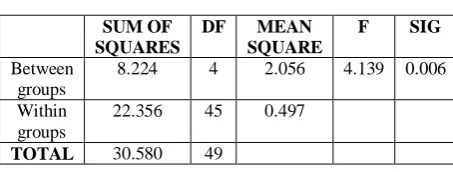
H03: There is no significant relationship between family income and purpose of investment among women in Arcot area. The ANOVA table 5.1 is given below.
Table 5.1 ANOVA
SUM OF SQUARES
DF MEAN
SQUARE
F SIG
Between groups
8.224 4 2.056 4.139 0.006
Within groups
22.356 45 0.497
TOTAL 30.580 49
The above table shows that there is a significant association between family income and purpose of investment. The null hypothesis is rejected as the p-value is less than 0.05. It is therefore concluded that there is a significant relationship between the respondents’ family income and purpose of investment.
Findings
The study reveals that the awareness level of investment by women in Arcot area is 48% which is very high. Most of the women had high school education, invest from their family income for their child’s education and marriage purposes out of their savings which are 11% to 20%. Because of these reasons they invest for the medium term of 2-5 years. Since the purpose of the investment is for marriage and children’s education, ANOVA is done to find out whether there is any relationship between the age of the investor and the family income on the purpose of investment. The results showed that it is insignificant. But education level does not have any influence on the purpose of investment.
III. CONCLUSION
There are many investment options available for women in general. As the purpose of the investment is to educate their children and their marriage, the
families of women in Arcot decide to invest for a medium term out of the family income to the extent of 20%. Their savings and investment lifestyle could support and act as the pillar of their family. Hence while making investments, they must consider factors like return and safety, so that they could lead a very prosperous life without depending on others for their needs and sorrows. This investment habit of women also constitutes entrepreneurship developmental and challenging environment.
IV. REFERENCE
1) Ananthapadhmanabha Achar (2012). Saving and Investment Behaviour of Teachers - An Empirical Study. International Journal of Physical and Social Sciences(IJPSS). Vol.2, No.8, ISSN No.2249-5894, pp.263-286.
2) Girish Jain and MeenuBaliyan (2014). Determinants of Saving and Investment in India. Scientific Society of Advanced Research and Social Change (SSARSC), International Journal of Geo Science and Geo-Informatics. Vol.1, No.1, ISSN No.2349-6975, pp.1-13.
3) Kanagaraj.A.R, Priyanandhini.N, and Venkatesan.R (2014). A Study on Perception of Women Investors towards Investments. Paripex - Indian Journal of Research. Vol.3, No.7, ISSN No.2250-1991, pp.1-2.
4) Kousalya.P.R and Gurusamy.P (2012). Women Investors’ Perception towards Investments. IJSR - International Journal of Scientific Research. Vol.1, No.6, ISSN No.2277 – 8179, pp.80-81. 5) Santhiyavalli.G and Usharani.M (2014).