BOSNIAN JOURNAL OF BASIC MEDICAL SCIENCES 2011; 11 (3): 185-189
Abstract
Complexity of multifactorial diseases as Parkinson’s disease (PD) often complicate identifying causal genetic factors by traditional approaches such as positional cloning and candidate gene analyses. PD is etiologically and genetically complex disease and second most common neuro-degenerative disorder after Alzheimer’s disease. Th e most cases of PD are idiopathic and small growing subset of individuals have single gene defect as the cause. Th e main goal of this research was to identify the potential candidate genes for idiopathic PD by using biomedical discov-ery support system (BITOLA). For detecting the potential candidate genes for PD was used opened system of bioinformatics tool BITOLA. Data of chromosome location, tissue specifi c expression of potential candidate genes and their potential association with PD were obtained from Medline, Locus Link, Gene Cards and OMIM. By using BITOLA system is identifi ed genes as potential candidate genes for PD. Th e role of three genes (MAPT, PARK, UCHL) in PD were confi rmed earlier. Discovering the novel candidate genes for multifactiorial diseases by using specially mentioned bioinformatics tool BITOLA could off er the new opportunity for researching genetics base of PD without using
tissue samples of patients. © Association of Basic Medical Sciences of FBIH. All rights reserved
KEY WORDS: BITOLA, Parkinson’s disease, candidate genes
candidate genes for Parkinson's disease
Amela Karić1*, Alen Karić2
1 Division of Genetics, Faculty of Science, University of Tuzla, Univerzitetska 4, 75000 Tuzla, Bosnia and Herzegovina. 2 Clinics for
Cardiovascular Diseases, University Clinical Centre Tuzla, Trnovac bb, 75000 Tuzla, Bosnia and Herzegovina
INTRODUCTION
Parkinson’s disease (PD) is complex multifactoral neurode-generative disorder which aff ects people over the age of . It is estimated that most cases of PD are sporadic and have late age onset, yet small but growing subset of individuals has a single gene defect as the cause [, ]. Th e identifi cation of the fi rst gene(alpha synuclein) in familial PD only years ago was a major step in the understanding of the molecular mech-anisms in neurodegeneration []. Until today it have been identifi ed at last loci associated with PD: PARK, PARK, PARK, PARK, PARK, PARK, PARK, PARK, PARK and GBA []. Linkage analysis and gene expression studies indicate a very large number of candidate genes for PD [, , , , ]. Also, variation of genes which are associated with
sporadic cases of PD in some cases increases or decreases risk of PD. Moreover, the concept of susceptibility genes allows the involvement of gene-gene and gene-environment interac-tion in sporadic PD []. Previous studies of genes identifi ed as candidate genes for PD indicate that there are many interac-tions between mutated genes. Although they only occur in a
small number of patients, the discovery of genetic forms of PD demonstrated conclusively that PD can occur through inheritance, which has opened a new and exciting area of re-search []. Traditional approaches such as positional cloning and candidate gene analyses, as well as modern methodolo-gies such as gene expression profi ling tend to fail to discover genes underlying diseases []. Also, DNA microarray analy-ses produce hundreds of diff erentially expressed genes which can not be distinguished from normally expressed genes. Genes that harbor no such mutations, but that play key roles in parts of the biological network that lead to disease, are systematically missed by forward genetics approach []. All those strategies fail to help researchers in reducing the target genes to a manageable number or to prioritize the disease specifi c causal genes for further analysis []. From this rea-son it is need to develop sophisticated techniques and tool to identify key candidates from gene list generated by disease gene discovery methods []. In terms of discovering new in-formation from the literature, especially for candidate genes for various diseases, Peterlin and Hristovski have developed biomedical support discovery system (BITOLA) []. By us-ing this system were identifi ed candidate genes of interest for multiple sclerosis (MS) and bilateral polymicrogyria (BPP) [, , ]. Methods of integration data from the literature, using BITOLA tools can reveal new potential candidate genes for Parkinson's disease. Th e main goal of this research was to identify candidate genes for PD which corresponds to the criteria nominated by authors in design of study. * Corresponding author: Amela Karić,
Division of Genetics, Faculty of Science, University of Tuzla, Univerzitetska 4, 75 000 Tuzla, Bosnia and Herzegovina Tel. +387 61 289 217; +387 35 320 860; Fax: +387 35 320 861 e-mail: [email protected]
BOSNIAN JOURNAL OF BASIC MEDICAL SCIENCES 2011; 11 (3): 186-189MATERIALS AND METHODS
In order to include some gene as candidate genes in the list of candidate genes for PD, that gene had to meet following criteria nominated by authors: to show a specifi c pattern of expression in brain tissue, to be involved in processes of cell adhesion and cell death, and that so far in the literature have not been brought into relation with PD. Th e reasons because this criteria was nominated are that brain tissue is a target in PD which is characterized by a progressive loss of dopami-nergic neurons of the substantia nigra. In the literature, oxi-dative stress and apoptotic cell death have been implicated in the dopaminergic cell loss. Cell adhesion molecules play a central role in neural development and are also critically involved in axon regeneration and plasticity of synapses in adult nerve system. Information about chromosome loci, tissue-specifi c expression and the function of potential can-didate genes and their association with some genetics disor-ders were extracted from databases: Medline [], Locus Link [], Gene Cards [] and Online Mendelian Inheritance in Man (OMIM) []. To fi nd new potential biomedical rela-tion between PD and pathogenetics mechanisms (cell adhe-sion and cell death) was used the BITOLA system []. Th e BITOLA system is an interactive literature-based biomedi-cal discovery support system. Th e purpose of the system is to help the biomedical researchers make new discoveries by discovering potentially new relations between biomedical concepts []. Th e set of concepts currently contains Medi-cal Subject Headings (MeSH), which is used to index Med-line, and human genes from Th e Human Genome Organiza-tion (HUGO). Th e potential new relations are discovered by mining the Medline database []. Th e system is available in two versions: ‘’closed discovery’’ and ‘’opened discovery’’ []. Open discovery allows the input of a single concept, then categories for fi rst-order relatives of that concept, then cat-egories for relatives of those fi rst order concepts []. Th e BI-TOLA system was used according to the authors proposed instruction []. Discovery algorithm for discovering new re-lations between medical concepts is described in Table []. Discovery algorithm for fi nding new relations between the given concepts was adapted to PD. As the concept X we nominated Parkinson’s disease, then concept Y is cell func-tion and concept Z is gene or gene products. Th e main goal was to fi rst fi nd all the concepts Y (cell function) related to the starting concepts X (PD). Th en all the concepts Z (gene or gene product) are found. As the last step, we check if X (PD) and Z (gene or gene product) appears together in the medical literature, then we evaluated the proposed (X (PD), Z (gene or gene product)) pairs and select among them those that deserve further investigation. If the chromosomal region of PD matches the location of the related genes (Z) and if
there are no MEDLINE documents mentioning both the PD and the genes Z, then the genes Z can be proposed as can-didate genes for X (PD). Because in Medline each concept can be associated with many other concepts, the possible number of XZ combinations can be extremely large []. In order to deal this combinatorial problem the author’s of BITOLA system integrated in discovery algorithm fi ltering (limiting) and ordering capabilities. Th e related concepts can be limited by the semantic type to which they belong and fi nal possibility for limiting the number of related concepts or false related concepts is by setting thresholds on the sup-port and confi dence measures of the association rules []. Th e main goal of the ordering is to present best candidates
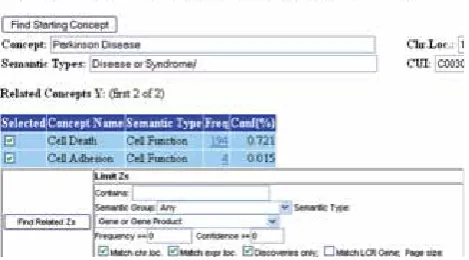
first to make human review as easy as possible []. Our discovery algorithm integrated in opened BITOLA system Figure . As beginning concepts X was entered the name Parkinson’s disease. After limiting the related concepts Y by the semantic type Cell function, concepts were obtained corresponding to MeSH descriptions. According to the re-search strategy, the cell adhesion and cell death were chosen as the most suited to PD. Using those concepts, all related concepts Z of the semantic type gene or gene products were searched and further limited to those matching chromo-some location and discoveries only. The all chromochromo-some loci which in literature associated with PD were examined.
RESULTS
Using the adapted discovery algorithm to the PD and its integration into the opened BITOLA system, we FIGURE 1. The user interface of open system BITOLA and inte-grated the discovery algorithm for fi nding new relation between medical concepts adapted to Parkinson’s disease
1. Let X be a given starting concept of interest.
2. Find all concepts Y such that there is an association rule XY. 3. Find all concepts Y such that there is an association rule YZ. 4. Eliminate those Z for which an association XZ already exists. 5. Th e remaining Z concepts are candidates for a new relation between X and Z.
BOSNIAN JOURNAL OF BASIC MEDICAL SCIENCES 2011; 11 (3): 187-189
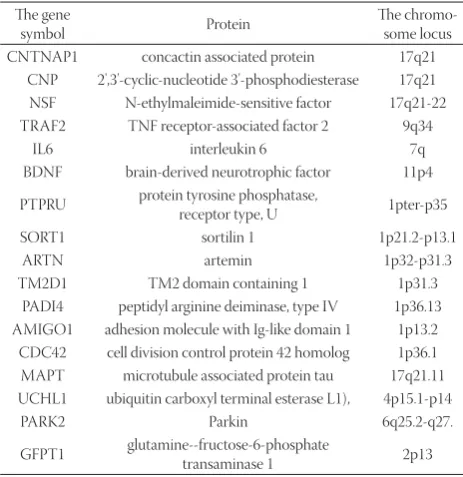
searched all the related concepts Z (gene or gene prod-uct) and further limited them to those matching the chro-mosome loci described in Table . In this manner genes were suggested by the opened BITOLA system. By further analysis of those genes we excluded genes whose expression pattern did not preferentially included the brain tissue which is target in the PD. According to the infor-mation from Locus Link [], Gene Cards [] and OMIM [] about tissue-specifi c pattern and the cell function (cell adhesion and cell death) of the remaining genes we in-clude genes as potential candidate genes for PD (Table ). In the next step, were tested the frequencies of those genes together with PD in the literature. The most frequencies have genes IL, BDNF, MAPT, and PARK. The gene IL appears with PD in Medline re-cords. Th e gene BDNF and PD in Medline records appears times. Th e gene MAPT co-occurs in Medline docu-ments and PARK with PD is documented in records. It could be explained by the facts that those genes were researched in population of patients with PD and the role of the genes MAPT and PARK in pathogenesis of PD is confi rmed. Th e PTPRU gene with concept X (PD) appears in three Medline documents. However, none of the listed studies do confi rm its role in PD, so we do not exclude it. Th e genes CNTNAP, CNP, TRAF, SORT, ARTN, TMD, NSF, PADI, CDC, GFPT and AMIGO do not appear together with the concept X (PD) in Medline documents. One of the rules of discovery algorithm is that associa-tion between concept X (PD) and the concept Z (gene or gene product) must not exists. So we exclude from further analysis genes IL, BDNF, MAPT and PARK. However, their existence in list of off ered genes in the BITOLA sys-tem is important because it is implicates on potential role of the BITOLA system in (re)identification disease candi-date genes. According to the tissue-specifi c pattern of the
remaining twelve genes and the facts that those genes are not researched into relation with PD, they could be pro-posed as interesting candidate genes for further analysis.
DISCUSSION
By analyzing of results obtained by using bioinformatics tool BITOLA we compiled the list of potential candidate genes for PD. Th e twelve genes are chosen as potential candidate genes (CNTNAP, NSF, CNP, TRAF, PADI, PTPRU, SORT, ARTN, TMD, CDC, GFPT and AMIGO) whose role in PD should be further explored. Th e most in-teresting of those twelve genes are NSF, CDC and GFPT because their role in pathogenesis of PD has not been studied yet. N-ethylmaleimide sensitive factor (NSF) is an ATPases associated with various cellular activities protein (AAA), broadly required for intracellular membrane fusion [, ]. It does seem to interact with other proteins, such as the AMPA receptor subunit, GluR, and beta-AR and is thought to aff ect their traffi cking patterns. Recently, it has been shown that NSF can be regulated by hydrogen per-oxide. HO is thought to inactivate NSF through oxida-tion of the Cys in NSF-D []. Consistently, mutaoxida-tion of Cys to threonine eliminates the sensitivity of NSF to HO []. While this might suggest that NSF could be a re-dox sensor in the cell, whose activity is decreased when the oxidation state of the cytosol increases []. Th e interesting fact is that, NSF gene is located nearby to the MAPT gene. Mutations in the tau gene, MAPT, cause familial frontotem-poral dementia with parkinsonism linked to chromosome Chromosome
region of concepts X (PD)
Number of genes which matched to the chromosome
region of X (PD)
Number of genes which have expres-sion in brain tissue
18p11.31-p11.2 2 0
17q21 14 8
11p15.5 15 1
9q34 7 5
7p21-p15 3 3
6q27 4 1
6q25.2-27 1 1
5q23.1-q23.3 1 0
4p14 2 1
2q22-q23 1 1
2p13 3 1
1p 128 49
TABLE 2. The chromosome regions examined in opened BITOLA system
Th e gene
symbol Protein
Th e chromo-some locus CNTNAP1 concactin associated protein 17q21
CNP 2',3'-cyclic-nucleotide 3'-phosphodiesterase 17q21 NSF N-ethylmaleimide-sensitive factor 17q21-22 TRAF2 TNF receptor-associated factor 2 9q34
IL6 interleukin 6 7q
BDNF brain-derived neurotrophic factor 11p4
PTPRU protein tyrosine phosphatase,
receptor type, U 1pter-p35
SORT1 sortilin 1 1p21.2-p13.1
ARTN artemin 1p32-p31.3
TM2D1 TM2 domain containing 1 1p31.3
PADI4 peptidyl arginine deiminase, type IV 1p36.13 AMIGO1 adhesion molecule with Ig-like domain 1 1p13.2
CDC42 cell division control protein 42 homolog 1p36.1 MAPT microtubule associated protein tau 17q21.11 UCHL1 ubiquitin carboxyl terminal esterase L1), 4p15.1-p14
PARK2 Parkin 6q25.2-q27.
GFPT1 glutamine--fructose-6-phosphate
transaminase 1 2p13
BOSNIAN JOURNAL OF BASIC MEDICAL SCIENCES 2011; 11 (3): 188-189 (FTDP-), and common variation in MAPT is stronglyassociated with the risk of progressive supranuclear palsy (PSP), corticobasal degeneration and, to a lesser extent, AD and Parkinson's disease (PD), implicating the involvement of tau in common neurodegenerative pathway(s) []. Th e genomic complexity around the MAPT locus is emphasized not only by complex arrangements of duplications close to the NSF gene but also in a recently identified de novo mi-cro deletion of – kb of the locus in individuals with developmental delay and learning disabilities []. On the basis of previous facts it seems to be interesting to research-ing potential interaction between MAPT and NSF genes. Neuronal apoptosis or programmed cell death (PCD) is a crucial process occurring not only during normal develop-ment and tissue turnover but also in pathological situations such as stroke and neurodegenerative diseases []. Neu-ronal PCD involves the activation of a number of enzymes and genes and is regulated by specifi c growth factors, such as neurotrophins, which promote survival of particular neu-ronal populations by binding to specifi c cell surface recep-tors. Over expression of activated Rac or Cdc in SCG neurons maintained in the presence of NGF induced apop-tosis, whereas expression of dominant negative mutants of Cdc or Rac blocked apoptosis following NGF with-drawal. Furthermore, Cdc-induced death was prevented by co expressing the c-Jun dominant negative FLAGΔ []. Taking into account the fact that CDC is a key com-ponent of the cell death machinery in sympathetic neurons [], its potential the role in PD should be further considered. Glutamine-fructose--phosphate transaminase (GFPAT) is the rate-limiting enzyme of the hexosamine pathway that has been implicated in the pathogenesis of diabetic nephrop-athy []. Glucosamine -phosphate is subsequently con-verted to uridine diphosphate N-acetylglucosamine, which is used for the O-glycosylation of intracellular proteins. Al-though this gene is associated with diabetic nephropathy, it is diff erentially regulated in PD and may play a role in spo-radic cases of PD and role in spospo-radic PD and represent candidate for as yet unidentifi ed disease-causing genes []. Taking into account the fact that genes of NSF, CDC and GFPT have not been brought into cor-relation with the PD, as opposed to gene PARK, MAPT and UCHL, their significance for the PD may represent a potential target for further research.
CONCLUSION
On the basis of above mentioned, the role of NSF, CDC and GFPT genes, as well as the role of genes that are selected in the list of candidate genes for PD in opened BITOLA system, could be readily tested by mutation
screening of PD patients for mutation in those genes. Discovering the novel candidate genes for multifactiorial diseases by using specially mentioned bioinformatics tool BITOLA could offer the new opportunity for researching genetics base of PD without using tissue samples of patients.
DECLARATION OF INTEREST
Th e autors state that there is no confl ict of interest.
REFERENCES
[] Grimes DA, Han F, Panniset M, Racacho L, Xiao F, Zou R, et al. Translated Mutation in the Nurr Gene as a Cause for Parkinson's Disease. Movement Disorders ; :-
[] Maraganore DM, de Andrade M, Elbaz A, Farrer MJ, Ioannidis JP, Kruger R, et al. Collaborative analysis of alpha-synuclein gene pro-moter variability and Parkinson’s disease. JAMA ;::-
[] Schiesling C, Kieper N, Seidel K, Krüger R. Review: Familial Parkin-son’s disease – genetics, clinical phenotype andneuropathology in relation to the common sporadic form of the disease. Neuropathol-ogy and NeurobiolNeuropathol-ogy ;:-
[] Feany MB. New Genetic Insights into Parkinson's disease. N Engl J Med ; :-
[] Pankratz N, Nichols WC, Uniacke SK. Genome-wide linkage analysis and evidence of gene-by-gene interaction in a sample of multiplex Parkinson’s disease families. Hum Mol Genet ;:-
[] Scott WK, Nance MA, Watts RL. Complete genomic screen in Parkinson’s disease/evidence for multiple genes. JAMA ;:-
[] Martinez M, Brice A, Vaughan JR. Genome-wide scan for Parkin-son's disease/the Gene PD Study. Neurology ;:- [] Elbaz A, Nelson ML, Payami H, Ioannidis JP, Fiske BK, Annesi G, et
al. Lack of replication of thirteen single-nucleotide polymorphisms implicated in Parkinson’s Disease: a large-scale international study. Lancet Neurology ;:-
[] Li YJ, Scott WK, Hedges DJ, Zhang F, Gaskell PC, Nance MA, et al. Age at onset in two common neurodegenerative diseases is geneti-cali controlled. Am J Hum Genet ;:-
[] Collier KS, Maries E, Kordower JH. Etiology of Parkinson’s disease: Genetic and environment revisited. PNAS ;:- [] Gudivada RC, Qu XA, Jegga AG, Neumann EK, Aronow BJ. A
Ge-nome –pheGe-nome integrated approach for mining disease-causal genes using semantic web. HCLS Workshop, th International World Wide Web Conference, May -, , Banff, Alberta, Canada
[] Chadt EE. Novel integrative genomics strategies to identify genes for complex traits. Animal Genetics ;:-
[] Biomedical Discovery Support System (BITOLA). Available at: http://ibmi.mfuni-lj.si/bitola/ accessed May
[] Hristovski D, Peterlin B, Džeroski S, Stare J. Literature Based Dis-covery Support System and its Application to Disease Gene Identi-fi cation. Proc AMIA Symp ;
[] Hristovski D, Stare J, Peterlin B, Džeroski S. Supporting Discovery in Medicine by Association Rule Minining in Medline and UMLS. Stud Health Technol Inform ; (Pt ):-
[] Hristovski D, Peterlin B, Mitchell JA, Humphrey SM. Improving Literature Based Discovery Support by Genetic Knoweledge Inte-gration. Stud Health Technol Inform ;:-
BOSNIAN JOURNAL OF BASIC MEDICAL SCIENCES 2011; 11 (3): 189-189
[] U.S.National Library of Medicine-MEDLINE. Available at: http:// nlm.nih.gov/sites/entrez/databases/accessed October [] GeneCards. Available at: http://genecards.org/ accessed from
to
[] Online Mendelian Inheritance in Man (OMIM). Available at:http:// nlm.nih.gov/omim/ accessed October
[] Zhao C, Slevin JT, Whiteheart SW. Cellular function of NSF:Not just SNAPs and SNAREs. FEBS Lett ; :- [] Morrell CN, Matsushita K, Lowenstein CJ. A novel inhibitor of
N-ethylmaleimide-sensitive factor decreases leukocyte traffi cking and peritonitis. J Pharmacol Exp Th er ; :-
[] Matsushita K, Morrell CN, Mason RJ, Yamakuchi M, Khanday FA, Irani K. et al. Hydrogen peroxide regulation of endothelial exocy-tosis by inhibition of N-ethylmaleimide sensitive factor. J Cell Biol ;:–
[] Pittman AM, Fung HC, de Silva R. Untatling the tau gene as-sociation with neurodegenerative dissiorders. Hum Mol Genet ;:-
[] Oppenheim RW. Cell death during development of the nervous system. Annu Rew Neurosci ;:–
[] Bazenet CE, Mota M, Rubin LL.Th e small GTP-binding protein Cdc is required for nerve growth factor withdrawal-induced neuronal death. Proc Natl Acad Sci USA ;:- [] Ng DP, Walker WH, Chia KS, Choo S, Warram JH. et al. Scrutiny
of the Glutamine-Fructose--Phosphate Transaminase (GFPT) Locus Reveals Conserved Nephropathy. Diabetes ;:- [] Moran LB, Duke DC, Deprez M, Dexter DT, Pearce RK,