
INTRODUCTION
Opioid receptors are predominantly expressed in the brain cortex, limbic system, and brain stem. Mu receptor is the most expressed opioid receptor in the amygdala, thalamus, and mesencephalon. The opioid mu receptor is encoded by the OPRM1 gene, located on chromosome 6q24–q25, span-ning over 200 kb and contaispan-ning at least nine exons [1]. This receptor can bind to several different endogenous ligands, such as b-endorphin, enkephalin, and exogenous opioids. The encephalic opioid system is involved in the development of drug addiction through its role in reward [2]. Knockout mice lacking mu receptors showed less reward and rein-forcement manifestations after repeated exposure to several abuse drugs [3]. Furthermore, exposure to non-opioid abuse drugs, such as alcohol, cocaine and tobacco, is also associated with up- or down-regulation of the encephalic opioid recep-tor levels. In particular, nicotine enhances the endorphinic
mu receptor mRNA and protein expression in brain regions important for drug reward in rodents [4,5] and stimulates endogenous opioid release [6], resulting in mu receptor acti-vation. Also, Positron Emission Tomography (PET) studies have demonstrated increased levels of OPRM1 in the ventral striatum in alcohol-dependent patients and alcohol-craving states [7]. Furthermore, antagonists of mu receptors such as naltrexone have been shown to reduce alcohol consump-tion [8].
Several polymorphisms in the OPRM1 gene have been reported to be associated with alcohol use and dependence,
A118G (Asn40Asp, rs1799971) being the most commonly reported. The lower expression of the receptor observed in G carriers [9-11], together with the results of studies suggesting increasing consumption rates in G carriers have led to the so-called “opioid receptor deficiency theory”. This theory pro-poses that a lower amount of receptor would lead to increases in alcohol intake with compensative ends. However, this the-oretical construct does not consider the receptor affinity. An initial study found that the G allele was associated with higher affinity receptors [12], thus potentially diluting the strength of the defective OPRM1 proposed in this theory. More recent works suggested a lowering effect of the G allele on
Corresponding Author: Francesc Francés,
Department of Preventive and Legal Medicine. School of Medicine, University of València, Avda Blasco Ibáñez 15, 46010 València, Spain E-mail: [email protected], Phone: +34-963864655; Fax: +34-963864166 Submitted: 25 November 2014 / Accepted: 8 January 2015
Association between opioid receptor mu 1 (
OPRM1
)
gene polymorphisms and tobacco and alcohol
consumption in a Spanish population
Francesc Francés*, Olga Portolés, Ana Castelló, José Antonio Costa, Fernando VerdúDepartment of Preventive and Legal Medicine, School of Medicine, University of Valencia, Valencia Spain., Atenea Health Center, Aldaia, Spain
ABSTRACT
Evidence gained from animals and humans suggests that the encephalic opioid system might be involved in the development of drug addiction through its role in reward. Our aim is to assess the influence of genetic variations in the opioid receptor mu 1 on alcohol and tobacco consump-tion in a Spanish populaconsump-tion. 763 unrelated individuals (465 women, 298 men) aged 18-85 years were recruited between October 2011 and April 2012. Participants were requested to answer a 35-item questionnaire on tobacco and alcohol consumption, as well as to complete the AUDIT and Fagerström tests. Individuals were genotyped for three polymorphisms in the opioid receptor mu 1 (OPRM1) gene, using a TaqMan® proto-col. In males, the rs10485057 polymorphism was associated with total pure ethanol intake and with the risk of being an alcohol consumer. Also, this polymorphism was significantly associated with higher Fagerström scores. Rs1799971 had a different influence on adaptive and maladaptive patterns of alcohol use. Despite the limited sample size, our study might enrich current knowledge on patterns of alcohol use, because it encom-passes both extreme and adaptive phenotypes, providing thus a wider perspective on this subject.
KEYWORDS: Tobacco; alcohol; drug abuse; genetic polymorphism
receptor binding potential [10,13], whereas other works failed to demonstrate any effect on receptor affinity [14].
Studies conducted on the effect of this Single Nucleotide Polymorphism (SNP) on alcohol consumption also have con-tradictory results [15]. In a recent meta-analysis that included 28 different studies with a total of over 8,000 subjects, authors suggested that the OPRM1 rs1799971 variant not appear to influence risk for substance dependence [16]. Among those studies that have found significant association, major evidence points to a link between the 118G allele and alcohol depen-dence [17], alcohol craving [13,18,19], the presence of alcohol use disorder [20] and total alcohol intake [19]. In contrast to these findings, other researchers have not been able to show any association between this genetic polymorphism, alcohol consumption, and states of alcohol dependence [2,21,22]. Most studies finding associations between this SNP and alco-hol consumption and/or dependence were undertaken on Asian populations, whereas those conducted on Caucasians mostly fail to demonstrate any association [23]. An ethnic-se-lective modulation on the effect of this SNP is a possible expla-nation of these results.
Likewise, in the studies on tobacco dependence, the rs1799971 variant is the most widely studied one, and results are equally discrepant [24,25].
The information regarding the relationship between other
OPRM1 gene polymorphisms and tobacco and alcohol con-sumption in humans is scarce. To date, no studies have been undertaken in a Spanish population.
Therefore, the aim of our study is to assess the possible association between polymorphisms in the OPRM1 gene and alcohol and tobacco consumption in a Spanish population as well as to assess the possible modulating effects of environ-mental factors.
MATERIALS AND METHODS
Subjects
763 unrelated subjects (465 women, 298 men) partici-pated in the study. This sample was obtained from a Caucasian non-isolated urban population and is representative of the Spanish-Mediterranean general population.
Participants (aged 18-85 years) were recruited through social, cultural and primary health care centers of the Valencian Community on the east Mediterranean coast of Spain. Individuals suffering from transmissible pathologies, physical or psychic decapacitating diseases were excluded. All the participants were informed about the aims of the study, its rules, and its procedures. After ensuring that they had under-stood the purpose and the implications of the study, they were requested to sign an informed consent form. The study
protocol was approved by the Ethics Committee of the School of Medicine, University of Valencia, Spain.
DNA extraction and genotyping of selected
polymorphisms
A whole saliva sample was obtained from each partici-pant, and genomic DNA was isolated employing the standard methods.
PCR was performed in an Eppendorf DNA thermal cycler. Samples were genotyped for three OPRM1 gene Single Nucleotide Polymorphisms (SNPs): rs1799971, rs510769, and rs10485057. For this purpose, we used a TaqMan® genotyping protocol.
The description of this protocol is as following: 20 ng of DNA was poured into each well of the reaction plate. 2.50 µL of TaqMan® Universal PCR Master Mix and 0.25 µL of the cor-responding TaqMan SNP genotyping assay, containing VIC and FAM probes, were then added to each well.
The plate was then run on an Applied Biosystems 7900HT Fast Real-Time PCR under the following thermal cycling con-ditions: After an initial denaturation at 95ºC for 10 minutes, 40 cycles of denaturation at 92ºC for 15 seconds and anneal-ing at 60ºC for 60 seconds were performed. Finally, genotype assignation was undertaken by registering the fluorescence emissions from each well at the corresponding VIC and FAM dye wavelengths.
Tobacco/Alcohol consumption and addiction
clinical and lifestyle variables
A number of socio-demographic and behavioral vari-ables such as gender, age, educational level, marital status, the amount of stress in everyday life and working place were assessed in order to appraise their potential confounding effect on the association study.
participants were requested to answer an AUDIT question-naire [28]. Alcohol use disorder (AUD) was considered to exist when the AUDIT test score was ≥8 [28].
Tobacco smoking habits were assessed by inviting the par-ticipants to complete a 13-item questionnaire – the question-naire specified the amount and type of consumed tobacco, as well as the temporal evolution of habit, familiar co-morbidity and attempts at relinquishing the smoking habit.
Participants who admitted being habitual smokers were invited to answer the Fagerström questionnaire in order to quantify their level of nicotine addiction.
Statistical analysis
All statistical analyzes were performed using SPSS soft-ware package (SPSS Inc, Chicago, Illinois). To assess the associations between tobacco and alcohol consumption, codominants, dominants, and recessive models were fitted. To estimate associations between genotypes and the quanti-tative intake (grams of alcohol per day, number of cigarettes per day), ANOVA, t-Student and logistic regression models were performed. In the case of variables with non-parametric distribution, mean differences were assessed using Kruskal-Wallis tests. Tobacco and alcohol consumption risk was esti-mated employing logistic regression models, calculating the Odds Ratio (OR) and its confidence interval (CI). Crude and covariate-adjusted models were carried out. Hardy-Weinberg equilibrium was assessed using the Chi-Square test. The level of bilateral p significance was considered statistically signifi-cant when under p = 0.05.
RESULTS
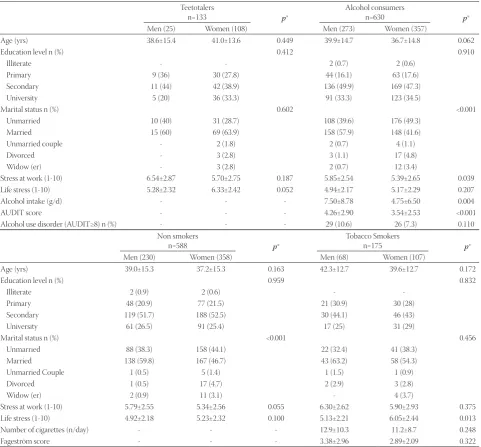
The general socio-demographic characteristics of our par-ticipants are presented in Table 1. The alcohol consumption habit is very common in the study sample (82.6%). In contrast, tobacco smoking is less frequent (22.9%). Men generally con-sumed higher amounts of alcohol and tobacco than women – however, the difference was statistically significant only in the case of AUDIT score.
The genotype distribution of the three studied SNPs was: 526 AA, 220 A/G and 17 GG for the rs179971, 477 CC, 249 CT and 37 TT for the rs510769 polymorphism, and 632 AA, 126 AG and 5 GG for the 10485057 polymorphism, respectively. These genotype distributions were in line with Hardy-Weinberg equilibrium (p = 0.280, p = 0.541 and p = 0.636, respectively).
Table 2 shows the genotype frequencies of the three polymorphisms among tobacco and alcohol consumers and non-consumers.
Assessing the relationship between the rs1799971 and alcohol consumption, we found that (after adjusting for age,
marital status and educational level, tobacco smoking and stress level) women carriers of the G allele had less risk of being alcohol consumers (OR=0.55; 95% CI: 0.304-0.998;
p = 0.049).
However, when we assessed the associations of this poly-morphism with the presence or absence of alcohol use disor-der through the AUDIT score, we found that, after covariate adjustment, male carriers of the G allele had an increased risk of presenting an alcohol pattern consumption compatible with AUD (OR=2.52; 95% CI: 1.02-6.24; p = 0.046).
No association between the rs1799971 polymorphism and the number of cigarettes or the Fagerström test scores was found.
The rs510769 polymorphism was not associated with alco-hol or tobacco consumption. Furthermore, we did not find any association either with quantitative variables of alcohol and cigarette consumption or with addiction test scores.
The third polymorphism studied, rs10485057, was asso-ciated with total pure alcohol intake in male participants (7.73±8.55 mg/day in AA as opposed to 4.93±5.80 mg/day in AG; p = 0.026). When covariates were taken into account in the analysis, the results remained significant (p = 0.043). Moreover, AA individuals were associated with an increased risk of being alcohol consumers (OR=2.40; 95%CI: 1.40-4.12;
p = 0.001). The AA genotype was also associated with the increased AUDIT scores, but this value did not reach statis-tical significance.
When tobacco smoking was assessed, after adjusting for covariates we found that male carriers of the AA variant in the rs10485057 locus had higher Fagerström scores than G carri-ers (3.16±2.93 in AA in contrast to 2.83±2.59 in G carricarri-ers; p
=0.037). AA male participants also showed increased tobacco consumption expressed in number of cigarettes/day, but this value did not reach statistical significance.
DISCUSSION
women, men carrying the G-allele showed a higher risk of having AUD.
It is important to emphasize that most of the published studies had a case-control design, and associations were
TABLE 1. Means (SD) and proportions of socio-demographic variables in the study sample
Teetotalers
n=133 p*
Alcohol consumers
n=630 p*
Men (25) Women (108) Men (273) Women (357)
Age (yrs) 38.6±15.4 41.0±13.6 0.449 39.9±14.7 36.7±14.8 0.062
Education level n (%) 0.412 0.910
Illiterate - - 2 (0.7) 2 (0.6)
Primary 9 (36) 30 (27.8) 44 (16.1) 63 (17.6)
Secondary 11 (44) 42 (38.9) 136 (49.9) 169 (47.3)
University 5 (20) 36 (33.3) 91 (33.3) 123 (34.5)
Marital status n (%) 0.602 <0.001
Unmarried 10 (40) 31 (28.7) 108 (39.6) 176 (49.3)
Married 15 (60) 69 (63.9) 158 (57.9) 148 (41.6)
Unmarried couple - 2 (1.8) 2 (0.7) 4 (1.1)
Divorced - 3 (2.8) 3 (1.1) 17 (4.8)
Widow (er) - 3 (2.8) 2 (0.7) 12 (3.4)
Stress at work (1-10) 6.54±2.87 5.70±2.75 0.187 5.85±2.54 5.39±2.65 0.039 Life stress (1-10) 5.28±2.32 6.33±2.42 0.052 4.94±2.17 5.17±2.29 0.207
Alcohol intake (g/d) - - - 7.50±8.78 4.75±6.50 0.004
AUDIT score - - - 4.26±2.90 3.54±2.53 <0.001
Alcohol use disorder (AUDIT≥8) n (%) - - - 29 (10.6) 26 (7.3) 0.110 Non smokers
n=588 p*
Tobacco Smokers
n=175 p*
Men (230) Women (358) Men (68) Women (107)
Age (yrs) 39.0±15.3 37.2±15.3 0.163 42.3±12.7 39.6±12.7 0.172
Education level n (%) 0.959 0.832
Illiterate 2 (0.9) 2 (0.6) -
-Primary 48 (20.9) 77 (21.5) 21 (30.9) 30 (28)
Secondary 119 (51.7) 188 (52.5) 30 (44.1) 46 (43)
University 61 (26.5) 91 (25.4) 17 (25) 31 (29)
Marital status n (%) <0.001 0.456
Unmarried 88 (38.3) 158 (44.1) 22 (32.4) 41 (38.3) Married 138 (59.8) 167 (46.7) 43 (63.2) 58 (54.3)
Unmarried Couple 1 (0.5) 5 (1.4) 1 (1.5) 1 (0.9)
Divorced 1 (0.5) 17 (4.7) 2 (2.9) 3 (2.8)
Widow (er) 2 (0.9) 11 (3.1) - 4 (3.7)
Stress at work (1-10) 5.79±2.55 5.34±2.56 0.055 6.30±2.62 5.90±2.93 0.375 Life stress (1-10) 4.92±2.18 5.23±2.32 0.100 5.13±2.21 6.05±2.44 0.013 Number of cigarettes (n/day) - - - 12.9±10.3 11.2±8.7 0.248
Fageström score - - - 3.38±2.96 2.89±2.09 0.322
* P values obtained from comparing the gender of alcohol consumers and teetotalers, and tobacco smokers and non smokers, respectively
TABLE 2. Genotype frequencies distribution in the study sample
Teetotalers (133) Alcohol consumers (630) Non-smokers (588) Tobacco smokers (175) Rs1799971 (n (%))
A/A 101 (75.9%) 425 (67.5%) 408 (69.4) 118 (67.3)
A/G 30 (22.6%) p=0.211 190 (30.1%) 166 (28.2) p=0.716 54 (31)
G/G 2 (1.5%) 15 (2.4%) 14 (2.4) 3 (1.7)
Rs510769 (n (%))
C/C 81 (60.9) 396 (62.9%) 371 (63.1) 106 (60.6%)
C/T 45 (33.8) p=0.880 204 (32.4%) 188 (32) p=0.772 61 (34.8%)
T/T 7 (5.3) 30 (4.7%) 29 (4.9) 8 (4.6%)
Rs10485057 (n (%))
A/A 99 (74.4) 533 (84.6) 485 (82.5) 147 (84.0)
A/G 32 (24.0) p=0.016 94 (15.0) 98 (16.7) p=0.458 28 (16.0)
G/G 2 (1.5) 3 (0.4) 5 (0.8) 0 (0)
*P value obtained employing the χ2 test by comparing genotype frequencies between alcohol consumers and teetotalers, and tobacco smokers and
assessed by comparisons with Alcohol Use Disorder patients or equivalents – although they may share biological and psy-chological characteristics, they cannot represent the general population.
Important evidence on the possible effects of this SNP on the general population has been published before, in Ehlers CL et al. (2008) [29] for example [29]. In that study, the selected sample was recruited from a general population of Native American origin. Results confirmed that the G-allele was associated with the unpleasant alcohol effects, resulting thus in lower alcohol intake. It seems that non-dysfunctional alcohol consumption is not comparable with pathological drinking patterns such as AUD, and these two might also dif-fer in its genetic origin. However, other studies have found evidence that there might exist an association between A allele and AUD. The recent study by Koller G et al. (2012) [22], conducted on alcohol-dependent Caucasian subjects, demon-strated an increased frequency of the A allele in these patients. Although interesting, the “opioid receptor deficiency” the-ory has several weak points. If G forms are associated with less amount of OPRM1, and higher alcohol consumption are justi-fied by compensatory mechanisms, it is difficult to understand the lower reinforcement observed in knockout mice for the OPRM1. Also, the reduction of alcohol consumption follow-ing naltrexone (blockfollow-ing of the OPRM1), especially strong in G forms, cannot be explained [30].
Two molecular factors are suggested to be important in determining the effect on rs1799971 genotype-related alco-hol consumption: the number of the receptors, but also their affinity. However, it is reasonable to think that genetic (mul-tilocus effects and interlocus correlations) and environmen-tal factors could modulate the specific effect of the SNP on these two parameters. This phenomenon could be responsi-ble for the contradictory findings reported in the case of the rs1799971 polymorphism [22], also called flip-flop results [31]. Supporting this hypothesis are recent works that suggest sev-eral other non-genetic factors influencing OPRM1 expres-sion [32,33].
Regarding nicotine dependence, the lack of an associa-tion between this SNP and tobacco consumpassocia-tion observed in our study is in concordance with the results of the only work undertaken on a Spanish population on this issue [34].
The rs10485057 is associated with alcohol intake and con-sumption in our male subsample. There is no further evidence in the available literature on this issue, and additional studies will help to explain the specific effect of this polymorphism on alcohol intake and addiction. Regarding tobacco smoking, we found only a marginal association between the rs10485057 polymorphism and the Fageström test outcome, showing that males homozygote carriers of the A variant have higher test scores. No association was found between this and other
polymorphisms studied and the amount of cigarettes con-sumed. Bearing in mind the limitations of our study in terms of the low prevalence of tobacco smokers, we need to refer to the research published by Zhang et al. (2006), stating that A and the G alleles in the rs10485057 locus were present in two haplotypes: one associated with tobacco consumption and another with nicotine dependence.
Our study has several weaknesses that must be taken into account. The first and most important is the limited sample size, together with the low frequency of both rare alleles and prevalence of smoking habit. Both of them could influence the association analysis.
CONCLUSION
Our results suggest that OPRM1 gene polymorphisms are associated with tobacco and alcohol consumption in a Spanish population, and this association could be modulated by genetic and environmental factors.
ACKNOWLEDGEMENTS
This research was supported by grants UV-INV-AE11-41946.
Authors would like to thank Dr. Dolores Corella for labo-ratory assistance, and the Athenea Health Care Center staff for their collaboration on patient recruitment.
DECLARATION OF INTERESTS
The authors declare no conflict of interests.
REFERENCES
[1] Mague SD, Blendy JA. OPRM1 SNP (A118G): involvement in disease development, treatment response, and animal models. Drug Alcohol Depend 2010;108(3):172–182. DOI: http://dx.doi. org/10.1016/j.drugalcdep.2009.12.016.
[2] Loh el W, Fann CS, Chang YT, Chang CJ, Cheng AT. Endogenous opioid receptor genes and alcohol dependence among Taiwanese Han. Alcohol Clin Exp Res 2004;28(1):15–19. DOI: http://dx.doi. org/10.1097/01.ALC.0000106303.41755.B8.
[3] Moles A, Kiefer BL, D’Amato FR. Deficit in attachment behav-ior in mice lacking the mu-opioid receptor gene. Science 2004;304(5679):1983-1986. DOI: http://dx.doi.org/10.1126/ science.1095943.
[4] Walters CL, Cleck JN, Kuo YC, Blendy JA.Mu-opioid recep-tor and CREB activation are required for nicotine reward. Neuron 2005;46(6):933–943. DOI: http://dx.doi.org/10.1016/j. neuron.2005.05.005.
[5] Wewers ME, Dhatt RK, Snively TA, Tejwani GA.The effect of chronic administration of nicotine on antinociception, opi-oid receptor binding and metenkelphalin levels in rats. Brain Res 1999;822(1-2):107–113. DOI: http://dx.doi.org/10.1016/ S0006-8993(99)01095-1.
and following nicotine withdrawal. Life Sci 1997;61(6):59-66. DOI: http://dx.doi.org/10.1016/S0024-3205(97)00444-X.
[7] Heinz A, Reimold M, Wrase J, Hermann D, Croissant B, Mundle G, et al. Correlation of Stable Elevations in Striatal μ-Opioid Receptor Availability in Detoxified Alcoholic Patients With Alcohol Craving: A Positron Emission Tomography Study Using Carbon 11–Labeled Carfentanil. Arch Gen Psychiatry 2005;62(9):57-64. DOI: http://dx. doi.org/10.1001/archpsyc.62.1.57.
[8] Soyka M, Rosner S. Opioid antagonists for pharmacological treat-ment of alcohol dependence – a critical review. Curr Drug Abuse Rev2008;1(3):280–291. DOI: http://dx.doi.org/10.2174/1874473710 801030280.
[9] Kroslak T, Laforge KS, Gianotti RJ, Ho A, Nielsen DA, Kreek MJ. The single nucleotide polymorphism A118G alters functional properties of the human mu-opioid receptor. J Neurochem 2007;103(1):77–87. [10] Zhang Y, Wang D, Johnson AD, Papp AC, Sadee W. Allelic expres-sion imbalance of human mu-opioid receptor (OPRM1) caused by variant A118G. J Biol Chem 2005;280(38):32618–32624. DOI: http://dx.doi.org/10.1074/jbc.M504942200.
[11] Weerts EM, Macul ME, Kuwabara H, Yang X, Xu X, Dannals RF et al. Influence of OPRM1 Asn40Asp variant (A118G) on [11C] carfentanil binding potential: preliminary findings in human sub-jects. Int J Neuropsychopharmacol 2013;8(1):1-7.
[12] Bond C, LaForge KS, Tian M, Melia D, Zhang S, Borg L, et al. Single-nucleotide polymorphism in the human mu opioid receptor gene alters beta-endorphin binding and activity: possible implications for opiate addiction. Proc Natl Acad Sci USA 1998;95(16):9608–9613. DOI: http://dx.doi.org/10.1073/pnas.95.16.9608.
[13] Ray LA. Stress-induced and cue-induced craving for alcohol in heavy drinkers: preliminary evidence of genetic moderation by the
OPRM1 and CRH-BP genes. Alcohol Clin Exp Res 2011;35(1):166– 174. DOI: http://dx.doi.org/10.1111/j.1530-0277.2010.01333.x [14] Beyer A, Koch T, Schroder H, Schulz S, Hollt V. Effect of the A118G
polymorphism on binding affinity, potency and agonist-mediated endocytosis, desensitization, and resensitization of the human mu-opioid receptor. J Neurochem 2004;89(3):553–560. DOI: http://dx.doi.org/10.1111/j.1471-4159.2004.02340.x.
[15] van der Zwaluw CS, van denWildenberg E, Wiers RW, Franke B, Buitelaar J, Scholte RH, et al. Polymorphisms in the mu-opioid receptor gene (OPRM1) and the implications for alcohol depen-dence in humans. Pharmacogenomics2007;8(10):1427–1436. DOI: http://dx.doi.org/10.2217/14622416.8.10.1427.
[16] Arias A, Feinn R, Kranzler HR. Association of an Asn40Asp (A118G) polymorphism in the mu-opioid receptor gene with substance dependence: a meta-analysis. Drug Alcohol Depend 2006; 83(3):262–268. DOI: http://dx.doi.org/10.1016/j. drugalcdep.2005.11.024.
[17] Nishizawa D, Han W, Hasegawa J, Ishida T, Numata Y, Sato T, Kawai A, et al. Association of mu-opioid receptor gene polymor-phism A118G with alcohol dependence in a Japanese population. Neuropsychobiology 2006;5(3)3:137-41.
[18] van den Wildenberg E, Wiers RW, Dessers J, Janssen RG, Lambrichs EH, Smeets HJ, et al. A functional polymorphism of the mu-opioid receptor gene (OPRM1) influences cue-induced craving for alcohol in male heavy drinkers. Alcohol Clin Exp Res 2007;31(1):1–10. DOI: http://dx.doi.org/10.1111/j.1530-0277.2006.00258.x.
[19] Pratt WM, Davidson D. Role of the HPA axis and the A118G poly-morphism of the mu-opioid receptor in stress-induced drink-ing behavior. Alcohol 2009;44(4):358–365. DOI: http://dx.doi. org/10.1093/alcalc/agp007.
[20] Miranda R Jr, Reynolds E, Ray L, Justus A, Knopik VS, McGeary J, et al. Preliminary Evidence for a Gene-Environment Interaction in Predicting Alcohol Use Disorders in Adolescents. Alcohol Clin Exp Res 2013;37(2):325-31. DOI: http://dx.doi. org/10.1111/j.1530-0277.2012.01897.x.
[21] Pieters S, van Der Vorst H, Burk WJ, Schoenmakers TM, van der Willenberg E, Smeets HJ, et al. The effect of the OPRM1 and DRD4
polymorphisms on the relation between attentional bias and alco-hol use in adolescence and young adulthood. Dev Cogn Neurosci 2011;1(4):591-599. DOI: http://dx.doi.org/10.1016/j.dcn.2011.07.008. [22] Koller G, Zill P, Rujescu D, Ridinger M, Pogarell O, Fehr C,
et al. Possible association between OPRM1 genetic vari-ance at the 118 locus and alcohol dependence in a large treat-ment sample: relationship to alcohol dependence symptoms. Alcohol Clin Exp Res 2012;36(7):1230-1236. DOI: http://dx.doi. org/10.1111/j.1530-0277.2011.01714.x.
[23] Chen D, Liu L, Xiao Y, Peng Y, Yang C, Wang Z. Ethnic-specific meta-analyses of association between the OPRM1 A118G poly-morphism and alcohol dependence among Asians and Caucasians. Drug Alcohol Depend 2012;123(1-3):1-6. DOI: http://dx.doi. org/10.1016/j.drugalcdep.2011.10.012.
[24] Munafò MR, Johnstone EC, Aveyard P, Marteau T. Lack of Association of OPRM1 Genotype and Smoking Cessation. Nicotine Tob Res 2013;15(3):739-44. DOI: http://dx.doi.org/10.1093/ntr/ nts174.
[25] Lerman C, Wileyto EP, Patterson F, Rukstalis M, Audrain-McGovern J, Restine S, et al. The functional mu-opioid receptor (OPRMI) Asn 40Asp variant predicts short-term response to nic-otine replacement therapy in a clinical trial. Pharmacogenomics J 2004;4(3):184–93. DOI: http://dx.doi.org/10.1038/sj.tpj.6500238. [26] Corella D, Sáiz C, Guillén M, Portolés O, Mulet F, González JI, et
al. Association of TaqIB polymorphism in the cholesteryl ester transfer protein gene with plasma lipid levels in a healthy Spanish population Atherosclerosis2000;152(2):367-76. DOI: http://dx.doi. org/10.1016/S0021-9150(99)00477-3.
[27] Cuevas-Badenes J, Sanchís-Fortea M. Tratado de alcohología. Madrid: DuPont Pharma; 2000.
[28] Saunders JB, Aasland OG, Babor TF, DeLaFuente JR, Grant M. Development of the Alcohol Use Disorders Identification Test (AUDIT): WHO collaborative project on early detection of persons with harmful alcohol consumption II. Addiction 1993;88(6):791– 804. DOI: http://dx.doi.org/10.1111/j.1360-0443.1993.tb02093.x. [29] Ehlers CL, Lind PA, Wilhelmsen KC. Association between
sin-gle nucleotide polymorphisms in the mu-opioid receptor gene (OPRM1) and self-reported responses to alcohol in American Indians. BMC Med Genet 2008;9:35. DOI: http://dx.doi. org/10.1186/1471-2350-9-35.
[30] Chamorro AJ, Marcos M, Mirón-Canelo JA, Pastor I, González-Sarmiento R, Laso FJ. Association of µ-opioid receptor (OPRM1) gene polymorphism with response to naltrexone in alcohol dependence: a systematic review and meta-anal-ysis. Addic Biol 2012;17(3):505-512. DOI: http://dx.doi. org/10.1111/j.1369-1600.2012.00442.x.
[31] Lin PI, Vance JM, Pericak-Vance MA, Martin ER. No Gene Is an Island: The Flip-Flop Phenomenon. Am J Hum Genet 2007;80(3): 531–538. DOI: http://dx.doi.org/10.1086/512133.
[32] Kim DK, Hwang CK, Wagley Y, Law PY, Wei LN, Loh HH. P38 Mitogen-activated protein kinase and PI3-kinase are involved in up-regulation of mu-opioid receptor transcription induced by cycloheximide. J Neurochem 2011;116(6):1077–1087. DOI: http:// dx.doi.org/10.1111/j.1471-4159.2010.07163.x.
[33] Kraus J, Lehmann L, Börner C, Höllt V. Epigenetic mecha-nisms involved in the induction of the mu-opioid receptor gene in Jurkat T-cells in response to interleukin-4. Mol Immunol 2010;48(1-3):257–263. DOI: http://dx.doi.org/10.1016/j. molimm.2010.08.002.
![1′,5 Dinitro 2′ phenyl 2′,3′,5′,6′,7′,7a' hexahydrospiro[indoline 3,3′ 1′H pyrrolizin] 2 one](data:image/gif;base64,R0lGODlhAQABAIAAAP///wAAACH5BAEAAAAALAAAAAABAAEAAAICRAEAOw==)