RESEARCH ON POLYMER SENSITIZING PACKAGE
METHOD OF INTELLIGENT CLOTHING FIBER GRATING
1LIQING WANG, 2CHANGYUN MIAO
1,2Tianjin Polytechnic University, Tianjin 300384, CHINA
E-mail: [email protected], [email protected]
ABSTRACT
This thesis studies the polymer Sensitizing package method of intelligent clothing fiber grating, analyze the performance of fiber grating sensor, respectively adopt capillary tubing package method on light grating , improved A1 box package method of fiber grating, aluminum groove package method of fiber grating, compare the advantages and disadvantages of each method, put forward polymer package method, of fiber grating, through the experiments of polymer package and the analysis of results, verify the fiber grating sensors used polymer package have a higher temperature sensitivity than naked fiber grating, and also more superior linearity and higher application value.
Keywords: Intelligent Clothing(IC), Fiber Grating (FG), Sensitizing Package (SP)
1.
INTRODUCTIONFiber grating sensor is a kind of device which can be buried in the measured object and in the material, change, induce and output for the temperature, stress, pressure, strain, velocity and flow and many other physical quantity. Fiber grating has many advantages which are that anti-electromagnetic interference, good durability, single-ended input, small volume, distribution measurement, anti-moisture and has nothing to do with strength information and so on. In recent year, it forms a new basic optical fiber sensor device in international, which can widely use in many occasions, and has an alternative trend to conventional sensors. The research from domestic and aboard shows that sensor characteristics of fiber grating are stable is the ideal temperature sensor. Compared with traditional sensors, as temperature sensor, fiber grating indeed has many advantage such as high sensitivity, corrosion resistance, anti-electromagnetic radiation, the optical path can be bent, small volume, easy to achieve telemetry and so on [1-3].
In order to meet practical application requirements of intelligent clothing, when designing the packaging methods of fiber grating sensors, should consider the following factors:
Temperature Sensitivity Coefficient of packaged fiber grating should reach to the accuracy requirements measured body’s temperature;
The packaged sensors must have a good repeatability and linearity;
Must provide adequate protection for fiber grating; ensure that fiber grating has a adequate strength;
Packaging structure must have good stability, in order to meet the requirements of long-term use.
In order to find double packaging method which is simple and easy to operate, and also have protective and temperature sensitizing for fiber grating, adopt the following methods to conduct experimental research.
2.
CONVENTIONAL PACKAGINGMETHODS OF FIBER GRATING
2.1. Capillary Tube Packaging Method of Fiber Grating
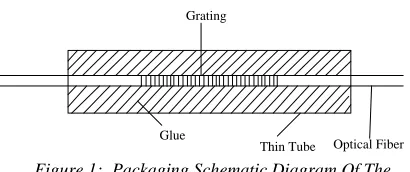
The capillary tube packaging method of fiber grating is that packaging the fiber grating in capillary tube with glues. Structure shows in Figure 1.
Glue
Optical Fiber Grating
[image:1.612.320.525.624.710.2]Thin Tube
In production process, it can that find that the capillary tube is very thin and very difficult to evenly fill glues in capillary tubes, therefore, this structure is inconvenient to operate, and in curing process of glue can produce bubbles in the capillary tube, which lead to the stress of fiber grating is uneven and easy to destroy the performance of grating. So this method is undesirable.
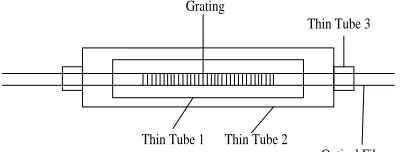
In order to avoid producing automatic glues pouring in capillary tube, it has been improved to the above methods, design the packaging structure shows in Figure 2.
Thin Tube 1
Optical Fiber Grating
Thin Tube 2
[image:2.612.330.514.156.233.2]Thin Tube 3
Figure 2: Improved Packaging Diagram Of Capillary Tube
Using three kinds capillary tube as packaging tool, the External Diameter of capillary tube 1, capillary tube 2 and capillary tube3 respectively is 1.8,1.4,1.0 mm, the length is 5, 10, 15 mm. Between each tube and capillary tube 3 and the fiber grating agglutinate with glues. The experiment shows that using temperature sensor the structure packaging shown in figure 4-4, when packaging, impose a certain pre-tension on fiber grating, it can make the sensors have a good reproducibility. However, through the experiment of measuring temperature, temperature sensitivity coefficient of fiber grating sensors after packaging is only 1.6 times with naked fiber grating, which does not meet measuring temperature accuracy requirements of intelligent clothing [4-6].
2.2. Improved A1box Packaging Method of Fiber Grating
Improved A1box package method of fiber grating shows in figure3. The length of A1 box is 40 mm, width is 8 mm, thickness is 2.4 mm, there is a small arched groove in the box, the width is 2 mm, depth is 1.5 mm. Fiber grating places inside after bending, dividing into three parts which the length is equal, the middle of 1 / 3 sticks on the Inner Groove, other 2 / 3 is in a free state, outside two ends of fiber grating keep relaxed as soon as possible, not to impose on tension. Then, fix optical fiber with glues in the two ends of small groove,
after fixing, filling non-curing Heat Conduction in the small arched groove, and then packing with cover.
Optical Fiber FBG
AI Box
[image:2.612.93.293.263.339.2]Small Arched Groove
Figure 3: Packaging Schematic Diagram Of A1box
The packaged fiber grating is bent, two ends optical fiber of fiber grating in the box keep in a relaxed state, so that the axial stress cannot pass to the fiber grating. Fillers in arched groove is paste shape and not Cured, have buffer and absorption to the outside stress, therefore, the fiber grating in the small groove will not be affected by the outside stress.
The thermal optical coefficient of packaged fiber grating has not changed, but the fiber grating, thermal paste and the Al box are packaged together, due the thermal expansion coefficient of Al box is large, when the temperature changes, Al box will expanse, the grating will obtain tension stress, the length will change, increase the shift of center wavelength, play the role of temperature Sensitizing. Through the experimental calculation can know that the temperature sensitivity coefficient of packaged fiber grating is 0.0202 nm/ ℃,about two times compared with naked fiber grating.
2.3. Aluminum Groove Packaging Methods of Fiber Grating
protected the Aluminum cover glass to Aluminum bar, the length of cover glass and Aluminum bar respectively is 6cm and 5cm, the width and depth of aluminum groove respectively is 2mm and 1.5mm. Packaged fiber grating is easy to fix onto the measured object, and Aluminum cover glass will not affect the measured object and pass the strain and temperature to fiber grating, it is very convenient for measuring and using. Temperature sensitivity of packaged fiber grating is 0.0326 nm/
℃ ,about 3times compared with naked fiber grating [7].
Optical Fiber FBG
Epoxy Resin
[image:3.612.94.299.259.365.2]Groove Screw
Figure 4: Packaging Schematic Diagram Of Aluminum Groove
3.
POLYMER PACKAGING METHODS OFFIBER GRATING
The design of fiber grating sensors should consider the following aspects: firstly, due to temperature coefficient of fiber grating is small, the sensitivity lonely as intelligent clothing temperature senor is not enough, in order to improve the sensitivity can put fiber grating in the packaged material which the thermal expansion coefficient is large; secondly, in design it should consider the entangled issues between temperature and stress after weaving into clothing; finally, in sensor packaging process, the design of material and structure should ensure the security and stability when the sensor used in intelligent clothing. Sum up the above factors, through a large number of experiments and comparisons, selecting polymer packaging method, selecting a kind of polymer material which the thermal expansion coefficient is large, physical and chemical characteristic are stable as fiber grating packaging material, using the simple and easy to operate packaging methods [8].
3.1. Polymer Packaging Material
According to the basic principles of temperature sensitivity packaging, the selected packaging materials should have a larger thermal expansion coefficient, but temperature change is stable, the compatibility with optical fiber is good. Select the
following mixed materials polymer to conduct temperature sensitive packaging for fiber grating, they are Unsaturated Polyester Resin, methyl ethyl ketone peroxide and Cobalt Naphthenate solution.
3.2. The Operation Process of Polymer
Sensitizing Packaging
[image:3.612.316.522.285.392.2]In the experiment, the length is 10mm, the peak reflectivity is close to 100%, side mode suppression ratio is about 29dB, 3dB bandwidth is 0.4nm, 30dB bandwidth is 0.8nm, flat fluctuation is less than 0.1dB, and reflective center wavelength is a series of high quality fiber grating ranges from 1530 to 1550nm. Reflectance spectra of fiber grating measured by optical spectrum analyzer shows in Figure5.
Figure 5: Reflectance Spectra Of Fiber Grating
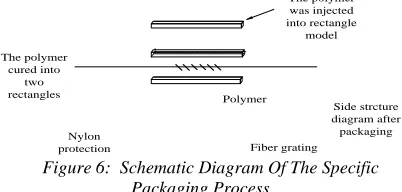
Since packaging materials requires a certain curing time, in the experiment adopts mold packaging. The specific process as follow: the first is to ratio polymer. Mix Unsaturated Polyester Resin, methyl ethyl ketene peroxide and Cobalt Naphthenate solution in the proportion of 5:2. After fully mixing, mixtures were injected into a rectangular mold which the length, width and specification is 25*8*1.5mm, after curing can obtain two rectangular polymers, the width is4mm. Then, grind a groove on the centre line of the two rectangles with tool, the naked fiber grating is also coated with liquid polymer and put into groove. Finally, merge the two rectangles; fix them with tool until they are cured. The specific packaging process shows in Figure 6. Packaged fiber grating sensor shows in Figure 7.
The polymer was injected into rectangle
model The polymer
cured into two rectangles
Side strcture diagram after packaging Polymer
Nylon
protection Fiber grating
[image:3.612.321.522.616.712.2]Figure 7: The packaged fibe grating sensor
4.
THE EXPERIMENT OF POLYMERPACKAGING AND RESULT ANALYSIS
4.1. Experimental Test Device
In order to effectively regulate and maintain the temperature, and ensure fiber grating sensors can feel the temperature uniformly, calibrate the fiber grating by water bath method, that is putting the packaged fiber grating into a water bath which the temperature is adjustable, Experimental test device shows in figure 8.The broadband light source in the SM130 demodulator directly incidence to fiber grating sensors through detection head, then reflect back to SM130 demodulator, through demodulator can observe and analyze the reflection center wavelength change of fiber grating sensors [9].
SM130 demodulator
Figure 8: The Calibration Experiment Device Graph Of Fiber Grating Sensor
4.2. The Experimental Test Data
Take two naked fiber gratings as experiment objects which the center wavelength is1549.04nm, one naked fiber grating directly use in the experiment, the other was packaged according to the above-mentioned packaging method. Put the naked fiber grating and the packaged fiber grating sensor respectively into water bath. Open the wavelength demodulation, from demodulator can see the center reflection wavelength value of fiber
[image:4.612.317.524.274.578.2]grating. With 25 ℃ as temperature starting point in this experiment, 42℃ is the temperature end point, regulate the temperature of water bath, write down Bragg wavelength values when the temperature was increased 1℃. The figure 9 is the reflection spectrum of naked fiber grating. Figure 10 is experiment data, take temperature(℃) as abscissa., the center wavelength (nm) as coordinate, then draw the temperature change curve of naked fiber grating.
Figure 9: Reflection Spectrum Of Naked Fiber Grating
Wavelength
[image:4.612.109.288.433.570.2]Temperature
Figure 10: Temperature Change Curve Of Naked Fiber Grating
abscissa., the center wavelength (nm) as coordinate, then draw the temperature change curve of fiber grating sensors [10].
Figure 11: Packaged Reflection Spectrum Of Fiber Grating Sensors
Wavelength
[image:5.612.96.300.115.496.2]Temperature
Figure 12: Temperature Change Curve Of Packaged Fiber Grating Sensors
Through observing the data and curve, it can be seen that the center reflection wavelength of packaged fiber grating sensors show a good linear relationship with the change of temperature. Through calculating, the temperature sensitivity coefficient of fiber grating sensor is 0.0916nm/℃. From it can be seen that the temperature sensitivity coefficient of fiber grating sensor packaged by polymer is higher than the temperature sensitivity coefficient of naked fiber grating. It also can see that during the whole temperature ranged25 to42℃, fiber grating sensor wavelength change invariably shows a good a good linear relationship with temperature change [11-12].
4.3. Analyze the Experimental Results
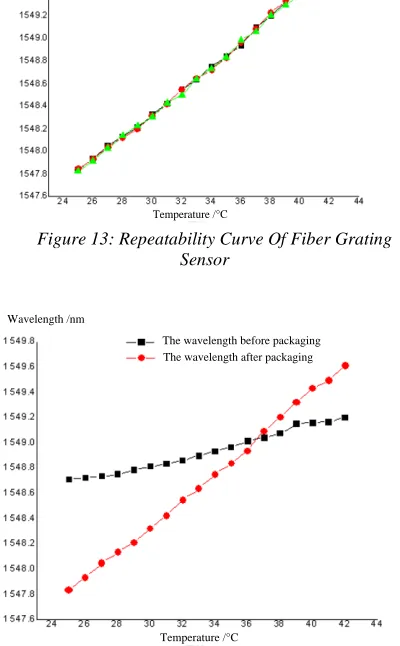
Through the repeated experiments of packaged fiber grating, can obtain large quantities of data; draw the curve shows in figure 13. From the figure
can see that the curve through three times measuring data has a good repeatability, it proves that the fiber grating sensor packaged by polymer has a good stability.
Figure 14 is comparison chart before-after packaging, from it can clearly see that temperature sensitivity of fiber grating sensor packaged by polymer is higher than the temperature sensitivity of naked fiber grating, and also has more superior linearity.
Wavelength /nm
[image:5.612.319.519.271.594.2]Temperature /°C
Figure 13: Repeatability Curve Of Fiber Grating Sensor
Wavelength /nm
Temperature /°C
The wavelength before packaging The wavelength after packaging
Figure 14: Temperature Changes Comparison Curve Of Fiber Grating Before And After Packaging
5.
CONCLUSIONsensitive packaging method of fiber grating: regard the polymer mainly with unsaturated polyester resin as substrate temperature sensitive packaging. In this way the temperature of packaged fiber grating sensor range from33℃ to 42℃, have a good linear relationship with temperature and a higher temperature sensitivity coefficient, is about 12.58 times than naked fiber grating. This kind of polymer packaging method not only has no instable hidden danger at bonding , and has good stability, after solidifying the texture is hard, can better protect fiber grating. This kind of packaging method has a simple operation, and the cost is low, obtaining material is very convenient, it not only can effectively reduce impact from external environment on fiber grating sensors performance, and substantially increase temperature sensitivity coefficient of fiber grating sensor, it is suitable for applying to intelligent clothing.
REFERENCES:
[1] Beard M D,Lowe M J S, and Cawley P, “Development of a guided wave inspection technique for rock bolts”, Quantitative Nondestructive Evaluation. AIP Conference Proceedings, Vol.12, 2012, pp.58-64.
[2] Nellen P M, Frank, “Optical fiber Bragg grat- ings for tunnel surveillance”, Proceedings of SPIE the International Society for Optical Engineering, 2011, pp.561-568.
[3] Yi-Fong Chen,Weng-Feng Tsai,Wei-Ching Chuang,Chia-Lun Chang,Chi-Ting Ho, “The fabrication of the UV polymer Bragg grating on the D-shaped fiber”, 2011 International Conference on Optics, Photonics and Energy Engineering,Vol.31, 2011, pp.89-95.
[4] Fu Hai-feng, Qiao Xue-guang, Fu Jun-mei, “Studying on the plat metal diaphragm based fiber Bragg gratings pressure sensing”, Acta Photonica Sinica, 2011, pp.456-461.
[5] Sungmee Park,Sundaresan Jayaraman. “Health and Quality ofLife:The Role of the Wearable Motherboard in WearableeHealth Systems for Personalised Health Management”, Studies in Health Technology and Informatics , 2012, pp.784-790.
[6] X.M.Ding,,J.L.HU,,X.M.Tao,et al. “Preparation of Temperature-Sensitive Polyurethanes for Smart Textiles”, Textile Research Journal, 2012, pp.124-129.
[7] Yao Y,Lian Z W,Liu W W,et al. “Measurement methods of mean skin temperatures for the PMV model”, HVAC R Research, 2011, pp.625-630.
[8] Noury N,Dittmar A,Corroy C,et al. “VTAMN—A smart clothefor ambulatory remote monitoring of physiological parameters andactivity”, Proceedings of the 26th Annual International Con-ference of the IEEE EMBS, 2010, pp.612-619.
[9] Rienzo M,Rizzo F,Parati G,et al. “MagIC system:A new textile-based wearable device for biological signal monitoring”, Pro-ceedings of the 27th Annual International Conference of IEEEEMBS on Applicability in Daily Life and Clinical Setting, 2011, pp.321-329.
[10] T.S. Bhatti, R.C. Bansal, and D.P. Kothari, “Reactive Power Control of Isolated Hybrid Power Systems”, Proceedings of International Conference on Computer Application in Electrical Engineering Recent Advances
(CERA), Indian Institute of Technology
Roorkee (India), February 21-23, 2002, pp. 626-632.
[11] B.N. Singh, Bhim Singh, Ambrish Chandra, and Kamal Al-Haddad, “Digital Implementation of an Advanced Static VAR Compensator for Voltage Profile Improvement, Power Factor Correction and Balancing of Unbalanced Reactive Loads”, Electric Power Energy Research, Vol. 54, No. 2, 2000, pp. 101-111.
[12] J.B. Ekanayake and N. Jenkins, “A Three-Level Advanced Static VAR Compensator”,