Morphogenetic Circuitry Regulating Growth and Development in the
Dimorphic Pathogen
Penicillium marneffei
Kylie J. Boyce, Alex Andrianopoulos
Department of Genetics, The University of Melbourne, Parkville, Victoria, Australia
Penicillium marneffeiis an emerging human-pathogenic fungus endemic to Southeast Asia. Like a number of other fungal pathogens,P.marneffeiexhibits temperature-dependent dimorphic growth and grows in two distinct cellular morphologies, hyphae at 25°C and yeast cells at 37°C. Hyphae can differentiate to produce the infectious agents, asexual spores (conidia), which are inhaled into the host lung, where they are phagocytosed by pulmonary alveolar macrophages. Within macrophages, conidia germinate into unicellular yeast cells, which divide by fission. This minireview focuses on the current understanding of the genes required for the morphogenetic control of conidial germination, hyphal growth, asexual development, and yeast morphogenesis inP.marneffei.
MORPHOGENESIS DURING THE GROWTH AND
DEVELOPMENT OFPENICILLIUM MARNEFFEI
P
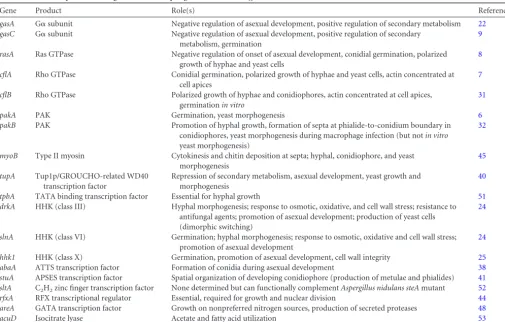
athogenic fungi have evolved traits that allow them to infect and grow on or in a host. One such trait is the ability to alter-nate growth forms, where each is suited to a particular environ-ment. This ability is called dimorphism, and it is exhibited by a diverse group of pathogenic fungi (Fig. 1). P. marneffei is an emerging human-pathogenic fungus endemic to Southeast Asia, where it is considered to be AIDS defining.P.marneffeiinfections occur primarily in individuals with defined immunocompromis-ing conditions; however, a small number of cases of infection in patients without a diagnosed immunodeficiency have also been reported (1,2). In none of the latter cases has immunocompetency been demonstrated.P.marneffeilacks a defined sexual cycle but possesses all of the genes believed to be required for mating, in-cluding both mating type idiomorphs in a heterothallic arrange-ment among isolates (3). P.marneffei, like a number of other fungal pathogens, exhibits temperature-dependent dimorphic growth, hyphal at 25°C and yeast at 37°C. Exposure to an air in-terface at 25°C promotes the saprophytic hyphae to differentiate to produce asexual spores (conidia), the infectious agents (Fig. 2). Conidia inhaled into the host lung are phagocytosed by pulmo-nary alveolar macrophages. Within macrophages, conidia germi-nate into unicellular yeast cells, which divide by fission (4). This minireview focuses on the current understanding of the genes required for the morphogenetic control of conidial germination, hyphal growth, asexual development, and yeast morphogenesis inP.marneffei(Table 1). It should be noted thatP.marneffeihas recently been renamedTalaromyces marneffeion the basis of new molecular phylogenetic analyses (5).
CONSERVED SIGNALING AND CELL POLARITY FACTORS ARE
REQUIRED FOR CONIDIAL GERMINATION INP.MARNEFFEI
Under favorable environmental conditions, dormant conidia (asexual spores) germinate at 25°C to give rise to the extensive radiating hyphal network necessary for saprophytic coloniza-tion or at 37°C to produce pathogenic yeast cells capable of causing disease in a human host. Germination requires an ini-tial period of isotropic growth, followed by the establishment of a polarized axis to allow germ tube emergence. InP. marnef-fei, germination is regulated by the heterotrimeric G-protein␣
subunit GasC, the Ras and Rho GTPases RasA and CflA, and the downstream p21-activated kinase (PAK) PakA (6–9) (Table 1;Fig. 2). ThegasCorthologues,rasA, andcflAare also impor-tant for conidial germination in the taxonomically closest model fungusAspergillus nidulans, inBotrytis cinerea, and in a variety of other fungal species (3,10–21).
Canonical heterotrimeric G proteins are composed of three subunits (␣,, and␥) which interact with receptors to transmit environmental signals. GDP-to-GTP exchange in the G␣subunit is triggered by ligand binding to the associated receptor and results in a conformational change and dissociation from theand␥ subunits. TheP.marneffeigenome contains three G␣ subunit-encoding genes (gasA,gasB, andgasC), one Gsubunit-encoding gene (sfaD), and one G␥subunit-encoding gene (gpgA).gasC, but notgasAorgasB, is required for conidial germination at both 25 and 37°C (6,9,22) (S. Zuber and A. Andrianopoulos, unpublished data). At both 25 and 37°C,⌬gasCandgasCG207Rdominant neg-ative mutants show slower germination rates than the wild type, while thegasCG45R dominant activated mutant has accelerated germination (9). GasC acts upstream of the RAS GTPase RasA, the Cdc42p orthologue CflA, and the downstream PAK PakA (Table 1). However, the roles of these downstream signaling components differ at 25 and 37°C. Both dominant negativerasAD125Aand dom-inant activatedrasAG19Vmutants show delayed germination at 25°C, producing large, swollen conidia, but germination at 37°C is unaffected (6, 8), whereas cflAD120A dominant negative and
cflAG14V dominant activated mutants show decreased and in-creased germination rates, respectively, at both 25 and 37°C (6,7). The cflAG14V allele can suppress the germination defects in a
rasAD125Amutant at 25°C, suggesting that CflA acts downstream of RasA at 25°C but not at 37°C (8).
Deletion ofpakAor mutation of the Cdc42-Rac-interacting binding domain (CRIB) required for interaction with Rho GTPases,pakAH108G, results in only a minor decrease in
germina-Published ahead of print30 November 2012
Address correspondence to Alex Andrianopoulos, [email protected]. Copyright © 2013, American Society for Microbiology. All Rights Reserved.
doi:10.1128/EC.00234-12
on September 8, 2020 by guest
http://ec.asm.org/
tion at 25°C but an almost complete absence of germination at 37°C (6). Both⌬pakAandpakAH108Gallele mutants suppress the accelerated germination of thecflAG14Vmutant at 25 and 37°C, suggesting that PakA acts downstream of CflA (6). The differing roles of RasA, CflA, and PakA at 25 and 37°C during hyphal and yeast morphogenesis, respectively, suggest that the circuitry and downstream effectors either differ or are differ-entially regulated. One clue as to the basis for this fundamental temperature-dependent regulation comes from the observa-tion that the germinaobserva-tion defect in the⌬pakAmutant at 37°C gradually decreases with temperature, as opposed to a sharp change at a threshold temperature (6). This points to control by thermodynamic stability of complexes, as opposed to the tightly regulated expression of a temperature-specific factor. Moreover, signals mediated by GasC trigger both RasA-CflA-PakA-dependent and -independent pathways to control germi-nation, as the⌬pakA mutation only partially suppresses the accelerated germination of thegasCG45Rmutant (6). This hy-pothesis is supported by the germination rates of a ⌬pakA gasCG207Rmutant, which are lower than those of both of the single mutant strains, suggesting an additive effect (6). InA.
nidulans, cyclic AMP (cAMP) and RAS pathways indepen-dently regulate germination (23). While it is likely that the second pathway in P. marneffei involves cAMP signaling, cAMP supplementation or addition of the phosphodiesterase inhibitor theophylline cannot suppress the⌬gasCmutant’s de-layed-germination phenotype (9).
Recently, novel roles for sensor hybrid histidine kinases (HHKs) during conidial germination inP.marneffeihave been described (24,25) (Table 1). Histidine kinases are alternative sen-sors to G-protein-coupled receptors for signaling changes in the external environment and often act via the activation of mitogen-activated protein kinase (MAPK) pathways. Reduced expression, because of RNA interference, of the class X HHK encoded byhhkJ
(hhk1) reduces germination at both 25 and 37°C (25). Deletion of the class VI HHK encoded byslnAalso results in a dramatic de-crease in germination at both 25 and 37°C (24). InSaccharomyces cerevisiae, theslnAorthologue SLN1, in combination with the Sho1p osmosensor, leads to the activation of Ste11p (MAPK
ki-nase kiki-nase) in a process that involves Cdc42p (CflA orthologue) and Ste20p (PakA orthologue) (26,27). HhkJ or SlnA may interact with CflA and/or PakA to activate theP.marneffeiSte11p ortho-logue SteC. Deletion ofP.marneffei slnAhas been shown to affect the phosphorylation levels of MAPK SakA (Hog1 orthologue), which has been proposed to act downstream of SteC (24,28). SakA phosphorylation levels have recently been shown to regulate the transition between spore dormancy and germination inA.
nidulans(29).
MORPHOGENETIC CONTROL OF HYPHAL GROWTH AND POLARITY
Once a conidium has extended a primary germ tube, polarized growth continues along the pre-established axis to produce the highly polarized hyphal cell. Hyphae undergo cytokinesis without cellular division to become septate and branch at division nodes. Subapical cells are predominately uninucleate, whereas apical cells are multinucleate. Polarized hyphal growth requires polarized ac-tin at the cellular apex. Rho GTPases, orthologous to Cdc42 and Rac, play conserved roles in the regulation of actin-mediated po-larized growth in fungi. However, the relative role of each GTPase in either hyphal growth or asexual development varies dramati-cally between species (reviewed in reference30). InP.marneffei, both CflA (Cdc42) and CflB (Rac) are required for polarized growth of hyphae, whereas only CflB is required for polarized growth of conidiophores (7,31) (Table 1;Fig. 2). Dominant
neg-FIG 1Evolutionary relationships of dimorphic human pathogens. The evo-lutionary tree shown is based on the conserved glycerol 3-phosphate dehydro-genase (GpdA) protein from all of the major dimorphic human pathogens and the monomorphic pathogenA.fumigatusfor reference. The tree was inferred by using the maximum-likelihood method based on the JTT matrix-based model, and the scale shows the number of amino acid substitutions per site (50). With the exception ofCryptococcus neoformans, which is in the phylum
Basidiomycota, all of the other species are in the phylumAscomycota. These species cover a diverse range of orders (Onygenales, green;Eurotiales, yellow;
Ophiostomales, orange; andSaccharomycetales, red).
FIG 2Life cycle ofP.marneffei. Shown is a representation of the life cycle ofP.
marneffeishowing the processes of germination that occur similarly at 25 and 37°C, vegetative hyphal growth and asexual development that occur at 25°C, and arthroconidiation and vegetative yeast growth that occur at 37°C. The genes involved in the various morphogenetic and developmental steps de-picted are indicated where appropriate and are described in the text. The # symbol denotes activity only at 25°C.
on September 8, 2020 by guest
http://ec.asm.org/
ative cflAD120A and activated cflAG14V mutants produce mis-shapen, swollen, and multinucleate hyphal cells displaying in-creased septa (7). Deletion of the related Rho GTPase (Rac) gene
cflB also results in aberrantly shaped, swollen, highly septate, multinucleate hyphal cells that are additionally hyperbranched (31). Mutation of bothcflAandcflBresults in no actin concen-trated at the hyphal apex (7,31). The phenotype caused by the dominant activatedcflAG14Vallele can be suppressed by a domi-nant negativerasAD125Aallele, suggesting that CflA acts down-stream of RasA during polarized hyphal growth (8). The domi-nant activated rasAG19V or cflAG14V alleles can suppress the hyperbranching but not the polarity phenotype of the⌬cflB mu-tant, indicating that CflA and CflB play unique roles (8).
Rho GTPases establish polarized growth not only by recruiting actin but by activating PAKs to regulate cellular division and pro-teins required for polarized growth, in addition to signaling cas-cades that culminate in changes in gene expression. Recent studies have shown that pakA (Ste20p) plays a role during polarized conidial germination (discussed above), whereaspakB(Cla4p) is required for the signal to grow in the hyphal form at 25°C (6,32). Interestingly, deletion of pakB results in inappropriate yeast growth at 25°C, with colonies appearing yeastlike (compact and mucoid), with individual yeast cells evident (32). While the⌬pakB
mutant shows decreased expression of hypha-specific genes and increased expression of yeast-specific genes at 25°C, deletion of
brlA(primary regulator of asexual development) from the⌬pakB
mutant strain prevents the formation of yeast cells, suggesting that these cells arise inappropriately from the conidiation program
(32). Deletion of the asexual development transcriptional repres-sortupAalso results in inappropriate production of yeast cells at 25°C (33). However, the decreased expression of hyphal genes in the⌬pakBmutant suggests that PakB is actively signaling to pro-mote hyphal growth, whereas TupA is repressing the expression of genes required for yeastlike growth and also indicates that yeast-type morphology is the default growth state. Expression ofpakB
mutant alleles with deletion of the CRIB domain (required for interaction with Rho GTPases) or the Gbinding (GBB) domain (required for interaction with thesubunit of heterotrimeric G proteins) could not suppress the hyperbranched, tightly packed hyphal phenotype of the⌬pakBmutant, suggesting that interac-tion of PakB with CflA or CflB and SfaD is essential for hyphal morphogenesis (32). Unlike PakA, which colocalizes with actin at discrete sites, PakB is localized as a cap at the hyphal apex, sug-gesting that it may also activate the polarisome (6,32).
REGULATION OF THE ONSET AND MORPHOGENESIS OF ASEXUAL DEVELOPMENT
Exposure of hyphal cells to an air interface and light at 25°C pro-motes asexual differentiation to produce asexual spores (conidia). While the molecular mechanism by which these inducing signals trigger development inP.marneffeiremains to be uncovered, the heterotrimeric G␣subunitsgasAandgasC(to a lesser extent) and downstream RasA are known to regulate the onset of asexual de-velopment (8,9,22) (Fig. 2). Mutants carrying thegasAG42Ror
gasCG45Rdominant activated allele display reduced conidiation, whereas those with the dominant negativegasAG203Rand⌬gasC TABLE 1Genes required for the growth and morphogenesis ofP.marneffei
Gene Product Role(s) Reference
gasA G␣subunit Negative regulation of asexual development, positive regulation of secondary metabolism 22
gasC G␣subunit Negative regulation of asexual development, positive regulation of secondary metabolism, germination
9
rasA Ras GTPase Negative regulation of onset of asexual development, conidial germination, polarized growth of hyphae and yeast cells
8
cflA Rho GTPase Conidial germination, polarized growth of hyphae and yeast cells, actin concentrated at cell apices
7
cflB Rho GTPase Polarized growth of hyphae and conidiophores, actin concentrated at cell apices, germinationin vitro
31
pakA PAK Germination, yeast morphogenesis 6
pakB PAK Promotion of hyphal growth, formation of septa at phialide-to-conidium boundary in conidiophores, yeast morphogenesis during macrophage infection (but notin vitro
yeast morphogenesis)
32
myoB Type II myosin Cytokinesis and chitin deposition at septa; hyphal, conidiophore, and yeast morphogenesis
45
tupA Tup1p/GROUCHO-related WD40 transcription factor
Repression of secondary metabolism, asexual development, yeast growth and morphogenesis
40
tpbA TATA binding transcription factor Essential for hyphal growth 51
drkA HHK (class III) Hyphal morphogenesis; response to osmotic, oxidative, and cell wall stress; resistance to antifungal agents; promotion of asexual development; production of yeast cells (dimorphic switching)
24
slnA HHK (class VI) Germination; hyphal morphogenesis; response to osmotic, oxidative and cell wall stress; promotion of asexual development
24
hhk1 HHK (class X) Germination, promotion of asexual development, cell wall integrity 25
abaA ATTS transcription factor Formation of conidia during asexual development 38
stuA APSES transcription factor Spatial organization of developing conidiophore (production of metulae and phialides) 41
sltA C2H2zinc finger transcription factor None determined but can functionally complementAspergillus nidulans steAmutant 52
rfxA RFX transcriptional regulator Essential, required for growth and nuclear division 44
areA GATA transcription factor Growth on nonpreferred nitrogen sources, production of secreted proteases 48
acuD Isocitrate lyase Acetate and fatty acid utilization 53
on September 8, 2020 by guest
http://ec.asm.org/
alleles show increased conidiation (9,22). The dominant negative
rasAD125Aallele results in the early onset of conidiation (8). GasA, GasC, and RasA are thought to activate a PKA signaling pathway that negatively regulates the expression of the primary regulator of asexual development brlAand its downstream target regulator
abaA(22). Sensor HHKs also regulate the onset and extent of asexual development inP.marneffeivia thebrlAregulatory path-way. Deletion ofdrkAand, to a lesser extent,slnAresults in a delay in the onset of conidiation and a decrease in conidial density (24). Consistent with this, the⌬drkAmutant showed dramatically re-duced levels ofbrlAexpression under conditions expected to in-duce asexual development. Rein-duced expression of a third HHK in
P.marneffei,hkk1, also reduces conidiation levels, suggesting sig-nificant functional overlap between these kinases (25). TheDRK1
orthologues inBlastomyces dermatitidis,B.cinerea, andA. nidu-lansalso regulate the extent of asexual development (34–36).
Conidiophores are produced from a specialized stalk from which differentiated uninucleate cells are produced sequentially in a budding fashion: metulae bud from the stalk, phialides bud from metulae, and uninucleate conidia bud from phialides. This developmental program is homologous to the well-characterized
A. nidulans conidiation program and is regulated in a similar manner, despite the morphological differences between the con-idiophores of the two genera (37,38). The molecular components of the central regulatory pathway controlling differentiation are also conserved. Deletion ofbrlAandabaAinP.marneffeiprevents the formation of conidia (38). The⌬brlAmutant produces only conidiophore stalks, whereas the⌬abaAmutant fails to undergo the shift from acropetal to basipetal division, resulting in a lack of phialides and conidia (A. R. Borneman and A. Andrianopoulos, unpublished data) (38). In contrast, the TupA transcriptional corepressor inP.marneffeiis required to repress thebrlA regula-tory pathway and deletion oftupAresults in premature conidia-tion and expression ofbrlA, while the opposite is true for theA.
nidulansorthologuercoA(39,40). Expression ofdrkAis increased in the⌬brlAmutant and reduced in the⌬abaAmutant, showing that feedback regulatory loops exist that control the signaling pathways, in addition to the loops betweenbrlAandabaAthat are known to operate inA.nidulans. Interestingly, whilebrlAis con-served throughout the classAscomycetes, theabaAgene appears to have been lost in the orderOnygenales, which encompasses many of the dimorphic pathogens, such asHistoplasma capsulatum.
A number of genes that affect overall conidiophore morphol-ogy or cell type morphogenesis inP.marneffeihave been charac-terized. Deletion of the developmental modifierstuAresults in conidiophores that lack metulae and phialides. In the⌬stuA mu-tant, conidia bud directly off the stalk, indicating that StuA is required for the spatial organization of the developing conidio-phore, as has been shown forA.nidulans(41–43). The aberrant placement of nuclei also has an impact on conidiophore differen-tiation. Reduced expression of the nuclear division transcriptional regulatorrfxAresults in multinucleate conidiophores containing aberrant nuclei that lack differentiated sterigmata (44). The Rho GTPase CflB, as well as being required for polarized growth of hyphae, is required for polarized growth of the conidiophore structure. Conidiophores of the⌬cflBmutant are difficult to dis-tinguish from the aberrant hyphae, as metulae and phialides are swollen, misshapen, and multinucleate (31). CflB is required for polarized actin at the cell apices of conidiophore cell types (31). More recently, genes that are required for the formation of the
septa that separate the conidiophore cell types have been charac-terized. Deletion of the type II myosin genemyoBresults in con-idiophores that lack clearly defined cell types. Typically, stalks produced a “phialide-like” cell from which a single terminal conidium was observed and conidiophores lacked or possessed malformed septa separating the metula-phialide and conidium-phialide boundaries (45). This suggests that the sequential pro-duction of metulae, phialides, and conidia by budding is contin-gent on the successful completion of septation. ⌬myoB
conidiophores also contained nuclei with aberrant morphology, suggesting that the conidiophore septa may be playing a spatial role in the placement of nuclei in the conidiophore (45). Deletion of the PAK encoded bypakBresults in conidiophores with normal metulae and phialides but only a single abnormally large terminal conidium (32). In contrast to the wild type, in which two chitin discs can be observed at the phialide-to-conidium boundary, only one, no, or incomplete septa are seen at the phialide-to-conidium boundary in ⌬pakB mutant conidiophores. This suggests that PakB is required for septation and cell separation of conidia from phialides.⌬pakBconidia also show abnormal chitin distribution (32). The role ofpakBin septation and cell separation of conidia from phialides is conserved in theMagnaporthe griseaorthologue
CHM1(46).
IN VITROANDIN VIVOYEAST MORPHOGENESIS
When switched to 37°Cin vitro,P.marneffeiundergoes a mor-phogenetic transition termed arthroconidiation (Fig. 2). During arthroconidiation, cellular division and nuclear division become coupled, double septa are laid down, and hyphae fragment at sep-tation sites to liberate uninucleate yeast cells, which subsequently divide by fission. During infection, the arthroconidiation process is bypassed. Conidia inhaled by the host are phagocytosed by pul-monary alveolar macrophages and germinate directly into the unicellular yeast cells in these host cells (4, 24). Both pH and nitrogen influence the transition to yeastin vitrobut are not suf-ficient to trigger the process. Hyphal growth at 28°C is optimal at a pH of 5 to 7, whereas a pH of 4 to 6 is optimal for yeast growth at 37°C. Compared to both neutral and alkaline pHs, an acidic pH increases the rate of hypha-to-yeast conversion (47). The nitrogen source also influences the transition to yeast at 37°C. The utiliza-tion of nonpreferred nitrogen sources has been shown to enhance filamentation at 37°C; however, this enhancement appears to be independent of the global regulator areA, which encodes the GATA transcription factor required for the utilization of nonpre-ferred nitrogen sources. Deletion ofareAdoes not decrease fila-mentation or affect yeast cell production (40,48).
Sensing of either the temperature shift to 37°C or the presence of the host intracellular environment is required for induction of the morphological transition ofP.marneffeito yeast growth. Both sensor HHKs DrkA and SlnA are required for yeast growth at 37°C (24). The⌬slnAmutant has delayed conidial germination at 37°C, and both the⌬slnAand⌬drkAmutants produce aberrant arthro-conidiating hyphal cells that are swollen and display fewer septain vitro(24). Only a very small number of aberrantly shaped and swollen yeast cells are produced (24). Concomitant with thein vitrophenotype, both the⌬slnAand⌬drkAmutants are unable to produce yeast cells in macrophages after 24 h, with phagocytosed conidia remaining ungerminated or predominately converting to germlings, respectively (24). The role of DrkA in the regulation of the transition to yeast growth is conserved inB.dermatitidisand
on September 8, 2020 by guest
http://ec.asm.org/
H.capsulatum, dimorphic pathogens with a budding mode of di-vision that also lack a class VI Sln1p orthologue (34). These results suggest that DrkA and SlnA are involved in sensing at 37°C and signaling to a downstream pathway to regulate the morphological transition to yeast growth, but it is not yet clear to which aspect of this signal they are responding. This pathway is likely to include the downstream response regulators orthologous toS.cerevisiae
Skn7p and Ssk1p and one or more MAPK pathways. InS. cerevi-siae, in response to osmotic stress, the single sensor HHK Sln1p (SlnA orthologue) phosphorylates the response regulators Ssk1p and Skn7p via the Ypd1 phosphotransfer protein. Ssk1p dephos-phorylation triggers the activation of the Ssk2p/Ssk22p-Pbs2p-Hog1p MAPK pathway, whereas Skn7p binds directly to DNA to regulate transcription (reviewed in reference 27). Deletion of DrkA inP.marneffeihas been shown to be essential for the in-crease in the phosphorylation of the SakA (Hog1p orthologue) and MpkA (Slt2p orthologue) MAPKs, most likely via the action of the Ssk1p orthologue SskA (24). TheP.marneffeiSkn7p ortho-logue SrrA is also likely to have a conserved role in transcriptional regulation, as it can complement the oxidative-stress sensitivity exhibited by theS.cerevisiae skn7disruptant strain (49).
A tight coupling of cellular division and nuclear division is essential for arthroconidiation and the production of yeast cells at 37°C. Therefore, mutations in genes involved in this process leads to a loss of yeast cell production. Deletion of the type II myosin gene essential for cytokinesis,myoB, leads to a loss of arthro-conidiation, and the deletion mutant therefore continues to grow as aseptate, branched, and aberrant hyphae at 37°C (45). Haplo-insufficiency or depletion ofrfxA, which encodes the RFX tran-scription factor that regulates nuclear division, blocks yeast cell morphogenesis, and only swollen, irregularly shaped arthro-conidial hyphae with nuclear or cell lysis defects are produced. Overexpression ofrfxA results in a complete lack of growth at 37°C (44).
In addition to regulating actin-mediated polarized growth of hyphae, the Ras and Rho GTPases also control yeast morphogen-esis. Both dominant active and negative alleles forrasAorcflAlead to the production of aberrant yeast cells with shape, size, branch-ing, septation, and chitin deposition defects (7,8). The constitu-tively activecflAG14Vallele suppresses the effect of the inactive
rasAD125Aallele, placing CflA downstream of RasA in the pathway regulating yeast cell morphogenesis (8). Interestingly, although
cflAis required forin vitroyeast morphogenesis,cflAD120Aand
cflAG14V mutants produce numerous yeast cells with wild-type morphology during macrophage infection, showing that thein vitrodefects are most likely a result of the defects in arthroconidi-ation rather than subsequent yeast growth (32). The converse is true for the related Rac GTPase CflB. The⌬cflBmutant produces yeast cells with wild-type morphologyin vitroat 37°C, but conidia fail to germinate in a macrophage infection assay (31, 32). The PAKs that act downstream of Rho GTPases, encoded bypakA
(Ste20p) andpakB(Cla4p), are also required for yeast morpho-genesis. Deletion ofpakAdecreases conidial germinationin vitro
and during macrophage infection, and the arthroconidiating hy-phae and yeast cells that are eventually producedin vitroare swol-len, with increased septation (6). Expression of thepakAH108G
allele (CRIB domain mutation), which is predicted to prevent CflA-PakA interaction, also results in conidial germination de-fects at 37°C and swollen arthroconidiating hyphae and yeast cells
in vitro, suggesting that PakA is acting downstream of CflA during
these processes (6). Interestingly, like the deletion ofcflB, that of
pakBdoes not affectin vitroyeast morphogenesis but has dramatic effects duringin vivoyeast growth in macrophages. Macrophages infected with ⌬pakB conidia contain predominantly highly branched hyphal cells and no yeast cells, indicating that PakB is required for yeast cell division during infection (32). PakB appears to be required for cell separation rather than cytokinesis, as hyphal cells are septate and PakB is specifically localized to septa and adjacent to the division site only after cell wall deposition has occurred (32). The mechanism by which PakB regulates yeast cell morphogenesis inside the host remains unclear. The ⌬pakB pakB⌬CRIBand⌬pakB pakB⌬GBBmutants produce both septate yeast and hyphal cells during infection, suggesting that the inter-action with Rho GTPases and heterotrimeric G proteins plays a partial but not essential role in PakB regulationin vivo(32). Inter-action is likely to be with CflB rather than CflA, ascflAmutants have no phenotype during macrophage infection (32). However, the ⌬cflB mutant fails to germinate in macrophages and the
pakBH204GorpakB⌬CRIBmutation does not recapitulate this phe-notype or that of the⌬pakBmutant, suggesting that PakB is also regulated by Rho-independent mechanisms (32). This pathway seems to be responding to host-derived inductive signals rather than temperature and provides an exciting avenue for further in-vestigation.
CONCLUSIONS
Many genes that are required forP.marneffeigrowth, morpho-genesis, and development have been identified and characterized. Their molecular and cellular roles have been uncovered, as have their interrelationships. A number of these genes are highly con-served in other dimorphic fungi or other related monomorphic fungi. While their molecular function is, more often than not, highly conserved, their cellular roles in a number of instances have diverged. For example, conserved signaling and cell polarity fac-tors play important roles during the various developmental and growth stages ofP.marneffeibut there are clear differences in how the downstream regulatory pathways operate. Also, conidial ger-mination requires both HHK and heterotrimeric G-protein–Ras signaling, as well as the establishment of actin-mediated polarized growth through the action of a Rho GTPase, but the cellular phe-notypes of mutants are often very different. This is not surprising, given the nature of natural selection and evolution. The sample size, in terms of similar studies of the same genes in different fungi, is unfortunately too small to allow strong conclusions about se-lective pressures.
For the dimorphic fungi, andP.marneffeiin particular, these studies have highlighted the complex interplay between asexual development and yeast morphogenesis, showing that the overlap-ping mechanisms are not just restricted toin vitrohypha-to-yeast dimorphic switching but also extend to morphogenesis inside host cells (24,38). This is despite the differences in yeast cell mor-phogenesisin vitroand in host cells inP.marneffei. Many ques-tions remain, such as the exact nature of the signals that trigger the dimorphic switch in response to temperature and the host cell and how these various gene products are integrated into signaling and response pathways to effect the transition. A particularly exciting avenue of research into the issue of host cell signals has been opened by studies of the PakB-dependent pathway that is required for yeast morphogenesis during macrophage infection, appears to respond to host signals rather than temperature, and is only
on September 8, 2020 by guest
http://ec.asm.org/
tially dependent on conserved Rho GTPases. Exploration of the molecular nature of this pathway during the morphogenesis ofP.
marneffeipathogenic yeast cells and how it operates in other di-morphic pathogens will be of great interest.
REFERENCES
1.Chan YF, Chow TC.1990. Ultrastructural observations onPenicillium marneffeiin natural human infection. Ultrastruct. Pathol.14:439 – 452. 2.Cao L, Chen DL, Lee C, Chan CM, Chan KM, Vanittanakom N, Tsang
DN, Yuen KY.1998. Detection of specific antibodies to an antigenic mannoprotein for diagnosis ofPenicillium marneffeipenicilliosis. J. Clin. Microbiol.36:3028 –3031.
3.Dyer PS, O’Gorman CM.2011. A fungal sexual revolution:Aspergillus
andPenicilliumshow the way. Curr. Opin. Microbiol.14:649 – 654. 4.Vanittanakom N, Cooper CR, Jr, Fisher MC, Sirisanthana T. 2006.
Penicillium marneffeiinfection and recent advances in the epidemiology and molecular biology aspects. Clin. Microbiol. Rev.19:95–110. 5.Samson RA, Yilmaz N, Houbraken J, Spierenburg H, Seifert KA,
Peterson SW, Varga J, Frisvad JC.2011. Phylogeny and nomenclature of the genusTalaromycesand taxa accommodated inPenicilliumsubgenus
Biverticillium. Stud. Mycol.70:159 –183.
6.Boyce KJ, Andrianopoulos A.2007. A p21-activated kinase is required for conidial germination inPenicillium marneffei. PLoS Pathog.3:e162. doi:
10.1371/journal.ppat.0030162.
7.Boyce KJ, Hynes MJ, Andrianopoulos A.2001. TheCDC42homolog of the dimorphic fungusPenicillium marneffeiis required for correct cell polarization during growth but not development. J. Bacteriol.183:3447– 3457.
8. Boyce KJ, Hynes MJ, Andrianopoulos A.2005. The Ras and Rho GTPases genetically interact to co-ordinately regulate cell polarity during development inPenicillium marneffei. Mol. Microbiol.55:1487–1501. 9.Zuber S, Hynes MJ, Andrianopoulos A.2003. The G-protein␣-subunit
GasC plays a major role in germination in the dimorphic fungus Penicil-lium marneffei. Genetics164:487– 499.
10. Bluhm BH, Zhao X, Flaherty JE, Xu JR, Dunkle LD. 2007. RAS2 regulates growth and pathogenesis inFusarium graminearum. Mol. Plant Microbe Interact.20:627– 636.
11. Chang MH, Chae KS, Han DM, Jahng KY.2004. The GanB Galpha-protein negatively regulates asexual sporulation and plays a positive role in conidial germination inAspergillus nidulans. Genetics167:1305–1315. 12. Chen C, Ha YS, Min JY, Memmott SD, Dickman MB.2006. Cdc42 is
required for proper growth and development in the fungal pathogen Col-letotrichum trifolii. Eukaryot. Cell5:155–166.
13. Doehlemann G, Berndt P, Hahn M.2006. Different signalling pathways involving a Galpha protein, cAMP and a MAP kinase control germination ofBotrytis cinereaconidia. Mol. Microbiol.59:821– 835.
14. Fortwendel JR, Fuller KK, Stephens TJ, Bacon WC, Askew DS, Rhodes JC.2008.Aspergillus fumigatusRasA regulates asexual development and cell wall integrity. Eukaryot. Cell7:1530 –1539.
15. García-Rico RO, Martin JF, Fierro F.2011. Heterotrimeric Galpha pro-tein Pga1 fromPenicillium chrysogenumtriggers germination in response to carbon sources and affects negatively resistance to different stress con-ditions. Fungal Genet. Biol.48:641– 649.
16. Kokkelink L, Minz A, Al-Masri M, Giesbert S, Barakat R, Sharon A, Tudzynski P.2011. The small GTPase BcCdc42 affects nuclear division, germination and virulence of the gray mold fungusBotrytis cinerea. Fungal Genet. Biol.48:1012–1019.
17. Lafon A, Seo JA, Han KH, Yu JH, d’Enfert C.2005. The heterotrimeric G-protein GanB(alpha)-SfaD(beta)-GpgA(gamma) is a carbon source sensor involved in early cAMP-dependent germination inAspergillus ni-dulans. Genetics171:71– 80.
18. Schumacher J, Kokkelink L, Huesmann C, Jimenez-Teja D, Collado IG, Barakat R, Tudzynski P, Tudzynski B. 2008. The cAMP-dependent signaling pathway and its role in conidial germination, growth, and viru-lence of the gray moldBotrytis cinerea. Mol. Plant Microbe Interact.21: 1443–1459.
19. Som T, Kolaparthi VS. 1994. Developmental decisions in Aspergillus nidulansare modulated by Ras activity. Mol. Cell. Biol.14:5333–5348. 20. Virag A, Lee MP, Si H, Harris SD.2007. Regulation of hyphal
morpho-genesis by Cdc42 and Rac1 homologues inAspergillus nidulans. Mol. Mi-crobiol.66:1579 –1596.
21. Zheng W, Zhao Z, Chen J, Liu W, Ke H, Zhou J, Lu G, Darvill AG,
Albersheim P, Wu S, Wang Z.2009. A Cdc42 ortholog is required for penetration and virulence ofMagnaporthe grisea. Fungal Genet. Biol.46: 450 – 460.
22. Zuber S, Hynes MJ, Andrianopoulos A.2002. G-protein signaling me-diates asexual development at 25°C but has no effect on yeast-like growth at 37°C in the dimorphic fungusPenicillium marneffei. Eukaryot. Cell
1:440 – 447.
23. Fillinger S, Chaveroche MK, Shimizu K, Keller N, d’Enfert C.2002. cAMP and ras signalling independently control spore germination in the filamentous fungusAspergillus nidulans. Mol. Microbiol.44:1001–1016. 24. Boyce KJ, Schreider L, Kirszenblat L, Andrianopoulos A. 2011. The
two-component histidine kinases DrkA and SlnA are required forin vivo
growth in the human pathogenPenicillium marneffei. Mol. Microbiol.
82:1164 –1184.
25. Wang F, Tao J, Qian Z, You S, Dong H, Shen H, Chen X, Tang S, Ren S.2009. A histidine kinase PmHHK1 regulates polar growth, sporulation and cell wall composition in the dimorphic fungusPenicillium marneffei. Mycol. Res.113:915–923.
26. Posas F, Wurgler-Murphy SM, Maeda T, Witten EA, Thai TC, Saito H.
1996. Yeast HOG1 MAP kinase cascade is regulated by a multistep phos-phorelay mechanism in theSLN1-YPD1-SSK1“two-component” osmo-sensor. Cell86:865– 875.
27. Saito H, Tatebayashi K.2004. Regulation of the osmoregulatory HOG MAPK cascade in yeast. J. Biochem.136:267–272.
28. Wei H, Requena N, Fischer R.2003. The MAPKK kinase SteC regulates conidiophore morphology and is essential for heterokaryon formation and sexual development in the homothallic fungusAspergillus nidulans. Mol. Microbiol.47:1577–1588.
29. Lara-Rojas F, Sanchez O, Kawasaki L, Aguirre J. 2011. Aspergillus nidulans transcription factor AtfA interacts with the MAPK SakA to reg-ulate general stress responses, development and spore functions. Mol. Microbiol.80:436 – 454.
30. Harris SD.2011. Cdc42/Rho GTPases in fungi: variations on a common theme. Mol. Microbiol.79:1123–1127.
31. Boyce KJ, Hynes MJ, Andrianopoulos A.2003. Control of morphogen-esis and actin localization by thePenicillium marneffei RAChomolog. J. Cell Sci.116:1249 –1260.
32. Boyce KJ, Schreider L, Andrianopoulos A.2009.In vivoyeast cell mor-phogenesis is regulated by a p21-activated kinase in the human pathogen
Penicillium marneffei. PLoS Pathog.5:e1000678. doi:10.1371/journal.ppat .1000678.
33. Todd RB, Andrianopoulos A.1997. Evolution of a fungal regulatory gene family: the Zn(II)2Cys6binuclear cluster DNA binding motif. Fungal
Genet. Biol.21:388 – 405.
34. Nemecek JC, Wuthrich M, Klein BS.2006. Global control of dimor-phism and virulence in fungi. Science312:583–588.
35. Vargas-Pérez I, Sanchez O, Kawasaki L, Georgellis D, Aguirre J.2007. Response regulators SrrA and SskA are central components of a phospho-relay system involved in stress signal transduction and asexual sporulation inAspergillus nidulans. Eukaryot. Cell6:1570 –1583.
36. Viaud M, Fillinger S, Liu W, Polepalli JS, Le Pecheur P, Kunduru AR, Leroux P, Legendre L.2006. A class III histidine kinase acts as a novel virulence factor inBotrytis cinerea. Mol. Plant Microbe Interact.19:1042– 1050.
37. Adams TH, Boylan MT, Timberlake WE.1988.brlAis necessary and sufficient to direct conidiophore development inAspergillus nidulans. Cell
54:353–362.
38. Borneman AR, Hynes MJ, Andrianopoulos A.2000. TheabaA homo-logue ofPenicillium marneffeiparticipates in two developmental pro-grammes: conidiation and dimorphic growth. Mol. Microbiol.38:1034 – 1047.
39. Hicks J, Lockington RA, Strauss J, Dieringer D, Kubicek CP, Kelly J, Keller N.2001. RcoA has pleiotropic effects onAspergillus nidulans cellu-lar development. Mol. Microbiol.39:1482–1493.
40. Todd RB, Greenhalgh JR, Hynes MJ, Andrianopoulos A.2003. TupA, thePenicillium marneffeiTup1p homologue, represses both yeast and spore development. Mol. Microbiol.48:85–94.
41. Borneman AR, Hynes MJ, Andrianopoulos A.2002. A basic helix-loop-helix protein with similarity to the fungal morphological regulators, Phd1p, Efg1p and StuA, controls conidiation but not dimorphic growth in
Penicillium marneffei. Mol. Microbiol.44:621– 631.
on September 8, 2020 by guest
http://ec.asm.org/
42. Miller KY, Toennis TM, Adams TH, Miller BL. 1991. Isolation and transcriptional characterization of a morphological modifier: the Asper-gillus nidulansstunted (stuA) gene. Mol. Gen. Genet.227:285–292. 43. Miller KY, Wu J, Miller BL. 1992. StuA is required for cell pattern
formation inAspergillus. Genes Dev.6:1770 –1782.
44. Bugeja HE, Hynes MJ, Andrianopoulos A.2010. The RFX protein RfxA is an essential regulator of growth and morphogenesis inPenicillium marneffei. Eukaryot. Cell9:578 –591.
45. Cánovas D, Boyce KJ, Andrianopoulos A. 2011. The fungal type II myosin inPenicillium marneffei, MyoB, is essential for chitin deposition at nascent septation sites but not actin localization. Eukaryot. Cell10:302– 312.
46. Li L, Xue C, Bruno K, Nishimura M, Xu J.2004. Two PAK kinases genes,
CHM1andMST20, have distinct functions inMagnaporthe grisea. Mol. Plant Microbe Interact.17:547–556.
47. Cao C, Li R, Wan Z, Liu W, Wang X, Qiao J, Wang D, Bulmer G, Calderone R.2007. The effects of temperature, pH, and salinity on the growth and dimorphism ofPenicillium marneffei. Med. Mycol.45:401– 407.
48. Bugeja HE, Hynes MJ, Andrianopoulos A.2012. AreA controls nitrogen source utilisation during both growth programs of the dimorphic fungus
Penicillium marneffei. Fungal Biol.116:145–154.
49. Cao C, Liu W, Li R.2009.Penicillium marneffei SKN7, a novel gene, could complement the hypersensitivity ofS.cerevisiae skn7disruptant strain to oxidative stress. Mycopathologia168:23–30.
50. Jones DT, Taylor WR, Thornton JM.1992. The rapid generation of mutation data matrices from protein sequences. Comput. Appl. Biosci.
8:275–282.
51. Pongsunk S, Andrianopoulos A, Chaiyaroj SC.2005. Conditional lethal disruption of TATA-binding protein gene inPenicillium marneffei. Fungal Genet. Biol.42:893–903.
52. Borneman AR, Hynes MJ, Andrianopoulos A.2001. An STE12 homolog from the asexual, dimorphic fungusPenicillium marneffeicomplements the defect in sexual development of anAspergillus nidulans steAmutant. Genetics157:1003–1014.
53. Cánovas D, Andrianopoulos A.2006. Developmental regulation of the glyoxylate cycle in the human pathogenPenicillium marneffei. Mol. Mi-crobiol.62:1725–1738.