A STUDY ON COMPETENCY MAPPING
AMONG THE EMPLOYEES OF SELECTED
PRIVATE SECTOR BANKS IN CHENNAI CITY
V.KOTHAINAYAKI
Ph.D Research Scholar, Department of Commerce, Mother Teresa Women University, Kodaikanal.
Dr. S. ARCHANA BAI
Research Supervisor and Guide, Department of Commerce, Sir Theagaraya College, Chennai 600 021.
Abstract
Competency is the potential of an individual developing behavior, sufficient for the job requirements governed by parameters of the organizational climate in achieving desired results. The competency mix is composed of Knowledge, Skills, and Attitude. The competencies are classified into two categories namely Core Competencies and Professional Competencies or functional competencies. Competency mapping recognizes the competency of an individual or group of individuals about job requirements. Competency mapping envisages development and sustainability of competency, based on the changing organizational needs. For current research four private sector banks namely HDFC Bank, ICICI Bank, Kotak Mahindra Bank, and Axis Bank were selected. The simple random convenience sampling method was adopted. The data were collected 50 respondents from each bank. Altogether 200 samples collected from all the four banks. The study found that majority 55.5% of the respondents are having a high level of competency mapping. Also, the factors of competency mapping namely Relationship management, Communication, Task proficiency, Leadership, and Adaptability significantly is influencing towards the job performance among the employees selected private sector banks employees in Chennai city. The study also determined that there is a significant correlation between competency mapping and job
Performance among the employees of selected private sector banks in Chennai city.
Keywords: Competency, Mapping, Banks and Performance
I.INTRODUCTION
In a knowledge-based economy, it is very significant for organizations to appraise the workforce regarding the competency and improve them on an ongoing basis to appear the global competition. The organizations rely on their competent employees as the principal support. The concept has led to the success of an organization. McClelland (1973) stated that a “competence” in tradition, is “a personal trait or set of habits that drive to more effective or superior job performance,” in other words, an "ability that adds open economic value to the efforts of a person on the job.” Competency mapping is used to identify essential attributes (knowledge, skills, and behavior attributes) that are required to perform job classification or any defined process. Competency mapping evaluates individual strengths and weaknesses, helping to show them, where career development efforts are needed. The present study endeavor is to assess competency possessed by the employees of selected private sector banks in Chennai city.
Classification of Competencies
competency that most individuals are expected to possess, most valued by organizations. The Nucleus Competencies are no fixed, as they change in response to the company's situation, involving flexibility and overtime, concomitant with new business changes and adaptations.
Professional Competencies or functional competencies: Distinctive organization competencies for each job are classified, where in the goal is to optimize review by improved technical skills. There are three groups:
Behavioral Competencies - required regarding behavior.
Start competencies- needed to perform a job efficiently.
Differentiating competencies-which identify and rate individual performances.
Competency Mapping: Competency mapping identifies the competency of an individual or group of individuals about job requirements. Competency mapping envisages development and sustainability of competency, based on the changing organizational needs.
Mapping is performed through the steps
Develop Competency Model
Competency Identification: It identifies the competencies required to perform a given job/role successfully. The following tools are used to recognize the competencies job; task forces, self-benchmarking or by superiors- HR specialist, job experts/ subject matter specialist, task analysis workshop, questionnaire, interviews, group work, critical incident technique and repertory grid.
Competency assessment Competency assessment is the process of assessing the required competency of an individual or group of individuals. The skill of individual or group is evaluated by using the following tools; Self and Superior Assessment, 360-degree feedback, Assessment center, Psychometric tests, Interviews, Leaderless
Group Discussion (LGD), In-basket exercise, Management Games, Roleplay, Case study, Scenario discussion and Portfolio presentation. Review of Literature
Yuvaraj (2011) identified that the Job Competencies required working in a manufacturing industry, professionals for knowledge, ability, and attitude. A gap analysis was further made to a limited enlarge.
Md. Ishtiak Uddin, et., al. (2012)found that Competency mapping can also be used for coaching and succession planning, considering the significance of Competency Mapping for individual and organizational growth, the present study was launched. In this paper, the efforts have been made to elaborate the various competencies with minute parameters and to correlate them with the managerial competence level.
Solomon (2013) established that the Competency mapping has tried to explore the level of Competency prevailing among the executives of the public sector. The results of the study explain that nearly half of the respondents have amoderate level of managerial HR and general competencies.
Dr. Murlidhar and Sunetra Khatod Jain (2015) originated that the competencies are developed through training and job rotation. Job rotation acts as a learning experience for the employees, and it widens their horizon about the company itself. To do all this effectively and efficiently, competency mapping for each recruitment cycle will ease the work; competency-based recruitment will result in proper selection as per criteria found from mapping and assessment, the employee will know his job and can perform his more independently and employee morale will boost up.
growth of bank because the growth and development of every business are based on the efficient and satisfied working staff.
II.OBJECTIVES
1. To examine whether the competency mapping factors influencing towards the job performance among the employees of selected private sector banks in Chennai city;
2. To determine the competency level of the employees in selected private banks in Chennai city;
3. To study the association between level of performance and competency mapping among the employees of selected private sector banks in Chennai city
4. To assess the correlation between overall competency mapping and job performance among the employees.
Statement of Hypothesis
The factors of competency mapping do not influence job performance among the employees of selected private sector banks in Chennai city.
There is no association between level of performance and competency mapping among the employees of selected private sector banks in Chennai city.
There is no significant difference within male and female respondents concerning factors of competency mapping among the employees of selected private sector banks in Chennai city. There is no significant difference among the
selected private sector banks with respect to competency mapping among the employees of selected private sector banks in Chennai city There is no correlation between overall
competency mapping and job performance among the employees of selected private sector banks in Chennai city.
III.SCOPE
The present study is focus to find out the level of competencies processed by the employees of selected private sector banks in Chennai city. The researcher views the competency ability to- maintain mutual relationship, communication, task proficiency, leadership and adaptability-to be estimated with questionnaire. This research is to help banks to develop the competency of the employees; while helping organizations regarding promotion of HR activities, training, career development, career succession planning, job redesign, counseling and coaching by suitable matching of individual competency with the competency required. Therefore the present research will identify and develop specific skills needed of the individuals, to minimize their deficiencies.
Research Methodology
Statistical Package for social sciences (SPSS version 21). The data were analyzed with the help of software package SPSS and Analysis of Moment Structure (AMOS) 21. Statistical techniques like frequency distribution, one-sample t-test, Independent t-test, Analysis of variance and Chi-square test was used for data analysis
Data Analysis and Interpretation
Table 1 Demographic Profile of Respondents
Frequency Percent Gender
Male 159 79.5
Female 41 20.5
Total 200 100.0
Age
Below 30 years 25 12.5
31-35 years 47 23.5
36-40 years 34 17.0
41-45 years 26 13.0
46-50 years 36 18.0
Above 50 years 32 16.0
Total 200 100.0
Marital Status
Single 47 23.5
Married 153 76.5
Total 200 100.0
Educational qualification
UG 66 33.0
PG 70 35.0
Professional 64 32.0
Total 200 100.0
Monthly Income
Up to Rs.40,000 55 27.5
Rs.40,001 - Rs.60,000 69 34.5
60,001 - 80,000 39 19.5
Above Rs.80,000 37 18.5
Total 200 100.0
Banks
ICICI Bank 50 25.0
HDFC Bank 50 25.0
Kotak Mahindra Bank 50 25.0
Axis Bank 50 25.0
Total 200 100.0
Years of Experience
Up to 4 Years 48 24.0
4-8 Years 83 41.5
8-10 Years 37 18.5
Above ten years 32 16.0
Total 200 100.0
Source: Computed from primary survey
Table Level of Competency Mapping among the selected Bank Employees
Level Frequency Percent Valid Percent Cumulative Percent
Low 26 13.0 13.0 13.0
Medium 63 31.5 31.5 44.5
High 111 55.5 55.5 100.0
Total 200 100.0 100.0
Source: Computed from primary survey
The above table reveals that the frequency distribution of level of competency mapping among the employees in selected private sector banks in Chennai city. Majority 55.5% of the respondents are a high level of competency mapping, followed by 31.5% of the respondents are having a medium level of competency mapping, and 13% of the
respondents are having a low level of competency mapping.
Null Hypothesis 1
The factors of competency mapping do not influence job performance among the employees of selected private sector banks in Chennai city.
Table 1 One-sample t-test for whether the factors of competency mapping influencing towards the job performance
Factors N Mean SD t-value p-value
Relationship Management 200 3.76 1.226 8.711 <0.001** Communication 200 3.67 1.265 7.493 <0.001** Task Proficiency 200 3.68 1.303 7.326 <0.001** Leadership 200 3.71 1.210 8.301 <0.001** Adaptability 200 3.62 1.193 7.351 <0.001**
Source: Computed from primary survey
The above table shows the results of one-sample t-test for whether the factors of competency mapping are influencing towards the job performance among the selected private sector banks in Chennai city. The result indicates the mean range from 3.62 to 3.76 and standard deviation range from 1.226 to 1.303. It is noted from the above table; all the factors p-values are less than 0.01. Therefore the null hypothesis rejected at 1% level significantly. Hence it is concluded that the factors of competency mapping namely Relationship
management, Communication, Task proficiency, Leadership, and Adaptability significantly is influencing towards the job performance among the employees selected private sector banks employees in Chennai city.
Null Hypothesis 2
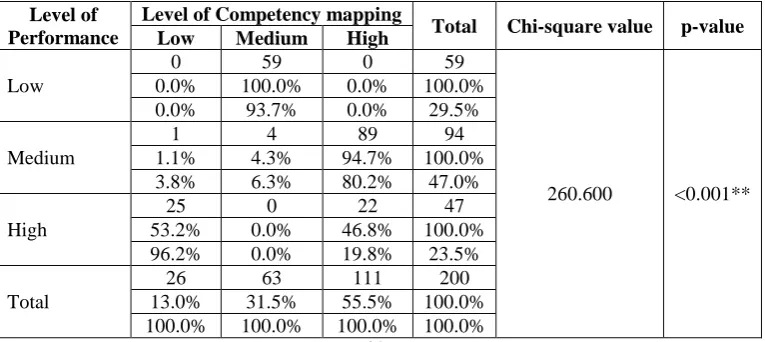
There is no association between level of performance and competency mapping among the employees of selected private sector banks in Chennai city.
Table 2 Chi-square test for whether there is any association between competency mapping and performance
Level of Performance
Level of Competency mapping
Total Chi-square value p-value
Low Medium High
Low
0 59 0 59
260.600 <0.001** 0.0% 100.0% 0.0% 100.0%
0.0% 93.7% 0.0% 29.5%
Medium
1 4 89 94
1.1% 4.3% 94.7% 100.0%
3.8% 6.3% 80.2% 47.0%
High
25 0 22 47
53.2% 0.0% 46.8% 100.0%
96.2% 0.0% 19.8% 23.5%
Total
26 63 111 200
The above table highlights that the results of Chi-square test for whether there is an association between competency mapping and performance among the employees of selected private sector banks in Chennai city. The calculated chi-square value is 260.600 and p-value less than 0.01.Therefore the null hypothesis is rejected at 1% level of significance. Hence it is inferred that there is asignificant association between level of performance and competency mapping among the
employees of selected private sector banks in Chennai city. The study found that the whenever the employee’s competency mapping level increased, the job performance also enhanced in the selected private sector banks in Chennai city.
Null Hypothesis 3
There is no significant difference between male and female respondents concerningfactors of competency mapping among the employees of selected private sector banks in Chennai city. Table 3 Independent t-test for gender and factors of competency mapping
Gender N Mean SD t-value p-value
Relationship Management Male 159 3.76 1.255 0.136 .892 Female 41 3.73 1.119
Communication Male 159 3.66 1.211 0.211 .833
Female 41 3.71 1.470
Task Proficiency Male 159 3.67 1.301 0.178 .859 Female 41 3.71 1.327
Leadership Male 159 3.72 1.233 0.160 .873
Female 41 3.68 1.128
Adaptability Male 159 3.58 1.182 0.819 .414
Female 41 3.76 1.241 Source: Computed from primary survey
Independent t-test for gender and factors of competency mapping among the employees of selected private sector bank employees in Chennai city highlights the above table. It is identified from the above table; the competency mapping factors namely Relationship Management (t-value=0.136 and P value= 0.892),Communication (t-value=0.211 and P value = 0.833), Task Proficiency (t-value=0.178 and P value= 0.859) , Leadership (t-value = 0.160 and P value = 0.873), and Adaptability (t-value= 0.819 and P value = 0.414). All the factors p-values are greater than 0.05, Therefore the null hypothesis accepted at 5% level
of significant. Hence it is concluded that there is no significant difference between male and female respondents with respect to competency mapping factors in private sector bank employees in Chennai city. The study established that both male and female employees are having similar opinion about the competency mapping in selected private sector banks in Chennai city.
Null Hypothesis 4
There is no significant difference among the selected private sector banks with respect to competency mapping among the employees of selected private sector banks in Chennai city Table 4 Analysis of variance test for Banks and Competency Mapping among the Employees
Banks N Mean SD F-value P-value
ICICI Bank 50 3.70 0.785
0.278 0.841 HDFC Bank 50 3.73 0.634
Kotak Mahindra Bank 50 3.60 0.838 Axis Bank 50 3.71 0.876
The above table depicts the results of Analysis of variance test for selected private sector banks and overall competency mapping among the employees of selected private sector banks in Chennai city. It is identified from the above table, the mean range of the selected private sector banks from 3.60 to 3.73 and standard deviation range from 0.634 to 0.876. The calculated F-value is 0.278 and P-value 0.841. The p-value is higher than 0.05, the null hypothesis is accepted at 5% level of
significance. However, it is concluded that there is no significant difference among the selected private sector banks concerning overall competency mapping among the employees of selected private sector banks in Chennai city.
Null Hypothesis 5
There is no correlation between overall competency mapping and job performance among the employees of selected private sector banks in Chennai city.
Table Karl Pearson correlation between overall competency Mapping and job performance among the Employees
Correlations
Overall competency Job Performance Overall competency
Pearson Correlation 1 0.383**
Sig. (2-tailed) .000
N 200 200
Job Performance
Pearson Correlation .383** 1
Sig. (2-tailed) .000
N 200 200
** denotes significant at the 1% level (2-tailed).
Karl Pearson correlation between overall competency mapping and job performance among the employee’s results highlights the above table. It is identified from the above table; the calculated r-value is 0.383 and p-value 0.000 which is less than 0.01. Therefore the null hypothesis rejected and concluded that there is a significant correlation between competency mapping and job performance among the employees of selected private sector banks in Chennai city.
IV.SUGGESTIONS
The selected private sector banks should provide the special training programme for the employees who is having low level competency mapping.
The banks must encourage the employees to share their views to the top management about their needs and grievances.
The banks also can implement communication audit which is an excellent way of finding out how effective the internal and external communications in banks.
The leadership skills of the bank employees should develop by the banks and encouraging them to participate in personality development programmes.
The banks should conduct the simulation training within and outside the bank premises. They can also persuade the employees to take tasks under their leadership.
V.CONCLUSION
proficiency, Leadership, and Adaptability significantly is influencing towards the job performance among the employees selected private sector banks employees in Chennai city. The study also inferred that there is asignificant association between level of performance and competency mapping among the employees of selected private sector banks in Chennai city. The study established that both male and female employees are having similar opinion about the competency mapping in selected private sector banks in Chennai city. The study also found that there is a significant correlation between competency mapping and job performance among the employees of selected private sector banks in Chennai city.
VI.REFERENCES
1) Alessandro Margherita and Giustina Secundo, Competency management in support of organizational change, International Journal of Manpower (2009), Vol.28, No.3/4, pp.260-275. 2) A Study on Mapping of Employees’
Competency (n.d.).
3) Andrew May (1999) Developing management competencies for fast – changing organization, Career Development International, Vol.4, No.6, pp.336-339.
4) Boyatzis R. (1982) The competent manager: a model for effective performance, New York: NY, Wiley Inter science