ISSN (Online): 2320-9364, ISSN (Print): 2320-9356
www.ijres.org Volume 7 Issue 2 Ser. I ǁ 2019 ǁ PP. 33-50
Intervention workshop supportfor Physical Science teachers in
developing exemplary lessons and learning and teaching support
materials for teaching stoichiometry
Desalu D. Denuga
1, Kenneth M. Ngcoza
2and Joyce Sewry
31Department of Mathematics, Science and Sport Education, Faculty of Education, University of Namibia, Katima Mulilo Campus, Private Bag, 1096, Katima Mulilo, Namibia
2 Faculty of Education, Education Department, Rhodes University, South Africa 3Faculty of Science, Chemistry Department, Rhodes University, South Africa
Corresponding author: Desalu D. Denuga
ABSTRACT:
The study investigated six Physical Science teachers from three different High school within Katima Mulilo community about their understanding of and mediation of learning of stoichiometry. All Physical Science teachers teach Physical Science in Zambezi region and volunteered to be part of research process, using participating action research (PAR) within community of practice (CoP). The participants were involved in intervention workshops on the mediation of learning of stoichiometry.The findings of this study further indicated that the community of practice (CoP) members acquired the professional transformations which were important breakthroughs in their careers. Transformation is defined in the Vygotskian framework as those forms of behaviour that are used between people in concrete social interactions (i.e. intermental plane to the forms of individual mental processes i.e. the intramental plane (Eun, 2008). The internalisation process does not occur automatically from a direct transformation of the intermental plane to the intramental plane, but through the use of mediators. The intervention workshops in my study were framed with activities serving as material mediators (artefacts) that aimed to solve stoichiometric problems. So, the collaborative working together of CoP members might lead to their continuing professional development. KEYWORDS: Stoichiometry, Mediation, material mediator, intermental plane, intramental plane intervention-workshop, PAR and CoP.
--- Date of Submission: 22-06-2019 Date of acceptance:08-07-2019 --- --
I.
BACKGROUND AND PURPOSE OF THE STUDY
The focus of this study is on the workshop intervention practices for professional development for the Physical Science teachers. This study further explores how the Physical Science teachers developed and constructed new knowledge about stoichiometry for effective classroom teaching. The study also shows the need for a continuing professional development program for the participating teachers, and it benefited the teachers as such. Ladson-Billings and Gomez (2001) view professional development as the cornerstone of school reform aimed at raising academic performance. They argue that no amount of “standards, benchmarks, and high stake testing can bring about school improvement without giving attention to teacher quality” (p. 680). A study of the current status of CPD program implementation and its trials in government secondary schools of Dire Dawa in Ethiopia (Tisasu, 2014), shows that teachers have a positive attitude towards the CPD. Collaborative engagement, strategies of planning and execution of topic concepts might have encouraged teachers to develop positive attitude towards CPD. The CPD engagement differs from country to country.
Statement of the problem
DNEA yearly examiners‟ reports (Namibia. Ministry of Education, 2000-2015) indicate that conceptual understanding in Stoichiometry is generally poor. This problem might be due to the following factors:
Not enough teaching materials in schools
Inexperience with experiments associated with Physical Science concepts
Lack of confidence in teaching the subject content knowledge in some areas of Physical Science
Overcrowded science classrooms
Absenteeism on the part of learners
Learners not doing their homework.
teachers‟ inadequate subject matter knowledge
www.ijres.org 34 | Page
]
Lack of basic mathematics skills on the part of learners and science teachers, in topics such as ratio,percentages and proportions (Namibia. Ministry of Education, 2000-2015).
Significance of the study
This study addressed an intervention in form of workshops to support Physical Science teachers in developing exemplary lessons for teaching stoichiometry. In the four workshops conducted, various topics were addressed that helped teachers improve their subject matter knowledge (SMK) and pedagogical content knowledge (PCK). These workshop interventions equipped the teachers so that they teach Stoichiometry effectively. The study was necessitated by factors that contribute to the poor performance in Stoichiometry.It might also empower the teachers to develop the learners‟ scientific concepts involved in stoichiometry; this might in turn help more learners to understand stoichiometry and encourage them to major in Science and Technology at a tertiary institution of their choice. The study might also assist the Namibian Ministry of Education‟s policy of teachers‟ placement and improve the skills, learning and teaching capabilities of all the participants including the researcher. Finally, being a lecturer at the university, this study might also help to improve my own practice and ensure that the student teachers studying at the university are competent to teach the topic of stoichiometry.
II.
THEORETICAL FRAMEWORK
Molasso (2006, p. 7), explains that “a theoretical framework refers to the theory that a researcher chooses to guide him/her in his/her research. Thus, a theoretical framework provides direct, practical, and interesting explanations and examples to answer a particular research problem”. To Grant and Osanloo (2014), a theoretical framework is the foundation which is used to construct knowledge in a research study. A theoretical framework is also regarded as a working exemplary allows the researcher to explore the relationships among variables in a logical and prescribed fashion.
Merriam (2009) explains that a theoretical framework is the structure on which research is based. Additionally, a theoretical framework is the vehicle driving all aspects of the research including the research problem, methodology, data analysis and interpretation of the data collected. Miles and Huberman (1994) hypothesise that a theoretical framework is important in the designing of a study as a visual or written product. Thus, the theoretical frameworks informing this study will be the community of practice (CoP), constructivism, namely, Piaget‟s cognitive constructivism and Vygotsky„s social constructivism, and Shulman‟s pedagogical content knowledge (PCK) as discussed below.
Research goal
The main goal of the study would be to co-develop exemplary lessons, worksheets, as well as learning and teaching support materials (LTSMs). Thus the study sought to address the following research objectives:
Explore subject matter knowledge (SMK) and PCK;
Enhance research skills and
Collaboration among thecommunity of practice (CoP) members even beyond the study,with the aim of improving the teaching and learning of stoichiometry.
I also recognised that improvement could only be achieved by active participation (Sedláček& Sedova, 2017) and commitment of all the Physical Science teachers within the community of practice. In the Zambezi Region where the research was conducted, 14 Physical Science teachers completed the questionnaires, but on my supervisor‟s advice only six Physical Science teachers I worked with participated in the study.
Research Design
According to Polict, Beck and Hungler (2001), a research design is a “researcher‟s overall strategy for answering the research questions or testing the research hypothesis” (p. 167). Research design incorporates samples, participants, method of data gathering, research instruments and implementation procedures of the instruments, data analysis and paradigm.
Selection of Participants
For the study, the professional development intervention involve a sample of six Physical Science teachers selected from three schools in the Zambezi Region.There were about 60 volunteered grade 11 participating learners(20 per school), who weretaught by these teachers using „afterschool science enrichment approach‟ (Agunbiade, 2015).
Method of data generations
Creswell et al. (2016) argue that methods are the tools that researchers use to collect data. The tools enable researchers to gather data about social reality from individuals, groups, and texts in any medium. This study made use of the following data gathering tools: workshop discussions with reflective notes with teachers, and lesson observations as well as research journal done by some of the participating teachers, and me. As emphasized by Cohen, Manion, and. Morrison, (2011), the use of a variety of data generating techniques afforded me an opportunity to triangulate the data. Also as a researcher, keeping the research question in mind was of paramount importance because more than one method gave valuable data. Below is a table that summarises data generating methods used for this study.
Table 1: Data generation methods
Method/instruments Purpose Actors
Workshop discussions Working together collaboratively to develop LTSMs and to construct knowledge
Six physical science teachers plus the researcher.
Videotaped lesson observations To test the LTSMs for the teaching of stoichiometry.
To critique the teaching methods through collaborative efforts.
3 physical science teachers from the 3 schools and the Researcher.
Research journal Recording experiences and challenges during the research journey.
All research participants
Activities and results of the study Intervention Workshop 1
The participating teachers shared their experiences about the teaching of stoichiometry in their schools. During the intervention workshopsome difficult stoichiometry concepts were identified, these were in line with the findings of Furio, et al., (2002). The identified difficult stoichiometry concepts concurred with the results of the diagnostic achievement test questions answered by the learners.
The difficult stoichiometry problems were harmonized with some other researchers who came up with ideas about the stoichiometry concept difficulties, listed below.
Limiting and excess reagent. (Gauchon and Méheut,(2007)
Calculations of moles(BouJaoude, & Barakat, (2003).Chandrasegaran, et al., 2009) Concentration formula to calculate moles in solution (BouJaoude and Barakat, 2000) Ratio calculationof moles in Stoichiometry(Dahsah and Coll, 2008)
Empirical andMolecular formula calculations (BouJaoude and Barakat, 2000) Percentage composition(Gilbert, 1998)
STPStandard Temperature and Pressure
Balancing of equation (Tóth and Kiss, 2005) Actual yield and Theoretical yield. (Hanson, 2016)
We carried out an experiment as community of practice (CoP) members to respond to a question raised by one of the teachers on limiting and excess reagent. Below is the experiment:
Materials: Candles, Beakers, matches, flat table or flat object, air (within laboratory)
Step 1: Two burning candles were setup and lit as seen in Figure 6.2, having enough supply of wax and air (Oxygen).
Step 2: One of the two burning candles was covered with beaker (Figure 6.3). Air access controlled.
www.ijres.org 36 | Page
]
Figure 1:Both candles where burning, having supply of air and fuel (nothing was limiting the combustion).Figure 2:One of the burning candles was covered with Beaker, limiting the access of air to the burning candle.
III.
CONCLUSION:
There is limited supply of air to the burning candle and it went off.The experiment showed that a limiting reagent is the substance that finishes first when carrying out experiments involving chemical reactions. In Figure 2, where one of the burning candles was covered, a beaker limited the air (oxygen) access to the wax in the burning candle and it went off. The other candle continued burning because nothing limits the supply of air.
Intervention Workshop 2
Box 1:Stoichiometry mapping by teacher 1, supported by other CoP members
www.ijres.org 38 | Page
]
Box 2: Basic Mathematics lesson plan12
40
= 0.3
BASIC MATHEMATICS OPERATION 1
Objective:
To teach the
basic
mathematics operations for real numbers on addition,
subtraction,
Multiplication, and division to learners
Introduction:
The four basic mathematical operations--addition, subtraction, multiplication, and
division--have application even in the most mathematical theories. Thus, mastering
them is one of the keys to enhance the understanding of mathematics that can be
applied in the teaching of Stoichiometry in chemistry.
Basic Mathematics (operational) for stoichiometry
The purpose of this Basic Mathematics is to review basic mathematics operational
concepts so that learners will be able to enhance the learning of stoichiometry. This
will be fundamental to better prepare the learners for the stoichiometry concepts.
Step 1
: Introduce the Basic Mathematics to learners by reviewing the material and
working through problems.
Step 2
: Mention the Basic Mathematics Refresher concepts (I) Fractions and
Decimals, (II) Percentages (III) Order of Arithmetic Operations; (lV) Basic Algebra
Step 3: Content to be covered.
Fractions and Decimals
Fractions, decimals and percentages are all numbers that represent a part of the whole.
We often
need to convert from fractions to decimals or from decimals to fractions.
Example:
Fraction Decimal
Converting a fraction to a decimal
Divide the
numerator
(the top number) by the
denominator
(the bottom number)
using your
Calculator.
This fraction is necessary when calculating the number of moles (n) in a given sample,
molarity or concentration of samples.
Numerator is the mass of a given sample.
Denominator is the molar mass of the given sample as obtained from periodic table of
elements.
Box 3: Basic Mathematics Operation in stoichiometry calculations.
Box 5: Some highlights on calculation of moles by T2
Teacher 2 explained the Mole concept by defining the mole concept explicitly as seen in Box 5using the lesson plan in Box 4. Representation was used to make the mole concept very easy to understand. He supported the teaching with representation for other Physical Science to visualise the meaning of moles (Evagorou, Erduran, & Mäntylä, 2015). From theserepresentations a game was developed by the Physical Science teacher for others to play. T2 further explained that learners might learn better and improve their skills and understanding when they practice all types of stoichiometry games. Wright, Betteridge and Buckby (2005) mention that games provide a context for meaningful scientific communication, which takes place as the learners seek to understand how to play and communicate through the game. By playing games, learners are offered a practice as conventional drill exercises, but in a more meaningful way to improve their stoichiometry concepts. By doing so, learners might be immersed in using the stoichiometry language concepts, which could assist them to better internalise a newly constructed stoichiometry concept as reiterated by Vygotsky (1978).
Moles triangular game
How to play the moles triangular game: 1. Have a periodic table at hand;
2. Have the masses or moles of substance at hand or develop yours;
3. Two out of the components of triangular stoichiometry mole house must be known; 4. The game is played by three people with calculators in their hands;
www.ijres.org 42 | Page
]
7. 3rd player tells you what to do and gives points to the first person to give the correct answer, 2 points for correct answer and 0 for wrong answer; and
8. Approximate the answer obtained to the nearest ten.
The constructed triangle Figure 3 houses all the tenets of moles calculating components.
Figure 3: Formula triangle for calculating moles
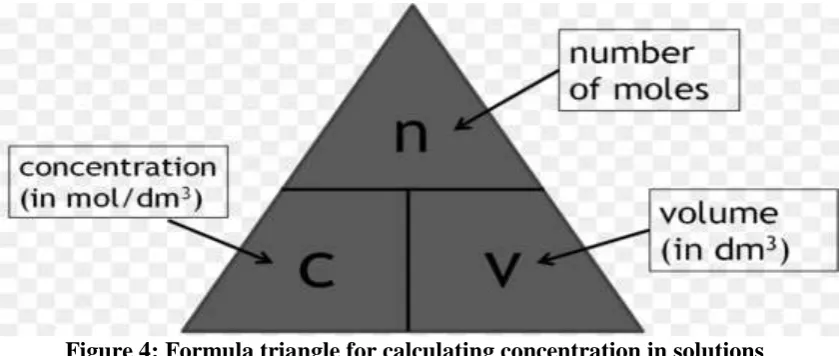
The formula triangle representation can be used to explain the concept of moles, concentration and volume in solutions. This representation in the teaching of stoichiometry was very helpful, and it was seen during the time learners answered the diagnostic achievement test questions. It could be inferred that using representations during the teaching of stoichiometry enhances effective teaching and learning of stoichiometry.
Figure 4: Formula triangle for calculating concentration in solutions
The game that was played to explain moles calculations was very interesting. After playing the game, the use of analogies became popular among the teachers. As a result, all the teachers were actively engaged in playing it during the second activity. Examples of moles calculations were carried out using the game analogue.
Workshop 3, learning and teaching support materials (LTSMs)
This activity was as per request by teacher 5 who asked that the CoP members be taught how to make learning and teaching support materials (LTSMs).I facilitated how LTSMs are developed.
Development of learning and teaching support materials
Procedures of LTSMs making during the workshop
As agreed before, I discussed with the community of practice (CoP) members how to make LTSMs. I quickly prepared a lesson plan on the methods of preparing LTSMs using available materials. The lesson was on how to make the electronic structure of an element.
Box 6: Some highlights on exemplary lesson plan of electronic structure of element
www.ijres.org 44 | Page
]
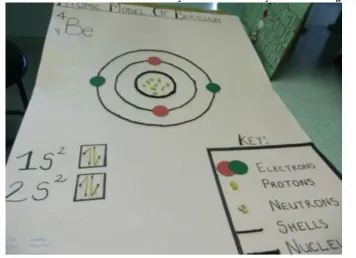
Figure 5: LTSM of the electronic structure of Magnesium constructed by CoP members groupFigure 6: LTSM of the electronic structure of Beryllium constructed by CoP members group 2
Reflections on the LTSMof electronic configuration construction
example, the matchsticks were used to show a pair of electrons in the orbit, coloured papers to beautify the LTSM and cardboard to house the electronic configuration. Bottle tops were used to show the position of electrons within the shell, marker pens were used for drawing, threads for making shells and seeds (to show the protons and neutrons).
Workshop 4
Workshop 4 was on percentage composition of substances and was presented by teacher 5.Below is the lesson plan prepared by T5 on percentage composition. T5 made use of an analogy representation in teaching the percentage composition.
Box 7: Highlights on practical analogue on percentage composition procedures
The analogy practical seemed to be an eye-opener on the teaching of stoichiometry. One of the teachers (T4) said that if this workshop could be extended it would enhance their SMK and PCK. After the presentation and reflection by T5, I facilitated balancing of chemical equations during the workshop, and I used the generic method of balancing chemical equations.
Lesson plan on balancing chemical equations
www.ijres.org 46 | Page
]
Box 8: Lesson plan for the balancing of chemical equationDuring the activity, Teacher 1 presented an equation that they failed to balance in class. ____ AlBr3 + ____ K2SO4 ____ KBr + ____ Al2(SO4)3
Balanced equation: 2 AlBr3 + 3 K2SO46 KBr + Al2(SO4)3
www.ijres.org 48 | Page
]
Box 10: Using algebraic method to balance equation
The algebraic method of balancing equations is the newest chemical equation balancing method and when fully understood, balancing of equations would be very easy.
Findings from the intervention
The findings of this study further indicated that the community of practice (CoP) members acquired the professional transformations which were important breakthroughs in their careers. Transformation is defined in the Vygotskian framework as those forms of behaviour that are used between people in concrete social interactions (i.e. intermental plane to the forms of individual mental processes i.e. the intramental plane (Eun, 2008). The internalisation process does not occur automatically from a direct transformation of the intermental plane to the intramental plane, but through the use of mediators. The intervention workshops in my study were framed with activities serving as material mediators (artefacts) that aimed to solve stoichiometric problems. So, the collaborative working together of CoP members might lead to their continuing professional development. The CoP members in my study also were the human mediators enhancing transformation that resulted in higher forms of mental functions leading to their continuing professional development (CPD).
The findings of this study revealed the zone of proximal development (ZPD) of participating teachers, coming from different backgrounds and having the ability to do certain skills before the intervention. ZPD is not only for learners, but it can be applied to teachers as well. In this study the zone of proximal development enabled teachers to define their immediate needs and the shifting developmental status, which necessitated the need for the workshop intervention.
IV.
RECOMMENDATIONS
The study focused on the influence of the intervention workshops with the view to improving the six Physical Science teachers‟ practice within a community of practice (CoP) in the Zambezi Region. The results illuminated the fact that the role and importance of the workshops and continuing professional development (CPD) cannot be overstated within a CoP.
Arising from this study, I thus offer the following recommendations for consideration by lecturers, teachers (curriculum implementers), school principals, inspectors, continuing professional development initiators and educational policy developers.
Teachers should develop effective teacher professional development activities such as study teams, cluster teaching, and peer coaching where teachers are expected to examine their assumptions and practices continuously;
Teachers should engage in hands-on practical activities to put more emphasis on the concepts 'to be innovative' and 'to be critical', during classroom teaching of stoichiometry;
The use of relevant teaching materials in the teaching and mediation of learning stoichiometry might be associated with a shift towards the use of TSPCK tenets for the teaching of stoichiometry concepts;
This study afforded learning opportunities for Physical Science teachers and such experiences resulted in positive learning experiences for their learners in the long run as well. I therefore recommend that Physical Science teachers should promote CPD-updating bottom-up, for school management to enhance their professional development.
From my own perspective, it is my contention that while engaging teachers in a continuing professional development (CPD), using participatory action research (PAR) within a CoP, should be done with care. I therefore recommend that university lecturers, senior education officers such as inspectors or subject advisers, who are knowledgeable about continuing professional development (CPD), should be part of a CoP.
I recommend that teachers develop LTSMs for any academic or non-academic classroom presentations for their continuing professional development (CPD) provided it enhances learning.
Concluding Remarks
This study presented, analysed and discussed the intervention workshops and some reflections that emerged as a result of the activities. Findings and recommendationwere discussed.
REFERENCES
[1]. Asheela, A. (2017). An intervention on how using easily accessible resources to carry out hands -on practical activities in science influences science teachers‟ conceptual development and dispositions. Unpublished master‟s thesis, Education Department, Rhodes University, Grahamstown.
[2]. Bertram, C., & Christiansen, I. (2015). Understanding research: An introduction to reading research. Pretoria: Van Schaik Publishers.
[3]. BouJaoude, S., & Barakat, H. (2003). Students‟ problem-solving strategies in stoichiometry and their relationship to conceptual understanding and learning approaches. Electronic Journal of Science Education, 7(3), 23 -29.
[4]. Bušljeta, R. (2013). Effective use of teaching and learning resources. Czech-Polish Historical and Pedagogical Journal, 5(2), 55-69.
[5]. Chandrasegaran, A. L., Treagust, D. F., Waldrip, B. G. & Chandrasegaran, A. (2009). Students‟dilemmas in reaction Stoichiometry problem-solving: deducing the limiting reagent in chemical reactions. Chemistry Education Research and Practice, 10, 14-23.
[6]. Cohen, L., Manion, L.,& Morrison, K. (2011).Research methods in education (7thed.)London: Routledge.
[7]. Creswell, J. W., Ebersöhn, L., Eloff, I., Ferreira, R., Ivankova, N.V., Jansen, J. D. , Nieuwenhuis J., …& Plano Clark, V. L. (2016). First steps in research. Pretoria: Van Schaik Publishers.
[8]. Croteau, J., Fox, W. P., & Varazo, K. (2007) Mathematical modelling of chemical stoichiometry. PRIMUS, 17(4), 301 -315. [9]. Dahsah, C.,& Coll, R. K. (2007). Thai grade 10 and 11 students‟ conceptual understanding and problem-solving ability in
stoichiometry. Research in Science and Technology Education, 25, 227-241.
[10]. Eun, B. (2008). Making connections: Grounding professional development in the developmental theories of Vygotsky. The Teacher Educator, 43(2), 134-155.
[11]. Evagorou, M., Erduran, S., & Mäntylä, T. (2015). The role of visual representations in scientific practices: from conceptual understanding and knowledge generation to „seeing‟howscience works. International Journal of STEM Education, 2(1), 11. [12]. Furio, C., Azcona, R., & Guisasolo, J. (2002). The learning and teaching of the concepts “amount of substance” and “mole”:
A review of the literature. Chemistry Education:Research and Practice in Europe, 3(3), 277-292.
[13]. Gauchon, L. & Méheut, M. (2007). Learning about stoichiometry: from students‟ preconceptions to the concept of limiting reactant. Chemistry Educational Research and Practice, 8(4), 362-375
[14]. Gilbert, G. L. (1998) Percent composition and empirical formula.Journal of Chemical Education, 75(7), 851. doi:10.1021/ed075p851
[15]. Grant, C., & Osanloo, A. (2014). Understanding, selecting, and integrating a theoretical framework in dissertation research: Creating the blueprint for your “house.”Administrative Issues.Journal Education Practice and Research, 4(2),12-26. doi.org/10.5929/2014.4.2.9
www.ijres.org 50 | Page
]
[17]. Ladson-Billings, G., & Gomez, M, L. (2001). Just showing up: Early literacy through teachers5 professional communities. PhiDelta Kappan, 82(9), 675-680.
[18]. Merriam, S. B. (2009). Qualitative research: A guide to design and implementation. San Francisco: Jossey-Bass.
[19]. Mertens, D. M. (1998). Research methods in education and psychology: Integrating diversity with quantitative and qualitative approaches. Thousand Oaks: Sage Publications.
[20]. Miles, M. B., & Huberman, A. M. (1994). Qualitative data analysis. Beverly Hills: Sage Publications. [21]. Molasso, W. R. (2006). Theoretical frameworks in qualitative research. Journal of College and Character, 7, 7.
[22]. Namibia. Ministry of Basic Education and Culture. (2000-2015). Physical Science Examiners Report on the examination: Namibia Senior Secondary Certificate. Windhoek, DNEA.
[23]. Polit, D.F.,& Beck, C.T., & Hungler, B. P. (2001)Essential of nursing research: Methods, appraisal, and utilization.Philadelp hia, PA: Lippincott Williams & Wilkins.
[24]. Sedlacek,M. & Sedova, K. (2017). How many are talking? The role of collectivity in dialogic teaching. International Journal of Educational Research,85, 99-108.
[25]. Tisasu, T. (2014). The current status of continuous professional development program implementation and its challenges in Government Secondary Schools of Dire Dawa City Administration. Unpublished master‟s thesis,Department of Educational Planning and Management, School of Graduate Studies, Haramaya University, Haramaya, Ethiopia.
[26]. Tóth, Z., & Kiss, E. (2005). Hungarian secondary school‟ strategies in solving stoichiometric problems.Journal of Science Education - Revista de educaciónenciencias, 6, 47-49.
[27]. Vygotsky, L. S. (1978). Mind in society: The development of higher psychological processes.Cambridge, MA: Harvard University Press.
[28]. Wright, A., Batteridge, D., & Buckby, M. (2005).Games for language learning (3rded.).New York:Cambridge University Press.