Iran J Public Health, Vol. 45, No.7, Jul 2016, pp.875-884
Original Article
Development and Validation of a Disease Severity Scoring Model
for Pediatric Sepsis
Li HU
1, *Yimin ZHU
2, Mengshi CHEN
3, Xun LI
1, Xiulan LU
3, Ying LIANG
1,
*Hongzhuan TAN
11. School of Public Health, Central South University, Changsha, P. R. China
2. Institute of Emergency Medicine, People's Hospital of Hunan Province, Changsha, P. R. China 3. Pediatric Intensive Critical Unit, Children's Hospital of Hunan Province, Changsha, P. R. China
*Corresponding Author: Email: [email protected]
(Received 10 Sep 2015; accepted 24 Jan 2016)
Introduction
Sepsis is systemic inflammatory response syn-drome (SIRS) resulting from a wide spectrum of infectious agents. This condition can further lead to severe sepsis and septic shock, and now it is the focus and challenge of critical care medicine (1,2). Recent data have shown that 18 million of new sepsis cases occur each year worldwide, with a high fatality rate of 30% (3, 4). The situation in children is even worse. Children especially infants are at high-risk of sepsis (5). They also have the highest fatality rate, especially those with severe sepsis (6, 7). Recent
data suggests that sepsis and its induced septic shock and multiple organ dysfunctions (MODS) are among the leading causes of admission to intensive care units (ICUs) and it leads to an extremely high fatality rate in pediatric intensive care unit (PICU) (8,9).
The key to decrease the fatality rate of pediatric sepsis, especially severe sepsis, is early diagnosis, accurate assessment and timely treatment. How-ever, the diagnosis of sepsis and evaluation of its severity only based on clinical signs and symptoms Abstract
Background: Multiple severity scoring systems have been devised and evaluated in adult sepsis, but a simplified scor-ing model for pediatric sepsis has not yet been developed. This study aimed to develop and validate a new scorscor-ing model to stratify the severity of pediatric sepsis, thus assisting the treatment of sepsis in children.
Methods: Data from 634 consecutive patients who presented with sepsis at Children’s hospital of Hunan province in China in 2011-2013 were analyzed, with 476 patients placed in training group and 158 patients in validation group. Stepwise discriminant analysis was used to develop the accurate discriminate model. A simplified scoring model was generated using weightings defined by the discriminate coefficients. The discriminant ability of the model was tested by receiver operating characteristic curves (ROC).
Results: The discriminant analysis showed that prothrombin time, D-dimer, total bilirubin, serum total protein, uric acid, PaO2/FiO2 ratio, myoglobin were associated with severity of sepsis. These seven variables were assigned with values of 4, 3, 3, 4, 3, 3, 3 respectively based on the standardized discriminant coefficients. Patients with higher scores had higher risk of severe sepsis. The areas under ROC (AROC) were 0.836 for accurate discriminate model, and 0.825 for simplified scoring model in validation group.
Conclusions: The proposed disease severity scoring model for pediatric sepsis showed adequate discriminatory capac-ity and sufficient accuracy, which has important clinical significance in evaluating the severcapac-ity of pediatric sepsis and predicting its progress.
such as temperature, heart rate and respiratory rate is quite difficult, due to its untypical and di-verse clinical signs as well as the complex and dy-namic pathophysiologic process (10). Failure to recognize the severity of illness in the early course of disease may lead to inappropriate disposition or treatment. Therefore, it is of utmost importance to develop a clinical tool that is more accurate and objective than clinicians’ experience to stratify se-verity of sepsis (11). In 2001, the North American and European sepsis definitions conference pro-posed the PIRO (predisposition, infection, re-sponse, organ dysfunction/failure) concept with the suggestion that sepsis could be stratified on the basis of easily measured biological indicators in a way similar to cancer, with the TNM (Tumor Node Metastasis) staging system (12).
In recent years, severity stratification scoring sys-tems such as Acute Physiology and Chronic Health Evaluation II (APACHEII), Sequential Organ Failure Assessment (SOFA), Pediatric Risk of Mortality (PRISM) score have been applied to various septic populations (13,14). These scoring systems indeed played a part in assessing sepsis in children with relatively comprehensive parameters. However, they were computationally complex and devised either for adult patients or for general critical disease, and mainly focus on the prediction of sur-vival or death (15,16), thus not suit for pediatric sep-sis. Moreover, because of important differences be-tween adults and children with respect to co-morbidities, organ failure, and baseline mortality rate, efficacy from adults may not be generalized to chil-dren(5).
To our knowledge, scoring model established spe-cifically for pediatric septic patients with high clin-ical application value has not yet been reported. The aim of this study was to develop a scoring model based on selected objective variables with high specificity and sensitivity, to aid severity as-sessment in children with sepsis.
Materials and methods
Study Population
Patients presenting with sepsis were retrospec-tively recruited from the PICU in Children’s
hos-pital of Hunan province between Mar 2011 and Mar 2013. This hospital is the only comprehensive children’s hospital in this province, with 80 PICU beds and over 200 two-way referral hospitals. More than 80% of the serious children patients in Hunan province were admitted in this hospital. So, the patients in this hospital are highly representa-tive of all serious children patients in Hunan prov-ince. Electronic management was implemented for all medical records in this hospital with complete and reliable information, which guaranteed the quality of data.
All selected patients met the pediatric-specific diagnostic criteria for sepsis established by the international pediat-ric sepsis consensus conference(17). In this study, mild sepsis refers to all sepsis except severe sepsis.
Patients who had been admitted for less than 24 h, and patients with important information such as age, gender and prognosis missing were excluded. To develop the scoring model, 75% of the pa-tients were randomly assigned to the training group and the remaining 25% to the validation group, according to their admission number. We used the training group to establish the model, and the validation group to evaluate the model.
Data collection
brain natriuretic peptide etc.). All variables were measured with international standard methods. This study was approved by Xiangya Medical School Research Ethics Committee, Changsha, China. We didn’t get written or verbal informed consent from participate or the next of kin, care-takers, or guardians on behalf of the mi-nors/children since we have not access the pa-tients. No any potential harm to the participants was apparent. To ensure anonymity, every partici-pant was consecutively assigned an identification number, used for further analysis.
Statistical Analysis
Collection and analysis of data were performed with Epidata3.0 and SPSS 17.0. Regression esti-mation technique was used to impute the missing values (the proportion of data missing for indi-vidual variables was less than 5%). Results are pre-sented as numbers with percentages in parenthe-ses for categorical variables and mean (±SD) or median (quartiles) for continuous variables. Un-ivariate analysis was used to select a subset of pre-dictors associated with sepsis severity at P<0.1 level to be considered for inclusion in the multiva-riable scoring model. Statistical differences in quantitative data were determined using the Stu-dent’s t-test. Variables with nonsymmetrical dis-tributions were evaluated using the Mann-Whitney test. Pearson’s chi-square test was used for qualita-tive data.
Continuous variables were categorized to binary or categorical indicators required for a clinically useful scoring system in sepsis. Multivariate sis was performed by stepwise discriminant analy-sis to identify variables independently associated with the severity of sepsis (α=0.05, β=0.1). We established the accurate discriminate model based on the discriminant coefficients resulting from the stepwise discriminant analysis. The simplified scor-ing model was developed based on standardized ca-nonical discriminant coefficients obtained from dis-criminant analysis, with the general rule of multiply-ing the coefficients by 10 and round off to the near-est integer.
To assess the accuracy of the models, we calcu-lated the sensitivity (Sn) and specificity (Sp), and
then constructed receiver operating characteristic (ROC) curves by plotting the Sn against (1-Sp) at different cutoff value. The discriminant perfor-mance of the scoring systems was assessed by the area under the ROC curve (AROC), with values close to 1.0 indicating high diagnostic accuracy. We determined the best cutoff value of the model according to the Youden index.
Results
Characteristics of Patients
During the 2-year study period, 687 patients ad-mitted to PICU met the criteria of sepsis or severe sepsis, of whom 43 (6.3%) were excluded for less than 24 h of hospital stay. Another 10 (1.5%) children were excluded for incomplete infor-mation. 634 children were included in the final analysis, with a response rate of 92.3%.
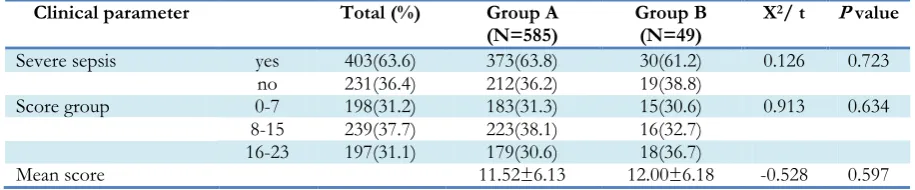
Of the 634 patients, 231 (36.4%) had severe sepsis. 424 (66.9%) patients improved or recovered, 49 (7.7%) gave up treatment and were discharged, and 161(25.4%) patients died. The average age was 16.9土24.4 months (range 1 month to 14 yr) and 65.3% were male. We randomly assigned all patients to the training group and validation group. The two groups had no statistical difference in gender, age, length of hospital stay, mechanical ventilation, blood culture; cause of sepsis and the proportion of patients with severe sepsis (Table 1). A total of 585 patients were included in the prog-nostic analysis due to 49 cases (7.7%) were aban-doned or left hospital voluntarily with no available prognostic information. We compared the initial characteristic between the included 585 patients and the excluded 49 patients. Table 2 reveals that there were no statistic difference in sepsis severity and mean score between the two group (P>0.05), which indicated that our results resulted from the remained sample may be reliable.
Univariate analysis in the training group
res-piratory rate, platelets, potassium, capillary refill time, prothrombin time, PaO2/FiO2 ratio, base
ex-cess, blood lactate, total bilirubin, serum total pro-tein, alanine aminotransferase, urea nitrogen, crea-tinine, uric acid, myoglobin, proealcitonin, brain natriuretic peptide, and troponin.
Discriminant analysis and discriminant model
The nineteen statistically significant factors identi-fied by the univariate analysis were taken to Fisher
stepwise discriminant analysis to construct a dis-criminant function (Table 4). As a result, seven variables were retained in the final discriminant model, including prothrombin time, D-dimer, PaO2/FiO2 ratio, total bilirubin, serum total
pro-tein, uric acid and myoglobin.
These results can be presented in the form of the following equation to establish the accurate discri-minant model for severe sepsis:
Table 1: Clinical characteristics of patients in the training and validation groups*
Clinical parameter Total (%) Training
group(N=476) group(N=158) Validation X
2 P
val-ue
Gender Male 414(65.3) 313(65.8) 101(63.9) 0.176 0.675
Female 220(34.7) 163(34.2) 57(36.1)
Age 1 month~ 511(80.6) 380(79.8) 131(82.9) 0.846 0.655
1 year~ 90(14.2) 71(14.9) 19(12.0)
5-14 year 33(5.2) 25(5.3) 8(5.1)
Length of
PICU stay (days) 1-3 111(17.5) 76(16.0) 35(22.2) 3.156 0.206
4-7 151(23.8) 116(24.4) 35(22.2)
>7 372(58.7) 284(59.6) 88(55.6)
Mechanical ventilation yes 295(46.5) 222(46.6) 73(46.2) 0.009 0.924
no 339(53.5) 254(53.4) 85(53.8)
Severe sepsis yes 231(36.4) 172(36.1) 59(37.3) 0.075 0.785
no 403(63.6) 304(63.9) 99(62.7)
*Results are presented as numbers with percentages in parenthesis
Table 2: Characteristic of the included 585 patients and excluded 49 patients
Clinical parameter Total (%) Group A
(N=585) Group B (N=49) X
2/ t P value
Severe sepsis yes 403(63.6) 373(63.8) 30(61.2) 0.126 0.723
no 231(36.4) 212(36.2) 19(38.8)
Score group 0-7 198(31.2) 183(31.3) 15(30.6) 0.913 0.634
8-15 239(37.7) 223(38.1) 16(32.7)
16-23 197(31.1) 179(30.6) 18(36.7)
Mean score 11.52±6.13 12.00±6.18 -0.528 0.597
*Group A: 585 patients included in the prognostic analysis;
Group B: 49 patients excluded in the prognostic analysis due to lack of prognostic information
Z=-7.312+0.702*X11 (total bilirubin) +0.634* X15
(uric acid) +0.680* X6 (D-dimer) +0.934*X12 (serum
total protein) +0.795*X5 (prothrombin time) +0.616*X16 (myoglobin) +0.551*X7 (PaO2/FiO2 ratio).
The average discriminant function value for se-vere sepsis group was Za=0.45, and for mild
sep-sis group was Zb=0.92, distinguishing value Zc=( Za +Zb )/2= (0.45 + 0.92) / 2 = 0.24. Thus,
Zi ≥ 0.24 was discriminated as severe sepsis, and
Table 3: Univariate analysis of suspected factors of severe sepsis in training group (476 patients)
Variables Mild sepsis
(N=304) Severe sepsis (N=172)
P value
Gender * 0.553
Male 203 (66.8) 110 (64.0)
Female 101 (33.2) 62 (36.0)
Age* 0.723
1 month~ 241 (79.3) 139 (80.8)
1 year~ 48 (15.8) 23 (13.4)
5 year~ 15 (4.9) 10 (5.8)
D - dimer* 0.000
positive 97 (31.9%) 109 (63.4%)
negative 207 (68.1%) 63 (36.6%)
Temperature (℃)† 38.5±1.0 38.4±1.3 0.668
HR (beats/min)† 153.7±24.4 161.2±31.8 0.008
Respiratory rate (breaths/min)† 44.2±12.3 47.8±13.8 0.004
Platelets (×10^9/l) † 347.4±184.2 270.7±180.8 0.000
Potassium (mmol/l)† 4.0±0.7 4.3±1.1 0.007
Systolic pressure (mmHg) 90(85-104) 89(82-105) 0.240
Capillary refill time(secs) 2 (1-5) 3 (2-10) 0.000
Leukocyte (×10^9/l) 12.9 (8.3-17.1) 12.8 (7.7-18.9) 0.686
PT(secs) 13.4 (12.4-14.3) 16.0 (13.7-20.4) 0.000
PaO2/FiO2 ratio 372 (250-444) 219 (332-400) 0.000
Base excess -2.5 (-5.4-0.5) -6.5 (-12.4~-1.0) 0.000
Blood lactate (mmol/l) 1.2 (0.9-1.9) 2.1(1.1-4.68) 0.000
PFG (mmol/l) 5.6 (4.6-6.7) 5.3 (4.1-7.0) 0.176
Sodium (mmol/l) 135 (133-138) 135 (131-138) 0.484
Total bilirubin (umol/l) 7.2 (5.1-11.5) 9.8 (6.5-18.3) 0.000
Serum total protein (g/l) 59.9 (54.9-65.3) 54.5 (46.9-60.0) 0.000
ALT (IU/L) 26.0 (17.2-41.7) 51.9 (28.0-137.3) 0.000
BUN (mmol/l) 3.6 (2.7-5.2) 6.5 (3.7-11.1) 0.000
Cr (umol/l) 27.4 (21.4-34.1) 40.5 (26.3-85.5) 0.000
Uric acid (umol/l) 194 (120-286) 304.5 (132-570) 0.000
Myoglobin (μg/l) 55.7 (22.0-107.3) 152.5 (49.4-774.4) 0.000
PCT (ng/ml) 0.70 (0.16-3.50) 6.17 (1.04-59.87) 0.000
BNP(pmol/l) 734 (281-2404) 7723 (1335-21379) 0.000
CRP(mg/l) 11.1 (2.3-38.1) 13.7 (2.31-51.5) 0.288
Troponin (ng/ml) 0.015 (0.004-0.075) 0.043 (0.004-0.28) 0.007
*Binary and categorical data are presented as n and percentages of totals, using the Pearson’s chi-square test/† Normally distributed data are presented as mean (±SD), using Student’s t-test/ Other nonsymmetrical distributed continuous data are presented as medians and 25th to 75th percentile ranges, using Mann-Whitney test/HR: Heart rate; ALT: alanine aminotransferase; PT: prothrombin time; PFG: fasting plasma glu-cose (FPG); BUN: Urea nitrogen; Cr: Creatinine; PCT: proealcitonin; BNP: Brain natriuretic peptide; CRP: C-reactive protein
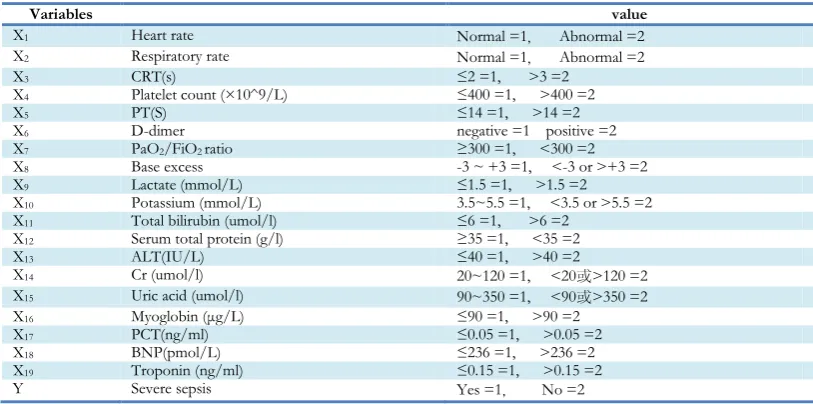
Table 4: Evaluation of the categorical variable*
Variables value
X1 Heart rate Normal =1, Abnormal =2
X2 Respiratory rate Normal =1, Abnormal =2
X3 CRT(s) ≤2 =1, >3 =2
X4 Platelet count (×10^9/L) ≤400 =1, >400 =2
X5 PT(S) ≤14 =1, >14 =2
X6 D-dimer negative =1 positive =2
X7 PaO2/FiO2 ratio ≥300 =1, <300 =2
X8 Base excess -3 ~ +3 =1, <-3 or >+3 =2
X9 Lactate (mmol/L) ≤1.5 =1, >1.5 =2
X10 Potassium (mmol/L) 3.5~5.5 =1, <3.5 or >5.5 =2
X11 Total bilirubin (umol/l) ≤6 =1, >6 =2
X12 Serum total protein (g/l) ≥35 =1, <35 =2
X13 ALT(IU/L) ≤40 =1, >40 =2
X14 Cr (umol/l) 20~120 =1, <20或>120 =2
X15 Uric acid (umol/l) 90~350 =1, <90或>350 =2
X16 Myoglobin (μg/L) ≤90 =1, >90 =2
X17 PCT(ng/ml) ≤0.05 =1, >0.05 =2
X18 BNP(pmol/L) ≤236 =1, >236 =2
X19 Troponin (ng/ml) ≤0.15 =1, >0.15 =2
Y Severe sepsis Yes =1, No =2
Table 5: Simplified scoring model developed based on the accurate discriminate model
Variables Coefficient* Score value†
PT(S) 0.367 ≤14 =0 >14 =4
D-dimer 0.318 negative =0 positive =3
PaO2/FiO2 ratio 0.270 ≥300 =0 <300 =3
Total bilirubin (umol/l) 0.312 ≤6 =0 >6 =3
Serum total protein(g/l) 0.450 ≥35=0 <35 =4
Uric acid (umol/l) 0.295 90~350 =0 <90 or >350 =3
Myoglobin (μg/L) 0.287 ≤90 =0 >90 =3
*Coefficient: standardized canonical discriminant coefficients
† The score is 0 if the variable is normal; for abnormal variables, the score equals to the coefficients multiplied by 10 and rounded to the nearest integer.
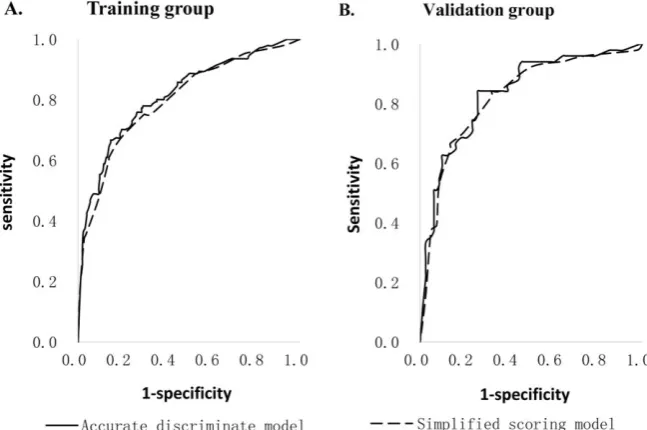
The performance of the discriminant model in discriminating mild sepsis and severe sepsis was estimated both in the training sample and valida-tion sample using ROC curves. The AROCs (Fig.1A) of accurate discriminate model were 0.816 (95% CI 0.771 to 0.861) in the training group and 0.836 (95%CI 0.765 to 0.907) in the
validation group. For simplified scoring model, the AROC remained relatively high with AROC 0.800 (95%CI: 0.753~0.846) in the training set and 0.825 (95%CI: 0.750~0.899) in the validation set (Fig.1B). Such large areas are generally ac-knowledged to be of excellent discrimination.
Fig.1 Receiver Operator Characteristic (ROC) curves for the accurate discriminate model and simplified scoring model in the training (A) and validation (B) groups.
Correlations of the score with sepsis severity and prognosis
We calculate the severity scores for each of the study subjects. These scores ranged from 0 to 23, with a mean (±SD) value of 11.6 (±6.2). Table 6 shows the prevalence of severe sepsis and fatality
Table 6: Prevalence of severe sepsis and prognosis in total patients according to summed score *
Score Group Total Severe sepsis (%) Death (%) Improved or recovered (%)
0-7 198 24(12.1) 21(10.6) 162(81.8)
8-15 239 69(28.9) 48(20.1) 175(73.2)
16-23 197 138(70.1) 92(46.7) 87(20.5)
Trend test P 0.000 0.000
*A total of 585 patients were included in the prognostic analysis due to 49 cases (7.7%) were abandoned or left hos-pital voluntarily with no available prognostic information.
Discussion
Sepsis is a severe condition triggered by systemic inflammation in response to infection (18), which remains one of the common critical illnesses en-countered in the PICU. It is very complicated for clinicians to diagnose and assess pediatric sepsis due to its untypical symptoms, rapidly develop-ment and dynamic pathophysiological process (19,20). Thus, practical clinical scoring models with few indicators are urgently required in pediat-ric critical medical care to assess patients' condi-tion (21). This study specially designed to stratify severity of sepsis for pediatric patients, using a score based on seven variables drawn from patient clinical findings and laboratory examinations. Advances in statistical methods have supplied the tools necessary to model complex relationships among many variables relevant to outcomes. In this study we used discriminate analysis to develop our model. Other alternatives would have been the use of synthetic evaluation model, for example hierarchy method and Delphi method (22). How-ever, those methods always select indicators sub-jectively or need other auxiliary methods to select indicators objectively. Besides, specialists were required to participate in and reach a high agree-ment coefficient to obtain reliable results. There-fore, the availability and comprehensiveness of discriminant analysis and the simplicity of pre-senting the results as simple scores have con-ducted us to this election. Discriminant analysis is a classification statistical method using the known categories of sample to establish the discriminant model. The unknown sample was then identified by the established model. The stepwise discrimi-nant analysis is the ideal statistical method for our
analysis by using fewer indicators to achieve stable discriminant effect (23). Receiver-operating curve (ROC) analysis has been used to determine the performance of a model in many studies (24). All of these ensure that our results are scientific and reliable.
In our study based on 634 patients, we selected 27 variables, which are readily available in most of the institutions and closely related with various systems of the body. Nineteen of them entered into discriminant analysis by univariate analysis, and 7 were retained in the final model. Most of the severity indicators found in our study are in concordance with previous study (25-27). Other indicators, such as C-reactive protein, tumor ne-crosis factor and procalcitonin, have been re-ported as potential biochemical markers of infec-tion (28-30), however have not been shown to be associated with severity of pediatric sepsis in our study. One explanation may be that only children diagnosed with sepsis were included in this study, so the biochemical markers of infection cannot be used to distinguish the severity of infected chil-dren.
The present scoring models were derived from readily available clinical variables. These variables and their coefficients are different from the widely used but complicated scoring systems such as APACHEII, SOFA, and PRISM score (15,16). This difference may be related to our specific re-search objects, which fully shows the rationality and uniqueness of our model in assessing severity of sepsis in children.
et al. (32) firstly derived and validated the Mortal-ity in Emergency Department Sepsis (MEDS) score to address the need for an early risk stratifi-cation tool for sepsis in adult patients. The score was based on nine variables drawn from patient profile, clinical findings, and initial laboratory ex-amination. The performance of the MEDS score has been validated in various populations to pre-dict the 28-d fatality rate, with AROC 0.76 to 0.82 (33,34). Then Corinne Alberti et al. developed a Risk of Infection to Severe Sepsis and Shock Score (RISSC) to estimate the risk of worsening sepsis in critically ill patients with infection (35). The score included 12 variables such as tempera-ture, heart rate, platelets,which are subsequently simplified into four subclasses of risk. Unfortu-nately, scores in the above studies were devised based on adult groups whose average age were over 60 yr old, which were not suitable for as-sessment of disease severity in pediatric popula-tion. Yet there are some scoring systems for mor-tality prediction in pediatric sepsis have been de-veloped in recent past. Okascharoen et al. (36) constructed and validated a prediction-scoring model for late-onset neonatal sepsis from clinical, laboratory, and management variables in a retros-pective cohort. The validity of this score was good with AROCs from 0.80 to 0.85, but its practical application only suits for neonates. Wong et al. (37) derived a pediatric sepsis biomarker risk model using 12 gene probes associated with out-come in children with septic shock with an AROC 0.811. However, it only suits for sepsis shock chil-dren and has technical limitation for widely clini-cal application.
In the present study, we evaluated the accurate discriminate model with training sample and vali-dation sample, which showed a good discrimina-tory performance in assessing the severity of sep-sis (AROC 0.815 to 0.836). It was similar to the clinical value of prediction-scoring model for late-onset neonatal sepsis and pediatric sepsis bio-marker risk model (36),better than the PRISM reported by De Araujo Costa et al (38) and APACHE score in assessing critical illness of children reported by Ana Lilia et al. (14).
Besides, our discriminant model only includes seven variables. It can be applied easily by clini-cians with simple calculation procedures installed on their personal computers. For those inconven-ient to use a computer, the accurate discriminate model is not convenient. In order to enhance availability, we provide a more convenient simpli-fied scoring model with similar clinical discrimi-nant effect (AUROC:0.800~0.825).The simpli-fied scoring model was superior to the MEWS, SCS and REMS in predicting septic fatality re-ported by Ghanem-Zoub (39), and also better than the SOFA and CIS score reported by Shigeto Oda (13).
In addition, we provided the risk estimation of se-vere sepsis and fatality according to the summed score, which is not only of diagnosis value but also of clinical predictive value.
patients exclusion from the prognostic analysis might have introduced a bias in this study. There-fore, more, larger and further prospective studies are necessarily needed.
Conclusion
An accurate discriminate model and simplified scoring model proposed in this study are new, ap-plicable tools for severity assessment in pediatric sepsis patients. Using generally available indicators, clinicians can easily stratify the disease severity and predict the risk of severe sepsis in septic chil-dren, which are very important in guiding treat-ment and improving outcomes. We propose that this severity-scoring model should be further eva-luated for severity stratification and mortality pre-diction in larger prospective study as well as in other ethnic groups.
Ethical considerations
Ethical issues (Including plagiarism, Informed Consent, misconduct, data fabrication, and/ or falsification, double publication and/ or submis-sion, redundancy, etc.) have been completely ob-served by the authors.
Acknowledgments
The authors thank the medical staff and all partici-pants who made the effort to this study. This study was funded by the grants from the China Hunan Provincial Science & Technology Depart-ment (grant 2013SK3218). The authors declare that there is no conflict of interests.
References
1. Fry DE (2012). Sepsis, systemic inflammatory re-sponse, and multiple organ dysfunction: the mys-tery continues. Am Surg, 78(1): 1-8.
2. Booker E (2011). Sepsis, severe sepsis, and septic shock: current evidence for emergency depart-ment managedepart-ment. Emerg Med Pract, 13(5): 1-22, 22-23.
3. Jawad I, Luksic I, Rafnsson SB (2012). Assessing avail-able information on the burden of sepsis: global
estimates of incidence, prevalence and mortality. J Glob Health, 2(1): 010404.
4. Wong HR, Weiss SL, Giuliano JJ, Wainwright MS, Cvijanovich NZ, Thomas NJ, et al. (2014). Test-ing the prognostic accuracy of the updated pedi-atric sepsis biomarker risk model. PLoS One, 9(1): e86242.
5. Wheeler DS, Jeffries HE, Zimmerman JJ, Wong HR, Carcillo JA (2011). Sepsis in the pediatric cardiac intensive care unit. World J Pediatr Congenit Heart Surg, 2(3): 393-399.
6. Wiens MO, Kumbakumba E, Kissoon N, Ansermino JM, Ndamira A, Larson CP (2012). Pediatric sep-sis in the developing world: challenges in defining sepsis and issues in post-discharge mortality. Clin Epidemiol, 4: 319-325.
7. Black RE, Cousens S, Johnson HL, Lawn JE, Rudan I, Bassani DG et al. (2010). Global, regional, and national causes of child mortality in 2008: a sys-tematic analysis. Lancet, 375(9730): 1969-1987. 8. Riley C, Wheeler DS (2012). Prevention of sepsis in
children: a new paradigm for public policy. Crit Care Res Pract, 2012: 437139.
9. Edmond K, Zaidi A (2010). New approaches to pre-venting, diagnosing, and treating neonatal sepsis.
PLoS Med, 7(3): e1000213.
10. Wong HR, Weiss SL, Giuliano JJ, Wainwright MS, Cvijanovich NZ, Thomas NJ, et al. (2014). The temporal version of the pediatric sepsis bi-omarker risk model. PLoS One, 9(3): e92121. 11. Vincent J, de Carvalho FB (2010). Severity of illness.
Semin Respir Crit Care Med, 31(1): 31-38.
12. Howell MD, Talmor D, Schuetz P, Hunziker S, Jones AE, Shapiro NI (2011). Proof of principle: the predisposition, infection, response, organ fail-ure sepsis staging system. Crit Care Med, 39(2): 322-327.
13. Oda S, Hirasawa H, Sugai T, et al (2006). Comparison of sepsis-related Organ Failure Assess-ment(SOFA) score and CIS(cellular injury score) for scoring of severity for patients with multiple organ dysfuction syndrome(MODS). Intensive Care Med, 26(12): 1786-1793.
14. De Leon AL, Romero-Gutierrez G, Valenzuela CA, Gonzalez-Bravo FE (2005). Simplified PRISM III score and outcome in the pediatric intensive care unit. Pediatr Int, 47(1): 80-83.
15. Le Gall J (2001). Modeling the severity of illness of ICU patients. Eur J Intern Med, 12(4): 321. 16. Moreno RP, Diogo AC, Afonso S (2009). Risk
PIRO? In Management of sepsis: the PIRO Approach. Eds, Jordi Rello, Emilio DiazandAlejandro Ro-driguez. New York: Spinger,pp.1-9.
17. Goldstein B, Giroir B, Randolph A (2005). Interna-tional pediatric sepsis consensus conference: def-initions for sepsis and organ dysfunction in pedi-atrics. Pediatr Crit Care Med, 6(1): 2-8.
18. Levy MM, Fink MP, Marshall JC, et al (2003). 2001 SCCM/ESICM/ACCP/ATS/SIS international sepsis definitions conference. Crit Care Med, 31(4): 1250-1256.
19. Haeusler GM, Slavin MA (2012). Complications of sepsis: the role of risk prediction rules, bi-omarkers and host genetics. Expert Rev Anti Infect Ther, 10(7): 733-735.
20. Anderson IB, Sudhakar S, Keenan CR, Srinivasan M (2013). The elusive SIRS diagnosis. J Gen Intern Med, 28(3): 470-474.
21. Remington JS, Klein JO, Wilson CB, et al (2006). In-fectious diseases of the fetus and newborn infant.
N Engl J Med, 355: 531-532.
22. Tan H, Ping W, Yang T, Li S, Liu A, Zhou J, et al. (2007). The synthetic evaluation model for analy-sis of flooding hazards. Eur J Public Health, 17(2): 206-210.
23. Chen Z, Li Y, Tong Y, Gao Q, Mao X, Zhang W, et al. (2016). Stepwise discriminant function analysis for rapid identification of acute promyelocytic leukemia from acute myeloid leukemia with mul-tiparameter flow cytometry. Int J Hematol, 103(3): 306-315.
24. Huang P, Tan H, Liu A, Feng S, Chen M (2010). Predic-tion of posttraumatic stress distorder among adults in flood district. BMC Public Health, 10(1): 207. 25. Pierrakos C, Vincent JL (2010). Sepsis biomarkers: a
review. Crit Care, 14(1): R15.
26. Standage SW, Wong HR (2011). Biomarkers for pe-diatric sepsis and septic shock. Expert Rev Anti In-fect Ther, 9(1): 71-79.
27. Meem M, Modak JK, Mortuza R, Morshed M, Islam MS, Saha SK (2011). Biomarkers for diagnosis of neonatal infections: A systematic analysis of their potential as a point-of-care diagnostics. J Glob Health, 1(2): 201-209.
28. Lee SH, Chan RC, Wu JY, Chen HW, Chang SS, Lee CC (2013). Diagnostic value of procalcitonin for bacterial infection in elderly patients - a systemic review and meta-analysis. Int J Clin Pract, 67(12): 1350-1357.
29. Tian Y, Tao T, Zhu J, Zou Y, Wang J, Li J, et al. (2013). Soluble tumor necrosis factor related
apoptosis inducing ligand level as a predictor of severity of sepsis and the risk of mortality in sep-tic patients. PLoS One, 8(12): e82204.
30. Yang SK, Xiao L, Zhang H, Xu XX, Song PA, Liu FY, et al. (2014). Significance of serum procalci-tonin as biomarker for detection of bacterial per-itonitis: a systematic review and meta-analysis.
BMC Infect Dis, 14: 452.
31. Ratzinger F, Schuardt M, Eichbichler K, Tsirkinidou I, Bauer M, Haslacher H, et al. (2013). Utility of sepsis biomarkers and the infection probability score to discriminate sepsis and systemic inflam-matory response syndrome in standard care pa-tients. PLoS One, 8(12): e82946.
32. Shapiro NI, Wolfe RE, Moore RB, Smith E, Burdick E, Bates DW (2003). Mortality in Emergency Department Sepsis (MEDS) score: a prospec-tively derived and validated clinical prediction rule.
Crit Care Med, 31(3): 670-675.
33. Carpenter CR, Keim SM, Upadhye S, Nguyen HB et al (2009). Risk stratification of the potentially sep-tic patient in the emergency department: the Mortality in the Emergency Department Sepsis (MEDS) score. J Emerg Med, 37(3): 319-327. 34. Jones AE,Saak K,Kline JA (2008). Performance of
the mortality in emergency department sepsis score for predicting hospital mortality among pa-tients with severe sepsis and septic shock. Am J Emerg Med, 26(6): 689-692.
35. Alberti C, Brun-Buisson C, Chevret S, Antonelli M, Goodman SV, Martin C, et al. (2005). Systemic inflammatory response and progression to severe sepsis in critically ill infected patients. Am J Respir Crit Care Med, 171(5): 461-468.
36. Okascharoen C, Sirinavin S, Thakkinstian A, Kitaya-porn D, Supapanachart S (2005). A bedside pre-diction-scoring model for late-onset neonatal sepsis. J Perinatol, 25(12): 778-783.
37. Wong HR, Salisbury S, Xiao Q, Cvijanovich NZ, Hall M, Allen GL, et al. (2012). The pediatric sep-sis biomarker risk model. Crit Care, 16(5): R174. 38. Costa GA, Delgado AF, Ferraro A, Okay TS (2010).
Application of the pediatric risk of mortality (PRISM) score and determination of mortality risk factors in a tertiary pediatric intensive care unit. Clinics (Sao Paulo), 65(11): 1087-1092. 39. Ghanem-Zoubi NO, Vardi M, Laor A, Weber G,
Bitterman H (2011). Assessment of disease-se-verity scoring systems for patients with sepsis in general internal medicine departments. Crit Care,