Efficient and Robust
Paramyxoviridae
Reverse Genetics Systems
Shannon M. Beaty,
aArnold Park,
aSohui T. Won,
aPatrick Hong,
aMichael Lyons,
bFrederic Vigant,
aAlexander N. Freiberg,
cBenjamin R. tenOever,
aW. Paul Duprex,
dBenhur Lee
aDepartment of Microbiology, Icahn School of Medicine at Mount Sinai, New York, New York, USAa;
Department of Microbiology, Immunology, and Molecular Genetics, University of California Los Angeles, Los Angeles, California, USAb; Department of Pathology, University of Texas Medical Branch, Galveston, Texas,
USAc; Department of Microbiology, Boston University School of Medicine, Boston, Massachusetts, USAd
ABSTRACT
The notoriously low efficiency of
Paramyxoviridae
reverse genetics
sys-tems has posed a limiting barrier to the study of viruses in this family. Previous
ap-proaches to reverse genetics have utilized a wide variety of techniques to overcome
the technical hurdles. Although robustness (i.e., the number of attempts that result
in successful rescue) has been improved in some systems with the use of stable cell
lines, the efficiency of rescue (i.e., the proportion of transfected cells that yield at
least one successful rescue event) has remained low. We have substantially
in-creased rescue efficiency for representative viruses from all five major
Paramyxoviri-dae
genera (from ~1 in 10
6-10
7to ~1 in 10
2-10
3transfected cells) by the addition of
a self-cleaving hammerhead ribozyme (Hh-Rbz) sequence immediately preceding the
start of the recombinant viral antigenome and the use of a codon-optimized T7
polymerase (T7opt) gene to drive paramyxovirus rescue. Here, we report a strategy
for robust, reliable, and high-efficiency rescue of paramyxovirus reverse genetics
sys-tems, featuring several major improvements: (i) a vaccinia virus-free method, (ii)
free-dom to use any transfectable cell type for viral rescue, (iii) a single-step transfection
protocol, and (iv) use of the optimal T7 promoter sequence for high transcription
levels from the antigenomic plasmid without incorporation of nontemplated G
resi-dues. The robustness of our T7opt-HhRbz system also allows for greater latitude in
the ratios of transfected accessory plasmids used that result in successful rescue.
Thus, our system may facilitate the rescue and interrogation of the increasing
num-ber of emerging paramyxoviruses.
IMPORTANCE
The ability to manipulate the genome of paramyxoviruses and
evalu-ate the effects of these changes at the phenotypic level is a powerful tool for the
in-vestigation of specific aspects of the viral life cycle and viral pathogenesis. However,
reverse genetics systems for paramyxoviruses are notoriously inefficient, when
suc-cessful. The ability to efficiently and robustly rescue paramyxovirus reverse genetics
systems can be used to answer basic questions about the biology of
paramyxovi-ruses, as well as to facilitate the considerable translational efforts being devoted to
developing live attenuated paramyxovirus vaccine vectors.
KEYWORDS
paramyxovirus, reverse genetic analysis, ribozymes
T
he
Paramyxoviridae
family, which belongs to the order
Mononegavirales
, is
com-prised of enveloped viruses that have a nonsegmented, negative-sense
single-stranded RNA genome. The family includes many viruses that have a significant impact
on human health and agriculture, such as measles virus (MeV), mumps virus (MuV),
human parainfluenza virus types 1 to 4 (hPIV1 to -4), Newcastle disease virus (NDV),
Nipah virus (NiV), and Hendra virus (HeV). The first successful full-length
paramyxovi-rus reverse genetics systems—which drive the
de novo
production of
replication-Received16 December 2016Accepted17 February 2017Published29 March 2017
CitationBeaty SM, Park A, Won ST, Hong P, Lyons M, Vigant F, Freiberg AN, tenOever BR, Duprex WP, Lee B. 2017. Efficient and robust
Paramyxoviridaereverse genetics systems. mSphere 2:e00376-16.https://doi.org/10.1128/ mSphere.00376-16.
EditorChristina F. Spiropoulou, CDC
Copyright© 2017 Beaty et al. This is an open-access article distributed under the terms of theCreative Commons Attribution 4.0 International license.
Address correspondence to Benhur Lee, [email protected].
S.M.B. and A.P. contributed equally to this work.
We report a strategy for robust, reliable, and high-efficiency rescue of paramyxovirus reverse genetics systems from all 5 major genera
RESOURCE REPORT
Host-Microbe Biology
crossm
on September 8, 2020 by guest
http://msphere.asm.org/
competent viruses from a cDNA template encoding the viral genome—were developed
in parallel by three different research groups in 1995, and recombinant viruses have
since been recovered from all major genera within the family (1–6). However, virus
rescue (i.e., recovery of infectious viral particles) remains inefficient and nonrobust for
many paramyxovirus reverse genetics systems; successful virus production typically
requires large numbers of transfected cells and repeated rescue attempts. There are
many unique challenges that contribute to the inefficiency of virus rescue for
paramyxoviruses. Historical perspectives on paramyxovirus reverse genetics systems
have been published by Conzelmann (2004) (7) and Pfaller et al
.
(2015) (8), and specific
challenges to virus rescue are discussed in detail here.
Reverse genetics can be used to produce modified viruses that have specific
properties with potential applications in vaccine development, gene therapy, and basic
science. The lack of efficient and reliable systems that could allow for genetic
manip-ulation of paramyxovirus genomes has hindered development of vaccines and antiviral
drugs and has limited the kind of experiments that can be done to interrogate the basic
biology of these viruses, such as the rescue and characterization of highly attenuated
mutants or mutational libraries. We have developed highly efficient reverse genetics
systems for a broad range of paramyxoviruses spanning all major genera. Here, we
present a strategy to efficiently recover recombinant virus that does not require the use
of a helper virus (e.g., vaccinia virus-T7) or stable T7-expressing cell lines. Our method
is robust, reliable, and has high potential for flexibility in the cell type and the ratio of
plasmids used for rescue.
RESULTS
In contrast with positive-strand RNA viruses and most DNA viruses, introduction of
genomic material from negative-sense RNA viruses into an appropriate host cell is not
sufficient to initiate an infectious life cycle (7). A generalized schematic of the
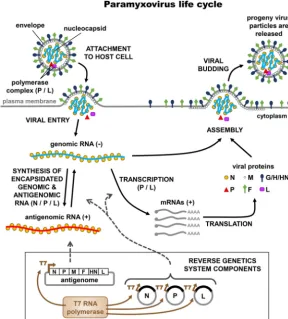
paramyxovirus life cycle and its relationship to virus rescue is illustrated in Fig. 1. The
minimal unit for initiating replication in paramyxoviruses is the ribonucleoprotein (RNP)
complex, in which the RNA genome or antigenome is encapsidated by the viral
nucleocapsid (N or NP) and further associated with the viral RNA-dependent RNA
polymerase (RdRp) complex. Transcription and replication of genomic or antigenomic
RNA must be mediated by the corresponding RdRp complex, which is comprised of the
phosphoprotein (P) and large protein (L) (7). As a result of these constraints, rescue
requires the intracellular transcription of full-length genomic (or antigenomic) RNA and
simultaneous expression of the viral proteins (N, P, and L) that form the RNP complex.
Typically, transcription of the viral antigenome—as well as that of the N, P, and L
support plasmids—is driven by T7 polymerase, a bacteriophage DNA-dependent RNA
polymerase that predominantly localizes to the cytoplasm of eukaryotic cells when
expressed ectopically. Since transcription of all four plasmids of a typical paramyxovirus
reverse genetics system is driven by T7 polymerase, the efficiency of viral rescue is
dependent on the efficient delivery and expression of the polymerase. During the
course of developing reverse genetics technologies, many different strategies have
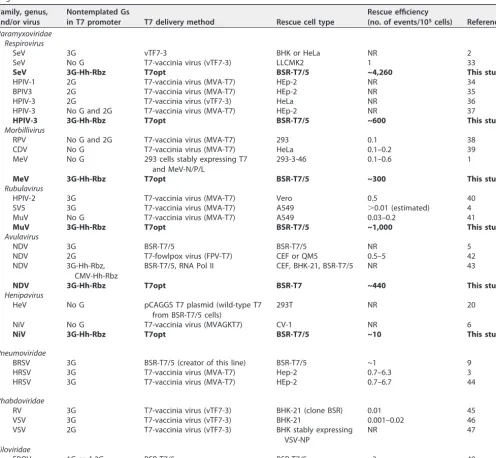
been used to deliver T7 polymerase intracellularly during rescue. Table 1 details the
rescue efficiencies of different approaches that have been utilized by reverse genetics
systems for paramyxoviruses and other members of the
Mononegavirales
order.
Effect of codon optimization of the T7 RNA polymerase gene.
To achieve high
levels of cytoplasmic T7 polymerase without the use of vaccinia virus, we first codon
optimized the T7 gene, which was derived from a bacteriophage and displays
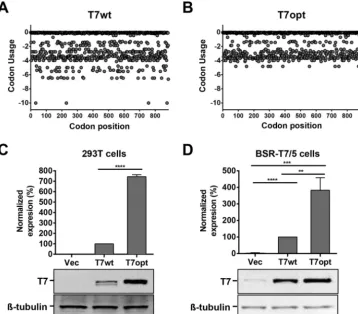
subop-timal codon usage when expressed in mammalian cells. Thus, we generated a T7
polymerase gene that is codon optimized for expression in mammalian cells (T7opt)
(Fig. 2A and B) and cloned it into a pCAGGS expression vector, which was designed to
drive high levels of gene expression. The T7 polymerase expression levels in cells
transfected with T7opt were evaluated by Western blotting (Fig. 2C and D), and were
significantly higher than that in cells transfected with a homologous plasmid
contain-ing the wild-type T7 gene (T7wt), both in HEK293T cells and BSR-T7/5 cells. BSR-T7/5
on September 8, 2020 by guest
http://msphere.asm.org/
cells are a BHK-derived stable T7 cell line created by Buchholz et al. in 1999 and are
commonly used for paramyxovirus reverse genetics (9). Codon optimization of the T7
gene significantly enhances expression of the polymerase. Furthermore,
supplementa-tion of BSR-T7/5 cells with T7 polymerase from either T7wt or T7opt significantly
enhanced T7 polymerase expression over endogenous levels, with T7opt conferring an
~150-fold increase over endogenous T7 expression levels (Fig. 2D).
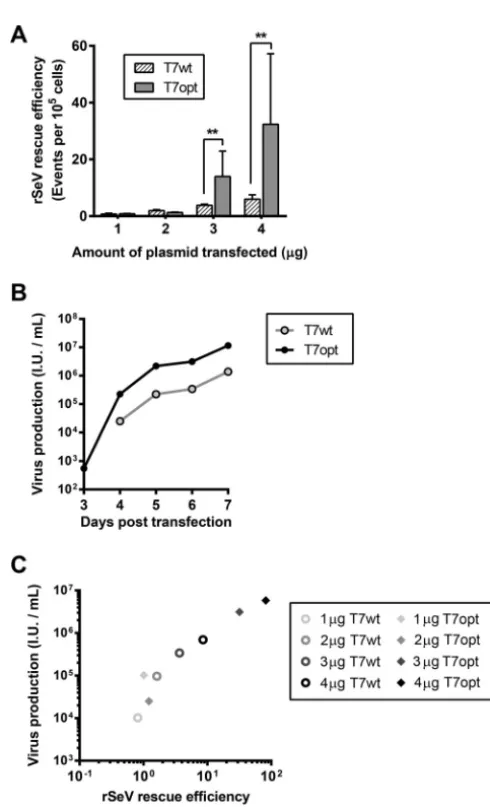
In order to evaluate the effect of T7 codon optimization on virus rescue, either T7opt
or T7wt was used to drive rescue of a recombinant Sendai virus with an enhanced
green fluorescent protein (EGFP) reporter (rSeV
Fushimi-EGFP) in HEK293T cells, using a
single-step transfection protocol described in Materials and Methods. The use of T7opt
significantly increased the frequency of GFP-positive rescue cells (i.e., rescue efficiency),
rSeV
Fushimi-EGFP, above that with rescue driven by T7wt (Fig. 3A). The titer of
rSeV
Fushimi-EGFP produced in the rescue well was similarly enhanced for rescue driven
by T7opt compared to rescue with T7wt (Fig. 3B). GFP-positive rescue events were
highly correlated with virus production (Fig. 3C; Pearson’s
r
⫽
0.9899,
P
⬍
0.0001); this
finding supports the biological relevance of early quantification of GFP-positive rescue
cells as a metric for rescue efficiency.
Introduction of a hammerhead ribozyme sequence into the viral antigenomic
plasmid.
It has been shown
in vitro
that the inclusion of three guanine (G) residues at
the 3
=
-end of the T7 promoter enhances processivity of the T7 RNA polymerase and
dramatically increases transcription levels (10). However, in the context of
paramyxo-virus reverse genetics systems, the use of the optimal (3G) T7 promoter has mixed
effects on virus rescue. Although use of the optimal promoter to drive rescue does
FIG 1 Components of a paramyxovirus reverse genetics system and their relationships to the viral life cycle. The schematic illustrates the major steps of the viral life cycle. The inset box shows the components of a paramyxovirus reverse genetics system, with dashed gray arrows indicating their participation in various steps of the viral life cycle.
Efficient and RobustParamyxoviridaeReverse Genetics
on September 8, 2020 by guest
http://msphere.asm.org/
provide an advantage at the level of transcription, the extra Gs are positioned after the
transcriptional start site and thus are incorporated into the 5
=
-end of the viral
antige-nomic transcript. These extra nucleotides not only interfere with appropriate
recogni-tion of the genomic terminus by the RdRp complex, but also conflict with the “rule of
six,” a property shared by all members of the
Paramyxoviridae
family, which is based on
the requirement that the genome be an exact multiple of 6 nucleotides in length for
robust virus rescue and efficient viral replication (11, 12). Approaches to mitigating this
conflict are varied in paramyxovirus reverse genetics systems; in some cases, the “no G”
approach yields the highest rescue efficiency, and in other cases the addition of one,
two, or three extra Gs is advantageous or necessary for successful rescue (Table 1).
To overcome the low rescue efficiency that results from the use of a suboptimal T7
promoter or the incorporation of extra nonviral residues at the 5
=
-end of the
antig-TABLE 1 Approaches and rescue efficiencies of reverse genetics systems for paramyxoviruses and other selected nonsegmented negative-sense RNA virusesa
Family, genus, and/or virus
Nontemplated Gs
in T7 promoter T7 delivery method Rescue cell type
Rescue efficiency
(no. of events/105cells) Reference Paramyxoviridae
Respirovirus
SeV 3G vTF7-3 BHK or HeLa NR 2
SeV No G T7-vaccinia virus (vTF7-3) LLCMK2 1 33
SeV 3G-Hh-Rbz T7opt BSR-T7/5 ~4,260 This study
HPIV-1 2G T7-vaccinia virus (MVA-T7) HEp-2 NR 34
BPIV3 2G T7-vaccinia virus (MVA-T7) HEp-2 NR 35
HPIV-3 2G T7-vaccinia virus (vTF7-3) HeLa NR 36
HPIV-3 No G and 2G T7-vaccinia virus (MVA-T7) HEp-2 NR 37
HPIV-3 3G-Hh-Rbz T7opt BSR-T7/5 ~600 This study
Morbillivirus
RPV No G and 2G T7-vaccinia virus (MVA-T7) 293 0.1 38
CDV No G T7-vaccinia virus (MVA-T7) HeLa 0.1–0.2 39
MeV No G 293 cells stably expressing T7
and MeV-N/P/L
293-3-46 0.1–0.6 1
MeV 3G-Hh-Rbz T7opt BSR-T7/5 ~300 This study
Rubulavirus
HPIV-2 3G T7-vaccinia virus (MVA-T7) Vero 0.5 40
SV5 3G T7-vaccinia virus (MVA-T7) A549 ⬎0.01 (estimated) 4
MuV No G T7-vaccinia virus (MVA-T7) A549 0.03–0.2 41
MuV 3G-Hh-Rbz T7opt BSR-T7/5 ~1,000 This study
Avulavirus
NDV 3G BSR-T7/5 BSR-T7/5 NR 5
NDV 2G T7-fowlpox virus (FPV-T7) CEF or QM5 0.5–5 42
NDV 3G-Hh-Rbz,
CMV-Hh-Rbz
BSR-T7/5, RNA Pol II CEF, BHK-21, BSR-T7/5 NR 43
NDV 3G-Hh-Rbz T7opt BSR-T7 ~440 This study
Henipavirus
HeV No G pCAGGS T7 plasmid (wild-type T7
from BSR-T7/5 cells)
293T NR 20
NiV No G T7-vaccinia virus (MVAGKT7) CV-1 NR 6
NiV 3G-Hh-Rbz T7opt BSR-T7/5 ~10 This study
Pneumoviridae
BRSV 3G BSR-T7/5 (creator of this line) BSR-T7/5 ~1 9
HRSV 3G T7-vaccinia virus (MVA-T7) Hep-2 0.7–6.3 3
HRSV 3G T7-vaccinia virus (MVA-T7) HEp-2 0.7–6.7 44
Rhabdoviridae
RV 3G T7-vaccinia virus (vTF7-3) BHK-21 (clone BSR) 0.01 45
VSV 3G T7-vaccinia virus (vTF7-3) BHK-21 0.001–0.02 46
VSV 2G T7-vaccinia virus (vTF7-3) BHK stably expressing
VSV-NP
NR 47
Filoviridae
EBOV 1G and 2G BSR-T7/5 BSR-T7/5 ~3 48
aReported or calculated measurements of rescue efficiencies, using the indicated approach to virus rescue. Data reported in boldface were obtained in this study. NR,
not reported; passaging the virus was required for detection of infectious virus and rescue efficiency could not be calculated. Abbreviations (those not defined in text): RPV, Rinderpest virus; CDV, canine distemper virus; SV5, Simian virus 5; bRSV, bovine respiratory syncytial virus; hRSV, human respiratory syncytial virus; RV, rabies virus; VSV, vesicular stomatitis virus; EBOV, Ebola virus; CMV, cytomegalovirus; RNA Pol II, polymerase II.
on September 8, 2020 by guest
http://msphere.asm.org/
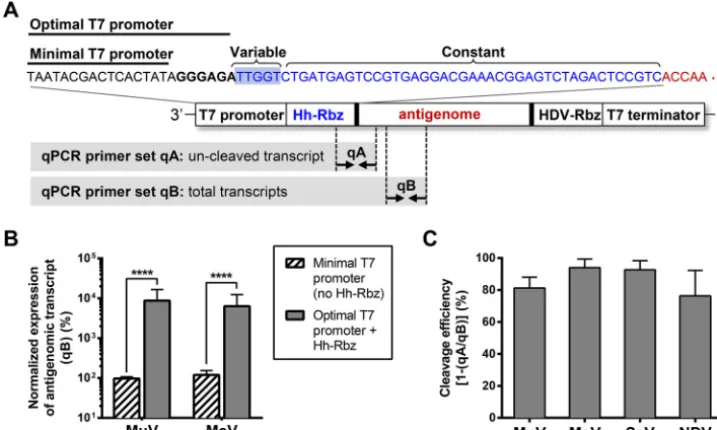
enome, we introduced an autocatalytic hammerhead ribozyme sequence (Hh-Rbz)
between the optimal T7 promoter and the start of the antigenome (Fig. 4A). A similar
Hh-Rbz design has been used by various groups to rescue viruses of the
Pneumoviridae
and
Rhabdoviridae
families, but this strategy has not been widely used for
paramyxo-virus rescue (13–16). For paramyxoparamyxo-viruses, this Hh-Rbz ensures adherence to the “rule
of six” by self-cleaving immediately preceding the start of the viral antigenomic
transcript; thus, Hh-Rba leaves the native 5
=
antigenomic terminus intact. The
effec-tiveness of various hammerhead ribozyme sequences was tested in two ways: by a
quantitative PCR (qPCR)-based cleavage assay using a recombinant NiV (rNiV)
minig-enome construct and by comparison of rescue efficiency in the context of a full-length
rNiV antigenomic construct, as described by Yun et al. (17). For rMuV, rMeV, rSeV, and
rNDV, transcription levels of the antigenome and Hh-Rbz cleavage efficiencies were
quantified by using qPCR, with the proportion of uncleaved and total transcripts
measured in RNA isolated from BSR-T7/5 cells that had been transfected with the
indicated antigenomic construct. While the rSeV
Fushimi-EGFP and rNDV
LaSota-EGFP
con-structs already had the optimal T7 promoter before we introduced modifications, the
rMuV
JL5-EGFP and rMeV
EdmonstonB-EGFP constructs only had the minimal T7 promoter.
We found that use of the optimal T7 promoter for rMuV
JL5-EGFP and rMeV
EdmonstonB-EGFP significantly enhanced transcription levels, with an increase of ~2 logs over that
of homologous constructs containing the minimal T7 promoter and no Hh-Rbz (Fig. 4A
and B). Hh-Rbz-mediated cleavage of the RNA transcript was highly efficient, ranging
FIG 2 Codon optimization of the T7 gene enhances protein expression. (A and B) Human codon usage of the T7wt gene (A) and T7opt gene (B) was calculated using the JCat codon usage calculator published by Grote et al. in 2005 (32). (C and D) Protein expression of the T7 polymerase was evaluated in HEK293T (C) and BSR-T7/5 (D) cells by Western blotting densitometry. Blots were stained with mouse anti-T7 and rabbit anti--tubulin primary antibodies. T7 polymerase expression was normalized to-tubulin expression, and the expression of T7wt was set to 100%. Bars show the mean densitometry quantification for three biological replicates, and error bars indicate 1 standard deviation. Statistical significance was evaluated by using a two-tailed unpairedttest.**,P⬍0.01;***,P⬍0.001; ****,P⬍0.0001.
Efficient and RobustParamyxoviridaeReverse Genetics
on September 8, 2020 by guest
http://msphere.asm.org/
from 76 to 94% in the four paramyxovirus constructs tested in this study (Fig. 4C). For
full transparency and reproducibility, the optimized version of all antigenomic plasmids
and support plasmids have been sequenced and deposited in GenBank (accession
numbers KY295909 to KY295932).
High rescue efficiency results from the combined use of T7opt and a
hammer-head ribozyme.
We tested the flexibility of our optimized rSeV
Fushimi-EGFP reverse
genetics system by varying the amount of N, P, and L support plasmids used for rescue.
Typically, the paramyxovirus support proteins must be expressed in a precise ratio for
successful virus rescue (7). The absolute amounts and ratios of transfected plasmids
vary considerably in different paramyxovirus reverse genetics systems, but generally, N
is needed in the most abundant amounts, followed by P, then L, which reflects the
relative abundance of these proteins during infection. Although the amount of SeV-N,
SeV-P, and SeV-L plasmid used for rSeV
Fushimi-EGFP rescue covered a very broad range
(~1
g), every rescue attempt was successful, albeit with varying efficiencies (Fig. 5A to
C). The Hh-Rbz-T7opt rescue approach allows for significant latitude in the ratios of
FIG 3 Codon-optimized T7 polymerase increases rescue efficiency and virus production. (A) Efficiency of rSeVFushimi-EGFP rescue on HEK293T cells was quantified by fluorescence-activated cell sorting at 2 days posttransfection. Statistical significance was evaluated by using a two-tailed unpairedttest.**,P⬍0.01. (B) rSeVFushimi-EGFP produced by rescue on HEK293T cells using 3g T7opt was quantified by determi-nation of titers on Vero cells. (C) Rescue efficiency was plotted against the titers corresponding to rescue at 6 days posttransfection. Pearson’s correlation was used to evaluate the significance of the relationship (Pearson’sr⫽0.9899,P⬍0.0001).
on September 8, 2020 by guest
http://msphere.asm.org/
transfected plasmids, and rescue efficiency was consistently high in every rescue
attempt.
The combined use of T7opt and an Hh-Rbz was employed to rescue representative
viruses from four of the five major
Paramyxoviridae
genera, and rescue efficiencies were
compared with those of homologous antigenomic constructs lacking the Hh-Rbz and
with the use of T7wt (Fig. 6A to D). The T7opt-Hh-Rbz approach yielded a high rescue
efficiency for all four reverse genetics systems. The effect of the Hh-Rbz appears to
involve a stronger contribution to increasing rescue efficiency than with use of T7opt,
as indicated by the higher fold change due to the presence of the Hh-Rbz in all cases
except rSeV. The combined use of an Hh-Rbz sequence before the start of the viral
antigenome and T7opt to drive rescue can have an additive effect to dramatically
increase the robustness, efficiency, and flexibility of paramyxovirus reverse genetics
systems. Using the approach described in this study, we have also constructed a reverse
genetics system for human parainfluenza virus type 3 (HPIV-3)
de novo
from synthetic
DNA. HPIV-3 is an important human pathogen in the
Respirovirus
genus. We used the
same amounts of plasmids and transfection reagents as in the rSeV
Fushimi-EGFP reverse
genetics system, with the hope that the flexibility we observed with rSeV
Fushimi-EGFP
(Fig. 5A to C) would provide some latitude in the conditions for successful rescue of
rHPIV3
JS-G.Luc-EGFP without onerous reoptimization. Indeed, we found that use of the
parameters from the SeV rescue system resulted in high rescue efficiency for rHPIV3
JS-G.Luc-EGFP (~600 events per 10
5transfected cells) (Table 1).
DISCUSSION
A recombinant T7-expressing vaccinia virus helper is commonly used in reverse
genetics systems to drive high-level expression of T7 polymerase in the cytoplasm.
However, the use of vaccinia virus has several disadvantages, primarily high
poxvirus-mediated cytotoxicity, challenges associated with separating vaccinia virus from the
rescued paramyxovirus, and increasing restrictions on the use of vaccinia virus,
espe-FIG 4 Introduction of an autocatalytic hammerhead ribozyme sequence permits use of the optimal T7 promoter to enhance transcription levels. (A) Sequence of the Hh-Rbz (blue text) and its context within the plasmid carrying the viral antigenome (red text). The variable region is the reverse complement of the start of the antigenome, while the constant region is fixed, regardless of the sequence context. The sequence of the minimal and optimal T7 promoter is shown in black text. Dashed lines indicate the approximate primer binding regions of the qPCR primers used in panels B and C. (B) Transcription levels measured by qPCR were normalized to the minimal T7 promoter (no Hh-Rbz) condition. Bars represent the means of four replicates, and error bars indicate 1 standard deviation. Significance was evaluated by using a two-tailed unpairedttest.****,P⬍0.0001. (C) Quantification of cleavage efficiency measured by qPCR. Bars represent the means of four replicates, and error bars indicate 1 standard deviation.
Efficient and RobustParamyxoviridaeReverse Genetics
on September 8, 2020 by guest
http://msphere.asm.org/
cially for paramyxovirus vaccine development. Due to these complications, cell lines
stably expressing T7 polymerase have been developed as alternatives to the use of a
helper T7-vaccinia virus. Several different stable T7 cell lines have been developed to
date, the most commonly used of which are BSR-T7/5 cells, a BHK-derived cell line
created by Buchholz et al. (9). Stable T7-expressing cell lines effectively circumvent
many of the issues associated with the use of vaccinia virus; however, with the possible
exception of MeV rescue, none has found broad acceptance as a substitute for the use
of T7-vaccinia virus. This is largely due to the fact that stable T7 cell lines have
significantly lower T7 expression levels than those of vaccinia virus-mediated systems
(18), and T7 expression has been shown to be a major determinant of rescue efficiency
FIG 5 Use of T7opt and Hh-Rbz permits flexibility in the amount of support plasmids transfected. Rescue transfections were performed on HEK293T cells. Rescue efficiency was quantified by fluorescence-activated cell sorting of the rescue cells at 2 days posttransfection to determine the frequency of EGFP-positive cells. Filled points indicate the standard amount of the indicated plasmid that was used in all other rSeVFushimi-EGFP rescue transfections in this study.
on September 8, 2020 by guest
http://msphere.asm.org/
(1). While the reason for this lower expression of T7 in stable cells has not been
definitively explained, it might be the result of suboptimal codon usage in the
bacteriophage-derived T7 gene or unwanted splicing that might occur at the mRNA
level when the T7 gene is expressed from the nucleus. Furthermore, the use of stable
cell lines imposes an experimental limitation, as it inherently constrains the cell type
that can be used for rescue.
Virus rescue experiments were performed on HEK293T cells, which do not
endog-enously express T7 polymerase; thus, the use of T7opt makes efficient rescue of
paramyxoviruses possible without the use of vaccinia virus or stable T7 cell lines. It
should be possible to adapt our one-step all-plasmid transfection protocol to rescue
recombinant paramyxoviruses on cell lines such as the WHO seed stocks of Vero cells
approved for use in human clinical trials. A plasmid-encoded T7 polymerase has
FIG 6 Combined use of T7opt and Hh-Rbz synergistically enhances rescue efficiency of paramyxovirus reverse genetics systems. Rescue efficiency of reverse genetics systems for rSeV (Respirovirus) (A), rMuV (Rubulavirus) (B), rNDV (Avulavirus) (C), and rMeV (Morbillivirus) (D) on HEK293T cells. For rMuV and rMeV, the premodified constructs lacked an optimal T7 promoter, and the addition of the Hh-Rbz therefore also included the addition of the optimal promoter. Bars show the means of three replicates, and error bars indicate the standard errors of the means. The inset shows the actualyaxis numbers under the indicated conditions and the fold change in rescue efficiency that was due to the introduction of the Hh-Rbz (red text) or the use of T7opt (blue text). Statistical significance was evaluated by a one-way analysis of variance with a Bonferroni correction.*,P⬍0.05;**,P⬍0.01.
Efficient and RobustParamyxoviridaeReverse Genetics
on September 8, 2020 by guest
http://msphere.asm.org/
previously been used to drive successful rescue of HeV and Crimean Zaire hemorrhagic
fever virus (CCHFV); in the latter case, codon optimization of the viral RdRp L gene was
critical for efficient rescue (19, 20). A plasmid-based method for delivering T7
polymer-ase is advantageous because it theoretically allows for the use of any transfectable cell
type. Therefore, using this system would allow the cell type to be selected with greater
consideration for the tropism of the virus or the experimental design.
Another factor that significantly contributes to the inefficiency of paramyxovirus
rescue is the requirement for an exact end-to-end copy of the viral genome, which can
be difficult to achieve with traditional reverse genetics systems. The genome length
must also comply with the “rule of six,” in which the total number of nucleotides must
be an exact multiple of six for the virus to replicate efficiently. Tolerance for variation
is particularly constrained in the genomic termini, as they contain critical elements for
replication, such as the signal for encapsidation and promoters for genome and
antigenome replication. In standard reverse genetics systems, an exact 3
=
-end of the
antigenome is generated by autocatalytic cleavage from a hepatitis delta virus
ri-bozyme (HDV-Rbz) sequence positioned directly downstream of the antigenome (5
=
-GGCCGGCATGGTCCCAGCCTCCTCGCTGGCGCCGGCTGGGCAACATTCCGAGGGGACCGTC
CCCTCGGTAATGGCGAATGGGAC-3
=
). Creating a precise copy of the 5
=
-end of the
antigenome, however, has proven more challenging. While both genomic termini have
poor tolerance for the addition of nontemplated nucleotides, the 5
=
-end of the
antig-enome may be particularly constrained. For vesicular stomatitis virus, a related member
of the
Mononegavirales
order, genomic constructs with short heterologous extensions
were tolerated on the 5
=
-end (3
=
-end of the antigenome), but extra nonviral residues on
the genomic 3
=
-terminus prevented replication (21). Moreover, the first several
nucle-otides of the paramyxovirus genome are highly conserved and start with the sequence
5
=
-ACCAA-3
=
(antigenomic sense), almost without exception (22). Thus, the viral
re-quirement for a 5
=
-ACCAA-3
=
transcriptional start sequence is in direct conflict with the
T7 polymerase requirement for a 5
=
-GGG-3
=
transcriptional start sequence for optimal
processivity.
Rescue efficiency of a rabies virus minigenome was significantly improved by the
use of an Hh-Rbz inserted between the T7 promoter and the start of the minigenome,
which allowed for the 3G optimal promoter without adding nonviral nucleotides to the
minigenome (23). This strategy was applied to a full-length rabies virus antigenome,
which increased rescue efficiency 100-fold when used in combination with an
en-hanced HDV-Rbz (16), but rescue efficiency was surprisingly poor when an Hh-Rbz
approach was used to rescue Borna disease virus and measles virus (24). This difference
in effectiveness of the Hh-Rbz in these studies might be attributed to variation in the
cleavage efficiency of the different ribozyme sequences used, as Hh-Rbz sequences are
a diverse family of endonucleolytic ribozymes found in organisms spanning almost
every kingdom of life and cleavage efficiency can vary considerably among distinct
sequences (25). Additionally, the effectiveness of the Hh-Rbz approach might have also
been reduced by constraints that limit the expression of T7 RNA polymerase, as
discussed above.
Reverse genetics systems for paramyxoviruses are notoriously inefficient and, when
successful, often yield inconsistent results. We have substantially increased rescue
efficiency and robustness for a diverse panel of paramyxoviruses, and this technological
advance allowed for the first genome-wide mutagenesis study of a paramyxovirus,
reported by Fulton et al. in 2015 (26), which was performed using the MeV reverse
genetics system that is described in the present study. We have also used the highly
efficient design described in the present study to construct second-generation reverse
genetics systems for NiV and HeV, as described in detail by Yun et al
.
(17). Taken
together, this approach to paramyxovirus rescue appears to be generalizable across the
entire
Paramyxoviridae
family and has been effective in every system we have built or
modified to date. Our T7opt-Hh-Rbz methodology allows for faster, safer, and more
efficient viral rescue, which can be leveraged to functionally interrogate paramyxovirus
biology on a genomic level and broaden the range of tools available to vaccinologists.
on September 8, 2020 by guest
http://msphere.asm.org/
MATERIALS AND METHODS
Cell lines.HEK293T cells, Vero cells (CCL-81; ATCC), and BSR-T7/5 cells (9) were propagated in Dulbecco’s modified Eagle’s medium (Invitrogen) supplemented with 10% fetal bovine serum (FBS; Atlanta Biologicals) and penicillin-streptomycin at 37°C. BSR-T7/5 cells were additionally cultured in medium containing 1 mg/ml G418 to maintain the T7 polymerase transgene.
Paramyxovirus reverse genetics plasmids.All modifications to reverse genetics plasmids were performed via insertion of modified PCR fragments into constructs at unique restriction sites via ligation-independent In-Fusion (Clontech). The modified fragments were generated via standard and overlapping PCR, using Velocity DNA polymerase (Bioline). Full-length paramyxovirus antigenomic constructs were maintained in Stbl2Escherichia coli(Invitrogen) with growth at 30°C. The wild-type bacteriophage T7 sequence was codon optimized (GenScript) and inserted into pCAGGS (T7opt; depos-ited in Addgene as plasmid 65974).
i. Sendai virus plasmids.The rSeVFushimi-EGFP clone was derived from SeV Fushimi strain with mutations introduced into the F and M genes to allow trypsin-independent growth, as previously described by Hou et al. (27). The rSeV reverse genetics system was a generous gift from Nancy L. McQueen. An EGFP reporter gene was inserted as an additional reading frame between the N and P genes via duplication of the N-P intergenic region, as described previously (28). The Hh-Rbz sequence was inserted between the T7 promoter and the start of the viral antigenome. T7-driven SeVFushimi-N, SeVFushimi-P, and SeVFushimi-L were as described by Hou et al.(27).
ii. Mumps virus plasmids.The rMuVJL5-EGFP clone was based on the Jeryl Lynn 5 (JL5) vaccine strain, as described by Lemon et al.(29). The rMuV antigenomic plasmid was a generous gift from W. Paul Duprex. A reporter gene encoding EGFP was inserted as an additional reading frame between the N and P reading frames via duplication of the N-P intergenic region. The Hh-Rbz sequence was inserted between the T7 promoter and the start of the viral antigenome, and the T7 promoter was modified to the optimal sequence.
iii. Newcastle disease virus plasmids.The rNDVLaSota-EGFP clone was based on the LaSota strain, as described by Elankumaran et al. (30), which contains an EGFP reporter gene as an additional reading frame between the P and M reading frames via duplication of the N-P intergenic region. The rNDV reverse genetics system was a generous gift from Subbiah Elankumaran. The native cleavage site for proteolytic processing of F was replaced with the cleavage site of urokinase-type plasminogen activator (uPA) to allow for trypsin-independent replication in tissue culture. The Hh-Rbz sequence was inserted between the T7 promoter and the start of the viral antigenome.
iv. Measles virus plasmids. The rMeVEdmonstonB-EGFP clone was derived from the Edmonston B strain, as described by Duprex et al. (31). The Hh-Rbz sequence was inserted between the T7 promoter and the start of the viral antigenome, and the T7 promoter was modified to the optimal sequence. T7-driven MeV-N, -P, and -L support plasmids were contributed by Richard Plemper and carried the genes cloned from a primary isolate of MeV.
v. Human parainfluenza virus type 3 plasmids.The rHPIV3JS-G.luc-EGFP clone was constructed entirely from synthetic DNA using the antigenomic sequence of the JS strain preceded by the optimal T7 promoter and the Hh-Rbz sequence. The HDV ribozyme and two tandem T7 terminators were placed downstream of the antigenome, and the entire antigenomic cassette was inserted into a pTM1 vector backbone. HPIV3JS-N, -P, and -L support plasmids were cloned out of the antigenome and inserted into a pTM1 vector backbone under control of a T7 promoter.
vi. Nipah virus plasmids.The rNiVMalaysia-EGFP clone and the T7-driven NiVMalaysia-N, -P, and -L support plasmids were based on the prototype Malaysia strain and were previously described by Yun et al. (17). The rNiV antigenomic plasmid has the Hh-Rbz sequence inserted between the optimal T7 promoter and the start of the viral antigenome.
Immunoblotting.For comparison of T7 polymerase protein expression upon transfection of T7wt or T7opt, HEK293T or BSR-T7/5 cells were transfected in a 12-well format with 0.5g T7wt, T7opt, or empty pCAGGS vector using Lipofectamine LTX with PLUS reagent (Invitrogen) according to the manufacturer’s protocol. At 24 h posttransfection, cell lysates were collected in SDS Laemmli buffer, boiled, and run on 10% Tris-glycine SDS-PAGE gels. Upon transfer to polyvinylidene difluoride membranes (Immobilon-F; Millipore), the membranes were blocked in Odyssey blocking buffer (LI-COR Biosciences), then incubated with a mouse anti-T7 antibody (catalog number 69522; Millipore) and a rabbit anti--tubulin antibody (clone 9F3; catalog number 2128; Cell Signaling Technology, Inc.), followed by fluorescent IRDye 800CW and 680LT antibodies (LI-COR Biosciences). Images were obtained on a LI-COR Odyssey imaging system, and densitometry of protein bands was quantified using the LI-COR Odyssey software.
Recovery of recombinant viruses from cDNA.For virus rescue, 1⫻106HEK293T cells or 4⫻105 BSR-T7/5 cells per well were seeded in each well of a 6-well plate in order to achieve ~50% confluence on the day of transfection. The following day, the indicated amounts (detailed below) of antigenomic construct, N, P, and L support plasmids, a plasmid encoding T7 polymerase, and Lipofectamine LTX/PLUS transfection reagent (Invitrogen) were combined in 200l Opti-MEM (Invitrogen) and mixed by pipetting gently. T7opt or T7wt was included in the rescue transfection mixture for all cell types, including BSR-T7/5 cells. After incubation at room temperature for 30 min, the DNA-Lipofectamine mixture was added dropwise onto cells. (It is critical that the DNA-Lipofectamine mixture not be mixed before adding to cells, as mixing can disrupt the liposomes.) Transfected cells were incubated at 37°C without exchanging the growth medium.
i. Sendai virus rescue.The amounts of SeV plasmids used for rescue were modified from previous work (27), as follows: 4g antigenomic rSeVFushimi-EGFP construct, 1.44g T7-SeVFushimi-N, 0.77g T7-SeVFushimi-P, 0.07g T7-SeVFushimi-L, 4g of T7opt, 5.5l PLUS reagent, and 8.9l Lipofectamine LTX.
Efficient and RobustParamyxoviridaeReverse Genetics
on September 8, 2020 by guest
http://msphere.asm.org/
When the amounts of T7 construct or helper plasmids deviated from the standard amounts above, as in the experiments shown in Fig. 3 and 5, the amounts of Lipofectamine LTX and PLUS reagent were scaled to maintain the same ratios of these reagents to the total amount of DNA transfected.
ii. Mumps virus rescue.The amounts of MuV plasmids used were modified from those reported in previous work (29), as follows: 5g of antigenomic rMuVJL5-EGFP plasmid, 0.3g T7-MuVJL5-N, 0.1g T7-MuVJL5-P, 0.2g of T7-MuVJL5-L, 2g T7opt, 7.5l PLUS reagent, and 18.75l Lipofectamine LTX. iii. Newcastle disease virus rescue.The amounts of NDV plasmids used were modified from those reported in previous work (30) as follows: 0.8 g of antigenomic rNDVLaSota-EGFP plasmid, 0.4g T7-NDVLaSota-N, 0.2g T7-NDVLaSota-P, 0.2g of T7-NDVLaSota-L, 0.4g T7opt, 2.0l PLUS reagent, and 5.0l Lipofectamine LTX.
iv. Measles virus rescue.The amounts of rMeVEdmonstonB-EGFP plasmids used were modified from those of previous work (31) as follows: 5 g of antigenomic rMeVEdmonstonB-EGFP plasmid, 1.2 g T7-MeV-N, 1.2 g T7-MeV-P, 0.4 g of T7-MeV-L, 3 g T7opt, 5.8 l PLUS reagent, and 9.3 l Lipofectamine LTX.
v. Human parainfluenza type 3 virus rescue.The amounts of rHPIV3JS-G.Luc-EGFP plasmids used for rescue were adapted from those of previous work with rSeVFushimi-EGFP (27) as follows: 4 g antigenomic rHPIV3JS-G.Luc-EGFP construct, 1.44g T7-HPIV3JS-N, 0.77g T7-HPIV3JS-P, 0.07g T7-HPIV3JS-L, 4g of T7opt, 5.5l PLUS reagent, and 8.9l Lipofectamine LTX.
vi. Nipah virus rescue. The amounts of NiV plasmids used for rescue were determined by homology with other systems, and the amounts of plasmid were adapted from those described in previous work (17) as follows: 7g antigenomic rNiVMalaysia-EGFP construct, 2.5g T7-NiVMalaysia-N, 1.6g T7-NiVMalaysia⫺P, 0.8g T7-NiVMalaysia⫺L, 2.0g of T7opt, 6.4l PLUS reagent, and 10.3l Lipofectamine LTX.
Determinations of titers of viral supernatants.Rescue cells were incubated at 37°C after trans-fection and monitored for the appearance of EGFP fluorescence. All titrations of virus stocks were performed on Vero cells in a 96-well format, with individual infection events identified via EGFP fluorescence at 24 h postinfection using an Acumen plate reader (TTP Labtech).
Quantification of rescue efficiency.Transfected cells were incubated at 37°C for 48 h, which is the earliest time point at which GFP can be reliably observed. Rescue cells were collected with trypsin, washed twice with Dulbecco’s phosphate-buffered saline (dPBS) plus 2% FBS, and fixed in dPBS plus 2% paraformaldehyde (PFA). To quantify rescue efficiency of rNiVMalaysia-EGFP, rescue cells were collected using trypsin, washed twice with dPBS plus 2% FBS, and fixed according to an approved protocol for biosafety level 4 (BSL-4) viruses. Briefly, infected cells were fixed by two successive rounds of incubation in dPBS plus 4% PFA overnight at room temperature, centrifugation at 1,250 rpm for 5 min, and replacement of the dPBS plus 4% PFA. For all reverse genetics systems, GFP-positive rescue events were quantified by flow cytometry using a FACSCanto II apparatus (BD Biosciences).
Ribozyme cleavage assay.The ribozyme cleavage assay was performed as previously described (17), with some modifications. BSR-T7/5 cells were transfected with 2g of antigenomic reverse genetics construct or 2g of empty pCAGGS in a 6-well format using Lipofectamine 2000 (Invitrogen) according to the manufacturer’s instructions. At 2 h posttransfection, cells were collected in TRIzol reagent (Invitrogen), and the RNA was extracted into water. RNA was treated with DNase (Invitrogen) at 1 mM MgCl2, treated with EDTA, and reverse transcribed with antigenome-specific primers using the Super-Script III first-strand synthesis system (Invitrogen) at 1 mM MgCl2. The SensiFAST SYBR and fluorescein kit (Bioline) was used to perform qPCR, with standard curves obtained via titration of the antigenomic constructs. Expression levels of antigenomic RNA were normalized using the expression level of hamster glyceraldehyde-3-phosphate dehydrogenase. The sequences of qPCR primers used in this assay are reported in Table S1 in the supplemental material.
Accession number(s).The optimized versions of all antigenomic plasmids and support plasmids have been sequenced and deposited in GenBank (accession numbersKY295909toKY295932).
SUPPLEMENTAL MATERIAL
Supplemental material for this article may be found at
https://doi.org/10.1128/
mSphere.00376-16
.
TABLE S1,
PDF file, 0.01 MB.
ACKNOWLEDGMENTS
We acknowledge Nancy L. McQueen, Subbiah Elankumaran, and Richard Plemper for
contributing paramyxovirus reverse genetics plasmids and for helpful discussions about
virus rescue strategies.
This work was supported by the National Institutes of Health (NIH), grant numbers
AI115226, AI125536, and AI123449 (to B.L.). This work was performed at UCLA and at
the Icahn School of Medicine at Mount Sinai (ISMMS). S.B. was supported by the UCLA
Molecular Pathogenesis training grant T32-AI07323 and the Host-Pathogens
Interac-tions training grant T32 AI007647-15 at ISMMS. A.P. was supported by the UCLA Cellular
and Molecular Biology training grant T32-GM007185, as well as by the Warsaw
fellow-ship provided by the UCLA Department of Microbiology, Immunology and Molecular
Genetics.
on September 8, 2020 by guest
http://msphere.asm.org/
The funders had no role in study design, data collection and interpretation, or the
decision to submit the work for publication.
REFERENCES
1. Radecke F, Spielhofer P, Schneider H, Kaelin K, Huber M, Dötsch C, Christiansen G, Billeter MA. 1995. Rescue of measles viruses from cloned DNA. EMBO J 14:5773–5784.
2. Garcin D, Pelet T, Calain P, Roux L, Curran J, Kolakofsky D. 1995. A highly recombinogenic system for the recovery of infectious Sendai paramyxo-virus from cDNA: generation of a novel copy-back nondefective inter-fering virus. EMBO J 14:6087– 6094.
3. Collins PL, Hill MG, Camargo E, Grosfeld H, Chanock RM, Murphy BR. 1995. Production of infectious human respiratory syncytial virus from cloned cDNA confirms an essential role for the transcription elongation factor from the 5=proximal open reading frame of the M2 mRNA in gene expression and provides a capability for vaccine. Proc Natl Acad Sci U S A 92:11563–11567.https://doi.org/10.1073/pnas.92.25.11563. 4. He B, Paterson RG, Ward CD, Lamb RA. 1997. Recovery of infectious SV5
from cloned DNA and expression of a foreign gene. Virology 237: 249 –260.https://doi.org/10.1006/viro.1997.8801.
5. Römer-Oberdörfer A, Mundt E, Mebatsion T, Buchholz UJ, Mettenleiter TC. 1999. Generation of recombinant lentogenic Newcastle disease virus from cDNA. J Gen Virol 80:2987–2995.https://doi.org/10.1099/0022 -1317-80-11-2987.
6. Yoneda M, Guillaume V, Ikeda F, Sakuma Y, Sato H, Wild TF, Kai C. 2006. Establishment of a Nipah virus rescue system. Proc Natl Acad Sci U S A 103:16508 –16513.https://doi.org/10.1073/pnas.0606972103.
7. Conzelmann KK. 2004. Reverse genetics of Mononegavirales. Curr Top Microbiol Immunol 283:1– 41.https://doi.org/10.1007/978-3-662-06099 -5_1.
8. Pfaller CK, Cattaneo R, Schnell MJ. 2015. Reverse genetics of Mononegavirales: how they work, new vaccines, and new cancer ther-apeutics. Virology 479 – 480:331–344.https://doi.org/10.1016/j.virol.2015 .01.029.
9. Buchholz UJ, Finke S, Conzelmann KK. 1999. Generation of bovine respiratory syncytial virus (BRSV) from cDNA: BRSV NS2 is not essential for virus replication in tissue culture, and the human RSV leader region acts as a functional BRSV genome promoter. J Virol 73:251–259. 10. Martin CT, Muller DK, Coleman JE. 1988. Processivity in early stages of
transcription by T7 RNA polymerase. Biochemistry 27:3966 –3974.
https://doi.org/10.1021/bi00411a012.
11. Kolakofsky D, Pelet T, Garcin D, Hausmann S, Curran J, Roux L. 1998. Paramyxovirus RNA synthesis and the requirement for hexamer genome length: the rule of six revisited. J Virol 72:891– 899.
12. Halpin K, Bankamp B, Harcourt BH, Bellini WJ, Rota PA. 2004. Nipah virus conforms to the rule of six in a minigenome replication assay. J Gen Virol 85:701–707.https://doi.org/10.1099/vir.0.19685-0.
13. Kwilas AR, Yednak MA, Zhang L, Liesman R, Collins PL, Pickles RJ, Peeples ME. 2010. Respiratory syncytial virus engineered to express the cystic fibrosis transmembrane conductance regulator corrects the bioelectric phenotype of human cystic fibrosis airway epithelium in vitro. J Virol 84:7770 –7781.https://doi.org/10.1128/JVI.00346-10.
14. Moriette C, Leberre M, Lamoureux A, Lai TL, Brémont M. 2006. Recovery of a recombinant salmonid alphavirus fully attenuated and protective for rainbow trout. J Virol 80:4088 – 4098.https://doi.org/10.1128/JVI.80 .8.4088-4098.2006.
15. Wang Q, Ma X, Qian S, Zhou X, Sun K, Chen X, Zhou X, Jackson AO, Li Z. 2015. Rescue of a plant negative-strand RNA virus from cloned cDNA: insights into enveloped plant virus movement and morphogenesis. PLoS Pathog 11:e1005223.https://doi.org/10.1371/journal.ppat.1005223. 16. Ghanem A, Kern A, Conzelmann KK. 2012. Significantly improved rescue
of rabies virus from cDNA plasmids. Eur J Cell Biol 91:10 –16.https://doi .org/10.1016/j.ejcb.2011.01.008.
17. Yun T, Park A, Hill TE, Pernet O, Beaty SM, Juelich TL, Smith JK, Zhang L, Wang YE, Vigant F, Gao J, Wu P, Lee B, Freiberg AN. 2015. Efficient reverse genetics reveals genetic determinants of budding and fusogenic differences between Nipah and Hendra viruses and enables real-time monitoring of viral spread in small animal models of henipavirus infec-tion. J Virol 89:1242–1253.https://doi.org/10.1128/JVI.02583-14. 18. Elroy-Stein O, Moss B. 1990. Cytoplasmic expression system based on
constitutive synthesis of bacteriophage T7 RNA polymerase in
mamma-lian cells. Proc Natl Acad Sci U S A 87:6743– 6747.https://doi.org/10 .1073/pnas.87.17.6743.
19. Bergeron É, Zivcec M, Chakrabarti AK, Nichol ST, Albariño CG, Spiropou-lou CF. 2015. Recovery of recombinant Crimean Congo hemorrhagic fever virus reveals a function for non-structural glycoproteins cleavage by furin. PLoS Pathog 11:e1004879.https://doi.org/10.1371/journal.ppat .1004879.
20. Marsh GA, Virtue ER, Smith I, Todd S, Arkinstall R, Frazer L, Monaghan P, Smith GA, Broder CC, Middleton D, Wang LF. 2013. Recombinant Hendra viruses expressing a reporter gene retain pathogenicity in ferrets. Virol J 10:95.https://doi.org/10.1186/1743-422X-10-95.
21. Pattnaik AK, Ball LA, LeGrone AW, Wertz GW. 1992. Infectious defective interfering particles of VSV from transcripts of a cDNA clone. Cell 69: 1011–1020.https://doi.org/10.1016/0092-8674(92)90619-N.
22. Falk K, Batts WN, Kvellestad A, Kurath G, Wiik-Nielsen J, Winton JR. 2008. Molecular characterisation of Atlantic salmon paramyxovirus (ASPV): a novel paramyxovirus associated with proliferative gill inflammation. Vi-rus Res 133:218 –227.https://doi.org/10.1016/j.virusres.2008.01.006. 23. Le Mercier P, Jacob Y, Tanner K, Tordo N. 2002. A novel expression
cassette of lyssavirus shows that the distantly related Mokola virus can rescue a defective rabies virus genome. J Virol 76:2024 –2027.https:// doi.org/10.1128/JVI.76.4.2024-2027.2002.
24. Martin A, Staeheli P, Schneider U. 2006. RNA polymerase II-controlled expression of antigenomic RNA enhances the rescue efficacies of two different members of the Mononegavirales independently of the site of viral genome replication. J Virol 80:5708 –5715.https://doi.org/10.1128/ JVI.02389-05.
25. Hammann C, Luptak A, Perreault J, de la Peña M. 2012. The ubiquitous hammerhead ribozyme. RNA 18:871– 885. https://doi.org/10.1261/rna .031401.111.
26. Fulton BO, Sachs D, Beaty SM, Won ST, Lee B, Palese P, Heaton NS. 2015. Mutational analysis of measles virus suggests constraints on antigenic variation of the glycoproteins. Cell Rep 11:1331–1338.https://doi.org/ 10.1016/j.celrep.2015.04.054.
27. Hou X, Suquilanda E, Zeledon A, Kacsinta A, Moore A, Seto J, McQueen N. 2005. Mutations in Sendai virus variant F1 R that correlate with plaque formation in the absence of trypsin. Med Microbiol Immunol 194: 129 –136.https://doi.org/10.1007/s00430-004-0224-3.
28. Pentecost M, Vashisht AA, Lester T, Voros T, Beaty SM, Park A, Wang YE, Yun TE, Freiberg AN, Wohlschlegel JA, Lee B. 2015. Evidence for ubiquitin-regulated nuclear and subnuclear trafficking among Paramyxovirinae matrix proteins. PLoS Pathog 11:e1004739.https://doi .org/10.1371/journal.ppat.1004739.
29. Lemon K, Rima BK, McQuaid S, Allen IV, Duprex WP. 2007. The F gene of rodent brain-adapted mumps virus is a major determinant of neuroviru-lence. J Virol 81:8293– 8302.https://doi.org/10.1128/JVI.00266-07. 30. Elankumaran S, Rockemann D, Samal SK. 2006. Newcastle disease virus
exerts oncolysis by both intrinsic and extrinsic caspase-dependent path-ways of cell death. J Virol 80:7522–7534. https://doi.org/10.1128/JVI .00241-06.
31. Duprex WP, McQuaid S, Hangartner L, Billeter MA, Rima BK. 1999. Observation of measles virus cell-to-cell spread in astrocytoma cells by using a green fluorescent protein-expressing recombinant virus. J Virol 73:9568 –9575.
32. Grote A, Hiller K, Scheer M, Münch R, Nörtemann B, Hempel DC, Jahn D. 2005. JCat: a novel tool to adapt codon usage of a target gene to its potential expression host. Nucleic Acids Res 33:W526 –W531.https://doi .org/10.1093/nar/gki376.
33. Kato A, Sakai Y, Shioda T, Kondo T, Nakanishi M, Nagai Y. 1996. Initiation of Sendai virus multiplication from transfected cDNA or RNA with neg-ative or positive sense. Genes Cells 1:569 –579.https://doi.org/10.1046/ j.1365-2443.1996.d01-261.x.
34. Newman JT, Surman SR, Riggs JM, Hansen CT, Collins PL, Murphy BR, Skiadopoulos MH. 2002. Sequence analysis of the Washington/1964 strain of human parainfluenza virus type 1 (HPIV1) and recovery and characterization of wild type recombinant HPIV1 produced by reverse genetics. Virus Genes 26:77–92.
Efficient and RobustParamyxoviridaeReverse Genetics
on September 8, 2020 by guest
http://msphere.asm.org/
35. Schmidt AC, McAuliffe JM, Huang A, Surman SR, Bailly JE, Elkins WR, Collins PL, Murphy BR, Skiadopoulos MH. 2000. Bovine parainfluenza virus type 3 (BPIV3) fusion and hemagglutinin-neuraminidase glycopro-teins make an important contribution to the restricted replication of BPIV3 in primates. J Virol 74:8922– 8929.https://doi.org/10.1128/JVI.74 .19.8922-8929.2000.
36. Hoffman MA, Banerjee AK. 1997. An infectious clone of human parain-fluenza virus type 3. J Virol 71:4272– 4277.
37. Durbin AP, Hall SL, Siew JW, Whitehead SS, Collins PL, Murphy BR. 1997. Recovery of infectious human parainfluenza virus type 3 from cDNA. Virology 235:323–332.https://doi.org/10.1006/viro.1997.8697. 38. Baron MD, Barrett T. 1997. Rescue of rinderpest virus from cloned cDNA.
J Virol 71:1265–1271.
39. Gassen U, Collins FM, Duprex WP, Rima BK. 2000. Establishment of a rescue system for canine distemper virus. J Virol 74:10737–10744.
https://doi.org/10.1128/JVI.74.22.10737-10744.2000.
40. Kawano M, Kaito M, Kozuka Y, Komada H, Noda N, Nanba K, Tsurudome M, Ito M, Nishio M, Ito Y. 2001. Recovery of infectious human parainflu-enza type 2 virus from cDNA clones and properties of the defective virus without V-specific cysteine-rich domain. Virology 284:99 –112.https:// doi.org/10.1006/viro.2001.0864.
41. Clarke DK, Sidhu MS, Johnson JE, Udem SA. 2000. Rescue of mumps virus from cDNA. J Virol 74:4831– 4838.https://doi.org/10.1128/JVI.74.10.4831 -4838.2000.
42. Peeters BP, de Leeuw OS, Koch G, Gielkens AL. 1999. Rescue of Newcastle disease virus from cloned cDNA: evidence that cleavability of the fusion protein is a major determinant for virulence. J Virol 73:5001–5009.
43. Li BY, Li XR, Lan X, Yin XP, Li ZY, Yang B, Liu JX. 2011. Rescue of Newcastle disease virus from cloned cDNA using an RNA polymerase II promoter. Arch Virol 156:979 –986.https://doi.org/10.1007/s00705-011 -0932-0.
44. Jin H, Clarke D, Zhou HZ, Cheng X, Coelingh K, Bryant M, Li S. 1998. Recombinant human respiratory syncytial virus (RSV) from cDNA and construction of subgroup A and B chimeric RSV. Virology 251:206 –214.
https://doi.org/10.1006/viro.1998.9414.
45. Conzelmann KK, Schnell M. 1994. Rescue of synthetic genomic RNA analogs of rabies virus by plasmid-encoded proteins. J Virol 68:713–719. 46. Lawson ND, Stillman EA, Whitt MA, Rose JK. 1995. Recombinant vesicular stomatitis viruses from DNA. Proc Natl Acad Sci U S A 92:4477– 4481.
https://doi.org/10.1073/pnas.92.10.4477.
47. Whelan SP, Ball LA, Barr JN, Wertz GT. 1995. Efficient recovery of infec-tious vesicular stomatitis virus entirely from cDNA clones. Proc Natl Acad Sci U S A 92:8388 – 8392.https://doi.org/10.1073/pnas.92.18.8388. 48. Volchkov VE. 2001. Recovery of infectious Ebola virus from
complemen-tary DNA: RNA editing of the GP gene and viral cytotoxicity. Science 291:1965–1969.https://doi.org/10.1126/science.1057269.