Disruption in
Aspergillus fumigatus
Kevin K. Fuller,a Shan Chen,aJennifer J. Loros,bJay C. Dunlapa
Department of Genetics, Geisel School of Medicine at Dartmouth, Hanover, New Hampshire, USAa; Department of Biochemistry, Geisel School of Medicine at Dartmouth, Hanover, New Hampshire, USAb
Low rates of homologous recombination have broadly encumbered genetic studies in the fungal pathogenAspergillus fumigatus. The CRISPR/Cas9 system of bacteria has recently been developed for targeted mutagenesis of eukaryotic genomes with high effi-ciency and, importantly, through a mechanism independent of homologous repair machinery. As this new technology has not been developed for use inA. fumigatus, we sought to test its feasibility for targeted gene disruption in this organism. As a proof of principle, we first demonstrated that CRISPR/Cas9 can indeed be used for high-efficiency (25 to 53%) targeting of theA. fu-migatuspolyketide synthase gene (pksP), as evidenced by the generation of colorless (albino) mutants harboring the expected genomic alteration. We further demonstrated that the constitutive expression of the Cas9 nuclease by itself is not deleterious to A. fumigatusgrowth or virulence, thus making the CRISPR system compatible with studies involved in pathogenesis. Taken to-gether, these data demonstrate that CRISPR can be utilized for loss-of-function studies inA. fumigatusand has the potential to bolster the genetic toolbox for this important pathogen.
A
spergillus fumigatusis a ubiquitous saprophytic fungus that plays an essential role in carbon and nitrogen recycling within ecosystems but is also a major cause of disease inimmunocom-promised individuals (1,2). Over the past several decades, the
incidence of invasive aspergillosis has risen along with the suscep-tible patient population, thus highlighting the need for a better
understanding of virulence determinants in the fungus (3–5). The
most powerful approach in this regard remains the generation and analysis of mutants. Randomized UV or insertional mutagenesis screens have been used on a limited basis to identify essential genes
(6) as well as novel pigmentation (7) and drug-resistant mutants
(8). However, due to the growing comparative genomic and
bio-logical data from other fungi, the major approach in recent years has by far been that of reverse genetics, involving the targeted disruption of candidate genes.
The major limitation for gene deletion inA. fumigatus, and
indeed most filamentous fungi, has been the relatively low rates of homologous recombination, reported as lower than 5%
de-pending on the gene (9). This is due largely to the presence of
nonhomologous end joining (NHEJ) systems that preferentially promote the ectopic insertion of the targeting DNA. The high false-negative ratios among transformants, coupled with labori-ous and often low-yield transformation techniques (e.g., chemical transformation of protoplasts), may necessitate the screening of hundreds of transformants across multiple transformation at-tempts before the desired mutant is isolated. Consequently,
sev-eral groups have developedA. fumigatusrecipient strains in which
the NHEJ pathway (⌬ku70or⌬ku80) is disabled, allowing
homol-ogous recombination to occur at a higher frequency among
trans-formants (9,10). Newer and more elegant methods, such as the
hygromycin resistance split-marker approach, where fragments of a selectable marker must recombine homologously in order to confer drug resistance, further increase the probability of
obtain-ing the desired mutant (11).
Another limiting factor for mutagenesis inA. fumigatusstems
from the restricted number of dominant selectable markers, of which there are three predominantly employed: the hygromycin
phosphotransferase gene (hph) for hygromycin selection,blefor
phleomycin resistance, and ptrA for pyrithiamine selection.
Therefore, work in wild-type (i.e., prototrophic) backgrounds permits the deletions of only three genes, which are performed in successive transformations. Several auxotrophic strains have been
employed by the community, includingadeA,adeB,argB,niaD,
pyrG,pyrE,sC, andtrpC. A limitation of using such strains,
how-ever, is the loss of virulence observed in some of the strains, e.g.,
pyrGstrains (12); thus, proper isogenic controls for virulence
ex-periments may be lacking.
Finally, the need for homologous genomic targeting may be bypassed by gene silencing with RNA interference (RNAi). Whereas this method provides an advantage of targeting multiple gene products, a complete loss of target gene expression has never
been achieved in this system (13,14).
A more recent alternative to homologous repair-based tech-niques is the clustered, regularly interspaced, short palindromic repeat (CRISPR) technology utilizing an RNA-guided nuclease, CRISPR-associated (Cas9) protein. CRISPR/Cas9 originates as a prokaryotic adaptive defense system against invading viruses and
DNA (15,16). Remarkably, and in just the past 2 years, the system
derived fromStreptococcus pyogenes(17) has been simplified as a
genomic engineering tool in diverse eukaryotes, such as mice and
Received9 July 2015 Accepted20 August 2015
Accepted manuscript posted online28 August 2015
CitationFuller KK, Chen S, Loros JJ, Dunlap JC. 2015. Development of the CRISPR/
Cas9 system for targeted gene disruption inAspergillus fumigatus. Eukaryot Cell 14:1073–1080.doi:10.1128/EC.00107-15.
Address correspondence to Jennifer J. Loros, [email protected], or Jay C. Dunlap, [email protected].
K.K.F. and S.C. contributed equally to this article.
Supplemental material for this article may be found athttp://dx.doi.org/10.1128 /EC.00107-15.
Copyright © 2015, American Society for Microbiology. All Rights Reserved.
on September 8, 2020 by guest
http://ec.asm.org/
rats (18–21), plants (22,23), and even fungi, including Saccharo-myces cerevisiae(24),Candida albicans(25),Trichoderma reesei
(26), and otherAspergillusspp. (27). Briefly, a synthetic
single-guide RNA (gRNA), which is a fusion of CRISPR RNA (crRNA) andtrans-activating crRNA (tracrRNA), associates with endonu-clease Cas9 and guides it to a 20-nucleotide genomic target. When the genomic target is adjacent to a Cas9-specific
protospacer-ad-jacent motif (PAM), 5=-NGG, Cas9 will induce a double-strand
DNA break (17,28,29). Indel mutagenesis occurs through NHEJ
in genomic targets, inducing frameshifts and resulting in nonsense mutations or otherwise nonfunctional proteins. For the CRISPR/ Cas9 system in yeast it has been reported that through short NHEJ-mediated indels, there is a 469-fold increase in mutation frequency
for target gene disruption aftercas9gene induction (24). Moreover,
the simultaneous targeting of multiple loci can be achieved by
intro-ducing multiple and unique gRNA sequences (18,26).
In summary, the CRISPR/Cas9 system provides the benefits of RNAi in that it bypasses the need for homologous recombination and allows for the targeting of multiple genes in a single transformation; however, it is perhaps more attractive than RNAi in that it works at the genomic level, making gene silencing complete and stable. In this report, we demonstrate that CRISPR/Cas9 can be used for
high-effi-ciency gene disruption inA. fumigatus, using thepksPgene
(essen-tial for melanin production) as a case study (30, 31). We also
demonstrate that constitutive expression of Cas9 alone does not alter growth rate, development, resistance to oxidative stress, cell wall homeostasis, antifungal sensitivity, or virulence in a murine
model. This, importantly, establishes thatA. fumigatusmutants
generated with CRISPR/Cas9 are compatible for pathogenesis studies. In addition, we describe an NHEJ-mediated integration of transforming DNA to the Cas9 cut site, a phenomenon that, to our knowledge, has not been described in other fungal CRISPR sys-tems.
MATERIALS AND METHODS
Vector construction and transformation intoA. fumigatus.All PCRs for vector construction were performed with Phusion Flash DNA polymerase (Thermo Fisher) unless otherwise noted. All primer sequences are listed in Table S1 in the supplemental material.
(i) p-hph-Ptef1-cas9-pksP-gRNA for introduction into wild-typeA. fumigatus.The hygromycin phosphotransferase (hph) cassette was am-plified from pAN7-1 using primers 1 and 2. The Ptef1-cas9cassette was amplified from p414-TEF1p-Cas9-CYC1t (Addgene plasmid 43802) with primers 3 and 4. ThepksP-gRNA cassette was generated across three PCRs: (i) the SNR52 promoter was amplified from p426-SNR52p-gRNA.CAN1.Y-SUP4t (Addgene plasmid 43803) with primers 5 and 6, (ii) thepksP-gRNA was amplified from p426-SNR52p-gRNA.CAN1.Y-SUP4t using primers 7 and 8, and (iii) the SNR52 promoter andpksP -gRNA fragments were fused in an overlap PCR using primers 5 and 8. Finally, thehph,cas9, andpksP-gRNA fragments were assembled and cloned into pRS426 by homologous recombination withinS. cerevisiae
cells (32). Yeast clones were screened by PCR, and the desired p-hph -Ptef1-cas9-pksP-gRNA was purified. The purified plasmid was used as a template for PCR using primers 1 and 8, and the resultinghph-cas9-gRNA product was introduced into Af293 protoplasts as described below.
(ii) p-bleR-pksPgRNA for introduction intocas9-hphstrains.The
bleRcassette was amplified from pBC-phleo (33) using primers 11 and 12. ThepksP-gRNA cassette was generated across three PCRs: (i) the SNR52 promoter was amplified from p426-SNR52p-gRNA.CAN1.Y-SUP4t with primers 13 and 6, (ii) thepksP-gRNA was amplified from p426-SNR52p-gRNA.CAN1.Y-SUP4t using primers 7 and 14, and (iii) the SNR52 pro-moter andpksP-gRNA fragments were fused in an overlap PCR using
primers 13 and 14. Finally, thebleRandpksP-gRNA fragments were fused in an overlap PCR using primers 11 and 14, and the overlap product was cloned into pSC-amp/kan (Strataclone). The p-bleR-pksP-gRNA plasmid was linearized with KpnI restriction endonuclease and introduced into either the Af293 or CEA10cas9-hphstrain by chemical transformation as described below.
(iii) p-hph-pksP-gRNA for transformation into wild-type A. fu-migatus.Thehphcassette was amplified with primers 1 and 20. ThepksP -gRNA cassette was generated across three PCRs: (i) the SNR52 promoter was amplified from p426-SNR52p-gRNA.CAN1.Y-SUP4t with primers 21 and 6, (ii) the pksP-gRNA was amplified from p426-SNR52p-gRNA.CAN1.Y-SUP4t using primers 7 and 8, and (iii) the SNR52 pro-moter andpksP-gRNA fragments were fused in an overlap PCR using primers 21 and 8. Finally, thehphandpksP-gRNA fragments were assem-bled and cloned into pRS426 by homologous recombination withinS. cerevisiaecells. The resulting p-hph-pksP-gRNA plasmid was used as a template for PCR using primers 1 and 8. The resulting product was intro-duced into Af293 wild-type protoplasts as described below.
Chemical transformation ofA. fumigatusprotoplasts. Transforma-tion ofA. fumigatusprotoplasts was performed as described previously (34) with some modification. Briefly, conidia were incubated in glucose min-imal medium (GMM) (1% glucose, 10 mM ammonium tartrate, salts, pH 6.5) supplemented with 0.5% yeast extract for 10 h at 30°C. Following incu-bation, the cell wall of germlings was digested with 3.5 mg/ml lysing enzymes (Sigma, L1412) for 5 h at 28°C. Protoplasts were transformed with⬃10g DNA using 60% polyethylene glycol (PEG) 3350 (Sigma-Aldrich) and plated onto GMM supplemented with 1.2 M sorbitol. Following 24 h of incubation at room temperature, plates were overlaid with top agar containing hygromy-cin or phleomyhygromy-cin and subsequently incubated at 37°C.
A. fumigatusstrains used for this study.The wild-typeA. fumigatus
strain Af293 was obtained from Judith C. Rhodes at the University of Cincinnati, and the wild-type CEA10 and⌬pksPmutant (Af293 back-ground) were obtained from Robert A. Cramer, Jr., at Dartmouth.
For construction of thecas9-hphstrains, thehph-cas9fragment was amplified from the p-hph-Ptef1-cas9-pksP-gRNA plasmid (see above) us-ing primers 9 and 10. The PCR product was then introduced into wild-type Af293 or CEA10 protoplasts by chemical transformation as described above. Integration of thecas9gene into transformants was initially deter-mined by PCR of gDNA with primers 3 and 4, followed by Southern blotting (described below).
Southern blotting.The number of sites into which thecas9gene was integrated in Af293 or CEA10 recipient strains was analyzed by Southern blotting using the digoxigenin (DIG) system (Roche). Briefly, 40g of genomic DNA was digested in a BamHI and NcoI double digestion in buffer 3.1 (New England BioLabs) overnight at 37°C and then electrophoresed in a 1% Tris-acetate-EDTA (TAE) agarose gel at 50 V for 2 h. The gel was ferred onto a positively charged nylon membrane (Roche) via capillary trans-fer overnight in 20⫻SSC buffer (1⫻SSC is 0.15 M NaCl plus 0.015 M sodium citrate). The membrane was hybridized overnight at 42°C with 200 ng/ml of a 2.4-kb DIG probe (Roche) targeted to thecas9gene (see Fig. S1A in the supplemental material). The probe was stained with anti-DIG–alkaline phos-phatase (AP) antibody (Roche) and visualized with chemiluminescent CDP-Star (Roche) according to the manufacturer’s instructions. The membrane was exposed to a chemiluminescent X-ray film (GE Healthcare) for 1 to 2 min to visualize bands.
Western blotting.The expression of Cas9 in thecas9-hphstrains was analyzed by Western blotting. Briefly, overnight 37°C liquid cultures of recip-ient strains were collected, lyophilized, and mechanically broken using 3.5-mm steel beads in protein extraction buffer (50 mM Tris-HCl [pH 7.5], 0.1 M EDTA, 1 mM-mercaptoethanol) and protease inhibitor (Pierce) for 2 min. The slurry was incubated on ice for 10 min, and then the supernatant was collected after centrifugation at 4°C. The protein amount was determined by the Bradford method using protein assay dye reagent concentrate (Bio-Rad). Twenty micrograms of protein was loaded into a 3 to 8% Tris-acetate polyacrylamide gel and wet transferred to a polyvinylidene difluoride (PVDF)
Fuller et al.
on September 8, 2020 by guest
http://ec.asm.org/
membrane (Millipore). The membrane was stained with a 1:500 dilution of anti-Cas9 monoclonal antibody (Epigentek), washed, and then stained with a 1:3,000 dilution of anti-mouse IgG horseradish peroxidase (HRP)-conju-gated antibody (Bio-Rad). The membrane was visualized with SuperSignal West Pico chemiluminescent substrate (Thermo Scientific) according to the manufacturer’s instructions and exposed to a chemiluminescence-sensitive X-ray film (GE Healthcare) for 1 to 2 min.
Reverse transcription-PCR (RT-PCR) analysis.Conidia of the wild-type andcas9-hphstrains were incubated in GMM (supplemented with 0.5% yeast extract) overnight at 37°C. Tissue was harvested by brief vac-uum filtration and then frozen with liquid nitrogen. RNA was isolated by crushing the frozen tissue with a glass rod and processing the powder with an RNeasy kit (Qiagen). Two micrograms of RNA was used for first-strand synthesis (Superscript III; Invitrogen), and 1l of cDNA was used in a 20-l PCR mixture using primers 15 and 16.
Sequencing of the target locus in transformant colonies.The coding sequence ofpksP(Afu2g17600) was amplified from each of the strains using Phusion Flash DNA polymerase and primers 17 and 18 and then cleaned using a PCR purification kit (Qiagen). The 1.3-kb region sur-rounding the gRNA cut site was sequenced at the Molecular Biology Core at Dartmouth using primer 19.
Growth rate and stress resistance assays.To assess the radial growth rate, 2l of a 5⫻106ml⫺1conidial suspension of the indicated strains was point inoculated onto the center of a GMM plate. Plates were incu-bated for 72 h at 37°C.
For the stress tolerance assays, 2l of a 5⫻106ml⫺1conidial suspen-sion was point inoculated onto GMM containing the indicated drug. Plates were incubated for 48 h at 37°C.
Virulence determination.All animal experiments were approved by the Institutional Animal Care and Use Committee at Dartmouth College. Groups of female CD-1 mice (Charles River Laboratories) were injected subcutaneously with 40 mg/kg of triamcinolone acetonide (Kenalog-10; Bristol-Meyers Squibb). On the following day (day 0), animals were anes-thetized in an isoflurane chamber and inoculated intranasally with fungal conidia suspended in 25l phosphate-buffered saline (PBS); Af293 ani-mals received 1.0⫻106conidia, whereas CEA10 animals received 5.0⫻ 105conidia. The Af293 animals (both wild type andcas9-hph) received a second 40-mg/kg injection on day⫹3. Moribund animals were eutha-nized by CO2asphyxiation. Mortality curves for the wild-type- and
cas9-hph-infected groups were compared by the log rank test.
Quantitation of conidiation.A 120-l portion of a 1.0⫻106ml⫺1 conidial suspension was plated across 15-mm GMM agar plates and in-cubated for either two (Af293 background) or three (CEA10 back-ground) days at 37°C. Following incubation, conidia were harvested by swabbing conidia into 10 ml of sterile water, and this was repeated three times (40 ml total). Conidial suspensions were diluted and sub-sequently enumerated with a hemacytometer. Three plates were ana-lyzed per group.
RESULTS
Targeted disruption ofpksPin wild-typeA. fumigatususing CRISPR/Cas9.Our overall goal was to assess the feasibility of
using the CRISPR/Cas9 system for targeted gene disruption inA.
fumigatus. As a proof of principle, we chose to target thepksPgene (AFUA_2G17600), encoding a polyketide synthase essential in the synthesis of dihydroxynaphthalene (DHN) melanin. In contrast
to wild-typeA. fumigatuscolonies, which appear green due to the
production of melanized conidia,⌬pksPmutants appear
com-pletely white (albino) (30,31). Accordingly, the successful
disrup-tion ofpksPcould be determined simply by the presence of albino
transformants, and the overall targeting efficiency could be dis-cerned from the phenotypic ratios.
The target gRNA sequence was designed based on criteria that
had proved successful inS. cerevisiae(24). First, we searched for
PAM sites (-NGG) that existed within an exon and approximately
100 to 200 nucleotides downstream of thepksPtranslational start.
The 13-nucleotide sequence directly upstream of each PAM site (i.e., the seed sequence) was used in a BLAST analysis against the
A. fumigatusAf293 genome; those that lacked complete identity to another locus were considered candidate gRNA targets. Three sites emerged based on these criteria, the most ATG proximal of
which was selected for our studies (Fig. 1).
We first generated a vector that, following random integration
into the genome, would allow forpksPtargeting in wild-typeA.
fumigatus(Fig. 2A). The construct consisted of three components:
(i) Ptef1-cas9, in which thecas9nuclease gene, used previously in
S. cerevisiae(codon optimized for use in human cells), is driven by
FIG 1Diagram of thepksP-targeting Cas9/gRNA complex. The illustration shows thepksP-specific guide RNA (gRNA) used in this study associating with the Cas9 endonuclease. The locations of the protospacer-adjacent motif (PAM), Cas9 double-strand cut site (3 to 4 nucleotides upstream of the PAM site), and other candidate gRNAs within the first exon are shown (green).
on September 8, 2020 by guest
http://ec.asm.org/
thetef1promoter; (ii) pksP-gRNA, consisting of the
above-de-scribedpksPtarget sequence fused with the structural gRNA
ele-ment; and (iii) the hygromycin phosphotransferase gene (hph) for
the positive selection of transformants. Following the fusion and
cloning of the three cassettes via yeast recombination, the
hph-cas9-gRNA insert was PCR amplified and introduced intoA.
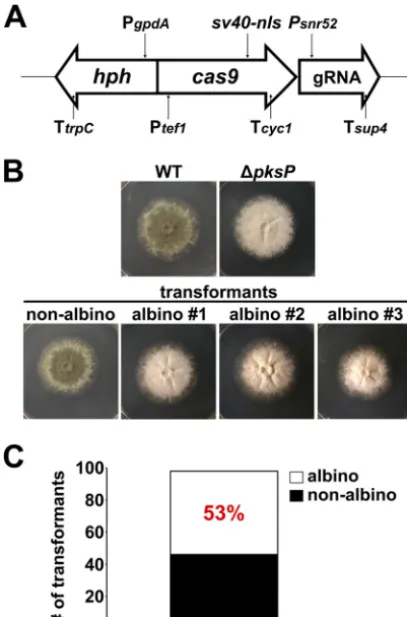
fu-migatus(strain Af293) protoplasts by chemical transformation. Two independent transformations yielded a total of 98 hygromy-cin-resistant colonies, which were subcultured onto GMM plates and incubated for 72 h at 37°C to assess their phenotype.
Remark-ably, 52 transformants (53%) resembled the⌬pksPcontrol strain,
whereas the remaining colonies were indistinguishable from the
wild type (Fig. 2BandC), indicating that the CRISPR/Cas9 system
can indeed function inA. fumigatuswith high efficiency.
Because the gRNA portionhph-cas9-gRNA cassette contains
homology to the genomic target, albeit across a small region (20
bp), we wanted to exclude the possibility thatpksPdisruption was
due to a homologous recombination event. Accordingly,
con-structs containing thepksP-gRNA alone (gRNA-hph) or thecas9
gene alone (cas9-hph) were generated and introduced into Af293
wild-type protoplasts. Whereas albino transformants were
gener-ated from thehph-cas9-gRNA construct, all hygromycin-resistant
colonies derived from the gRNA-hphor thecas9-hph
transforma-tions resembled the wild type (see Fig. S1 in the supplemental
material). This suggested that both thecas9gene and thepksP
-gRNA are essential components forpksPtargeting in our system
and that the contribution of homologous recombination alone is negligible.
Effect of constitutivecas9expression onA. fumigatusgrowth and virulence.If mutants generated with the CRISPR system are to be useful for pathogenesis studies, it is imperative that
expres-sion of thecas9nuclease itself is not deleterious with respect toA.
fumigatusgrowth or virulence. We sought to test this by
generat-ing strains that constitutively expresscas9without the presence of
a targeting gRNA. To do so, the Ptef1-cas9cassette (described
above) was fused with thehphmarker, and the resulting construct
(the same used in the control transformation described above)
was introduced into the two most commonly employedA.
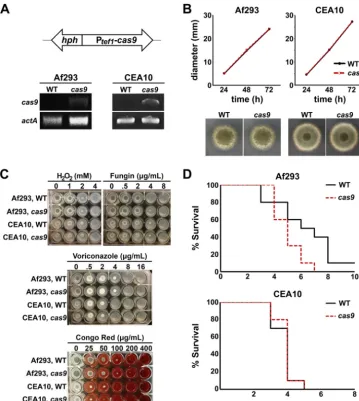
fu-migatusstrains, Af293 and CEA10 (Fig. 3A). The integration of
cas9into the genome of hygromycin-resistant colonies was first
tested by PCR (data not shown) and then confirmed by Southern blotting (see Fig. S2A in the supplemental material). The
expres-sion ofcas9was subsequently confirmed by both Western blot (see
Fig. S2B in the supplemental material) and RT-PCR (Fig. 3A)
analyses. The colonial appearance of allcas9-expressing
transfor-mants (calledcas9-hph) was identical to that of the respective
Af293 or CEA10 recipient strain. A single isolate in either
back-ground, chosen on the basis of fewestcas9integrations by
South-ern blotting, was chosen for further phenotypic analysis and use. We first tested growth rate by spotting conidia of each strain onto GMM plates and incubating for 72 h at 37°C. As shown in
Fig. 3B, the colony diameters of thecas9-hphstrains were indis-tinguishable from those of their respective wild-type controls at
each time point, indicating that growth rate was unaffected bycas9
expression. The amount of conidia produced by the cas9-hph
strains was also identical to that of the wild type, suggesting that asexual development was also unaffected (see Fig. S3 in the sup-plemental material).
To broadly assess the impact ofcas9expression on stress
resis-tance and cellular homeostasis, we tested the sensitivity of the
cas9-hphstrains against a panel of stressing agents. Included in the analysis were hydrogen peroxide, which induces oxidative stress
through the induction of hydroxyl radicals (35), Congo red, which
perturbs the cell wall by binding polysaccharide fibrils (36), and
fungin (a polyene) and voriconazole, which affect cell membrane homeostasis either by binding ergosterol in the membrane or by
inhibiting its synthesis, respectively (37). In all cases, the
sensitiv-ity of thecas9-hphstrain was identical to that of its respective
wild-type strain, suggesting that homeostasis in response to these
stresses is not affected by the expression ofcas9(Fig. 3C).
Finally, the virulence of the strains was tested in a murine model of invasive aspergillosis. Briefly, groups of CD-1 outbred mice were immunosuppressed with the synthetic corticosteroid triamcinolone acetonide and then subsequently inoculated intra-nasally with the indicated strains. Whereas the animal survival curves are different in the Af293 and CEA10 backgrounds, the
cas9-hphstrains were statistically indistinguishable from their
re-spective wild-type controls (Fig. 3D).
In summary, constitutive expression of thecas9endonuclease
does not alter growth, development, stress resistance, and,
impor-tantly, virulence in either the Af293 or CEA10 background ofA.
fumigatusunder the tested conditions.
Thecas9-hphstrains as recipients for gRNA transformation.
FIG 2Disruption ofpksPusing CRISPR/Cas. (A) Scheme of the transforma-tion construct used for transformatransforma-tion into Af293 protoplasts. Transcriptransforma-tional promoter (P) and terminator (T) elements are noted. (B) Hygromycin-resis-tant transformants were incubated on GMM to assess their pigmentation phe-notype. Representative transformants are shown. Albino colonies resemble the
⌬pksPcontrol; nonalbino colonies resemble the wild type. (C) Phenotypic ratios of the transformants.
Fuller et al.
on September 8, 2020 by guest
http://ec.asm.org/
We next assessed whether thecas9-hphstrains could serve as recipients for a separate gRNA transformation. A plasmid that
contained both thepksP-gRNA (described above) and thebleR
cassette (bleomycin/phleomycin resistance) as a selectable
marker was constructed (Fig. 4). Linearized plasmid was
intro-duced into either the Af293 or CEA10cas9-hphstrain by
chem-ical transformation, and the phenotypes of the phleomycin-resistant colonies were analyzed following incubation on GMM. In the Af293 background, 19 out of 41 (46.3%) phleo-mycin-resistant colonies displayed the albino phenotype, whereas 16 out of 63 (25.4%) were albino in the CEA10
back-ground (Fig. 4). Cumulatively, these data suggest that pksP
targeting via CRISPR/Cas is efficient in both the Af293 and
CEA10 backgrounds. Moreover, the cas9-hphstrains can be
used as recipient strains for downstream gRNA transformation and in this way may serve as universal strains for CRISPR-mediated mutagenesis.
Genotypic analysis of thepksPlocus in both albino and non-albino transformants.The Cas9/gRNA complex is known to in-duce double-strand breaks at the gRNA target sequence, which are then resolved through error-prone NHEJ in the absence of a
ho-mologous sequence (24). To determine if the albino mutants
ob-tained in our experiments could be attributed to a similar
mech-anism, primers spanning the 5=end of thepksPcoding sequence
were used to generate products (expected size, 1.5 kb), which were then subjected to Sanger sequencing. The Af293 wild-type and
cas9-hphrecipient strains were analyzed as controls, and both
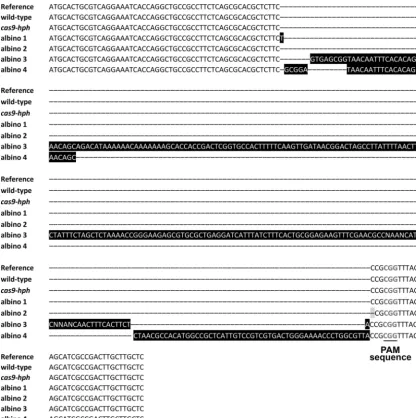
were identical to the Af293 genomic reference at thepksPlocus
(Fig. 5).
Two of the albino transformants in our analysis yielded a PCR product of the expected size, the sequencing of which revealed that either a single nucleotide insertion or deletion had occurred three
base pairs upstream of the targeted PAM site (Fig. 5,
transfor-mants 1 and 2). Anin silicotranslation of the mutant sequences
FIG 3Generation and analysis of constitutivecas9-expressing strains. (A) Top, scheme of the construct used for transformation into Af293 or CEA10 wild-type protoplasts. Bottom, RT-PCR analysis confirmingcas9expression in the transformants. (B) Growth rate analysis. Conidia of the indicated strains were point inoculated on GMM and incubated for 72 h at 37°C. Pictures, shown below the respective growth curve, were taken following the 72 h of incubation. (C) Stress sensitivity. Conidia were point inoculated onto GMM plates containing increasing concentrations of the indicated drugs and incubated for 48 h at 37°C. (D) Virulence. Groups of 10 CD-1 mice were immunosuppressed with triamcinolone acetonide and inoculated intranasally with the indicated strains.
on September 8, 2020 by guest
http://ec.asm.org/
predicted a frameshift that would ultimately lead to a premature translational stop within 14 or 25 amino acids of the insertion or deletion, respectively (data not shown). Thus, these single nucle-otide indels are consistent with the CRISPR-mediated mutations
described in other systems (24).
Surprisingly, most albino colonies yielded amplicons that were of a higher molecular weight than the 1.5 kb band of wild-type, indicating perhaps that larger insertions had taken place. For the single-construct transformation into wild-type, sequencing of the amplicons indeed revealed that a portion of the transforming PCR fragment had integrated at the expected
Cas9 cut site. More completely, the insertions included the 3=
end of the PCR fragment, extending variably into the structural
gRNA sequence (Fig. 5, transformants 3 and 4). Because
non-integrated (episomal) DNA is typically degraded inA.
fumiga-tus, these data suggested that bothcas9and thepksP-gRNA were
rapidly expressed within the protoplasts, allowing for the NHEJ machinery to integrate part of the introduced DNA at the Cas9-mediated double-strand break.
Similarly for the transformation of thecas9-hphrecipient strains
(described inFig. 4), four out of eight albino colonies yielded
prod-ucts of up to 6.5 kb larger than the expected size, suggesting that the
entire linearized plasmid had been inserted into thepksPlocus (see
Fig. S4 in the supplemental material). This was confirmed, as
se-quencing of the high-molecular-weight bands (⬃8 kb) all revealed
plasmid integration at the Cas9 cut site (data not shown).
We also analyzed several of the nonalbino transformants, and all yielded sequences that were identical to the wild-type reference (see Fig. S5 in the supplemental material). This sug-gested that the nonalbino phenotype is most likely due to a lack
of targeting at thepksPlocus, rather than an insertion/deletion
that yielded no functional alteration to PksP (e.g., a single amino acid insertion).
Taken together, these data indicate that the albino phenotypes observed in our transformants were due to the expected Cas9-mediated cutting at the gRNA targeting sequence. The specific NHEJ-mediated events at the cut site varied, however, ranging
from the single-nucleotide insertion/deletions, as observed in other systems, to large insertions of transforming DNA con-structs.
DISCUSSION
Gene replacement through homologous recombination can be
im-proved by several approaches inA. fumigatus. First, Krappman et
al. showed that by simply increasing the size of homologous
flanks in the transforming construct (directed toward abr2),
targeting efficiency could be increased from 0% (0.1-kb flanks)
to 10% (1 kb) to 22% (2 kb) (10). Though targeting could
presumably be increased with even larger flanking regions, the cloning efficiency becomes the limiting factor; therefore, stan-dard protocols typically involve flanking regions of approxi-mately 1 kb on either side of the target gene. The second
ap-proach involves introduction of DNA into mutant strains ofA.
fumigatusthat are deficient in an essential component of the NHEJ
pathway. For example, in the same study, the replacement ofabr2
with 0.1-kb flanks was increased to 75%, and with 2-kb flanks it
was increased to 95% in a⌬akuA(ku70) mutant (10). Similarly, da
Silva Ferreira et al. demonstrated thatpksP targeting could be
increased from 3% in a wild-type background to 85% in a⌬akuB
(ku80) strain (9). Finally,Agrobacterium tumefaciens-mediated
transformation (ATMT) ofA. fumigatusconidia has been found
to yield recombination rates of 35 to 66%, depending on the gene
(38,39).
Unlike all of the above-mentioned strategies, the CRISPR/Cas9 system bypasses the need for homologous recombination alto-gether, as the Cas9 nuclease is directed to its target through asso-ciation with a short gRNA. In this study, we have demonstrated
the utility of this system inA. fumigatusby disrupting thepksP
gene with an efficiency of 25 to 53%. We propose that the system
functions inA. fumigatusas it does in other organisms, based on
two lines of evidence: (i) mutant phenotypes were observed only
upon introduction of both thecas9gene and the gRNA, and (ii)pksP
disruption occurred at the expected Cas9 cut site in all albino mutants tested. What is perhaps unique to our data, however, is the finding that the transforming DNA can be integrated at the Cas9 cut site, presumably through the NHEJ pathway. Indeed, this phenomenon
has recently been described in a mammalian cell CRISPR system (40).
However, to our knowledge, this is the first report of such construct integrations among fungal CRISPRs. Why such a mechanism might
dominate (⬎50% of albino transformants tested) inA. fumigatus,
but not other fungi, remains unclear.
Importantly, we have demonstrated that the CRISPR/Cas9 system
works in two commonly employed strains ofA. fumigatus, Af293
and CEA10. Although we did find different targeting ratios in the two backgrounds in our experiment (46.3% for Af293 and 25.4% for CEA10), we cannot yet state whether these differences would hold up across multiple transformations or across different loci. Nevertheless, the ability to introduce CRISPR/Cas9 constructs
into anyA. fumigatusbackground represents a distinct advantage
of the system. In contrast, although targeting rates may be higher in NHEJ mutants (up to 95%), researchers are confined to work
with strains in whichakuA/akuBmutations have been generated.
The expression of heterologous enzymes has been known to alter fungal physiology in unpredictable ways. In the dimorphic fungal
pathogenHistoplasma capsulatum, for example, the expression of
thehphselectable marker does not affect growth or
develop-ment but remarkably enhances virulence. This influence of
FIG 4pksPtargeting incas9-hphrecipient strains. A plasmid containing the
pksPgRNA sequence and the bleomycin resistance gene (bleR) was constructed
and introduced into Af293 and CEA10cas9-hphrecipient protoplasts. Phleo-mycin-resistant colonies were incubated on GMM, and the proportion of al-bino colonies was determined.
Fuller et al.
on September 8, 2020 by guest
http://ec.asm.org/
HPH on virulence is dependent upon its phosphotransferase
activity, although the exact mechanism is unknown (41).
Ac-cordingly, we addressed concerns regarding the impact of the
Cas9 nuclease onA. fumigatusby generating strains that
consti-tutively express thecas9gene. Importantly, we report that the
cas9-hphstrains are identical to their wild-type controls with respect to all tested phenotypes, including virulence in an im-munosuppressed murine model. Thus, growth- and pathogen-esis-related phenotypes associated with CRISPR/Cas-gener-ated mutants can likely be attributed to the gene under study
rather than to unknown effects of thecas9transgene. We
pro-pose that thecas9-hphstrains we have generated could be
im-portant community resources for all downstream
CRISPR-based experiments for two reasons: (i) the largecas9cassette
would not have to be cloned into the transformation con-structs, thereby making gRNA construction more efficient and
high throughput, and (ii) a strain that expressescas9 would
serve as a more appropriate reference strain (i.e., control) than the standard wild type.
In summary, we have demonstrated that CRISPR/Cas9 can
be developed as a tool for high-efficiency gene disruption inA.
fumigatus. The further development of this technology (i.e., multigene targeting and recyclable cassettes for the reuse of selectable markers) is under way and holds significant potential for advancing the state of genetic research in this organism and, consequently, an understanding of its pathogenesis.
ACKNOWLEDGMENTS
We thank Robert A. Cramer, Jr., at Geisel School of Medicine at Dart-mouth for the generous donation of the CEA10 and⌬pksPstrains and for helpful comments throughout. We also thank George Church at Harvard Medical School for the donation of the Addgene plasmids and the staff of the Comparative Research Center at Dartmouth for excel-lent technical support.
This work was supported by an R01 grant (GM083336) from the Na-tional Institute of General Medical Sciences of the NaNa-tional Institutes of Health to J.J.L. and J.C.D.
FIG 5Sequence alignment of thepksPlocus of albino transformants. Black-highlighted letters are used to depict nucleotide insertions at the cut site; gray-highlighted letters depict nucleotide deletions. PAM, protospacer-adjacent motif.
on September 8, 2020 by guest
http://ec.asm.org/
REFERENCES
1.Rhodes JC.2006.Aspergillus fumigatus: growth and virulence. Med Mycol
44(Suppl 1):S77–S81.
2.Askew DS.2008.Aspergillus fumigatus: virulence genes in a street-smart mold. Curr Opin Microbiol11:331–337.http://dx.doi.org/10.1016/j.mib .2008.05.009.
3.Upton A, Kirby KA, Carpenter P, Boeckh M, Marr KA.2007. Invasive aspergillosis following hematopoietic cell transplantation: outcomes and prognostic factors associated with mortality. Clin Infect Dis44:531–540. http://dx.doi.org/10.1086/510592.
4.Segal BH.2009. Aspergillosis. N Engl J Med360:1870 –1884.http://dx.doi .org/10.1056/NEJMra0808853.
5.Singh N, Paterson DL.2005.Aspergillusinfections in transplant recipi-ents. Clin Microbiol Rev18:44 – 69.http://dx.doi.org/10.1128/CMR.18.1 .44-69.2005.
6.Firon A, Villalba F, Beffa R, d’Enfert C.2003. Identification of essential genes in the human fungal pathogenAspergillus fumigatusby transposon mutagenesis. Eukaryot Cell2:247–255.http://dx.doi.org/10.1128/EC.2.2 .247-255.2003.
7.Jackson J, Higgins L, Lin X.2009. Conidiation color mutants of Asper-gillus fumigatusare highly pathogenic to the heterologous insect host Gal-leria mellonella. PLoS One 4:e4224. http://dx.doi.org/10.1371/journal .pone.0004224.
8.Manavathu EK, Alangaden GJ, Chandrasekar PH.1998. In-vitro isola-tion and antifungal susceptibility of amphotericin B-resistant mutants of
Aspergillus fumigatus. J Antimicrob Chemother41:615– 619.http://dx.doi .org/10.1093/jac/41.6.615.
9.da Silva Ferreira ME, Kress MRVZ, Savoldi M, Goldman MHS, Härtl A, Heinekamp T, Brakhage A, Goldman GH.2006. TheakuBKU80mutant deficient for nonhomologous end joining is a powerful tool for analyzing pathogenicity inAspergillus fumigatus. Eukaryot Cell5:207–211.http://dx .doi.org/10.1128/EC.5.1.207-211.2006.
10. Krappmann S, Sasse C, Braus GH.2006. Gene targeting inAspergillus fumigatusby homologous recombination is facilitated in a nonhomolo-gous end-joining-deficient genetic background. Eukaryot Cell5:212–215. http://dx.doi.org/10.1128/EC.5.1.212-215.2006.
11. Gravelat F, Askew D, Sheppard D. 2012. Targeted gene deletion in
Aspergillus fumigatususing the hygromycin-resistance split-marker ap-proach. Methods Mol Biol845:119 –130.http://dx.doi.org/10.1007/978-1 -61779-539-8_8.
12. D’Enfert C, Diaquin M, Delit A, Wuscher N, Debeaupuis JP, Huerre M, Latge JP.1996. Attenuated virulence of uridine-uracil auxotrophs of
Aspergillus fumigatus. Infect Immun64:4401– 4405.
13. Mouyna I, Henry C, Doering T, Latgé J.2004. Gene silencing with RNA interference in the human pathogenic fungusAspergillus fumigatus. FEMS Microbiol Lett15:317–324.
14. Henry C, Mouyna I, Latgé J.2007. Testing the efficacy of RNA interfer-ence constructs inAspergillus fumigatus. Curr Genet51:277–284.http://dx .doi.org/10.1007/s00294-007-0119-0.
15. Horvath P, Barrangou R.2010. CRISPR/Cas, the immunes system of Bacteria and Archaea. Science 327:167–170. http://dx.doi.org/10.1126 /science.1179555.
16. Wiedenheft B, Sternberg SH, Doudna JA.2012. RNA-guided genetic silencing systems in bacteria and archaea. Nature482:331–338.http://dx .doi.org/10.1038/nature10886.
17. Jinek M, Chylinski K, Fonfara I, Hauer M, Doudna JA, Charpentier E.2012. A programmable dual-RNA– guided DNA endonuclease in adaptive bacterial immunity. Science337:816 – 821.http://dx.doi.org /10.1126/science.1225829.
18. Cong L, Ran FA, Cox D, Lin S, Barretto R, Habib N, Hsu PD, Wu X, Jiang W, Marraffini LA, Zhang F.2013. Multiplex genome engineering using CRISPR/Cas systems. Science339:819 – 823.http://dx.doi.org/10 .1126/science.1231143.
19. Wang H, Yang H, Shivalila C, Dawlaty MM, Cheng A, Zhang F, Jaenisch R.2013. One-step generation of mice carrying mutations in multiple genes by CRISPR/Cas-mediated genome engineering. Cell153:
910 –918.http://dx.doi.org/10.1016/j.cell.2013.04.025.
20. Shen B, Zhang J, Wu H, Wang J, Ma K, Li Z, Zhang X, Zhang P, Huang X.2013. Generation of gene-modified mice via Cas9/RNA-mediated gene targeting. Cell Res23:720 –723.http://dx.doi.org/10 .1038/cr.2013.46.
21. Li D, Qiu Z, Shao Y, Chen Y, Guan Y, Liu M, Li Y, Gao N, Wang L, Lu
X, Zhao Y, Liu M.2013. Heritable gene targeting in the mouse and rat using a CRISPR-Cas system. Nat Biotechnol31:681– 683.http://dx.doi .org/10.1038/nbt.2661.
22. Jiang W, Zhou H, Bi H, Fromm M, Yang B, Weeks DP.2013. Demon-stration of CRISPR/Cas9/sgRNA-mediated targeted gene modification in Arabidopsis, tobacco, sorghum and rice. Nucleic Acids Res41:e188 – e188. http://dx.doi.org/10.1093/nar/gkt780.
23. Shan Q, Wang Y, Li J, Zhang Y, Chen K, Liang Z, Zhang K, Liu J, Xi JJ, Qiu JL, Gao C.2013. Targeted genome modification of crop plants using a CRISPR-Cas system. Nat Biotechnol31:686 – 688.http://dx.doi .org/10.1038/nbt.2650.
24. DiCarlo JE, Norville JE, Mali P, Rios X, Aach J, Church GM.2013. Genome engineering inSaccharomyces cerevisiaeusing CRISPR-Cas sys-tems. Nucleic Acids Res 41:4336 – 4343.http://dx.doi.org/10.1093/nar /gkt135.
25. Vyas VK, Barrasa MI, Fink GR.2015. ACandida albicansCRISPR system permits genetic engineering of essential genes and gene families. Sci Adv
1:e1500248.http://dx.doi.org/10.1126/sciadv.1500248.
26. Rui L, Chen L, Jiang Y, Zhou Z, Zou G.2015. Efficient genome editing in filamentous fungusTrichoderma reeseiusing the CRISPR/Cas9 system. Cell Discovery1:15007.http://dx.doi.org/10.1038/celldisc.2015.7. 27. Nødvig CS, Nielsen JB, Kogle ME, Mortensen UH.2015. A
CRISPR-Cas9 system for genetic engineering of filamentous fungi. PLoS One10:
e0133085.http://dx.doi.org/10.1371/journal.pone.0133085.
28. Jiang W, Bikard D, Cox D, Zhang F, Marraffini LA.2013. RNA-guided editing of bacterial genomes using CRISPR-Cas systems. Nat Biotechnol
31:233–239.http://dx.doi.org/10.1038/nbt.2508.
29. Pattanayak V, Lin S, Guilinger JP, Ma E, Doudna JA, Liu DR.2013. High-throughput profiling of off-target DNA cleavage reveals RNA-programmed Cas9 nuclease specificity. Nat Biotechnol31:839 – 843.http: //dx.doi.org/10.1038/nbt.2673.
30. Langfelder K, Jahn B, Gehringer H, Schmidt A, Wanner G, Brakhage AA.
1998. Identification of a polyketide synthase gene (pksP) ofAspergillus fu-migatusinvolved in conidial pigment biosynthesis and virulence. Med Mi-crobiol Immunol187:79 – 89. http://dx.doi.org/10.1007/s0043000 50077.
31. Tsai HF, Chang YC, Washburn RG, Wheeler MH, Kwon-Chung KJ.
1998. The developmentally regulatedalb1gene ofAspergillus fumigatus: its role in modulation of conidial morphology and virulence. J Bacteriol180:
3031–3038.
32. Oldenburg KR, Vo KT, Michaelis S, Paddon C.1997. Recombination-mediated PCR-directed plasmid construction in vivo in yeast. Nucleic Acids Res25:451– 452.http://dx.doi.org/10.1093/nar/25.2.451. 33. Silar P.1995. Two new easy to use vectors for transformations. Fungal
Genet News Lett42:73.
34. Yelton MM, Hamer JE, Timberlake WE.1984. Transformation of Asper-gillus nidulans by using atrpCplasmid81:1470 –1474.
35. Thön M, Al-Abdallah Q, Hortschansky P, Brakhage AA. 2007. The thioredoxin system of the filamentous fungusAspergillus nidulans: impact on development and oxidative stress response. J Biol Chem282:27259 – 27269.http://dx.doi.org/10.1074/jbc.M704298200.
36. Ram AF, Klis FM.2006. Identification of fungal cell wall mutants using susceptibility assays based on Calcofluor white and Congo red. Nat Protoc
1:2253–2256.http://dx.doi.org/10.1038/nprot.2006.397.
37. Ghannoum MA, Rice LB.1999. Antifungal agents: mode of action, mech-anisms of resistance, and correlation of these mechmech-anisms with bacterial resistance. Clin Microbiol Rev12:501–517.
38. Sugui JA, Chang YC, Kwon-Chung KJ.2005.Agrobacterium tumefa-ciens-mediated transformation ofAspergillus fumigatus: an efficient tool for insertional mutagenesis and targeted gene disruption. Appl Environ Microbiol71:1798 –1802.http://dx.doi.org/10.1128/AEM.71 .4.1798-1802.2005.
39. Qiao JJ, Liu W, Ma Y, Wan Z, Li RY.2008.Agrobacterium tumefaciens -mediated transformation of uracil auxotrophAspergillus fumigatusis an efficient method for target gene knockout. Beijing Da Xue Xue Bao40:
330 –333.
40. Bachu R, Bergareche I, Chasin LA.2015. CRISPR-Cas targeted plasmid integration into mammalian cells via non-homologous end joining. Biotech-nol Bioeng.112:2154 –2162.http://dx.doi.org/10.1002/bit.25629.
41. Smulian AG, Gibbons RS, Demland JA, Spaulding DT, Deepe GS, Jr.
2007. Expression of hygromycin phosphotransferase alters virulence of
Histoplasma capsulatum. Eukaryot Cell6:2066 –2071.http://dx.doi.org/10 .1128/EC.00139-07.
Fuller et al.