OPTIMIZATION OF DIRECTIVITY FOR
RECTANGULAR ANTENNA ARRAYS
USING SOFT COMPUTING
MANDEEP KAUR
Student, Electronics and Communication Deptt.Yadavinra College of Engineering, Talwandi Sabo,Punjab, 151302, India
Phone +91-97812033104 Email:[email protected]
Mr. JAGTAR SINGH
Reader, Electronics and Communication Deptt.Yadavinra College of Engineering, Talwandi Sabo,Punjab, 151302, India
Email:[email protected]
Abstract:
The gain or directivity of antenna is very important parameter which is less in a single antenna. In order to increase the gain and directivity the antenna array is used. If a number of broadside types of linear arrays are arranged one above the other, then the rectangular array is formed. In this paper different types of rectangular antenna array are designed by using PCAAD software. Also the spacing between the elements of antenna array is optimized for optimal value of directivity. Also the effect of increasing the number of elements of antenna array on directivity is calculated using PCAAD software and graphs are plotted in MATLAB.
Keywords: Directivity, Rectangular Array.
1. Introduction
In the figure 1 shown above, it contains the element of the Mth row and the 1st column of the array matrix. If N such arrays are placed at even intervals along the y direction, a rectangular array is formed. In other words, the planar array under consideration can be structured by a linear array of M elements in place, for example, along the X-axis, and then repeat N such array along the direction Y-axis. It is assumed that they are equispaced at a distance and there is a progressive phase shift along each row.
Directivity of planar rectangular array
The general expression for the calculation of the directivity in terms of array factor of rectangular array is given as below [1]:
… (1)
For large planar arrays, which are nearly broadside, the above equation reduces to
… (2) where
is the directivity of the respective linear BSA along x-axis, is the directivity of the respective linear BSA along y-axis.
A still more accurate expression for directivity of a large rectangular array of dimension l X h of uniform amplitude distribution may be deduced from equation (1)
… (3)
So this is the expression for the directivity of a large rectangular broadside array with a uniform amplitude distribution radiating unidirectionally where Area of Aperture =hl and λ is wavelength [2].
2. Simulations and Results
The optimization of directivity for the various numbers of elements for rectangular arrays can be done by varying the spacing between the elements to be placed then the values of directivity is calculated using PCAAD software and is plotted in MATLAB. The values of directivity at these spacing are noted with special emphasis on the one giving us maximum directivity. This particular value of spacing is the optimum value that we are looking for. It can be defined as the value of spacing giving maximum directivity for a given number of elements, if other factors are not taken into consideration. The point of maximum directivity is then observed in the directivity versus inter-elemental spacing graph.
2.1 Effect of Number of Array Elements on Directivity
The effect of number of array Elements on directivity can be observed by noting down the value of directivity for number of array elements of rectangular array and plotting it into the MATLAB.
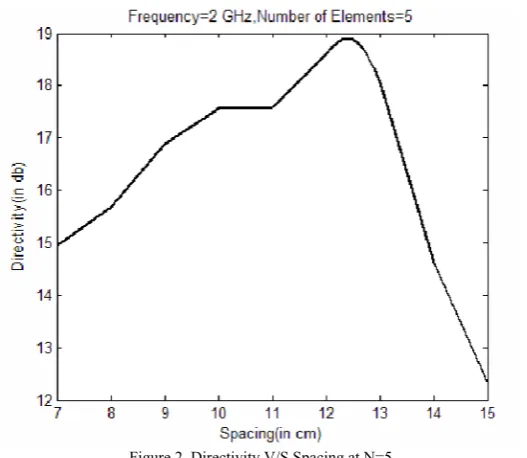
It is clear from figure 2 that the directivity of the array increases when the spacing between elements is varied from 7 cm to 15 cm. It becomes almost constant at 10 cm upto 11 cm, after 11cm the value of directivity again starts increasing upto 12.4 cm and then starts decreasing. It also shows that directivity has increased from its previous value. So the value at which the directivity starts decreasing is known as optimum spacing. The value of directivity at this optimum spacing is 18.90 db.
2.2 Effect of Number of array elements of rectangular array on Optimum spacing and directivity at
optimum spacing
The effect of number of elements on optimum spacing and directivity can be understood by comparing the values of number of elements, optimum spacing and directivity at optimum spacing in the tabular form.
Table 1 Effect of Number of Elements on Spacing and Directivity
Number of
Elements
Optimum Spacing(in cm) Maximum
Directivity(in db)
2X2 10 8.80
3X3 11 13.52
4X4 12 16.59
5X5 12.4 18.90
6X6 13 20.55
7X7 13.1 22.16
8X8 13.3 23.40
9X9 13.5 24.49
10X10 13.6 25.42
Table 1 shows the effect of number of elements on the optimum spacing and the value of directivity. It shows that the optimum spacing is almost constant for different numbers of elements. But the value of directivity at that optimum spacing goes on increasing with increase in number of elements.
2.2.1 Evaluation of results in terms of number of elements and optimum spacing
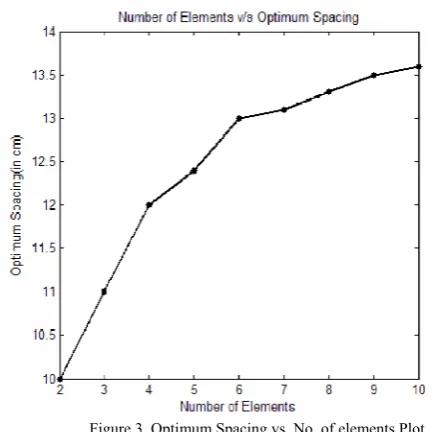
After the values of optimum inter-elemental spacing for different numbers of elements in a rectangular broadside antenna array are found, we are ready to analyze the value of optimum inter-elemental spacing in terms of the number of elements in the array. The following graph helps us do exactly that.
It can be seen as in fig.3 that the optimal inter-elemental spacing keeps on increasing with the rise in number of antenna elements in a linear uniform broadside array. We also know that directivity increase with increase in number of elements from equation (1) and the simulation results. Therefore, to get more directivity, the size of
the array has to be increased. The equation implies that the directivity should vary in direct proportion with the number of elements in an array. As previously stated, this equation is based on some assumptions. So we investigate the practical effect of no. of array elements on its directivity using PCCAD simulation results.
2.2.2 Evaluation of results in terms number of elements and directivity at optimum spacing
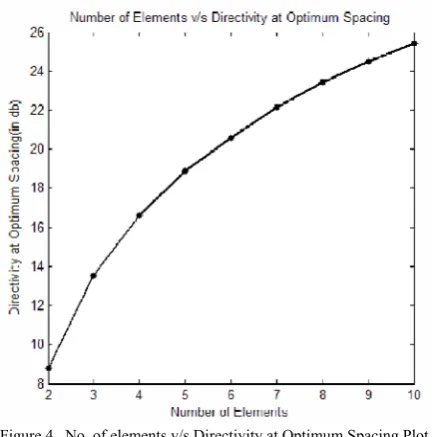
The equation (3) implies that the directivity should vary in direct proportion with the number of elements in an array. As previously stated, this equation is based on some assumptions. So we investigate the practical effect of no. of array elements on its directivity.
It is evident from figure 4 that the directivity actually goes on increasing as we increase the no. of elements in an array. A noticeable thing about the above plot is that it is not a straight line as is normally expected. The graph deviates from a straight line in the downward direction. Hence, as number of elements increase the directivity increases exponentially.
3. Conclusion
In this paper, spacing between the elements of antenna array is optimized using PCAAD software. For the case of 5X5 rectangular antenna array, the optimized spacing is found 12.4 cm and directivity at optimum spacing is 18.90. In the same manner values of maximum directivity and optimum spacing are calculated for other elements Also it is concluded that the directivity of antenna arrays increases with increase in number of elements.
References
[1] Constantine A. Balanis, “Antenna Theory – Analysis and Design”, John Wiley and Sons, Inc., 1997
[2] K.D.Prasad, “Antenna and Wave Propagation”, Satya Parkashan, 2007.
[3] Boufeldja Kadri, Miloud Boussahla, Fethi Tark Bendimerad, “Phase-Only Planar Antenna Array Synthesis with Fuzzy Genetic
Algorithms”, IJCSI International Journal of Computer Science Issues, Vol. 7, Issue 1, No. 2, January 2010 ISSN (Online): 1694-0784 ISSN (Print): 1694-0814.
[4] Gerd Sommerkorn, Dirk Hampicke, Ralf Klukas, Andreas Richter, Axel Schneider, Reiner Thoma, “Uniform Rectangular Antenna Array Design and Calibration Issues for 2-D ESPRIT Application”, 4th European Personal Mobile Communications Conference,
Vienna, February 2001.
[5] J. Davalos Guzman, S. Gomez Ochoa, N. Ramirez Hernandez, J. L. Ramos Quirarte, “MATLAB Tool for Analysis and Design OF Linear and Planar Antenna Arrays”, 1st International Congress on Instrumentation and Applied Sciences, Cancun Q.R. Mexico,
October 26-29, 2010.
[6] Peter Joseph Bevelacqua, “Antenna Arrays: Performance Limits and Geometry Optimization”, Arizona State University May 2008. [7] Frode Bohagen, Pal Orten, and Geir Oien, “Optimal Design of Uniform Rectangular Antenna Arrays for Strong Line-of-Sight MIMO
Channels”, Hindawi Publishing Corporation EURASIP Journal on Wireless Communications and Networking Volume 2007, Article